
Loading stories
Stories
Stories and longer works that move through scene, tension, mood, and consequence.
These stories sit where lyric attention meets narrative consequence.
Some move quietly. Some cut faster. All of them care about what a room feels like before and after the sentence that changes it.
If the poems hold fragments of pressure, the stories ask what happens when that pressure has to move through character, place, silence, timing, and consequence.
They are interested in more than plot. They care about the atmosphere around the action, the undertow beneath the dialogue, and the private thing a character cannot quite say directly.
Read them for the sentence, the scene, or the shift. The work should hold at all three levels.

At a fundraiser cloakroom, a familiar coat unsettles two sisters' arrangement.

A son arrives to collect his mother and is handed something to do.

A fictional caretaker’s guide to what a performance leaves behind.

An apprentice and a projectionist must decide what a closing planetarium should preserve.

An assault forces a surveyor to reckon with what a safety report cannot see.

A shelter roster cannot tell the whole story of who needs a cool room.

Two siblings must decide whether an unfinished song belongs to the dead or the living.

A forgotten road persists in a cartographer’s work—and her mother’s memory.

The garage log says she left; the night attendant remembers otherwise.

A damaged helmet brings an old injury back to the repair bench.
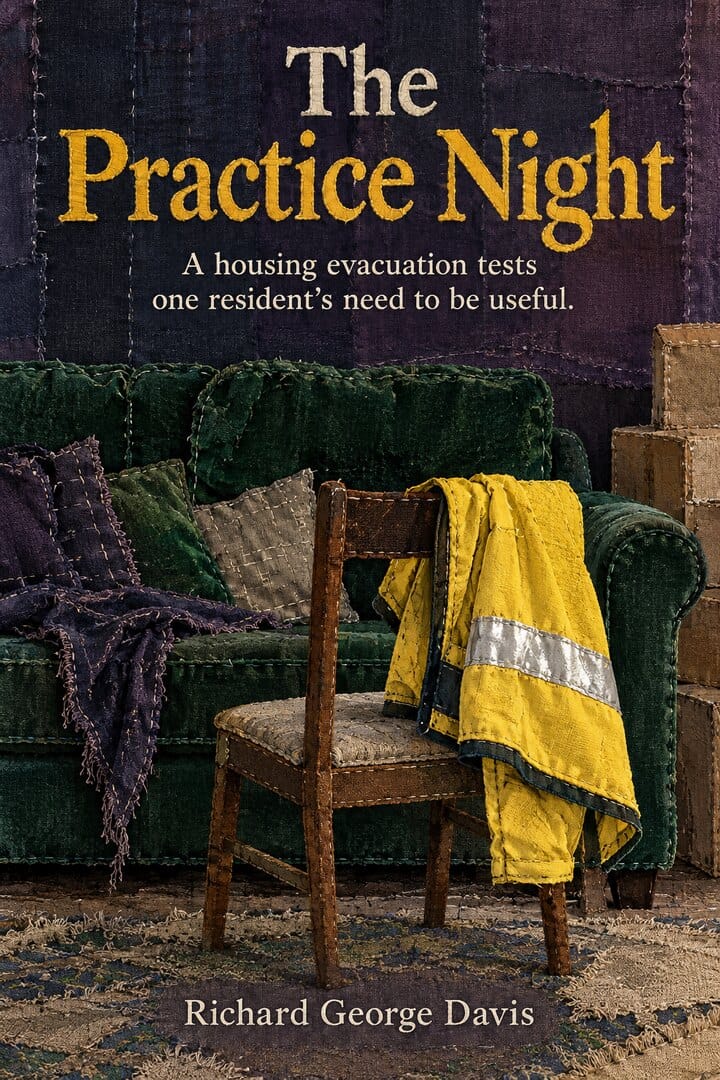
A housing evacuation tests one resident’s need to be useful.

Three community groups arrive to use one booked room, and a scheduling conflict becomes an improvised public performance.

A frequent-service interval gives passengers a useful expectation, but it cannot describe every journey or every wait.

Field notes describe a cloud while a questioning voice tests the observer’s assumptions and comparisons.

A new owner and a long-serving dishwasher decide what deserves replacing before the café closes for the night.

A pool caretaker tests ordinary explanations for a repeated sound and leaves a practical maintenance request.

A sequence of optional observations accompanies someone waiting for a bicycle repair, while keeping the safety check mandatory.

A line of blue paint divides a home and garden, forcing a couple to confront what can still pass between them.

A kettle label opens a discussion of repair rights, practical access and the difference between a repairable object and a repair someone can obtain.

A translator weighs an ambiguous handwritten mark and chooses an editorial notation without assigning it an author.

A moving queue at a library van makes room for different needs while each person completes a small part of the visit.

Siblings turn a cancelled lunch into an afternoon of miniature golf, teasing and a small disclosure.

Noise measurement can compare exposure, while a room’s felt quiet depends on who is heard and who is expected to adapt.

Two occupants revise a household guide as their competing memories challenge who gets to set the rules.