
A Short Guide to the Room After the Audience
A fictional guide to a room that exists only after a performance has ended.
1. The chairs
Count the chairs only after the audience has gone. Before that, a chair is a promise: someone may sit, someone may rise, someone may choose the end of a row and keep a little distance. When the seats are empty, their number becomes a fact again. The guide says there are one hundred and twenty. The caretaker says there are one hundred and nineteen, because one has a split leg and is kept in the store cupboard. Both counts are useful. Neither tells you how many people found a place.
Do not add the coats left behind. A coat is not a person, even when it has been warmed by one. Put it on the lost-property table. If there is a name inside, write the name on a card and wait. The guide does not include the waiting, but the room does.
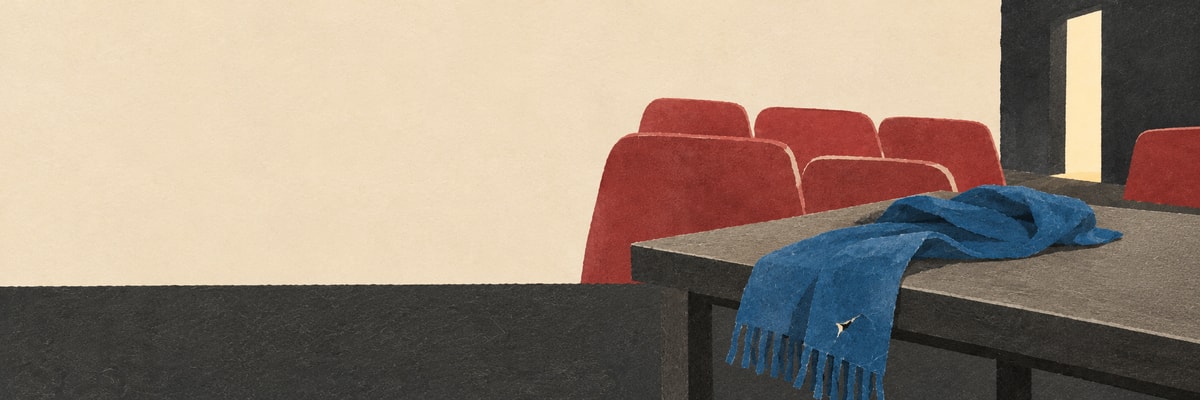
The caretaker keeps a ledger for objects that return. A blue scarf came back twice; the second time, its owner recognised the small tear near the fringe. The guide would call that successful identification. The caretaker says the important part was that no one had to prove the scarf belonged to them. She set it on the table, visible from the door, and left the choice there. The ledger records dates, not reunions.
2. The cup
Under the seventh row, there is usually a paper cup. It is not always the same cup. The guide calls this recurring object “evidence of refreshment” and recommends that it be removed before the next booking. The caretaker bags it before sweeping the floor, then crosses out “evidence” and writes “rubbish”. The guide is right about the timetable; neither label tells her what the cup held.
A shallow dent marks the rim. The hand, the drink and the moment are not visible. The caretaker records the dent and leaves the other fields blank. This is the rule for the room: describe the mark, not the person you imagine making it.
There are other marks the guide leaves out: a damp half-circle on the floor, a sugar grain caught in the seam of the seat, the pale ring where the cup stood before someone lifted it. They matter while the caretaker decides what to clean. She wipes the floor so the next person will not slip. She does not scrape the seam with a knife; the grit can wait for a better tool.
3. The sound
After the audience, the room is not silent. The ventilation fan continues; the projector ticks as its casing cools; the exit sign makes a faint electric hum. The caretaker can distinguish these sounds from the larger noises that have stopped: a cough, a bag closing, the scrape of shoes against the aisle.
The guide lists the mechanical sounds and calls them stable. The caretaker hears a pause between them. It has no measurable length. Still, she waits through it before switching on the work lights.
Do not write that the room remembers. The walls can hold a sound while it is made; the caretaker cannot say what anyone carried outside. The room contains the conditions under which a sound can end: walls, fabric, air, distance, a door not yet opened.
The caretaker tests the latch once, then again with her palm flat against the door. The first click belongs to the mechanism; the second is hers. She does not list either as a sound event. The guide has no column for the difference between checking a thing and trusting it. It has a box for “secure”, which she ticks only after the handle stops moving.
4. The ceiling
The ceiling is painted with stars. They are arranged for a show, not copied from a particular night. The guide calls them decorative. The caretaker points out that the projector has been aligned to them for twenty years. The guide leaves “decorative” in place; it is a useful description of painted stars, even if it says nothing about the work the alignment required.
This guide has no instrument for settling the disagreement. It can say that the stars are painted, that the projector is real, and that the audience saw both at once. It cannot say whether they saw the same sky. The caretaker leaves “shared” out of the record.
At the end of the booking, the stars go out. Nothing falls. No one is asked to explain what they saw. The black ceiling becomes a surface again, which is not the same as becoming nothing.
From the back row, the painted points are faintly visible under the work lights. The caretaker can find the largest one without looking up for long. This is a practical skill, like knowing which switch controls the aisle and which one leaves the exit lit. The guide calls the stars a fixed feature. The caretaker says they are fixed in the way a repaired chair is fixed: held in place by decisions someone may have to make again.
5. The door
The caretaker has to walk the length of the room to reach the door. The lights are on now. The chairs are upright. The cup is in the bin, though the dent remains on the guide’s page as a drawing no one can identify.
There is a sentence on the door’s notice: PLEASE ENSURE THE ROOM IS LEFT AS FOUND. The caretaker has amended it in pencil: PLEASE LEAVE THE ROOM READY FOR SOMEONE ELSE.
She steps into the corridor to check the new line can be read from the far end before anyone opens the door.
The second instruction is less exact. Dust moves; paint fades; a chair is repaired; someone notices a mark and chooses not to erase it. The caretaker cannot restore the room to an earlier state. She can leave it ready for another use without claiming to know who will enter.
The guide says to switch off the lights and check the latch. The caretaker does these things in order. At the threshold, she looks back once. There is no audience. In the dark, she can just make out the aisle. A row of red seats holds its shape.
She returns the key to its numbered hook. Beneath the closed door, a bar of corridor light remains.



No published comments yet.