
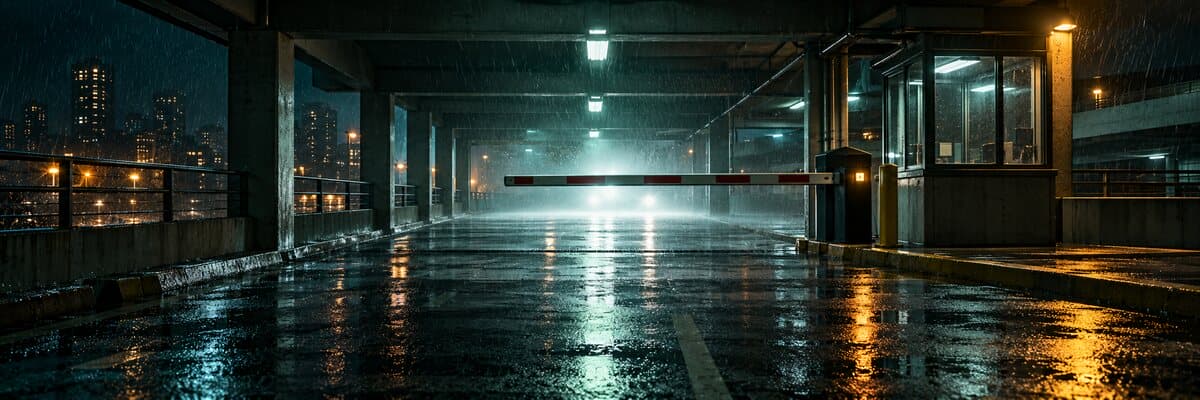
At 3:14 in the morning, the woman asked me to prove she had left before the man in the stairwell was killed.
She stood at the counter with a damp paper ticket between two fingers. The garage was empty except for the cars that belonged to people who had forgotten to come home. On the monitor, each level appeared in green and grey. The rain blurred the camera above the entrance.
“You need the time printed on the back,” I said.
“I need the time you saw me leave.”
I turned the ticket over. The ink had run where her thumb held it.
“The printer gives you the time.”
“The printer gives me what the system says.”
She was right, which made her difficult.
I took the ticket to the terminal and entered the number. It had been paid at 1:38. The vehicle was a small white hatchback, registered to a man whose name I recognised from the overnight incident report. I had not read the report carefully. I had only checked whether the police wanted the footage and whether anyone had left a key in the office. I matched it to the first small white car I remembered leaving after the barrier release, without checking its plate.
The system showed no exit scan.
“That can’t be right,” she said.
“It happens.”
“Did you see me leave?”
The barrier arm had been lifted manually at one forty-six. I had signed for the override. I remembered the little car turning out into the rain. I remembered because I was eating a peach and had to wipe my hand on my trousers before I pressed the button.
“I saw a car leave,” I said.
“Mine?”
“I don’t know.”
She set a folded note on the counter. It was not a large amount. That was how the trouble started. Large amounts announced themselves.
“I can print a duplicate,” I said.
“With the right time?”
“The terminal prints what it has.”
She looked towards the camera screen. “And what do you have?”
I thought of the peach stone in the office bin. I thought of the override record. There was a second log, kept for faults and emergencies. I could change a time there, if I wanted. I had done it before, for people who arrived late and did not want the fee to show at home. I called it customer service. The manager called it keeping the queue moving.
“Why do you need this?”
“My husband says I was here after two.”
“Were you?”
She picked up the note and put it back in her coat pocket.
“If I say yes, will you print it?”
“I can’t change the time.”
“You changed the time for the man in the blue bakkie last Thursday.”
The rain struck the windows harder. On the monitor, the entry camera showed nothing but a white flare across the road.
“I don’t know what you’re talking about.”
“I was waiting for a lift.”
She said it without raising her voice. Perhaps she wanted me to know she had seen me. Perhaps she wanted me to know she had been there. The difference mattered, though I could not tell which way.
I went into the office and opened the fault log. The manual release was there under my name. Beside it, I had entered the ticket's white hatchback as the exiting vehicle at 1:46. I had seen a small white car pass; I had not checked the plate. The payment terminal reset at 2:03. I had let the next car leave without scanning it because I was speaking to the manager on the phone.
I could print the payment record. I could not prove which car had gone through the raised barrier. The camera had caught the number plate in a wash of headlights, but the file was still on the server.
She looked at the ticket in her hand. “A man was found in the stairwell just after two.”
“Was it your husband?”
“No.”
“Then why—”
“Because he says I came back.”
I understood the shape of it then, but not the facts. She needed a receipt that would make her absence official. Or she needed a witness who would say he had seen her leave. Or she needed me to be the one who could not say it.
“I can’t put words in the log,” I said.
“You already did.”
The printer sat beside the desk, its paper roll nearly finished. I opened the footage archive and found the seven-minute clip. The small white car appeared at 1:46. The plate was unreadable. The driver’s face was turned away. When the barrier rose, the passenger door opened for a second and then shut.
The car left.
It might have been hers.
I printed the payment record and the fault log. On the second page, I wrote that the barrier had been manually raised at 1:46; I had seen a small white car pass, but had not checked its plate. My log named the hatchback without proof. I withdrew that identification and signed beneath the correction. Then I scanned both pages into the shared incident log.
She read the pages in silence.
“This doesn’t say I left.”
“It says what I saw.”
“What did you see?”
“A car.”
“You could have said that before.”
“Yes.”
She tucked the papers inside her coat. The original ticket remained on the counter.
“Keep that,” I said.
“It’s mine.”
“Then take it.”
She did. The elevator opened behind her. She stepped inside without looking back.
At 5:02, the manager called after the shared incident log delivered my two-page correction. He asked why I had amended the vehicle entry.
I told him the truth.
He was quiet for long enough that I checked the phone had not disconnected.
“You know you’ve made this worse,” he said.
The rain had eased. On the entrance camera, a car turned in from the road and stopped beneath the barrier. Its headlights washed the lens white.
“Yes,” I said.
The barrier stayed down.

No published comments yet.