
At twenty past eight, Nandi found a window small enough to fit in her palm.
It was a brass pin, no longer than a matchstick, its head flattened and pierced clean through. One end had blackened. The other shone where it had rubbed against the cabinet. She had been sorting the projector’s spares—screws, lenses, loose parts—into trays. The pin belonged in none of them.
She held it to the desk lamp. A point of light passed through the hole and landed on the inventory sheet, directly above ONE MECHANICAL PLANETARIUM, MODEL UNKNOWN.
“There’s your improvement,” she told the projector.
The courier was due at nine. The planetarium had closed a week early when the new projector failed to connect to its control tablet. Nandi’s contract ended with the final inventory. She had not yet worked out what to do with the part of her job that could not be packed.
One old booking remained on the calendar: FOUR PEOPLE, 20:30, CARRIED FORWARD FROM MARCH. Nandi had marked it as an error.
A knock sounded at the lobby door.
The people outside were a teacher, a boy in school uniform and an older man holding four faded tickets.
“The show’s cancelled,” Nandi said.
“We saw the message,” said the teacher. “I teach at the primary school down the road. This is my dad and my son. We wanted to come before you packed up.”
“For the stars?” Nandi asked.
The boy shrugged. “For the machine.”
His grandfather turned one ticket over in his hands. “My wife called it the window. She never liked a room without one.”
Nandi looked at the unpunched tickets. They were stamped with the March date. “The dome hasn’t got any windows.”
“She said it had one,” the man replied. “Some nights.”
The boy glanced at the brass pin in Nandi’s hand. “Is that it?”
“It’s a loose part.”
“That isn’t the same thing as not being a window.”
His mother touched the boy’s shoulder. Nandi checked the time, then the open crates. “I can show you the machine. The room has to be empty by nine.”
“That’ll do,” said the grandfather.
In the dome, the machine waited under its canvas cover. Nandi uncovered it and found the carrier plate: a turning plate of stars inside a fixed brass mask that held the horizon steady. She switched on the lamp. Light spilled through a narrow slot in the mask and smeared across the plaster. A worn groove ran from the slot to a pin-sized recess. Nandi seated the pin’s blackened shank there; its flattened head covered the slot, leaving one point of light through its tiny hole.
The projector’s handwheel had caught during the afternoon inspection. Nandi loosened its retaining nut by a quarter-turn and tested it. The wheel turned, though the old bearing still dragged at one place. The adjustment cost six minutes. The courier would have less time to complain than the planetarium had left to answer him.
They took their seats. The grandfather chose the back row, near the door. His daughter sat on one side of him; the seat on his other side stayed empty. The boy chose the middle, then looked over his shoulder at the old man.
“Your gran sat here,” the grandfather said, tapping the empty seat beside him. “She liked to know where the exit was.”
“But she came to the dome?” Nandi asked.
“She liked a window. She didn’t say it had to open.”
Nandi dimmed the house lights and began turning the handwheel. Familiar constellations appeared, scattered across the plaster. The wheel juddered at the worn bearing, and the stars jumped before they began to turn.
“It’s out of alignment,” Nandi said.
“The sky or the machine?” asked the grandfather.
“The machine.”
The teacher stepped to the platform. “Show me where to hold it.”
Nandi put the teacher’s palm against the wheel, braced it through the rough place, then let her guide it. Nandi stepped back to the seats. The projected stars turned. A pale point held still above the exit sign.
“There,” said the grandfather.
He had not pointed at the constellations. The boy turned towards the door and raised his hand over the dot.
“It isn’t a star,” Nandi said.
When he lowered his hand, he found the point again above the door.
“Gran used to do that,” he said.
“She knew it wasn’t a star,” his grandfather said. “She called it the house star.”
Nandi had spent three months learning which faults could be repaired and which could only be described accurately. The dot was wrong on the chart.
“Do you think they meant it to land there?” the teacher asked.
Nandi examined the pin in the mask. The wear on the brass matched its blackened shank; it fitted without force. The machine offered no history of who had set it there.
“I don’t know,” she said.
The teacher left the wheel and returned to her seat. Her father took the fourth ticket from his pocket and set it on the empty place beside him. It had no crease, only the March date.
The show ended at eight forty-six. When the house lights came up, the grandfather picked up one of the other tickets and read the old date again.
“We bought them in March,” he said. “I kept moving the date while she was ill. After she died in June, I kept the booking.”
The grandfather lifted the ticket from the empty seat and handed it to Nandi. “Make him a window.”
“May I?” Nandi asked, showing him the pin.
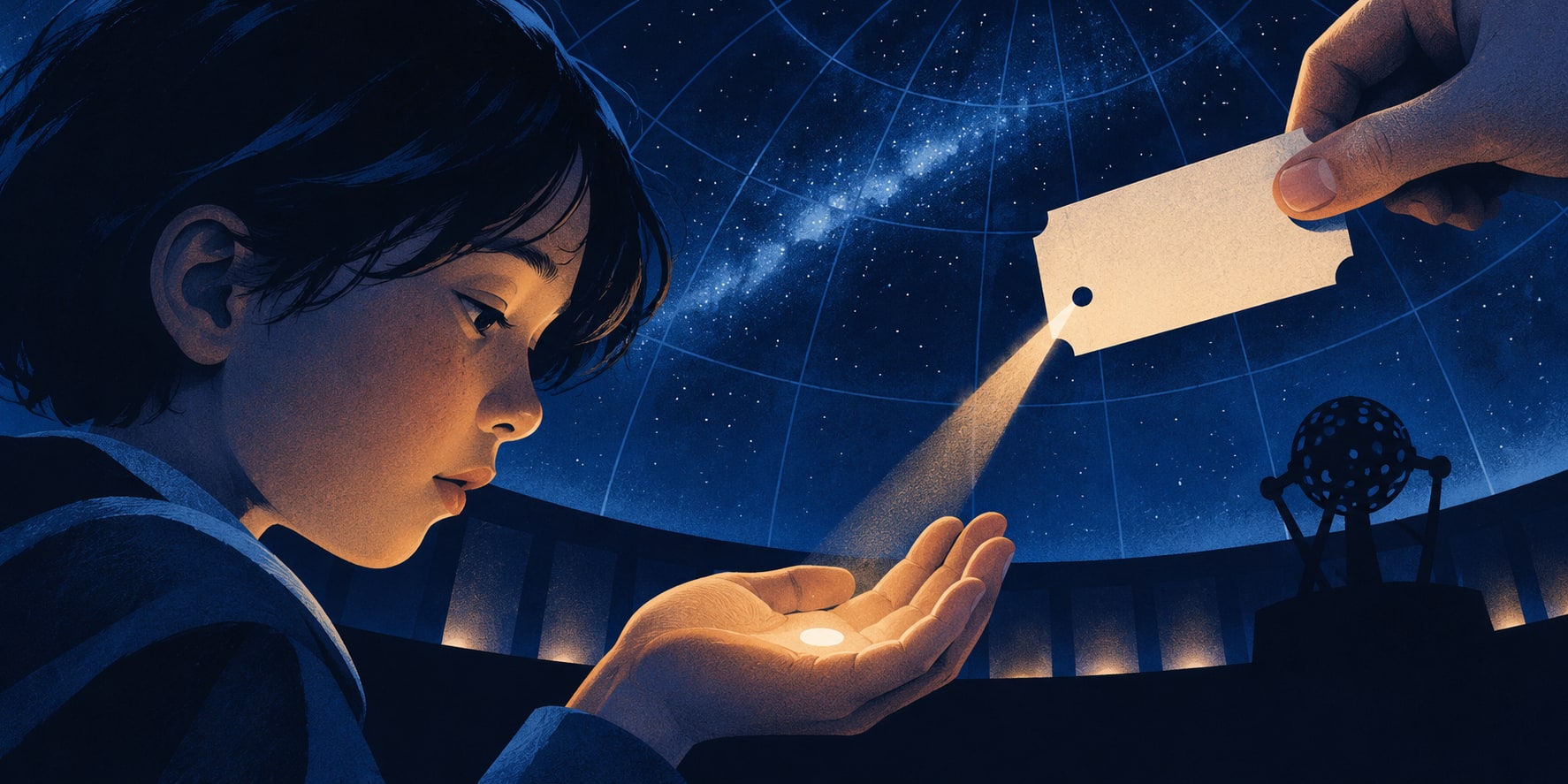
He nodded. Nandi pressed its point through the ticket, then reseated the pin in the mask, its blackened end snug in the worn groove. The grandfather switched on his phone torch and held the ticket above the boy’s palm. Light passed through the tiny hole and gathered in the cup of the child’s hand.
“We have a projector at school,” said the teacher. “Could you show us how to make a sky around it?”
Nandi looked at the dark brass mask, then at the point of light cupped in the boy’s palm. “Tuesday after school?”
“Tuesday.”
At eight fifty-eight, the courier wheeled the projector out. Nandi crossed the last item off the inventory and signed the sheet. The grandfather folded the fourth ticket once, through the March date, and put it in the boy’s pocket.

Loading published comments…