
Measure One
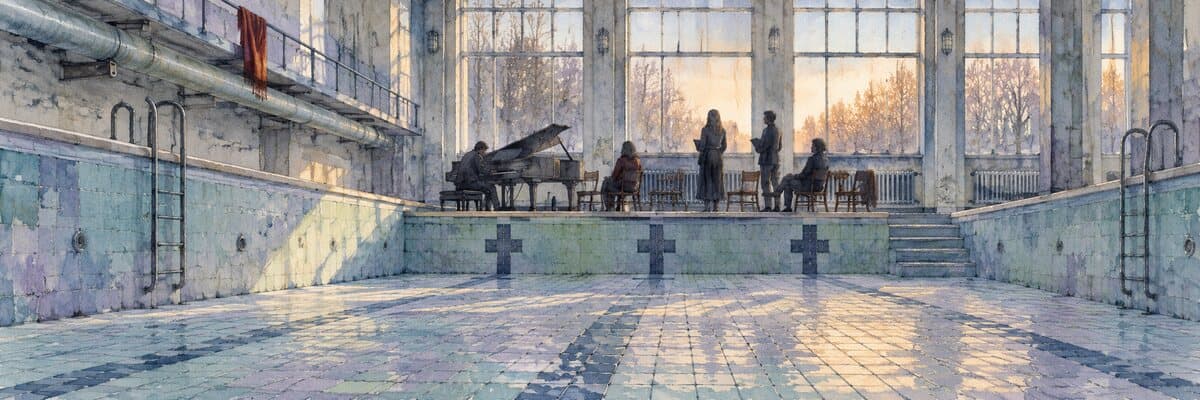
The public bathhouse had been emptied of water for six weeks, but the deep end still held sound.
Nessa heard it when the choir came in from the street: one shoe on the tiled steps, a cough, the zip of a coat. Each noise crossed the drained pool and returned slightly changed, as if the room were trying out a reply.
She had set the chairs in a crescent around the old starting block. Twenty-three people had come for the last rehearsal. At six, the caretaker would open the street doors for the public performance. Tomorrow the building would be handed to the contractors. The notice on the door said the new owners planned to keep the façade. It said nothing about the gallery, where the pipes had made their own low harmony for fifty years.
“We’ll start with the ending,” Nessa said.
They opened their folders. She had written a final chord above the empty staff, four notes arranged to settle the song cleanly on its feet. The choir tried it once, then again. It sounded right. That was the trouble with it.
From the back row, someone said, “You’ve filled in the blank.”
Nessa knew the voice before she turned. Silas stood in his coat with his hands at his sides. He had their mother’s narrow mouth and none of her patience for waiting to be invited in.
Measure Two
At home, their mother had taught them to sing by making them listen first.
She would set a glass on the kitchen table and tap it with a spoon. Nessa heard a note. Silas heard the room around the note: the refrigerator motor, the neighbour’s radio, a bus changing gears on the hill. Their mother said they were both right, which Nessa understood as permission to continue.
The song began as four descending notes. Their mother wrote them on the back of an envelope and left the last line blank. At rehearsals she would lift one finger before the final rest. The choir waited. Sometimes a pipe knocked in the gallery. Sometimes a chair leg scraped. Then the room let the sound go.
After their mother died, Nessa took over the choir. She copied the song into a new folder and filled the blank line with a chord. It made the piece easier to teach. It gave the singers somewhere to put their breath.
Silas stopped coming.
Measure Three
“It ends there,” he said, pointing to the page.
“It stops there.”
“Those aren’t the same thing.”
The choir looked from one sibling to the other. Nessa slid her pencil behind her ear, a small gesture she used when she wanted a conversation to become a rehearsal.
“We’ve sung it this way for four years.”
“You have.”
She set the score on the piano. “You could have said something before tonight.”
“I did.”
“You left.”
“After you told everyone Mum had written your ending.”
The old piano had been moved from the gallery into the shallow end. Its wheels rested on strips of felt. Nessa placed one hand on the closed lid. The wood gave back a small, warm sound when she knocked it with her knuckle.
“What did she want us to do?” Nessa asked.
Silas looked into the drained pool. “She wanted us to hear what came after.”
“That’s not an answer.”
“It’s what I heard.”
Measure Four
They tried the song without the chord.
The first four notes went down the length of the pool. The alto section came in early. The tenors lost the pitch. Nessa lifted her hand to bring them back, then lowered it. They found the tune again without her.
The final rest arrived.
Someone breathed through their nose. A chair creaked. From the street, a delivery van reversed with three beeps. The room returned them all.
Silas stood with his mouth closed.
Nessa stopped the rehearsal. “You can’t ask them to sing a room.”
“I’m not asking.”
“They need to know where to come in.”
“They already do.”
One of the altos raised her hand. She was wearing a red scarf, the same one she wore every week. “I thought the rest was a mistake,” she said. “I’ve been waiting for the chord.”
Nessa almost told her that the chord was safer. It gave the audience a place to clap. It proved they had reached the end together.
Instead she asked, “Would you like to try it without?”
The alto nodded. “I’d like to hear what happens.”
Silas lifted the score from the piano and tried to hum the four notes. He got the first two, stopped, and looked at the page as if the rest might come back in a different order.
“I remember her leaving space,” he said. “I don’t know if that was deliberate. Maybe she hadn't written it yet.”
It was the first thing he had said that Nessa could not turn into an accusation or an instruction.
Measure Five
During the break, Silas sat on the edge of the pool with his shoes beside him. Nessa carried over two paper cups of water.
“You could have come back,” she said.
“I couldn’t come back to your version.”
“It was the only one people had.”
“That doesn’t make it hers.”
Nessa sat one step below him. The water tasted faintly of the paper cup. She had not meant to turn the song into a memorial. She had meant to keep it in use. Every year the new chord made the choir less afraid of the blank line. Every year she told herself that was what their mother would have wanted.
“I thought if I left the gap, we’d lose the piece,” she said.
Silas rolled the empty cup between his palms. “Maybe it’s the bit we were meant to keep.”
She wanted him to say that he understood why she had done it. She had prepared an explanation for his silence, too. It stayed behind her teeth.
The caretaker called them back. He had been waiting by the door with the keys in his hand. Beyond him, the first audience members were taking their seats.
Measure Six
Nessa took her pencil from behind her ear and erased the chord.
The paper thinned. A grey mark stayed where the notes had been.
“I can’t give you what Mum meant,” she said. “I can take my ending off the page.”
Silas looked at the score. “That’s enough for tonight.”
Before she raised her hands, Nessa faced the choir. “I need to correct something. The added chord was mine. I told you Mum wrote it, but she didn't. I wanted the song to end cleanly.”
No one asked why. The alto with the red scarf nodded once, and Nessa turned back to the piano.
They began again with the audience in place: the choir’s families, two former lifeguards, the caretaker, a child who had come in holding a balloon. Nessa raised both hands.
The four notes travelled down the empty pool.
At the gap, she did not cue the chord. She kept her hands lifted while the singers listened. The child’s balloon tapped the ceiling once. The caretaker shifted his keys. The alto with the red scarf let out a breath that trembled at the end.
The choir held its place. When the sound faded, no one clapped straight away. Then the child did, and the rest followed.
Coda
Nessa closed the folder. At the doorway, Silas asked if she still had the old piano stool. She said she thought it was in the garage. The hall where he rehearsed on Tuesdays had a piano but no stool. If she came, he said, she could bring it. She said she would come and listen. He nodded as if that were a plan they could both manage.
They carried the score between them. The blank line showed through the page where the eraser had worn it thin.
Outside, a bus changed gears on the hill.


No published comments yet.