
Fictional literary essay
A blind corner is a disagreement between a building and whoever wishes to see around it.
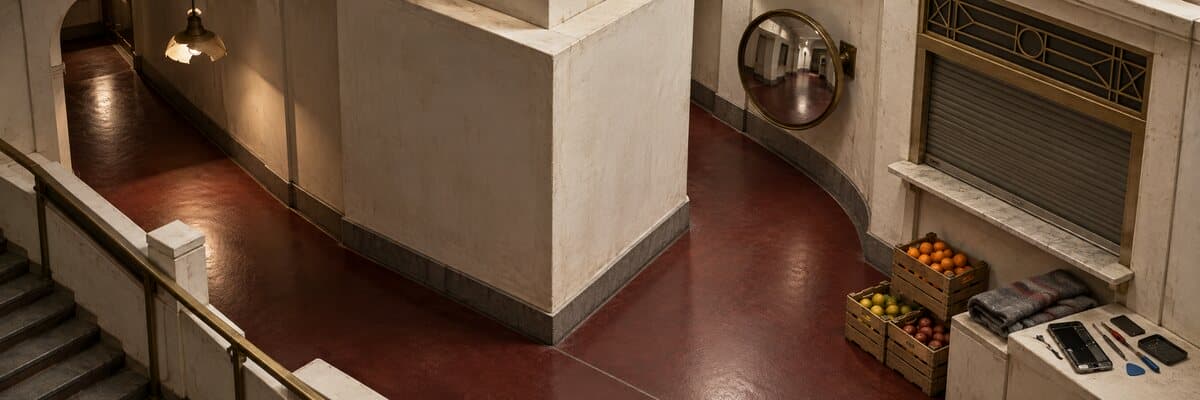
Architects usually resolve the disagreement in favour of sight. They cut back a wall, move a doorway, install a convex mirror. The mirror is the cheapest solution. It offers a small, distorted version of what is coming, which is generally considered sufficient.
For six years I surveyed such corners for the municipality. My reports described them as obstructions. This was the approved term, and I used it without difficulty until the incident at the eastern bus terminus.
The terminus had an elbow-shaped passage between the public toilets and a shuttered ticket office. Women selling fruit stored their empty crates there. Drivers smoked there. A boy repaired phone screens on a folded blanket, working beneath a headlamp because the overhead fitting had been broken since before my first inspection.
My recommendation was a mirror.
The installation took forty minutes. A contractor drilled above the ticket office, fastened the bracket and adjusted the angle while I stood at the far end of the passage. In the mirror I appeared short and broad, with a head disproportionately large for my body. I raised one arm. The contractor tightened the bolt.
Three weeks later, a woman was assaulted in the passage.
The police requested my report. They also requested the camera footage from the terminus, which showed a man following her towards the toilets and, nine minutes later, returning alone. It did not show what happened inside the passage. His face was clear. His jacket had the same company logo as the contractor's van.
I expected an arrest. The police asked whether the mirror had been correctly positioned. I answered that it had. I also sent the footage and asked whether they needed the contractor's details for the man in the jacket. No reply came to that question. The next request concerned the bracket's angle.
I visited the passage again. Someone had thrown a plastic bag over the mirror. I removed it. The boy with the phone screens watched me from his blanket.
“Now we can see again,” I said.
He asked who I meant.
I had no answer ready, although I had used we throughout my career: we improved access, we reduced risk, we restored adequate illumination. It was a convenient pronoun. It allowed a person holding a clipboard to stand briefly among the people who would remain after I drove away.
The mirror made the passage visible from the forecourt. It also made the forecourt visible from the passage. A person waiting behind the ticket office could watch the security guards without stepping out. I had drawn only one arrow on the installation plan.
This is the difficulty with a blind corner. Its usefulness changes with the direction of approach.
A woman once told me she used that passage to take her tablets. She worked at the terminus and did not want questions from her colleagues. Another woman used it to count the morning’s takings before walking to the bank. Neither would have described concealment as an obstruction.
I did not include these uses in my assessment. There was no heading for them, but I could have added a paragraph.
When the assault appeared in the local paper, the municipality issued a statement listing recent security improvements. My mirror was second on the list. The statement said the passage had been made safer. I had signed the completion certificate from which this claim was derived.
For several days I kept the newspaper in my drawer. Occasionally I opened it to check the wording. The woman’s name was withheld. Mine had never been sought.
I began to understand the attraction of a properly completed form. It can preserve an action while removing the person who performed it. A mirror was installed. A recommendation was implemented. There was no need to picture me standing in the passage, pleased to see my raised arm.
I cannot make a general defence of blind corners. I have seen people quicken their steps before reaching one. There should have been a working light in that passage. There should have been someone the woman could call to, and someone prepared to come.
But I no longer accept the neat sequence in which seeing leads to knowing and knowing leads to help. We had a face, a company logo and nine minutes. The only question I received again was whether the bracket's angle was correct.
My revised report occupied eleven pages. On the first, I replaced obstruction with place. On the last, beneath a description of the sight lines, I added the uses I had previously omitted.
The head of department returned it with one instruction in the margin:
Please confine yourself to the mirror.
I have the report open beside me. The cursor is after the woman counting her money. I am trying to remember whether she said she went to the bank every day or only on Fridays.
No published comments yet.