
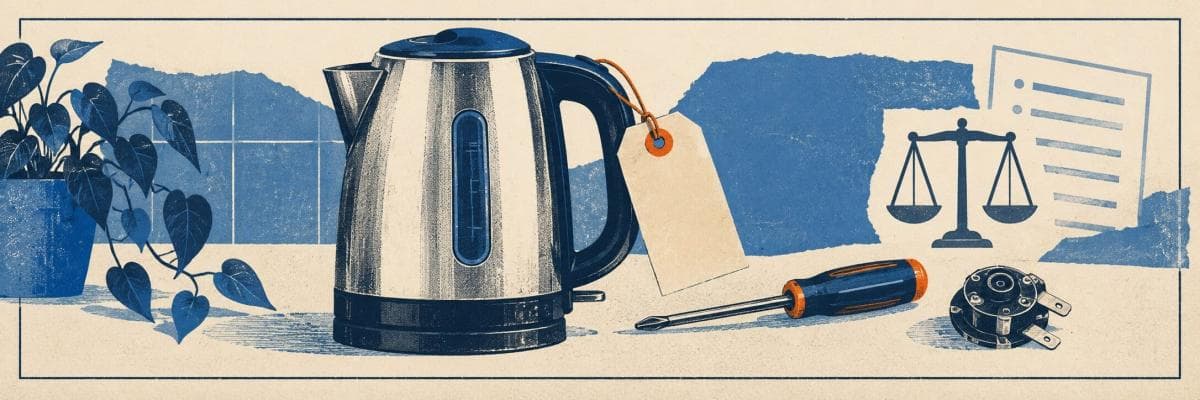
The label on the kettle said TESTED. Beneath that, in blue pen, someone had written: “Switch replaced. Keep dry.” The handwriting leaned forward as if the instruction had somewhere else to be.
The kettle boiled. It clicked off. The label remained stuck to the handle, its corner lifting each time the lid opened.
There is a difference between a thing that can be repaired and a thing someone can get repaired. The first is a question of design: can the casing open, can the part be reached, can the fault be understood? The second has a queue in it. It asks who has the tool, the spare part, the time, the transport and the money to do the work.
The European Union’s Directive on common rules promoting the repair of goods addresses some of that distance. It requires Member States to ensure that manufacturers repair goods for which, and to the extent that, repairability requirements are set by the Union legal acts listed in the directive’s annex. Repair must be free or reasonably priced and completed within a reasonable time; manufacturers are not obliged to repair when repair is impossible. The obligation does not cover every object or every fault. A European Commission explanation presents the measure as part of a wider effort to make repair more accessible after sale, alongside information and service-finding provisions.
The legal boundary is a useful one. It prevents “right to repair” from becoming a promise that every object can be restored by anyone, anywhere, at any cost. The directive’s repair obligation is attached to the goods and repairability requirements listed in EU law. It leaves other objects, faults and circumstances outside that specific duty. The European Commission says the new European repair platform is expected to become operational in January 2028. The directive’s repair-information provisions and optional comparison form may help consumers compare practical conditions, but information is not the same thing as a nearby workshop with a free appointment.
The rule also recognises some of the ordinary costs that do not fit inside the word “repairable”. Its European Repair Information Form can set out the defect, suggested work, price or price calculation, time needed and the availability or cost of a temporary replacement. Those details matter because a repair is not an abstract property of an object. It is a service offered at a place, for a price, within a period when the owner may still need the object.
Even a clear form cannot settle what is reasonable for every household. Someone who uses a kettle only at breakfast can manage a few days without it; someone caring for others may have less room to wait. One repairer may be close enough to reach on foot, another may require a trip across town. The directive sets a legal frame for covered repairs and their terms. It does not make time, transport or access identical for every consumer.
The label cannot tell us which of those conditions applied to the kettle, or where it was repaired. It says only what happened in this invented scene: one switch was replaced, and someone thought the next person should keep water away from it. That sentence is not a policy. It is a small handover between the person who opened the casing and the person who will press the button tomorrow.
The person who wrote the label may have expected the kettle to be used in the same kitchen, by someone who knew where it sat and how it behaved. Another owner might need the repairer’s name, the part number or a date before deciding whether to trust it. A label can carry a repair across the gap between two users, but only if it records what the next user needs. “Tested” names a completed check; “switch replaced” names a changed part; “keep dry” leaves the reason unstated. Each phrase has a different job.
That is why practical repairability cannot be read from a product specification alone. The object may be designed to open, yet the person holding it may not have the right tool or a service within reach. A repair can be technically possible and still cost more than a replacement, take longer than the owner can manage, or require a part that is temporarily unavailable. These are not all defects in the design, and the law does not resolve every one. They are conditions around the act of repair.
The label’s usefulness is modest. It cannot promise that the kettle will never fail again. It can tell the next person that someone examined it and changed one part, then give a small instruction for using it safely. The promise becomes more trustworthy when it admits its size.
When the kettle clicked off, the label trembled against the handle. The repair had not made it new. It had returned one ordinary action to the person waiting beside it: fill, switch, listen. The instruction “keep dry” was obvious, but not useless. A good repair often ends with a sentence about what the object can now be trusted to do, and what still needs care.



No published comments yet.