
The Practice Night
The sofa arrived on the day Leah learnt she would have to apply for her own job.
The delivery men took the door off its hinges to get it in. She helped hold it while they worked, standing barefoot in the passage with her laptop making small, insistent noises on the kitchen counter. One of the men asked whether she wanted the door back on before they left.
‘No, that’s an optional extra,’ the other said.
She laughed too loudly. They let her keep holding it while they found the screws.
The sofa was green. For three weeks she had looked at it in other people’s rooms: rooms with tall windows, bowls containing nothing, a dog asleep at exactly the point where the cushions met. In her flat it covered the socket she needed for the router. They moved it out again. She fetched an extension lead.
By the time they had gone, her meeting had started.
She pulled a dining chair in front of the new sofa and listened to a woman explain that all existing staff were encouraged to express interest in the revised structure. Leah’s own face occupied a square beside the woman’s. She tried to arrange it into the expression of someone who might be worth keeping.
That evening she ate sitting on the floor. The treatment on the fabric required twenty-four hours to dry.
Her mother called to ask how it looked. Leah said it was lovely.
‘You sound tired.’
‘They had to take the door off.’ She looked towards the passage, where a pale rectangle showed around the refitted hinge.
‘Well. You’re getting there.’
Leah looked at the sofa’s wooden feet. Her mother had said something similar when the bed arrived, and when Leah had stopped keeping her clothes on the rail left by the previous tenant. There were fewer boxes now. The rooms looked as though somebody lived in them. She had bought the sofa wide enough for visitors. When her friend Ruth suggested coming round on Saturday, Leah had asked for another week. The flat was nearly ready.
She asked her mother about the garden and kept her on the phone until it was too late to go for a walk.
On Tuesdays, when she could, Leah went to Bell Court.
She had lived there until she was eleven. On the ground floor there used to be a shoe repairer who let her turn the handle of his machine, provided she kept her other hand behind her back. She could still remember the resistance of it, then the sudden easy revolution when he helped without admitting it. Outside his shop, her father would be talking to somebody. She had spent whole afternoons wanting him to finish.
The shop was a parcel room now. Six doors along, frosted glass covered the bakery windows. A small brass sign offered skin treatments; the old striped awning was still bolted above it. She did not know when either had changed. For years she had only passed the building on her way somewhere else.
The tenants’ meeting was the first time she had been inside again. She had gone because her mother forwarded a notice about a crack in the stairwell. At the meeting, two men argued over whether it was new. A woman produced a photograph from a birthday party in which the crack could be seen behind a balloon. When the meeting ended, Leah waited for the woman with the photograph to finish putting the chairs away. Then she realised she could help.
David asked if she could help the following week. When she asked what needed doing, he looked at the chairs she was carrying. ‘We’ll find something.’
He did. She called residents who had not answered the circular, carried boxes of torches, learnt which gates stuck in wet weather. Once she spent forty minutes getting a frightened dog out from under a parked car. She missed a work call and had to explain herself the next morning. She did not mention the dog. Her manager wanted to know whether she had been available. She said she had, apart from those forty minutes.
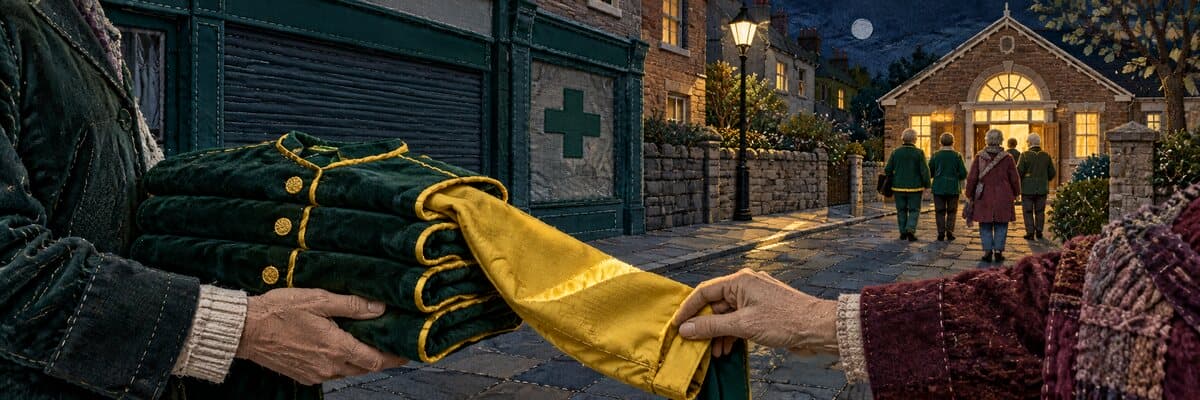
When David offered her a place on the exercise team, she took the yellow jacket home and hung it over a chair.
On Thursday, answering a message at half past ten, she laid the jacket over her knees and pulled a loose thread from the reflective strip. David had asked whether she could do the next three Tuesdays. She checked her calendar. The evenings were empty, though she would have to move work out of them.
The exercise was scheduled for Tuesday evening. She put in two hours’ leave, although she had already worked them on Sunday.
At ten past eight, the woman in flat 19 brought down a cake.
Leah had prepared for medication, walking frames, people who refused to leave their pets. There was a box on her form for each. She had not prepared for a cake on a glass stand, held level in both hands while the woman descended the last three steps.
‘Where must I put this?’
‘You can leave it upstairs.’
‘Then what am I practising?’
Behind her, someone laughed. The woman turned, pleased, and Leah took the stand before either of them could drop it.
It was a lemon cake. The icing had set unevenly, thick on one side, almost transparent on the other. Leah could smell the zest. She had meant to eat before coming. At six, the meeting she was leaving had acquired another half-hour, then a document everyone needed to see. She had closed the laptop while somebody was saying her name.
‘The table by the gate,’ she said. ‘Thank you.’
The woman did not release it. ‘You’ll bring the plate back?’
Leah promised she would. Only then did the woman let go. ‘People say that.’
Leah gave her the clipboard to hold while she carried the cake outside.
In the courtyard, the residents of Bell Court stood among the parked cars in dressing gowns and good shoes. Most had brought their phones. A man was filming the upper windows. He wanted a record, he told her, in case they said afterwards there had never been a problem. Someone had carried a chair down four flights and was sitting on it with the expression of a person determined to get his money’s worth.
The exercise was free. Leah had explained this twice at the residents’ meeting. The chair man had asked who paid for it, then, and she had given him the name of the foundation on her jacket. He had written it down.
Now he beckoned her over to complain that the assembly point was in the way. When she asked what it was obstructing, he pointed to the painted rectangle under his feet.
‘My parking.’
‘You’ve moved the car.’
‘I might want to put it back.’ He watched her almost smile. ‘All right. Ten minutes.’
There were thirty-six occupied flats. By eight fifteen she had accounted for twenty-nine. Not people: flats. A family of five made one tick; a woman living alone made one tick. She had queried this during training. David said each flat needed a resident to confirm that everyone was out. In the courtyard she kept asking people who they had left upstairs. Several had to go and check.
‘Nineteen?’ she called.
‘Cake,’ said the woman beside her.
Leah ticked the box.
The woman from 19 sent a girl in a school tracksuit upstairs for a knife. People began cutting slices on folded paper towels. The chair man accepted one, inspected its underside and asked for a larger piece. Two residents who had spent a year passing each other at the lift discovered they both knew the same unreliable plumber. They summoned a third man to confirm how unreliable he was.
Leah stood with the clipboard against her chest. There was icing on the cuff of her jacket. The woman from 19 broke a piece off her slice and held it out. Leah shifted the clipboard, took it with her fingers and ate. Lemon caught at the back of her jaw.
‘You used to live here,’ the woman said. When Leah nodded, she asked after her mother’s little red car.
‘No, she sold it years ago.’
‘She used to have trouble starting it.’
Leah had forgotten. The bonnet up; her mother dressed for work, standing clear while a neighbour leant into the engine. From the back seat Leah had watched her mouth tighten as she checked her watch.
‘She did,’ Leah said.
The woman offered her another piece. Leah took it, then asked her to hold the list while she checked the next arrival. They stood shoulder to shoulder to read the numbers.
David came through the gate carrying the orange equipment bag and asked how they were doing.
‘Seven outstanding.’
‘Six.’ He put the bag down beside the table. ‘Twenty-four’s away.’
She checked. A woman had answered the intercom in 24. Leah had heard a television behind her.
‘When did they go?’
‘This afternoon.’
‘Someone’s there.’
‘Cleaner, perhaps.’ He looked towards the entrance.
‘Then I should get her.’
‘Let me check first.’
He was already reaching for his phone. At her first session she had locked her keys in the equipment cupboard. He had stayed until the caretaker arrived, although he had a bus to catch. When she apologised the following week, he had needed reminding.
She looked up at the fourth floor. Most of the windows were dark. At the far end, behind the balcony mesh of 24, a television changed colour against a ceiling.
David walked a few paces away to make his call.
Leah pressed the intercom button again.
This time the woman answered immediately.
‘Is it over?’
‘Not quite. We still need you downstairs.’
A pause. Then, more quietly: ‘He said I must stay.’
‘Who did?’
Her phone vibrated in her trouser pocket. She pressed it still against her leg. Someone behind her wanted to know whether they could go back in. She raised a finger without turning.
‘The man who came before you. With the keys.’
Through the gate she could see David speaking into his phone. She lifted the receiver to show him someone had answered. He held up a hand: wait.
The woman said, ‘Are you from the same people?’
Leah looked down at the foundation’s name on her jacket.
‘Yes,’ she said. ‘But I’m coming up.’
She put the clipboard on the cake table.
David lowered his phone as she passed him.
‘Leah. We need everyone outside.’
‘There’s someone in twenty-four.’
‘Give me a minute. I need to find out who’s been in there.’
She stopped with her hand on the gate. The woman was still on the intercom. Leah had left the receiver lying beside its cradle; from here she could hear the small electrical rustle of the open line.
David covered his phone. ‘Please. You can’t be part of the count and inside the building.’
‘Then stop the exercise,’ she said.
For a moment she thought he would take the jacket back. She had a sharp, childish sense of having spoilt the evening, and nearly offered to wait.
David looked past her at the residents. ‘All right. Hand over to Miriam. I’ll stay on the gate.’
She had been thinking of Miriam as the woman with the cake. Now she had to ask her to take responsibility for the list. Miriam wiped her fingers carefully before accepting it.
‘Tell twenty-four we’ve saved her a piece,’ she said.
Leah went back to the intercom. ‘I’m coming up the stairs. What’s your name?’
‘Nadine.’
‘Mine’s Leah.’ She waited for an answer, then realised there need not be one. She replaced the receiver properly and went inside.
On the second landing, her legs began to hurt. She had carried things up these stairs a few weeks earlier without noticing the climb; now she was conscious of going alone. A bag of rubbish stood beside a door. From another flat came the thin, wavering whistle of a kettle nobody was there to switch off.
At the third landing she paused by the crack. Someone had drawn a pencil line across it and written a date. There was a second mark lower down, newer and darker. She could not tell whether either meant it had grown. She resisted touching the edges, as though a finger might settle the question.
Nadine was waiting with her door open. She wore a black waistcoat over a sleeveless shirt, and a pair of spectacles hung against her chest on a chain. One trouser leg ended above the ankle; the other had been turned up and pinned. At her feet was a wooden wedge.
‘Mind that. If it shuts, you have to pull from the bottom.’
Leah stepped over it. ‘Is it sticking?’
‘Since the rain. It was the top before.’ Nadine pushed it experimentally with her heel, then put the wedge back. ‘They shaved it in March.’
The television stood on a low shelf, showing a woman stirring something in a pan. Beside it, a jacket hung on a dressmaker’s dummy. Half the lining had been opened and folded back. There were three more jackets over a chair, each with a name written on paper pinned to the collar.
‘Are you the building people or the practice people?’ Nadine asked.
‘The practice people. David’s downstairs.’
‘He can bring his own jacket, then. I’m not doing that one by guesswork.’
Leah glanced at her sleeve. ‘You make these?’
‘Alter them. They buy one size and expect forty people to become it.’ Nadine picked a thread off the dummy. ‘Choir. They have to raise their arms. Nobody thought of that when they ordered.’
She switched off the television before Leah could ask about the man with keys.
‘What did he tell you?’ Leah said.
‘That someone was coming to inspect. I said I’d wait. I wasn’t giving him the place to himself.’
‘Did he say you weren’t allowed out?’
‘No.’ Nadine looked at her. ‘I said he told me to stay. I didn’t say he locked me in.’
Heat rose under Leah’s collar. She looked down at the wedge, still lying where Nadine had put it.
‘Sorry. I wanted to make sure.’
‘So did I.’ Nadine moved a jacket from the chair. ‘Sit down if you’re going to stand there apologising.’
Leah stayed on her feet. ‘David had you down as away.’
For the first time Nadine stopped handling the clothes.
‘Who told him that?’
‘I don’t know.’
‘Well, ask him.’ She took a folded sheet from beneath the sewing machine. ‘Perhaps this has got muddled.’
It offered her three nights elsewhere while access works were carried out. There was a photograph of a bedroom, a telephone number and a space for a signature. The signature space was empty. Nadine had written across the bottom in blue ink: Need address. Need return date.
‘Did you ring?’
‘Twice. They told me it was three nights. I said three nights from when.’
Leah looked again at the photograph. A bed, two bedside lamps, a window beyond which nothing could be seen. There might have been a street outside, or another wall. She had spent so long looking at rooms like this before choosing her sofa that she wanted, absurdly, to know who had removed the curtains for the picture.
‘Do you want to go?’ she asked.
‘If it needs doing, it needs doing. I’ve got a bag.’ Nadine nodded towards a small case standing under the table. A pair of shoes rested on top. ‘But I’m not leaving these for somebody to put in storage.’
‘The machines?’
‘Those too. I meant the jackets. Concert’s Friday.’
Below the window a car horn sounded twice. Nadine went to look down, bracing one hand against the sill. Leah found herself following her across the room. From here the residents looked closely packed, though half the courtyard was empty. Miriam was leaning over the list with someone beside her. David stood at the gate.
‘I can help carry things,’ Leah said.
Nadine turned. ‘Where?’
Leah had not thought that far. She could see herself taking the machine downstairs, the two of them manoeuvring it between parked cars, people making space. After that there was only the small case and an address neither of them knew.
‘I’ll find out what they’ve arranged.’
‘And tell me before you arrange anything else.’
Leah took out her phone. A work message filled the screen, asking for the latest version. Under it was another, sent four minutes later: Can someone confirm Leah is picking this up? She moved it aside and called David.
He answered without greeting. ‘Everything all right?’
‘She’s here. She hasn’t signed the relocation form.’
‘Fine. Bring her down and we’ll sort it out.’
‘What address is she supposed to go to?’
‘I don’t handle that.’
‘Who does?’
He gave her a first name. She asked for a number and heard him speaking to somebody away from the phone. While she waited, Nadine sat at the machine and lowered its foot onto the open lining. The needle began to move. The sound filled the room, irregular at first, then steady as she guided the seam through with both hands.
David came back. ‘I’ll send it. Listen, we’ve got someone waiting to check that flat. Can you get her downstairs for ten minutes?’
‘Who’s waiting?’
‘The surveyor. This is why we need the access clear.’
Leah looked towards the door. From where she stood she could see the wedge, the rubbed patch above the latch and a crescent of pale wood where the edge had been shaved.
‘She can hear you,’ she said. It was not quite true; she had to raise her voice over the machine. ‘I’m putting you on speaker.’
Nadine finished the seam before she reached for the phone.
‘David? I’m here. Who said I’d gone away?’
There was a pause long enough for the courtyard voices to become audible at his end.
‘You were on the transport list.’
‘That isn’t the same thing.’
‘I’ll have it corrected.’
‘Before anybody goes into my flat.’ Nadine held the phone in one hand and the loose end of thread in the other. ‘And this person can come upstairs while I’m here. I want to show them the door.’
When the call ended, Leah waited for her to say what they should do next. Nadine returned the phone and bent over the jacket to inspect the seam.
‘There’s a box of pins on the table,’ she said. ‘Will you pass it?’
Leah found the box under the relocation leaflet. She moved the paper to one side and held the pins where Nadine could reach them.
Nadine took three pins from the box and put them between her lips. She lifted the jacket from the machine, considered it, then removed the pins again.
‘No. He can come and try it on. I’m not taking another guess.’
She found a name on her phone and sent a message with one thumb. Leah held the box until Nadine noticed and pointed to the table. For a little while there was nothing else to do. A motorbike passed below the window, accelerating, and Nadine watched the doorway as though the noise had interrupted something she had been about to say.
‘Do you sing?’ Leah asked.
‘Badly. They used to put me next to somebody loud.’ She folded the loose lining into the jacket. ‘Now they bring me these.’
There was a knock against the open door. The woman on the landing carried a small torch and a canvas bag darkened at the bottom. She introduced herself as Helen, the structural engineer. David had called her the surveyor. Behind her stood a man with a ring of keys clipped to his belt.
Nadine looked at him. ‘You took your time.’
‘Sorry. Had to open up downstairs.’
His name was Paul. He did maintenance for the managing agent, he told Leah, and had asked Nadine to wait because Helen needed to see the flats above the stair. Nadine made him repeat which parts of her flat he had permission to enter. Then she drew the wedge out and showed Helen how the door caught.
Helen watched it close, examined the frame and asked when it had last shut properly. She did not push harder when it stuck. Nadine described the rain, the shaving in March, the mess left in the passage. She remembered the month because a customer had trodden pale curls of wood onto a pair of black trousers.
‘Does that mean it’s moving?’ Leah asked.
‘I can’t tell you that from this door.’ Helen took a photograph and asked to look at the wall inside.
Nadine moved the dummy herself. Behind it, a narrow brown stain ran down from the ceiling. She had put a plastic tray on the floor below it. Helen bent to look, then her phone rang.
She listened with her torch still pointing at the skirting. ‘Send me that.’
Paul took a step nearer. Helen held up a finger without looking at him. An image appeared on her screen; she enlarged it, asked a question Leah did not understand, and listened again.
‘Keep people away from underneath. I’ll bring these two down.’
She put the phone away. ‘We need to leave now. My colleague has found damage beneath the stairs. Nadine, is that your bag?’
‘What damage?’
‘The steel inside one of the concrete supports is badly corroded. Some of it has gone. We’re stopping access while we assess it.’
Nadine looked at the machine. Its lamp was still on, illuminating the patch of table where her hands had been.
‘Can that come?’
‘Not now. Take your bag and come with me.’
Leah reached for the case, but Nadine was already lifting it. She put the shoes inside and zipped it shut. At the table she pulled her handbag free of the chair, slipped her phone and the small sewing case into it, and pulled her cardigan from the chair. She turned off the sewing machine. Leah gathered the four jackets. They were light, awkward with their hangers, and one sleeve trailed until Nadine folded it over her arm.
‘Keep those labels on.’
They followed Helen out. Paul stayed at the flat door while Nadine locked it. She tested the handle once, handed Leah the case and put the keys into the zipped pocket of her handbag.
On the stairs Leah kept close to the wall. She could not remember how she had walked up. Helen was speaking into her phone again, telling somebody to stop anyone coming back inside. From below came David’s voice, louder than Leah had heard it before.
Nadine stopped at the next landing. Leah turned, catching a hanger against the rail.
‘My glasses.’
They hung against Nadine’s waistcoat. She touched them and went on.
Outside, David was moving people away from the entrance. Miriam had the clipboard held against her chest. The man with the chair was arguing about his car, which stood beyond the gate now, at the edge of the road. Helen directed everyone further along the pavement, away from the building. She was still on the phone to the emergency services when the first vehicle arrived. Paul went to meet the others coming out.
Leah put the case down beside Nadine. She could still feel the weight of it in her fingers.
‘Are we going back in?’ Miriam asked.
Helen shook her head. She said they had found serious deterioration in a support to the common stair. Until they knew more, the building could not remain occupied. Someone asked whether it was going to fall down. Helen did not supply a time or a reassuring laugh. She repeated that they needed to keep clear and that nobody was to go in for belongings. A responder beside her took over the requests for help; David was directed to keep the residents together while the building was checked.
The people nearest her began asking about those belongings anyway: a charger, house keys, an inhaler. David passed the request for the inhaler to one of the arriving responders and wrote down the others. He asked who had not come outside, this time waiting while neighbours checked names with one another. When Miriam reached twenty-four, she looked directly at Nadine.
‘Here,’ Nadine said.
David drew a line through his own earlier entry. ‘I read the transport sheet as departures. That was my mistake.’ He asked Miriam to start again from the top.
Across the road, a light went on in a window above the skin clinic. Leah watched someone pull a curtain aside. She had been on that side of things often enough, looking down at an ambulance or a gathering of people, trying to work out whether anything was required of her before returning to the room.
David handed her his phone. ‘Can you speak to Sonia? She has the rooms. Tell her we need them tonight.’
Helen had found something real beneath the stair. The room in the photograph was no longer just an offer on paper; it was somewhere Nadine could sleep while they worked out what to do. Leah took the phone before David finished asking.
The room offered to Nadine was at a guesthouse on the other side of town. Leah found its address on her own phone while Sonia read out the booking. There were three shallow steps at the entrance, visible in a photograph. Nadine looked over her shoulder and said she could manage those; what she needed to know was whether she would have a room to herself.
Sonia checked and confirmed that the room was private. Nadine leant towards the phone. ‘Take it. Put my name on that one.’
Leah read the name back letter by letter. Sonia corrected a digit in the telephone number. They arranged a car rather than the larger vehicle going to a different address. The booking was confirmed, and Leah felt her breathing settle.
Nadine had called the man whose jacket remained unfinished. He was coming to fetch the others. When Leah offered to explain the situation to him, Nadine said, ‘He knows. I’ve told him to bring his wife’s car. His is full of speakers.’
They waited on a low wall beside a closed pharmacy. Nadine sat with the case between her knees and the jackets across her lap. She examined a sleeve in the light from the shop sign, pinched something from it and flicked it away.
Leah’s colleague had sent a message: I’ve taken over. Please send whatever you have.
She opened the document on her phone. In this view the columns were too narrow to read. She found the share button, checked the recipient twice and sent it. Then she began an explanation of why she had been unavailable. Nadine asked her to hold the jackets while she put on her cardigan. Leah deleted the explanation and put the phone away.
Miriam joined them carrying the glass cake stand in both hands. Most of the cake was gone. A smear of icing crossed the place where the last slice had been lifted.
‘My sister says I can come to her.’ She looked towards David. ‘But he’s already got me a room.’
Leah asked whether she wanted it cancelled.
‘She works early. I’d have to get myself back.’ Miriam shifted the stand against her hip. ‘They’ll bring us back from these places, won’t they?’
‘After the three nights. I’ll arrange it.’
Miriam nodded. ‘Then I’ll tell her I’m sorted.’
Leah watched her walk away, pleased to have settled another thing. She could do the return journeys in the same order as the outward ones. Addresses, names, a time people could expect somebody. On Friday she could come here before work, or take the morning if they allowed it. She pictured herself waiting at the gate while the cars arrived.
Nadine held out David’s phone, which Leah had left on the wall between them.
‘Ask about the machines while you’ve got her.’
Sonia answered on the fourth ring. Leah gave Miriam’s flat number and asked what time the return transport would run.
‘We haven’t booked returns.’
‘Can we book hers now? She needs to know.’
‘There isn’t a date for access yet.’
Leah looked across the road. Helen stood with two people in uniform near a vehicle with its lights turning. The building behind them was quite still.
‘Friday,’ she said. ‘The rooms are for three nights.’
‘Yes. Tuesday, Wednesday, Thursday.’ Sonia paused. ‘That’s what we’ve been able to purchase.’
Nadine was looking at her now. Leah moved closer so she could hear.
‘And after Thursday?’
‘That hasn’t been agreed.’
‘But the leaflet says while the work’s being done.’
‘I know the leaflet. We had to get something out before the meeting.’
Leah pressed the phone harder against her ear. ‘Did you have a return date then?’
‘No. We were waiting on the inspection.’
A man stopped beside them and asked whether this was where the cars were coming. Leah pointed him towards David. She waited until he had gone.
‘Then why were people told three nights?’
‘That was what we could book.’
‘You knew people would read it as three nights away, then home.’
‘Yes.’ Sonia spoke more quietly. ‘We were still trying to get people to accept the rooms. Let me speak to David.’
For a moment Leah wanted to give him the phone and go back to arranging cars. Nadine’s room was booked. Someone was coming for the jackets. There were things she knew how to finish.
Across the pavement Miriam was speaking to her sister, the cake stand tucked under one arm. She lifted her free hand when she saw Leah watching.
‘He’s busy,’ Leah said. ‘I’ve just told someone we’re bringing her home on Friday.’
Sonia said nothing.
Leah lowered the phone. ‘There’s no return booked,’ she told Nadine. ‘They don’t know when you can go back. The money for the room stops on Friday.’
Nadine looked at the jackets, then towards the road where her car would arrive. ‘Keep the room. I need somewhere tonight.’ She eased the case out from between her feet. ‘But give me that number. I want to speak to her myself.’
Leah passed her the phone and went to find Miriam before she finished her call.
Miriam had put her phone on speaker so she could balance the plate. Her sister was asking which guesthouse.
‘Miriam, wait.’ Leah stopped close enough to hear the traffic at the other end of the call. ‘I was wrong about Friday. There isn’t a return date.’
Miriam lowered the phone. ‘You said you’d arrange it.’
‘I thought the three nights meant the work would be finished. It’s only what they’ve paid for.’
‘Who’s that?’ her sister asked.
‘The girl helping.’ Miriam looked at Leah. ‘Then where am I supposed to go on Friday?’
Leah nearly said they would find somewhere. She could feel the answer ready in her mouth, with nothing behind it. ‘They haven’t arranged that.’
Miriam listened while her sister repeated the offer. Then she asked whether the small room still had the boxes in it. Her sister said it did, but they could move them onto the landing. There was an exchange about a mattress Leah could not quite follow. Miriam turned away to finish it. Leah stood holding out her hands for the plate until Miriam noticed and gave it to her.
The underside was sticky. She shifted her fingers to the stem and waited.
When Miriam ended the call, she asked Leah to cancel the room. ‘My nephew can fetch me. She’ll give him the key.’
‘Are you sure? You could still use the room tonight.’
‘And move again on Friday?’ Miriam reached for the stand. ‘At least I know whose kitchen I’ll be in.’
Leah let go of it. Miriam asked her to put the sister’s address beside her name, rather than strike her off the list. She wanted them to know where she was when there was news about the building. Leah wrote it down on her own phone and read it back. She did not offer another date.
David was by the pharmacy door, checking a registration number with a driver. He looked up when Leah said Miriam would not need her booking.
‘Fine. There’s someone else who can use it.’ He went to make a note, then felt his empty pocket. ‘Where’s my phone?’
‘Nadine’s speaking to Sonia. Did you know there’s nothing arranged after Thursday night?’
His pen stopped. Leah told him what Sonia had said, including the fact that there had never been a return date. He looked towards Nadine, who still had his phone.
‘Let me speak to her.’
They went back to the wall. Nadine was listening with the phone pressed to her ear. She raised a hand to stop David taking it.
‘No, I want the number I can ring tomorrow. This isn’t my phone.’ She waited, then repeated a name and number while Leah wrote them down. Only when she had checked them did she hand the phone back.
David walked a few paces away. Leah stayed with Nadine. The jackets had slipped, and the hem of one rested on the pavement. Nadine lifted it and brushed the edge with her palm.
‘She says someone will call me tomorrow. Now I can call them if they don’t.’ She put the number into her own phone. ‘What did Miriam decide?’
‘Her sister.’
Nadine nodded. ‘Mine would have me in the car before I finished asking. Then I’d hear about it every time I left a light on.’
She smiled, briefly, and leaned forward to watch a car slowing on the other side of the road. It went past. Leah had an impulse to tell her that she could come to her flat. There was the sofa, wide enough, and a socket if they moved it again. But she was already imagining being needed there: coming home with shopping, finding the lamp on, having a reason to hurry. She looked down at Nadine’s case. Nadine had asked for a room to herself.
David returned and held the phone out for Leah to take. She kept her hands in her jacket pockets.
‘She knew there wasn’t a date,’ he said. ‘They’d booked the rooms before Helen had finished assessing anything.’
‘And they told people three nights anyway.’
‘Yes.’ He rubbed his forehead with the heel of his hand. ‘We need to get everyone somewhere tonight. Can we do that first?’
‘They need to know what they’re accepting.’
‘Leah, look at them.’
She did. The man who had complained about his parking stood with a blanket over his dressing gown. Miriam was talking to a woman Leah had counted twice during the practice because she kept moving between groups. People were cold now. They were watching David for instructions, and he was waiting for Leah to take his phone.
‘Once they’re in, we can explain it properly,’ he said.
The car for Nadine arrived beside the kerb. Its driver lowered the window and called her name. Leah turned towards it with relief before she could stop herself. She could get the case into the boot, hold the door, see one person settled. David would ask her to check the next car. They could finish this.
Nadine stood. ‘I’m taking that room,’ she told David. ‘But I know what you haven’t got for me. Tell the others.’
The driver got out and opened the boot. Nadine gave him her case, then asked him to wait while the jackets were collected. He said he had another job after this. She called the choir man and told him exactly where to stop.
Leah faced David again. ‘I told Miriam I’d bring her home on Friday. I have to tell anyone else who heard me.’
‘You shouldn’t have said that.’
‘I know.’
He looked at the phone, then put it in his pocket. ‘All right. Stay here. I’ll tell them.’
‘With you,’ she said.
He did not answer, but when he walked towards the waiting residents he left room for her beside him. His explanation was brief. The rooms were paid for until Friday. There was no confirmed date for getting back into Bell Court. They did not yet have accommodation agreed beyond that.
Before anyone could ask, Leah said she had been wrong about the return transport. Her voice sounded too loud, and she lowered it halfway through Miriam’s name.
A woman asked whether she could use the room for one night and go to her son the next day. Another wanted the address repeated. David answered the questions he could, taking his phone out again to check. Nobody thanked Leah for correcting herself. When she came back to the wall, Nadine was telling a broad man in a choir fleece which jacket must be tried on before anyone removed a pin.
The choir man took the jackets from Nadine one by one and stacked them across the back seat of his wife’s car. She checked each collar before he shut the door. The finished three could go to their owners. The fourth needed its sleeve corrected.
‘Bring that one to the guesthouse before nine,’ she told him. ‘I’ll finish it by hand.’
He wrote the address on the paper pinned to the collar and read it back to her.
The driver waited with the boot open. Nadine got in, pulled the door shut and lowered the window again.
Nadine asked Leah to send the number before she went. She kept the window down while Leah found it.
Leah sent Sonia’s number while the car was still there. Nadine checked it, nodded once and let the driver take her away.
There were other cars to confirm, two people who needed the accessible vehicle and a man insisting that his brother lived in a flat no one had listed. David took the brother’s number and called. He did not ask Leah to reassure anyone. When the last resident who needed transport had left, he and Miriam counted the names again, matching them to the people who had departed or chosen another address.
‘That’s everyone we can account for,’ David said.
Helen had not left. She was speaking to an officer beside the gate. A strip of barrier tape crossed the entrance, tied to the rail at one end and the postbox at the other. It stirred whenever a car went past.
Miriam lifted the cake stand from the table. Leah reached for it, but Miriam shook her head.
‘I’ve got it. You take the list.’
Leah took the clipboard. David had entered a destination beside every name. He asked her to check hers, then turned the sheet over to record the outstanding arrangements.
‘Put Friday,’ she said. ‘That’s when the rooms run out.’
He wrote it down, with the return date still unconfirmed. Leah watched until he had finished, then sent him the addresses she had kept on her phone.
Before Leah left the pharmacy, Nadine called from the guesthouse. She had the room to herself. There was a chair by the window, she said, and the woman at reception had found her a needle and thread. Leah could hear a tap running. Nadine put the phone down to turn it off.
‘It still drips,’ she said when she came back. ‘You can tell David I’m here.’
Leah sent the confirmation. David replied with a tick.
At home, Leah left her shoes by the door and stood in the kitchen with the light off. The sofa’s green back filled the room. A work message waited on her screen. Her manager had thanked the colleague who had taken over and asked Leah to send her own application by noon tomorrow.
She started to type that she would. She put the phone on the counter. It lit again almost at once.
Ruth had written: Still Saturday? I can bring food.
Leah looked at the unopened boxes stacked beside the sofa. She had been going to clear them before Ruth came. There were still books inside, and a lamp she had not decided where to put. She typed, Yes. Come at one. The place is a mess.
Ruth sent a thumbs-up. Leah did not tidy.
On Friday morning, Leah met Nadine at the guesthouse before checkout. While they were packing, Nadine’s phone rang. She answered it sitting on the bed, her case open at her feet.
‘No, I can’t stay another night there. I know. I’m asking whether you have the number for the housing person.’ A pause. ‘I have it. I’m asking who has actually spoken to them.’
The choir man had returned the unfinished jacket on Wednesday before nine. The other three had gone home with their owners. Nadine had finished the last sleeve by hand in the room by the window, using a small pair of scissors she carried in her sewing case. The machine was still in the flat. She had asked twice about collecting it. No one had given her a time she could enter.
‘They’ve booked me a car to my cousin’s,’ she said when she had ended the call. ‘She has a spare room for a few days. She also has a dog that thinks it owns the bed.’
Leah had come to carry the case and the finished jacket. Nadine kept the sewing case on her lap.
‘When do you have to leave?’
‘Half past ten.’ Nadine checked the clock on her phone. ‘I need to give this back first.’
The choir rehearsal room was above a pharmacy, reached by a narrow stair with a handrail polished smooth in the middle. The man in the choir fleece met them at the door. He put on the jacket Leah was carrying and raised both arms; the lining held. Nadine watched his shoulders, then pulled one sleeve down a fraction.
‘Keep them there. If you wash it before tonight, cold water.’
He asked whether she could take another jacket next week.
‘Not while my machine’s in the flat.’
‘I could bring it to you.’
‘You could. I still need the machine.’ She wrote the address of her cousin’s place on the back of a card and handed it to him. ‘Ask me there. Don’t tell them I’ll do it.’
He took the card. ‘All right.’
Leah carried the empty hanger back downstairs. Outside, a small car was waiting with its engine running. The driver put Nadine’s case in the boot. She kept the sewing case on her lap.
‘David said there might be news next week,’ Leah said.
‘News about what?’
‘The inspection.’
‘That’s news about the building.’ Nadine closed the case. ‘It’s not a date for my machine.’
Leah had David’s number open on her phone. She locked the screen.
The driver shut the boot. Nadine lowered the window. Leah stepped back from the car so it could pull away.
Leah remained on the pavement while the car pulled into traffic. She still had time to get to the office.
She started walking towards the bus stop. Her phone vibrated before she reached it. Nadine had forwarded a photograph of the choir man with his arms raised in the jacket. Beneath it she had written: Look at that left cuff. Leah enlarged the picture, then put the phone away.
She opened her calendar to see when she could next get across town. Tuesday at Bell Court filled the evening. The address was still there, and the time David had asked her to arrive. She closed it without making a change.



No published comments yet.