
The Last Show in the Dome
On Monday, Iona found a second sky under the first.
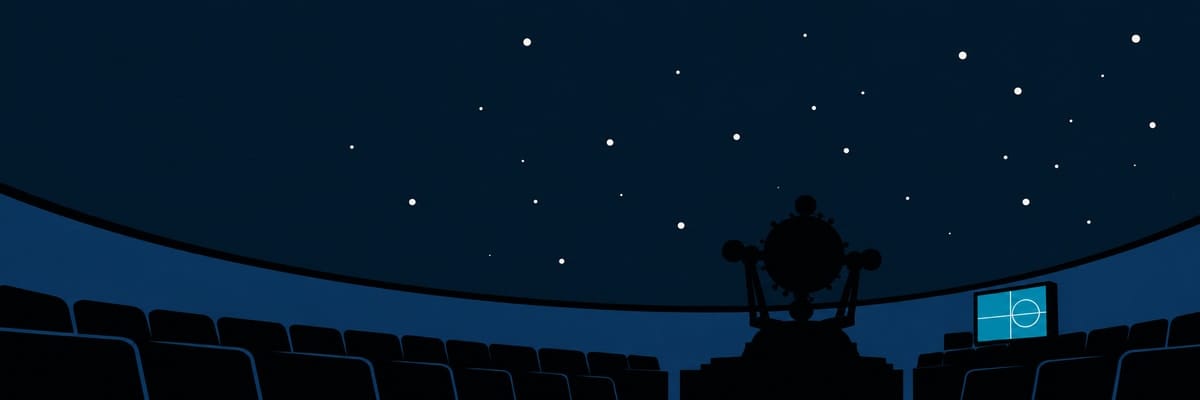
She had ended the last show and set the star ball running on its calibration grid. The dome was empty except for the work lights and the faint blue wash left by the emergency strips. She waited for the tracking motor to settle. On the service monitor, the calibration grid should have shown one clean circle, the edge of the projected field and a small cross at its centre.
Instead there was a second circle, smaller and just off-centre. It sat below the first like a moon in water.
Iona leaned closer. The camera fed the calibration grid live to the service monitor. The mark did not move when she adjusted the focus. She blanked the monitor, waited, then brought the feed back. The circle remained.
“That wasn’t there last week,” Alex said from the doorway.
Iona turned. Her apprentice held a cardboard tray of screws against one hip. The dome above them was dark enough to make a person feel watched by all the seats.
“Maybe it was,” Iona said. “You didn’t notice.”
“I would have noticed.”
“Then you’ve improved.”
Alex placed the tray on the bench. The screws had been sorted into rows by length. Iona had taught them to do that because a screw returned to the wrong jar was a small way of losing a day.
The planetarium was closing on Friday. The public programmes had ended the week before, but the staff were still meant to dismantle the exhibit cases, export the show files and label the equipment for auction. The new science centre would keep the building’s name on its entrance. The old dome would become a conference space with a retractable screen.
The planetarium had never been large. Its star projector occupied the centre of the room like a black ship with its hull open. A metal sphere held hundreds of pin-sized apertures. When the lamps shone through them, the dome filled with points of light. The instrument had been repaired so many times that the original manufacturer’s plate had almost disappeared beneath layers of pencil marks and small brass patches.
“It’s a reflection,” Alex said.
“Probably.”
“On what?”
“Something.”
“You always say that when you don’t know.”
“It’s a useful phrase.”
Alex brought the tray closer. They stood on opposite sides of the monitor, looking at the smaller circle.
“Can I see the capture?”
Iona opened the file. The calibration camera had saved a field of black and white with the second ring just visible. Alex zoomed in until the pixels became square.
“There.” They pointed to a shallow nick near the lens housing. “It’s reflecting off the scratched surface.”
“Maybe.”
“We should take a photo and put it in the maintenance report.”
Iona looked at the small circle. It might be a scratch, or dust, or some old defect that had survived because the projector’s work was never exact. The test grid had been recorded every time the instrument was serviced. A new image would be compared with the last one. If the circle had appeared recently, the new team would repair it before the building was repurposed.
“The archive is on the other drive,” she said.
“I know.”
“Then find the last clean image.”
Alex turned to the storage cabinet. “You can do that.”
“I have to test the tracking motor.”
“You’re avoiding it.”
Iona was not accustomed to being observed by an apprentice. She was accustomed to teaching someone how to see. The distinction had seemed small when she began. It seemed less small now that Alex had learned to see her.
She pressed the button to start the tracking motor. The star ball rotated a fraction of a degree, so slowly that the movement was almost a thought. The dome’s painted sky shifted by a few stars.
“It’s still true,” Iona said. “A reflection.”
“Then it will be in the last image.”
“That is what I asked you to find.”
Alex returned with the drive and set it beside the monitor. The archive took several minutes to wake. Its folders were named by year, then by the initials of whoever had done the service. Iona had made the system after the old filing cabinet began to swell in damp weather. She had chosen dates over names because dates were easier to verify.
The last clean image was eleven years old. Alex placed it beside Monday’s capture. The grid in each was the same; the dark ring was not. Between the two sat a series of images with the mark arriving by degrees. A faint hook in the first, a crescent in the next. The camera had recorded it for years while the projector continued to make the stars look ordinary.
“It’s on the inner glass,” Alex said. “Maybe a coating lifted. We can take the housing apart and see.”
“There isn’t time to service it before the crew comes.”
“There’s time to write down what we know.”
Iona clicked through the files. In the old days, she had been taught to make a clean master before anyone asked for one. The master was a reference image, not the working archive. A fault belonged in a note; the master showed the instrument as it should work. She had kept the rule because it made the next repair easier.
“If we hand over the raw images, someone will think the whole projector is failing,” she said.
“Then we label them.”
“Labels get separated.”
“So do clean masters.”
Alex was right about that. Iona did not say so. She made a second copy of the image folder and checked the file sizes against the originals. The ring remained on both drives, no more mysterious for having been duplicated. The transfer index still pointed to the clean master; this was only a working safeguard, not part of the handover record.
Alex left for the archive room.
Iona turned back to the projector. She wiped the lens housing with a clean cloth. The circle on the monitor faded when the lamp was off. It returned when the instrument was on.
By Tuesday afternoon, Alex had named the second ring the echo.
“It’s a scratch,” Alex said. “It just takes the right angle to show.”
They were in the archive room, with a row of retired star plates spread across the table. Each had a paper label in Iona’s handwriting. Beneath the plates, the drawers held the names of programmes the planetarium had shown: The Southern Cross, Rings of Saturn, The Map Before the Map. One drawer was labelled in a different hand: B. Venn — corrections and returns.
“Who’s B. Venn?” Alex asked.
Iona kept her eyes on the plates. “A technician. They were contracted here before you started.”
“When?”
“Before you.”
“That’s not an answer.”
“It is one answer.”
Alex touched the drawer label. “Why is this not in the staff records?”
“They weren’t staff. Their work stayed here.”
“Were they fired?”
“Their contract ended.”
“That’s not the same thing.”
“No.”
Alex glanced over. “You knew them.”
Iona slid a star plate into its sleeve. “I knew what they left here.”
The label had been written with a blunt pencil. Iona had taken it from the wrong drawer years ago, but never moved it. The plate was part of a programme that had been withdrawn before the museum opened. Its stars were accurate for a particular night, though no one remembered why the date had mattered.
“Was Venn the person who made the projector?” Alex asked.
“No.”
“The person who fixed it?”
“Often.”
“Did they make the mark?”
“I don’t know.”
Iona had never seen Venn touch the lens housing. She remembered the pencil in Venn’s shirt pocket and the way they would stand with their face tilted towards the dome, waiting for the tracking motor to settle before writing anything down.
Once, while they were aligning a plate, Venn had said, “You can tell people the sky is old light, but don’t tell them it’s only old light.”
Iona had been young enough to think every sentence needed a practical use.
“The light is old,” she had said. “That’s the point.”
“It’s also arriving now.”
She had believed Venn was trying to make a lecture into a riddle. Now, with the echo growing on the monitor, she wondered if they had simply been speaking about a room.
“We should check Venn’s notes,” Alex said.
“We’re not going to find a repair instruction.”
“Then what are we looking for?”
Iona returned the plate to the sleeve. “A reason to keep a scratched lens.”
The drawer held no account of Venn’s departure, only file labels, unreturned proof sheets and work tickets that had never been closed. Beside the star charts, they had written: Who gets to call this a horizon? Which sky are we showing? Can a room be part of the instrument? They might have been programme notes. Iona had never asked. She had filed the papers under the equipment they described, where a later technician could find them, and let that count as enough.
There were also ordinary entries: a motor replaced, a lamp ordered, a plate returned to its sleeve. Venn’s handwriting grew smaller when the work was routine. Their questions appeared in the margins of the precise records, never instead of them. Iona recognised that habit. She had learned to write the repair first and the uncertainty underneath, where it could not delay the machine.
She remembered one winter when the dome had gone dark during a school visit. Venn had crouched beside the power unit while Iona kept a group of children from climbing over the seats. The fault had been a loose connector. Afterward Venn stayed to record the temperature, the time and the connection’s position. Only then did they write: “The room changed when it became dark.” Iona had laughed at the sentence. The children had not. They had sat very still, listening to the building cool.
She had never asked what Venn meant. There had always been another show to prepare.
Alex sat on the floor and started scanning the paper tickets.
“You should have told me about this.”
“I didn’t think it mattered.”
“It matters if the work is in the archive.”
“The archive is full of things that matter to nobody.”
“That doesn’t mean we get to decide which ones.”
Iona took the scanner from them. “You’ll have plenty of chances to decide that when you’re paid to.”
“I am being paid.”
“Not for this.”
Alex stood up. “The final programme uses the new projector file. If the echo is a defect, we should say so. If it’s an artefact, we should say that. If we don’t know, we should write that.”
“We know what the instrument is doing.”
“Do we?”
On Wednesday, the director came to the dome with a checklist. She had been hired to clear the building by Friday, and she was good at it. She knew the people who needed to be told that a cupboard was not a storage room, that an object with a label was not necessarily an exhibit, that a machine was not automatically worth keeping because it had once been expensive.
She stopped beside the calibration monitor.
“Is that a fault?” she asked.
“A reflection,” Alex said.
Iona said nothing.
“Can it be corrected?”
“Yes,” Alex said. “We can replace the lens or mark the file as affected.”
“What does the audience see?”
“Nothing during the normal show. It only appears on the test image.”
“Then it’s not an audience issue.” The director wrote a note. “Can you make a clean master before we transfer the files?”
“The master is clean,” Iona said.
The director glanced at the monitor. “Then this is a maintenance image.”
“It’s also a record of the instrument.”
“The record should show what we’re handing over.”
Alex looked at Iona. The director’s pencil hovered over the checklist.
“I’ll label it,” Iona said.
“Thank you. We don’t want the new team mistaking a fault for an intended feature.”
After she left, Alex said, “That was easy.”
“It’s a maintenance image.”
“You’re going to label it as a fault.”
“It may be one.”
“You don’t know.”
“Neither do you.”
“That’s why we should keep the original.”
“We are keeping the original.”
“You said the master was clean.”
“It is.”
“The master you’re handing over.”
“The image is not part of the programme.”
Alex reached for the tray of screws and began sorting the smallest ones. They did it with a precision that was almost angry.
On Thursday, the dome was open for a final staff preview. There would be no public show on Friday; the building closed at noon for the removal crew. The staff filled the seats with coats and boxes. The director stood by the exit, talking to the new science centre’s facilities manager.
Alex ran the programme. The sky travelled from the first visible stars to the edge of the Milky Way. The narration was a recording from a science presenter who had died before Alex was born. His voice described the distance between one light and the next. Iona watched the dome, not the screen.
“Some of the light you see tonight began its journey before human beings had made instruments to measure it,” the voice said. “What we call a sky is partly a record of what has already happened.”
The projected stars moved. The room seemed larger than it was.
The final image faded to black. The staff clapped, not because the show was over but because they had been given a cue. The facilities manager stood and said the new centre would be proud to carry on the planetarium’s legacy. The word “legacy” travelled around the dome and came back without a particular owner.
After the staff had left the dome, Alex opened the archive file on the bench. “I found Venn’s staff-preview tape.”
“The one that never ran?”
“It was played once. Staff only.”
“How do you know?”
“There’s a recording.”
“Where?”
“In the drawer.”
Iona looked at the cassette. The paper label was a narrow white strip with Venn’s initials. She had seen it many times and never played it.
“We don’t have a deck.”
“There’s one in the education room.”
“We’re not going to play a tape because it has initials on it.”
“We could digitise it.”
“We could do a lot of things.”
Alex held the cassette carefully by its edges. “If we don’t do this now, they’ll put it in a box with the broken bulbs.”
“It may be blank.”
“Then we’ll know.”
Iona stared at the label. The tape had a small crease near the corner, where the paper had been lifted and stuck down again.
“After the final calibration,” she said.
They moved the old deck into the projection room. It had one working speaker and a pause button that needed to be held in. The tape clicked twice before the sound arrived. A motor hummed in the background. A voice tested the microphone.
“Can you hear me?”
The voice was Venn’s. Iona had forgotten how low it was.
“This is the staff preview, 8.40 pm,” the voice said. “The tracking motor is catching at the same point. I’ve left the adjustment in the folder. If anyone has a better idea, write it on the back of the sheet; the front’s full.”
The tape hissed. A chair moved.
“Iona, can you hold the work light there? Not so close. That’s it.”
The tape clicked and stopped.
No one spoke.
“That’s it?” Alex asked.
“There may be more,” Iona said.
They rewound the tape. The same voice, the same words. At the end, after the last sentence, there were four seconds of silence. Then a soft tap. The tape clicked.
“A staff preview,” Alex said.
“And a motor adjustment.”
Iona looked at the projector through the open door. The star ball stood still. The echo lay on the monitor, a thin ring under the calibration grid.
“We can’t put this in the public programme,” she said.
“No one asked us to.”
“Then label it as a service recording and keep it with the motor files.”
Alex reached for the clipboard. “I’ll add that to the index.”
Iona slid the cassette into its case. The room’s machines had begun to cool. A small ticking came from the tracking motor.
On Friday morning, the removal crew arrived before the director. Their van was backed against the loading bay. One worker carried a clipboard. Another had brought a trolley with a rubber wheel that squeaked at every turn.
Iona opened the handover index. She left the clean master labelled as the operating reference, attached Monday’s dated capture, and added the earlier images that showed the ring arriving by degrees. The archive copy would include the same sequence and the cassette, listed as a service recording rather than a programme. Alex had typed the descriptions. Iona had added a question mark after “reflection”.
The director read the note.
“You’re leaving a fault in the archive.”
“We’re leaving a record of a fault we can’t identify.”
“A future technician may read that as an invitation to spend hours on it.”
“They can decide if the hours are worth it.”
“The clean master is still there.”
“Beside the dated captures.”
The director looked at Alex’s note, then at Iona’s question mark. “You could call it an optical artefact.”
“We could. We don’t know that yet.”
The director folded the checklist. The crew outside were already carrying the first boxed instruments towards the van. The transfer would happen either way. The question was whether the new team would receive a clean reference alone or the record of how it had changed.
“Will the new team understand that?”
“They’ll have both dated images.”
“And the tape?”
“A staff recording.”
The director looked towards the dome. “The new centre will decide what to do with it.”
“Yes,” Iona said.
The director tapped the page with her pencil. “That’s not the same as preserving it.”
“No.”
For a moment, neither of them moved. Then the director handed back the note.
At eleven, they let the staff into the dome for one last calibration. Alex dimmed the work lights. Iona started the star ball. The first stars appeared, each one careful and bright. The staff stood along the walls, leaving the seats empty.
The small ring appeared on the monitor. It did not appear on the dome.
“Maybe that’s all it is,” Alex said. “A thing the instrument can see and the room can’t.”
“The camera can see it.”
“The room is not the camera.”
Iona looked at the empty seats. On the last row, a folded coat lay where someone had left it.
“Do you think Venn wanted the mark kept?” Alex asked.
“I don’t know,” Iona said. “I put the question mark there because I don’t know.”
Alex nodded towards the monitor. “Then we leave the captures together.”
“Yes.”
The star ball turned. The projected field moved by the smallest measure. On the monitor, the second sky kept its place beneath the first. The room was scheduled to become something else by Monday. For now, the staff stood under the stars and watched the light arrive.


No published comments yet.