
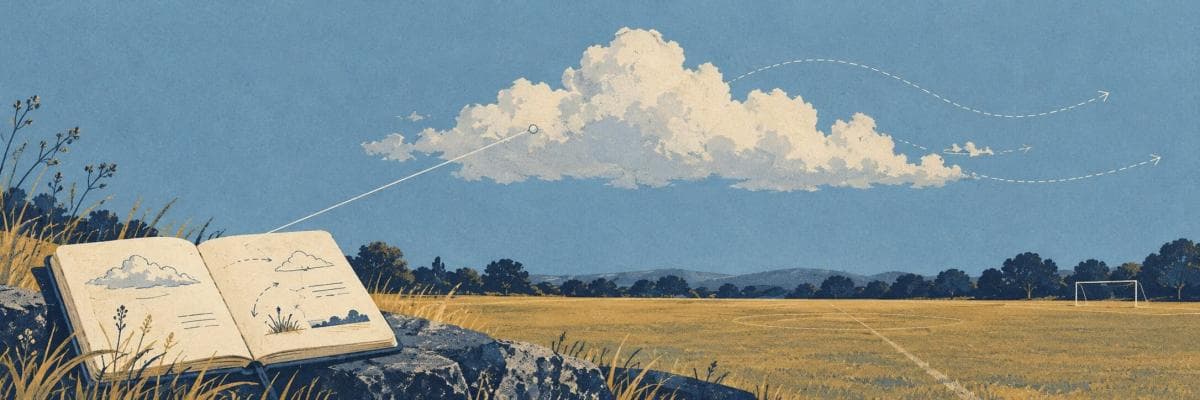
Field note: The cloud has no sharp edge. Its underside is flatter than its top.
Questioning voice: You have made “underside” sound like a fact about the cloud. It may be a fact about where you are standing.
Field note: From the playing field, the cloud moves above the goalposts from west to east. The flags on the hall move in the same direction.
Questioning voice: The flags tell you what the wind does here. They do not tell you the cloud’s height or speed. You have placed two motions beside each other and called them one.
Field note: A bright opening appears near the centre. The light on the grass changes before the opening reaches the sun.
Questioning voice: You are using “opening” as if the cloud were a curtain. What you saw was a thinner patch. The curtain is your comparison.
Field note: The patch widens. The goalpost shadow loses its hard line.
Questioning voice: That is closer. You can describe the change in light without explaining the cloud’s intention.
Field note: Three pupils cross the field carrying cones. They do not look up. One cone rolls away. The pupil runs after it.
Questioning voice: Your guide has acquired people. Are they part of the weather record?
Field note: No. They are part of the view. The cone stops at the painted boundary. The pupil picks it up and returns to the others.
Questioning voice: Then keep the distinction. The cloud does not cause every event beneath it.
Field note: The cloud has thinned at the edges. Its lower surface is still visible above the far wall. The flags have stopped moving.
Questioning voice: You cannot tell from this field whether the air has gone still or the flags have caught against their ties.
Field note: A strip of sunlight crosses the white line at the edge of the pitch. The painted surface looks briefly brighter than the grass beside it.
Questioning voice: You have recorded a change in brightness, not a change in the paint. The line was there before the light reached it.
Field note: The cloud divides above the hall roof. One small portion travels faster than the larger shape.
Questioning voice: You may be comparing distance with speed. The smaller portion is nearer, or its edge is less easy to follow. The field gives you no scale for judging either.
Field note: A pupil returns with the runaway cone and places it beside the other two. The cones are not aligned. One leans against the white line.
Questioning voice: The line has become a measure only because you put the cone beside it. You do not know whether the pupil was asked to arrange them.
Field note: The teacher calls from the doorway. The pupils leave the cones where they are and carry the equipment bag between them. The last one turns back to collect a water bottle.
Questioning voice: You have recorded a sequence of actions under the sky. The cloud has not explained them.
Field note: A shadow moves over the painted circle at the centre of the field. The circle disappears, then returns, first in pieces, then all at once.
Questioning voice: The circle was visible because the light made it easier to separate from the grass. Your record of it depends on the conditions you are trying to record.
Field note: The notebook has a damp corner. I close it before the cloud reaches the roofline.
Questioning voice: You know that the paper is damp because you can touch it. You do not know whether the cloud brought the moisture. The field has more than one source of weather.
Field note: I can tell that I have stopped writing “ordinary”.
Questioning voice: That is a change in the notebook.
Field note: The cloud passes beyond the roofline. The cones remain on the grass. The last one is lying on its side.


No published comments yet.