
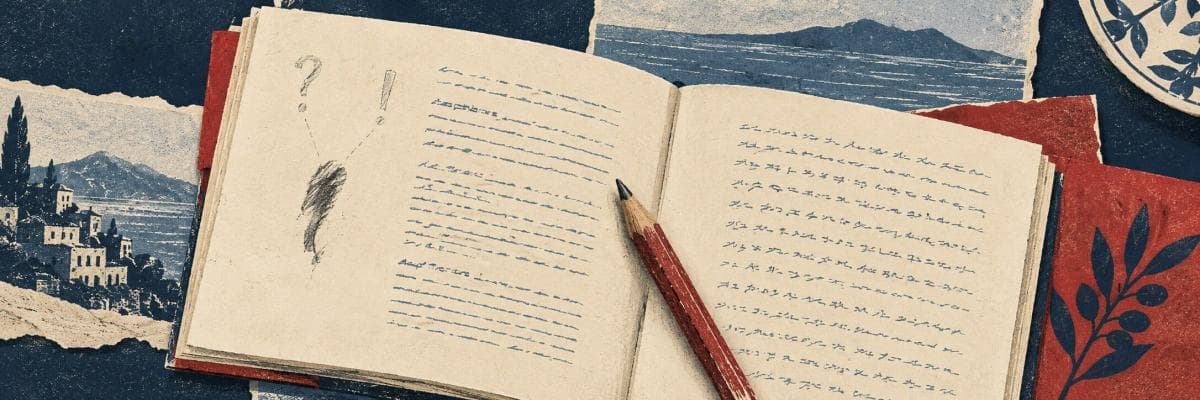
The diary’s printed sentence ends: “We turned inland before the rain.”
In the margin, beside “inland”, someone has written a small word that could be “again”. The first letter is open at the top. A descender meets the printed line. It may be a correction to the route, or it may belong to a sentence written on the previous page.
If the word is “again”, the travellers have turned inland before. The journey gains a loop. If it is “against”, the sentence may be unfinished, its object lost beyond the page. If it is neither, then the mark may have been made by someone reading rather than someone travelling.
The paper is rubbed at that edge. There is no ink on the facing page. The printed sentence keeps its full stop.
The mark is darker where the pen changes direction. Under a reading lamp, I can see a faint stroke before the open letter, but it may be a crease in the paper. I do not photograph it from an angle that would make one reading look certain. In the working copy I place a bracket after the word and add a note: [handwritten mark in margin, uncertain]. The bracket belongs to my edition, not to the diary.
I compare the ink with the printed letters only to describe how they differ. The print is even; the note leans. That does not tell me whether it was made by the diarist, a later owner or someone waiting for the book to be returned. The date on the title page identifies the edition, not the hand in its margin.
I translate the line as it stands. In the note, I write: “Marginal mark uncertain; possibly ‘again’.” I do not put the possible word into the diary’s mouth.

No published comments yet.