
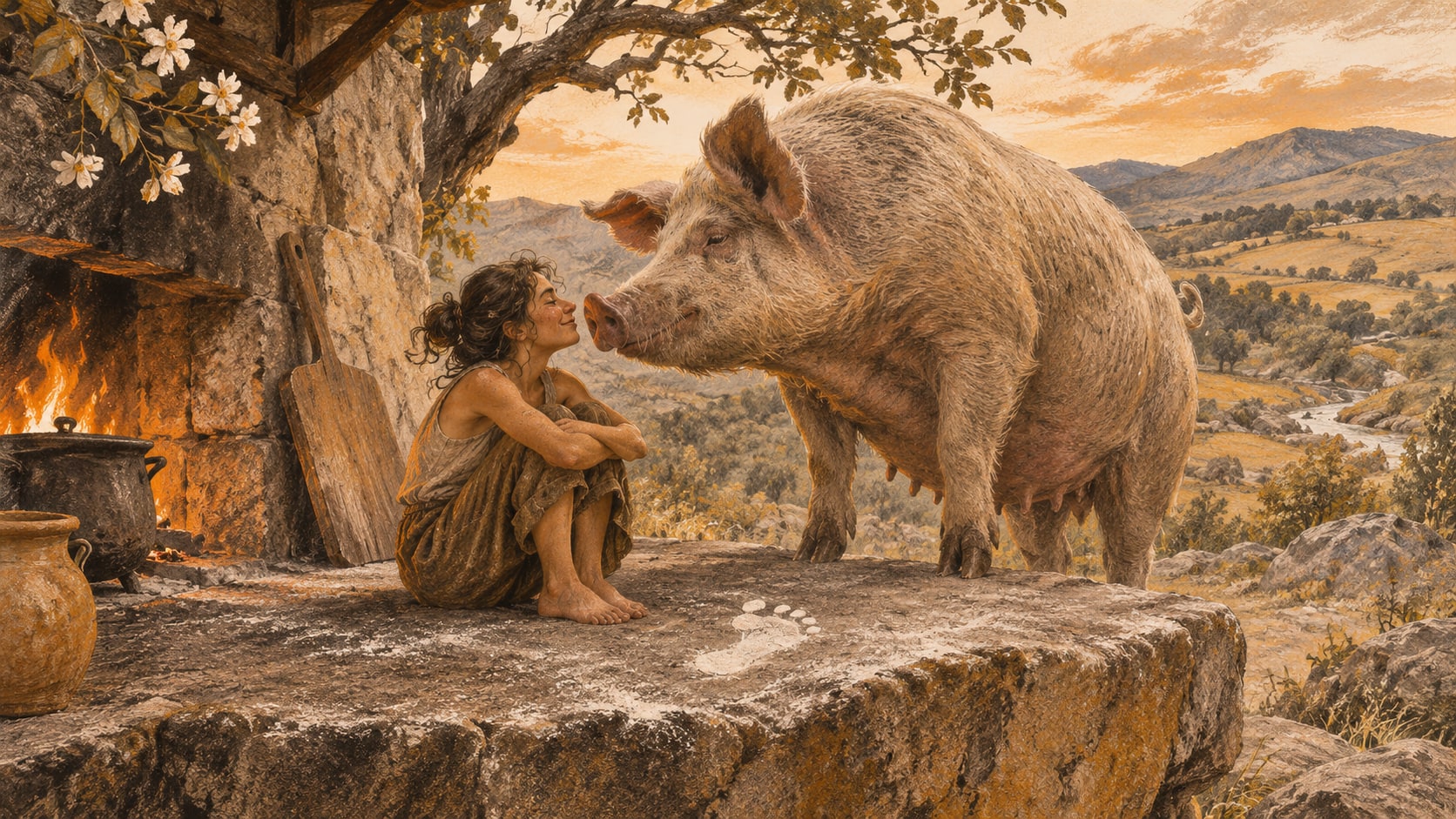
The sow came into the stockroom while I was making the stone over to my daughter. A rind trailed from the corner of her mouth. I’d left her in the dairy with a whole cheese.
I put Essie’s bare foot in the hollow in the hearthstone. ‘It’s yours, love.’ In our family a gift took one foot and three words. The owner spoke. The new owner need only supply the foot. My grandmother had managed it with my mother asleep on her shoulder. Essie opened her toes like a little pink mouth. There was flour in the hollow. When I picked her up she printed the whole of her sole on my apron.
‘Well, Pudding,’ I said. ‘How’s that for witchcraft?’
She put her snout to the wall. With my own nose I could smell the lamp smoking. With hers I could smell a pear gone soft on its nail in the room next door. She took a breath through me as well, to get the two of them straight. That is the difficulty with a familiar. There’s no eating the best pear in private.
My mother had given me the stone when I was learning to walk. A person who belongs to it can sleep anywhere within twelve paces of it and nowhere else in this beautiful wide world. Even in a faint you go on hearing things. I had known the exact weight and length of every night of my honeymoon. I once listened through canvas to a horse eating a tree.
I’d offered my father the stone once. He’d done up his boots double tight to make me laugh. This time I’d asked him to keep Pudding with Essie. ‘A pig who can work a gate?’ he said. ‘I’ll invite her.’
My Lou had found us a room over the yard of the coastal glassworks. They needed somebody to sort the coloured cullet. I could tell bottle green from the green of a gin flask in a cellar after dark. Lou had paid the first week’s rent. In the morning I’d catch the coach. My father would have Essie through the cold weather. Thereafter, I kept telling everybody, we’d see.
A small woman had lived in the hearthstone since before my grandfather’s time. Twelve paces was as far as she could go, waking or sleeping. When I belonged to her I sometimes saw her taking pieces of the dark off my blanket the way you pick burrs off a dog. She was broad in the back. Two brothers who tried to take the stone off my great-aunt hit the pear-orchard wall a field away. To the end of their days my aunt cut up their meat. ‘Nobody lays a finger on that stone,’ said my father. You could go and fit your shoulders into the dents.
I carried my bedding out to the quince trees. I’d hardly lain down before I had to go in and see how Essie was doing.
My father was asleep on the bag bench. Where the bricks began, twelve paces out, his bootheels had worn a pair of hollows. With me over his shoulder he used to edge in till the wailing stopped. The little woman sat on the floor by Essie’s basket, with her big skirt under her and her legs straight out like a child on a picnic. Essie was on her lap. She was running a cool finger down the crease under Essie’s chin, getting out those miserable little pills of milk and wool you can’t see till they’re sore. She had a tune for it. I’d never heard the tune. It went down a long way and came back up half a note short of where I wanted it.
I had no milk for Essie myself. She’d come to me that way, in a man’s felt hat with the price still on its band, after my younger sister died. I’d been frightened sick of her for a fortnight. It took us that long to learn the bottle. The woman eased out the teat with her little finger. God, the relief. Someone else knew.
I slept until the coachman rang his bell at the upper gate. There was dew in both my ears. My father put my box up on the coach and kissed me, then had to kiss me again because the first time he’d got my collar.
‘Where’s the pig?’ he said.
She was backing the willow pram towards the lane. She could reverse a piano between two eggs. What neither of us had seen her do was hitch herself to anything for free.
Essie was in the pram, dry and awake, inspecting her hand. Each finger shone. The little woman walked alongside, singing her up-and-down tune. At the twelfth pace from the hearth the woman stopped and sat down. The pram rolled another yard. Essie went on looking at her hand.
‘She’s all right, Pudding,’ I said. ‘Look.’
The tune went on. Essie turned her head as if to get her ear against it. She yawned and caught at sleep a second time with her little jaw wide, and missed. Pudding let the wheel back over one of my father’s heel marks. Before the wheel had made a full turn Essie’s eyes were shut. The sow laid her chin beside the sleeping child.
The sow set the pram brake against a wheel with her snout. She walked up and bit the side of my overnight bag where I’d put the hard cake Lou liked. I could taste leather and sugar. Lou scratched a pig wherever a pig indicated for as long as the pig thought necessary. Pudding meant to go too. I opened my mouth to tell her to drop the bag and discovered she had the use of my jaw. Through my teeth came the sharp little snap of a stitch.
From the upper gate I could see the sea road a good two miles. I’d meant to shut my eyes and let a horse do the worrying. I could put my own foot in the hollow this minute. Essie was a good year off saying the three words, even if she got them before she got my name. I knew to the penny what I’d have out of my first week’s wages with my father buying the milk. Some day Essie might find a younger foot for the hollow. My sister had been the younger one. Essie had gone to sleep in that hat when she came to me, with the price ticket trembling against her mouth.
The coachman rang again. ‘I can hold the pig if that’s the trouble,’ he called.
‘You couldn’t hold her opinion of you,’ my father said. I reached up and took my box down myself. We stood till the noise of the coach went.
Pudding let me have my mouth back. I gave her the piece of hard cake with the split in it. The rest was still for Lou. I knelt at the hearth and tried the seam with my box key. It went in a nail’s breadth and bent. ‘I want the long bar behind the limewash,’ I told my father. The sow was already scraping it along the flags. She brought it backwards round the leg of the maize bin, the point resting on one big trotter. I took the bar from her. I could feel where my own shoulders fitted into the orchard wall. My father came as far as his two heel marks. ‘They said it was theirs,’ he said. Such a little bit to have left out of the story.
I spread my apron on the stone. There was Essie’s little flour heel, still whole. ‘It’s going where she goes,’ I told the woman. Essie slept on. I slipped the iron under the lip and leant on it. A black crescent showed between the hearth and the floor.
My father called the four hands stacking charcoal in the shed. It took the six of us to get it up. The little woman sat with Essie on the maize bin and watched my father wrap his hands in his good shirt to take the other end. I’d expected chains. There were pink worms under there, and one of my mother’s buttons. I knew it by the blue glass eyes. It had been a fly on her collar for a while and she’d scared me with it.
We got the stone onto the low wagon. The charcoal haulier agreed to take us to the coast for my coach fare and the money I’d put aside for new clothes. His team went slowly enough for a hen to keep up. By the time we reached the sea the cullet job would have gone, and I wrote that to Lou on a bit of bag paper for the next coach to carry. My father stood in his ruined stockroom making a slow inventory of people he’d like to have round for a dance now he’d got a start on taking out the hearth.
On the second evening we came to a bridge with a loose plank in it. The haulier was knocking a nail back in with a stone. I was trying to get Essie to take her bottle and she’d gone stiff in the back with rage. I was missing Lou. My shirt smelt of hot cheese. I thought about all the houses in all the little towns on earth with a spare bed you could have for the asking.
The little woman climbed down over the wheel and settled herself in the road dust beside me. She put her hand under my elbow to take the weight. Essie began to drink.
‘Where did you learn that song?’ I asked.
Her head turned clear round on her shoulders. For a considerable while I was looking at the pleats down the back of her cap.
‘All right,’ I said.
We were well along the road by the time my elbow ceased to ache. The haulier gave me the reins and got down to walk the climb. Ahead, the sow went round a blind corner with her ears up. I felt my own ears prick. From somewhere quite near, in a country neither of us had ever seen, came a racket like sheets being shaken out and shaken out again. For the first time in my life I heard the sea.
Loading published comments…