
At nine seconds into the recording, the caller stopped speaking. There was no click, no breath and no hiss from the telephone line. The sound simply ended. Four seconds later it returned, and the caller finished her sentence.
“I thought I could hear someone in the garden,” she said. Then the silence. “But it was only the gate.”
Mira played the recording again. The waveform on her screen showed the gap as a straight line. She enlarged it until the line filled the monitor. There was nothing in it, not even the low electrical noise present throughout the rest of the tape.
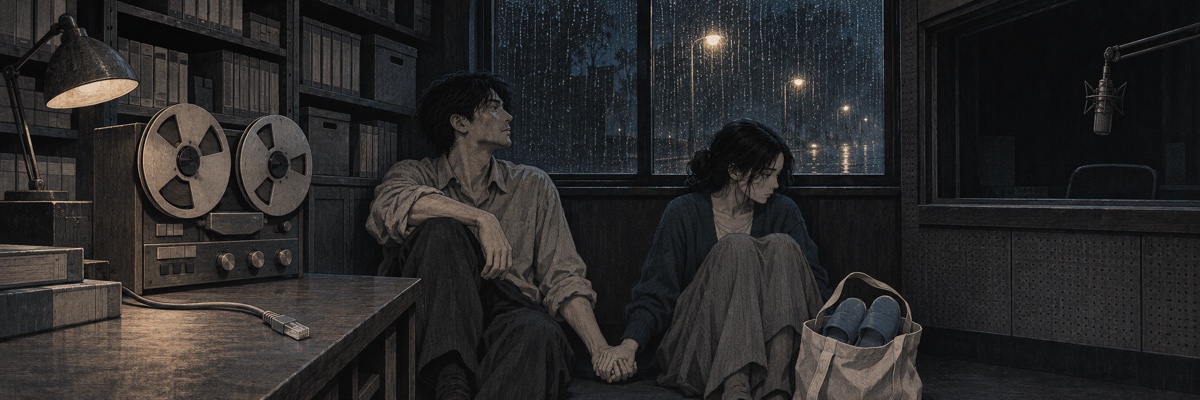
The recording came from a box labelled NIGHT GARDEN, 1998. The station had asked her to digitise it before the old tape machine failed. Mira worked three evenings a week in the archive room, transferring interviews, music programmes and local news into files that could be searched. Most nights she listened through headphones while the present-day broadcast played faintly through the wall.
She cut the silent interval and placed it on a separate track. Before playing it, she could hear the fan, a chair scraping in the studio next door and a car passing outside. She pressed play. For four seconds, all those sounds disappeared. They returned together, and she took off the headphones. The fan kept turning behind its grille. She had not noticed the pause as an event until the room came back.
Her brother was presenting the late programme. Through the studio window she saw him leaning towards the microphone, one hand raised to tell her to wait. He finished the announcement, started a song and opened the door.
“You're early,” he said. “I thought you were coming tomorrow.”
“I swapped shifts.”
He had not seen her for three months. At their mother's funeral they had spoken only about the flowers and the arrangements for the car. Since then he had sent two messages asking about the sale of the house. She had answered one. He looked tired, with headphones resting around his neck and a pen tucked behind his ear.
“Can you listen to something?” she asked.
He followed her into the archive room. She played the caller's sentence. At the end he said, “That's Mum.”
“It isn't. The box is from 1998. She didn't call the station.”
“Not the caller. In the gap.”
“There isn't anything in the gap.”
He put on the headphones and listened again. This time he closed his eyes. “She says my name.”
Mira listened after him. She heard only the abrupt absence of sound and its return. She deleted the separate track, then checked that the original recording was unchanged. The gap remained in it.
Her brother watched her. “Why did you delete it?”
“I don't know what it is.”
“You could have let me hear it again.”
A light flashed in the studio: the song was ending. He went back through the door. Mira saw him put on his headphones and lean towards the microphone. His lips moved. No sound came through the wall. Then he sat back, frowning, and started another track.
He came out while the music played. “Did you hear that?”
“No.”
“I was talking. The meter didn't move.”
Mira looked at the archive screen. The recording had stopped playing. She had not touched the controls since he left. The cursor sat at the beginning of the gap.
They played the live studio feed through the archive speakers. During the next announcement his voice came through normally for several sentences. Then it stopped for four seconds. The meter continued to move. When he finished, the sound returned.
They called the station engineer, who was at home. He told them to check the cables and restart the desk. Mira did both while her brother played a longer piece of music. The music went out without interruption. The next spoken announcement lost four seconds.
“Keep the microphone open,” the engineer said over the phone. “I'll listen from here.”
Her brother read the weather. The engineer heard every word. In the archive room, Mira heard the silence. She took the phone from her brother and asked the engineer to repeat what had been said during the gap. He did. It was an ordinary forecast, with rain expected after midnight.
After they hung up, her brother said, “It isn't in the broadcast.”
“Not for him.”
Mira went to the kitchen and turned on the tap. Water ran into the sink. Her brother spoke from the doorway. She saw his mouth form words, but heard nothing until he said, “Are you listening?”
“What did you say?”
“I asked if you wanted tea.”
The water had made no sound during the pause. It was still running. Mira turned it off.
They searched the tape box for a note about the original call. Most of the sleeves held dates and song lists. One contained a handwritten log from the programme producer. Beside the caller's name was a brief note: silence again; caller waited for reply. Similar notes appeared beside three other calls across the month, with different gap lengths. On the last page the producer had written: No more live calls after midnight.
Mira found the earlier recordings. The first silence lasted a single second. In the second it lasted two. One of the later calls lost four seconds, but that caller never returned to finish speaking. The recording ended with the presenter saying hello into the dead line.
“Maybe someone was on the line with them,” her brother said.
“Someone who didn't speak.”
He looked at the log. “Mum volunteered here then.”
Mira knew that. Their mother had answered telephones at the station before they were born. She had told them stories about callers who rang to request songs for neighbours or to announce lost dogs. She had never mentioned the silence.
Her brother took out his phone. “She left me a message in hospital. I haven't deleted it.”
Mira remembered him arriving with the slippers in a paper bag. Their mother had complained that the soles were too smooth, although she had asked for that pair herself. He had gone back to the car for the others, and she had fallen asleep while he was away. Mira had put the blue slippers beside the bed. Later, when the nurse came in, she had moved them out of the way and forgotten to tell him where. They had searched the room together, irritated with each other, until their mother woke and pointed at the chair. It had been such a small muddle, and they had made it last the whole visit.
Mira wanted to tell him not to play it. Instead she asked what it said.
“Nothing much. She wanted me to bring her slippers.” He found the file and pressed play.
Their mother's voice filled the little room, dry and impatient. She asked for the slippers and reminded him to bring the blue pair, not the brown ones. Then she paused. Mira knew that pause: it had always come before a further instruction, some detail their mother was certain he would forget. This time it stretched. Four seconds passed. Five.
Her brother held the phone closer. His face changed. “She's saying something.”
Mira heard nothing. She reached for the phone. He pulled it away.
“Let me listen.”
The screen showed that the message had ended. The playback bar was at the far right. Still he held the phone to his ear. His lips parted as if he were about to answer.
Mira took his wrist. He shook her off. The room was silent: no fan, no music through the wall, no traffic. She watched the second hand on the clock above the door. It moved, but she could not hear it.
She pulled the phone from his hand and pressed the screen. The message closed. Sound returned. Her brother shouted at her, then stopped and stared at the phone.
“What did she say?” Mira asked.
“I don't know. I thought I did.”
The studio light flashed again. The long piece of music had ended. He went to the microphone, but the desk would not start the next track. He tried another. The file opened, the counter moved, and no sound came through the speakers.
Mira picked up the studio telephone. There was no dial tone. On the screen in the archive room, the old recording had begun to play. The caller's waveform moved towards the gap.
Her brother came in behind her. “Turn it off.”
She pressed stop. The cursor continued. She pulled the power cable from the computer. The monitor went black. In the glass she could see her own reflection and her brother's, both looking towards the dark screen.
A voice came from the studio. Their mother's voice, asking whether anyone was there.
Her brother moved towards the door. Mira held his arm. “The computer's off.”
“Maybe the engineer got the desk working.”
The voice asked again. It sounded tired, the way their mother had sounded in the last weeks. Mira felt her brother pull against her hand. She let go, but stepped in front of him.
“We can call him from outside,” she said. “We can ask him.”
The voice said Mira's name. It had her mother's sharpness, the familiar impatience. For a moment Mira wanted to answer more than she wanted anything else. She could picture the hospital room, the blue slippers beneath the bed, the water glass on the tray. She had left before the end of visiting hours that last day because she had an appointment she could not remember now.
Her brother said, “She asked for you.”
“I know.”
The voice stopped. The silence that followed was not empty. Mira felt a pressure in it, an expectation so immediate that she opened her mouth. Her brother did the same. She shut hers and took his hand.
They stood together without answering. The clock's second hand moved. The studio light went out. After a long time, the fan in the computer began to sound again, though the computer was unplugged. Mira realised the sound came from the ventilation grille above the door.
Her brother sat down on the floor. “What if it was her?”
“I don't think it was.”
“You don't know.”
“No.” She sat beside him. “I don't.”
They waited until the engineer arrived. He found the desk running normally and the studio telephone connected. The transmitter had continued to broadcast the emergency music loop. He could not account for the recording playing on an unplugged machine. He checked the tapes and advised them to leave the damaged one out of the archive until he could inspect it.
Mira put the tape in a box and wrote the date on the lid. She did not copy the gap into another file. Her brother watched, but did not ask her to stop. They locked the archive room and walked outside with the engineer. Rain had begun, light enough that the streetlamps showed each drop.
At the corner her brother said he still had the blue slippers. They were in a bag with some of their mother's clothes. He had not been able to take the bag to the charity shop.
“We can do it together,” Mira said.
He nodded. “Saturday?”
She said yes. They stood under the station awning, waiting for his bus. He asked whether she remembered the song their mother used to sing while washing dishes. Mira could remember the tune but not the words. She hummed the first few notes. He joined in, quietly and out of time.
A bus came round the corner. They stopped. For a moment neither spoke, listening to the engine and the rain on the road. Her brother squeezed her hand, then stepped out from under the awning. The bus doors opened. He climbed aboard and found a seat near the front.
Mira watched until it had gone. She walked home in the rain, humming the tune again whenever she could remember how it began. At the crossing she stopped beneath a shop awning while a delivery van passed. The driver waved her across, and she lifted a hand in thanks before continuing towards the lights at the end of her street.


No published comments yet.