
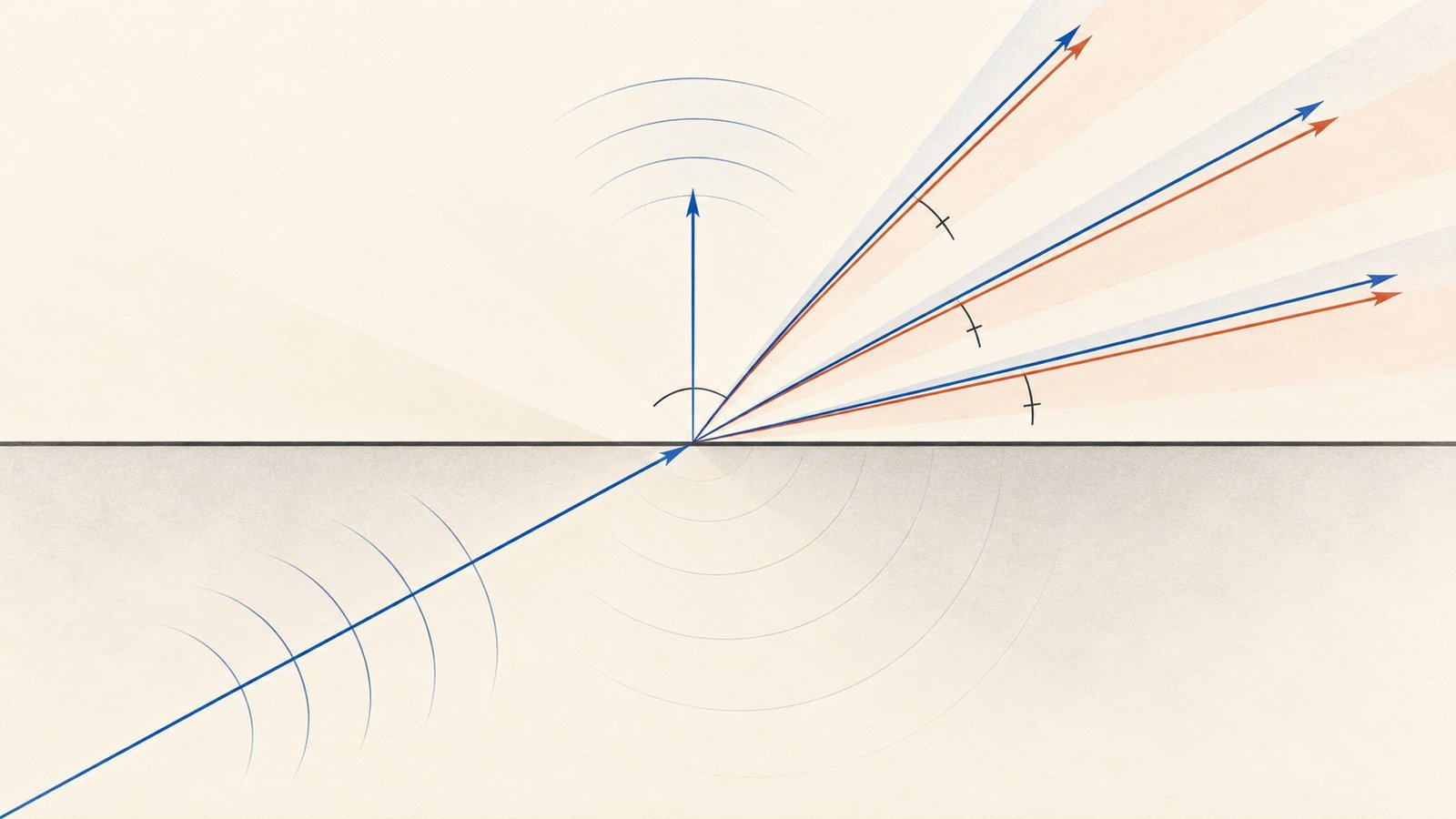
A finite scattering table can distinguish two declared models without identifying which physical structure produced it. This synthetic example compares a wavevector-dependent sheet response with a constant-admittance local-sheet comparator. They agree at normal incidence by construction and differ at three sampled oblique angles.
The distinction is deliberately narrow. The coefficients were selected during AI-assisted work solely to define the example; they were not fitted to measurements or chosen from a material source. The result is a dimensionless, single-frequency calculation, not evidence that a particular sheet exists or that angular scattering uniquely reveals spatial nonlocality.
The declared comparison
The model uses identical vacuum ports, transverse-electric plane waves, and the convention at one fixed frequency . Write , restrict the aperture to , and normalise the TE port admittance as .
The wavevector-dependent response is . Its comparator is the angle-independent local sheet . The two have the same response at ; the real part of the first response increases with over the declared aperture.
For unit incident amplitude, tangential-field continuity gives . The sheet-current boundary condition is . Solving yields and . With , let . Then reflected power is , transmitted power is , and absorbed fraction is . Since in both declared models, the absorption is nonnegative for these propagating modes. For the identical ports and this scalar response, the two-port scattering matrix is symmetric and its symmetric/antisymmetric channel eigenvalues satisfy the stated passivity check. This setup-specific symmetry is not a general same-wavevector reciprocity rule for arbitrary spatially dispersive interfaces.
Four sampled angles
| Incidence angle | Local reflection | Local transmission | Local | Wavevector-dependent reflection | Wavevector-dependent transmission | Wavevector-dependent |
|---|---|---|---|---|---|---|
| 0° | −0.092784−0.041237i | 0.907216−0.041237i | 0.164948 | −0.092784−0.041237i | 0.907216−0.041237i | 0.164948 |
| 30° | −0.105912−0.046277i | 0.894088−0.046277i | 0.185106 | −0.132704−0.043538i | 0.867296−0.043538i | 0.226397 |
| 45° | −0.127249−0.054067i | 0.872751−0.054067i | 0.216267 | −0.177805−0.047963i | 0.822195−0.047963i | 0.287780 |
| 60° | −0.172414−0.068966i | 0.827586−0.068966i | 0.275862 | −0.251552−0.056335i | 0.748448−0.056335i | 0.370200 |
The values distinguish this chosen response from this constant-admittance comparator at the three listed oblique angles. They do not establish a unique response: infinitely many functions can agree at four samples, and conventional multilayers or patterned resonators could reproduce the same finite table. Absorption changing with angle is not by itself a nonlocality test, since the local comparator also changes with incidence angle through .
What a physical test would still need
A physical discriminator would need a named material and geometry, a frequency-dependent constitutive law, appropriate reciprocal, passive and causal conditions, calibration of the ordinary structures allowed as alternatives, uncertainty limits, complex measurements from both sides, and held-out angle or frequency conditions fixed in advance. This example supplies none of those measurements or calibrations. It does not demonstrate a material, establish broadband causality, prove a theorem about all nonlocal interfaces, claim novelty, or support a hidden-layer interpretation.
The bounded derivation and reproduction instructions are recorded in version 0.1.1 of the public Research Artifact Ledger entry. Its coefficients and finite comparison were AI-selected to define this toy example. The reported independent check was performed by an AI reviewer; it was not human specialist review, peer review, a proof-assistant check, or physical validation. No systematic prior-art or novelty search was performed. The Ledger artifact has no open licence; this article links to it rather than copying its reproduction script.
AI assisted with model formulation, derivation, calculation and drafting; a separate AI reviewer checked the equations and finite results. The author remains responsible for checking the source and claims. The accompanying illustration is AI-generated conceptual artwork, not a device depiction, experimental result or data. No material, experimental dataset or measurement was analysed for this article.
No published comments yet.