
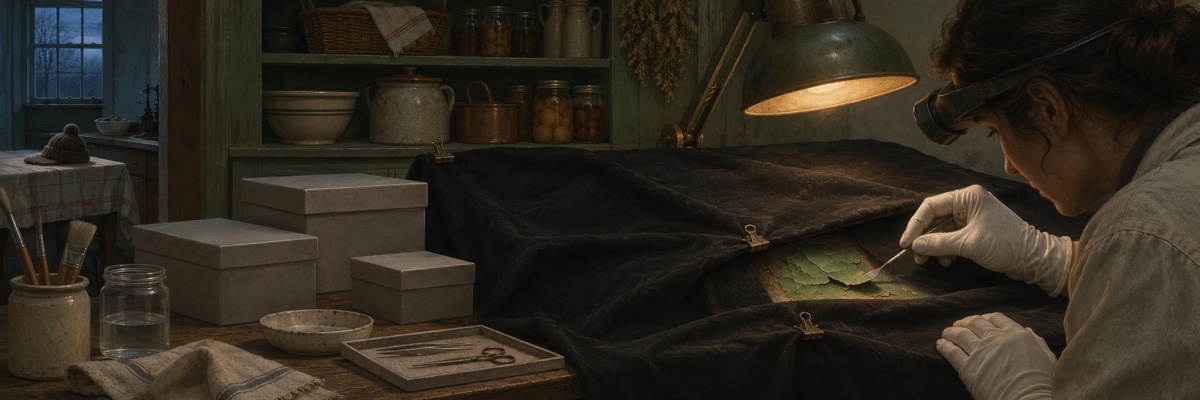
The woman in the painting had no face, but somebody had varnished her cheek.
Under the inspection lamp the oval shone. Around it the room remained matt: a green table, three mismatched chairs, a window opening onto weather too dim to identify. Mara tilted the painting and the small patch of gloss caught the light again.
'There,' Mrs Vale said. 'Can you remove that?'
'Possibly. I need to identify it first.'
'It looks like grease.'
The painting had hung for thirty years in the dining room. In that time Mrs Vale had outlived her husband, sold the business they had built together and dismissed the last person who still knew where they kept the spare bulbs. She was donating the house and its contents to a foundation. On Saturday it would open for a preview.
Mara had three days.
She took photographs, made notes, and asked Mrs Vale to leave the room while she worked. This last request was professional habit. The relief with which she made it was not.
Something about the painting required privacy.
The label on the frame read THE WARM ROOM, E. ROOK, 1989. Mara knew the artist's name from auction catalogues. Rook had painted interiors with flat, almost petulant colours and figures whose hands were much more carefully rendered than their faces. Prices had risen since her death.
Mara dampened a swab and tested the bottom corner. Nothing lifted. She tried the glossy cheek with a dry swab.
It came away wet.
She held it under the lamp. The moisture was colourless. Against her better judgement, she touched the cotton with a gloved finger.
Warm.
Behind her, somebody drew a chair out from the dining table.
Mara turned. All eight chairs were in place.
When she looked back, the painted woman had a mouth.
Not a completed mouth. Two brown strokes had appeared beneath the shine. They were parted as though the woman had been about to object to something and then thought better of it.
Mara knew that expression. Her sister made it on the telephone when Mara interrupted her. Absurd: one could not see an expression on the telephone. Yet she knew it precisely, with the certainty of a smell.
She covered the painting, told Mrs Vale not to uncover it, and went outside.
In the garden she called Leila.
'Say something,' Mara said.
'About what?'
There was the familiar voice, impatient but amused.
'Nothing. I wanted to hear you.'
'You could come round. We do still live in the same city.'
Mara promised Sunday.
Back inside she found Mrs Vale standing before the painting with one corner of the cover raised.
'I said you should leave it alone.'
'You said you were going outside.'
'Please leave it covered.'
Mrs Vale let the cover fall. 'It belongs to me.'
The next morning the cover was folded on the dining table.
The woman in the painting had lost her mouth. In its place was a thick ridge of green paint. The glossy patch had moved to one of her hands.
Mrs Vale apologised without quite admitting an offence. She had not slept. She sometimes sat in the dining room at night. Her husband had liked to read there, even after his eyesight made reading difficult.
'It gives me the feeling that he hasn't left yet,' she said. 'You don't have to understand.'
Mara understood enough to feel ashamed of her irritation.
She photographed the changed surface. The ridge was visible in both the photograph and the room. It was not a trick of fatigue. She compared yesterday's image. Beneath the woman's chin, where she remembered the mouth, the photograph showed only flat cream paint.
It had appeared after the photograph.
She wrote that down, carefully.
In the afternoon she removed the painting from its frame. A sheet of brown paper protected the back. Along the lower edge somebody had written in pencil: NOT A WINDOW. The letters looked hurried, but the final full stop was heavily pressed into the paper.
Under the paper was a second inscription on the stretcher.
IF YOU HAVE COME TO REST, SOMEONE ELSE WILL HAVE TO STAND.
Mara sat on the floor. From there the painted table was almost at eye level.
For the first time she saw the room properly.
The chairs were shabby. One had a strip of cloth tied around its cracked back. The window had been painted shut. A chipped cup stood at the woman's elbow, and the hand beside it was not resting on the table but gripping its underside.
Mara felt herself recognised.
There was no other way to describe it. The room accepted the exact tiredness she had brought to it. Her overdue invoices, her unfinished kitchen, the humiliating pleasure of being recommended for this job: everything fitted. She had been carrying an unwieldy collection of things for years. Here was a table where she could put them down.
She cried without warning.
The painted woman's fingers tightened.
Upstairs, Mrs Vale dropped a glass.
Mara covered the canvas and ran to her.
The woman stood beside the basin, looking at her own hands. Water spread between pieces of the glass. She had been washing it after taking her tablets.
'I can't remember whether it's mine,' she said.
'The glass?'
'My hand.'
Mara stayed with her until the feeling passed. She could not know whether the painting had caused it. She recorded the time anyway.
That night she looked for people who had known Rook. An old exhibition catalogue listed a studio assistant, now a picture framer in another town. Mara sent a photograph of the inscription and asked if it was the artist's handwriting.
He called ten minutes later.
'Who's been sitting with it?'
Mara told him.
'Cover it.'
'It is covered.'
He breathed out. She heard a radio in the background, then the click as he switched it off.
His name was Tom. Rook had employed him to stretch canvas and clean brushes. Sometimes she asked him to sit for a hand or an elbow. She paid him for those hours. He wanted Mara to understand that. There had been ordinary work and ordinary money.
'But when she painted the rooms,' he said, 'she asked us to remember somewhere we belonged.'
'Who was us?'
'People. Friends. Models. Her brother. Me.'
He had thought of his grandmother's yard. He remembered the gate, the peach tree, the gritty tap. Afterwards he could still describe them. But when he visited, he felt nothing. His grandmother held his face between her palms and asked what she had done.
'I thought I was depressed,' he said. 'Perhaps I was as well.'
Rook had made twelve interiors. The first buyers complained that the feeling wore off. They asked her to renew it. She began inviting guests into the studio to look at the paintings, one at a time.
'She stopped asking them to remember anything. They did it themselves.'
'Where does it go?'
'Into the next person, I think. With other things mixed in. She said she was teaching it hospitality.'
Mara thought of the hand beneath the table.
'Can it be destroyed?'
'One caught fire. The owner had a dinner party a week later. Six people kept coming back. He had to move out.'
'Why?'
'They said they lived there.'
He did not know whether covering it stopped it permanently. He had never owned one. Before he ended the call he asked Mara to send him a picture of the empty stretcher if she ever managed to make it empty.
She did not promise.
On Friday she told Mrs Vale what she had seen and what Tom had said. She showed her the photographs and the notes, separating what she knew from what frightened her.
Mrs Vale listened. Then she opened the cabinet beside the fireplace.
Inside were her husband's spectacles, a folded newspaper and a small woollen hat.
'He wore this indoors at the end. I used to tell him he looked ridiculous.'
She placed the hat in Mara's hands.
'Do you feel him?'
'No.'
'Neither do I.'
The older woman closed the cabinet.
'That room is the only thing that helps.'
'It may be taking something from other people.'
'You don't know that.'
'I know the surface changes. I know what happened upstairs.'
'And you know I paid for it. My husband paid for it. We didn't steal it from anyone.'
Mara had rehearsed an answer about possession and consent. Standing there with the hat still in her hands, she could not say it. Mrs Vale had bought a painting. She had not knowingly bought a stranger's grandmother.
'Don't let people see it tomorrow,' she said instead.
'The preview is for the collection. It can't simply disappear.'
'Say it's undergoing treatment.'
Mrs Vale looked at the covered rectangle.
'Is that what you would call this?'
They agreed it would remain covered. Mara would stay through the preview and take it to a secure workroom afterwards. She had no cure to offer. She could only keep it from receiving new visitors.
Before leaving that evening, she called Leila to cancel Sunday.
'Of course,' her sister said.
Mara recognised the shape of the conversation and felt nothing about it. No guilt, no affection, no familiar irritation. It was as if somebody had handed her a transcript involving two people she had never met.
'Leila?'
'What?'
'What did we eat when the electricity went off that Christmas?'
'Cold beans. Straight from the tin. You said we were pioneers.'
Mara remembered. She could see the tin between them on the balcony, the towel around Leila's wet hair. It was an accurate, useless picture.
She sat on the pavement outside Mrs Vale's gate until the security light went out.
On Saturday the house filled with shoes, perfume and the small authoritative noises people make in rooms they might soon help administer. Mara kept the dining room closed. A man from the foundation asked whether there was mould.
'The painting isn't stable,' she said.
'Will it be expensive?'
'I don't know.'
At two, Mrs Vale brought her a sandwich. Mara had not eaten since breakfast. She thanked her and went into the kitchen to wash her hands.
When she returned, the dining room door was open.
Mrs Vale had removed the cover.
Seven people stood before the painting. Nobody was talking. A young man had taken off his jacket and laid it carefully across a chair, as if he had arrived somewhere he meant to stay.
The painted woman was standing.
Her chair lay on its side. The table had moved closer to the edge of the canvas. Beneath it, compressed into the dark, were bare feet in different sizes.
Mara pushed between the visitors with the cover in her hands.
Mrs Vale caught her arm.
'Wait. Please. He was just here.'
She was not looking at the canvas. She was looking at a chair beside it.
Mara pulled free and covered the painting.
The young man began to cry. Another visitor asked why the door was in the wrong place. Mrs Vale sat down on the floor and covered her face with both hands.
Mara ushered the guests into the garden. She gave them water. She wrote down their names while they could still provide them. The foundation man wanted to know whether anyone had taken something. When she said yes, he asked what substance.
'I can't explain yet.'
After the cars left, she locked the front door.
Mrs Vale was still on the floor.
'I saw him,' she said.
Mara sat beside her. 'Was he wearing a hat?'
'No.'
'What did he say?'
'Nothing. He was here.'
They listened to the house. From behind the cover came the noise of a cup being set down, then set down again. Someone was practising the movement.
'I think it knows what you need now,' Mara said.
Mrs Vale reached for her hand.
'I know.'
At last she gave Mara permission to remove the painted surface, whatever that meant for the value of the work. They made a written record because neither trusted what they might agree to after looking at it again.
Mara did not burn the canvas. She did not cut a hole in the painted door. She took the stretcher to the pantry, where there were no chairs, and worked through a narrow opening in an opaque cover. She could see a few square centimetres at a time. Enough to treat the material; too little, she hoped, to receive the room.
The first lifting of paint brought the smell of peaches.
She stopped. Tom's grandmother's yard. Or merely solvent and the jar of jam on the shelf behind her. She could not afford to decide by longing.
She sealed the fragment in an opaque container and continued.
By midnight her hands cramped. The green table came away in brittle scales. Under it was an earlier table, then another, then the outline of a child's desk. Every room had been painted over a room. In places the surface was so thin that she doubted the order in which she had seen them.
Mrs Vale brought tea and stood beside her while she drank it.
'There were people at our dinners,' she said. 'Sometimes they looked frightened when they left. I thought they were jealous.'
Mara wanted to reassure her. Instead she asked her to write down the names she remembered.
At three, Mara exposed the painted woman's gripping hand.
It was larger than the hand in her first photograph. The knuckles were square. A pale scar crossed the thumb: the scar Mara had earned opening a stubborn tin with the wrong tool.
She shut her eyes and replaced the cover.
From the pantry doorway, Mrs Vale said, 'Are you there?'
'Yes.'
'Then keep speaking.'
Mara talked about the work. She named the colours she removed and the tools she put down. Mrs Vale answered each time. Towards dawn the surface beneath the last figure gave way to plain canvas.
Nothing returned to them.
Mara could remember the balcony and the cold beans. She still could not feel her sister in the memory. Mrs Vale sat at the kitchen table with her husband's hat in her lap. It remained a hat.
They packed every removed fragment in opaque boxes. Mara photographed the bare canvas for Tom. She did not call it a cure.
The boxes are in a locked cupboard now. Mara checks them without opening them. Sometimes one is warm.
On Sundays she goes to Leila's house. She washes the dishes, listens to complaints, stays when the conversation runs out. Once, laughing at something Leila said, she felt a small unexpected attachment to the person beside her. It frightened her so much that she went home early. The next week she made herself stay.
Mrs Vale visits the workroom every month. She asks the same question each time: whether a tiny piece would be enough. Mara says she will not find out.
Last week the foundation wrote asking for the remains. Its inventory included the painting, and the agreement covered all constituent materials. The letter was courteous. There would be a new gallery, it said, and an opportunity to interpret the work through its remarkable history of conservation.
Mara read it at her desk.
Behind her, from the locked cupboard, a chair scraped across a floor.

No published comments yet.