
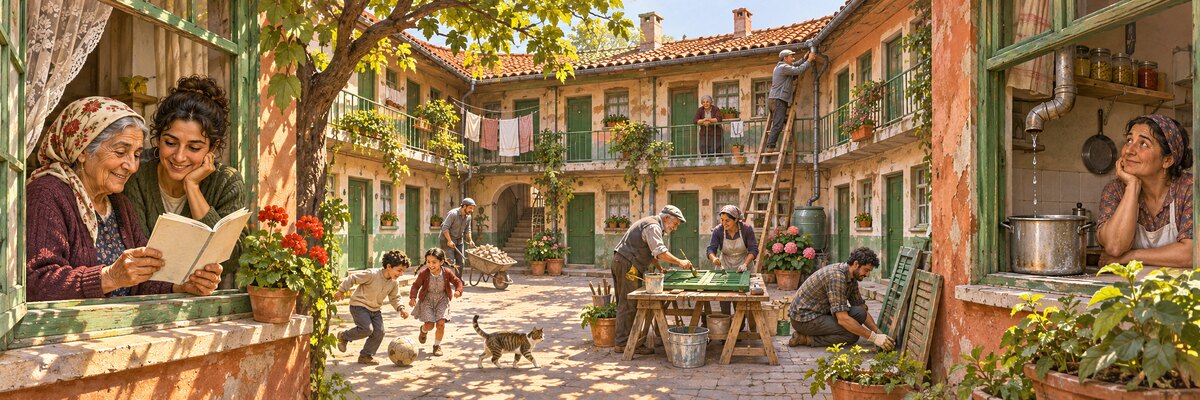
My mother wanted the courtyard named after her while she could still correct the lettering.
“Afterwards they'll put Margaret,” she said. “I've spent seventy-four years getting people to call me Peg.”
She had brought the proposal herself, in the interval between her morning tablets and the ones that made her sleep. The twelve households would vote on Thursday. She expected an awkward silence, then unanimity. I expected much the same.
I was writing about her for the co-operative's fortieth anniversary booklet. I lived in number six now. She had told the story of its foundation so often that I thought the job would be easy. The landlord's men had arrived to clear the building. My mother had stood in the courtyard and refused to move. By evening the residents were standing with her. There was a photograph: her arm raised, her mouth open, everyone behind her.
I had been six. In the photograph I was nowhere.
“Where was I?”
“With Iris. You couldn't keep out of the way.”
Iris still lived in number two. She and my mother exchanged Christmas cards across a distance of eight metres. Sometimes they quarrelled about whose bin had been left outside. I put her name in my notebook and asked my mother what she had shouted.
She gave me a sentence about homes being for people rather than profit. It sounded excellent. I wrote it down.
At home I made three good paragraphs. I had been writing instruction leaflets for a boiler company all week, and it was a pleasure to produce something nobody would need to read under a sink. I sent the draft to my mother. She telephoned immediately.
“Don't say frail.”
“I haven't.”
“You say slight. People will know what you mean.”
I changed it to small. She was satisfied.
On Wednesday I took Iris a copy. She read standing up because she had a cake in the oven. Behind her, something dripped steadily into a saucepan.
“Is that the ceiling?”
“The cupboard. Waste pipe.”
“Have you told anyone?”
“I've told the person who's going to fix it.”
She turned the page. I waited for her to recognise the sentence from the courtyard.
“Very nice,” she said.
“You were there.”
“Yes.”
“Does it sound like her?”
“It sounds like something she'd have liked to say.”
The oven alarm went off. She put the pages on the table and lifted out a cake that had risen on one side. While it cooled, she told me where I had been that day.
She had taken me and four other children to the public baths. They spent the afternoon swimming while the adults waited for the police. At closing time she bought us chips. She had twelve pounds and no idea whether she could bring us home.
“Then your mum came. Said they'd agreed to a meeting. You were furious because she wouldn't buy you an ice cream after the chips.”
I remembered that. The orange wrapper. My mother's hand closing over mine when I tried to pull away.
“Why didn't you stand with them?”
“Someone had to take you lot.”
In my draft the neighbours had gathered when they heard my mother's voice.
“Did she call them down?”
Iris pushed a skewer into the cake. It came out wet.
“We'd arranged it on Sunday. At mine. Your mum wasn't there. She was working.”
Outside, I sat on the courtyard wall and rang my mother.
“Of course we planned it,” she said. “You don't think we just happened to be home?”
“That's how you tell it.”
“It's a better story.”
On Thursday she wore lipstick to the meeting. She had stopped wearing it at home because it came off on the rim of her water glass. I helped her down the stairs. On each landing we paused as though examining something.
The meeting was in the laundry room. I put her chair near the door so she could leave quietly if she needed to. She moved it to the middle.
We dealt with the roof first. Then my mother introduced her proposal. She spoke without mentioning her illness, though the scarf she wore over her hair made that omission almost theatrical.
Iris asked whether we had to name the courtyard after anybody.
“It's been the courtyard for forty years.”
“Places can acquire names,” my mother said.
“People can go on using the old ones.”
Six households voted for Peg's Courtyard. Five voted against. The couple in number nine abstained because, they said, this was uncomfortable. Seven votes were required to change a common area's name. My mother congratulated the chair on conducting the meeting efficiently.
I had voted for her. Iris had voted against. I knew because she kept her hand up while the chair checked the numbers.
Upstairs my mother asked me to take off her shoes.
“Would it have hurt her?”
I loosened the laces. Her ankles were swollen above the socks.
“I don't know.”
“Forty years. I could be somebody who paid the rent and kept to herself.”
“You couldn't.”
She laughed, then began to cough. I waited with a glass of water until she could take it.
“Write the thing,” she said. “Let them call it what they like.”
I brought my laptop the next morning. She was awake, watching a programme about houses neither of us could afford. I read the new beginning. It put Iris at her kitchen table, arranging who would call the others and who would keep the children away.
“You've made me a late arrival.”
“You were.”
“I stood there when the men came.”
“I've kept that.”
“With everybody else.”
“Yes.”
She turned down the television. I read the description of her in the photograph, then the paragraph about the baths. There was no good place for the sentence she had given me, so I had removed it.
“You've taken out the speech.”
“Did you say it?”
“I don't remember.”
We listened to the television at its new volume. A couple stood in a kitchen, smiling at a tap.
“I remember being frightened,” she said. “I thought if I kept talking, they couldn't start.”
“What did you talk about?”
“Their children. Whether they had any. One showed me a picture. I kept asking questions. His mate got annoyed.”
I opened the laptop again.
“That's better,” I said.
“For you.”
I looked at her. She had pulled the blanket up to her waist. There were small red marks where her slippers had pressed against her feet.
“Yes,” I said.
She let me write it down. Then she asked me to go and look at Iris's pipe.
“I'm waiting for someone,” Iris told me through the door.
“I know.”
“You won't know what you're doing.”
“I brought a bigger saucepan.”
She let me in. I emptied the small one and dried the shelf while she moved her tins. The chipboard had swollen around the screws. When the repairer came, we had to break part of the cupboard away to reach the joint.
That afternoon I took my mother a copy of the finished piece. She read it slowly, holding the pages nearer the window. At the sentence about the frightened man showing her his children, she stopped.
“He wasn't frightened. I was.”
I crossed out the word. Below it she wrote his name. She had remembered it while I was downstairs.
“Does Iris get to read it?” she asked.
“Yes.”
“Before they print it?”
“Yes.”
She handed it back. “Tell her I still think she could have voted for me.”


No published comments yet.