
The cardigan came out of the wash small enough for a child I did not know.
It had been blue. It was still blue, which seemed unfair. If it had changed colour I might have argued that it belonged to somebody else. The little pearl buttons were all present, eight of them, and the left cuff still had its loop of loose wool. Everything necessary to identify it had survived.
I put it flat on the table.
“Don't pull it,” said the woman working beside me.
“I wasn't going to.”
“You've got hold of both sleeves.”
I let go.
It should never have gone in with the bedding. That much was mine. A pillowcase had come down with it inside, and I had shaken out the pillowcase without looking. Thirty years in laundries had not made me incapable of this. They had made me exceptionally good at being annoyed when somebody else did it.
The ward assistant arrived at eleven. She asked if we had seen a blue cardigan. A patient had been asking since breakfast.
“Describe blue,” I said.
She looked at me.
I brought it out.
“Oh,” she said. Then, after a moment, “Oh, dear.”
We stood over it. Above our heads a pipe knocked three times, rested, and knocked again.
“Could you take it up?” she asked.
I could have said I was busy. I was busy. There were sheets at my back in a stack that leaned, and my colleague had already moved over to do my folding. But the assistant was nineteen or twenty, the same age my daughter had been when she learnt that a difficult customer could make her cry simply by being disappointed.
“I'll come at lunch.”
The assistant gave me the patient's surname and bed number. I wrote them on a piece of paper and tucked it under the cardigan. Then I tried pulling one sleeve.
At lunch I bought a cheese roll and put it in my locker. On the stairs I rehearsed saying that an item had become mixed with hospital linen. It was a perfectly accurate sentence in which I hardly appeared.
The patient was sitting beside her bed in a nightdress and slippers, studying a supermarket leaflet. She was perhaps my age. Her hair was brushed back so tightly that a pale strip showed along her forehead. A handbag rested on her knees.
I told her who I was.
“Have you found it?”
“Yes.”
“Oh, good.”
I unfolded it. She put the leaflet down.
“I put it through the wrong wash,” I said.
She looked at the cardigan for so long that I began to explain the pillowcase. Halfway through, I stopped. She was still looking.
“My sister's coming,” she said.
“We can arrange a replacement. I've spoken to my supervisor.”
“Today?”
“I don't think today.”
“When, then?”
“I don't know.”
Her sister was due at two. She had not seen her for three years. There had been no quarrel, she told me, before I could arrange one in my head. Her sister lived far away and hated travelling, and now her nephew had driven her down. They were staying only the afternoon.
“I've got a dressing gown,” she said. “I don't want to see her in it.”
I nodded. She rubbed the little sleeve between her finger and thumb.
“Can you fix it?”
“No.”
“Then why have you brought it?”
Because I wanted her to see that I was sorry. Because I had thought she might laugh. Because downstairs, beside the machines, it had seemed possible to make a mistake right by carrying it upstairs yourself.
“I thought you'd want it back.”
She handed it to me.
“Not particularly.”
In my locker I had a navy cardigan. I wore it on the bus and took it off before work. It had large plastic buttons and deep pockets, one of which held a receipt my husband had asked me to keep. He had bought a tap washer and wanted proof that it had cost more than I believed.
I took out the receipt and the wrapped cheese roll, which I had put in the other pocket without remembering. I checked the wool for crumbs.
My colleague watched me shake it.
“Don't give away your clothes.”
“It's a loan.”
“How will you get it back?”
“I work here.”
“You work down here.”
The patient touched the navy sleeve when I offered it, then held it beside her face.
“It's very dark.”
“It is.”
“Have you got a lighter one?”
For a moment I disliked her so thoroughly that I could feel the expression taking hold of my mouth.
“At home,” I said.
She considered this, and I saw her decide not to ask.
“Never mind. Thank you.”
She put it on. The shoulders fitted but the sleeves covered her knuckles. I reached to turn them back. She moved her hand away and did it herself, two neat turns. She fastened the middle buttons and looked down.
“It'll do.”
I said she could leave it with the ward assistant when she had finished. Then I left before offering anything else.
The cheese roll had flattened in its paper. I ate it in the changing room. My colleague came in and sat beside me. She had a container of rice, a fork and ten minutes.
“Did she like it?”
“Not especially.”
She opened the container. “It's not an especially nice cardigan.”
“You could have said that before.”
“You've worn it for six years. When was I supposed to start?”
At half past three I took a trolley upstairs. We did not usually deliver at that hour, but a ward had asked for more pillowcases. I was trying to manoeuvre a stiff wheel past a fire door when the patient came along the corridor with another woman. They walked slowly. The visitor held a paper cup in each hand; the patient carried the supermarket leaflet folded under her arm.
She was wearing my cardigan unbuttoned. Her sister wore a bright yellow jacket, with a brooch shaped like a bunch of cherries.
“That's the lady,” the patient said.
I put my foot against the trolley wheel.
“The cardigan lady?” her sister asked.
“Yes.”
The visitor looked at me, and I waited for her to say something about kindness.
“She's always cold,” she said. “Even as a child. July, middle of the afternoon, she'd want the windows shut.”
“You used to sit on my feet.”
“Because you put them under me.”
They carried on past. I held the fire door until they were through.
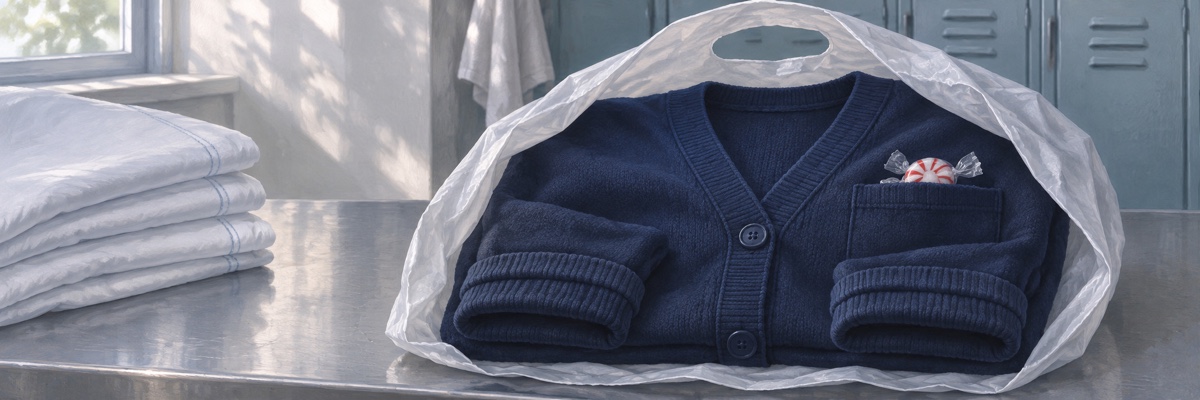
The cardigan came back two days later, folded in a carrier bag. One pocket contained a peppermint in a twisted wrapper.
There was no note. I put the cardigan on for the bus. The cuffs had kept their folds, and I had to work each one down with my thumb before my wrists were covered.


No published comments yet.