
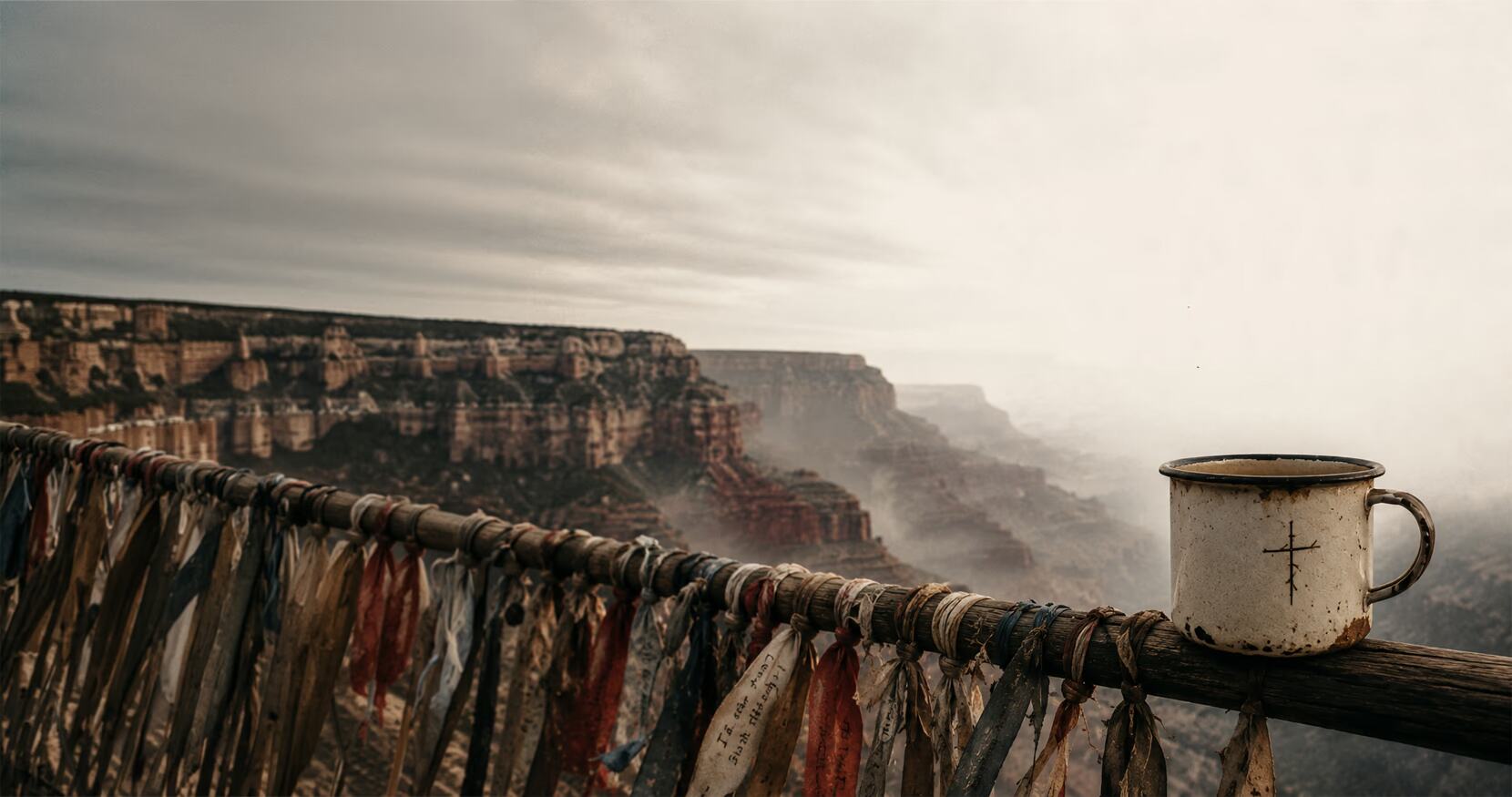
Tessa Quill arrived in Mercy Draw with half a bottle of warm water, two notebooks, and a bus ticket that had expired somewhere east of Amarillo.
The driver let her off beside a sign shaped like a praying hand. Someone had shot three neat holes through the painted knuckles. Beyond it, the canyon opened without ceremony: red shelves of stone, a drop too large for panic, shadows pooled at the bottom like old ink.
LOW WATER STATION — ½ MILE
APOLOGIES AT SUNRISE
NO REFUNDS FOR SILENCE
The bus sighed once and left her in dust.
Tessa stood with her rucksack cutting into one shoulder and watched the road shimmer. She had come west after a job interview collapsed in seven minutes. The editor had read her old pieces, tapped a fingernail on the table, and said, ‘You write beautifully about people you don’t like.’
She had thanked him. She had even smiled. It had been the most embarrassing thing she had done all week.
Low Water Station crouched near the rim like a salvage yard that had learned manners. Six retired school buses had been welded into a horseshoe around a tin-roofed kitchen. Their yellow paint showed in strips beneath murals: bluebonnets, vultures, a saint holding a coffee pot, a woman with a canyon for hair. Enamel mugs hung from nails along the outside wall, hundreds of them, clinking in the wind.
A woman in denim overalls stood under a shade sail, unloading ice from a pickup. She had silver hair cut to her jaw and a face that looked weathered rather than old.
‘You Tessa?’ she called.
‘Depends who’s asking.’
‘Della Boone. You emailed about work-trade.’
Tessa had no memory of emailing anyone. She had sent messages to five hostels in a bus station toilet, thumbs moving faster than hope.
‘Right,’ she said. ‘I can wash pans.’
‘Everybody says that. Half of them leave the egg welded on.’
‘I can wash pans with emotional commitment.’
Della considered her. ‘That’ll do for one night.’
Inside the kitchen, the air smelled of coffee, gas flame and hot dust. A chalkboard menu listed breakfast tacos, black coffee, grapefruit, and THE REGRET PLATE, which came with beans, eggs, toast, and ‘one truth you can live with’.
‘Tourists love a joke until it costs extra,’ Della said, catching Tessa looking.
‘Does it?’
‘Always.’
She handed Tessa a cream enamel mug with a green rim. Its handle had been repaired with copper wire. ‘Scratch your name on the bottom. Hang it on the nail over Bus Three. Drink only from this.’
‘Allergic to sharing?’
‘Worse.’
Tessa turned the mug over. The base was crowded with old scratches, polished down and crossed out. VERA. ELI. A shape like a star. Someone had gouged BLESS THIS MESS into the curve and given up halfway.
‘How many people has this mug had?’
‘Enough to know better.’
Della gave her an awl. Tessa scratched T. QUILL into the enamel. It looked like evidence.
By supper, she knew the hostel’s rhythm. Guests arrived flushed and clever, bought beer from the fridge, took photos of the canyon through their sunglasses. They signed the ledger, chose a bunk, scratched a mug, and asked whether the apologies were real.
Della always gave the same answer.
‘Only if yours is.’
At 20:00, a rim guide named Nix gathered the guests beneath the shade sail. They were 24, maybe 25, with a shaved head, turquoise earrings, and a ranger’s calm without the uniform.
‘House rules,’ Nix said. ‘Drink water. Don’t cross the rail. Don’t yell your apology after dark unless you enjoy being wrong in public. The canyon answers at sunrise, sometimes. It doesn’t do requests, corrections, birthdays, proposals, brand partnerships, or revenge.’
A man in a white hat lifted his phone. ‘Has anybody gone viral here?’
‘Yes,’ Nix said. ‘Mostly from heatstroke.’
The guests laughed. Tessa did too, because it was easier than wanting to.
Later, after she had scrubbed two skillets and a pot of beans, Della showed her the mug wall inside the kitchen. These were not for guests. They hung behind the till, each on its own labelled hook.
MAE BOONE.
C. RUSK.
D. BOONE.
RED MERIDIAN.
UNKNOWN — 2011.
TOWN USE ONLY.
The white mug marked C. RUSK had a blue rim and a crack running from lip to base. Fine wire stitched the crack shut.
‘Souvenirs?’ Tessa asked.
Della shut the cupboard door. ‘Archives.’
‘That sounds like a word people use when they don’t want to say shrine.’
‘Then don’t say shrine.’
That night Tessa slept in Bus Three above a former substitute teacher from Tulsa and beneath a teenage boy who muttered state capitals in his dreams. The bus smelled of vinyl, sun-baked curtains, and the little cedar blocks Della had hung from the luggage racks. Outside, the mugs clicked all night.
Once, near dawn, Tessa woke and heard the canyon answer someone in a woman’s voice.
Not words. Only the shape of a voice travelling up from the dark.
In the morning, her mug was gone.
The wall outside Bus Three had rearranged itself. Not visibly. Not with drama. The nail still held a mug. It simply wasn’t hers.
The mug waiting for her was white enamel with a blue rim, wire-stitched crack, and C. RUSK scratched into the base.
Tessa stood in her socks, hair stuck to her cheek, and knew the sensible action: leave it there, wake Della, stay out of local weirdness.
Instead, she took it to breakfast.
The kitchen had turned brittle. The honeymooners from Lubbock had switched cups. Nix’s tin mug hung from a French backpacker’s nail. The teenage boy held a pink cup that said GLORIA in glitter polish and looked as if it had accused him.
Della came in carrying grapefruit and saw Tessa’s hands.
‘Put that down.’
‘Morning to you too.’
‘Tessa.’
The use of her name was worse than a shout.
The guests went quiet. Even the griddle seemed to lower its voice.
‘Why is everybody looking at the mug like it owes child support?’ Tessa asked.
Della crossed the kitchen. ‘Because it belongs locked up.’
‘Then your lock has opinions.’
Della reached for it.
Tessa had always hated being told not to touch the thing already in her hand. At eight, she had opened her father’s desk drawer because he said never. At 19, she had read the letter marked private. At 31, nearly jobless and almost broke, she lifted Caleb Rusk’s mug and drank.
The coffee tasted wrong. Not bad. Wrong. Tin, chicory, river stone, pennies held under the tongue.
Far beyond the buses, Saint Jude Draw answered.
The voice came out of the canyon clean and close, a man speaking from the next room.
‘Tell her the samples were clean.’
The teenage boy dropped Gloria’s mug. It bounced once on the rubber mat and did not break.
Della took Caleb’s mug from Tessa with two hands.
‘Breakfast is closed,’ she said.
The camera man in the white hat half-raised his phone. Nix plucked it from him and slipped it into their back pocket without looking.
‘Hey.’
‘You can have that back when your face catches up with your manners,’ Nix said.
Della locked Caleb’s mug in the till drawer. Her hands shook once, not enough for anyone kind to mention.
Tessa should have left then. The 10:15 bus came through Mercy Draw every day except Sunday and days when the driver didn’t feel like it. She had enough money to get to Clovis if she skipped lunch. She could still write puff pieces about dental clinics or ghostwrite museum captions for people who liked history without argument.
Instead, she asked Nix, ‘Who’s Caleb Rusk?’
Nix looked towards Della.
Della was scraping eggs into the bin. ‘A man who mistook a canyon for a witness stand.’
That was not an answer. It was bait.
Tessa stayed.
LOW WATER STATION — HOUSE CARD, LAMINATED
- Scratch your name before first use.
- Drink only from your own mug unless instructed by staff.
- At sunrise, carry your mug to the Sorry Rail.
- Speak one apology. Keep it plain.
- If the canyon answers, do not answer back.
- If your mug has moved, alert Della before drinking.
- If you drink anyway, what follows is on you.
The town of Mercy Draw had twelve businesses and 19 ways to sell remorse.
At The Bent Spoon diner, Tessa found apology postcards beside the till. SORRY FROM THE EDGE. FORGIVE ME OR DON’T, I GOT TACOS. A rack of tiny enamel-mug keyrings spun under the air vent. On the wall hung a framed newspaper clipping about Mae Boone, though the print had faded to grey.
Della’s sister. Tessa knew that before she read the caption.
Mae had dark hair, a wide grin, and one hand raised against the sun. Behind her stood the Sorry Rail, strung with ribbons. The photograph had been taken two weeks before she vanished.
Mercy Draw had buried an empty coffin. Tessa remembered that now, and worse, remembered what she had done with it. She had called the detail mythic. She had not asked who had to sit in the front row.
She took a photo of the clipping. Her phone camera struggled with the glare. The screen reflected her own face back at her, pale and irritated, already looking for a sentence.
The waitress, a broad woman with a silver braid, set down coffee without asking.
‘Della know you’re poking?’
‘Is that a service or a warning?’
‘In this town those are cousins.’ The waitress tapped the clipping. ‘You press?’
‘Not currently.’
‘That’s like saying not contagious currently.’
Tessa wrapped both hands round the cup. Ceramic, not enamel. Safe, she hoped.
‘What happened to Mae?’
The waitress looked at the canyon through the diner window. You could see a red sliver of it between the feed store and a closed taxidermist.
‘Mae trusted the wrong man to make the right thing happen.’
‘Caleb Rusk?’
‘You heard that name from Della?’
‘I heard it from a mug.’
The waitress flinched before she could hide it.
‘Then finish your coffee and leave.’
Tessa did not. She ate toast she couldn’t afford and opened her phone.
Years ago, when she still had a staff email and a reason to believe her own cleverness, she had written a piece about Mercy Draw.
She found it in 14 seconds.
The headline still made her stomach tighten, not because it was cruel — though it was — but because it had rhythm.
THE TOWN THAT MONETISED REGRET
Her editor had changed the headline. She remembered using that defence at a party, laughing as if she had been mugged by typography. But the line everyone quoted was hers.
In Mercy Draw, even grief comes with a gift shop.
Tessa had never been to Mercy Draw then. She had written the piece from a motel in El Paso after two phone calls, three local-news clips, and a municipal website with a broken slideshow. The article had done well. Not huge, but well enough to be passed around by people who liked their compassion edged.
Six months later, Red Meridian Hospitality had announced plans for a glass skywalk, a boutique spa, and a bottled-water line called Saint Jude Still. The investor deck had quoted her article twice. Not the cruelest line; the useful ones. The ones that made Mercy Draw look unserious, provincial, ready to be improved by people with capital and better fonts.
Tessa closed the article and stared at her reflection in the dark screen.
The waitress returned with the bill.
‘You remembered?’ she said.
‘Apparently not enough.’
The woman’s face changed by half an inch. Not softer. More accurate.
‘That’s usually how it starts.’
Back at Low Water Station, the afternoon heat pinned the buses in place. Guests slept in bunks or pretended to read under the shade sail. Della fixed a leaking cooler with a spanner and refused Tessa’s help.
Nix sat on the steps of Bus Two, polishing mug hooks with steel wool.
‘Does the canyon always answer?’ Tessa asked.
‘No.’
‘What decides?’
‘Wrong question.’
‘What’s the right one?’
Nix blew metal dust from a hook. ‘What does it cost when it does?’
That was better. Tessa wrote it down.
Nix nodded at the notebook. ‘You always make people into homework?’
‘Only when they’re secretive.’
‘You wrote that article.’
Tessa closed the notebook.
Nix smiled without pleasure. ‘Mercy Draw has four hundred people, one canyon, and internet access. We know what you did for nouns.’
‘It was a bad piece.’
‘It was a good piece. That was the problem.’
Della came out with a cardboard box and shoved it into Tessa’s arms. ‘Bus Four. Clean sheets. Don’t open anything that doesn’t open easy.’
In Bus Four, Tessa found Dr Caleb Rusk’s first note behind a panel that opened very easy.
It had been folded into a square and wedged above the wheel arch. The paper smelled of dust and old adhesive.
The mugs do not match names.
They match avoidance.
The canyon gives the wrong mouth to the right guilt.Della contains. Mae believed. I measured.
None of these are the same as telling the truth.
On the back, in a different pressure:
If C.R. cup moves again, follow the old water line.
Do not let D.B. speak first.
Tessa sat on the lower bunk until the bus heat soaked through her jeans.
Outside, someone laughed too loudly. A mug clicked on its nail. The canyon waited in the light, all red distance and no mercy at all.
At sunset, the guests gathered for the practice apology.
Della hated the term, but Nix used it because tourists liked rehearsals. They stood in a loose line at the Sorry Rail, each holding their own mug. No one drank. Not yet. The ritual belonged to sunrise. Evening was for learning where to stand and how not to perform.
The canyon took up half the sky. Ribbons snapped against the rail. Luggage tags fluttered: DAD, I SOLD THE GUITAR. MARIA, I READ THE EMAIL. KEVIN, THE DOG DIDN’T RUN.
A retired teacher named Gloria stepped forward with her pink mug held against her chest. She had a soft voice and a posture that made apology look like a subject she had taught for years.
‘I am sorry,’ she said, ‘that I told your mother before you could.’
The canyon took the sentence and did nothing with it. Wind moved the ribbons. A vulture crossed the far wall.
Gloria bowed her head as if the silence had still found a place to land.
‘Good,’ Della said. ‘Now say it tomorrow when it can hurt you properly.’
A honeymooner tried next. His apology was about leaving a bachelor party early.
‘It knows filler,’ Della said before he reached the second sentence.
A man in hiking sandals apologised to ‘anyone I may have hurt’. Nix stopped him with one raised finger.
‘Don’t outsource precision,’ they said.
Tessa watched the rail, the mugs, the mouths opening and closing. The place looked ridiculous. It looked sacred. It looked like court with no judge and no verdict until morning.
When the line ended, Della held out Tessa’s cream mug.
‘Take your own cup tomorrow.’
‘And if I take Caleb’s?’
‘Then you’re not as smart as your sentences.’
That landed. Tessa let it.
‘Is he dead?’ she asked.
Della looked past her to the canyon wall, where the last sun lit a stripe of stone like a match.
‘Caleb Rusk is a consequence,’ she said. ‘Those are harder to bury.’
That night, Tessa waited until the generator dropped into its second, rougher rhythm. Then she took the torch from above the sink, Caleb’s note from her notebook, and a water bottle from the staff shelf.
The old water line began behind a gate marked COUNTY ACCESS. The padlock hung open, a little piece of theatre no one had bothered to update.
The trail dropped in switchbacks cut into red stone. In daylight it would have been dangerous. At night it felt personal. The torch beam caught scrub, cable, the chalky white of old pipe. Tessa moved slowly, one hand on the rock. Twice she thought of turning back. Twice she heard Della in her head — stay off the trail — and found that warning had become a rope pulling her down.
At the bottom, a lamp burned in a survey cabin on concrete blocks.
A man stepped out holding a flare gun.
‘That won’t help unless I’m a boat,’ Tessa said.
The man lowered it. ‘Della sent you?’
‘Della told me not to come.’
‘That sounds like Della.’
Dr Caleb Rusk was thinner than his missing-person photo and less haunted than Tessa wanted him to be. His beard grew in grey at the chin. His shirt had been washed badly in mineral water. His eyes were bright, assessing, alive with the horrible comfort of a man who had been right often enough to mistake it for goodness.
Inside, the cabin walls were pinned with maps, sample charts, old permits, tourist postcards, and mug tags. Dozens of them. Some were enamel bases cut out with tin snips. Some were cardboard circles. Some were plastic key fobs from motel rooms long gone.
Tessa saw names she recognised.
MAE.
DELLA.
C. RUSK.
RED MERIDIAN.
A blank strip of masking tape had been stuck below them, its edge lifting in the heat.
‘That one’s waiting,’ Caleb said, following her gaze.
‘For who?’
‘Whoever Della sends down next.’
Tessa looked at the blank tape until it felt worse than a name.
She took out his note. ‘You left this.’
‘I left many things. Della kept tidying.’
‘The mug said the samples were clean.’
His mouth tightened.
He opened a metal box and took out a field report. Red Meridian Hospitality. Saint Jude Draw Aquifer and Rim Stability. Caleb Rusk, PhD.
‘The water was clean,’ he said. ‘The rock would hold with reinforcement. That was the measurement.’
‘But not the truth people needed.’
He rubbed his face with both hands. For the first time, he looked merely tired.
‘I bought the town time.’
‘You falsified it.’
‘Yes,’ he said, and hated her for making the word so small.
Wind pressed at the cabin walls. Something loose ticked outside.
‘Mae Boone wanted proof Red Meridian had bribed the county,’ Caleb said. ‘Della wanted the hostel left alone. I wanted the canyon protected. Everybody had a clean reason and dirty hands.’
‘And the mugs?’
He looked at the wall of names. ‘Mae believed they could expose the land agent. Make him confess. The canyon wouldn’t answer him directly; men like Boyd Pelham apologise in paragraphs. So I tried a transfer.’
‘You made someone else drink from his mug.’
‘Mae volunteered.’
The room felt suddenly smaller.
‘Della says Mae died.’
‘Della says a great many things in the service of remaining useful.’
‘Is Mae alive?’
Caleb picked up a mug tag with Mae’s name on it and set it down again.
‘Mae walked away from the rail and did not come back.’
That answer had too much room in it.
Tessa left before dawn with a copy of the report, Caleb’s second notebook, and no permission. He watched from the cabin door as she climbed.
‘You’re going to write it,’ he called.
She kept moving.
‘Good,’ he said. ‘Just don’t make her innocent because she feeds people.’
At the top, Della waited beside the open gate.
She did not ask if Tessa had seen him.
‘You stole my torch,’ she said.
‘I brought it back.’
‘That fixes almost nothing.’
Tessa handed her the report. Della did not take it.
‘He says Mae volunteered.’
Della’s jaw shifted.
‘He says you contain the ritual.’
‘That one’s true.’
‘He says you lie.’
‘That one depends who slept.’
The sun had not cleared the canyon yet. The mugs along the wall were dark shapes, waiting for names.
‘What happened to Mae?’ Tessa asked.
Della took the torch, checked it for damage, and placed it on the kitchen shelf.
‘Mae thought people could be shamed into decency. Caleb thought truth was a knife only he was educated enough to hold. I thought if I kept coffee hot and rules posted, nobody else would get hurt.’
‘That’s not what happened.’
‘No.’
The first guests stirred. Gloria came out in a cardigan, pink mug in both hands. The teenage boy followed her, hair flattened on one side.
Della opened the locked till drawer and removed Caleb’s white mug. Then she opened the cupboard behind the till and took down three more.
D. BOONE.
MAE BOONE.
RED MERIDIAN.
‘Sunrise,’ she said.
The Sorry Rail filled slowly. No one spoke much. Even the tourists could feel the morning had stepped out of entertainment and into debt.
Nix arrived last, carrying a coil of faded survey tape. Caleb came behind them.
The guests turned. Della did not.
Caleb had climbed up in daylight and looked worse for it: older, dust-white, his mouth set in the line of someone prepared for applause or arrest.
‘Della,’ he said.
She placed the mugs on the rail.
‘No speeches,’ she said. ‘The canyon hates competition.’
Tessa almost smiled. Almost.
Della gave Tessa her cream mug. ‘Your own first.’
The command felt fair. Worse, it felt earned.
Tessa stepped to the rail.
Below, Saint Jude Draw opened into colour: red stone, blue shadow, scrub holding to ledges by stubborn roots. The drop did not pull her. It did not need to.
She drank from her own mug.
The coffee had gone cold. It tasted like last chances always did in films and nothing like them in life: bitter, ordinary, slightly burnt.
The canyon answered in Tessa’s article voice, crisp and clever and pleased with itself.
‘In Mercy Draw, even grief comes with a gift shop.’
The line crossed the canyon and returned thinner.
Tessa felt every face behind her, but the worst witness was herself from eight years ago, typing fast, making pain portable.
She turned to Della.
‘I’m sorry,’ she said.
Della’s expression did not change. ‘That’s yours. Don’t hand it to me like a tip.’
The words went in clean.
Caleb made a small sound. Approval, perhaps. Tessa disliked it enough to save her.
She picked up Caleb’s white mug.
Della reached for her wrist. ‘Don’t.’
‘Is this instruction or containment?’
‘Both.’
Caleb stepped forward. ‘Let her.’
‘Of course you’d say that,’ Nix said.
The rim held them in a hard little circle: Tessa with Caleb’s mug, Della with her hand half-raised, Caleb watching as if the world had finally arranged itself into experiment.
Tessa drank.
For a second, nothing happened. The wind lifted ribbons. A raven moved along the far wall, black against red.
Then Mae Boone’s voice came up from the canyon.
It was warm. It was tired. It was not ghostly. That was the worst of it. It sounded like a woman calling from another room while folding laundry.
‘Caleb, honey,’ Mae said, ‘truth ain’t clean because you made somebody else bleed saying it.’
Caleb’s face emptied.
Della sat down in the dust as if a string had been cut. Nix crouched beside her but did not touch.
The guests held still.
Tessa set Caleb’s mug on the rail.
‘You used her,’ she said.
Caleb swallowed. ‘She volunteered.’
Della looked up then. Her voice was hoarse but steady. ‘No. I did.’
The second silence was stranger than the first.
Della pushed herself to her feet and took the mug marked MAE BOONE.
‘Mae didn’t drink from Boyd Pelham’s cup,’ she said. ‘I switched it.’
Caleb stared at her.
Della’s smile was small and without mercy. ‘You never knew that part. You were too busy being the man with a theory.’
Tessa’s hands went cold.
‘Switched it with whose?’ she asked, though she already knew.
Della held up her own mug.
D. BOONE.
The name looked fresh, cut deep.
‘Mine,’ Della said. ‘Mae carried my apology to the rail. Not Boyd’s. Not Caleb’s. Mine.’
No one asked what the apology was. The canyon would.
Della drank from Mae’s mug first.
The answer came in Della’s own voice, younger by years and sharpened by envy.
‘I switched the cups because everybody loved your courage and I was tired of being the careful one.’
Della closed her eyes.
The echo threw the words back until they lost grammar and became sound.
Caleb whispered, ‘You let me believe—’
Della opened her eyes. ‘I let you live with half the truth. You liked it there.’
Then she drank from her own mug.
Nothing happened.
The canyon did not answer. The silence stood up.
Della looked confused for the first time since Tessa had arrived. She drank again.
Nothing.
Nix rose slowly. ‘Della.’
Della turned the mug over. The base still read D. BOONE. No new scratches. No fading. No mercy trick. Just her name, hard and ordinary, held in both hands.
‘It won’t take it,’ Della said.
Nobody corrected her.
A gust lifted dust along the rail. The canyon had answered lies, evasions, filler and borrowed guilt. Now it gave Della something worse than speech: timing she could not control.
Caleb sat on the ground, all experiment gone out of him. The guests looked away one by one, as if privacy had arrived late and embarrassed.
Tessa took Della’s mug and set it back on the rail.
‘Maybe it already did,’ she said.
Della shook her head.
‘No,’ Tessa said. ‘I don’t mean forgave you.’
The story took three days to begin.
Not the published piece. That would take lawyers, calls, records, verification, a decision about what to name and what to leave as wound. Tessa began with the correction.
She wrote it at the kitchen table beneath a light full of moths, while Della cooked beans and Nix cleaned mugs with vinegar. Caleb slept in Bus Six with the door open, because nobody trusted him and nobody had decided what mercy cost.
Tessa wrote:
I came to Mercy Draw too late and wrote about it too early.
I treated local grief as evidence for a clever conclusion.
This correction does not repair what that article made easier for others to take.
It only stops pretending I was not there.
She sent it to the magazine. Then she printed a copy on Della’s old receipt printer because the hostel’s actual printer had died in 2019 and nobody had forgiven it.
The paper curled as it came out.
Della read it once.
‘Needs less poetry,’ she said.
‘It has no poetry.’
‘Exactly. You’re straining.’
Tessa cut three adjectives. Della nodded.
On the fourth morning, the bus to Amarillo arrived 20 minutes late. Tessa stood by the road with her rucksack, watching dust gather around its tyres.
Low Water Station looked smaller from the sign. The buses, the shade sail, the mug wall, the little shop of apology postcards. Behind it all, Saint Jude Draw kept its own counsel.
Nix came out carrying Tessa’s cream mug.
‘You forgot this.’
‘I left it.’
‘That’s different where you’re from?’
Tessa took it. The base still read T. QUILL, but beneath the letters, faint as an old bruise, another name had begun to show through.
D. BOONE.
Not replacing hers. Not clearing it. Only there, under the surface, where someone had scratched and crossed and scratched again.
Tessa ran her thumb across both names.
‘Does it ever stop?’ she asked.
Nix looked at the canyon.
‘Wrong question.’
Tessa smiled then, unwillingly.
‘What’s the right one?’
Nix handed her a strip of faded survey tape.
‘What are you carrying on purpose?’
The bus driver honked. Tessa tied the tape around the mug handle, climbed aboard, and took a seat by the window.
As the bus pulled away, the mugs at Low Water Station clicked in the morning wind: not applause, not warning, just enamel touching enamel.
The canyon slid out of sight without saying another word.

No published comments yet.