
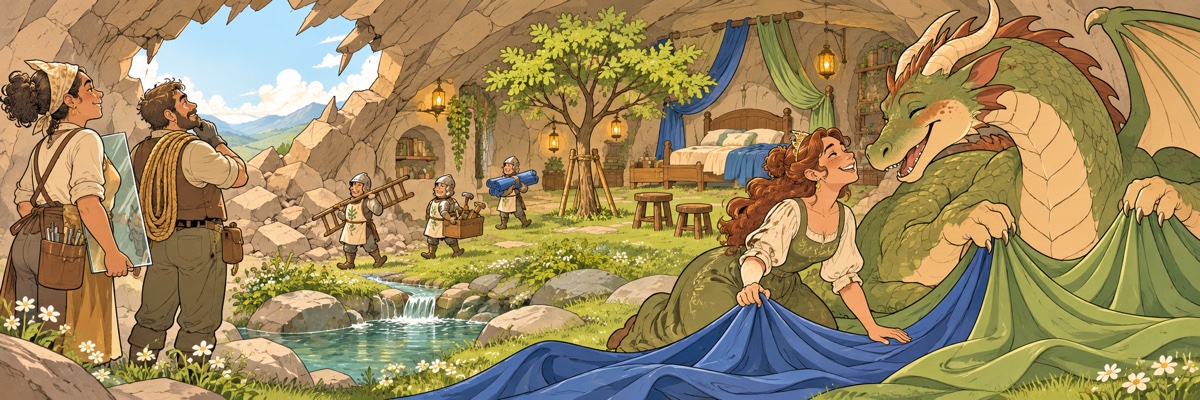
The princess had been promised to the man who killed the dragon, which was awkward because she had already put a deposit on the dragon's cave.
It faced south. There was a spring, a level floor and enough land for an orchard. The palace, by contrast, had seventeen staircases and not one window through which her father could be thrown without landing on a visiting dignitary.
She went up with the remaining money in a flour sack.
“I hope you haven't spent the deposit,” she said.
The dragon raised her head from a book the size of a mattress. “I bought curtains.”
“You haven't got windows.”
“I know. It was rash.”
They sat beside the spring. The princess explained the royal proclamation. The dragon explained that she had been a woman until a magician, displeased by her refusal to marry him, had given her scales, wings and an appetite for oxen.
“Did you eat him?”
“He was standing very close.”
The princess considered this. She had turned thirty the previous winter, an event her father continued to describe as an emergency. A woman who dealt promptly with a difficult suitor appealed to her.
“How do you change back?”
“There will be something. A task. A kiss. They generally put a fault in the spell so they can come back later and be thanked.”
“Where is the spell?”
The dragon looked towards a small scorched heap under a chair.
“Oh.”
“I was cross.”
That afternoon the first knight arrived. His armour shone, his pennant snapped and his horse stopped firmly at the smell of dragon. He descended on foot and announced his intention to save the princess.
“Carry that end,” she said.
Together they moved the bed she had ordered from the village carpenter into the cave. The knight was rather good at carrying furniture, and she gave him two coins and the address of a widow who needed a wardrobe taken upstairs. He seemed relieved.
The next knight wanted proof that the princess was not bewitched.
“Ask me a question only I could answer.”
He thought for some time. They had never met. At last he asked whether she preferred a man with a beard.
“No,” she said, which was both an answer and insufficiently specific to help him.
By the end of the week, the cave contained three beds, a wardrobe and a selection of stools. Men who had come to kill the dragon were returning to ask whether there was more work. The princess had not foreseen the cost of feeding them.
“We could charge a toll,” she suggested. “For the mountain road.”
“That's how my trouble started. I stood in the road asking whether anyone knew a decent glazier. Someone screamed. By evening I had demanded three virgins and half the harvest.”
The princess laughed so hard that the dragon leaned forward to see whether she was choking. Her breath lifted the princess's hair. The princess, abruptly serious, put her palm against the softer scales beneath the jaw.
“May I?” she asked.
“Which part?”
“I'm not certain yet.”
They kissed as well as their mouths permitted. Nothing happened to the dragon except that she closed her eyes.
The princess did not say she was sorry. She was not.
Her father arrived on Sunday in a carriage drawn by six horses, followed by a smaller carriage containing the man who had written the proclamation. The writer stayed inside. He knew what kings were like when a sentence became inconvenient.
“This cannot continue,” the king told his daughter.
“We need a bigger kitchen,” she agreed.
“I am talking about your future.”
The dragon emerged carrying a tree. She had pulled it up to enlarge the kitchen and was deciding where to put it. The king's horses ended the visit by galloping downhill with both carriages.
Afterwards the princess was quiet. The dragon planted the tree by the spring, tamping the earth with a claw.
“You could go back,” she said.
“Do you want me to?”
“No. But I liked living alone. I might sometimes be unpleasant.”
“I am often unpleasant.”
“I've noticed.”
Their first argument concerned the curtains. The princess thought it wasteful to cut holes in a mountain for something purchased by mistake. The dragon said they were excellent curtains and that she had lived in darkness long enough. She struck the wall with her tail, bringing down a portion of roof and exposing a view of the whole valley.
They spent the night under the bed while rain fell through their new window.
In the morning the princess went down to the village. The dragon watched her go, then began to gather the pieces of stone. By noon the princess returned with two of the knights, a glazier and a woman who knew about roofs.
“You came back,” the dragon said.
“Yes. The blue ones or the green?”
The dragon spread both sets of curtains on the grass. They considered them until the glazier, who charged by the hour, coughed.


No published comments yet.