
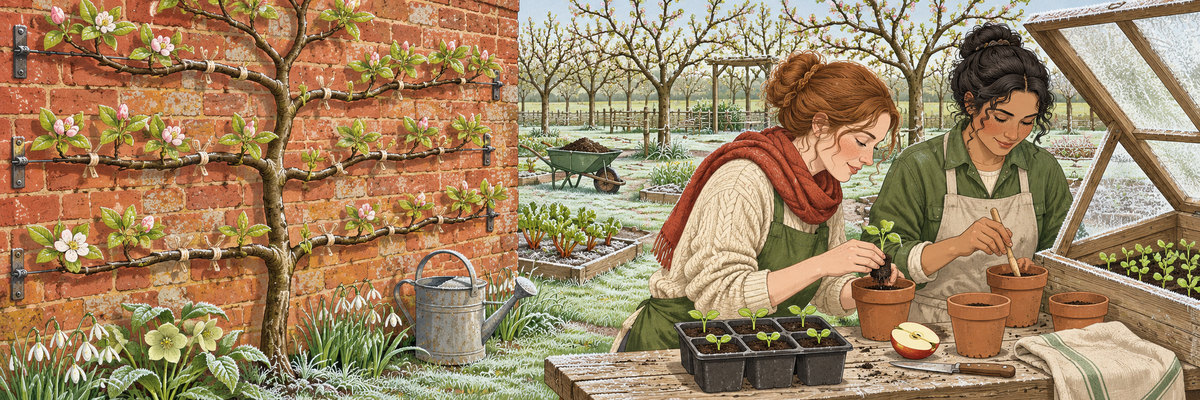
The city orchard grew its fruit on espaliered branches along a south-facing wall. In summer the wall stored warmth; in winter, the old brick sheltered the roots. The orchard was planted to feed the public kitchen, but its trees had also become a place where people met without needing to buy anything.
Mpho managed the grafting beds. Most of the trees carried named varieties, each descended from a cutting someone had brought from a different climate. The labels recorded the fruit's origin. They did not record who had taught whom to prune it, or why one branch was always left to grow wild.
In the third year, a late frost killed half the blossoms and blackened several new shoots. The kitchen still had enough apples for the school holiday programme, but Mpho wanted to prune the damaged shoots and graft known varieties onto the existing trees. That would preserve the fruit the kitchen already knew, though it could not restore this year's lost blossoms or guarantee next season's yield.
"Grafts keep the varieties we know," Laila said. "Seedlings give us a chance of fruit neither of us would choose from a catalogue."
Laila proposed planting seedlings instead: slower and less predictable, each one free to differ from its parent. They could preserve variation for a future no one could describe. Mpho wanted to protect the fruit the kitchen had promised. Neither proposal was foolish. The grant that paid their wages required a measured yield by summer.
They chose six trees for the grafts and set aside six trays, one seed from each of the sharp apples. The school group helped press fallen apples into juice. Some tasted sharp, others almost floral; one made the children screw up their faces and ask for water. Laila saved its seeds anyway.
At the next grant meeting, the coordinator asked Mpho for a single projected yield. She gave last year's number and described the frost. When he asked which trees would meet the target, she showed him the split planting plan. He tapped the six seedling trays on the page. “Those don't count yet.” Laila began to answer, but Mpho raised a hand. The grant paid for their work; she would not risk it to win an argument. They agreed to report the grafts as the measured crop and the seedlings as a trial, with the next review after two summers.
The school returned for the late fruit. One child wanted the same sharp apple again, though she had disliked it the first time. She bit through the peel and offered half to Laila. “It tastes like the middle,” she said. Laila asked what that meant. The child shrugged and ran to catch the others. Neither woman wrote the phrase on the planting map.
By the first spring, the grafted branches had leafed out. None of the seeds had germinated. Mpho refused to call either result a success. She asked the kitchen to keep the tart juice for a sauce and took the six trays to a shaded cold frame at her home, where she could water them through the dry weeks.
The following spring, Laila came to Mpho's home to help move the seedlings into pots. She wrote the planting dates on them but no names. When the first seedling opened its leaves, she called Mpho outside to look.
They did not know what fruit it would make. For once, the grant form had no box asking them to guess.


No published comments yet.