
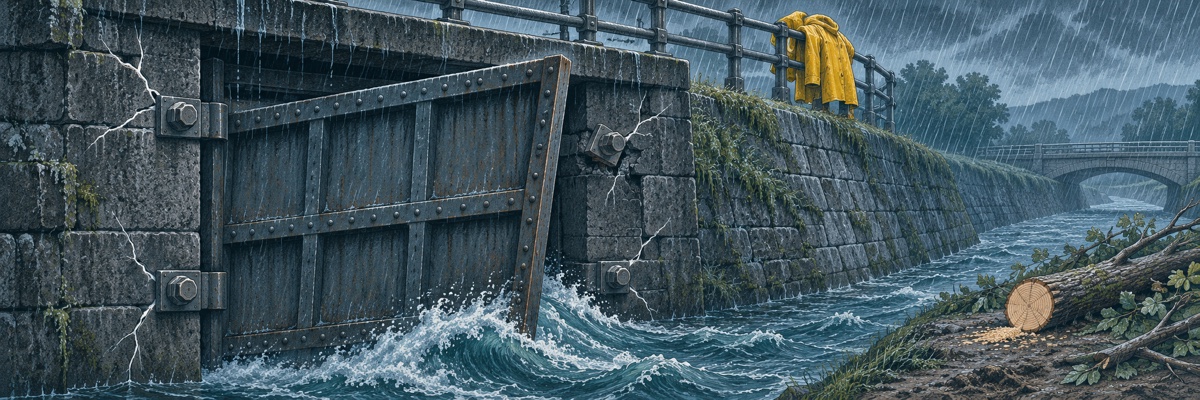
When the first crack appeared in the wall, Iva was standing at her sink, washing a plate. The plate split in her hands. One half fell into the water; the other remained between her fingers, its edge sharp and white.
She had been thinking about the letter from the Works Department. It had arrived that morning, informing her that the payment for keeping calm would end at the close of the month. The wall had settled, the letter said. Her services were no longer required.
She put the broken plate on a towel and went to the window. Across the street the flood barrier rose above the roofs, a smooth grey curve against the darkening sky. A thin white line ran down it from the top. As she watched, a bird landed beside the line. Dust fell from the stone, and the bird flew away.
Iva fetched her coat. In the hall she met her daughter coming up the stairs with a bag of groceries.
“There's a crack,” Iva said.
“I know. Everyone's outside.”
They went down together. In the street, neighbours stood in small groups, looking up at the wall. A man from the Works Department had placed cones around the base and was talking into a radio. He told people to go home. When Iva approached him, he recognised her and lowered the radio.
“It's superficial,” he said.
“The stone is moving.”
“The engineers are on their way.”
She touched the wall. It was cold and faintly damp. The crack continued below the level of the street, disappearing behind a drain cover. She could feel a tremor through her fingertips, slow and regular, as if something heavy were pressing against the other side.
“How high is the water?” she asked.
“I don't have that information.”
“You have a radio.”
He lifted it again and turned away. Iva took her hand from the stone. Her daughter, Mera, had gone to speak to the woman who ran the corner shop. The shopkeeper was pulling boxes off a low shelf and passing them to two boys, who carried them upstairs.
Iva had helped build the wall twenty years earlier. She had been paid by the day to break the stone taken from the quarry, shaping it into blocks small enough for the masons to lift. The foreman had learned that her temper could do the work of a hammer. When she was angry, stone fractured along the lines she traced with her fingers. When she was frightened, it sometimes broke without her touching it.
The Works Department had offered her a contract after the wall was finished. She was to stay away from it and take a monthly payment in return. The contract had seemed generous at the time. Mera was small, and Iva needed money for rent. Later, when the payment became a condition for her flat as well, she had tried to argue. The official had shown her a clause she had signed. She had left his office with a headache and found a crack in the paving outside.
Mera returned with the shopkeeper. Her name was Tali, and she had lived on the street longer than either of them.
“The lower gate is jammed,” Tali said. “My brother works there. He rang from the station.”
“What gate?” Iva asked.
“The one that sends water into the old channel. They opened it during the last storm.”
“There wasn't enough water then to reach the houses.”
“There is now.” Tali pointed uphill. A Works van was coming down the road, its lights flashing. “He says the gate won't lift. If the wall holds, the water keeps rising. If it doesn't, it comes through here.”
The van stopped beside the cones. Two engineers got out, carrying cases. Iva recognised one of them: a woman named Sela, who had inspected the wall after the previous storm. Sela listened to the man with the radio, then looked at the crack. She ran a metal rule along it and wrote something on a pad.
Iva told her what Tali had said about the gate.
“I know,” Sela said. “We've sent a crew.”
“Can they open it?”
“They're trying.”
Iva waited while Sela measured the width of the crack at three points. The other engineer set up a light. It cast the wall in a harsh white band and made the line look deeper.
“Tell us what happens if they can't,” Iva said.
Sela lowered the rule. “We evacuate this street and the next four. The wall may hold, but we can't rely on it.”
“Where do we go?” Tali asked.
“The school on the hill is open. Buses are coming.”
Tali looked towards her shop. “My mother can't climb onto a bus without help.”
“I'll send someone.”
“You said that last time.”
Sela met her eyes. “I'll go with you myself.”
They went into the shop together. Mera followed to carry Tali's mother's medicines. Iva stayed by the wall. The man with the radio had begun knocking on doors, asking residents to gather at the corner. He looked frightened now. She helped him move the cones so that the buses could turn.
An hour later the street was almost empty. Tali's mother had gone in a van with two other residents who needed help. Mera had put the medicine bag beside her and written the name of the school on a piece of paper in case they were separated. The buses had taken the remaining families up the hill. Iva had sent Mera with the last one, despite her protests.
“You can be angry with me tomorrow,” Iva had said.
“I'm angry now.”
“Good. Get on.”
Mera had climbed aboard, but Iva could see her through the window, talking to the driver and pointing back towards the wall. The bus pulled away before Iva could go after her.
Sela returned from the gate with mud on her trousers. “The lifting gear is broken,” she said. “The crew can't replace it in time.”
“Can you cut the gate free?”
“Not from this side. The water's against it.”
Iva looked at the crack. It had widened enough for her to fit the tip of a finger into it. “Could I break around it?”
Sela shook her head. “That might bring the whole section down.”
“Show me.”
They walked along the base of the wall to the gatehouse. The old channel ran away from it through a strip of empty land, then curved towards the river. There were houses beyond the channel, but they stood above a high bank. Sela pointed out the gate's stone frame and the bolts holding the lifting gear.
“If we remove the bolts, the pressure may push it open,” she said. “But we can't reach the lower ones.”
“Can we break the stone around them?”
“Maybe. If the frame fails evenly.”
Iva put her palm against the frame. It was a different stone from the wall, darker and rougher. She could feel the bolts as small interruptions inside it. She had never tried to break a shape so precisely under pressure.
Sela unfolded a plan on the bonnet of the van. She marked four points where the frame could be weakened without cutting into the wall itself. “If the gate moves, get clear of the channel,” she said. “Don't wait to see whether it opens all the way.”
“Where will the water go?”
“Into the river, if the channel is clear.”
“Have you checked?”
“The crew walked it this afternoon.”
A voice behind them said, “There's a tree across it.”
Mera stood beside the van, her hair wet. Tali was with her. They had returned on foot from the school, following the channel. Mera held up her phone. On the screen was a photograph of a fallen tree lying across the watercourse, branches caught against the banks.
“The crew missed it,” Sela said.
“It fell after they went through,” Tali said. “We heard it.”
Sela called the crew on her radio. Two workers were still at the far end of the channel with cutting equipment. She gave them the location and asked them to clear the tree. One replied that they would do what they could, but the ground was becoming unstable.
Mera stood with her arms folded. “You can't make me get on another bus.”
“I can try,” Iva said.
“You need someone to tell you if the wall moves.”
Sela gave Mera a yellow coat from the van and placed her on the bank above the gate, where she could see the crack and the channel. Tali took the radio and went to the other side. Iva stayed at the frame with Sela. They waited for the crew's call.
While they waited, Iva thought about the letter on her kitchen table. She had accepted the payment because she needed it. Over the years she had let officials tell her what her anger might do, until she had begun to avoid arguments, difficult conversations and even the news. She had said little when the rent rose. She had said little when Mera's school closed. Each time, she had checked the walls of their flat for cracks.
She was angry now, and frightened. The stone beneath her hand remained whole. She pressed her fingers to the first mark Sela had made and thought of the men who had signed the letter saying the wall had settled. She thought of Tali's mother being carried down the stairs, apologising to everyone who helped her. A fine line appeared under her fingertips.
“That's it,” Sela said. “Stop there.”
Iva moved to the second point. The line deepened. A small chip fell at her feet.
The radio crackled. The crew had cut through the trunk and pulled the larger branches clear. Water could pass, though smaller debris remained. Sela thanked them and told them to get to high ground.
Mera called from the bank. “The crack's moving.”
Iva looked up. The white line in the wall had opened into a dark slit. Water beaded along it and ran down the stone. She went to the third mark. The frame resisted; her fingers slipped on the wet surface. She felt the familiar impulse to swallow her anger and make herself small enough to be safe. Instead she put both hands on the stone.
The fracture ran from her left palm to her right. A bolt shifted inside the frame with a sound like a spoon striking a glass. Sela stepped back.
“One more,” she said.
At the fourth mark Iva could no longer separate anger from fear. She thought of Mera standing on the bank and the houses below them, the kitchens and beds and photographs left behind. She pushed. The stone split around the bolt.
The gate moved. At first it shifted only a finger's width. Water burst through the gap, striking the far bank. Sela pulled Iva away. They climbed the path as the gate swung outward, dragging part of its frame with it. A wave ran down the channel, carrying branches and dark water towards the river.
On the bank Mera grabbed her mother's hand. Tali stood beside the radio, listening to the crew report that the water had reached them. The gate continued to open until it rested against the side of the channel. Behind it the level fell slowly, leaving a wet line on the stone.
The crack in the wall stopped widening. Sela watched it for several minutes before telling them to move farther uphill. They walked together to the school. In the hall, families sat on folded blankets while volunteers handed out tea. Tali found her mother near the stage, asleep in a chair with the medicine bag at her feet.
At dawn the rain stopped. The Works Department announced that the wall had held and that residents would be allowed home after an inspection. Sela came into the hall with a list of streets. She told Iva that the gate would need a new frame and the wall a full survey. She also said the department wanted to speak to her about the damage.
“Tell them to speak to me too,” Mera said.
“And me,” said Tali.
Sela looked at the three of them. “I will.”
When they returned to the street, Iva's flat was dry. The broken plate still lay on the towel beside the sink. She picked up the larger piece and held it against the smaller one. They fitted, but a thin line remained between them.
Mera came in carrying the grocery bag she had left at the shop. The bread was flattened; the apples had rolled loose. She put them on the table and opened the curtains. Outside, workers were setting up barriers around the crack. Neighbours stood nearby, asking when the inspection would begin and who would receive its findings.
Iva placed the pieces of plate in a box. Then she took the letter from the table and went downstairs with Mera. Tali was already outside, speaking to a woman with a clipboard. Iva joined them and waited until the woman looked up.
“We have questions about the wall,” she said.



No published comments yet.