
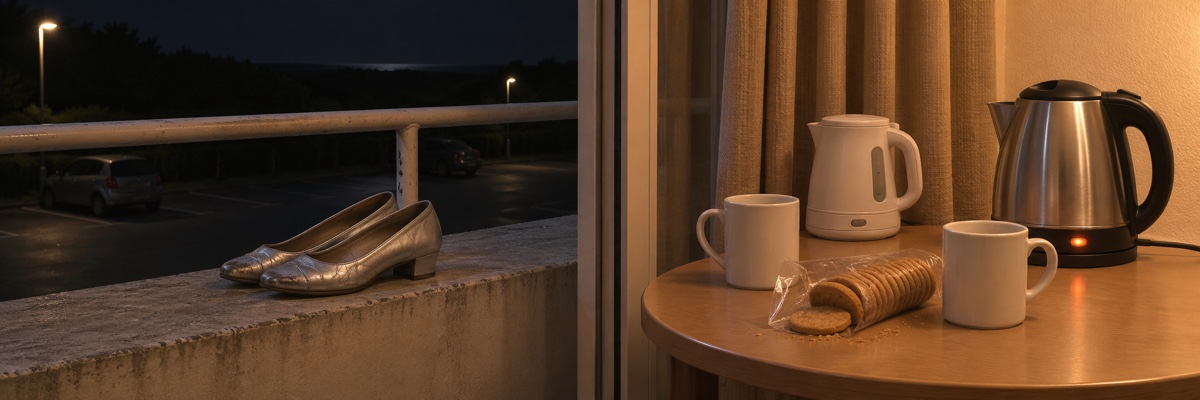
Her sister had written, Bring the silver shoes, which should have warned Celia that an apology was not the main purpose of the weekend.
She brought them anyway. They had been wrapped in a supermarket bag at the back of her wardrobe for six years. The heels were lower than she remembered. Everything about dancing in those days seemed high until she examined the evidence.
At the hotel, Vivienne was arguing with the receptionist about a room that faced the car park.
“You said sea view.”
“You can see the sea from the balcony.”
“By leaning.”
Celia set down her case. Vivienne turned and kissed the air beside her cheek.
“You look well.”
“So do you.”
This was not true. Vivienne looked tired and expensive, as though maintaining her face had become a night shift.
Their last conversation had concerned the sale of their mother's flat. There had been a buyer, a delay, a telephone call Celia did not return. Afterwards each sister told the story with a different event at its centre. Neither version had room for the other one.
In the room they unpacked around each other. Vivienne had brought a travel kettle, though the room already had one. Celia had brought biscuits, though she did not know whether her sister still ate sugar.
“We should go down at seven,” Vivienne said.
“All right.”
“I've entered us.”
“For what?”
Vivienne held up the hotel programme. Saturday evening, ballroom competition, open pairs. First prize: a weekend for two including breakfast.
“You haven't danced with me since—”
“You'll remember.”
Celia sat on the bed. Through the open balcony door she could hear a child repeatedly being told to get away from someone's car.
“Is that why you asked me?”
“I thought we'd enjoy it.”
“You need somebody who can follow.”
“I can follow.”
“You never have.”
Vivienne folded the programme carefully and put it beside the kettle. She had learnt to lead at school because she was tall; Celia had learnt to follow because Vivienne had needed someone in the kitchen. They had practised while their mother cooked, avoiding the oven when its door came down. Celia could still feel the tile with the raised corner beneath the ball of her foot.
At dinner they ate fish in a bright dining room. Vivienne asked about work. Celia asked about the roof repair. They both concentrated on the bones.
“We don't have to enter,” Vivienne said.
“You've paid.”
“It was fifty rand.”
“Then we had better win.”
The ballroom was a function room with the tables pushed back. A man in a red jacket operated a laptop. Someone's grandson had been enlisted to announce the couples and was enjoying the microphone more than the job required.
When their names were called, Celia felt the familiar small rise of panic. Vivienne took her hand. Her palm was dry and her fingers uncertain.
“You're nervous.”
“Don't be ridiculous.”
The music began. Vivienne stepped on Celia's foot.
“Sorry.”
“Again?”
“Sorry.”
“I meant the step.”
They tried again. For half a circuit, nothing worked. Celia anticipated turns that did not come; Vivienne corrected too late. The other couples passed them with the careful expressions people use around a car with its bonnet up.
Then the raised tile appeared in Celia's mind. She shifted before she could think about it. Vivienne moved with her. They turned away from an imaginary oven and found the rhythm.
Celia laughed. Her sister's face altered, losing several expensive years.
They did not win. A couple in matching purple won, helped by a lift Celia thought should have been prohibited in a room with low light fittings. She applauded them warmly. Vivienne clapped as if killing a moth.
Back upstairs, Celia put the silver shoes on the balcony. Her feet were swollen. Vivienne filled both kettles, noticed what she had done and began to laugh.
“I did ring you back,” Celia said.
The laughter stopped.
“Three days later.”
“I know.”
The kettles boiled at different pitches. Vivienne switched one off.
“Not tonight,” she said.
Celia nodded. She opened the biscuits and put them between the cups.
Below them, music began again. The competition was over; the man in the red jacket had found something faster. Vivienne looked towards the balcony.
“Your feet?”
“Terrible.”
“Mine too.”
They drank their tea. Then Celia fetched her flat shoes, and Vivienne put the room key in her pocket. In the lift they stood side by side, watching the floor numbers descend.
No published comments yet.