
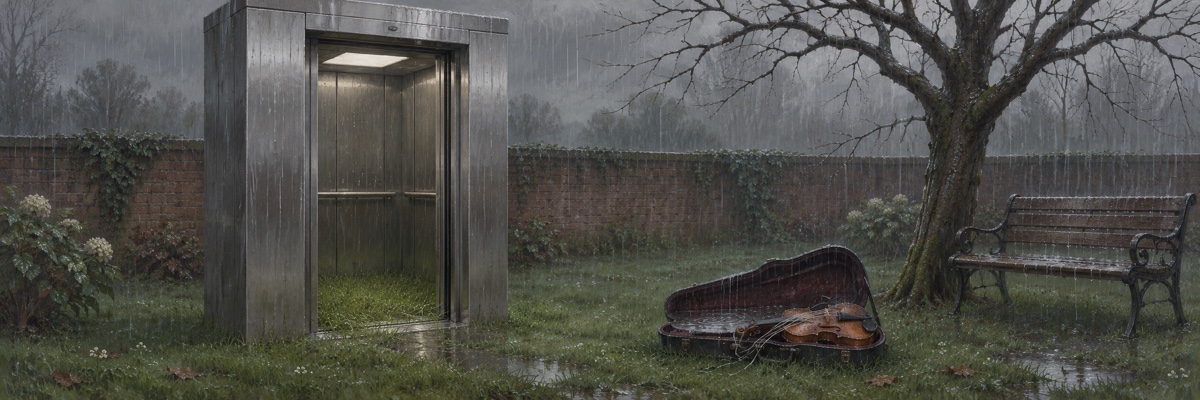
The rain started on the fourteenth floor. It struck the lift roof in a hard, even burst, loud enough that Anil stepped out into the corridor to check whether a pipe had broken. The carpet was dry. Through the window at the end of the passage he could see a cloudless sky and a line of washing on a balcony across the street.
He sent the lift down empty. The rain travelled with it. At the ground floor the concierge looked up from her desk and asked if someone was throwing stones.
“I'll take it out of service,” Anil said.
He placed a barrier across the entrance and called his office. They told him to wait for a second technician. The concierge made tea while he sat in the lobby, listening to the rain on the other side of the lift doors.
The building was called North House. His father had been its caretaker for twenty-one years. Anil had lived here as a child, in a flat behind the laundry, and had left at nineteen without collecting the last of his things. His father had retired the previous winter. He now lived with Anil's sister in a house on the other side of town. Anil had promised to visit on Sunday and had cancelled twice.
A girl came through the front doors carrying a violin case. She stopped at the barrier. “How long?”
“We're waiting for someone,” the concierge said. “You can use the stairs.”
The girl looked at the case and then at the stairwell. “I live on seventeen.”
“I'll carry it,” Anil said.
She let him take the case. On the stairs she told him she had a lesson the next day and had not practised enough. Her mother would ask her to play as soon as she got home. Anil said he had once played the trumpet badly enough to make the neighbour bang on the wall. The girl asked whether he still had it. He told her his father had probably kept it in the flat behind the laundry.
“That flat is empty,” she said. “They took everything out.”
On the seventh landing she stopped to tie her shoelace. Anil went up another flight before realising she was not behind him. He came down and found her looking through the small window in the stairwell door.
“There's someone in the lift,” she said.
The lift doors on the seventh floor were closed. Anil could see them through the glass. He pushed the stairwell door open and went into the corridor. The indicator above the lift showed a dark horizontal line. He pressed the call button. Nothing happened.
“Where did you see them?”
“In the window.”
The lift doors had no window. Anil turned towards the stairwell. The girl was already moving up the steps. He followed her to the seventeenth floor, delivered the violin to her flat and went back down.
The second technician called to say she was delayed in traffic. Anil waited in the lobby for another twenty minutes. The rain stopped. He took his equipment to the lift and began the checks he could safely carry out from the landing. The car stood at ground level, empty and dry. When he opened the doors there was a smell like wet earth after a long hot day.
He ran the car upwards without passengers, watching the indicator. It passed thirteen, then fourteen. The display went blank. The sound of rain returned. Anil stopped the car and brought it down. The roof was wet. A single leaf lay in the corner, brown around its edges and marked with a black spot.
The concierge said, “Your father used to keep a bucket there.”
“Where?”
“Outside the lift. When it rained.”
“It doesn't rain inside.”
“He said that too.” She went back behind her desk and returned with a small brass key. “He left this for you. Said you'd know what it opened.”
It was the key to the flat behind the laundry. Anil had not seen it in years. He took it from her and walked down the passage past the washing machines. The door stood between two dryers, its paint worn smooth around the handle.
Inside, the flat was bare except for a chair and a cardboard box. The carpet had been removed, leaving pale outlines where the furniture had stood. Anil opened the box. It contained his school reports, a trumpet mouthpiece and a notebook with a green cover. On the first page his father had written dates and floor numbers. Beside some were brief descriptions: wind, leaves, November; snow, little girl in red; water on steps.
Anil turned the pages. On one, dated six years earlier, his father had written: Man in blue coat says I must not take the stairs on Tuesday. His face was mine. Beneath it, in different ink: Took them anyway. Nothing happened.
He called his father. His sister answered and passed over the phone. His father's voice was faint, but he sounded pleased to hear from him.
“Do you remember the lift at North House?” Anil asked.
“The one that rained?”
“Yes. What was it?”
“I never found out.”
“There are notes. You wrote about a man who looked like you.”
“He was older. I thought he might be me.”
“What happened to him?”
“He went back in. Don't let anyone follow him.”
“Why?”
His father took a long time to answer. Anil heard his sister asking whether he wanted water. “Because the next time the lift opened, he was outside my door. I could hear him breathing. I looked through the peephole and he was standing there with his hands at his sides. He stood there until morning.”
“Did you speak to him?”
“I asked what he wanted. He said he wanted to come home.”
Anil looked around the empty room. “Did you let him in?”
“No. Your mother was inside.”
The line crackled. His father said, “Are you coming on Sunday?”
“Yes,” Anil said. “I'll come.”
He meant it when he said it. He had meant it the other times too, but this time he looked at the bare floor while he said it, and imagined his father sitting with a glass of water beside him, waiting for the phone to be put away.
When he returned to the lobby, the barrier had been moved. The lift was gone. The concierge was standing at her desk with the telephone pressed against her ear.
“The girl from seventeen,” she said. “Her mother called. She hasn't come home.”
“I took her up.”
“The mother was in the kitchen. She heard the door, but the girl didn't come in.”
Anil looked at the lift indicator. It showed fourteen. He pressed the call button. The doors opened immediately. Inside was the girl with the violin case. Rain drummed on the roof above her.
She said, “You left this on the stairs.”
He had given her the case outside her flat. He remembered her taking it from him. The concierge came around the desk and called the girl's name. The girl did not answer. She held the case out to Anil.
“Come out,” he said.
“I need you to take it.”
He did not touch the case. He put his foot across the threshold. The air inside was cold. At the back of the car, reflected in the metal, he saw himself standing in the lobby with the concierge. The reflection remained there when he moved his arm.
He stepped back. The doors began to close. He put his hand between them, and they opened again. The girl was gone. The case lay on the floor.
Anil called his father back. He described the girl and the case. His father asked whether the concierge had seen her too. She nodded, and Anil told him yes.
“Then it isn't only showing you something,” his father said. “It has brought something out.”
“Where is the girl?”
“I don't know.”
Anil's sister came on the line. “What's happening?”
He told her he was working and would explain later. She said their father was tired. Anil apologised and ended the call. The concierge was already phoning the girl's mother again. He heard her say that there had been a mistake, that they were still looking.
He took the notebook and the brass key from his pocket. The leaf was caught between two pages where he had put it. He placed it on the concierge's desk, weighed it down with the key and told her not to move either until he returned.
“Where are you going?” she asked.
“To fourteen.”
She gripped his sleeve. “Wait for the other technician.”
He looked at the lift. The case was still inside, its handle wet. “If she comes, tell her what happened. Don't let her get in.”
He stepped into the car. The doors closed before he could press a button. The indicator lit without a number. The car rose gently, as it always had, and the lobby slipped out of sight.
At fourteen the doors opened onto rain. It was not falling in the corridor; it filled the space beyond the threshold, a grey curtain through which he could make out the tops of trees. He picked up the violin case and stepped out. His shoe sank into wet grass.
He stood in a small public garden bordered by a brick wall. The rain was cold against his face. A bench sat beneath a bare tree, and on it the girl was playing her violin. The tune stopped as she saw him.
“It's tomorrow,” she said.
He went to her. The violin in her hands was the same size and colour as the one in the case, though he could not see inside the case to be certain. “Your mother is looking for you.”
“She told me to practise.”
“Where did you come from?”
“The lift opened here.” She looked behind him. “Where is it?”
The lift stood in the middle of the garden, its metal doors open. Water ran across its threshold. Anil had the case in one hand. He opened it; inside was a violin, its strings snapped. The girl lowered her bow.
“That's mine,” she said. “I broke it.”
“When?”
“Tomorrow.” She looked at the instrument in her hands. “Or I haven't yet.”
Anil closed the case. “We need to go back.”
She did not move. “I heard myself play. I was good.”
“You can practise at home.”
“I don't want to go home yet.”
He sat at the other end of the bench. Rain ran off the tree and down his neck. He thought of his father listening at the flat door, with another version of himself waiting outside. He thought of the girl on the seventh landing, saying she had seen someone in the lift. The lift had been closed then. Perhaps she had seen herself.
“What happens if we stay?” he asked.
“I don't know.”
The violin case began to shake against his leg. Its catches rattled. Anil put it on the ground and held it shut. The girl watched, wide-eyed. The violin in her hands was dry despite the rain. A drop landed on its body and ran upwards, towards her chin.
“That isn't yours,” he said.
She laid it carefully on the bench. It continued to play a single thin note after she let go. She stepped away from it and took Anil's hand.
They walked to the lift. The doors began to close. Anil ran, pulling her with him, and they crossed the threshold just as the metal panels met behind them. The car descended. Through the closing doors he had seen the case lying open in the grass, with rain collecting inside.
The doors opened on the ground floor. The concierge stood there with the girl's mother and the second technician. The mother pulled the girl close. The girl began to cry, saying that her violin was broken and she was sorry. Her mother told her it did not matter, then asked where it was.
The second technician put a new barrier across the doors. Anil showed her the notebook and told her what had happened. She listened without interrupting, then asked whether he had hit his head. He said he had not. She suggested he sit down anyway.
The concierge brought him a glass of water. The leaf was still on her desk, held down by the brass key. It was green now, with a black spot near the stem. Anil watched it for some time. The concierge asked whether she should throw it away. He said no and folded it into the notebook.
On Sunday he went to his sister's house. His father was in the garden, sitting under an awning with a blanket over his knees. He looked smaller than Anil remembered. Anil pulled up a chair and told him about the girl. His father listened, then asked if she had got home.
“Yes.”
“Good.”
They sat together while Anil's sister brought tea. She had planted beans along the fence, and their small leaves had begun to curl around the wire. His father asked about work, and Anil told him about a lift in an office block that kept stopping between floors. He did not mention North House again.
When it was time to leave, his father said, “There's something on your shoulder.”
Anil brushed at his jacket. A drop of water fell from it onto the paving. Then another. Above them the awning was dry. His father reached out and held his hand beneath the third drop. It landed in the centre of his palm and stayed there, round and clear.
Neither of them moved. From inside the house came the sound of a kettle being filled. His father closed his hand around the drop and asked Anil whether he would stay for supper.
Anil said he would.



No published comments yet.