
By the time Hester realised the ferry was dead, she had already charged the passengers.
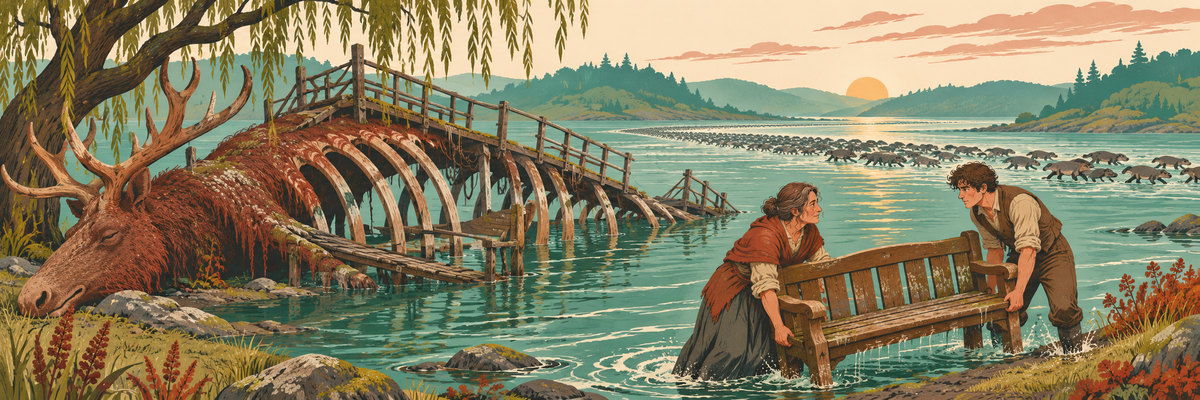
The creature lay with its chin on the landing, its broad back level with the boarding planks. Twenty-three people had come aboard, along with two bicycles, a basket of geese and a honeymoon couple who had asked whether there would be a view. There would be nothing but a view if the creature continued to ignore her heel.
She pressed the hollow behind its left ear. Usually this made the whole body shiver. The passengers would seize the rail, somebody would laugh, and the ferry would lift its chin and walk into the river.
This morning, nothing.
Her son stood at the bow. He had put on his good boots again. They were brown leather, with pointed toes and soles unsuited to an animal whose skin was always wet.
“Go and get the prod,” she said.
“No.”
He was looking at the ferry's eye. The round black lid, which ordinarily slid sideways against flies, had stopped halfway across it.
Hester went to look. Beneath the transparent inner lid the pupil had opened so wide that she could see herself: a small woman on an immense, dark landing.
“Everyone off,” she said.
The honeymoon man asked about refunds. His new wife struck his elbow, but Hester was glad of him. She could open her bag and count money. She knew what to do with money.
The last to leave was a woman carrying a birthday cake. She stepped backwards down the planks, guarding the pink tower with her chin, while Hester's son supported her other elbow. The ferry gave a long sigh. A bubble rose between its teeth and burst with a smell of boiled cabbage.
“Could still be sleeping,” Hester said.
Her son, Will, did not answer. He had been born in the year the ferry first shed its antlers. She had measured his growth against the new branches every spring, until he became too tall and embarrassed to stand there.
Now he squatted by the creature's mouth, holding his coat clear of the water.
“What?” she said.
“Something moved.”
“Course something moved. It's a river.”
He waited until she had turned away before putting his ear against the jaw.
The ferryman from upstream arrived after lunch with a bottle, two saws and an apprentice who was far too pleased to be there. He had lost a creature once. He said the town would have to cut this one up before the heat set in.
“Tow it off the landing first. Otherwise nobody else can use the landing.”
“With what?” Hester asked.
“Mine could manage.”
His ferry waited offshore, occasionally blowing a jet of water through its nostrils. It was a narrow young beast, pale as a peeled onion. Hester's own was red-brown and broad, with the two worn hollows on its back where her heels went. She had never given it a name. There had only ever been one.
“What happens to the pieces?” Will asked.
The older ferryman shrugged. “What happens to everything?”
He offered her the bottle. She declined, then took it. The apprentice had climbed onto the dead creature and was marking places to cut with a stick of chalk.
“Get down,” she said.
“You want the ribs whole. You can sell those.”
“I said get down.”
The apprentice jumped, and his chalk rolled into the crease behind the creature's shoulder. Hester could see the absurd little white cylinder there, but she could not make herself fetch it.
She agreed to the tow. In the evening, when the landing was empty, the younger ferry drew the carcass along the bank to a disused gravel inlet. Will went with it, crouched between the stumps of its antlers. Hester walked the towpath. Every few steps she looked down and saw her old place passing beside her, as though someone else had taken her shift.
They secured the body to a willow. The other ferryman would return with the saws at seven.
On the walk home Will said, “I've got the job.”
She had known about the interview. She had ironed the shirt, although she called it a visit to the city.
“Good,” she said.
“Monday.”
“This Monday?”
“There isn't another one before it.”
His good boots were ruined. A dark line ran halfway up each one. She would have liked to point this out, but there was nothing useful in it.
At the house she made eggs. He ate three and washed his plate. When he was little he had believed the ferry slept standing on the riverbed and that the current was its dreaming. It had taken Hester years to discover that he was not asking where it slept because he wanted a correct answer. He had wanted her to tell him about the dreams.
She woke at midnight to someone tapping the kitchen window.
Will stood outside with a lantern. He had changed into his old boots.
“You need to come.”
At the inlet the smell had thickened. Hester covered her nose with her sleeve. Pale blisters had risen along the creature's flanks, each the size of an apple. Something ticked beneath them.
She had expected flies. There were no flies.
Will lifted his lantern. A blister stretched. Inside it, a pair of legs unfolded, impossibly fine and long. The skin broke and a creature dropped into the shallows.
It had the ferry's broad skull and four jointed legs. No longer than Hester's thumb, it stood in water that barely covered its toes. It shook itself, opened its mouth and made a sound too high for her to hear properly. Her back teeth hurt.
More blisters broke.
“They're babies,” she said.
“I don't think so.”
Will held the light against the body. Through a split in the flank she could see the ribs, stripped clean where the small creatures had gathered. They were eating it from within. One backed out carrying a shred of red tissue twice its own length.
Hester reached for a stone.
Will caught her wrist, then let it go. “Look.”
She did not want to look. The ferry had carried her through thirty-three winters. She had climbed onto it pregnant, feverish, furious, once wearing the dress she had been married in because the landlord had locked their clothes inside the house. She had believed it knew her weight.
A small creature climbed from the dead nostril. It dragged behind it a translucent scrap of membrane which inflated in the breeze. For a moment it appeared to have a sail.
Hester lowered the stone.
“How many?”
“I've no idea.”
“And what do they grow into?”
“I've no idea about that either.”
They stayed until the lantern burned low. The little creatures went on eating. Under their feet the enormous body settled, not all at once, but with patient, wet collapses. The railing tilted. The bench where passengers sat slipped sideways and hung by one rope.
At dawn Hester took off her boots and waded out to remove it.
The wood was good oak. Will joined her at the far end. Between them they carried the bench ashore, then the rail, then the two boarding planks. She found the apprentice's chalk and put it in her pocket.
By seven, the flank had opened into a lace of tendons. Hundreds of small heads turned towards the sound of the visiting ferryman's voice.
“Well,” he said. “Never seen that.”
He knelt. His apprentice hung back, having lost his enthusiasm for the saws.
“Any of them big enough to keep?” the ferryman asked.
Hester looked at the creatures. The largest was no longer than her hand. Its legs ended in small cups that let it climb over the slick ribs. It paused to rub its head against a neighbour, which shoved it away.
“Keep how?”
“Raise. Train. You're out of business otherwise.”
This was true. The passengers would cross at his landing or take the road. In a week they would have new habits. The ropes, the licence, the hut with her good kettle: none of it would carry a person over water.
The ferryman offered to buy the biggest creatures. He had a breeding pond above the weir, he said. Perhaps they would amount to nothing. Perhaps they would be worth a great deal.
Will watched her.
“Fetch the laundry tub,” she told him.
He did not move.
“Fetch it, please.”
He went. Hester hated the consideration in his face more than she would have hated an argument.
They filled the tub with river water and put six creatures inside. The little mouths opened and closed. One began to eat a splinter caught under the rim, scraping it with a noise like a key being cut.
The ferryman promised to come back after his morning crossing. Hester sat on the salvaged bench. Will stood by the willow, touching the damp bark with his palm.
“You can go,” she said. “I don't need watching.”
He turned. “I'm not watching you.”
“What, then?”
“I don't want to miss what happens.”
For the first time since he had told her about the job, she could hear the difference.
The six in the tub began to circle. They swam faster and faster until the water rose at the edges, exposing the metal bottom. Hester reached in. The current struck her fingers hard enough to numb them. Outside the tub, the river creatures gathered in the shallows, hundreds now, then thousands, their narrow legs drawing fine lines through the mud.
Will pointed upstream. A branch swept past the mouth of the inlet, travelling fast with the current. The creatures were turning against it. Even those still eating inside the carcass lifted their heads.
The tub rang. A small mouth had found the soldered seam.
Hester thought of the breeding pond, its fence, its still water. She could buy feed, perhaps. She knew about keeping things alive through cold weather. She could learn the rest. Then one of the creatures in the tub rolled sideways. The others swam over it.
She put both hands under the handles.
“Help me.”
Will took the far side. They carried the tub into the shallows and tipped it. Six small bodies slipped into the river. The sideways one lay motionless for a moment, then righted itself and vanished among the others.
At the carcass, a long dark muscle broke. The antlered head sagged, and the remaining skin slid from the shoulder. It made an ugly sound. Hester flinched. A piece of rotten flesh caught against her ankle and she kicked it away.
The little creatures were leaving. They went upstream in a broad, wavering band, climbing over stones where the water thinned. Beyond the inlet they began to fasten themselves together, foot to back, head against flank. They formed a low moving ridge that broke the surface. A leaf rode on it for several yards before dropping off.
Will started along the bank.
“Go on,” she said. “I'll see to this.”
He hesitated only long enough to hand her the lantern.
She spent the morning taking the ropes out of the willow. The ferryman returned, saw the empty tub and said nothing until she asked what he would give her for the bench. They argued over the price. She made him carry it himself.
By late afternoon the inlet held a bare spine, a scatter of ribs and scraps too small to salvage. Will came back muddy to the hips. He had followed the creatures to the weir, where they had climbed out together, crossed a field and gone into a drainage ditch beyond the road.
“On land?” she said.
“Just for that bit.”
He was smiling. She had not seen him smile like that at home for some time.
On Monday she walked with him to the coach. His suitcase bumped against his knee. At the stop he handed her a paper packet containing the fare for the first week and half his saved wages.
She pushed it back into his coat.
“I sold the bench.”
“It wasn't worth that much.”
“You weren't there.”
After the coach left, she went down to the landing. A woman waited with a basket, looking across the river. Hester explained about the other crossing and pointed out the path.
Then she unlocked the hut, put the kettle on and sat on the step to drink. Beneath her, something small scraped the underside of the lowest plank. She leaned over, but the water was brown and moving, and whatever it was had already gone.
No published comments yet.