
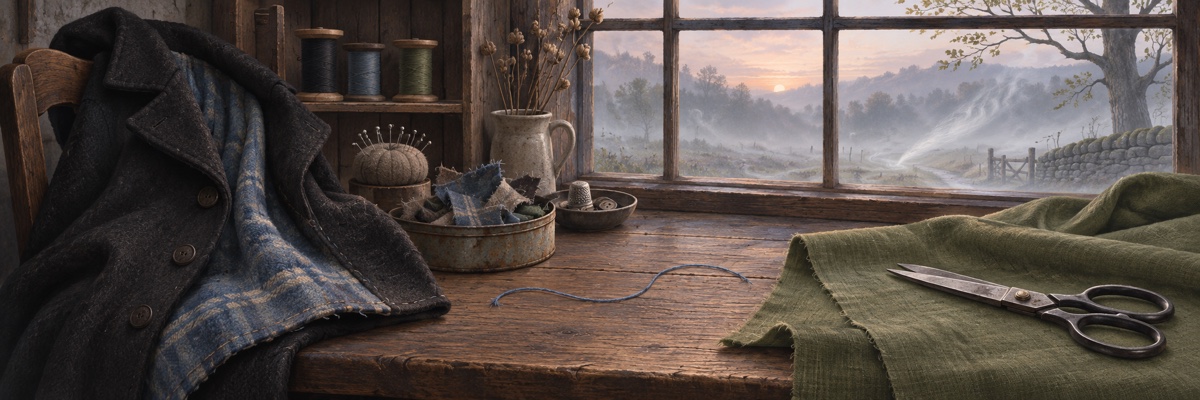
The coat arrived on a Thursday, wrapped in a cloth that smelled of woodsmoke. Ena recognised it before she opened the parcel. She had made the lining from a blue blanket, cutting around the thin places where her son had rubbed his feet at night.
He stood on the other side of the counter, taller than she remembered, with rain in his hair. He had not written to say he was coming. He put a hand on the parcel while she untied the cord.
“The left sleeve leaks,” he said.
Ena turned the coat over. The outer cloth was black, worn shiny at the elbows. At the left cuff a line of stitching had come loose. She put her finger through the opening and found a damp patch between the layers.
“You've been wearing it in storms,” she said.
“That's what it's for.”
“It isn't finished.”
“I know.”
When she had made the coat, he was seventeen and about to leave for the northern road. He had asked for something warm. She had given him the coat with one seam open, telling him that another person's hand must close it if he wanted the weather to pass around him. She had expected him to ask her to finish it. Instead he had put it on and walked out into a clear autumn morning.
Now he was twenty-six. He had a pale line across his chin and a habit of holding his left shoulder slightly higher than his right. Ena wanted to ask about both. She took the coat to the worktable instead and laid it beneath the lamp.
“I can mend the sleeve,” she said. “It'll take the afternoon.”
“Can you finish the other seam too?”
She looked at him. “Are you going north again?”
“Yes.”
“Winter's nearly here.”
“That's why I need it.”
He had not sat down. His boots left small dark marks on the floorboards. Ena fetched a cloth and put it beside him. He took it without comment and wiped up the water.
“There are dry socks by the stove,” she said.
“I've got some.”
“Then put them on.”
He went behind the curtain that divided the shop from the kitchen. She heard him moving a chair, then the soft thud of his boots on the floor. She threaded a needle and began to unpick the damaged cuff. The work was familiar enough that her hands could do it while her thoughts went elsewhere. She remembered him sitting under this table as a child, making a house from scraps. He had cut a door into the best piece of red wool she owned. She had been angry until he put a tiny chair inside and invited her to look.
He came back in dry socks and sat by the stove. “I met someone you know,” he said. “On the road from Harth.”
“Who?”
“Lida. She used to bring you buttons.”
“She's still travelling?”
“She has a cart now. Two horses.” He smiled. “She made me buy buttons I didn't need.”
“That's how she got the horses.”
They talked about Lida for a while. Ena asked where he had been living. He named a town by the lake and described a room above a bakery, where the floor grew warm before dawn. He had been repairing boats. The work was good in summer and scarce in winter. He said all this without looking at her, watching the fire instead.
“Why are you going back north?” she asked.
He picked at a loose thread on his sock. “A friend of mine is there.”
“The one you wrote about?”
“I wrote about several.”
“The one who fell through the ice.”
His hand stopped. “Yes.”
In the letter, written four years ago, he had said his friend had survived. A group of travellers had pulled her out. He had not said where he was when it happened. Ena had written back asking whether he was safe. His reply had taken six months and had not mentioned the friend.
“She asked me to come,” he said.
“Is she ill?”
“No. She's building a house. She needs another pair of hands.”
“Then why do you look as though you're going to a trial?”
He stood and went to the window. Outside, a woman was struggling with the cover of a market stall. The wind had lifted one corner and wrapped it around the pole. He watched until she freed it.
“I was there when she fell,” he said. “I saw the ice break. I ran.”
Ena laid down the coat. He kept his back to her.
“Other people pulled her out. When I came back, she was on the bank. I told them I'd gone for a rope.”
“Had you?”
“No.”
“What did she say?”
“Nothing then. She was too cold. I left the next morning.”
Ena waited. He turned from the window and sat down again.
“She wrote last month. She said she knew. She wants me to come and help with the roof before the snow.”
“Why?”
“I don't know. I haven't asked.”
Ena picked up the sleeve. The lining had torn where it joined the cuff. She cut away a frayed thread and found a length of blue wool that matched closely enough. “You could write to her.”
“I have. She wrote back with the measurements for the beams.”
“Perhaps she needs the roof.”
He laughed once. “Perhaps.”
The wind increased during the afternoon. Rain rattled against the window and ran down the glass in slanting lines. Ena finished the cuff and held the sleeve up to the light. The stitches were even. She handed the coat to her son and asked him to put it on.
He stepped outside. Rain struck his shoulders and rolled away from the cloth, leaving his shirt dry. Then a gust came from the side, and water entered through the unfinished seam under his arm. He came back in laughing, with a wet patch spreading across his ribs.
“It's better than it was,” he said.
She helped him out of the coat. The open seam was where she had left it nine years before, a hand's length beneath the right arm. She had folded the edges inward and tacked them loosely so the lining would not show. The thread was still there, faded and soft.
“I can close it,” she said.
He looked at her. “Will you?”
She had imagined this moment when she made the coat. In that imagining, he was still young enough to be grateful for her help and the road was a short one, leading him back by spring. She had not imagined the years between, or the letters that became fewer, or how much she would resent the coat when he did not return.
“I was angry when you left,” she said.
“I know.”
“I wanted you to ask me to finish it. I thought if you needed me, you'd come back.”
He touched the open seam. “I thought you wanted me to find someone else to do it.”
“I didn't.”
“I asked Lida once. She said she wouldn't do it while I was running away from something.”
“That sounds like her.”
“She offered again last year. I said no.” He looked at the rain. “I wasn't ready to go back.”
Ena pulled a chair beside the worktable. “Tell me what happened on the ice.”
He sat opposite her. At first he spoke in short sentences: the lake, the sound it made, his friend stepping ahead. Then he described the white rush of fear when the ice cracked and the way his feet had carried him towards the trees. He had hidden behind a fallen trunk until he heard the others shouting. He had found a rope there, left by fishermen, and carried it back after she was already out.
“I wanted her to think I'd tried,” he said. “I wanted all of them to think it.”
“Did you tell her?”
“In my letter. After she wrote to me.”
“And she sent measurements.”
He nodded. “She also said she was angry. She said I didn't get to decide whether she wanted to see me.”
Ena considered this. She had spent years deciding what her son's silence meant. Some days she had been certain he did not care whether she lived or died. Other days she had told herself he was too busy, too far away, too content. She had written letters and torn them up before he could see how much she wanted from him.
“I don't know what she'll say when you get there,” she said.
“Neither do I.”
“Will you stay if she's still angry?”
“I'll ask her if she wants me to.”
The light outside faded. Ena lit the lamp and drew the coat towards her. Her son made tea in the kitchen. He found the cups without asking where they were kept. He had to reach past her to take the kettle from the stove, and for a moment his arm rested against her shoulder.
She removed the old tacking thread. It came away in a single length. The cloth underneath was clean and darker than the rest of the coat. She folded the edges together and pinned them. Her son put a cup beside her and sat down with his own.
“I can do that part,” he said.
“You can hold it.”
He held the cloth while she stitched. She worked slowly, keeping the seam flat. The needle passed through the black outer layer and the blue lining, then back again. By the time she reached the end, the tea had gone cold.
He put the coat on and went outside once more. The rain had become a fine, wind-driven mist. It curved around him in the light from the shop window, touching the pavement on either side. He stood there for a few seconds, then raised his hands. The mist passed around them too, leaving his palms dry.
Ena opened the door. “Come in before you frighten the neighbours.”
He came in smiling. She had not seen that smile since he was a boy, though it belonged to the man standing in front of her. He took off the coat and hung it by the stove.
“Will you leave tomorrow?” she asked.
“If the road's open.”
“There's bread and soup. You can sleep in your old room.”
“I'd like that.”
They ate at the kitchen table. He told her about the bakery, the boats and a dog that had followed him for three days before deciding another traveller was more interesting. She told him about Lida's last visit, the new roof on the school and the neighbour who had planted beans in the strip of earth beside the road. Some things were awkward. Twice they reached for the same subject and stopped. They let the pauses sit until one of them found something else to say.
In the morning the wind had dropped. Ena packed bread, cheese and two apples into a bag. Her son put on the coat and checked the road from the doorway. The clouds were lifting over the hills.
“I'll write,” he said.
She almost asked when. Instead she handed him the bag. “Tell me if the roof is finished.”
He put his arms around her. The coat smelled of woodsmoke and the fresh soap she had used on the cuff. She held him for as long as he stayed, then let him go.
At the gate he turned. “The red wool,” he said. “I remember.”
“So do I.”
“I was going to make you a bigger chair.”
“You never did.”
“I know.” He lifted the bag. “I'll write.”
He walked down the road until the bend hid him. Ena went back into the shop and opened the shutters. On the worktable lay the old tacking thread, a thin curve of faded blue. She picked it up and put it in the tin with the other scraps. Then she took out the next coat waiting to be mended. Its owner had asked for a new pocket, deep enough to carry a book. Ena found a piece of green cloth for the lining and laid it beside her scissors, ready for the afternoon.

No published comments yet.