
By the time Nera got home, the sea had reached her kitchen.
It had come in under the door as a thin green line, climbed the legs of the table and settled in a trembling dome around the fruit bowl. Three oranges floated at its centre. The membrane held its shape without a container, except where a corner had entered the sink and was exploring the drain.
Nera stood on the threshold with her flight bag in one hand and the silver rescue medal in the other. She had been given the medal that morning, in front of three cameras and a woman from the Port Authority who had called her a pilot who never forgets the people depending on her. The clasp was awkward, and she had taken it off in the lift.
The kitchen dome made a small sucking noise. One orange turned.
“Don't step in it,” said a voice behind her.
Her neighbour Omi stood in the passage wearing rubber boots and carrying a bucket of wet towels. There was a red pressure mark across her forehead where her breathing hood usually sat. She looked at Nera's bag, the medal and then Nera's face.
“You're back early.”
“The ship was early.” Nera held up the medal as if it explained anything, then put it in her pocket. “What happened?”
“The seal feed ran out six weeks ago.”
Nera knew the answer before Omi continued. Each flat in the block paid into the feed that kept the building's tidal membrane healthy. Each flat also had a small weekly valve to open, allowing nutrient gel into the living skin at that level. Nera had opened hers every Sunday for four years. On the day she left, the emergency call had come while she was packing. She had meant to ask Omi to take the key and open it. She had left the key on the table by the door, beside a note that said please and nothing else.
“I thought the valve was automatic,” she said.
“You knew it wasn't.”
“Yes.”
Omi set down the bucket. “I found the note after the third week. The key was there, but I didn't know what you wanted. By then your section had begun taking feed from the rest of the building. We thought it was a leak. We fed it then. That kept the outside sealed. It didn't draw the growth back out of the pipes.”
“Why didn't you message me?”
“We did. The ship's relay sent back a notice that you were beyond range.” Omi nudged the bucket aside with her boot. “Then we were busy.”
Nera's block stood on piles above the salt flats. Twice a month the tide rose high enough to cover the lower floors, and the membrane stretched over the walls and windows to hold the water out. The laundry and enclosed yard lay inside the same outer seal. During the long dry intervals it lay thin and almost invisible in channels around the building. Nera had always liked watching it wake: the first clear bulge at a window, the slow knitting of one edge to another, the tiny bubbles travelling through its veins. She had never needed to think of it as anything but a thing that worked.
“Where is everyone?” she asked.
“Top floor. The contractors are coming at four.”
“What contractors?”
“The ones who will cut it out. Come upstairs. Don't shut that door; the pressure changes make it spread.”
Nera followed her up the stairs, leaving her bag outside the flat. On the second landing a length of translucent green skin bulged from a crack in the plaster. Someone had tied a scarf around the crack, as though dressing an injury. On the third floor a pair of children's shoes stood in a basin of salt water. The shoes were empty. The skin had grown around their soles and fixed them to the basin.
Omi saw her looking. “The twins thought it would make them float. It did, but they couldn't get them off.”
The top-floor common room smelled of wet coats and boiled rice. Half the building was there, including the twins, who ran at Nera with such force that she had to brace herself against the table. They had watched her rescue on the news: the crippled survey ship, the tumbling cargo ring, the long cable she had carried across open space. They wanted to know whether the people she had brought out were afraid. She said yes, and one of the twins asked whether she had been afraid too.
“Very,” said Nera.
“Good,” said the child, and went back to drawing a ship with eight enormous engines.
At the far end of the room a maintenance worker was speaking to the building steward over a set of plans. His name patch said SEDU. He had a scar across one eyebrow and a pencil tucked behind his ear. When Omi introduced Nera, he did not look up from the plan.
“Your valve was dry,” he said. “The skin compensated by taking gel from the upper lines. Then it grew into the grey-water pipes looking for moisture. It found plenty.”
“Would more feed draw it back?”
“I’ve tried. It has enough to keep the outside sealed until the tide turns. The part inside is another matter. It has attached itself to the pipes on every floor. When the pressure drops, it will contract. It could pull the joints apart.”
Nera studied the plan. The intake line ran down the centre of the building, with branches to each flat. The skin had followed it like a hand reaching through a narrow sleeve.
“Can you cut it into sections?”
“We can. Each cut makes it seal over, but the pressure pushes it farther along the pipe. We tried on the ground floor. It came out in the laundry.”
The steward, a small woman named Ves, held out a sheet of figures. “The contractors want to remove all of it and fit a temporary synthetic cover. That will last a season. After that we need a new living skin.”
The total was more than Nera had earned in the past year. Beside it was a column of amounts already spent: gel, extra pumping, emergency call-outs, replacement pipe. Omi had paid for the largest delivery. Ves had paid for another. Five flats had contributed to a shared tank.
“I can pay you back,” Nera said.
Ves's expression did not change. “Can you pay the rest?”
Nera thought of the rescue reward. It had been promised, not yet deposited. She had already allocated it in her head to a new drive coil and six months without contract work. “I can pay most of it when the Port Authority releases the money.”
“Most is not all.”
“No.”
The twins had brought their drawing to the table. One pointed at the green lines on Sedu's plan. “It looks like a tree.”
“It does,” he said.
“Can it come out the way it went in?”
Sedu opened his mouth to answer and stopped. He put his pencil on the plan. “It came in looking for water. The trouble is that the pipes are narrower at the joints. If we pull from one end, it will bunch.”
“Don't pull it,” said Nera. “Lead it.”
She explained the cable she had used on the survey ship. The damaged ring had been rotating too quickly for her to attach a tow line to its main spar. She had sent a thin pilot line through a service channel, used it to draw a heavier line behind, then anchored that line to three points in succession so the load never fell on a single joint. It had taken seven hours and had worn through the fingertips of her suit.
Sedu listened without interruption. “The skin isn't a cable. It moves towards water and nutrients. It won't follow a line.”
“Then give it something to follow.”
“We can't flood the building.”
“Not the building. A hose.”
He considered the plan again. “If we run a feed hose down the central pipe, past the farthest growth, it might follow the gradient back. But the hose has to come through the inspection bends. There's no room for a person.”
“There was no room for a person in the ring either.”
Ves folded her arms. “How long?”
“I don't know,” said Nera.
Sedu checked the tide table on his wrist. “Three hours before the outside pressure begins to fall. The contractors arrive in ninety minutes. If we start and fail, they may have less time to cut the skin free.”
Omi took the pencil from him. “What do you need?”
“Feed, a long narrow hose, and a way to carry it through the bends without puncturing the pipe.”
“I have garden hose,” said the steward.
“Too stiff,” said Sedu.
“I have the twins' old inflatable slide,” Omi said. “The air tube is soft.”
The twins objected to this proposal with one voice. Omi promised them a new slide if the old one saved the building, and they immediately began arguing about its colour. For the first time since arriving, Nera saw Ves smile.
They set up at the top-floor inspection hatch. A small service tank of nutrient gel sat beside the central feed line. Sedu shut the grey-water pumps and opened the hatch. A clear green tendril pressed through the opening, touched his glove and withdrew. The pipe was packed with membrane, pale as the inside of a leaf.
Nera lowered a weighted cord into the pipe, paying it out while Omi watched at the laundry hatch below. At the first bend the weight stuck. She twisted the cord and felt it roll loose. At the second it stopped entirely. She drew it back and found a little knot of membrane attached to the weight. It tightened around her finger when she touched it.
“It's hungry,” she said.
Sedu studied the knot. “It may be following the water.”
Nera detached the knot and set it in a bowl of salt water. She replaced the weight with a smooth capsule from her flight bag: an emergency locator, no longer transmitting, small enough to pass the bend. She tied one end of the slide's air tube to it and connected the other end to the service tank's gravity valve. Then she lowered the capsule again, feeding the tube through behind it. Twice it snagged; twice she eased it back and changed its angle. On the third attempt the capsule reached the laundry hatch. Omi caught it in a net, unclipped the capsule and put it in her coat pocket for later. She guided the tube through the laundry, then out through the yard door into a large tub beside the shallow pool.
Sedu opened the tank valve. A thin line of blue gel ran down the tube, appearing as beads through the pinholes Nera had made along its length. The open end dripped into the tub outside. He went down the service stairs and fitted a small clamp at the laundry hatch. Nera followed; Omi was already there. The three watched the route together.
For several minutes nothing happened. Nera sat on the damp laundry floor with the tube looped across her knees. Above them, people moved from flat to flat, opening taps into buckets so the pipes would remain empty. Every few seconds the building creaked as the tide pressed against the outside skin.
Then the tube shivered in her hands. A green ripple travelled down the pipe, past the laundry hatch and through the door towards the blue line in the tub.
“Ease the clamp,” Sedu said.
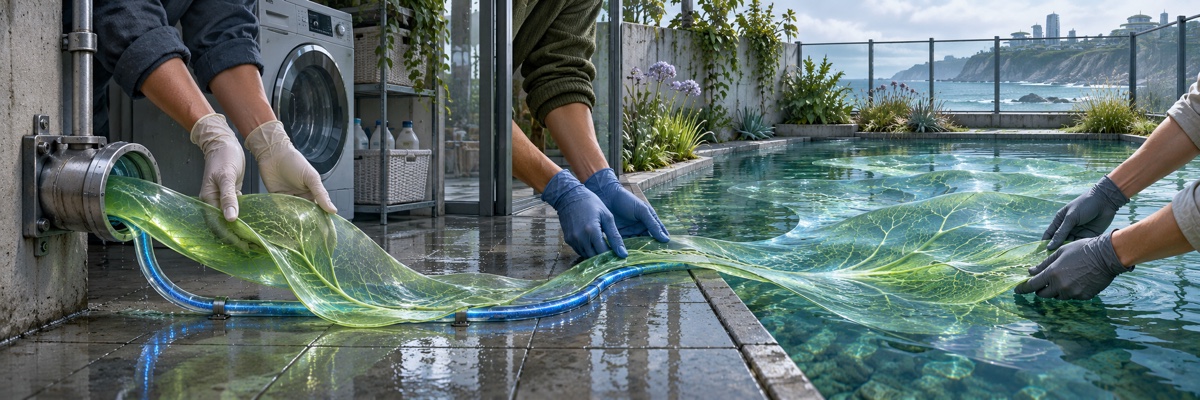
Nera loosened it. The membrane emerged from the pipe in a slow, muscular fold, crossed the laundry threshold and gathered in the tub. The first length was no wider than her wrist. Behind it came a thicker branch, then a tangled mass that filled the tub and rose over its rim.
Omi brought a second tub from the laundry. “The contractors are waiting at the yard gate.”
“Tell them twenty minutes,” said Nera.
“I told them ten. They're charging us while they wait.”
The flow slowed. Sedu checked the branches, listening at each access point. One section had released from the third floor, but another remained lodged behind the second-floor junction. Nera fed a little more gel down the tube. The mass in the first tub shifted; a green tongue reached across the rim towards the pool.
“We need to move it,” she said.
Omi and Nera tipped the tub towards the shallow water. The membrane clung to the rim but did not resist being turned. It slid out and spread across the pool in a transparent sheet. For an instant Nera saw the sky through it, the pale afternoon sun broken into a hundred wavering pieces. Then it contracted into a thick green rope around the feed tube.
The contractor's van stood at the gate. Two workers watched without offering advice. One was holding a cutting torch. Beyond them the salt flats were hidden under grey water.
Sedu knelt beside the laundry hatch, listening to the pipe through a metal rod. “It's caught at the second-floor joint. I can hear it moving but it won't come past.”
“Can we open the joint?”
“Not without taking the wall apart.”
“Then take the wall apart,” said Omi.
They ran upstairs with Sedu's tools. The scarf had been removed from the crack in the plaster, and the bulge beneath it had grown larger. Sedu put a hand to the wall. “This is the branch. If I cut here, I might cut the skin.”
“Can you see where the pipe lies?”
“Not exactly.”
Nera took a breath. On the survey ship she had used sound to locate a damaged spar behind a sealed panel. She borrowed Sedu's metal rod, tapped along the wall and listened. Most of the plaster gave a dull, even answer. At one spot there was a sharper click, then a faint answering knock from within.
“There,” she said.
Sedu scored a square around the spot and worked the plaster loose with a chisel. It fell in chunks onto Omi's towels. Behind it was a copper joint, and around the joint a loop of membrane had tightened like a fist. The feed tube had passed through the centre of the loop, but the skin could not follow without pulling itself tighter.
Sedu unscrewed the inspection cap and held it clear. Through the access sleeve, Nera eased a finger under the loop. It gripped her glove. She moved slowly towards the open pipe mouth, drawing the loop sideways rather than down. It yielded a little. Omi slid the smooth locator capsule beneath it. Together they worked the loop over the capsule and through the sleeve. The tube jerked. Nera snatched back her hand as the membrane slipped through the pipe. From below came a wet slap and a shout from one of the contractors.
“Sorry!” Omi called.
“Don't be,” the contractor shouted back. “It's beautiful.”
By the time the last branch emerged, the tide had begun to fall. The building's outer skin thinned over the windows, and the pressure in the pipes dropped without a burst joint. The contractors inspected every floor, charged for their waiting time and left their torch in the van. Sedu kept the upper service tank feeding through the hose at a low rate into the yard pool until the freed membrane had settled. A specialist would have to decide whether it could be grafted back to the building. For the coming tide, the synthetic cover was still necessary, but only for a section of wall. The price on Ves's sheet became much smaller.
Nera paid the emergency expenses that evening from her savings and signed an instruction for the rest to come from her reward. There would be enough left for the drive coil if she waited and bought a used one. There would not be six months without work. She found that she did not much care about the coil that night. She cared very much about the sum beside Omi's name, and she paid that first.
“Interest,” Omi said, when Nera showed her the transfer.
“I can add interest.”
“I want Sunday dinner for four weeks.”
“That seems reasonable.”
“And not the dried noodles you take on flights.”
“I'll have to learn something else.”
“You can start by cleaning your kitchen.”
The dome around the fruit bowl had collapsed into a shallow puddle. The oranges were soft but sound. Nera lifted them out one by one, washed the green film from their skins and put them on the windowsill. Then she opened the cupboard beneath the sink. A thin strand of membrane lay curled around the waste pipe, no longer attached to the rest. She carried it down to the yard in a glass of salt water.
The twins were sitting beside the pool in their socks, discussing the new slide. They had decided on yellow with a blue ladder. When Nera poured the strand into the water, it drifted towards the larger mass and joined it so neatly that she could not find the seam.
“Did you save it?” one asked.
“Sedu says it might live. We'll know after the specialist comes.”
The child accepted this and offered her a drawing. The ship now had a long blue hose trailing from its stern, and a green building floated safely at the other end. Nera carried the picture upstairs and fixed it to the refrigerator with the rescue medal. Its clasp held the paper better than it had held her jacket.
On Sunday she opened her valve. Omi stood beside her while the gel ran into the line, and Nera wrote the date on a card tied to the handle. When they had finished, she handed Omi a spare key with a label attached. On one side she wrote the flat number. On the other she wrote, in full, what the key was for.



No published comments yet.