
The woman who sold me the poison had moved into a larger shop by the time I went back for the antidote.
“She's been dead eleven years,” she said. “Antidote won't help.”
I asked what would.
She considered me across a counter full of jars. Some contained ordinary things: cloves, mustard seed, the dried peel of a fruit I recognised. One held a sound. When she moved it, I heard a spoon strike the side of a cup in my mother's kitchen.
“You still cook?”
“Yes.”
“Well, then.”
The price was taste. Not my tongue or my sense of smell: she was exact about that. I would smell bread in the oven and know what I was missing. I would feel salt scrape my gums and a chilli burn them, but neither would have flavour. The woman I had killed would be restored on the day of the bargain, eleven years older, with no obligation to me.
“No obligation,” the seller repeated.
I told her I understood.
At that time, I had won three medals for my cooking. The dead woman had won one. In the dream I had most often, I was explaining this distinction to a room full of people who kept turning towards the door.
I paid.
She took my taste with a wooden spoon. It hurt less than I expected and more than I could describe afterwards. Then she gave me an address and a paper bag containing two pears.
“She'll be hungry.”
I found her sitting on the steps of the municipal baths. Her hair had grey in it. She was wearing the dress they buried her in, a blue thing with buttons I remembered disliking at the funeral.
“You,” she said.
I gave her a pear.
She bit into it without wiping it on her sleeve. Juice ran down her wrist. I had forgotten that about her: the mess she made while eating, the contrast with the spotless little dishes she put before other people.
“Did you do this?”
“Yes.”
“The whole thing?”
I nodded.
She ate the second pear. Then she asked for money.
I had imagined several conversations. In some she struck me; in some she wept. None began with her pointing at my purse.
“All of it,” she said.
There was enough for clothes and a room. I gave it to her and waited. She stood, stiffly, put the pear cores in the bag and walked away.
I went back to my kitchen. On the stove a sauce had thickened while I was out. I tasted it by habit, then tasted again. Warm paste. I added salt and made my assistant try it.
He spat into the sink.
For three weeks I cooked by measurement. For another two I pretended that this was sufficient. Then I hired a woman who had worked at a roadside grill and paid her to tell me when things were wrong. She told me often, sometimes before tasting. I gave her charge of the stove and took over the accounts.
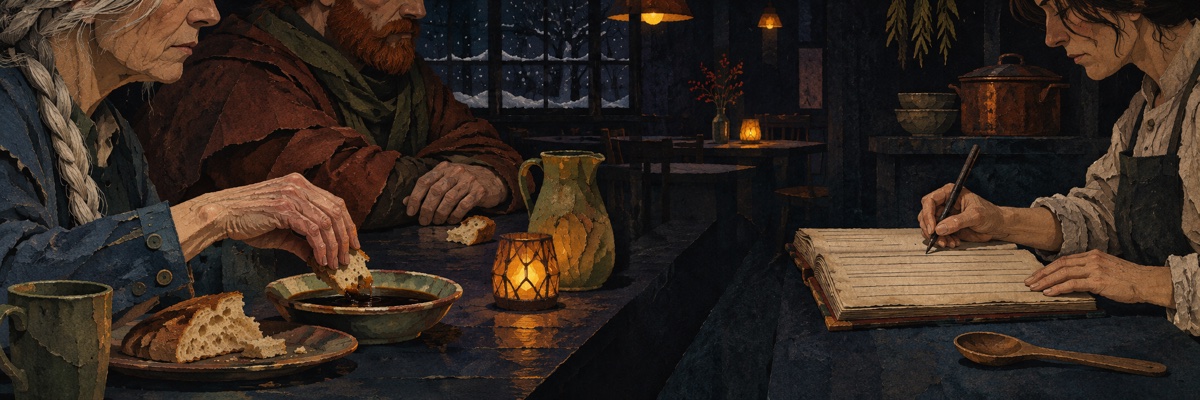
The restored woman came to the restaurant in winter. She brought a man with a small red beard. I had never seen him before. They ordered the most expensive meal and two bottles of wine.
I went to their table.
“Everything satisfactory?”
She looked up from her plate. “The beans are overcooked.”
“I'll tell the kitchen.”
“You do that.”
I wanted to tell her what I had paid. I wanted the man with the red beard to know why I stood there, reduced to carrying someone else's judgement back to a stove I no longer controlled. She lifted her glass. There was a fleck of sauce near her mouth.
“Is there anything else?” I asked.
“Bread.”
I brought it myself. She broke a piece, dipped it into the sauce and offered it to the man. He shook his head, smiling, already full. She ate it, then reached for another piece.
At the counter I watched them finish. When they asked for the bill I wrote down every item, including the bread, crossed out nothing and sent my assistant to collect it.

No published comments yet.