
Charles takes the stairs two at a time, keys jangling like a skittish pocket bird. The block smells of curry and dust, winter coats not quite dry. He checks the third-floor corridor—hobs off, prams pulled clear, a mop bucket nudged back from the landing edge. A rolled rug leans against a door like a tall, sulking cousin; he tucks its end under to stop a trip. He taps the cracked plastic on his kitchen timer. Two minutes to midnight.
On the noticeboard, someone has drawn tiny bull horns on the “NO FLY-TIPPING” poster. Someone else tried to rub them out and only managed to polish the paper greasy. He smooths it with his palm anyway, as if paper behaves when asked nicely. He likes the estate this way, on the cusp. Eleven fifty-nine and fifty-eight, fifty-nine—
The world blinks.
Silence drops like a thick curtain. A luminous hush. The blue fly in the stairwell window stops mid-buzz, an ink fleck on glass. Charles breathes out and the breath feels loud, wrong in the museum air. He slips on his fluorescent vest, its tape strips cold against his arms, and the bin-store key warms under his thumb. The key has a stamped code that has lived a groove into his skin. He likes the weight of it: responsibility that fits in a fist.
He moves through the stillness doing his little salvations. A spoon off a hot ring; a hallway door that would have banged in a gust; a child slid gently from sofa to bed—six-year-old legs floppy in football pyjamas, mouth open to a cartoon dream. None of it costs him much. The scientists never came, but the rules hold: weight moved takes days from the mover. Cost applies only to motion you cause in the Pause; once time returns, gravity charges no one. First week, only the cleaners seemed to move; later, someone noticed the bin-store key in their hands, and the token stuck. A cup and saucer? A whisper of hours. A sleeping child? 3 kg of duvet, 22 of boy. He forgets to count, sometimes. He shouldn’t. Early on, he dragged a toppled plant—the ceramic pot (7 kg, who knew?), the soaked soil, the tray of pebbles—and woke the next day with a knee that spoke to him like an old teacher: sit down. He has been tidier with his years since. For a week he carried odd things to the bathroom scale like a hobby: kettle 1.8 kg, hoover 6.5 kg, front door 17 kg if you lean it wrong; numbers burned in his head like warning lights.
He’s on the second-floor landing when he hears it: the absence of a sound that should already have happened. The stairwell echo. A foot misses. A gasp is a bead in the air that does not fall.
He peers over the rail. Tasha from 2B hangs in space, a shopping bag clamped in the crook of her elbow, her other hand flung behind her in a wild recruit of air. The bag is full of tins and a 2-litre bottle of cola, the kind that drops like a shotput. The stubborn strap has twisted, pulled her balance wrong. Her expression is a question she will never finish asking if he leaves her.
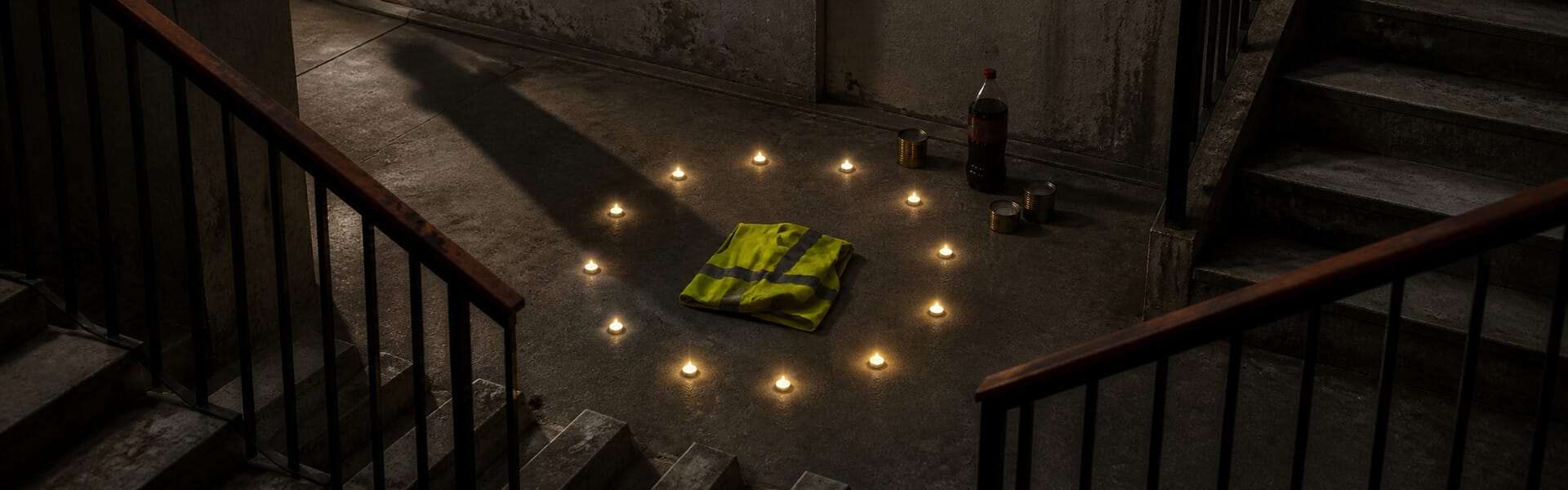
Charles sets the timer on the rail. Twelve bright dots: the Pause. Twelve minutes to make a decision and live its cost.
He runs down the stairs. Close up, the suspension shows its texture. Her hair is a halo of separate lines. A fleck of mascara hangs mid-air like soot. The bottle’s label has a ripple where it should be smooth. Tiny, unimportant details he notices because noticing is easier than counting days. He thinks of Mum in the ground-floor flat across the courtyard, asleep with her arm across her face to block the streetlamp. He thinks of her mornings: kettle boiled, jam buttered thin because thick is a waste, the radio with its reassuring bleat and its names for hours. He promised her years. He sold his motorbike and bought a cane chair that lets her sit by the window. He runs his thumb across the key’s stamped code. The metal hums a tune he pretends is an old song.
Right. Alternatives.
He sprints to the bin store, unlocks the door, drags out the big blue crash-mat from the kids’ club—a relic somebody dumped after Friday sports. 40 kg. He counts on his fingers: forty days for a cushion Tasha won’t hit because the stairwell is too narrow. He shoves the mat back, swearing, which costs nothing.
He raids the corridor for things that weigh almost nothing: a hoover box, flattened; a roll of festive gift-wrap; a line of washing strung between two handles, a flimsy net that smells of conditioner. He starts to build, angling the washing line so her shoulder will hit and slide into the averted corner, trying to turn a three-metre drop into two shorter slips. He unslings the shopping bag. Tin by tin, he eases weight from her arm. Baked beans, chopped tomatoes, a rogue dog food tin—call it 400 grams each. He lays them along the treads like little planets. The cola bottle bristles at him. 2 kg. 2 days. He kisses his teeth and rolls it gentle onto the landing, the plastic crackling in his palm as his skin takes the debt.
He wedges his fluorescent vest under her hip where the banister will catch. He waits a second, hand hovering near her ribs, because there’s a trick to force giving. If you can bring the centre of gravity a fingertip closer to safe, you save kilograms later. He has learned leverage the way you learn neighbours’ birthdays: by accident, then by care.
Timer: ●●●●●●●●.
He checks her pockets for heavier things—a phone, a bunch of keys like his own—pulls them free, sets them on the step. He thinks, too late, about her pride. Privacy is weight as well, in its way. He sets the phone face-down, respectful, and rolls the ring of keys into the crook of the stair where they can’t escape.
The plan is good, nearly good. It will not be enough if her head clips the edge. He measures the gap with his eye and, for once, cannot find the little cheat that preserves him.
Timer: five dots.
He thinks of Mum again, stuck on a sentence sometimes, middle of making tea, asking where the tea is while holding the pot. He thinks how long five days feels when you are counting. He could keep those days. He could set a notice on the board in the morning: “Be careful.” He could hope.
He breathes, thin. “All right,” he says to the air, to himself. “All right.”
He gets into the well below her, two steps down, feet planted. He spreads the hoover box across the landing edge to blunt it. He bends his knees. He places his palms under air where her back will be and his hands tingle, as if nerves understand what time doesn’t.
Timer: two dots.
He looks at her face. He remembers her offering his mum a lift to the GP last winter when the buses were on strike. He didn’t take it. Pride cost days too.
“On three,” he tells a world that cannot hear. “You fall. I’ll take it.”
Timer: one dot.
The Pause lets go.
Sound returns—the stairwell’s hollowness, the glug of the cola bottle rolling to a stop, the clatter as tins hop and settle. Tasha’s scream snaps into being and then breaks when the washing line catches her underarms, slides her into the banister. Charles’s palms meet her back and the world thumps through him, weight translating into age in a way he can’t see but feels: a metal taste, a deep ring in his knees, something at his temples tightening like a stitch. They collapse together into a lopsided sit. The hoover box tears into polite confetti. For a beat the stairwell tilts; nausea licks his teeth; he breathes until the world levels.
“Jesus,” Tasha gasps, gripping the rail, hand shaking. She looks at him properly. “You—did you—? I slipped.”
“You slipped,” he says. His voice is breathy and older than it was. He picks a bit of cardboard from her sleeve, sets it neat on his knee before he remembers he can let mess be mess. He looks past her, counting tins. None rolled over the edge. He nods, once, to himself.
She sees the vest under her, half-rug, half-flag. “Is that yours?”
“Keep it,” he says, throat raw. “Bright thing on a dark stair. Good luck.”
She laughs, wet. “You’re a weirdo, Charles.” Not unkind. “Thank you.”
“Mind the strap,” he says. He wants to say: tell no one. He wants to say he’s short on days. He says nothing. The Pause is gone but leaves a back-draught behind it. He helps her gather tins, refuses to take the heavy bottle when she offers.
They part on the landing with the awkwardness of strangers who have shared a near-intimacy. She looks back and he realises the vest really does glow; the tape catches any light going and makes an event of it. Good. Let something shine.
The night thins after that, as if embarrassed. Charles walks the rest of his round, slow now. The fly remembers to buzz. Someone snores. He lifts a fallen umbrella, sets it by a door, and it feels like too much effort, a kilo of weather he cannot spare. In 4C, an extractor fan hums into the morning it hasn’t met yet. In 1A, the fish tank is lit like a private sun. He touches the glass and the stopped fish come alive in his imagination, flicking their fins impatiently.
Estate Notices Pinned during the Quiet: appears at 00:12. YOGA IN COMMUNITY HALL: Mondays 7 pm. Bring mat. — Nadine. CAT FOUND? Black, small, answers to anything if it’s food. — 3D. NO FLY-TIPPING Council cameras in operation (smiley face added, then crossed out).
By dawn he is outside, watching the bus stop fill. The glass advert shows a smiling family pouring juice. He sees his reflection doubled over theirs. There’s a grey at his temples he doesn’t recall from yesterday—fine, almost handsome if you don’t count the ache. He rubs it and finds the skin different: not worse, just truer. The bus arrivals board ticks and he likes the ordinary certainty of numbers that do not cost him.
He crosses the courtyard to his mother’s block. The kitchen window is gold with first light. He lets himself in, toeing off his shoes, the key soft in his hand now, as if the metal has known it will be needed again. Mum sits at the little table, buttering jam thin. She looks up and blinks, then smiles as if he’s arrived from a long way off.
“You’ve grown distinguished,” she says, amused, her words in order this morning. Sometimes they scatter like pigeons; sometimes they land in a row. “My father went grey like that. Only at the sides. Looked like cutlery.”
“Have I?” He kisses her head. Kettle on. The kettle clicks alive. The timer face-down beside it, a spider-web of cracks. He flips it over so the dots show twelve again, like a lie you can live with.
“Where did you go?” she asks.
“Round,” he says. “Stairs and doors. Quiet hours.”
She thinks about that, nodding. “People make noise without meaning to. Babies. Televisions. The way cupboards slam.”
He spreads marmalade thin. “We’re lucky for noise. Means we’re not alone.”
She reaches out and touches the new grey, light as falling ash. “When you were small you used to sleep so hard we’d put you on the balcony to wake you with the cold. You’d sleep through weather.”
“Not any more,” he says, and smiles.
After breakfast he checks the pills in the little weekly box, Monday’s door opening with a satisfying click. He notes milk, bread, the onion that has gone green inside its brown. He writes a tiny list on the back of a takeaway flyer and pins it to the noticeboard by her calendar. The board is crowded with small demands and permissions. He adds nothing about years. No point; time has its own handwriting in this flat.
He leaves her watching the morning show with the sound low. The presenter smiles too much. Mum prefers the subtitles; they keep her anchored. She waves the remote like a tiny sceptre when he goes, and he bows to her, as always, because habit is a kind of love.
Day brings estate business and small mercies: a boiler whine, scooters in the walkway, a misdelivered parcel opened in panic. He smooths, names used like charms; fixes what he can, promises what he can’t.
He naps after lunch in the office chair and wakes with a line on his cheek like a road on a map. He calculates idly: the cola bottle, 2 kg; the catch, what? 10? Only what he moved while the dots were lit counts. The vest wedge, the tins, the dragging the crash-mat and shoving it back—call it 2 more for nothing. Call it eight. He can live with eight. He presses the heel of his hand against his temple and feels the throb that says the count is moot; the body knows.
He text-messages Tasha: You all right? He has her number from the spreadsheet where he keeps repairs. He adds: Sorry if phone was moved. Safety. He almost sends a winking face, deletes it. He is not a winking-face man.
A minute later: I’m okay. Elbow sore. Thank you. How did you— (then nothing) He replies: Tape your strap. Or carry two bags. Lighter. She sends back: Bossy. 🟧 (an orange square that must be his vest)
He allows himself a grin. You can like a person without having the days to spare for them. That’s another rule.
He takes Mum to the GP on the early afternoon bus. She holds the rail and watches people get on and off with a commentator’s interest. “Everyone’s got shoes,” she says, pleased by the fact. On the way back they stop at the shop. He takes the heavier bag without thinking and then returns it to her with a theatrical groan. “Oh no, my back.” She calls him daft and keeps the milk. In the lift she looks at their reflected faces and touches her temple as if to check the colour is permanent. “I like it,” she says. “You look like you’ve been somewhere.”
“I have,” he says. “Stairs.”
Evening comes soft and ordinary. Someone barbecues on a balcony with too much lighter fluid and the smell walks down the cavity of the estate. A teenager practises trumpet and lands the same note again and again until it sounds like persistence itself. Charles walks the bin path, nods to people, accepts a slice of over-fried plantain from a neighbour who refuses to take it back. He eats it standing up at the corner where the CCTV used to be. He knows which cameras are dummies and which are fond of their job. He is fond of his, most days.
At twenty-three fifty he counts the staircase bulbs. He winds the timer with care; the crackling face feels ready to give up. He lingers by the noticeboard and straightens a flyer for yoga.
Estate Notices Pinned 19:05 — two tabs missing YOGA IN COMMUNITY HALL: Mondays 7 pm. Bring mat. — Nadine. (a biro note adds: “No shoes on mats!!”) CAT FOUND? Black, small, answers to anything if it’s food. — 3D. (a new line: “Actually sleeps in 3D now, sorry.”)
NOTICE: Lift out 10–12 am Tuesday for servicing. Use stairs. Sorry. — Management. NO FLY-TIPPING Council cameras in operation. (smiley face removed; a tiny halo drawn over the word NO.)
Midnight again. The blink, the hush. He feels it differently now, as if his nerves are singing from the night before. He does his round with a new care, minding his own steps like fragile items.
On first floor, a dog locked in a flat mid-bark is a frozen sculpture of indignation, lips peeled over small teeth. The Pause makes him almost comical. Through the letterbox flap he can smell panic, the tartness of stress. He remembers the woman in 1C—Lina? Liana?—who worries the dog will ruin the carpet. A rolled-up runner sits outside her door for airing; its underlay peeks out like tongue. He crouches and threads the runner inside with two fingers and a knee, creative in the way guilt makes you. It’s already scuffed—proof of use. Ten kilos, perhaps twelve. He grimaces. But the runner will give the dog a surface to dig that isn’t the landlord’s deposit. He leaves a note on the mat: SORRY USED THIS. DOG PANIC. A.
He moves a forgotten iron from a board in 4B, clicks it off, and thinks of the flat’s owner—the nurse on nights who leaves food for the foxes. He turns a laptop lid down. He straightens shoes that will trip a morning.
He is lighter with weight now, choosier. The day’s ache taught him a boundary. He will not drag the recycling sack some idiot left by the stairs; let tomorrow’s shove do that and buy the idiot the lesson. He will not carry the fallen bookshelf in 5F; it can lean until daylight and an extra pair of living hands. He refuses two days here and three there with the courage of someone who has already spent good coin.
He makes it to the stairwell where last night rang itself like a bell in his bones. The washing line he’d strung is down, the doors returned to ordinary angles. On Tasha’s banister, the vest glows even in Pause. Light has a memory of light.
Something knocks. Not a sound—Pause disallows that—but a fact. The door to the roof is ajar. A back draught has pulled it half-open. The hinge is old, the kind that turns squeaks into sermons in daytime. He thinks of teenagers and skylines and how people go up to feel like themselves. He steps through and into air that has become solid.
The roof is a geography of TV aerials and pigeon scurf. The city beyond is a paused juggle of lights. A single cigarette ember hangs, orange as a planet; its owner is a statue of slouch against the low wall, a boy he recognises from 5C—Dilan, who raps badly in the stairwell for practice. The ember tells him the boy would have flicked it if time worked. The ember could have found felt or leaves, could have argued with an old dry bird’s nest in the gutter.
Charles pinches the ember dead between finger and thumb. Half a gram, a fraction of a day he will never feel. He times himself by the dots because habit is a leash; he has nine left.
There’s a runaway football up here as well, wedged near the edge, skinned of its panels like an orange left too long. He thinks of kicking it clean and then imagines how much a ball weighs. He leaves it. He goes to the door and sets a light brick to keep it nearly shut but not latched, which will satisfy both breeze and hinge. Compromise is a cheaper form of heroism.
Back down the stairs, he peeks through Tasha’s letterbox. The vest on the banister is gone. He feels oddly bereft, then sees it hung on a coat hook inside. She kept it as a luck, not a shrine. Good.
The dots are down to three. He is nearly finished when he finds the source of a sweet-cold smell: the freezer room off the bin store, propped open by a crate. The floor slicks from slow defrost; a split bag of ice-cream cakes dots the tiles. A rat is paused mid-scurry, whiskers waiting for a sentence. He shudders. The mop and bucket would cost too many days. He nudges the crate so the door rests a hair from shut and makes a mental note: sand for the slick, a sign for the latch. He lets the rat finish its run when time returns. Not everything is his to rescue.
The Pause ends with its usual private violence, as if a rubber band snaps around the estate. Sounds couple back together; air fills with its own invisible traffic. The dog in 1C finishes a bark like a word falling downstairs. Someone upstairs flushes a toilet the moment time allows. He feels an ache he can locate and an ache he can’t.
He goes to the roof in proper time and tests the hinge. It cries but doesn’t shout. He writes a note for Dilan—NO SMOKING UP HERE MATE, TAKE YOUR EMBERS HOME—and leaves it wedged where a hand will find it. He likes Dilan. The boy’s rhymes are shoddy, but he says them as if they save him. Perhaps they do.
Day again. On 1C’s mat: a Post-it — “Runner saved the carpet. Dog calmer. Thank you. —Lina.” The smile drawn on it is smaller than a coin. Tasha knocks mid-morning with a Tupperware of something that smells of cinnamon and apology. “Banana bread,” she says. “Everyone makes it now when they don’t know what to do. I thought—well.” She gestures at his temple with a wince. “You look—”
“Distinguished,” he says. “It’s the fashion.” He takes the bread and the thanks. He doesn’t take the story she offers—how she grabbed, how the world lilted, how afterwards she sat and cried on the bathmat because she didn’t know what else to do. He lets her keep it. A person needs one thing that belongs only to them after a fright.
He slices the bread for tea with Mum and they eat it in thin squares as if it’s rich. Mum says, “Someone likes you,” in a sing-song that belongs to an earlier version of her. He says, “Someone nearly fell down the stairs,” and the sing-song folds into a purse of concern. “Oh,” she says. “Then we will like her, out of policy.”
That evening he phones his sister in Birmingham. She has children and a capacity for advice. He doesn’t tell her about the key and the Pause—no one outside the estate believes it unless they’ve felt the odd air, and even then belief slides off like rain. He asks instead about Mum’s pills. He asks about making time feel like less of a trick. She tells him to drink more water and go to bed earlier. “That’s what we tell the kids,” she says. “It usually works for adults, too.”
He goes to bed earlier. He lies listening to the building rehearse its repertoire: plumbing aria, footstep percussion, cutlery tick. He loves it in the way you love a body that isn’t always kind to you. He thinks of the years he has spent and the years he has hoarded like pound coins in a jar. He thinks of the strange arithmetic of care: how sometimes you pay with time and sometimes with pride and sometimes with the part of yourself that insists you should be allowed to be tired. He sleeps.
When the next night comes, he meets it with the steadiness of someone who has practised being needed. The blink, the hush. He walks.
On the second floor, a pair of trainers have been left square in the corridor where the lift opens. He could move them. He leaves them and instead pins a scrap to the noticeboard before time returns: TRAINERS TRIP. PUT INSIDE DOORS. The Pause ends and the first person out of the lift tuts at the note as if notes are rudeness. Later, Charles will find the trainers moved. You can’t control grace, but you can invite it.
At the corner by the bins he hears a whimper. He turns and finds the dog from 1C, ears pitched for a siren he can’t hear in the Pause. The letterbox has sprung open under the pressure of a small snout. He squats, again, an old man squat now that his body complains. The dog wears a collar with a plastic barrel that hides a paper roll. He twists it open, reads the number, and considers the phone that won’t work for twelve more minutes. He threads the runner further, checks the water bowl. Light things. He resists the urge to move the whole dog into calm. He lowers a hand through the flap and lets the dog smell the familiar estate on him. The dog’s eyes soften. A person can save a life by not moving it.
He stands and looks down the stairwell. The place reads as his life does: repeated, dented, a little ridiculous, surprisingly generous. He thinks of the day his hair will go white all the way through. He thinks of Mum’s hands on the jam knife, precise as a surgeon. He thinks of Tasha’s breath in his throat when he caught her and how it made his heart sound like a late bus turning the corner at last.
The dots on the timer are honest with him. Three, two.
He writes one more note and pins it under the NO FLY-TIPPING poster, careful with the drawing pin so it doesn’t crack the board.
THANK YOU: To the person who left the runner. To whoever moved the trainers. To whoever cleans the fish tank. To time, for sometimes pausing. — A.
When the estate inhales again, when noise returns and smell slides back into the world, the note flutters as if applauding. A teenager in the lift rolls his eyes at it. Later, someone will draw a small heart in biro beside the words. Later still, the paper will get greasy and he’ll replace it with another slip of thanks wearing the same handwriting.
He walks home to Mum in the morning, the vest over his arm because he took it back from its hook in Tasha’s hall with a texted permission slip and a loaf of bread in exchange. The tape catches dawn and sends it around corners.
Buses begin their day. The roof door hinge grumbles, but it is a bassline now, not a sermon. Under the poster, the pinheads shine like tiny moons. The estate exhales, as if nothing happened, as if everything did.

No published comments yet.