
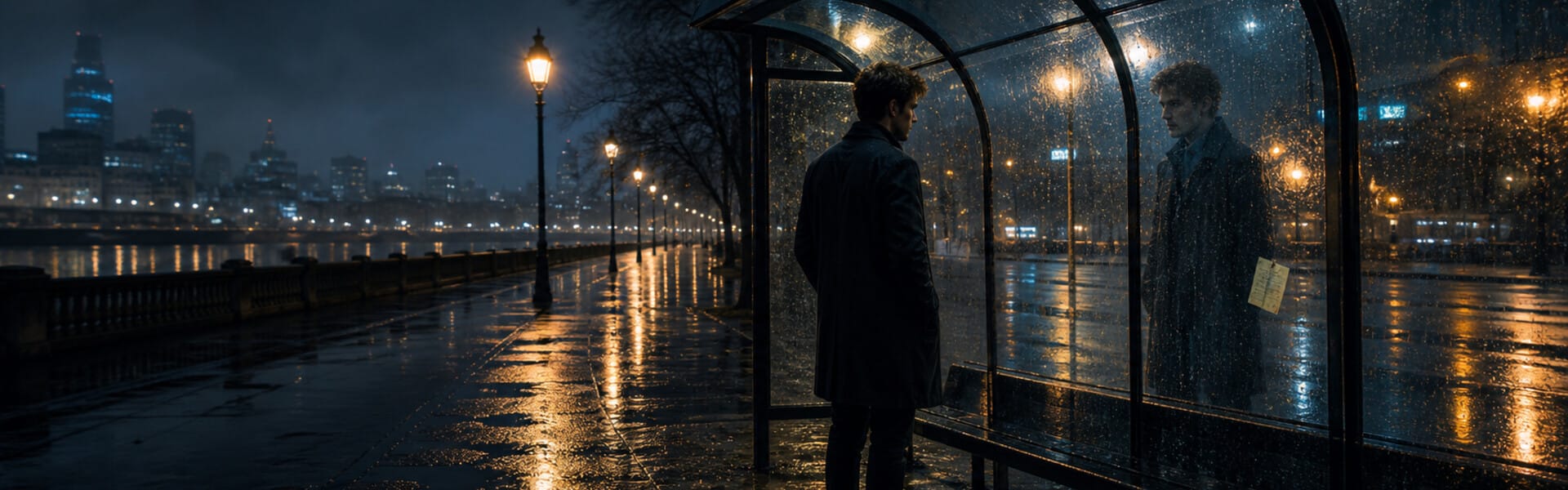
The night bus crossed the river as if baptised by steam. A hiss from the brakes, a sigh from the doors, a breath from the thin crowd—then the route number flickered from mundane digits into the faint, pearly script that only showed after midnight. Someone had once told Theo that the buses kept their own hours and their own maps. He’d laughed, then forgotten the laugh, then stopped forgetting when the glass began to lag.
He rubbed a circle in the window fog with a cuff. His face looked back a heartbeat late: his jawline tugged by some slow tide, eyelid caught like film on a sprocket. The lag made him seasick without moving. He rang the bell and stepped into air that smelt of damp cardboard and old stone. The bus hissed away with the prim patience of a teacher who knew you’d be back.
On the pole at the shelter a sticker bubbled under rain: FIND YOUR DOUBLE. Under it, the council crest and a warning about public order. Somebody had written in biro: IT HAS YOUR FACE. Another hand in green added: OR YOU HAVE ITS.
The ticket clung to his palm, tacky with some bus-floor spill. He folded it into a neat square and slid it into the coin pocket. The fold sat right, as if it had found an old crease. He counted the scrying domes along the terrace—CCTV to anyone else—little black bubbles that watched and, sometimes, told the truth.
He could have gone home. He could have locked the door, boiled the kettle, stood at the sink with the good mug. But hiding would only move the hunt forward to tomorrow. The lag would be there in the bathroom mirror, the smear on the lift glass, the spoon bowl reflection stretching his mouth wafer-thin. The double would find him nearer his front door, and then there’d be no space to move.
So he chose to move now. Hunt, not hide. He heard his decision the way he sometimes heard thoughts—slightly to one side of his skull, like the radio in the flat upstairs.
Patel’s was a market at this hour. Not just trolleys and BOGOF beans—stalls set up in the floodlit car park: crates of pomegranates, cut tulips, knock-off chargers, saints cast in sodium light. People wandered with the polite distance of the over-tired. A warden in a yellow vest paced with a rod hung with salt strings that smelt like the sea and old kitchens. Theo took a basket to be less obvious and walked with the everyday sway of someone pretending to decide between two brands of pasta.
The fruit looked slick. His face looked slicker. Every polished skin gave him back an angle of his head with that slight slip in time. He breathed in for four, out for four, the way an old counsellor had taught him, and laid his damp ticket flat to the glass of the chiller. Paper steadied the hand; the curve of the door turned the faces into balloons. Tiny delays—half-flutters—showed as ripples.
He moved the ticket to the next door and watched the reflection train. A woman in a red raincoat held the same breath as him; on the third beat her reflection blinked; so did the man with the aching expression of someone doing the night shift twice. He let them go. He kept counting.
A guy in a work fleece looked at his own reflection and didn’t blink when Theo did. Theo blinked again—one, two, three—and on three the fleece blinked. Relief should have come. Instead a raw prickle lifted the hair at his nape. The rule had slipped; that was the trouble with rules—it only took a smear on the glass or a curve too tight and the world could lie.
‘You all right, pal?’ a warden asked in a friendly way that wasn’t.
Theo smiled in that quick British way that meant of course, sorry, my fault for existing. He set the empty basket down and walked out at the pace of someone who had remembered milk at home. He felt eyes on his back. Not just one pair. The market watched like a pond watches a pebble, rings spreading even after the pebble sinks. Somewhere behind him, someone who wore his mouth as if they’d practised it would be turning his head at the same angle, adjusting for the same draught in the doorway, lifting left foot first because he had learned that was his habit.
The multistorey kept the city’s heat like a held breath. Concrete spirals coiled down to the river and up to the sky, pillars salted with bird droppings and old chewing gum. Sodium saints burned in their glass niches—tubes humming like a choir with bad lungs. The wind found a laugh in the bays and made it mean. Theo passed Bay 14, Bay 15, Bay 16, the numbers as comforting and pointless as counting beads.
He found a spanner in a wall-mounted bracket near the pay station. His palms were damp; he wiped them on his jeans and remembered too late that this smeared sweat, didn’t remove it. Footsteps ticked like coins in a pocket. He tucked himself behind a pillar; the scrying dome above his bay pulsed its red LED alive, as if waking to watch.
When the shadow moved, he moved. He stepped around the pillar and made the small, mean swing that coaches taught in gyms to people who weren’t ready for fighting but thought they ought to be: short arc, throat height. The spanner chimed. Metal kissed a phone case; plastic split, saving the throat by luck and millimetres. The other him—because he was sure, in his stomach he was sure—caught his wrist and twisted. Theo grunted; the arm went hot then numb. Overhead, a saint flared to full and made them both bright.
They saw each other properly then. Same notch on the upper lip, tiny off-centre mole as if the face had been printed with the plate a little skewed. Same scar under the kneecap from the pedal that bit when he’d outgrown his first bike. For a second they both smiled: that tight, pleased-with-himself smile he’d seen in the mirror when he got away with something.
They backed the same way, then corrected the same mistake, then ran in opposite directions because some part of him—that part that played chess on his phone and imagined he could see three moves—knew that symmetrical escape would get him killed.
In the lift, he pressed eight for the block, then the alarm. A hush settled inside like felt. The strip light gave up and the emergency glow replaced it, green as a swimming pool. The mirror on the back wall wore a smear in the shape of a handprint pulled into a jellyfish by cheap cleaner. He faced himself, lifted his left hand, watched the glass lift left with him.
The doors juddered. The rubber lip squealed as someone forced them. A boot and a knee arrived first, then another him, squeezing through sideways, jaw clenched. Not the car-park twin. New. Calm. The face had the same features but wore them differently, as if the skull under the skin knew a joke and didn’t need to tell it to you. He paused to tap his left thumb once against his trouser seam—an absent habit Theo had never had—and the nerves in the car eased as if they recognised the cadence.
‘I’m the original,’ the newcomer said, tone flat as fact.
‘Everyone says that,’ the other said from the corridor, leaning on the door to keep it open. He held a short length of metal the way a priest holds a candle: upright, reverent.
Theo swallowed. His mouth tasted of penny coins. ‘Prove it.’
‘In the boiler corridor,’ the new one said. ‘There’s a dome. And somebody has been touching the mirrors with grubby hands, which is either spiritual sabotage or a cleaner with a vendetta. Both will do.’
They moved as a set, a strange triptych. The corridor smelt of hot dust and bloodless heat. The pipes ticked like a slow clock learning to count.
By the noticeboard the ink writhed itself legible:
PHENOTYPIC REPETITION: WHAT TO DO AVOID mirrors where possible. DO NOT engage alone. TRUE SELF makes a new mistake; COPY repeats an old one. KEEP receipts. Amendment: Mirrors in Lifts, Arcades & Underways cannot be trusted after midnight unless salt-washed.
Beyond it, the building itself offered a clean aside, the kind the Ministry rarely delivered well: Straight glass is truth-adjacent; convex exaggerates delay; transitional spaces lie. Salt helps. The letters steadied like a teacher’s underlining.
On they went—and the city twitched. The salt-strings on a warden’s rod hung wet and useless in the draught; down the hall three shoppers lifted their hands in the same slow wave Theo had used moments ago and then, sheepish, dropped them—an Echo Crowd ripple, harmless and wrong. A breaker tripped somewhere with a pop; paths shifted. The sodium saints hiccuped and coughed back to light.
At the dome in the boiler corridor, Theo lifted his damp ticket as brace. Paper steadied the view; the curve ballooned their faces. ‘On three,’ he said. ‘Raise your right.’ He counted and watched. One. Two. Three.
Three hands rose. The car-park twin lagged a fraction. Theo pivoted, swung short and mean. Metal met meat. The twin went down with a fox-bright staccato breath. Theo lifted the spanner for a second bite—
‘Wait,’ the third said, very quietly.
In the dome, the three ballooned faces panted. Theo’s reflection had lifted left on the call, not right, then corrected late. The smear in the lift—he had adjusted to it earlier without realising. He had trained himself to the wrong rule. He had repeated the mistake.
‘The poster line’s fine,’ the third said. ‘Mirrors lie for a living. Convex ones lie artfully. Transitional spaces—lifts, arcades, these under-ways—lie unless you salt them. Come away if you want a test that isn’t a bad pub quiz. I know a door.’
The fallen twin made a sound. Not a word. A thin rope of a noise. Theo had the sudden impulse to apologise. To whom, he didn’t know.
They took the service stair that gelled with old skin and the sweet smell of cheap bleach. Somewhere below, a tick started—soft metronome of escalation only the city’s nervous could hear. The Underways began where the door stuck and the stair became something that couldn’t be mapped. The corridor widened, then narrowed, then widened again in a way that made geometry feel like a polite suggestion. The third led, as if he had walked it before. The injured twin limped, metal bar turned walking stick. Theo watched the backs of both heads and felt like a child being taken somewhere he wasn’t old enough to go.
They met the Hag where the pipes sang. Everyone called her that, but she looked like a woman who’d grown out of cleaning shifts and into spells without changing her shoes. Tabard with bleach streaks. A rosary made of till coins. Eyes like wet coal.
‘Three for the price of one,’ she said, and slipped the rosary over her knuckles. ‘Which one pays?’
‘We’re looking for the River Archive,’ the third said. ‘We need a record.’
‘True names don’t come out without wet fingers,’ she said, which was Underways for: you pay with something you’ll miss. ‘What’ve you got?’
Theo held up the ticket. She sniffed.
‘Old paper. Good veins.’ She pinched the square and read the crease like a palm. ‘Someone’s folded this before. Someone who didn’t learn quick enough. You can trade it for a path, but the river will want more.’
‘Take my memory of the shed,’ Theo said before thinking, and then had to swallow the grief of saying it. ‘My dad’s shed. The smell of creosote. The way he’d clear his throat before saying champ. Take it. Leave the shape. Take the weight.’
The Hag looked at him with something like pity and something like respect. ‘Well bargained for an amateur.’ She palmed the ticket. The Underways rearranged as if furniture moved in a flat above. A door that wasn’t a door became a door. Cold air rolled through, carrying the dark-bread smell of the river that ran under the streets and collected what the city forgot.
‘Mind the archivists,’ she said. ‘They tidy by putting things where they can’t be found.’
The River Archive looked like a library after a flood and before a refit. Shelves had grown out of stone. Strings of old receipts and prayer slips hung like bunting. The water slipped by, black and practical. Little inked fish swam in the margins where labels had bled.
The archivists were men and women with paper-cut fingers and bandages. They moved in a parallel hush. When Theo said his name, three heads turned, three pens paused, three mouths thinned the same way, annoyed and sympathetic.
‘Name’s not the problem,’ one said. ‘Time is. Hold still.’
They brought out a box of blown glass the size of a loaf. Inside it hung three threads like hairs. Each sang its own small song—heartbeat laid out as music.
‘Listen,’ an archivist said. Theo listened and knew which was him because it hurt. The thread that hurt sang almost in time, but with a lag that arrived when fear pushed; it stumbled where surprise should lift.
‘Copy,’ the archivist said gently. She tapped the third thread—the calm one—and it thrummed true and mean. ‘Original.’ The middle thread, still singing fox-bright relief and swagger, wavered. ‘This one’s clever but brittle. If he isn’t dead yet, he’s close.’
‘He’s not dead,’ Theo said, hearing his voice from very far away and very near. ‘He’s behind us, counting his breaths wrong.’
‘Pay,’ the archivist said. ‘Or take nothing but the ache of knowing.’
Theo took the ache and paid as well. He closed his eyes and unhooked the shed from the inside of his chest. It left like a tooth—shock of rawness, metallic taste, urge to touch the hole. When he tried to remember, a paper cut-out of the memory remained: a rectangle, a smell if someone else named it first, a space where the good bench with the vices must have stood. He reached for the spanner to test its weight and found a blank where the old memory of grip should sit; his palm argued with the metal like strangers sharing a handle. He would have to learn the feel again from scratch.
The third watched with that same calm. He rested his left thumb against his trouser seam, that small private cadence. The twin pressed two fingers to his own pulse and frowned like someone miscounting change.
‘What then?’ Theo asked no one. The river wrote nothing back.
They walked out with the knowing and without the ticket. The Hag had already hung it on a string over the warm pipe to dry; its watermark flickered with a boat that wasn’t there before. The glass of the archive fogged a fingertip’s worth where the truth had brushed it.
‘You don’t have to go to the boiler corridor,’ the Hag said. ‘Stairs go other ways too.’
‘He’ll go,’ the third said. ‘We all will.’
They went. The city felt thinner now. Theo could see where the scrying domes drank the ordinary light and put back something that wasn’t quite the same. You could live here your whole life and not notice if you didn’t count, if you didn’t listen for the lag, if you didn’t have a second heartbeat walking two steps behind you.
The boiler corridor waited with its patient heat. The dome hummed. The injured twin stood by the junction box, face set the way Theo’s got set when he wanted to look brave to himself. Somewhere a breaker popped; the saints coughed; the escalation tick found a higher register.
‘We can walk away,’ Theo said, and surprised himself by meaning it. He could go up and brew the kettle and see if the mug felt the same in his hand. He could call in sick and mean it. He could live as a copy and see if the world held.
‘We won’t,’ the third said. ‘Because he’ll swing again in a minute. And you’ll try to forgive him at the same time as ducking. We’re a tangle of bad strategies.’
The twin lunged before the sentence finished, because that was how he was built: to go first and call it courage. Theo’s body moved like he’d practised this scene and hated practising it. He fell into their stance a heartbeat early—the flaw the third had named—and corrected with a shove that put the third to the safe angle. He chin-checked the twin with the heel of his palm. The spanner—because of course he’d fetched it—rang off the pipe. The dome drank the movement; the red LED blinked as if a camera somewhere decided whether they were a story worth saving.
‘On three,’ Theo said for the last time, although they were already moving and no one would wait. He counted, and he watched the dome’s balloon faces, and he tried to let compassion fight the logic and lose. He swung short and mean when the lag showed. Metal said the small dull truth of bone being told something new. Heat from the pipe lit his knuckles; a copper taste flooded his mouth; the echo of the blow walked away down the corridor and didn’t come back.
They waited for breath that didn’t resume. The third’s shoulders slumped in a way that looked like relief and grief folded together. Theo didn’t know which was which inside himself. He found himself touching the coin pocket as if the ticket might be there again; of course it wasn’t, but his fingers wanted the crease.
‘If I’m copy,’ he said, steadying his mouth, ‘say what that means.’
‘It means you’re later,’ the third said softly. ‘Not less. You’ll make a new mistake tomorrow. I’ll try not to repeat it.’
They went up in the lift together and faced the smear. Theo raised his left; the reflection raised left with him, on time. His stomach dropped at the ordinary beauty of it. He hadn’t noticed how kind a mirror could be when it wasn’t doing tricks.
‘Do you want the name?’ the third asked in the lobby, like offering a cigarette on a wet morning. ‘The one you were copied from?’
‘I have the shape,’ Theo said. He touched the hole where the shed had been and knew they were both looking at the same absence from different angles. ‘Keep the weight.’
The third nodded. ‘Crowds help,’ he said. ‘Stay in them. You’re worse alone.’
‘So are you,’ Theo said, and tasted envy like salt on a glass rim.
They stepped into morning that tried to begin and couldn’t quite. The city blinked between wards—the pearly script on the bus signs fading to digits, the saints coughing back to life in ordinary sodium. A sticker on the lamppost had peeled another layer in the night: KILL YOUR DOUBLE over FIND YOUR DOUBLE, over LOVE YOUR NEIGHBOUR in faded print from a different campaign. The paper looked like dragon skin with all the scales half-off.
At the stop, an LED whine sank to silence as the sign settled back to mundane numbers. The bus hissed as if amused. They boarded and stood side by side like brothers who didn’t have to perform the role. They didn’t talk. They watched the scrying dome where drivers checked the top deck for teenagers smoking. The red LED pulsed. Their faces ballooned. On the third pulse both rose left, then right, then left again—together. The soft tick thinned to the LED’s faint whine, then nothing. Something inside Theo unclenched like a hand told it could stop gripping.
At the river, fog rose like a sheet. People got on, people got off, nobody knew them as anything except two men with the kind of hunger you keep at the back of your mouth so you can pass for all right.
Later—days later, or the same day run again—Theo took the Under-Hag a bunch of garage lilies that smelt of funerals and petrol. He didn’t know if you took flowers to an Under-Hag, but he did it anyway. She accepted them with the face people make when they’re surprised into liking you.
‘You’ll need change,’ she said, and handed him a palmful of coin-sized charms stamped with bus routes and saints. ‘When the lights go out, tip the dark. It hates bad customers.’
‘Do copies get to keep keepsakes?’ he asked. ‘Is that allowed?’
‘Allowed by whom?’ she said. ‘Kings? Mirrors? Yourself? Keep what you can carry without becoming a museum.’
He kept the advice. He kept the feel of the crease in his pocket even when the ticket was gone. He kept the ordinary kindness of dawn finding his flat and showing him dust so he’d have something to do with his hands. He kept the decision to count crowds as company and not threat unless they proved otherwise.
On a wet Thursday when buses ran late and people ran later, he saw his face in a chemist’s convex mirror and watched it arrive precisely on time. He had the urge to wave. He didn’t. He bought plasters and aspirin and a packet of mints. Two shoppers at the till unconsciously mirrored his pocket-pat and then, embarrassed, aborted the gesture—an Echo Crowd ripple, small and harmless. He put a mint on his tongue and let the little white boat dissolve.
That night he passed a noticeboard where the moving ink had written a new line:
Copies may live. Originals may die. The city keeps time for both.
He touched the corner where paper curled. He didn’t tug this one. He let it be. The city kept its own clocks and didn’t need his help.
In the flat, he boiled the kettle and found the good mug and didn’t flinch when he saw himself in the window over the sink. He lifted his left hand. The reflection lifted with him, on time. He eased the lid on a jar with new care, feeling for the grip he was busy relearning. Breath went out; another came in. He waited for lag and got ordinary glass. He smiled the small, foxlike smile and felt it soften.
Tomorrow the buses would hiss and the domes would hum and somewhere someone would stick a new sticker over an old one. The river would keep its dark bread smell. The Hag would count coins with knuckled prayers. The third would walk somewhere ahead, making a new mistake he’d have to forgive himself for, and Theo would follow, slightly late, trying to make mistakes that were his and not anybody else’s.
He kept nothing sharper than he could carry without bleeding. He kept the habit of counting, then the habit of stopping. He kept the space where the shed had been and found he could put other things there if he was careful.
He didn’t throw away any more tickets. When he found one on the pavement, softened by rain, he folded it along the natural lines, the way a city teaches you to fold. He put it in his pocket, not because it would save him, but because it reminded him that paper remembers fingers and fingers remember things you haven’t said out loud yet.
The city ticked. He breathed with it. Late, but learning.
No published comments yet.