
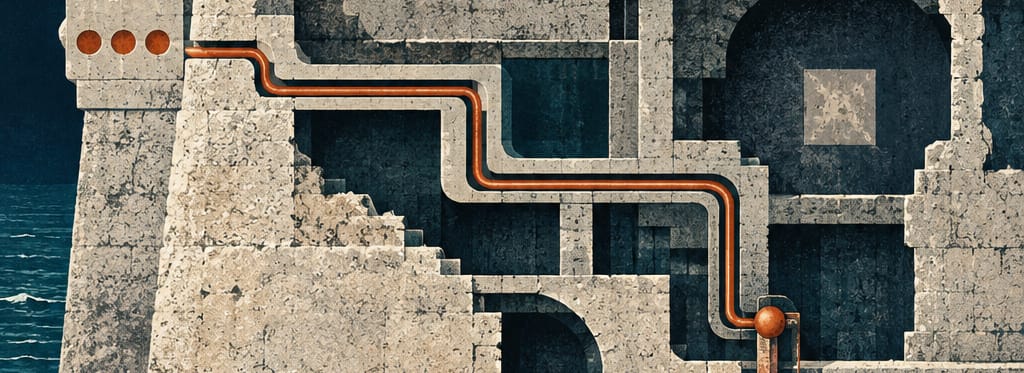
The first knock came through the wall while I was scraping salt from the harbour gate.
Three taps, a pause, two taps. The pattern was the old maintenance call for person inside. Nobody had used it since most wall rooms were sealed, and the only things inside this section of the harbour wall were supposed to be conduits.
I put my ear to the stone. ‘Again.’
Three taps. A pause. Two.
The gate held back the sea at high tide. In two hours the spring surge would arrive, carrying storm water down the channel at the same time. I had been sent to free a wheel that had rusted shut. Whoever was inside the wall could wait, I told myself, until I had done that.
‘Can you hear me?’ a voice asked.
I dropped the scraper. The voice sounded close enough to be standing in the next room, but I knew what the wall did to sound. A bell struck at the north end could be heard at the south stair before it reached the room beneath it. The old builders had packed the passages with pipes and ceramic mouths. Nearness, here, was an unreliable thing.
‘I hear you,’ I said. ‘Where are you?’
‘At the red wheel.’
There were four red wheels. I asked which one.
‘The one beside the window.’
I had repaired every chamber in this wall. None had a window.
I walked to the inspection hatch and turned its handle. The wheel beyond it was blue. The passage was empty. A light burned somewhere past the next bend, though that circuit had been cut in winter.
‘What can you see?’ I called.
‘The sea,’ she said. ‘Mostly the back of your head.’
I turned. From the harbour walk there was no window, only a square of plaster the colour of wet bread. I put my palm against it. Something pressed back. We both pulled away.
The settlement had been built in layers after the first breakwater failed. Each new wall enclosed the previous one, leaving rooms for pumps, workers and, when space became dear, families. The rooms were abandoned gradually. On old plans the wall looked like a single band of grey, thick enough to hide its former addresses.
‘My name is Eda,’ she said. ‘The wheel won't turn. Water's coming up my stairs.’
I told her mine. ‘Neri. I'm outside the gate.’
‘Then turn your wheel before the surge arrives.’
The wheel under my hands did not move. When I leaned my weight against it, a small red mark appeared on the plaster beside the square. I tried again. The mark widened into a line.
‘Stop,’ Eda said. ‘My wall is splitting.’
I could not see her split. She could not see my wheel. Our two accounts made a dangerous diagram.
I ran to the keeper's hut for the plans. The keeper watched me spread them on the floor. ‘Those inside rooms were filled,’ he said.
‘She has a name.’
‘Sound carries.’
‘She can see the back of my head.’
He came outside and faced the blank plaster. Eda told him the colour of his scarf. He took it off and held it behind his back. She told him the lining had a tear. His hand went to the tear before he remembered that a guess, however good, was still possible.
We found the earliest plan, drawn before the harbour walk was paved. A narrow chamber sat between two gate mechanisms. A glass block had once opened towards the sea; the later wall enclosed it. What Eda called a window might be a relay image made by angled glass. What my hand had met might be hers through a thin membrane. The plan did not say. It showed a service tunnel under the walk, sealed at one end by a plate.
The keeper wanted to knock out the plaster. I remembered the red line.
‘If that's load-bearing, we flood both sides,’ I said.
We carried a spool of wire to the service plate instead. The bolts had been covered by twenty years of paint. Eda counted her stair treads while I chipped at them: one dry, one wet, two wet. At the last bolt she stopped counting. I imagined her watching water climb towards her knees. I had no proof of the height, but I could hear her breathing.
The plate came free. Behind it was a gap too narrow for a person and a lever tied to a heavy rod. When I pulled, my gate wheel loosened a fraction. Eda cried out. I let go.
‘Tell me what moved,’ I said.
‘The red wheel. A tooth. And the water dropped for a second.’
The keeper wanted me to pull hard. We had one hour. I asked Eda to strike the red wheel once whenever I began to pull, twice if the crack grew. She agreed. At first the knocks reached me out of order. The pipes carried her warning by a longer route than the sound of the wheel. We tried a slower count, with a pause long enough for both signals to arrive.
At the fourth pull I heard one strike, waited, and heard no second. The rod shifted. Outside, the gate lifted a hand's width. Water pressed through beneath it and ran into the lower channel. On the other side of the plaster, Eda laughed once. Then the line along the wall stopped widening.
We held the lever while the surge passed. The keeper sent for a mason, who cut a safe opening from the dry end the next morning. Eda stepped out carrying a tin cup, a coat and a small pot of mint. She had worked in the chamber for eleven years, entering by a landward stair that the storm had flooded. Her father had done the job before her. The keeper had inherited the new plan and knew neither fact.
From outside, Eda examined the plaster square. It showed no window. She set her mint on the harbour walk and stood beside me. The sea looked nothing like the image she had lived with: there was less sky, and a breakwater cut across the horizon.
‘Did I describe it wrongly?’ she asked.
‘You described what you could see.’
She took the pot back up. The leaves were salt-burnt on one side. She turned them towards the sun, and we went to find out what else the plan had left inside the wall.


No published comments yet.