
I
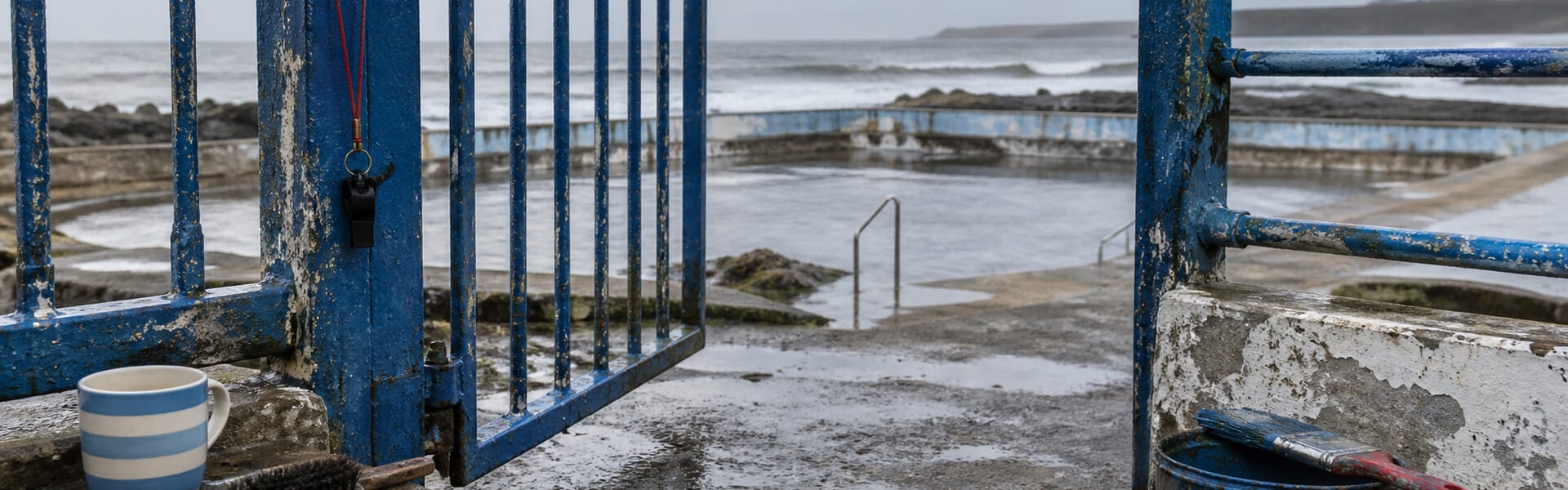
The first time the rail gave under his brush, paint came away in a ribbon, soft as old soap. Ivor rolled it on his thumb and flicked it towards the pool, where it fell short and caught in a web strung like a crack between post and chain. The lido had taken another winter and not thanked anyone for it. Salt had lifted the blue into curls; concrete had split hair-fine; the diving board no longer shouted, only sulked.
In the hut the kettle rattled on the plug-in ring. He stood in the doorway and watched the steam fog the window. The place smelled like a cupboard of lanes: damp towel, rope, a history of chlorine. Above the desk the tide timetable hung beneath a drawing pin bruise, paper browned at the edges; pencil marks marched up and down it—safe hours, red-circled days when the spring tides would paw at the far wall.
The council’s October letter put non-viable in neat, thin type—like a wrist. He had read it at the small kitchen table with a fork on a plate of beans, and the word had gone around his house, touching chair leg, hallway, window latch, like a draught you could not plug. Close the place, sell it. Fold it into some developer’s idea of luxury: glass, deck chairs that never got sand on them.
He lifted the whistle from its hook. The lanyard had a place where his thumb fit without thinking, a smooth trough from years of idle rub. The whistle itself was blunt and black, the mouth of it shining where it kissed teeth. He set it back, then didn’t, then did. The calendar still said August. A girl in a red cap dove forever into a square of sky.
It would be easy to let the place rust—let the sea finish the job.
A gull heckled from the platform, one foot tucked. The wind slid off the water with that wet iron smell that sharpened your teeth. Ivor slipped his mug around his hands, walked to the gate, and told himself he was only checking the chain. The padlock stared back, dutiful and thick. He imagined children he had known by voice before name, imagined elbows and squeals and belly-flop slaps. A chorus of “Oi, Mister!” that would never bother to know his surname. He set the mug on the top rail.
The TURN came flat as a switch. He fetched the wire brush and scraped. Flakes skittered down like fish scales. He worked one post to the bone and then a second. When his shoulder burned he popped the tin of primer he had told himself not to buy. The first stroke was white as a gull’s wing. It bled across the scarred metal and left it honest. By noon a patch of railing had a new skin. The sea lay down its breath and picked it up again. He checked the tide times and marked a square: Friday, 10:30–14:00 safe.
At dusk he locked up and left a clean white thumbprint on the hut door, a mark like an oath he hadn’t meant to make.
II
The boy came three days later, hood up, trainers dark with old spray. He rattled the gate, hands in pockets.
“We’re shut,” Ivor called.
The boy did not step back. “I know. You’re Ivor, right?”
He was always Ivor to the kids, never Mr Anything. “Who’s asking?”
“Kai. I used to come with my mum. She’d do lengths. I sat on the warm pipes and nicked crisps.”
“Charming upbringing,” Ivor said.
Kai smiled, brief and sideways. “Saw you painting. Thought you might want a hand.”
“I didn’t.”
“Right.” The boy’s hands stayed in pockets, but his shoulders refused to slouch. “Look, I get funny in open water. Panic. Open water makes the edge look farther than it is. Brain lies. Hands don’t. Thought… if I could get back in here, maybe it’d fix it a bit.”
“We’re not open.”
“I could scrape railings,” Kai said. “I’m good at tedious.”
“Everyone says that until they meet tedium proper.”
“Try me.”
Ivor looked past him at the town. The shops were compact and stubborn. An estate agent’s window had a new word on it—‘harbourside lifestyle’—that made him want to sandpaper something. He could say no and the boy would go, and maybe nothing would crack in him over that. Or he could say yes and find he had a pair of hands that were not his own, and with hands came noise and with noise came other people, and that door never shut without catching a finger.
He stood with the weight of the keys in his pocket. “If you’re staying, you start with the bottom rail. Salt gets under that worst. Don’t lean on it; it’ll throw you.”
The boy’s face opened like a curtain tugged. “Yes, I—thank you.”
“You’ll need gloves. Bring your own. And I didn’t promise anything about swimming.”
Kai nodded like a diver steeling himself, and Ivor hated the small tug of pride he felt for an outcome that wasn’t his.
III
They worked the week thin. The weather held in its grey, a lid on a pan of water. They scraped and primed; he taught Kai how to feed a brush at a seam and not leave tears that would catch. Kai showed up on time, gloves cheap and red. He did not talk much, and when he did it was a low commentary that neither asked nor apologised.
“Never knew steel could smell like that,” he said, scraping.
“Salt wakes everything up, even metal.”
“Wakes people up too?”
“Some of us.”
On Thursday a woman with a pushchair paused properly and watched their strokes. The baby inside slept heavy; its hand was open to nothing. The woman had seaside skin—the kind wind polished, not sun. She gave Ivor a small smile, then rode the pram away.
On Friday they were packing when a man in a council fleece arrived with a roll of notices under his arm. He smelled like printer ink and car heater.
“You are?” the man asked, pen ready.
“Caretaker,” Ivor said.
“Caretaker of what?” The man tipped a look at the rail, white where it hadn’t been.
“What’s left,” Ivor said.
The man peeled a notice and smoothed it onto the gate with one hand like a baker frosting a cake. The paper took the curve of the metal as if there had always been a place for it. PUBLIC SAFETY WARNING. UNAUTHORISED ACCESS PROHIBITED. FUTURE WORKS PENDING. In smaller print, there was an email address and a phone number, as if complaint could be directed into a drain.
“Pending what?” Kai asked.
“Assessment,” the man said. “And then the best outcome for all stakeholders.”
“Stakeholders,” Ivor repeated, savourless.
The man eyed the whistle on the hut hook and smiled in a way that did not include anyone. “Good to see community spirit,” he said, and left.
The shallow-end ladder wobbled. Kai frowned, tightened a loose bolt with a borrowed spanner, dropped it, swore softly, then tightened it again. The clean click gave him a look of ridiculous pride.
After the notice, Kai leaned on the rail, then caught himself and lifted his weight. “You going to leave it?”
“I’m going to make a cup of tea,” Ivor said.
“And after tea?”
The question went round the yard and touched the chain, the hut, the timetable pin. He could obey and get on with the dignified business of folding away years. Or he could break a small rule now and a bigger one tomorrow and be wrong in public.
He set the kettle on. “Tomorrow’s low tide at eleven. Bring a broom.”
Kai looked at the notice, then at him. “You’re going to open.”
“I’m going to tidy,” Ivor said. “And if someone happens to walk in while the gate is tidied, it would be discourteous to shove them out.”
IV
Saturday brought a sky the colour of washing-up water but dry, and that made it a blessing. They hosed the green from the edges; he chalked a square of the promenade as a ‘changing-ish place’ and taped bin bags for windbreaks. He unlocked the gate and looped the chain so it pretended to be there.
Word got round the way word went round in such towns—fast, tangled, and inaccurate. By noon there were six people waiting: the pushchair woman, now with a small boy as well; an older man in a cap who claimed he had swum here the day the Queen came to open the bypass; a mother with twin girls in matching towels; a person in a wetsuit that made them look both sleek and absurd.
“You can’t just let them,” Kai said, low.
“I can just watch,” Ivor said, and lifted the whistle.
The first toot startled gulls. It startled him too. The sound was authority and memory. The small boy ran, stopped, looked at him with wounded eyes, then laughed and ran again with more care. Water admitted bodies with that sharp intake, the air filled with squeal and flinch and then the dull joy that sits heavy and warm once shock is over.
The twin girls edged towards the deep end like diplomats. The older man floated on his back, cap caught on the wind. The person in the wetsuit cut neat lanes and ignored everyone. The pushchair woman watched, hands on her son’s shoulders.
“Name?” Ivor asked her, between whistle and wave check.
“Maya,” she said. “This is Alfie. The baby’s Mina but Mina sleeps where she wants.”
“You brought snacks,” he said, noting the cool bag.
“We’re professionals.”
He felt the tightness of the week release one notch. Kai stood at the shallow steps and held out a hand wordlessly to those who wanted it; he looked, in that moment, like a lad who knew how to be used and not resented for it.
The incident was small, and in spite of that, his heart kicked him like a horse. One of the twins took a long breath at the wrong time and decided she would not like breathing anymore. Her mouth opened to a black coin. He was moving before the thoughts formed—whistle, lean, reach. The girl took his wrist in both small hands as if it were a rope and he pulled without fuss, water streaming off her plaits. She coughed water, then tears, then a wet hiccup that turned to laughter because her sister was already laughing and calling her a baby.
“Not a baby,” he said. “Just found the deep a surprise. Happens to the best of us.”
The mother mouthed a thank you across distance. He raised the whistle and let it stand in for grace. When he looked, Kai was grinning the grin of someone who had seen a trick and liked knowing it.
“Still think you’re not opening?” the boy asked.
“I’m tidying,” Ivor said again, but the word had softened into a lie that knew it was loved.
V
That night the weather swerved. Wind came up from the direction people blamed for bad decisions. By midnight the rain arrived in hard lines the streetlights revealed and then hid. Ivor stood in his kitchen and looked at the kettle like it might rule on his next move. If he left the lido to it, the chain would work loose, the gate would bang until it tore its hinge, and bits of their work would go into the sea and return in guilty drifts. If he went down, he’d be a man in a wet hat.
He put on the wet hat.
At the pool the wind tried to push him by the shoulders. The diving platform groaned, a low animal sound. Foam slapped the outer wall, then retreated ashore to sulk in the gravel. He set his back to the gate to keep it steady and soaked inside his coat in a single minute.
A torch clicked alive beside him. Maya, hair rammed under a beanie, jacket zip up to her chin.
“You’ve no sense,” he said, grateful to see her and annoyed to be grateful.
“I brought rope,” she said. “Neighbour’s washing line. Don’t ask.”
“Don’t need to if you tell me anyway.”
They worked with small words. He tied a figure-eight he had taught a hundred kids in a hundred summers; she took the knot like she had been waiting to be given something with rules. He reached for a second line; the wind plucked it from his hands and sent it skating. Kai’s torch found it first. The boy sloshed across the yard, hair plastered.
“My gran said you’d be here,” he said, unapologetic.
“Your gran would be right,” Ivor said. “Tie this.”
Kai made the first loop wrong, swore under his breath, remade it, then pinched the final tuck home with satisfying neatness. They made a triangle of rope and stubbornness. Wind worried it, then took its worry elsewhere. They stood in the lee of the hut and watched the tide throw itself and rearrange nothing.
“When I was twelve,” Ivor said, surprising himself, “a boy went quiet in the middle lane while I was looking the other way. Doesn’t take a minute. If the girl today had taken that breath an inch deeper…”
Maya did not put a hand on his arm, for which he loved her immediately. “She didn’t,” she said.
“No.”
“And you didn’t look away.”
He thought of the years he had been paid to blow a whistle and be the boring adult who told you off for running. What a strange thing to be proud of: boredom as an act of care. His bones had got older doing it; they had got older anyway.
Kai glanced at the timetable through the hut window, where the damp had faded the pencil marks to shy ghosts. “Tomorrow’s safe two till five,” he said.
“If they don’t chain us for good after this,” Ivor said.
“Then we’ll cut it,” Maya answered, and the ordinary violence of that made him laugh.
VI
The council set the meeting for a Tuesday in a room that smelled faintly of other people’s coffee and a century of dust. On the wall a clock the size of a ship’s wheel ticked like a threat. Three councillors arranged their faces into professions of interest. A woman from a trust wore a scarf with cranes on it and had a warm voice; a man from ‘the developer’ wore a smile that had forgotten what it was for.
Ivor did not plan to speak. He had brought the tide timetable, a folder of photographs, and a bag of receipts for paint and rope. Maya brought a petition she had sworn she wasn’t collecting and a baby who slept through policy. Kai wore his best shirt and a look of someone who will not move unless pushed.
A councillor cleared his throat. “We all value history,” he said, and that set the tone: the tidy burial of a memory.
Maya stood. “It isn’t history if we’re standing in it,” she said. Her voice was not loud, but it carried the way certain truths do when they arrive with their shoes on. She passed around photographs: muscle men from the 50s, women in caps with lipstick bright as buoys, a lad leaping, arrested midair forever. “We don’t want a plaque,” she said. “We want a place. We want our kids to have a cold shock on their tongues and a safe spot to learn how their bodies move in water.”
The cranes-scarf woman nodded as if given a fact rather than an opinion. “What about safety?” she asked. “Staffing? Liability? I’ll need a lifeguard rota on paper, first-aid refreshers scheduled, and proof of public liability before a key crosses a desk.”
Ivor placed the timetable on the table like a map. His pencil marks looked small, but he kept his hands clear. “We plan our open times to the tide. We keep a watch. We train volunteers. You can take the old arrangements from the archive and staple my name to them if that helps you sleep. We’ll file the rota and the certificates.”
“And funding?” the developer’s man said, smile like a damp patch growing. “You’ll find the maintenance costs are… ambitious.”
“Friends of the Lido,” Kai said, before Ivor could. “We’ll set it up. We’ll charge a little and ask a little and sell a lot of tea. My gran makes rock cakes like weapons.”
The developer’s smile tightened. “Tea is not a business model.”
“No,” Maya said. “It’s a community. You can tell the difference by the noise it makes.”
There was quiet in which Ivor felt, astonishingly, protected. He had not asked for it. He had expected to be the one in front while the weather battered him. But here were people standing in his wind.
The cranes woman smiled. “A trial season,” she said, “with safety measures, volunteer training, paperwork in order, and a review at the end. Limited hours to start. If it works, we talk long term. If it doesn’t—”
“We’ll know we tried,” Maya said.
The councillors huddled as if a sea had to be crossed and they were arguing who should build the boat. The developer’s man checked his phone, as if money might text him comfort.
“Three months,” the lead councillor said at last. “No promises beyond that.”
“No promises,” Ivor repeated. How many of those had he lived on. He picked up the timetable and did not apologise for the tremor in his hand.
VII
They set the day for May, a Saturday, blue by accident. Word travelled again, this time with bunting. Alfie arrived with a paper crown; the twins with matching plasters on their knees, already scuffed. An old woman came with a fold-out stool and the claim she had met her husband here and he had proposed while still dripping. “We were mad for it,” she said, and nobody asked whether she meant the sea or each other.
They had painted and tied and mended until the place felt less like a memory and more like a room you could live in. They had hung a board near the gate that said FRIENDS OF THE LIDO in tidy letters; beneath it names had tucked themselves like swallows under an eave.
Ivor wore a clean shirt under his coat. The whistle lay against it like punctuation that could be question or command. Kai stood to his right in a high-vis vest that made his shoulders look reliable. Maya carried a tray of tea and put it down and then did not pick it up again because the tray was no longer hers once people saw it; it belonged to the day.
“Speech,” someone called. It might have been Alfie, because it sounded like mischief.
“I’m not a speech kind of man,” Ivor said.
“Good,” Maya replied. “Make it short.”
He looked at the water. It had the same look it had had every day of his adult life—grey, a bit sulky, likely to surprise you if you treated it like furniture. “Keep your heads,” he said. “Mind the edges. If you want to run, do it somewhere else. If you want to show off, make it tidy. If I toot the whistle, you listen. And if you’ve got complaints, congratulations, you’re part of something.”
It would do. He turned the key. The gate groaned, then yielded. He checked the tide times without pretending it was a superstition. Safe until two. The pencil mark looked very black and very small, like any promise.
Water admitted them, and them it. The first shock made mouths open. Then there were strokes, and different ideas of grace. The twins took it in turn to cannon; the old woman put her feet in and told Alfie a story he would misremember later; the cranes-scarf woman swam with a competent head; the councillor who had said history tried not to look like he was enjoying himself.
“Want me in the deep end?” Kai asked.
Ivor touched the whistle. It clicked against his wedding ring, which he still wore because what else would that finger do. He studied the boy and saw the way he held himself near a waterline, not avoiding it, not daring it, only insisting he would not be persuaded by fear. He took the whistle off and passed it.
Kai blinked. “I’m not—”
“Today you are,” Ivor said. “You can practice the toot.”
“Is there a wrong way?”
“Oh, endless.”
The boy laughed, lifted the whistle, and sent a clean note across the pool that turned three heads. His face changed the way faces change when they are given a job they think belongs to someone else, and the edges fit anyway. Something eased in Ivor’s chest and settled, heavier in a good way. Responsibility had weight; shared, it sat better.
Kai passed the whistle back. Ivor looped the lanyard round his neck and felt the familiar click at his sternum.
Maya stood beside him and followed the wake of a swimmer with her eyes. “You look lighter,” she said.
“I’m heavier,” he said. “Responsibility is weight.”
“You know what I mean.”
He did. He would not name it where someone could hear and call it sentiment. He touched the tide timetable. On the desk lay a stack of forms: volunteer rotas, first-aid refreshers, a note about sourcing a second-hand rescue can. Paperwork had not been his friend for years. Now it looked like a cat that had decided he was acceptable furniture.
At half-one a cloud did its coastal trick and cut the light; the wind pulled at bunting and made it flap like a bad idea. He checked the sea clock with the old habit that had nothing to do with the one on the wall. Safe, still. He raised a hand and the gulls along the rail fell briefly quiet, as if the place itself were listening. He blew the whistle once, casual, to remind small legs to mind themselves. His thumb found its groove in the lanyard.
“Lido closes at two,” he called, and people nodded without argument because they trusted the shape of a rule.
At ten to two he lifted his hands and waved, the small shepherding gesture of a man who has ushered a hundred different afternoons to their close. “Last lengths,” he said. “Savour them.”
Bodies slid through water, doing what bodies had always done when given a lane and permission. He counted under his breath in a way no one registered. Two by the steps. One at the rope. Three at the shallow. Wetsuit, cap, towel, tiny hands on tile. He let the whistle fall quiet.
At two he shut the gate and loved its groan. People milled, damp and pink, summarising their own prowess with elegant lies. The wind had put flags in their hair. Someone pressed a flapjack into his hand and called it wages. The cranes-scarf woman promised training dates; the councillor murmured something about budget; the developer’s man stayed away. Contribution of a kind.
Maya looked at his fingers, at the place they had been stained white a month ago, the thumbprint on the hut door now half-worn off but still there if you knew where to look. “You going to keep that?” she asked.
“The print or the door?”
“Either.”
“Both,” he said.
He locked up and put the keys in his pocket and felt them a little less like ballast, a little more like a bell. The sea breathed in, breathed out. Gulls heckled somewhere out beyond the wall and then thought better of it. He stood with his people, and when they left he did not feel the old conclusive silence lick at his shoulders; he felt a pause that contained a next time.
Back in the hut he updated the tide timetable with a new neat line: OPEN: SUN 11:15–14:45. The pencil marked the paper; the paper accepted the mark. On the wall the August girl still dove into blue. He did not take the calendar down. He did not change it either. Time could fray at the edges without losing its centre.
He hung the whistle on its hook. It clicked against wood, ordinary as cutlery. He turned out the light, stepped out, and left the hut with the door behind him wearing a fingerprint he had made without permission. The paint had dried into it properly now. It looked like a small white fossil in a blue field, the kind the sea makes by accident and people pick up and call lucky.

No published comments yet.