
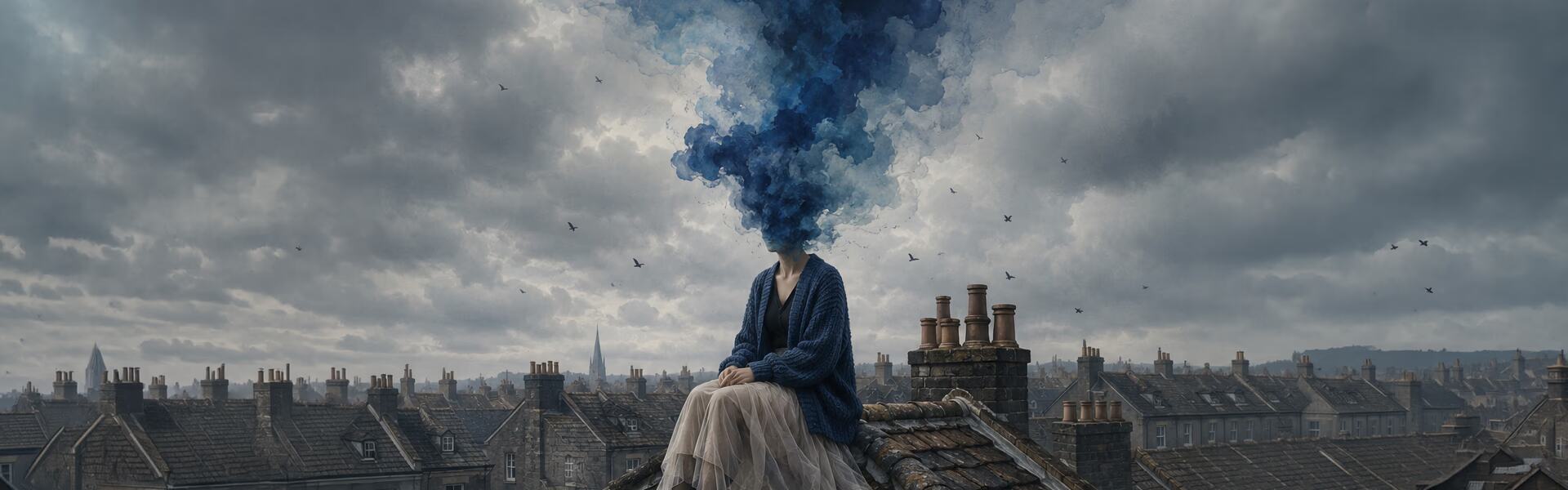
Mina hooked one boot under the ridge tile and felt the headache look for daylight.
The roof still held yesterday’s damp. It worked into her tights, into the hem of the charity-shop tulle skirt she had bought because it looked like something a swan would refuse. Her cardigan sagged from both shoulders. Below her, the kitchen skylight stood open by a hand’s width, letting out cumin, washing-up liquid, and her mother’s voice.
‘Mina. Down.’
‘I’m nearly done.’
‘You said that last time.’
Last time had left blue residue on the satellite dish and three complaints in the North Lane residents’ group. Last time, Mrs Vale from number 12 had come round with a photograph printed on office paper: Mina kneeling on the roof, smoke hiding her face, hands gripping her cardigan as if the whole sky might take it.
Mina pressed her thumb into the valley of her collarbone. The smoke came anyway.
It rose cold from the back of her neck. Not fire smoke, not kitchen smoke, not the sweet guilty drift from Yas’s mates behind the garages. This was blue and soft-edged, heavy as wet wool. It climbed over her jaw and nose until the world blurred behind weather.
From the skylight, Yas said, ‘You look mad cinematic.’
‘Shut up.’
‘Medically cinematic.’
Across the gap, Mrs Vale’s secateurs stopped ticking. She stood in her pocket garden with one gloved hand on a dead rose stem. Even from the roof, Mina could feel the woman arranging her face into concern.
‘Are you quite safe up there, love?’ Mrs Vale called.
Love. The word landed like a stone in a mug.
Mina tried to make the smoke thin. She knew the trick: slow breathing, eyes on a fixed point, pretend the pain belonged to someone on television. The cloud trembled, then folded itself into a shape.
A rectangle.
Yas went quiet.
The blue deepened. A second rectangle slid inside the first, then a narrow little door, then a square that might have been a mattress or a table. Lines branched. A pipe. A window with no view. The cloud held itself above the roofline, neat as a drawing on tracing paper.
Mina had seen the smoke make cupboards, boarded windows, a square of carpet beneath a bed. Never a person. Always the place something had been put away.
‘Mina,’ her mother said.
Mrs Vale dropped the rose stem.
Something clinked in the gutter by Mina’s ankle. A key had come loose from a clot of moss and wet leaves. It was small, silver, and tied to a cloudy plastic tag.
12A.
Above the gutter, a strip of lead flashing had lifted along the party wall. The key must have been tucked there, out of rain, until yesterday’s weather worked it loose.
Mina closed her fingers around it before anyone else could see.
By the time she climbed through the skylight, the smoke had thinned to a blue bruise along her hairline. Her mother stood on a chair to help her down, though Mina was 22 and hated being lifted anywhere.
‘You are on a roof in a tutu,’ her mother said.
‘It’s tulle.’
‘It’s Tuesday.’
Yas laughed once and stopped when their mother looked at him. He had already spread a tea towel over the table and was drawing what he had seen with a biro: rectangle, inner rectangle, door, pipe, mean little window.
‘That’s number 12,’ he said.
‘There is no room there,’ their mother said. ‘There is loft insulation and that awful woman’s Christmas decorations.’
Yas tapped his drawing. ‘Then why did your weather system do architecture?’
Mina rubbed the cloudy tag with her thumb.
Their mother took the kettle off before it boiled. She did that when frightened, as if even steam had to be managed. ‘Nobody is going over there. Nobody is showing anybody anything. Nobody is saying hidden room.’
The doorbell rang.
Mrs Vale did not wait to be fully invited in. She stood on the threshold in gardening gloves, cheeks bright, mouth damp at the corners. In one hand she held a folded sheet of paper. In the other, nothing. Mina noticed the nothing first. The woman’s fingers kept closing around the air.
‘Parveen,’ Mrs Vale said, ‘I’m sorry, but this has gone on long enough.’
‘Mina has migraines,’ her mother said.
‘Migraine is one thing. Outdoor discharge is another.’
Yas pressed his mouth into his sleeve.
Mrs Vale unfolded the paper. It was headed NORTH LANE RESIDENTS’ ASSOCIATION in clip-art ivy. ‘We have to think of the terrace as a whole. Paintwork, resale, children’s nerves.’
Mina looked from the ivy header to Mrs Vale’s gloves. ‘Whose children?’
Mrs Vale’s concern cracked, then reset. ‘It is not always about you, dear.’
The key warmed in Mina’s fist. She could feel the plastic tag biting the crease of her palm.
‘Did anything fall into your gutter?’ Mrs Vale asked.
Yas looked at Mina. Their mother looked at Yas.
Mina looked at Mrs Vale’s gloves: soil beneath the nails, one rose thorn stuck in the cuff, a pale line where a ring had been removed.
‘Leaves,’ Mina said.
Mrs Vale held her smile. ‘If you find anything that belongs to number 12, you’ll return it.’
Mina stood. Her knees felt borrowed. ‘If number 12 has another number inside it, maybe number 12 should explain.’
The kitchen shrank around that sentence.
Mrs Vale folded the complaint with great care. ‘Parveen. Speak to your daughter.’
‘I am speaking,’ Mina said.
Mrs Vale stepped backwards into the afternoon’s flat light. ‘Then speak quieter.’
Extract: North Lane Residents’ Association group chat, 15:42
Mrs V: Please keep pets and young people away from rear gardens until the atmospheric nuisance at No.10 has passed.
Yas: not a nuisance if it’s got a floor plan
Mrs V: Who added Yasir?
Yas: ask why no.12 has a secret no.12a
Her mother shut herself in the front room. She did not lock the skylight. On the chair beneath it she left Mina’s old trainers, toes facing the wall.
The second time Mina climbed out, she took the key.
Yas went first through the skylight, all elbows and fake bravery. ‘This is stupid,’ he said, already reaching back for her.
The terrace roofs stepped away in both directions, red-brown and lichen-scabbed. A gull stood on a chimney pot with the bored authority of a landlord. Number 12’s rear roof had newer tiles near the party wall, a different colour, too clean.
Mina moved along the valley where the houses touched. The headache had settled behind her eyes like a thumb pressing from inside. She could feel the smoke waiting.
Yas pointed to a square of sealed glass low on number 12’s roof. ‘That wasn’t there when we were kids.’
‘You were eight.’
‘I had strong opinions about skylights.’
From below, Mrs Vale’s back door clicked.
Mina crouched. The smoke leaked before she meant it to. Blue slid over the tiles, found the sealed glass, and gathered itself into the same room as before. This close, the lines sharpened. Mattress. Pipe. Shelf. Kettle. Bucket. Narrow door with a padlock drawn in dense blue knots.
Mina’s stomach turned.
The smoke trembled. Mina tasted metal.
A sound came from beneath the roof.
Three taps.
Yas grabbed her sleeve.
Mina tapped back before fear could stop her. Once. Twice. A third time.
Silence.
Then three taps again, fast enough to be a hand.
The key in her palm seemed to grow teeth.
Mrs Vale’s voice rose from the garden. ‘Get away from there.’
Mina leaned over the gutter. Mrs Vale stood below with her gloves off now. Her face had lost all its neighbourly furniture. No smile, no concern, no love.
‘That is private property,’ Mrs Vale said.
‘Someone’s in there.’
‘You are unwell.’
Yas leaned over the gutter. ‘Then the pipes have learnt rhythm.’
Mrs Vale did not look at him. ‘Give me the key, Mina.’
There it was: her name spoken plainly. Not dear, not love, not poor thing. Just Mina, as if the woman had been saving it for a worse day.
Her mother appeared in their garden below, phone in one hand, scarf slipping from her hair. ‘Mina, come down now.’
Mina saw the old bargain waiting for her: down, inside, curtains, kettle, denial. The family could survive that. They were good at surviving in neat rooms. Her headaches would stay weather. Mrs Vale would keep her garden clipped. The terrace would return to bins and parcels and whose cat had done what in whose lavender.
Under the roof, someone tapped again.
Mina stood.
The tiles shifted beneath her trainers. Yas said her name, but softly, as if he knew the choice had already left him behind.
She opened her hand. The key lay across her palm: 12A, cloudy tag, silver teeth.
Then she let the smoke come.
It came hard. Blue poured from her throat, her ears, the roots of her hair. It took her face and shoulders and rose taller than Mrs Vale’s chimney. Pain flashed white through her skull, but Mina held herself upright, gripping nothing, letting the weather use her.
The cloud spread over number 12.
Windows opened along the terrace. A man at number 8 came out with a mug. Someone’s toddler shouted, delighted. The gull lifted from the chimney pot and beat itself into the grey sky.
The smoke drew the hidden room in the air, huge now, impossible to mistake. Mattress. Shelf. Bucket. Kettle. Door. Padlock. Then it folded down against Mrs Vale’s back wall and marked a rectangle in blue where no door stood.
From inside the wall came three knocks.
No one spoke.
Mina’s mother crossed the garden. She did not look at Mrs Vale. She looked up at Mina, and for once her fear had no shame in it.
‘Yasir,’ she said, ‘call.’
He lowered his phone at once.
By dusk, the rectangle in the wall had become a real opening.
No one on North Lane called it a rescue while it was happening. People said practical things because practical words were easier to carry. Torch. Blanket. Water. Move that bin. Mind the glass. The man who came out of number 12A walked slowly, one hand on the brickwork.
‘Rafiq,’ he said, before anyone could ask the wrong question.
He wore two jumpers and held a supermarket carrier bag against his chest, blinking at the garden as if it were too large to understand.
Mina watched from the kitchen, wrapped in a blanket she did not remember accepting. Her hair smelled faintly of rain on metal. Blue had dried beneath her fingernails.
Yas stood beside her, making tea badly.
‘You did architecture with your head,’ he said.
Mina gave him a look.
‘Heroic architecture.’
He put too much milk in anyway.
Her mother came in last. She had mud on the hem of her trousers and Mrs Vale’s complaint folded in one hand. Without a word, she tore it once, then again, then dropped the pieces into the food-waste caddy with the onion skins.
Mina waited for the lecture. It would be about roofs, danger, neighbours, family dignity, the many ways a person could invite trouble by being visible.
Her mother touched the blue mark at Mina’s temple. Her thumb came away stained.
‘Next time,’ she said, ‘you shout before climbing.’
Mina laughed. It hurt, so she stopped.
Outside, on the roof, a little of the smoke had settled into the moss by the gutter. It coloured the tiles a stubborn, rain-dark blue. No one could scrub it without going up there.
Mina kept the key until morning.
Not because it opened anything now. Because it had.
No published comments yet.