
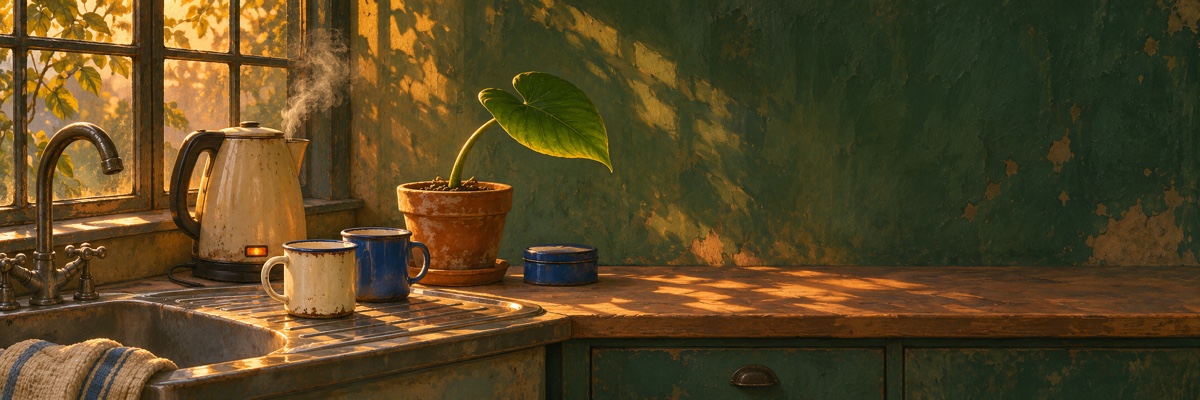
The kettle would not boil for Mara until she told it the truth.
At first she thought the plug was loose. She pushed it in, pressed the switch and listened. The red light came on. A thin thread of steam rose from the spout, curled towards her face and vanished.
"Fine," she said. "I don't want tea."
The kettle clicked off.
Mara stared at it. The house had been empty for eleven days, since the morning her father had died behind the counter of his repair shop. The neighbour who had found him said he had looked peaceful. Mara suspected that was what people said when they had no better news to offer.
She filled a glass at the tap. The kettle clicked again, reproachfully this time.
"I came for the deed," she told it. "And the account books. That's all."
The switch sprang up.
"Oh, don't you start."
Her father had been a mender of things nobody else wanted: clocks that lost a minute a day, lamps with frayed cords, radios that caught voices from other rooms. The shop sign said ELECTRICAL REPAIRS, though his customers often came with objects that had never used electricity. Some paid him in cash. Others brought cakes, or a lift to the hospital, or the promise of a favour to be collected when needed.
He had never been very good at repairing a conversation.
On the kitchen table lay a toaster with a luggage label tied to its cord. Mara recognised the blue enamel casing. Mrs Dube had owned it since before Mara was born. Under FAULT, her father had written: BURNS EVERYTHING SINCE HER SON LEFT.
Mara lifted the lever. From the empty slots came the smell of bread, then a boy's voice saying, "I'll be back before Sunday."
She dropped it. The toaster landed on its feet with a sharp metallic complaint.
Underneath the first line, in fresher ink, her father had added: ELEMENT SOUND. DO NOT PROMISE WHAT YOU CANNOT FIX.
She turned the label over. There was no price, only a telephone number and three dates on which he had tried to call. Mara had come prepared to find unpaid invoices. It had not occurred to her that people might be waiting for their things to come home.
Mara set her glass down and opened the drawer beneath the telephone. A stack of takeaway menus, a broken pencil, six batteries of doubtful age. At the bottom lay a folded note in her father's narrow writing: DEED IN BLUE TIN. DO NOT FEED THE PLANTS AFTER DARK.
There were three blue tins on the kitchen shelves. The first held buttons. The second held a stale biscuit and a small grey moth, which flew out and settled on Mara's sleeve. The third was empty except for a key and a label: GREENHOUSE.
The moth opened and closed its wings. A voice like a grain of sand against glass said, "Not that one."
Mara put the tin down carefully. "Which one, then?"
The moth considered her. "I forget."
She laughed before she could stop herself. It had been a week since she had laughed, and the sound startled them both. The moth rose from her sleeve and found the light above the sink.
For years Mara had treated these small disturbances as part of the house: the broom that swept towards whatever you were avoiding, the clock that stopped during arguments and had to be coaxed forward afterwards. At university she had stopped mentioning them. There were easier things to explain about her father.
She had once asked why he did not charge more. He was repairing a red umbrella that dripped indoors, although it had not rained for weeks.
"Somebody has to do it," he had said.
"Does it always have to be you?"
He had looked up then, impatient with a question that did not concern the umbrella. She had learned to take her own broken things elsewhere.
Outside, the garden was a crowded argument between winter weeds and things her father had planted in optimistic rows. The greenhouse leaned against the back wall. Mara remembered helping to build it when she was twelve, holding panes steady while her father fitted the clips. He had explained each step to her as if she were a colleague. For that afternoon at least, she had believed she might be one.
The key turned. A warm smell of damp earth met her, though the heater was cold. On the bench stood a line of flowerpots, each with a white tag. Some tags had names: Mrs Dube, Simon at the pharmacy, M. Patel. Others named objects: RED UMBRELLA, BRASS BELL, WEDDING SHOES.
The wedding shoes pot contained a healthy fern. Its leaves trembled when Mara touched the rim.
"I only borrowed them," it whispered.
Mara withdrew her hand. The fern settled.
At the far end of the bench, a clay pot held a plant with a single thick leaf. Its tag read MARA. Beneath it, in smaller writing, was the date she had left for university.
"No," she said.
The leaf tipped towards her. She crossed her arms. It tipped farther, a green ear waiting for a voice.
Years ago she had asked her father for money to buy a ticket to the city. Her mother had died that winter. The shop was struggling. Mara had won a place at university, but the bursary would not cover the journey or the deposit on a room. She had rehearsed the request until she could say it without sounding as frightened as she was.
He had told her he could not spare it. She had called him selfish. He had called her ungrateful. The next day she borrowed from a friend and left without saying goodbye.
Later, when she phoned, he talked about the weather or the shop. She did the same. There were Christmas visits, then fewer visits. Each of them waited for the other to name the thing between them.
Mara lifted the pot. A dry rattle came from beneath it: a blue tin, small enough to hide in the saucer. Inside was the deed, folded around a slip of paper.
I sold your mother's ring to help Mr Naidoo. He was going to lose his house. I thought there would be time to earn it back before you needed it. I was ashamed to tell you. I am sorry.
There was no signature. She knew the writing.
The greenhouse seemed to narrow around her. She read the note twice, then sat on the low stool by the door. Mr Naidoo had lived next door when she was a child. His wife had taught Mara to make pastry, always tapping her fingers away from the dough when she worked it too long. They had moved years ago. Mara had not known why.
Beside her stool was a watering can, its long spout stopped with a cork. She pulled the cork out. A woman's sob escaped, so close that Mara turned to look behind her. She pushed it back at once.
The pots nearest the door shivered. In the shop, people could leave an object and walk away. Here he had kept whatever the objects had surrendered. She wondered whether he had asked permission. Whether a customer who collected a working bell knew that something of their sorrow remained on his bench.
On a shelf she found a school exercise book. Each page carried a name, an object and a few practical instructions. Mrs Dube's toaster needed to be returned with the words her son had actually spoken; it would burn bread while being asked to remember a promise he had never made. The fern belonged to a woman who had borrowed her sister's wedding shoes and worn them to marry the man the sister loved. RETURN ONLY TO OWNER, her father had underlined. ASK BEFORE RELEASING.
Mara turned to her own name. Most of the page was blank.
Can listen, he had written. Cannot speak for her.
Underneath was a list of dates. She recognised two Christmas visits, a hospital appointment he had attended alone, her thirty-fifth birthday. He had watered the plant on days when they had spoken without saying anything that mattered.
She closed the book. Keeping a record was not the same as making an effort. She wanted to tell him that, too.
The leaf brushed her wrist. She put the note back in the tin and shut the lid.
"Did he tell you?" she asked it.
The leaf stayed still. Perhaps it could only listen. Perhaps it knew better than to answer.
By afternoon she had found the account books and packed a box for the solicitor. The kettle boiled when she said, "I'd like tea, please," and she drank it standing at the window. Across the fence, the neighbour was taking washing off the line.
She could tell him about the ring. She could tell everyone who had described her father as a kind man, as if kindness were a possession that made its owner easy to love. She wanted them to know how much the silence had cost her. She wanted her father to be there to hear it.
Her phone held a message from her brother in Durban: How is it going? Anything worth keeping? He had been too young to understand the quarrel when it happened. Later he had explained their father to her with the confidence of somebody who had received a different man.
She photographed the note. In the little preview it looked like evidence: the ring, the money, the shame, all fitted into a rectangle. She opened her brother's message, attached the photograph and wrote, This is why.
Then she stopped. The note explained what her father had done. It did not explain what she had lived with, or why she had never asked again. Her brother would call; he would defend him, or apologise for him, and she would be back in the old argument with one of its participants missing.
She removed the attachment. She wrote instead, I found something difficult. Can we talk tomorrow? Then she sent it before she could replace it with a report about boxes.
The kettle clicked. She turned on it.
"That was true."
It remained quiet. She was beginning to suspect that truth was enough to make it boil, but not enough to make it kind.
The telephone rang. It was Mrs Naidoo, whose number had remained on the old phone's list under PASTRY.
"I'm sorry," the woman said. "I've been trying to call all week. Is there anything I can do?"
Mara looked at the tin on the table. "Did you know he helped you? Before you moved?"
A pause. "We knew he lent us the money. We paid him back as soon as we could."
"Did he ever mention where he got it?"
"No. He said he'd had a little luck."
Mara pressed her thumb against the tin's lid. "He sold my mother's ring."
Another pause, longer this time. Then Mrs Naidoo said, "Oh, Mara. I wish he had told us."
"I wish he'd told me."
"You must have thought we knew."
"I didn't know there was anything to know."
Mara heard a chair scrape at the other end. For the first time that day she could imagine the kitchen beyond the receiver: another table, another person sitting down because standing had become difficult. She loosened her grip on the tin. Mrs Naidoo had lost the chance to ask him, too. That did not make their losses equal, but it gave them somewhere to begin.
They spoke for a while. Mrs Naidoo remembered the ring: a small dark stone that caught the light when Mara's mother rolled out pastry. She offered to come over. Mara almost refused, then looked at the two cups on the draining board.
"Could you bring flour?" she asked. "I don't know what's still good here."
Before Mrs Naidoo arrived, Mara took the plant from the greenhouse and set it on the kitchen sill. She gave it a little water, because the light outside was still gold. The leaf lifted, shedding one clear drop onto the wood.
"I was angry with him," Mara said. "I still am."
The kettle began to hum. She hadn't touched its switch.
"And I missed him."
The water came to a boil. The leaf remained turned towards her while she found a second cup.

No published comments yet.