
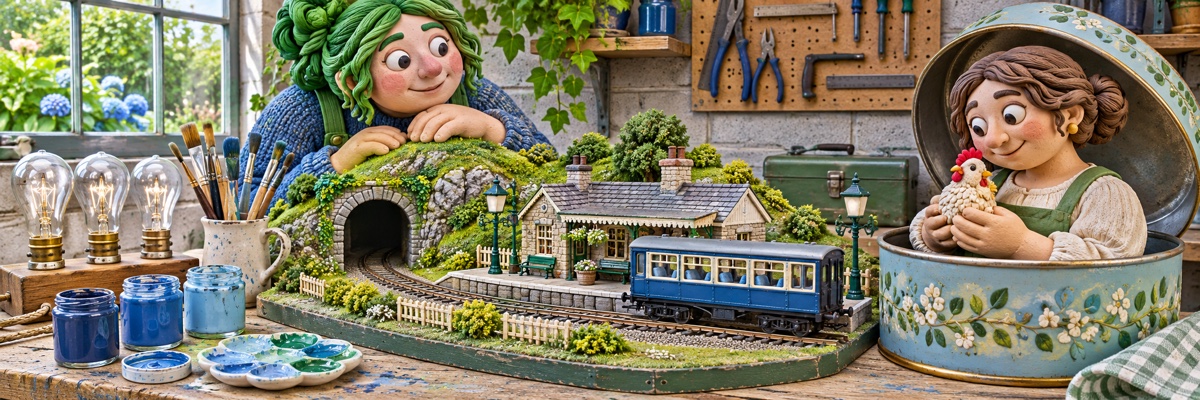
The blue was wrong in daylight and almost right under the garage bulb. Bernard had begun to suspect the bulb.
He bought three more, each with a different temperature printed on the box. Under the coolest, the carriage looked like a swimming pool. Under the warmest, it looked green. Under the third, he could see where his thumb had touched the paint.
His daughter came in carrying a cake tin.
“You need a window in here.”
“Daylight changes.”
“I've heard.”
She put the tin on his workbench. He moved it away from the drying carriage.
The train had run past their old flat every morning when she was small. He could recall its blue at the curve beside the bottle store: not navy, not royal, a blue that seemed darker while the train approached and brighter as it moved away. The photographs disagreed. Some were faded. Some had been taken through glass. In one, his own young shoulder occupied most of the carriage he wanted to see.
“Open it,” his daughter said.
Inside the tin were tiny people.
She had made them from modelling clay and painted them with a brush whose stray hairs were still visible in the finish. There was a woman carrying a chicken, a man in a striped suit, two children sharing a large ice cream and a person with green hair.
“Passengers,” she said.
He picked up the striped man. The legs were nearly as thick as the torso. At the scale Bernard was using, the man would have stood almost three metres tall.
“Wonderful,” he said, and heard himself say it in the voice he used when someone gave him novelty socks.
“They're too big.”
“Only a little.”
“You could put them near the front.”
“That doesn't make them smaller.”
She closed the tin. He tried to explain perspective, but she said she knew what perspective was. She had come to collect a ladder and had to leave before the traffic worsened.
After she went, Bernard found the green-haired person beneath a sheet of sandpaper. He held it beside the station. Its head was level with the roof.
He laughed, then put it in a drawer.
For the rest of the afternoon he mixed paint. A drop of black flattened it; white made it chalky. He cleaned his brush, mixed again and stopped when the room began to smell more strongly of solvent than he liked. Outside, an actual train passed somewhere beyond the houses. He could hear the wheels but not see it.
At supper his wife asked about the people.
“The scale was wrong.”
“She showed me photographs.”
“Then you saw.”
“Yes.”
He went back to the garage. His wife did not follow. She had a programme she enjoyed, involving people who bought houses without examining the roofs.
He opened the drawer and set the green-haired person on the platform. It looked absurd. He tried it by the goods shed. Worse. He put it on the hill behind the tunnel and found that it resembled a giant waiting patiently for a train.
This pleased him for several seconds, until he began calculating how large the tunnel would need to be.
He rang his daughter.
“Would you like the dimensions?” he asked.
There was a long pause.
“For what?”
“If you wanted to make some more.”
“I don't.”
“Right.”
He looked at the little green head above the hill.
“I found one you'd left behind.”
“You can throw it away.”
“I don't want to.”
She said nothing. In the background someone asked her a question about tiles.
“I'm sorry,” he said. “I was rude about them.”
“You were.”
“Did you get the ladder?”
“No. I forgot.”
He offered to bring it in the morning. She said nine would be fine, and to ring the bell because the side gate was jammed.
The next day he brought the ladder and the green-haired person. His daughter was painting her kitchen cupboards a yellow that made his teeth ache. He held the ladder while she worked along the top edge.
“That's a good finish,” he said.
“Don't sound surprised.”
At eleven she came down and made tea. The cake tin was on the counter. Bernard took out the woman with the chicken and examined the bird. Its red comb consisted of three small points, each separately formed.
“How did you do this?”
“Toothpick.”
He nodded. She turned the woman in his hand to show him the chicken's feet.
He stayed to do the lower cupboards. When his daughter asked whether the yellow was straight from the tin, he said yes. She looked at him until he admitted he had added a little white.

No published comments yet.