
Maurice had been collecting two suppers for eleven weeks before the woman at the hatch asked after his wife.
“Still much the same,” he said.
He had not prepared that answer. It was available, and the kitchen was loud, and behind him someone wanted to know whether the shepherd's pie contained lamb. The woman passed him two foil dishes. He put them in the shopping bag his wife had brought home from a conference on coastal erosion.
“Give her our love.”
“I shall.”
Outside, the paper covering one dish lifted in the wind. Maurice held it down with his thumb all the way to the car.
There was enough food for Tuesday and Wednesday. Sometimes Thursday as well, if he added bread. He liked the parish kitchen's suppers because they came with carrots, and he could not buy carrots in quantities suitable for one person without feeling that the shop was taking a position on his life.
At home he ate from the dish. Then he washed the fork and put the other supper in the fridge. He did not set a place for his wife. He had done that once, in the first week, and found it intolerable. He was not confused about her being dead.
The following Tuesday the woman at the hatch was gone. In her place stood an older man with a shining bald head and a badge that said TREVOR, although Maurice knew perfectly well who he was.
“Two?” Trevor asked.
“Yes, please.”
“Chicken or vegetable?”
“One of each.”
Trevor lifted the lids to look. He had enormous hands, mottled pink, and fingernails cut too close. Maurice remembered him putting those hands flat on the shoulders of people he barely knew. At the funeral he had advanced with both of them extended, as though Maurice were a vehicle he intended to park.
“How are you doing?”
“Very well.”
“Good.” Trevor gave him the dishes. “Nice bag.”
Maurice looked down at the cliff on its side.
“My wife's.”
“Yes.”
That evening the vegetable option turned out to be macaroni cheese. Maurice had never considered macaroni a vegetable, but he ate it willingly. He was scraping the corners when the doorbell rang.
Trevor stood outside with a loaf.
“Forgot to put these out,” he said.
“You needn't have come all this way.”
“I'm two streets over.”
“I know where you live.”
Trevor's wife had left him years ago, taking the dog and most of the furniture. Maurice knew this because his own wife had known it. She had been impatient with the parish's habit of calling Trevor a bachelor. “He has a wife,” she would say. “She just can't bear him.” Then, because she disliked unfairness even when it was funny, she would describe something generous he had done.
Maurice took the bread and began to close the door.
“Any tea going?” Trevor said.
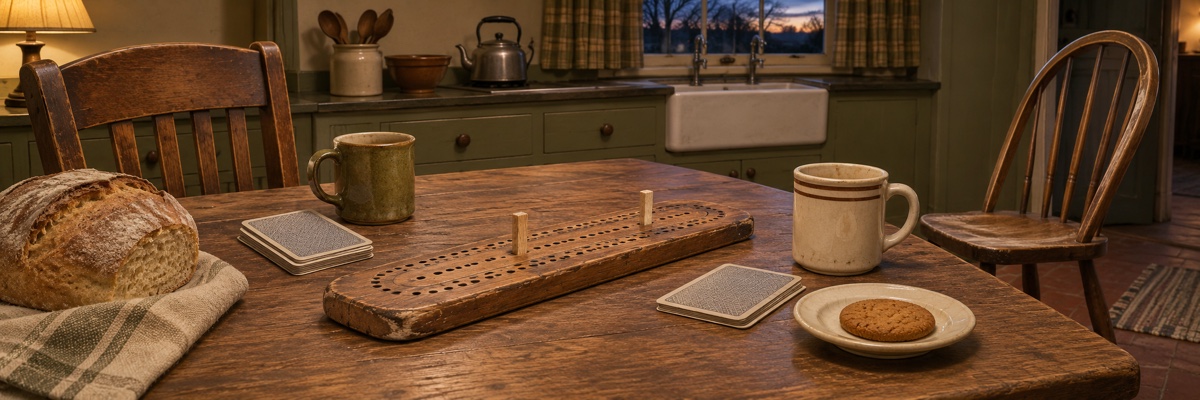
There was no credible reason to refuse. Maurice led him into the kitchen, where the empty dish lay in the sink. He turned it over while filling the kettle.
Trevor sat in his wife's chair.
“Not there,” Maurice said.
Trevor stood at once.
“That leg's loose.”
It was not. Maurice had repaired it himself, three years earlier. Trevor tried the chair beside it and looked up, waiting.
“That one's fine.”
They drank tea. Trevor praised the biscuits, which were ordinary ginger nuts, and said he had given up sugar. He put two biscuits in his mouth almost together. Maurice watched a crumb lodge in the fold of his chin.
“You know she's dead,” Maurice said.
Trevor swallowed.
“Yes.”
“And you know I've been taking two.”
“I put them in the bag.”
Maurice had imagined a different conversation. Trevor would pretend surprise; Maurice would explain that he ate one the next day; they would agree it was an economical arrangement. Instead Trevor reached for another biscuit.
“There's a waiting list,” Maurice said. “For the suppers.”
“No. Sometimes there's a queue.”
“The woman thinks my wife is ill.”
“Which woman?”
“Glasses. About fifty.”
“That narrows it down to most of us.”
Maurice laughed before he could stop himself. Trevor smiled, exposing a small triangular space between his front teeth. For a moment Maurice could see how a woman might once have liked him.
“I told her she was much the same.”
Trevor looked at his cup.
“Well,” he said, “she is.”
The laugh that came out of Maurice then was horrible, a scrape followed by a barking sound. He put his cup down too quickly. Tea ran over the saucer and onto the table.
Trevor was already standing. He took a cloth from the draining board and laid it over the spill. He did not touch Maurice.
“Sorry,” he said.
“No.” Maurice wiped his nose on his sleeve. “No, that's exactly the trouble.”
He wanted to explain the eleven weeks. He could remember Tuesday last week and Tuesday before it, but the days between had become something he walked through to get to the hatch. The clock on the oven had been wrong since a power cut in August. He had stopped correcting it because there was another clock on his phone.
Instead he said, “The bread's not very good.”
“It's free.”
“That's not an ingredient.”
Trevor nodded solemnly. “I'll tell the baker.”
When he left, he asked whether Maurice played cards.
“Not bridge.”
“Neither do I.”
“Everyone means bridge when they ask that.”
“I mean cards.”
Maurice said he used to play cribbage. Trevor said he had a board. Nothing was arranged. Maurice watched him walk down the path with one hand raised against the branch that overhung the gate.
For the next six days he hoped Trevor would not come back and listened for the doorbell.
On Friday he went to buy biscuits. At the shelf he remembered that Trevor had given up sugar, then decided a grown man could make his own mistakes. He bought the ginger nuts and a packet of plain crackers. His wife would have called that hedging. She had been willing to serve things people disliked, arguing that they could leave them. Once, at a dinner, she had told a guest that she too hated the soup, but they were halfway through it now. Maurice had loved her for that and had also wished, sometimes, that she would stop. He put both packets in the cupboard, where no visitor could see how much thought had gone into them.
On Tuesday he collected only one supper. Trevor was washing up at the rear of the kitchen. The woman with glasses was back at the hatch.
“How's your wife?”
“She died in August,” Maurice said.
The woman went still. Behind her, plates clashed in a deep metal sink.
“Oh. I'm so sorry. I didn't—”
“I know.”
She reached for a second dish. He put his hand on the first.
“Just this one.”
“Take another for tomorrow.”
He shook his head. He could feel Trevor watching from the sink, and that made the refusal more important than it should have been.
He ate the chicken slowly. There was a baked apple for pudding, which he had not expected. His wife would have complained that they had left the skin on. She had possessed a small, precise range of food objections, each defended as though the rest of the world were hiding its agreement.
At half past seven the doorbell rang.
Trevor held up a wooden box. “Found it.”
Maurice let him in.
The board was missing two pegs. Trevor had brought matchsticks. He broke their heads off and pushed them into the holes. Maurice fetched a pack of cards from a drawer. His wife had bought them in Lisbon; each king had a different moustache.
“Do you remember the rules?” Trevor asked.
“Perfectly.”
He remembered most of them. They argued about the score of a hand until Trevor looked it up on his phone. Maurice was wrong. He had not expected this to happen in his own kitchen, with his own cards.
“You could have left it,” he said.
“The mistake?”
“Yes.”
“Would you have?”
Maurice began to shuffle.
Halfway through the second game Trevor asked whether there was anything to eat. He had missed supper while they finished washing up.
Maurice said there was bread.
“What about that other dish?”
“I didn't take it.”
Trevor looked at him, then at the fridge. “Right.”
“You saw me not take it.”
“I saw you at the hatch. I was washing a pot.”
Maurice put the cards down. He could hear himself becoming the sort of man whose wife explained him to other people.
“Eggs,” he said. “I've got eggs.”
They went to the stove. Trevor wanted his fried hard. Maurice considered that a waste of an egg, but he broke two into the pan and left them there. They ate standing up because the cards covered the table.
Trevor got yolk on his shirt despite the eggs being hard. He examined the mark without much interest. Then he asked where the washing-up liquid was.
“Leave it,” Maurice said.
“No, come on. You cooked.”
Trevor washed; Maurice dried. The kitchen window reflected the two of them, Trevor broad and bald, Maurice narrow, his cardigan buttoned one hole wrong. He had dressed in a hurry because the doorbell had rung while he was changing for bed. At half past seven.
He put down the plate and corrected the buttons. Trevor handed him the pan.
Back at the table, Maurice won by a margin that made him suspicious. He looked across at Trevor, who was counting his remaining cards with his lips moving.
“Are you letting me win?”
“No.”
“Because I don't need—”
“I can't count when I'm tired.”
Maurice waited. Trevor rubbed his eyes with the heels of his hands. For the first time all evening he looked his age.
“How tired?” Maurice asked.
“Oh, the usual amount.”
They put the cards away. At the door Maurice almost asked him to stay, then remembered the two streets, the empty house, the long day at the sink. He had been thinking of Trevor as someone who arrived with things.
“Next Tuesday,” he said. “Come earlier.”
“For cards?”
“For supper.”
Trevor nodded. “I'll bring bread.”
“Bring better bread.”
After he had gone, Maurice returned to the kitchen. Trevor's cup stood beside the cribbage board. One of the matchsticks had split and would not go back into its hole.
Maurice found a box in the drawer and broke off two fresh lengths. He tried each in the board. Then he moved the chair with the supposedly loose leg back to the table. He sat in it, facing the place where he usually ate, and finished the last ginger nut.

No published comments yet.