
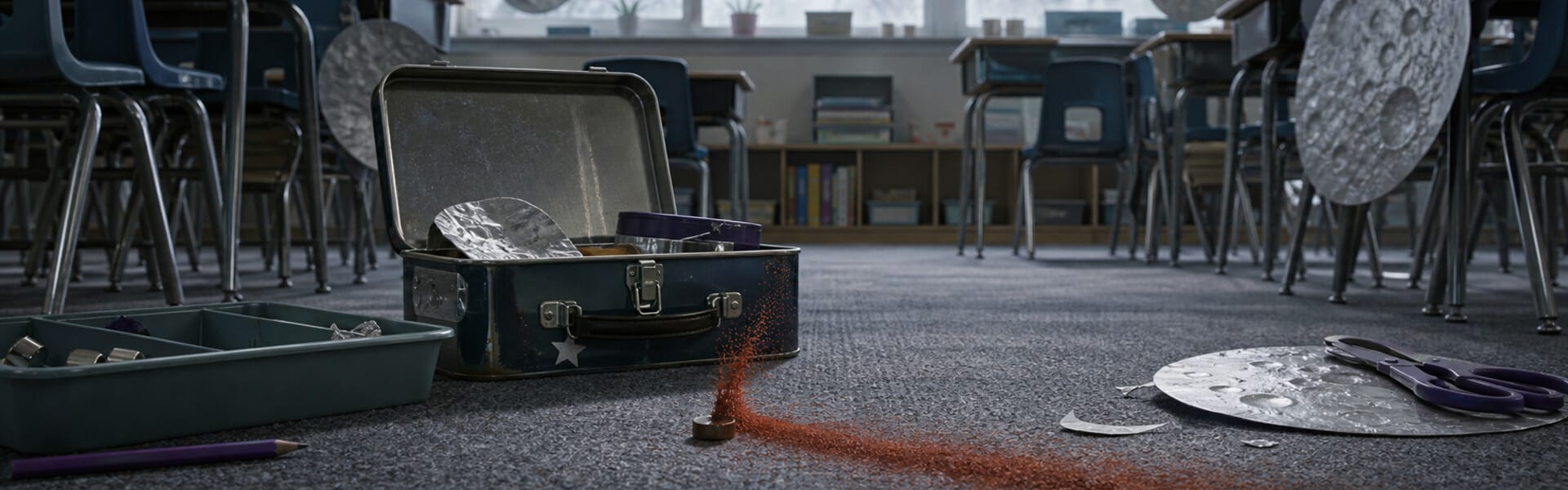
At 15:14, while the rest of Year Four were cutting paper moons out of silver card, Ilya Sen opened his lunchbox and tipped a line of red dust onto the carpet.
It was the colour of Mars.
Lena Voss noticed because Ilya sat nearest the window. The winter sun caught the red grains beside his black school shoe. He had not shouted or called for her. He had emptied the lunchbox as carefully as if it contained pencil shavings, and now he watched the dust collect.
Scissors clicked around the classroom. Glue sticks rolled. Someone asked if a moon could have eyelashes.
At the back table, Noor Rahman had folded her offcuts into stars no larger than fingernails. Leo Okafor was arguing that a dead satellite counted as a moon if it stayed in orbit long enough. Lena had told him that persistence was not the same thing as belonging, which had only encouraged him.
Lena crossed the room.
‘Ilya,’ she said, keeping her voice low, ‘what have you got there?’
He looked up at her. He was eight, small for his age, with a face so solemn that even his smiles seemed planned in advance. His hands were red to the wrists.
‘I didn’t bring it,’ he said.
Lena crouched. ‘Did someone put it in your lunchbox?’
He shook his head.
The dust smelled faintly metallic. Not playground sand, not brick powder, not paprika from someone’s packed lunch. It clung to the carpet fibres in tiny rust-coloured beads. When Lena reached for a magnet from the science tray and lowered it, the grains lifted.
Not much.
Enough.
Behind her, Asha said, ‘Miss, Ilya’s bleeding dirt.’
‘He is not bleeding,’ Lena said.
Her own heart had begun to strike high in her throat.
The school had a Mars corner in the library. Every school did. Posters of the first settlement under its glass dome. Smiling colonists in pale suits. Children’s editions of the disaster report, softened into heroism. The red planet had become safe through repetition: assembly topic, memorial stamp, history unit, charity wristband, bedtime documentary.
Lena knew better than most how a dead place could be made decorative.
Her mother’s mission patch lay face-down in Lena’s desk drawer, beneath spare whiteboard pens and a packet of plasters. It was the one piece of Mars she had kept.
She took a paper towel from the sink, folded it twice, and held it beneath Ilya’s hands. ‘Can you stand up for me?’
He stared at the dust.
‘I was in the corridor,’ he said.
‘Which corridor?’
‘The red one.’
Their classroom door was yellow. The main corridor outside was blue. The older children’s corridor was green. The school had colour-coded itself into cheerfulness after the last inspection.
‘Here at school?’
Ilya’s lips trembled, but his eyes stayed dry. ‘No. The other one.’
The lights flickered.
Only once. A little skip in the fluorescent strips overhead.
Every child looked up.
Then Ilya began to hum.
It was a thin sound, three notes repeated. Not a tune. An alarm stripped of volume. Lena had heard it before, though not in any classroom. In a government briefing room, twelve years ago, when an official from the Mars Recovery Authority had played six seconds of the colony’s final habitat warning and told the families it was all that remained.
Her hand closed around Ilya’s wrist too hard.
He stopped humming.
‘Ilya,’ she said. ‘Where did you hear that?’
His gaze shifted past her shoulder to the coat pegs, the trays, the paper moons. To some other room laid over this one.
‘Commander Voss said not to open it.’
Lena let go of him.
No one in the classroom knew her mother’s final rank. The school records listed Lena as Ms L. Voss. Her pupils knew she disliked glitter, drank coffee from a chipped blue mug, and could catch a lie from the doorway. They did not know that her mother had died on Mars before Lena was old enough to resent her properly.
‘What did she say?’ Lena asked.
Ilya’s lips moved.
The voice that came out was not his.
It was not Eva Voss’s voice either. It was a child’s voice pushed through broken radio, flattened by static and fear.
‘Seal the inner door,’ Ilya said. ‘If it learns us, it follows.’
The room had gone completely quiet.
A moon cut from silver card slid off a table and landed glue-side down.
Lena stood. She could feel every child watching her for the correct adult expression.
She found one.
‘Everyone,’ she said, ‘leave your scissors on the tables. Asha, take the register. We’re going to the library.’
Children moved better when given jobs. They liked procedure, even when they knew it was pretending. Asha snatched up the register with both hands. Mateo began to cry because his moon was not finished. Tamsin took his elbow, brisk and bossy.
Ilya did not move.
Lena crouched again. She brushed the loose dust from Ilya’s hands onto the paper towel, folded it and put it into the pocket of her cardigan.
‘Can you walk?’
He blinked, once.
‘I left the door open,’ he whispered.
‘No,’ Lena said. ‘You’re here with me.’
‘It knocked three times.’
Something in the wall gave a small answering click.
Lena looked at the radiator. Old pipes. Old building. A noise with no meaning.
Then it clicked again.
Once.
Twice.
Three times.
The library smelled of plastic book covers and radiator heat. Lena sat the class on the carpet between the picture-book bins and told them to read silently, which produced a theatre of obedience. Pages turned too loudly. Eyes slid towards Ilya, who sat under the window with his knees up and his red hands hidden in his sleeves.
The headteacher, Mr Choudhury, arrived in the doorway with his lanyard swinging.
‘Lena?’
She stepped out into the corridor.
His smile had already failed. He was a kind man made worse by policy. ‘Reception said you requested the medical room and isolation folder.’
‘I need to call Ilya’s parents. And the school nurse. And I need you to look at something without asking me first whether I’m tired.’
He lowered his voice. ‘Are you tired?’
She took the paper towel from her pocket and unfolded it.
Red dust sat in the creases.
Mr Choudhury looked at it. Then at her. He had been headteacher for five years. He had seen parents threaten staff, children arrive hungry, a fox get into the nursery shed, and one Year Six pupil glue himself to a radiator for climate protest. He did not panic easily.
‘Where did that come from?’
‘Ilya’s lunchbox.’
‘Is it paint?’
Lena lifted the magnet from her other pocket. The grains rose.
Mr Choudhury stepped back.
‘Jesus.’
From the library, a child began to hum.
Three notes.
Lena turned.
It was not Ilya this time.
Asha Patel sat cross-legged near the graphic novels, her head tilted to one side. She hummed with her eyes shut. Beside her, Mateo had started drawing in the back of his reading record. Not a moon. Not a face. A rectangle with a wheel at its centre.
The airlock door.
By 16:00, six children had drawn it.
Each picture was different in style and identical in the parts that mattered. The wheel. The hinge pattern. The three narrow windows set too high for a child. Scoring marks on the inside.
Lena laid the drawings on a table in the staff room. Mr Choudhury stood opposite her with both hands pressed flat to the laminate.
Outside, parents gathered at the gates, bright coats in the early dark. The children were meant to have gone home 20 minutes ago. Reception kept calling through to ask what it could tell them.
‘Mass suggestion?’ Mr Choudhury said.
Lena looked at the six doors.
‘No.’
‘There are procedures for unexplained behavioural events.’
‘This is not a behavioural event.’
‘Then what is it?’
She moved Asha’s drawing beside Mateo’s. The lines of the wall continued from one page to the next. She added Tamsin’s, then Ilya’s. Noor had drawn the ceiling vents. Leo had drawn the floor, including a bolt with one side filed flat.
Six children, six fragments, one corridor.
Red walls. Inner door. Three knock marks.
A printed label ran along the bottom of Asha’s drawing in careful block capitals.
HAB-2 / BIOLOCK / EXTERNAL ACCESS PROHIBITED
Lena touched the words. Her finger came away smudged with pencil.
‘This was on Mars,’ she said.
Mr Choudhury did not ask how she knew.
Everybody knew her mother in a vague public way, the way they knew craters and flags and names from stamps. Commander Eva Voss had become a school assembly sentence: gave her life to protect Earth’s first off-world settlement. Lena had spent her childhood in rooms where adults lowered their voices, then straightened when they saw her. She had spent her twenties refusing interviews. She had spent her thirties teaching children long division under posters of a planet that had eaten her mother and been made inspiring afterwards.
Mr Choudhury’s phone rang.
He glanced at it.
‘Unknown number.’
The staff room lights flickered once.
He answered.
Lena watched his face change.
‘Yes,’ he said. ‘This is Daniel Choudhury. Yes, we have the children supervised. No, I don’t understand how you—’
He stopped. Listened.
Then he said, very carefully, ‘Who authorised you to contact my school?’
Lena covered the red dust with her hand before he put the call on speaker.
The voice was male, calm, mid-range. Trained to sound like the least alarming part of a bad day.
‘Mr Choudhury, my name is Dr Cale Harrow. I’m with the Mars Recovery Authority. A containment support unit is six minutes from your location. Please keep the affected children inside the building. Do not allow parents to remove them. Do not trigger fire alarms, lockdown alarms, emergency lighting or any equipment with a low-oxygen warning. Do you understand?’
Lena took the phone.
‘Cale.’
There was a small silence.
Then: ‘Lena Voss.’
‘How do you know about this?’
Another pause. She could hear road noise behind him. He was not in an office. He was close.
‘At 15:16, a communications band that has been silent for nine years began transmitting your school’s network address,’ he said. ‘Then it transmitted your surname.’
Lena looked at the phone as if distance could still protect her from it.
‘You were already nearby.’
‘We have teams near every unresolved signal cluster.’
‘Schools.’
‘Among other places.’
‘You knew this could happen.’
‘We knew something could.’
‘How many children are affected elsewhere?’ Lena asked.
‘How many are with you?’
‘Answer my question.’
‘Lena, I need your number first.’
She looked at the drawings.
‘Six.’
‘Any humming or repeated speech?’
‘Yes.’
‘Any red dust?’
Her hand went to her cardigan pocket, though the dust was on the table now.
‘Yes.’
Cale exhaled.
‘Keep them calm. Keep them in ordinary light. Separate them from screens if you can.’
‘What is happening?’
‘The memories are clustering.’
Mr Choudhury said, ‘Memories?’
Cale ignored him. ‘Lena, listen to me. If one child begins to describe a sequence in detail, interrupt. Ask them about something present-tense and concrete. Their shoes. Their lunch. The weather. Do not ask what happens next.’
The line crackled.
Through the staff room wall came the sound of children turning pages. Too quiet. The whole school seemed to be holding its breath.
‘Cale,’ Lena said, ‘what happens if they remember?’
The answer came at once.
‘It remembers back.’
The containment unit arrived in white vans with no sirens. That frightened Lena more than sirens would have.
Parents were pushed back from the gates by people in grey jackets who spoke softly and showed laminated authority cards. A woman in a red coat screamed Ilya’s name until another parent held her. Camera phones came out. Drone lights bobbed above the playground fence like insects.
Inside, the children were moved to the hall.
‘This is ridiculous,’ Mr Choudhury said, though he had already obeyed every instruction. ‘They’re children.’
Cale Harrow met them at the hall doors. He was older than Lena remembered. Of course he was. She had last seen him across a hearing table nine years earlier. Back then, she was still Dr Voss, child trauma consultant. He was the MRA’s bright behavioural systems lead, with a clean shirt and no grey in his beard. He had testified that the exposure trials were necessary. She had testified that teaching grief to reproduce itself in children was not therapy, whatever the acronym.
He looked as if he had not slept since.
‘Lena,’ he said.
‘Don’t.’
He accepted that with a nod.
The hall had been transformed with the speed of institutions that had rehearsed what they denied. Portable lamps. Folding screens. Medical mats. Silver cases. Six chairs placed in a wide circle under white light, with black tape marking a boundary around them. The other children sat at the far end with two teaching assistants, watching a film on a projector that had no sound.
The affected children sat separately.
Ilya’s mother had forced her way as far as the hall entrance and was being held there by a woman from the MRA whose badge said FAMILY LIAISON. She was not unkind. That made it worse.
‘He’s eight,’ Ilya’s mother said. ‘You cannot quarantine an eight-year-old.’
Cale turned to her. ‘Mrs Sen, I know this is frightening.’
‘Do you?’
Ilya looked at his mother. His small face folded.
Lena stepped between him and the adults.
‘Let her sit where he can see her,’ she said.
Cale shook his head. ‘No physical contact until we know whether proximity accelerates—’
‘Let her sit where he can see her.’
Something in her voice made him look properly at her.
He gave one brief nod.
The family liaison moved Mrs Sen to a chair by the wall. Ilya watched until she sat down. Only then did his shoulders lower.
Cale opened a tablet. ‘We need your cooperation, Lena.’
‘You have my pupils in a school hall under containment lighting.’
‘Yes.’
‘You are past the cooperation stage.’
‘Fine. Then I need your compliance.’
She laughed once. ‘There he is.’
His face tightened.
From one of the chairs, Mateo began to whisper. A woman in grey moved towards him with a recorder.
Lena reached him first.
‘Mateo,’ she said, kneeling. ‘Look at me. What colour are your socks?’
He blinked.
‘Blue.’
‘Show me.’
He lifted one shoe obediently. A blue sock with a banana on it.
‘Good. What did you have for lunch?’
‘Pasta.’
‘Red pasta?’
He swallowed. ‘White pasta.’
‘Good.’
The woman in grey frowned. ‘We need spontaneous recall.’
‘You need him here,’ Lena said. ‘Not there.’
Cale had heard. He said nothing.
The first test began at 17:20 despite Lena’s objections and Mr Choudhury’s demand for a written order. He received one, six pages long, signed by a minister whose department had changed names twice since the Mars disaster.
Before Cale switched on any equipment, he faced the parents.
‘What we are proposing is not completion,’ he said. ‘It is a brief orientation below the threshold at which the fragments join into a route.’
He turned his tablet so the parents could see a graph: six thin lines wandering beneath a thick black bar.
Mrs Sen had stopped crying. She watched him with her arms folded hard across her coat.
‘You know the threshold?’ she asked.
‘We know the lowest level at which a route has formed before.’
‘That is not what I asked.’
Cale glanced at the six children. ‘No. We don’t know it for them.’
Mrs Sen’s arms loosened from their hard fold. Mr Choudhury looked again at the thick black line on the graph. Lena had expected reassurance and distrusted Cale slightly less for withholding it.
‘Fragments do not remain private when they are active. In Busan, one child triggered during a planetarium visit. Staff isolated her. Eighteen children in adjacent rooms began recalling within seven minutes. Suppression did not stop the event; it widened it. If we identify which fragment each child is holding, we can interrupt before their memories synchronise.’
‘And if you are wrong?’ Mr Choudhury asked.
‘Then we stop the test.’
‘That is what people say before a test,’ Lena said.
Cale met her eyes. ‘It is also what we do if the combined readings pass point three on our coherence scale.’
At least he had named a stop point in front of the parents.
The children wore pulse monitors. Independent battery lamps replaced the hall lighting. An electrician from the MRA opened the emergency-light cabinet and fitted a mechanical block across the red backup circuit. Lena watched him test it twice.
A lamp shifted from warm white to a faint dusty pink.
Not red, Lena thought. Not quite.
A speaker played three notes at a volume so low she felt them more than heard them.
Asha closed her eyes.
‘Stop,’ Lena said.
Cale did not look away from his tablet. ‘It’s within tolerance.’
‘For whom?’
‘Coherence point one four,’ a technician said. ‘No route behaviour.’
Asha began to hum.
Then Tamsin.
Then Mateo.
Then all six children, the sound thin and tidy and wrong.
On Cale’s tablet, six separate lines bent towards one another.
‘Point two six,’ the technician said.
Cale looked up. ‘Cut the tone.’
The speaker light went dark.
The humming continued.
The hall seemed to tilt. Lena gripped the back of a chair. In the far corner, the projector froze on a cartoon rocket, smiling over a crater.
The children spoke together.
Not in perfect unison. More like a class reading badly from the same page.
‘Eleven minutes remaining.’
Mrs Sen stood. Two MRA staff moved towards her. Cale raised one hand and they stopped.
‘Point three one,’ the technician said.
Cale crossed the black threshold line on the floor. ‘End it. Full grounding protocol.’
The woman beside the speaker pulled its cable from the case. The three-note alarm continued, no louder than before.
‘External pressure stable,’ the children said.
The pink light deepened.
The lamp controls still read white.
‘Knock event one.’
A sound came from the disconnected speaker.
One knock.
Every adult flinched.
The children did not.
‘Knock event two.’
Second knock. This time from beneath the varnished floor.
Lena smelled metal. Dust. Burnt plastic. The harmless click of the staff-room radiator came back to her, suddenly impossible to dismiss.
‘Knock event three.’
The third knock came not from the speakers but from the hall doors.
Mrs Sen screamed.
The children opened their eyes.
All six of them looked at Lena.
‘It learned the shape of fear,’ they said.
The lights blew.
For two seconds the hall went black.
Despite the mechanical block, emergency strips came on red along the skirting boards, and every child was crying.
Every child except Ilya.
He looked at Lena as if he had been waiting years to tell her.
‘Your mother opened the door,’ he said.
Mrs Sen crossed the hall before anyone could stop her.
The family liaison reached for her arm. Mrs Sen shook her off with such clean fury that the woman stepped back.
‘No,’ Mrs Sen said. ‘You have had him long enough.’
She knelt in front of Ilya and took his face in both hands. His red fingers closed around her sleeve.
‘Look at me,’ she said. ‘Not the door. Me.’
His eyes found hers.
Lena looked away because the intimacy of it felt almost indecent under institutional light.
Mrs Sen turned on her.
‘You knew that name,’ she said.
Lena did not pretend. ‘Yes.’
‘Your mother.’
‘Yes.’
‘So what is my son carrying? Your grief? Their experiment? Some dead woman’s last mistake?’
Cale said, ‘Mrs Sen—’
‘Do not manage me.’
Her voice cracked, but did not weaken.
‘He still sleeps with a plastic dinosaur. He still thinks peas are a punishment. You all keep saying “memory” as if that makes him less of a child.’
Ilya pressed his face into her coat.
Lena had no answer that would help Ilya or satisfy his mother.
‘You’re right,’ she said.
Mrs Sen’s anger stalled. She took one step back from Lena.
The public version of the Mars disaster had been engraved into Lena before she understood what public meant.
At 04:03 UTC, a biological contamination alarm sounded in Habitat Two. At 04:09, Commander Eva Voss ordered inner seals closed to protect the main dome. At 04:14, contact was lost. At 04:22, automated quarantine saved the remaining settlement infrastructure for later recovery. There were no survivors. Eva Voss’s action prevented possible return contamination and protected Earth’s long-term exploration programme.
Lena had heard it in auditoriums, documentaries, memorial gardens, school assemblies. Her mother had closed the door. Her mother had kept danger out. Her mother had chosen Earth.
Now an eight-year-old boy with red dust under his nails had said she opened it.
Cale found Lena in the medical room, where she had gone because no one else was there and because it still had an analogue clock.
‘You should sit,’ he said.
She was already sitting.
He closed the door behind him.
Through the wall came the murmur of the hall: parents, officials, children drinking water through straws because their hands shook.
‘Is it true?’ Lena asked.
Cale looked older under the strip light. The skin beneath his eyes had a yellow tint. ‘We don’t know.’
‘That is what people say when the truth is worse than the sentence.’
He leaned against the sink. ‘No complete, synchronised habitat video was recovered from the final 11 minutes. Only telemetry fragments, suit vitals and automatic logs. Private recordings were quarantined before the inquiry.’
‘And audio?’
His silence answered.
Lena stood.
‘Play it.’
‘No.’
‘Cale.’
‘It triggers recall.’
‘Then tell me.’
He looked at the medical posters on the wall. Wash hands. Catch it, bin it, kill it. A cartoon germ with eyes.
‘There was something outside BioLock Two,’ he said.
Lena waited.
‘Not biological in any way the sensors understood. Not mechanical. It did not breach the habitat. It waited.’
‘And knocked.’
‘Yes.’
The word had to travel a long way through him.
‘The colonists believed it was responding to distress rhythms. Heart rate. Breath. Alarm cadence. Fear, possibly.’
Lena thought of the children speaking together. It learned the shape of fear.
‘That is not science,’ she said.
‘No.’
‘What did my mother do?’
Cale looked down.
‘She ordered the inner seal opened for 4.8 seconds.’
Lena’s mouth went dry.
‘Why?’
‘We think she was trying to transmit.’
‘Transmit what?’
‘A warning.’
‘Through the door?’
‘Through whatever was outside it.’
She stared at him.
He rubbed both hands over his face. For the first time, he looked less like an official than a man trapped inside an answer he hated.
‘There was a cognitive-relay experiment on Mars,’ he said. ‘It was secret. The system was meant to turn a colonist’s emergency experience into a low-bandwidth signal when speech failed: smell, rhythm, images, the body’s fear response.’
Lena sat back down.
She knew the later trials on Earth, though not the Mars experiment. Bereaved families had been exposed to controlled sensory fragments. Children had been watched for inherited stress markers. She had called it ritualised contamination. Cale had called it data.
‘You seeded the memorial broadcasts,’ she said.
‘We did not seed them. The final signal contaminated the carrier band.’
‘And three years later you reopened the raw carrier for the global memorial.’
His face hardened. ‘The world was mourning again.’
‘The world was watching.’
‘We believed we had cleaned it. The memorial-viewing software stored fragments on people’s devices for 18 months before the fault was found.’
Lena laughed. ‘Clearly.’
‘In homes. Nursery screens. Old tablets handed down to children. It remained dormant for years.’
‘In children.’
He said nothing.
Lena unfolded the paper towel she had carried from the staff room. The red grains trembled when Cale brought his tablet near.
‘And this?’
‘Local iron,’ he said. ‘Paint, soil, pipe scale. The relay draws it together when a child’s memory fragments start to join. It is not Martian ground, whatever it makes the children remember.’
She watched a grain lift and settle.
‘A footprint.’
‘If that helps.’
It did not.
Lena stood again. Sitting across from Cale made the meeting feel normal.
‘Why now?’
‘We think the children are reaching the age when memory becomes continuous enough to host the full sequence.’
‘Host.’
He flinched.
Good, she thought. Flinch.
‘What happens if they complete it?’
‘The fragments join into a complete memory.’
‘And?’
Cale opened the door a crack, checked the corridor, then closed it.
‘And the signal has coordinates.’
Lena stared at him.
‘Coordinates to what?’
He looked at her as if she had asked a childish question.
‘To us.’
For a while there was only the clock.
Tick.
Tick.
Tick.
On the third tick, both of them looked at the door.
Nothing knocked.
At 22:41, the MRA permitted one comfort item per child after scanning each object for red dust. The rule produced a queue at the hall doors and a second argument about whether a blanket counted as an item or clothing.
Parents sat behind the taped line. Some prayed. Some argued into phones. Some stared at their children with a look Lena recognised from hospital rooms: the disbelief of adults who had discovered that love was not a force field.
Noor chose a packet of origami paper. She folded stars under the white lamps and arranged them in strict colour order around her mat. Leo’s mother brought his battered book about orbital debris; he held it open without turning a page.
Asha asked for the headphones she used with bedtime stories, then refused to put them on because she might miss a knock. Mateo received a stuffed crocodile and made it bite the wire of his pulse monitor until a technician asked him to stop.
Tamsin chose her mother’s scarf rather than anything from home.
Mrs Sen brought the plastic dinosaur.
It was green, hollow and worn pale at the nose. The scanner operator turned it over twice before passing it through the gap in the tape. Ilya snatched it and hid it beneath his blanket.
‘You told them,’ he said to his mother.
‘I told them you were eight.’
‘Mateo will see.’
Mateo lifted his crocodile from the next mat. ‘Mine can eat yours.’
For the first time since the lunchbox opened, Ilya looked offended by something ordinary.
‘Tyrannosaurus is bigger,’ he said.
‘Not this crocodile.’
The argument lasted four minutes. Lena let it.
At 23:00, the children were allowed to sleep on their mats, as if any child could sleep under those lights with adults whispering at the edges.
Lena stayed beside Ilya.
He did not sleep. He lay on his side facing the wall, fingers curled under his chin.
‘Miss?’
‘Yes.’
‘Am I in trouble?’
Lena looked at the green dinosaur under his blanket before she answered.
‘No.’
‘I opened the lunchbox.’
‘That isn’t a crime.’
‘I remembered.’
‘Also not a crime.’
He considered this.
‘Dr Harrow says remembering can be dangerous.’
‘He’s not always wrong.’
Ilya turned onto his back. Under the portable lamps, his face looked smaller than it had in the classroom.
‘Did your mum really go to Mars?’
‘Yes.’
‘Did you want her to?’
Lena almost answered as an adult. She almost said it was complicated, that Eva had been brave, that exploration mattered, that families could be proud and hurt at the same time. All the polished memorial sentences.
Instead she said, ‘No.’
Ilya nodded as if this confirmed a private theory.
‘My mum doesn’t like me going to sleepovers.’
‘That is slightly different from Mars.’
‘But not to her.’
Lena smiled despite herself.
Ilya picked at the edge of his blanket. ‘When I’m there, I’m not me.’
‘In the memory?’
‘Mostly I’m a man called Arun. He’s scared all the time but trying to count things.’
‘What things?’
‘Bolts. Breaths. Knocks.’
Arun Mehta, Lena thought. Habitat engineer. His name was on a bronze panel in the memorial garden beside her mother’s.
‘And sometimes,’ Ilya said, ‘I’m your mum.’
Lena did not move.
‘What does she feel?’
He closed his eyes.
‘Sorry,’ he said.
He said it as though the apology belonged to Eva, not to him.
‘For what?’
His face tightened.
Lena touched his shoulder. ‘Ilya. Socks.’
His eyes opened.
‘What colour?’
‘Blue.’
‘Lunch?’
‘White pasta.’
‘Where are you?’
He looked around the hall. The mats. The tape. His mother asleep upright against the wall with her coat around her shoulders.
‘School,’ he said.
‘Good.’
He breathed.
After a moment, he whispered, ‘She was sorry before she opened it.’
Lena looked away.
Across the hall, Cale watched them from beside a portable monitor. His tablet lit his face from below.
Lena had once believed institutions were made of rooms. Briefing rooms, tribunal rooms, therapy rooms, memorial rooms. She understood now that institutions were made of people who looked tired while doing unforgivable things they considered necessary.
At 02:00, she stole his tablet.
It was not elegant. She waited until Cale was called to the entrance by a parent threatening legal action. She walked past the charging station with a blanket over one arm and the calm gait of a teacher who had cleaned up vomit, separated fights and carried sleeping children without seeking permission. The tablet went under the blanket. No one stopped her.
She locked herself in the staff toilet.
The tablet should have needed Cale’s handprint. Instead, the emergency medical panel stood open. Her old MRA consultant number was already entered beneath a temporary authorisation:
SITE 14 / VOSS, L. / CLINICAL ACCESS / EXPIRES 04:30
Lena stared at it.
Across the hall, Cale had watched her ground Ilya. He had watched her notice him watching. Now he had left his tablet unlocked within her reach and walked towards a parent who did not need him for anything.
It might still be a trap.
She pressed AUTHORISE.
Files opened under a plain directory title: JUVENILE MNEMONIC CLUSTER / SITE 14.
Her school was Site 14.
There were other sites.
Milan. Nairobi. Busan. São Paulo. Reykjavík. A mining town in Western Australia. A floating school in the Mekong Delta. A paediatric day ward in Toronto.
Children, all around eight or nine. All born within 18 months of the third-anniversary Mars memorial broadcast, while contaminated fragments still lived in local caches.
Lena opened the live index before she understood what she was doing.
SITE 03 / BUSAN: 19 children triggered during a planetarium visit. One described Habitat Two in Korean, then corrected herself into English she did not know.
SITE 09 / NAIROBI: roadside power cut; school bus emergency lighting produced mass humming. Driver reported three knocks from the luggage compartment.
SITE 12 / REYKJAVÍK: child drew airlock door in frost on classroom window. Frost formed on inside pane only.
SITE 17 / TORONTO: paediatric day ward; two eight-year-olds who did not share a language repeated the alarm rhythm by striking medicine cups together.
SITE 21 / UNKNOWN: data quarantined.
Unknown.
Lena clicked it.
The file refused to open. A warning appeared:
COMPLETION EVENT SUSPECTED. ROUTE QUALITY: HIGH.
She sat on the closed toilet lid with Cale’s tablet on her knees and understood, coldly, that her school was not the emergency. It was only the nearest room in a burning house.
There were more files.
TRIGGER PROFILE: red light, enclosed spaces, low-oxygen alarm cadence, three-knock pattern, adult suppression language.
Adult suppression language.
She opened the subfile.
Examples: Calm down. Don’t make it worse. That didn’t happen. You’re safe now. Don’t remember. Nothing is outside.
Lena sat on the closed toilet lid and laughed silently until her eyes hurt.
The system had learned fear from adults telling children not to be afraid.
Another file.
COMPLETION EVENTS.
Most were partial. One was not.
The subject was not a child but a former colonist trainee exposed to a recovered signal during equipment analysis. Completion had lasted 11 minutes. Afterward, all devices within 40 metres had transmitted a knock sequence for 22 seconds. The subject survived physically. The report said psychologically non-responsive.
The final paragraph was shorter.
AFTER COMPLETION: PRIMARY DESTINATION LOST. SIGNAL MOVED TO ANOTHER ACTIVE, INCOMPLETE CARRIER AFTER 14.2 SECONDS.
The fragments did not spread like smoke. The signal looked for another unfinished mind.
There was video.
Lena should not have opened it.
She opened it.
A man sat in a white room with a paper cup in front of him. He was not restrained. He did not look frightened. If anything, he looked relieved. His lips moved without sound for the first few seconds, then the audio clicked in.
‘It doesn’t walk,’ he said. ‘It waits where fear opens.’
A researcher asked a question off-screen.
The man smiled.
‘You’re doing it now.’
All at once, every monitor in the room went red.
Lena closed the file before the end.
Her hand shook so badly she nearly dropped the tablet.
At the bottom of the directory was one restricted message, tagged EVA_VOSS_PRIVATE_BUFFER / UNSENT / RECOVERED PARTIAL.
No complete, synchronised habitat video, Cale had said. A private recording was not the same thing, but he had known enough to choose his words carefully.
Lena opened it.
The screen stayed black for long enough that she thought the file had failed. Then her mother appeared.
Not the memorial Eva. Not the bronze-panel version, jaw lifted, eyes fixed on the horizon. This Eva was lit by red alarm light, hair stuck to her forehead, a dark bruise rising along one cheekbone. The camera shook.
Lena made no sound.
Eva looked not at the lens but past it, listening.
Knock.
She flinched.
‘If this reaches Earth,’ Eva said, ‘do not turn it into a story.’
Knock.
Her breath caught. Behind her, someone shouted a name.
‘It reads us through the fear pattern. We taught it. God help us, we taught it.’ She swallowed. ‘It cannot follow an incomplete signal. It needs a mind to finish the route. Children will do that fastest. They feel fear before they have words for it.’
Knock.
Eva looked into the camera then.
‘Lena,’ she said.
The toilet light hummed.
Lena pressed one hand to her mouth.
‘I’m sorry I made leaving you look noble. It was still leaving. Remember that correctly.’
Something slammed behind Eva. She turned.
Voices. Alarm. Static.
Eva leaned close.
‘If they remember, teach them to lie. Not deny. Not forget. Lie with detail. Fear hates contradiction. Give it the wrong door.’
The video cut.
Lena sat in the staff toilet with the tablet on her knees and the after-image of her mother’s face still in her vision.
Then someone knocked.
Once.
Twice.
Three times.
‘Lena,’ Cale said through the door. ‘Open up.’
She returned the tablet because there was no point pretending.
Cale did not shout. That made her want to hit him more.
‘You had no right,’ he said.
They stood in the resources cupboard between boxes of exercise books and dried-out markers. It was the only place left without MRA staff or sleeping parents.
‘There are children in at least 31 sites,’ Lena said.
‘More now.’
‘You authorised me.’
‘I authorised a clinician at an active site.’
‘You typed my number.’
Cale picked a purple marker from an open box, found it dry and put it back. ‘I needed someone inside this building to see what central command would not release.’
‘Including my mother.’
His hand stayed in the box. ‘I did not know they had attached her buffer to the cluster file.’
Lena believed that he had not known. She did not forgive him for making belief necessary.
‘And your plan is what? Complete the memories under controlled conditions?’
‘If we can resolve one clean sequence, we may be able to identify how it travels and block it.’
‘Completion gives it coordinates.’
‘Partial completion gives it noise. Noise spreads. Lena, this is already happening. We can either let children all over the world trigger in kitchens and classrooms and buses, or we can build one controlled route and close it.’
‘With my pupils.’
‘With children already active.’
She stared at him.
He rubbed his eyes. ‘I know what that sounds like.’
‘Do you?’
‘Yes.’
‘No. You know what to say after it.’
For a moment she saw the young man from the hearing table: certain, exhausted, clever enough to rearrange guilt into necessity.
Then he said, ‘I have a daughter.’
Lena did not let her face move.
‘She’s seven,’ he said. ‘She should be outside the contaminated cache window. I still check her drawings.’
Lena resented the daughter for half a second, then resented Cale for making his fear ordinary enough to recognise.
‘Then help me stop this without using them as equipment.’
‘I don’t know how.’
Lena thought of her mother’s message. Give it the wrong door.
‘They can alter the memory.’
Cale shook his head. ‘Memory contamination increases instability.’
‘Children alter memories every day.’
‘This is not play.’
‘It is exactly play. It is how they survive adults.’
He looked at her.
Outside the cupboard, someone spoke sharply. A child murmured in sleep.
Lena lowered her voice. ‘Your completion model assumes memory is a recording. It isn’t. It is rehearsal. Reconstruction. Every time they enter it, they can change it.’
‘That does not mean the signal accepts false data.’
‘Has anyone tried?’
His silence was enough.
Lena stepped closer. ‘Of course not. You have been asking frightened children what happens next.’
Cale looked away.
Once, Lena would have waited for permission from a man with a tablet. Some dutiful part of her still wanted the system to become kind if she explained the problem well enough.
She ignored it.
‘I need paper,’ she said. ‘Coloured pencils. Tape. The children’s drawings. And no red light.’
‘Lena—’
‘You can help me or you can explain to 31 sites why you chose not to.’
For once, he moved quickly.
At 03:42, central command refused permission.
Cale read the refusal twice, placed his tablet face down on the PE bench and asked the parents to come closer. The black tape still divided them from their children. Mrs Sen stepped over it. The other parents followed, one after another, and nobody from the MRA tried to put them back.
‘There is a possible intervention,’ Cale said. ‘It has never been tested. Dr Voss believes the children can corrupt the recalled route by building a detailed contradiction.’
‘Lena,’ she said.
He looked at her.
‘If you are going to use my name to make this sound official, use the one I use.’
‘Lena believes the children can corrupt the route.’
Noor’s father raised his hand as though they were at a parent evening. ‘What happens to the false destination?’
Cale did not answer quickly. Lena knew this was the part central command would have removed from a briefing.
‘If the false memory becomes a complete route,’ he said, ‘the presence appears to affect matter at the destination. We have observed signal loss, electronic failure and, in one incomplete event, the disappearance of a small unmanned probe. If the destination fails, the signal will probably seek another active memory.’
‘Another child,’ said Asha’s mother.
‘Yes.’
The parents began talking at once.
Mrs Sen did not. She looked at Ilya, who sat on his mat with his plastic water cup between both hands.
‘You keep asking us,’ she said.
Cale turned towards Mrs Sen. ‘You are their parents.’
‘And they are the ones inside the door.’ She turned to Lena. ‘Ask them.’
The voices died away unevenly, one parent at a time.
Lena sat on the floor inside the broken circle of tape. Six tired faces watched her. For most of the day, adults had discussed them from standing height.
‘I have an idea,’ she said. ‘It might send the memory somewhere empty. It might only move it to another child. I don’t know. If we do nothing, the memories may join by themselves. I don’t know when.’
Mateo pulled one banana sock above the other. ‘Those are both bad choices.’
‘Yes.’
‘That’s not how choices work at school.’
‘School has been unusual today.’
Noor picked at a paper star she had carried from the classroom. ‘Can the wrong place be somewhere with no people?’
‘That is what we would try.’
Leo looked towards the silent projector. ‘The satellite graveyard.’
Lena remembered his argument over the silver-card moons. ‘The one beyond lunar orbit?’
He nodded. ‘The one from the space-junk lesson. They send broken satellites there so they won’t hit anything that still works.’
Cale crouched beside the circle. ‘There are 43 registered objects in that field. All unmanned. All already out of service.’
‘So it can eat rubbish,’ Leo said.
His mother covered her mouth. Leo saw and looked down.
Asha asked, ‘What about the children after us?’
‘If this works,’ Lena said, ‘we give them the same game before the route finds them.’
Cale turned his tablet over.
‘I can open the MRA’s emergency education channel and send the game to the other sites once we start,’ he said. ‘Central will close it as soon as they see what I am sending.’
‘How long?’ Lena asked.
‘Thirty minutes if the night supervisor is slow.’
Tamsin raised her chin. ‘Do we get to say no?’
‘Yes,’ Lena said.
‘Even if everyone else says yes?’
‘Especially then.’
Tamsin considered the adults, the lamps, the locked hall doors. ‘I say yes. But I want my mum here.’
Her mother crossed the remaining space and sat behind her.
One by one, the others decided. Mateo needed the toilet first. Noor wanted her father inside the circle. Leo asked whether a lie still counted if the monster knew they were lying. Asha said yes before Lena finished asking. Ilya waited until the adults had run out of reassuring things to say.
‘If I don’t do it,’ he said, ‘will I keep being Arun and your mum?’
‘I think so.’
‘Then I want to choose the wrong door.’
Mrs Sen sat behind him and put both hands flat on the floor, close enough for him to reach but not holding him there.
The lesson began at 04:15.
Six children sat in a circle on the hall floor with paper spread between them. Their parents sat with them. MRA staff stood by the doors while Cale used the emergency channel central command had forbidden him to open.
Lena sat cross-legged in the circle.
‘We’re going to play Wrong Planet,’ she said.
Mateo rubbed his eyes. ‘I don’t know that game.’
‘I’ve just invented it.’
Tamsin, even pale with tiredness, looked suspicious. ‘That’s allowed?’
‘Teachers are allowed to invent boring games.’
Asha almost smiled.
Ilya sat with his hands in his lap. His mother sat close behind him, mouthing something that might have been a prayer or his name.
Lena placed the six airlock drawings in the middle.
‘You all drew the same place. That means the memory is trying to make one picture. We are going to help it make the wrong picture.’
Mateo frowned. ‘Like lying?’
Several adults shifted.
Lena kept her eyes on the children. ‘Yes. Like lying to someone who wants to hurt you.’
Ilya looked up.
‘Grown-ups say lying is bad.’
‘Grown-ups say lots of things because we don’t want to explain context before dinner.’
Asha gave a small wet laugh.
Lena picked up a blue pencil. ‘The door in the memory is red. What colour shall we make it?’
‘Blue,’ Ilya said at once.
‘Too easy,’ Tamsin said. ‘Doors are sometimes blue.’
‘Purple,’ said Mateo.
‘With flowers,’ said Asha.
‘Good. Purple with flowers.’ Lena drew over the airlock door. ‘What about the knocks?’
No one answered.
‘In the memory there are three knocks,’ Lena said. ‘What else could there be?’
A long pause.
Noor put her paper star on top of the drawn door. ‘It can knock four times. Four is wrong.’
‘Four is still knocking,’ Leo said.
Then Ilya said, ‘A cat.’
Mateo blinked. ‘On Mars?’
‘Wrong Planet,’ Ilya said.
So Lena drew a cat outside BioLock Two.
The officials at the edge of the hall watched in silent horror as six children vandalised the most dangerous memory in human history.
They added a bus stop. A sea. A wrong moon with eyelashes. Banana socks on the habitat walls. A sign that said THIS WAY TO NOT EARTH. Tamsin insisted the corridor should smell of chips. Asha drew 12 doors instead of one. Noor turned the ceiling vents into flowerpots. Leo reversed every bolt on the floor. Mateo coloured the external access wheel bright green because, he said, no serious monster would trust that.
At first it was only play.
Then the hall temperature dropped.
The white lamps dimmed.
Cale, by the monitor station, looked up sharply.
‘Lena.’
‘Keep drawing,’ she told the children.
The speakers clicked.
One knock.
The children froze.
‘What was that?’ Mateo whispered.
Lena picked up a pencil and forced her hand not to shake. ‘That was the cat.’
No one laughed.
Two knocks.
A red line appeared across Ilya’s drawing. Not pencil. Light. It crawled from the door towards the edge of the paper.
Ilya whimpered.
Lena put her hand flat over the line.
The skin of her palm went cold.
She was in the corridor.
Not fully, and not in the way Ilya was. But the school hall faded around her. The smell of polish and packed lunches fell away. Red light pulsed over curved walls. The floor trembled beneath her knees. Somewhere, an alarm counted down without numbers.
She heard breathing. Arun counting bolts. Eva whispering, not now, not yet. Three knocks already inside the skull.
The door stood ahead.
Not purple. Not flowers. Red. Waiting.
One command filled the borrowed memory.
Finish.
Lena felt every adult instinct rise in her: explain, protect, deny, take over. She nearly did. She nearly told the children they were safe.
Adult suppression language.
Instead she said, ‘Ilya, what’s outside?’
He shook with the effort of not looking.
‘A cat,’ he said.
The pressure increased.
‘What kind?’
His eyes streamed.
‘A stupid one.’
The red corridor flickered.
Asha leaned forward. ‘With no tail.’
Mateo grabbed a green pencil. ‘And it’s wearing my socks.’
Tamsin said, voice small but firm, ‘And it’s not knocking. It’s asking to borrow sugar.’
Noor pressed her paper star onto the red line. ‘It has forgotten which number comes after two.’
Leo said, ‘It thinks rubbish is a planet.’
The red corridor wavered.
For one second, the thing outside the door had no shape because the children disagreed with it.
The pressure weakened. Lena knew what to ask next.
‘Where does the door go?’ she asked.
Ilya looked at her.
Behind his eyes, Mars waited.
‘Not Earth,’ he said.
‘Where?’
Leo pushed the sheet of black paper towards him. Noor set her tiny folded star in its centre.
Ilya’s hand moved faster than his body seemed able. He drew the satellite graveyard from their lesson: old metal, broken panels, machines tumbling where nobody lived. Leo added the empty moon below it. Noor drew a border of stars that did not match any classroom chart.
‘Here,’ he said. ‘It goes here.’
Cale shouted a warning from the monitors, but Lena could not make out the words.
The hall doors slammed shut.
Every screen in the room turned red.
The children spoke together, but these were new words, not part of the Mars memory.
‘External access rerouted.’
The pressure in Lena’s head released.
For the first time since 15:14, Lena felt the school become only a school: varnished floor, old wall bars, forgotten PE cones, somebody’s lost cardigan under a chair.
Then, from far above them — not in the hall, not in the pipes, not in the speakers — came three knocks.
They were distant.
Very distant.
The lights came back.
Asha threw up into a paper bin. Mateo burst into loud, indignant tears. Tamsin crawled into her mother’s lap. Noor began counting her folded stars, lost her place and began again. Leo watched the monitors with both hands over his ears. Ilya sat very still, staring at the altered drawing.
Lena lifted her hand from the paper.
Her palm was marked red, not burnt, not cut. Dust lay in the lines of her skin.
Cale stood among the monitors.
Every screen showed the same image: a route arcing away from Earth towards the satellite graveyard beyond lunar orbit.
He looked at Lena as if she had broken a law physics had not yet written.
Then the first satellite marker vanished from the map. A status box changed from DECOMMISSIONED to NO OBJECT DETECTED.
It had not exploded. The monitor showed no debris and no loss-of-signal warning.
The satellite was simply gone.
One by one, the dead machines disappeared.
The children watched the screens.
Ilya whispered, ‘It followed.’
Mrs Sen pulled Ilya into her arms. His face crumpled at last.
Lena stood. Her legs almost failed.
Cale came towards her. ‘What did you do?’
‘Taught a lesson.’
‘Lena.’
‘It has the wrong map.’
‘For now.’
‘Yes.’
He looked at the children, then at the parents, then at the monitors where satellites continued to vanish in patient sequence.
‘Central will detain you.’
‘Probably.’
‘They will say you contaminated the recall.’
‘Correct.’
‘They will say you endangered Earth.’
Lena laughed. She could not help it. ‘Did I?’
He did not answer.
The final satellite blinked out.
The map route stopped.
For a long moment, nothing happened.
The empty field had bought Earth a pause, not safety.
A smaller line appeared at the top of Cale’s tablet.
PRIMARY DESTINATION LOST. FALLBACK QUERY ISSUED.
It vanished before Lena finished reading it.
Then every monitor displayed one line of text.
ROUTE TERMINATED.
The hall erupted. Parents closed their arms around their children. MRA staff shouted into comms. Mr Choudhury sat down hard on a PE bench and covered his face.
Lena stayed where she was, watching the screens.
ROUTE TERMINATED.
Not threat terminated. Not signal closed.
Route.
Cale saw it too.
‘You need to leave,’ he said.
She looked at him.
He held out his old access card. ‘Service exit. The east gate camera is down for maintenance.’
‘Why?’
‘Because I just put it down for maintenance.’
For a second, he was the young man from the hearing table again. Then he was older and frightened and trying, too late, to become useful.
Lena took the card.
‘What about the other sites?’
He looked towards Ilya, still in his mother’s arms, one red hand gripping her coat.
‘Give me the rules,’ he said.
Cale raised the tablet. On its screen, the emergency education channel was already copying the children’s altered drawings.
‘Don’t tell them to forget,’ Lena said. ‘Ask what is wrong. Make every contradiction specific. Let the children choose an empty destination.’
‘And when it falls back?’
The small line on his tablet had said what both of them knew.
‘They try again.’
At the east stair, the service-exit arrows pointed down. The classroom was one floor above her. Lena stood with Cale’s card in her hand while boots entered the hall behind her and central command began using her full name over the public-address system.
She went up.
Before dawn, Lena was in her classroom.
The school was still under containment, but containment had gaps when built by tired people for an event they did not understand. Cale’s card opened two doors. Mr Choudhury saw her through the library window and deliberately turned his back.
The classroom looked interrupted rather than abandoned. Silver-card moons lay on tables. Glue sticks sat uncapped. Ilya’s lunchbox waited in a sealed evidence bag by the sink. A moon with eyelashes was pinned under one chair leg.
Lena stood in the middle of the room.
For 12 years she had hated Mars as a thief, then as a monument, then as a national mood. Now it was a door adults had built and children had been left to close.
The classroom printer woke.
Lena turned.
The MRA had cut the school’s ordinary network access. Only emergency channels remained, and the classroom printer was not supposed to receive them. Still, it warmed, clicked, dragged in a page, and began.
Not a message.
A drawing.
It came out line by line: a child’s pencil airlock, scanned badly. Purple flowers around the frame. A cat in banana socks. Twelve doors. A sign that said THIS WAY TO NOT EARTH.
Lena went still.
At the bottom, in a different child’s handwriting, was a new sentence.
THEY SENT IT AWAY AND IT CAME TO MY SCHOOL. WE SENT IT SOMEWHERE EMPTY. THAT PLACE DISAPPEARED. THEN IT LEFT US.
Under that, the automated header:
SITE 09 / NAIROBI / CHILD: M. OKOYE / AGE: 8
CARRIER ACQUIRED FROM: SITE 14
FALSE ROUTE TERMINATED
NEXT CARRIER: SITE 12
The printer produced a second page.
Another drawing. Reykjavík. Same flowers. Same cat. The door crossed out. Beside it, a second door with three knocks drawn as black circles. Across the top, someone had written THE CAT HATES COLD. The header beneath it read:
CARRIER ACQUIRED FROM: SITE 09
FALSE ROUTE TERMINATED
NEXT CARRIER: SITE 03
Then Busan: a planetarium dome filled with green doors.
CARRIER ACQUIRED FROM: SITE 12
FALSE ROUTE TERMINATED
NEXT CARRIER: SITE 17
Then Toronto: two medicine cups, a purple sun, a door drawn too high for the child’s hand.
CARRIER ACQUIRED FROM: SITE 03
FALSE ROUTE TERMINATED
NEXT CARRIER: UNKNOWN
The children had not sent it to one another. Each group had invented an empty destination. Each time that destination disappeared, the signal had fallen back into another child.
Then a fifth page with no site name and no drawing.
CURRENT CARRIER: UNKNOWN
ROUTE FORMING
Lena grabbed the stack with both hands. The pages were warm.
On the carpet beneath Ilya’s table, the red dust had been cleaned away. Of course it had. An MRA vacuum unit had taken every fibre, every grain, every measurable trace.
Still, when Lena opened her desk drawer to find a pencil, the mission patch was there where she had left it.
Commander Eva Voss. Ares Habitat Two. Red thread on black cloth.
Beside it lay a new line of dust.
Lena touched it with one finger.
The grains lifted towards her skin as if magnetised.
From somewhere far off, so far it might have been memory or weather, came one knock.
Then silence.
Lena picked up a purple pencil and bent over the unnamed page.
She wrote, very carefully:
Purple door. Cat outside. Draw it wrong.
No published comments yet.