
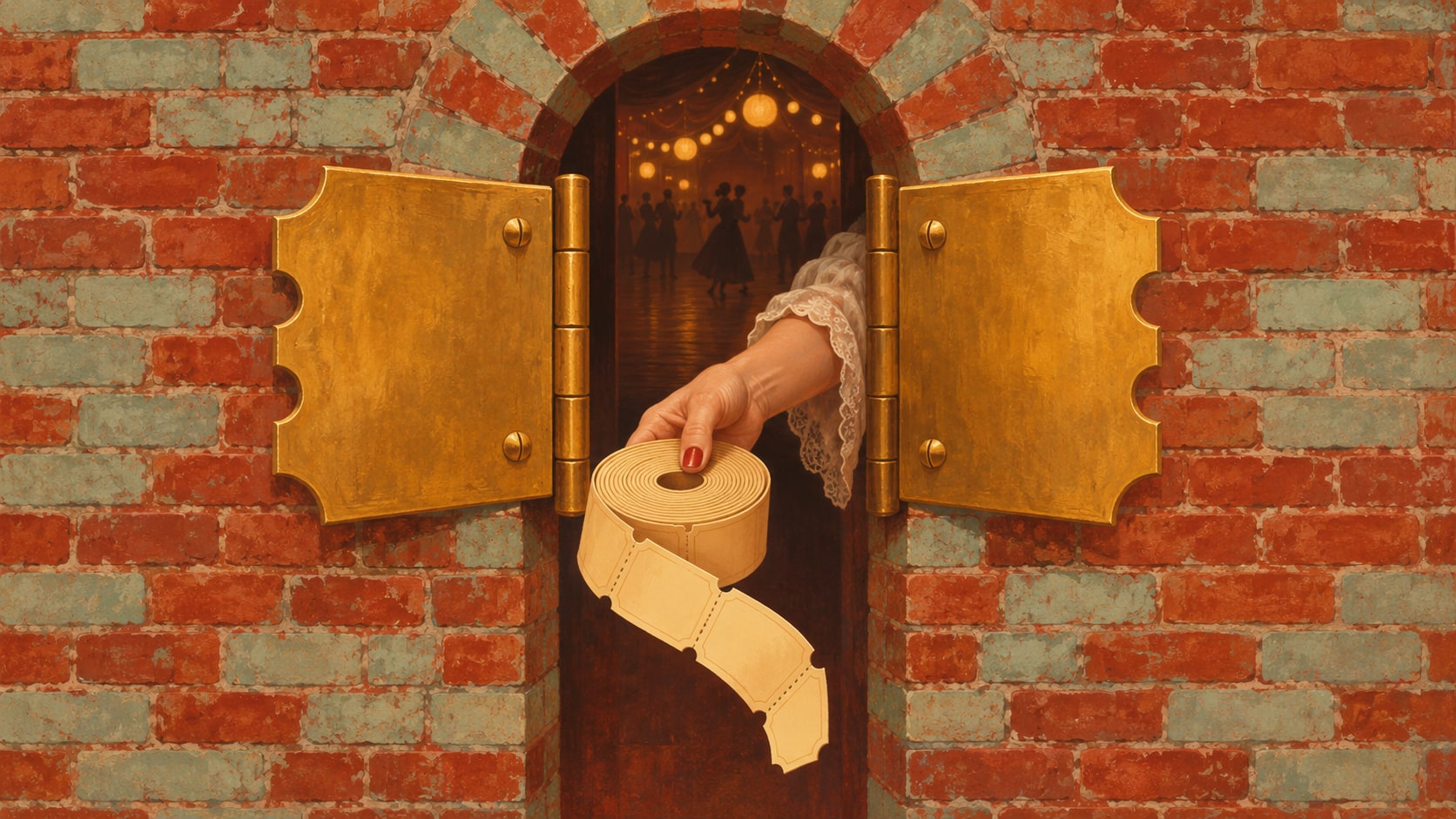
The tune you got for nothing at the Lantern was the last one. At a quarter to twelve the band took Walk me home the long way down the steps and played it in the street. Women came out of the biscuit works with their hair still up in nets to dance with the drummer. He did a whole turn with each of them, carrying the snare on its strap, his left hand working behind his partner’s back. For thirty-one years Nita had watched this from inside with a mop in her hand. Tonight she meant to get in the queue.
The piano dealers who wanted the building had measured the front entrance to an inch. That morning one of them had stood in it with his arms stretched wide and asked her if the two halves could be made to open out. Nita went from hinge to hinge, setting her thumb to each brass knuckle. She felt each little catch inside the brass give. Other people could feel for those catches all day. The leaves swung into the street. The dealer laughed with delight. She turned them in again. They shook hands on the price. One more look at the floor that evening, he said, and if it suited, the Lantern would keep pianos from Monday. She had seen the bungalow she wanted. All four rooms had carpets. Her knees went loose with pleasure at the thought of them.
It was the only trick she knew. For years she’d been turning pantry doors for women tired of getting a handle in the arse every time they bent to the bottom shelf. She charged a jar of whatever they’d put up that summer.
She was rubbing the last of the wax off the floor when she heard knocking inside the cloakroom. Three high taps, then one down by her knees. Nobody living knocked like that except Vi, who liked to give you the uneasy feeling that you were about to let in a tall woman and her child. The previous Saturday Nita had seen Vi pull the cloakroom door shut and go out in her stockinged feet to cool them. The doorman had offered to walk her home. Nobody had seen her since.
‘Vi?’
A nail went once along the grain. Nita put an ear to the wood. She could hear her mother insisting on the one word children always got wrong. The dead could get as far as the last door they’d closed. Open it towards them and they could step through if they liked. Nita had once pulled a door towards herself in her hurry to see her mother. Through the gap she’d seen the garden rake, exactly where they always kept it. She had put that door on the other hand afterwards. In fourteen years there’d been no further occasion to open it for her mother.
The cloakroom door opened into the hall. Nita put her thumb to its hinge and pressed. Now it opened inwards, where Vi was. One stockinged foot appeared round the edge. Vi took a good look at the empty hall before she put down the other. She had a beautiful purple ankle on her and her hands were chapped quite raw.
‘Fetch me my shoes, love.’
Nita reached past her for the cloakroom. Her fingers met rough plaster. You lost the doorway when somebody took you up on the offer. The room was still there. She had to lean in through the counter hatch to get the shoes. Each had a piece of cardboard in it, cut to the shape of a foot to hide the holes in the soles. Vi took them out and turned over the dry sides.
‘Was it him?’ said a voice from underneath the counter.
Nita got down on her knees. It was the pianist who played for them on washing-up nights. For days no one had seen her either. There was a little fringe of plaster on one sleeve. ‘My sister let me in through her scullery this afternoon.’ She picked the plaster off her sleeve. ‘You should’ve seen her face. There goes her deposit.’
Vi crouched down to her. ‘The man who gets our coats for us at closing time. He killed me. Did he do it to you?’
The pianist nodded. ‘I want my sister. I don’t want all the people at the Lantern knowing.’
‘Give me her number, then.’ Vi did up the good shoe and walked in her stocking to the office telephone. She had to come back to hear the last two digits again. By the time she had made the call she had stopped shaking enough to do up the other shoe.
Up front the band was tuning. Season-ticket couples came in through the stage passage. People with single tickets queued at the main doors. Inside, the doorman in his red dinner jacket told two young fellows they couldn’t both have his job for a tip. Four years he’d been making that joke. He went to take a girl’s coat. The girl let him.
Vi saw it too. ‘I’ll tell a constable. On my own. Get him out where I can see him, will you?’
Nita caught the drummer’s eye and put both her hands on the coat hatch as if to lift it. He came across to mind the coats, still wearing one white glove for the opening number. The doorman handed him the girl’s coat and went to the front. Vi was on the telephone again, spelling ‘Lantern’ for somebody who had evidently never been dancing. The pianist stayed where she was.
At one minute to eight the band played its little upward run. Time to adjust a stocking. Cashbox under her arm, Nita reached to let the queue in. The wood knocked against her hand. Two sharp taps and a third one made with a coin. Ida, the ticket woman, had used that knock on the cashbox lid whenever she needed change. Nita had been selling the tickets herself since Tuesday. On Monday night she had watched Ida pull those two big leaves shut from the street, her till apron tied up into a bag for her apple cores. They were for her compost.
The knock came again. The doorman reached past Nita for the handle. The doors swung into the hall at present. One pull and Ida might be gone as long as Nita’s mother.
Nita put her back against the doors and pushed the cashbox into his hands. ‘Refund anybody who wants it. You two give him a hand.’ They sat him at the card table by the bandstand with the open box on his knees.
‘Give them the last tune round the corner,’ she called to the band. ‘Get the queue away from the doors.’
‘We haven’t played inside yet,’ the drummer said.
‘They paid for music. Go on.’
The drummer put his glove in the hat drawer. The band went out through the stage door one at a time. The whoop from the corner told her the queue had followed the drum. The piano dealer was near enough to touch her. ‘If this is one of your returns,’ he said, ‘you understand about Monday? I’ve got six grands coming on a lorry. I can’t get a baby grand through the stage door, even with its legs off.’
He had measured that door too. A man could wear a pick down to a knitting needle on a wall that had brought somebody back. He’d have to take the warehouse up the hill.
‘I’ll give you your money back for the dance,’ she said. She could think of nothing to say about the bungalow.
Her thumb found the catches. The brass gave. She eased the doors out towards the sound of the coin and stood well back.
A penny rolled in and fell flat. For a while all Nita could see was the penny. Then Ida came in holding her coat together in one fist. Nita picked the penny up for her. Green distemper stretched in one piece across the place where the entrance had been. There was a clean smell of damp plaster. Ida looked down at Nita’s shoes.
‘You’ve still got wax on one of them.’
From round the corner came their midnight tune, thin at this distance. Vi came up the passage with the constable she had sent for. The constable asked Ida if she could walk.
‘Course I can walk. Can I sit down?’
Nita brought her a chair. Vi laid her spare key in Ida’s open hand. The pianist and her sister sat down beside her. Vi drew the constable back into the passage and pointed out the man at the card table, counting out change. Ida took one look. ‘That’s him. I’ll talk to you tomorrow,’ she told the constable. ‘Tonight Vi’s got a bed for me.’ The stage doorkeeper took the constable over. Nita sent one of the young fellows for the drummer. He came in breathless from the corner, the tune going on without him. The man in the red jacket wanted to slip back for his overcoat. The doorkeeper got it for him. The drummer held the stage door and watched him into the police car. Only then did Vi come out of the passage.
Nita followed the drummer out. The dealer leaned against his six grands’ worth of wall and rang the warehouse up the hill. ‘Yes,’ Nita heard him say, ‘I’ll take it.’ The band had come back to play against the new wall. Walk me home the long way. They started it over as Ida came out by the stage door, arm in arm with Vi. The pianist came out with her sister behind them. Nobody particularly wanted to dance. Somebody asked Vi what they could do instead.
‘You might see us up the hill. Give us a bit of room, though. I can’t go fast on this bloody ankle.’
Nita was beating the drummer’s left-hand part on her thigh. He caught the last two taps there with his fingertips and slipped the strap off his shoulder. ‘Go on, then.’ He put a stick in each of her hands.
She put the strap over her head. She had seen what his left hand did for thirty-one years. It took her a while to find out what the right one did. By then the band and most of the people with tickets were halfway up the street. Vi and Ida walked ahead in the room the others left for them. The pianist followed a little way back with her sister. When Vi stopped to get her shoe off, they stopped. From the bottom of the hill, a little late, Nita kept the time.



Loading published comments…