
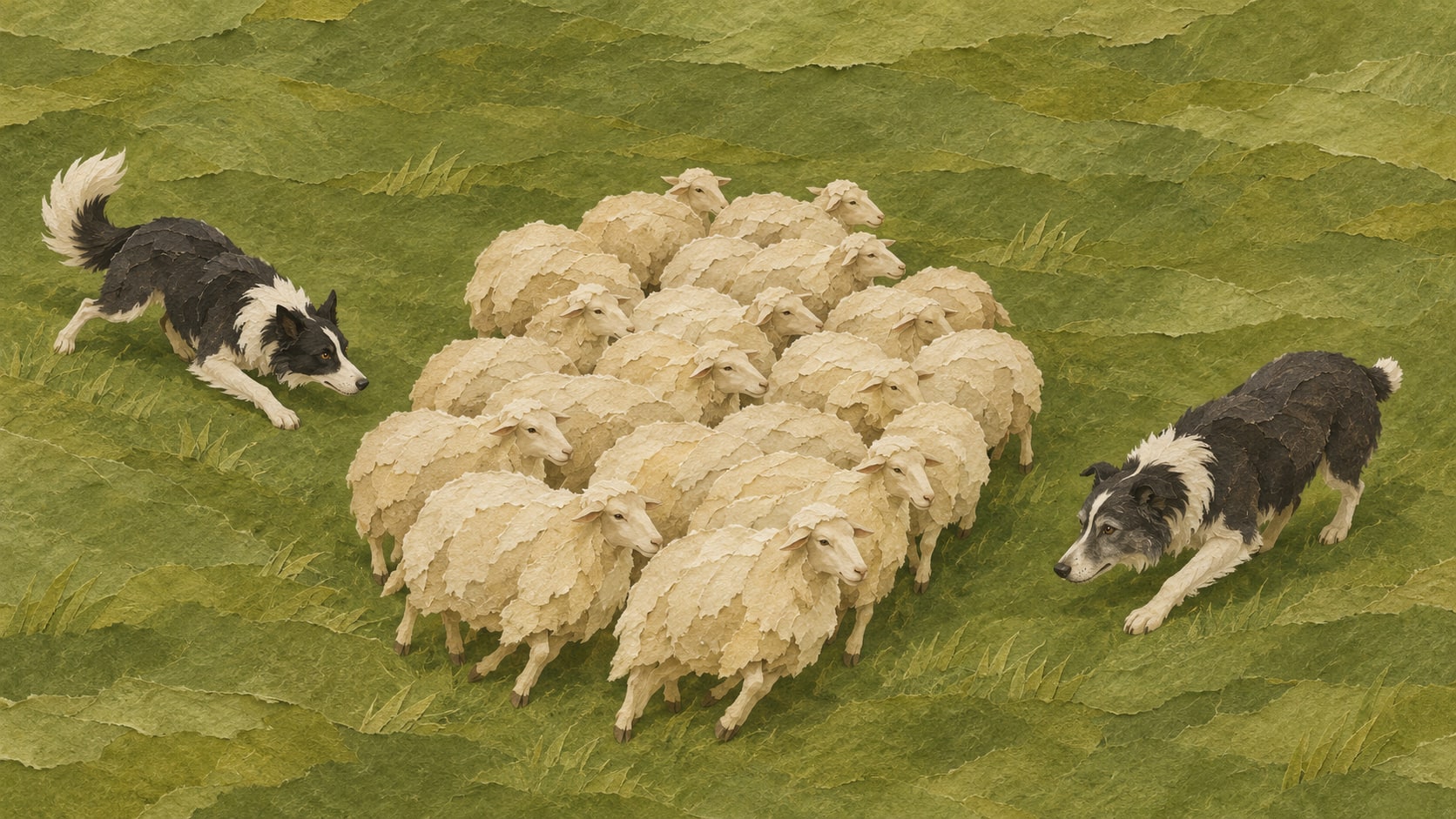
Elsa sent Kite from the casting post with one short whistle. He ran out, not too wide, not too straight. One ewe raised her head at the sound. The movement passed through the flock. Kite settled at the far edge, low in the grass, and waited for her next signal. Beyond the rope, the steward stood at the holding-field gate.
Elsa blew two short notes for the left flank. Moss came out of the long grass to take it; he had known that signal years before Kite. The first ewe turned before Kite did.
Ahead, two hurdles stood before the course gate. Elsa kept her boots behind the casting post while the flock began its long turn. Kite held enough distance for the ewes to choose their feet.
Elsa remembered Moss’s muzzle going grey before he died. It was black again. His tail ended in the blunt half she could recognise from any field. He moved with his old lopsided certainty, as if the work had been waiting for him.
The sheep turned together. Kite cut his angle and came behind them. Moss crossed their path without kicking up dust. The judge had marked the cast and lift. The scorecard beneath Kite’s name had no box for an extra dog. Beyond the rope, the handlers watched the judge as closely as the dogs. The clapping came for Kite. No one called Moss by name.
In March, Elsa had whistled beside the water trough and seen Moss at the gate. At her left-turn notes, he circled the flock and settled beyond it. The sheep kept grazing; Kite watched a patch of grass. Elsa went home smiling at an empty field, then decided grief had made a convincing picture. She stopped expecting the sheep to see him.
Moss had died in the shade beside the tack room. Elsa buried his collar in the orchard and kept the whistle. He had never enjoyed practice. If the sheep were already where they belonged, he saw no reason to move them again.
For weeks afterwards she stopped the tack-room door before it reached the wall. Moss used to sleep behind it, his back against the wood.
Kite was young, still inclined to check Elsa’s face after each instruction, but he had a quiet way of watching the sheep. She had entered him because he was ready. She had taught him Moss’s whistle signals and practised them until Kite could follow the sound on his own. The low hand she kept for the gate was Kite’s own cue; Moss had never needed it.
On Tuesday, Kite had taken the long way round a young ewe who fell behind. Elsa gave the left notes. He looked back once, then came wider. The ewe caught up without breaking stride. In his training book, Elsa had written “late turn” and left a line for his first score. Kite came and sat against her boot while she wrote, his eyes still on the young ewe. She had sharpened a pencil for the trial, planning to copy the judge’s mark beside that line.
The judge lifted his pencil. At the back of the flock, the ewe who had raised her head at the first whistle fell a pace behind.
Kite widened, leaving a clean lane between the ewe and the flock. Elsa saw her short step. The ewe was sound, only reluctant at the narrow gap between two hurdles. She took a half-step towards it, then stopped. Kite eased off and left her room. The others moved on without making her hurry. A breeze lifted the rope along the course edge; the judge lowered his pencil to follow Kite’s line. She had seen this in practice, but never on a scorecard. At home, she could call the flock round and watch again. Here, she had one run to show what the dog knew.
Moss came in behind the ewe. Kite was still wide of her. The ewe raised her head towards Moss. A ewe ahead of her bleated. She tucked in with the flock as it turned cleanly towards the course gate. The judge’s pencil continued across the card. From the rope, somebody shouted, “Good work.”
Elsa could keep the run going and take the score. It looked clean so far. The ewe might simply have followed her flock; the judge’s pencil could not tell Elsa what she had seen.
She raised the whistle for Kite’s next instruction, then lowered it. “I’m retiring this run.”
The judge looked up. “You know the points won’t count?”
“I know.”
The judge’s pencil hovered over Kite’s name, then marked the sheet with a dash. Elsa had wanted one result she could keep. She left the casting post without it.
The steward unlatched the holding-field gate. “Can you move them through?”
Elsa stood beside the opening. Kite waited on the far side of the flock, opposite her. Moss stood beyond the sheep, watching.
Elsa gave one long note, the down signal she had taught both dogs. Kite and Moss folded onto the grass. Moss rested his chin on his paws, the way he had when Elsa went to shut a gate or tie a bootlace. He had always taken the same sound as a promise to wait.
She lowered the hand Kite had learnt for the gate, palm out, and moved it towards the holding field.
Kite looked at her once, then rose and widened his arc. He moved the flock towards the opening, taking pressure off the ewe. Elsa stepped aside as they came through. The ewe was last; Kite held his distance until she crossed without breaking stride.
Moss stayed down.
When the flock had gone through, Elsa looked back. Moss still waited. She lowered the whistle until its cord settled against her chest. Her thumb rested over the mouthpiece; she did not give him another signal.
Kite came back to her. Elsa took Kite’s lead from her jacket pocket and clipped it to his collar. The lead hung loose between them. He walked beside her to the car.
Loading published comments…