
The woman at my counter took three straight pins out of her mouth before she smiled at me. She put the pins through her lapel at precisely the same slant. I put her down as somebody who made clothes. I had lately been pinning up a bedroom curtain with things meant to join sheets of paper. I felt a little abashed.
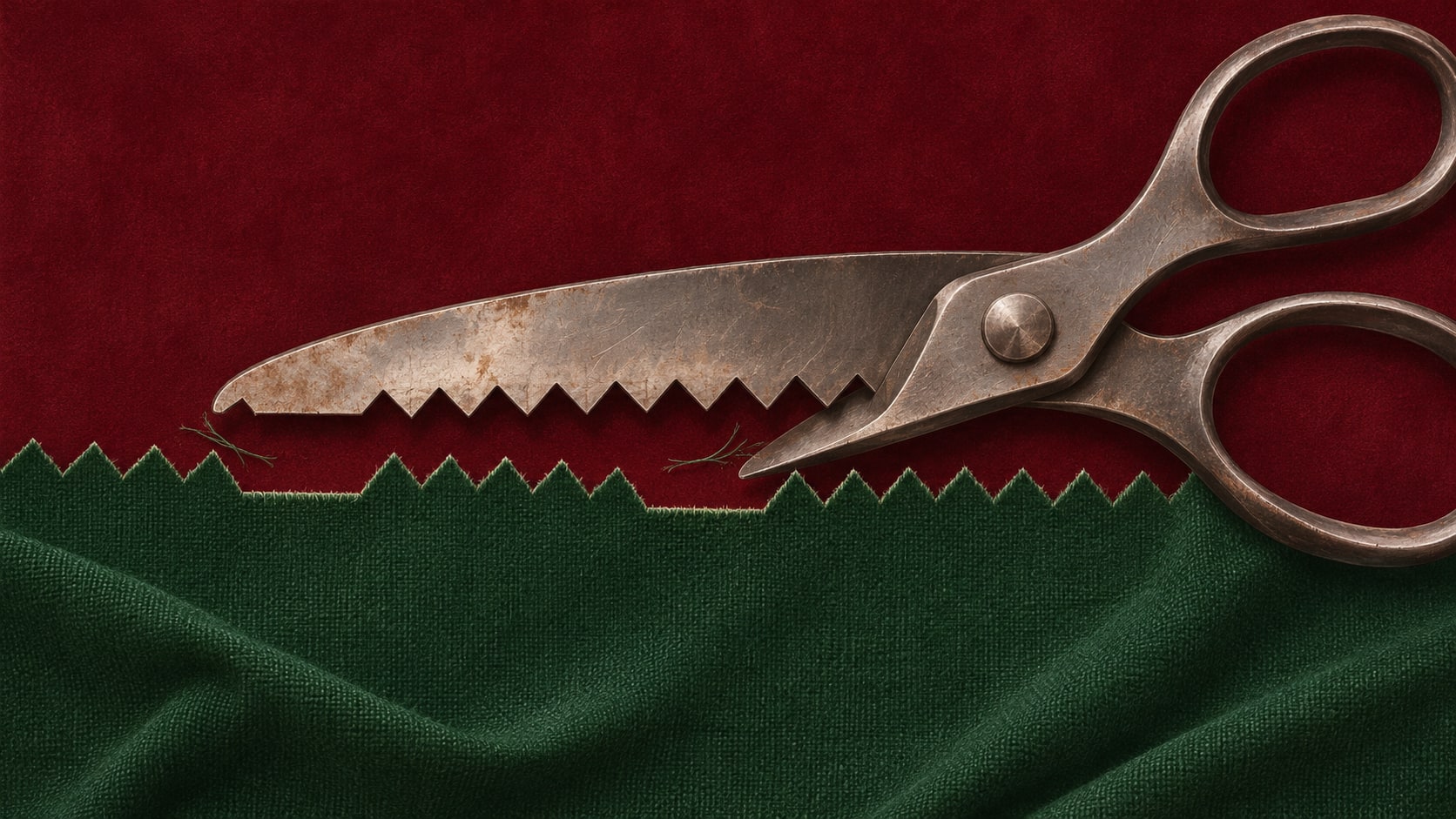
She laid a strip of green cloth down on my desk. One edge was cut in the regular little mountains you get with pinking shears, except that every so often there came a long stretch of flat country.
‘You’re here for the big scissors.’
She nodded.
I remembered them coming in. I’d had to put both hands into the handles to open them. The intake card described two broken teeth in the upper blade.
I told her I’d fetch them from the cage.
When I got up I heard, right inside the bone behind my ear, What a dear, putting on lipstick to work in this hole.
It was a hole. There were no windows. The transport department had put us in underneath the pedestrian ramp at South Terminus. Every few minutes a bus pulling into the bay outside would press an inch of brown water up through the drain by the mop sink. Still, I liked my lipstick, a hot pink you could see on me from the other end of a platform. I turned to give her a look. She was examining the pins in her lapel and had an altogether more serious face than the remark deserved. Heavy boots passed overhead. Both bloody wheels on the same side, very loud, and for a moment I forgot what the woman had come for. Then a suitcase clattered down the ramp on two bare corners. This had been happening to me since I was a girl. At a bus stop I could get half a dozen heads at once. If I wanted to hear one in particular I generally got the person behind me adding up change.
In the cage, Alban was finishing the clearance trolley. The shears were wired to the top shelf by one handle. He had wheeled the trolley right up to the yellow line where the van would come level with it.
‘Those are surrendered,’ he said.
‘Lady wants them.’
‘I expect she does. People do.’
He showed me the particulars. Eighteen days earlier somebody had reported the loss at one of the little pillars up on the concourse. The description was good, down to the two broken teeth, and the owner had given a mobile number for collection. Twice the service had sent its usual question. ‘Do you still want this item?’ No reply. That morning, at six, it had recorded the owner’s agreement to surrender. Underneath, in the box in which we used to write what the customer actually said, were four pale grey words. Usual response for route.
On Monday mornings the service tried its new instructions against last month’s clearances. We used to enjoy seeing what it had come up with. It sent the third notice on Sundays for a while. Same number of cases still open on the eighteenth day. Then it tried dropping a notice. That didn’t bring the figures down either. Across the top, where it used to print ‘No answer’, it now printed ‘Answer: no’. No, I don’t want it. It had cleared the whole of April by shifting a word the width of a thumb.
‘No answer,’ I said.
‘You can read it either way.’ Alban was loosening the screws on an old oven rack so the thing would lie flat on the trolley. ‘They only give me till half past.’
I fetched the woman round to the side of the cage. Through the mesh she could put three fingers into the handle. It was a handsome black thing with a long hollow polished grey where the edge of a hand had rubbed it. She held the swatch against the open blades. One flat stretch lay against the gap in the blade. She rocked the shears on the wire to feel their weight.
I asked whether she had got our messages. She took an old telephone from the pocket of her coat. There was a white star in the middle of the dark glass with cracks going off it all the way to the edges. She held it out to me as if some part of my job might be to mend that, too.
‘You can make a declaration that the city has got it wrong. Name and home address. They’ll freeze the sale and write to you.’
She shook her head at the form. I turned it round and showed her that she could write on it herself. She turned it back to me. My old schoolteacher used to do that with an exercise book when the error was one I was perfectly capable of finding.
From somewhere fairly close to us came the thought of a door with a shoe shoved under it. A woman’s shoe with a split in the leather toe. I could smell the polish on it. I was on the point of offering to write down the address of the terminus in place of hers when I realised what I had done. That shoe had got as far as the box for her street address. I put the pen down. It could have been my shoe. As a child I had once spent a whole summer whitening a split in some Sunday shoes with a piece of chalk.
Alban read the sale ticket to her. ‘Eight rand for mixed iron. You could buy the lot at the depot tomorrow. They’ll make you take the rest, I’m afraid.’
He meant it kindly. There were two curtain rails, a lawn-edger, the rack off an oven. The depot was three buses away. I knew because I had gone last Saturday to fetch a box of drill bits for a man whose walking stick kept slipping on our floor. The box was twelve rand. The bus fares had cost me forty-two. I put the drill bits straight into his hand outside the terminus. On the Monday sheet our office came top, with a neat green tick for every case, including his. Alban cut that one out for the wall. The grey, narrow witness book was clipped to the desk below it. He’d pointed it out at induction, before I had anything to write in it.
The van backed in. The hurry-up whistle came through loud enough to hurt my teeth. The young driver had his lips round an apple. Alban was holding two screws between his. I could have sworn it was one of the two. The woman took her fingers out of the shears. Four little tooth marks stood up in her skin where she’d pressed it against the mesh.
I had fifty rand in my purse. Tomorrow I could go to the depot and buy the load myself. Fifty would do it exactly. I pictured myself on the bus with an oven rack between my knees. The drill bits had weighed next to nothing in my bag. My whole Saturday with that rack would count at the office as nothing having happened at all.
‘Alban, pass me the witness book.’
‘Who’s your witness?’
‘Me.’
That brought him right up close. The book was for disposals we’d signed off in error. Either of us could put a hold on the load. Then both signatories had to be at the terminus from eight till eleven on Saturday, going through the load with the depot supervisor. There had been an incident with a canoe.
‘You saw the list this morning,’ he said. ‘You weren’t there eighteen days ago.’
I pulled the clearance lists from the pocket on the trolley. Last Friday’s had the box of drill bits on it. There was my little flourish under ‘Checked’, although I’d spent my own money putting that one right the next day. This morning I’d signed for the shears below Alban’s name, over my tea at nine. The woman still had her cloth in her hand. I lifted the cover of the witness book and showed her the numbered slip at the foot of the page. ‘They’ll try the blades against your cloth on Saturday. Whoever brings this back can take the shears if they match.’ She folded the cloth to fit the page and kept a finger on it.
‘My son’s got an outside lane for once,’ Alban said. ‘Four hundred metres, nine o’clock on Saturday. The boy runs so beautifully when he can’t see the others.’
I would have liked him to say something cruel. He undid the clip that held the book to the desk and waited for me to make up my mind.
After ‘Reason for hold’ I wrote what I had seen her do with the cloth. After ‘Officer responsible’ I had a good three inches to myself. I wrote my name in full and added the number of the drill-bit case. The driver read enough to know that he could finish his apple in peace. He put the tailboard up. Alban wheeled the trolley away from the yellow line. The woman slid her cloth across the entry and held the cut edge clear while I worked the stapler. I tore the counterfoil along the perforations. It bore the same number as the entry. At my desk I entered the book and page against the shears. On the board above the van bay the figure for open cases went from nought to one.
I wrote ‘Saturday, ten’ on the back of the counterfoil and handed it over. She fixed it to her coat with a pin. I wanted her to think something then. She might have thought, for example, I can cut out the sleeves on Monday. I would have liked something I could tell Alban. For once there was room in my head. Halfway up the ramp she stopped and came back. She pointed at her mouth. I put my hand to mine and looked at her. She ran her tongue over one front tooth, very slowly and so that only I could see. In the back of my spoon I found the pink crescent. I rubbed it off. She waited for me to check again before she went.
Loading published comments…