
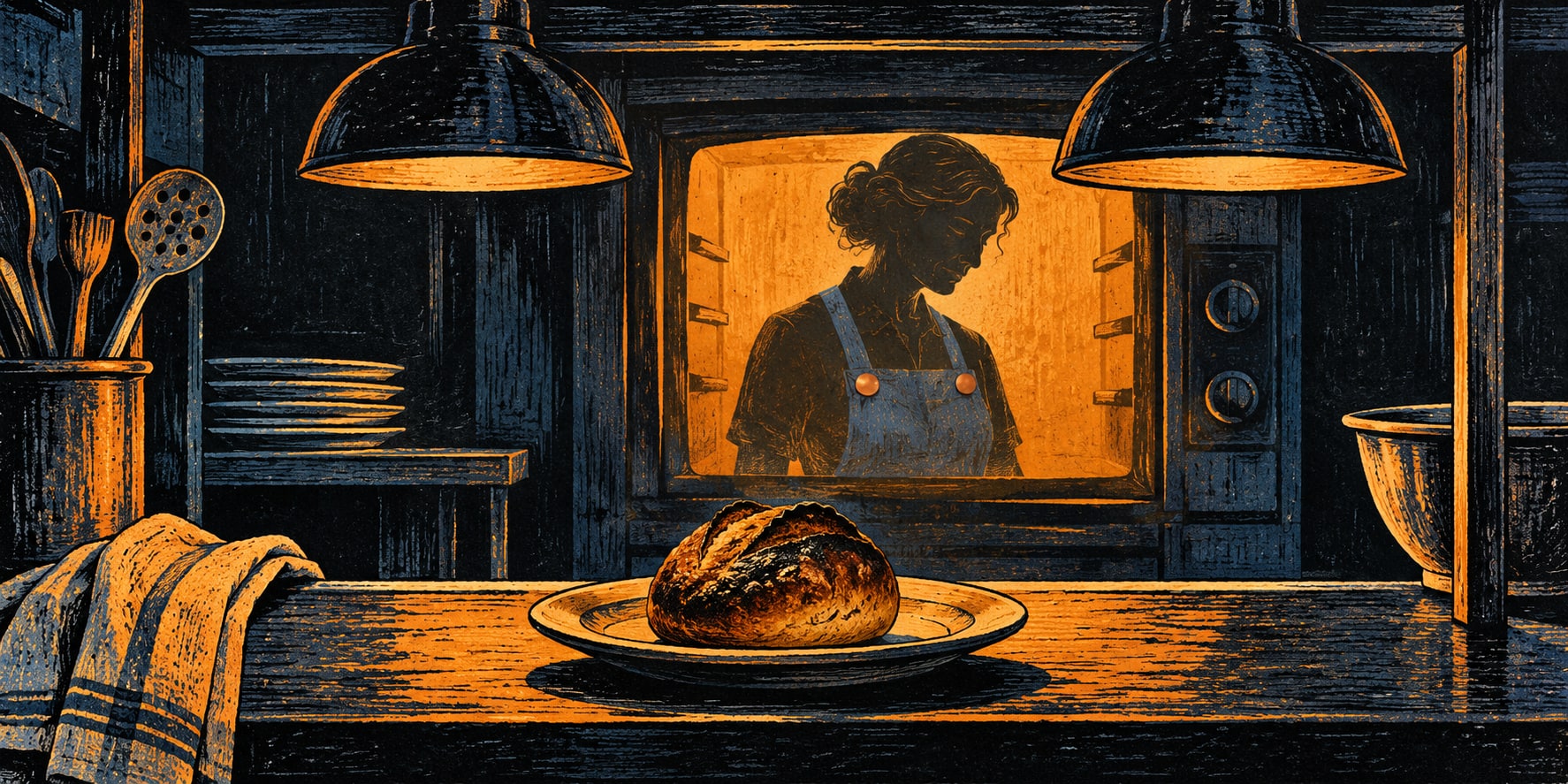
The oven timer rang at 2:14, though Lindi had switched it off at one.
She was scraping burnt sugar from a pan. The old kitchen had been quiet for half an hour. The fridge was unplugged; its last ingredients sat in a cooler bag inside an open delivery crate. The timer had no hands, only a red dial with one tooth missing.
At close, the kitchen had one rule that belonged to no manager: leave the darkest roll on the pass for whoever was still cleaning. The staff called it the cook’s share. Mara had kept the custom alive for thirty years.
The oven door had a loose hinge. Once it had thrown a tray across the kitchen. The cooks tapped twice before opening it, then waited for the spring to settle.
The bell rang again. Lindi turned the timer to zero. The oven light came on, although the heat dial was dark. Amber spread across the floor.
A woman stood beside it, the glow catching the copper buttons on her blue apron. Her hair was tucked beneath a paper cap.
The woman tapped twice on the oven door.
“You’re not still on the clock,” Lindi said.
“You’re early,” the woman said.
“For what?”
“The bread.”
“We’re not making bread.”
The woman pointed at the timer. “You should be.”
Lindi set down the scraper. “Who are you?”
“Mara.”
Lindi knew her name. Mara had died before Lindi started at the kitchen. People still told the story of the wedding party she had fed with one working stove and a bucket of onions.
“You’re dead.”
“That hasn’t stopped the timer.”
“The bell brought you?”
“The bell let me in. The light decides how long I stay.”
“The kitchen closes at midnight.”
“Then there’s time.”
“The bread basket’s empty.”
“There’s self-raising flour in the blue tin.”
“That’s for the farewell meal.”
“It is the farewell meal.”
Mara pointed at the shelf by the pass. Lindi had searched it twice: old takeaway menus, two dead marker pens and a stack of paper orders held by a rubber band. Behind them lay a card with a grease stain shaped like a continent.
The card listed self-raising flour, salt, sour milk, eggs, oil and syrup. It gave no quantities for the flour, sour milk or syrup. The owner had written across the top: MARA’S BREAD. HOUSE RECIPE. ORIGINAL TO REMAIN WITH PREMISES.
“His rule?” Lindi asked.
“His handwriting.”
“If I make it here, he’ll call it the house bread.”
“My name is on the card.”
Mara rubbed her thumb across the grease stain. “He wrote the name.”
Lindi had taken the job because the shifts paid on time and cooking for people beat watching the clock in a warehouse. The shifts had not always paid on time. The last time she stayed forty minutes to clear a flooded sink, the owner crossed out the extra time and wrote SLOW CLOSE on her sheet. She had a folded copy in her apron.
Lindi opened the blue tin. There was flour for two trays. She measured one batch into a bowl, leaving the remaining flour in the tin and the other ingredients in the cooler bag. From the bag she took salt, sour milk, an egg, oil and syrup, then worked the dough until it began to hold together. Mara watched without helping.
“You’re squeezing it.”
“It’s dough.”
“It’s not a rent application. It doesn’t have to prove it can take pressure.”
Lindi stopped kneading. “How did you know?”
“Everyone squeezes the first batch.”
Lindi folded the dough, shaped it into small rounds and left space between them. She turned on the oven and waited for it to heat. Then she set the timer for twelve minutes. Its bell rang once when the tops had split and browned. She stopped it before it could ring a second time.
The kitchen filled with the tang of sour milk and the darker sweetness of syrup. Lindi bit a corner while it was still warm. The sweet came first, then the sour stayed.
At four, the farewell guests arrived, most carrying their own containers. Tumi, who had washed dishes here for years, came with an empty tin. Her cuffs were still damp. The man who repaired the extractor fan brought ginger beer. A woman in a blue cardigan said she had cooked here for two weeks during a summer job, thirty years earlier.
Lindi put the bread on the pass. She left the darkest roll on a saucer at the back.
The woman in the cardigan took a pale roll. “Still too sweet,” she said to Mara.
“You said that every time.”
“And you still saved me the darkest one.”
“You were night staff. You had standards.”
The woman laughed. Lindi switched off the oven. The light went dark. The timer fell silent. Mara’s outline thinned, but did not disappear. Lindi turned the oven dial back on. The light came on, and Mara took her shape beside it.
“Who started the cook’s share?”
“I was always the last one cleaning,” Mara said. “I kept one roll back. By the next week, everyone had a name for it.”
Tumi had just been offered a Monday staff-meal shift at the new kitchen by the station. “I can make it there, if they pay for the prep.”
“There’s flour for another tray,” Lindi said. “Try it.”
Tumi took the remaining flour and salt, cracked in an egg, added oil and syrup, then held the sour-milk jug over the bowl. “How much?”
“Enough for the fold to close without cracking.”
Tumi added a little, judged the tackiness with two fingers and cut the rounds with a wet knife. Mara started to lift a hand. She let it fall.
Lindi set the second tray for twelve minutes. The timer rang once. Tumi tapped twice, waited for the spring to settle, opened the door and set the tray on the pass. She broke one roll and tasted it. “Less syrup next time,” she said.
Lindi wrote the method on the back of her time sheet: add liquid until the dough folds without cracking; leave space between the rounds. She left Mara’s original card on the shelf.
The guests began to leave. Tumi washed the plates. The woman in the cardigan wrapped a piece of bread for the bus. Mara stood beside the oven with her fingers on its handle.
Lindi switched it off. The light vanished. Mara was gone.
At midnight, Lindi locked the kitchen and slipped the keys through the owner’s office slot. Tumi left with the darkest roll and the method from Lindi’s time sheet.


Loading published comments…