
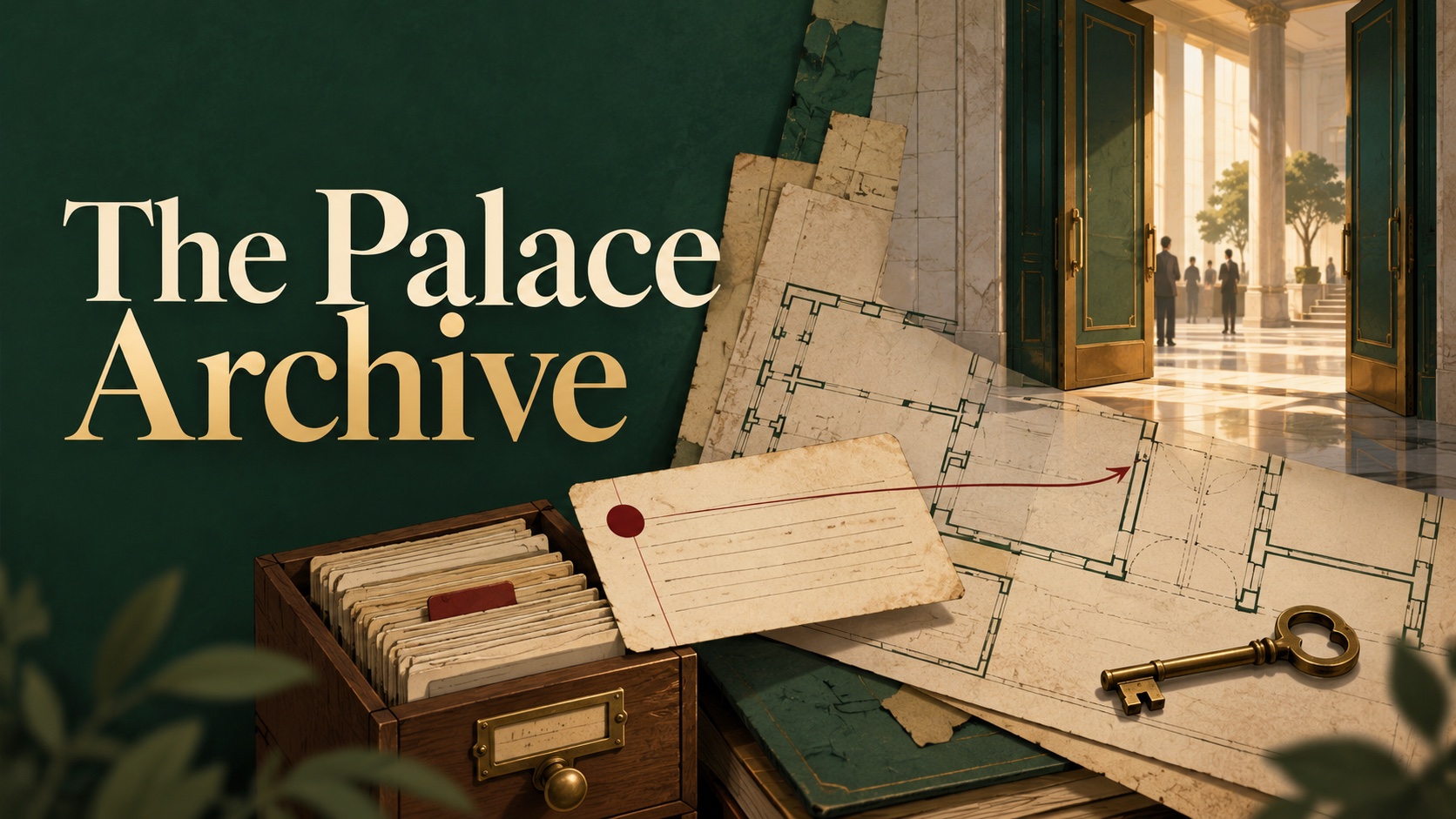
On Ren’s first morning at the palace, someone asked him to find the door that had been ceremonially opened three times.
“Which door?” he asked.
The attendant consulted a list. “The one to the west gallery.”
Ren looked through the open doorway behind him. Beyond it, a corridor ran towards the west gallery.
“That one?”
“No. It was officially opened last spring.”
“But it’s open now.”
“Yes. The opening is finished.”
The attendant put a small brass key in Ren’s hand and left him with a folded map, a timetable and a length of blue ribbon that was meant to mark the occasion. Ren put the key in his pocket. He tied the ribbon to the map so he would not lose either.
The palace employed three people to arrange ceremonies and one to make sure the cupboards in the archive did not fall open. Ren was the cupboard person. His title was junior archivist, which had sounded grander in the letter offering him the post. He had been told to tidy the ceremonial holdings before the succession announcement, due the following week. He had not been told about the opening of the door.
He found the archive by following the scent of dust and orange peel. The room was tall and cool, with shelves that turned along the walls and a narrow table under the windows. A brass bell sat on the table, its label reading RING ONLY IN CASE OF FIRE. Someone had set a bowl of mandarins beside it.
Ren wrote the location of the bell in his notebook, then the location of the mandarins. By the time he reached the first catalogue drawer, he had also noted a loose hinge, a draught beneath the west door and the fact that the window latch could be lifted with one finger.
“You are the new archivist,” said a voice behind him.
Ren turned. A woman in a dark green jacket stood at the end of the table. She was in her thirties, perhaps, and held a folder flat against her side. Her hair was pulled back without a pin out of place.
“Ren. Yes. And you are?”
“Ansel. I’m expected to become the next head of this house.”
He had heard the title in the induction notes. He had not expected the heir to come to the archive before lunch.
“I’m looking for a record of the Vale household,” Ansel said. “They’re named in the surviving household records for the old winter ceremony. The official account says they delivered the first baskets to the palace.”
“And you think they didn’t?”
“I think the account is too neat.”
Ren liked her at once, which was inconvenient. He had been taught not to confuse a good question with a good person. He had also been taught that a person who could ask a question without pretending to know the answer was more interesting than most catalogues.
“I’ll check the indexes,” he said.
Ansel opened the folder. Inside was a printed copy of the succession speech. “I would rather have the answer before I sign this.”
“That is sensible.”
“It has been described as brave.”
“You can be sensible and brave at the same time.”
She studied him. “You will get on well here.”
“Because I agree with you?”
“Because you sound worried by the possibility.”
She left him with the folder and went back to the ceremony. Ren meant to check the winter-ceremony index. Instead, a shelf card for a winter-hall ledger turned up in the flower catalogue. He followed its mark through the neighbouring drawers, looking for other misfiled records. By the time he returned to the index, the first hour had gone and Ansel had left for a succession meeting. His detour cost him the chance to answer before her speech went to the printer with the old account intact.
The Vale name appeared in a book of household accounts, a list of seasonal gifts and a ledger of arrangements for the winter ceremony. In the published history, it appeared only as a household delivering food after the palace had invited them. That account began with the palace setting aside provisions for its tenants during a bad winter. The language was polished: “At the sovereign’s invitation, provisions were distributed from the lower court.”
The ledger was filed under Flowers, winter hall. A pressed violet marked the page. The first entries were short:
Three carts at east gate. Flour, onions, apples. Received by A. Vale. No palace stores used.
Below it, in another hand:
Each house brings one basket. Leave two at the lower steps for the night workers. Do not wait for the steward’s list.
Ren read it twice. The ceremony had not begun as a royal gift. It had been a practical arrangement made by people inside and outside the palace, for other people who would otherwise have gone without. The first record did not name the night workers. It did not say whether the palace had known about the food or objected to it. It did not prove that the Vale household had started the arrangement. It did show that the public story had made a royal invitation out of something the palace had not organised.
He checked the previous year’s accounts. Flour had been ordered for the kitchens, but the amounts did not match the baskets recorded in the ledger. A list of repairs showed that a side door had been left unlatched on winter nights. The wages book recorded extra shifts for the kitchen staff but no payment for distributing food.
The next book was a delivery register, kept by the gate clerk. Its pages were ruled into columns for date, cart, load and destination. In the week of the first distribution, three carts had entered by the east gate after the kitchens closed. The destination column said only lower passage. The handwriting was different from the ledger’s. On the last entry, someone had added all received; no palace stores used.
It was corroboration, not a complete account. The clerk had recorded what crossed the gate, not who had arranged it. The household ledger named the Vale household and “other contributors” but did not say how many there were. A later ceremonial book called the first baskets a gift from the sovereign. It had been written years afterwards, in a hand Ren did not recognise.
He made a small table in his notebook: what each record said, what it did not say, and what would contradict it. The gate register supported the arrival of food from outside the kitchens. It did not prove that the palace had been excluded from the decision. The repair note supported access through the lower passage. It did not name the people who had carried the baskets. The ceremonial book showed when the palace’s version entered the record. It did not show why.
Ren crossed out origin of the winter ceremony and wrote evidence for the earliest recorded distribution. It was less dramatic and more useful. He felt a mild disappointment at the change, then a stronger relief. The first phrase had made the records sound as if they owed him a beginning. They did not.
At the bottom of the repair list, someone had written: The basket shelf is for use. Stop polishing it.
Ren smiled.
He made a note of the shelf mark and wrote possible correction to catalogue description in pencil. He did not yet change the public record. A catalogue description was not a place to settle every question its documents raised.
A bell rang somewhere in the palace. The label on the brass bell in the archive remained untested.
At eleven, a person in a plum-coloured coat swept into the room carrying three rolled plans and a silver tray. The coat was cut in a court fashion Ren had seen in an old portrait, but the boots were new and sensible.
“You must be Ren,” the person said. “I’m Cousin Pell. I have been told to make the ceremony run smoothly.”
“Can I help?”
“Not unless you can teach a chair to remain where it is put.”
Pell set the tray on the table. A card was pinned to it: Memorial plaque, west landing. Corrected date. The date had been corrected twice, in two different inks.
“Why is the plaque here?” Ren asked.
“Because the committee cannot decide whether it belongs in the west gallery or the west landing. The gallery committee says landing. The landing committee says gallery. The plaque is waiting for a decision.”
“What is the ceremony?”
“We shall carry it to the west landing and announce that it has arrived.”
Ren glanced at the card. “The date is wrong.”
“It has been corrected.”
“Twice.”
“That is why we are confident.”
Pell watched Ren’s expression. “You have found something.”
“I have found a ledger that changes how the winter ceremony is described. I have not found enough to name who began it.”
“How disappointingly careful.”
“I’m new.”
“You will get over that.”
Pell took the tray and departed with the plaque. A moment later, Ren heard the west door bang open, then applause. The plaque had been ceremonially placed on a shelf.
Ansel came back just before lunch. She had removed the folder from under her arm.
“What did you find?”
Ren showed her the ledger, the accounts and the repair list. He described what each could and could not support. Ansel listened without interrupting.
“If the Vale family organised it,” she said, “they did not do it alone.”
“That is what the records suggest.”
“And the palace history claims the sovereign began it.”
“The record we have does not support that claim.”
“Can we say the opposite?”
“Not yet.”
Ansel looked down at the page. “The speech says the household was invited. That could be true.”
“It could. This ledger says the baskets were already at the east gate. It doesn’t say who invited whom.”
“I don’t want to replace one convenient story with another.”
Ren’s pencil stopped above the paper. “Neither do I.”
She looked at him then, directly, and he felt the archive become smaller around them.
“What would you change?” she asked.
“The catalogue description. It could say the official account attributes the distribution to a royal invitation, while a surviving household ledger records baskets brought by the Vale household and other contributors. It could say the record does not establish who began the practice.”
“That’s not a story anyone can use in a speech.”
“It is a record someone can check.”
Ansel folded her hands. “The announcement needs to show that the house can still be trusted to carry an obligation. The councils outside the palace are already arguing about whether the succession should happen at all. If I say the palace invented a tradition, they will ask what else it invented.”
“Maybe the answer is that it invented a ceremony.”
“And if the ceremony is all that makes the councils come to the table?”
Ren looked at the shelves. The archive was full of people who had done work without receiving the public description of it. There was no index for the things that had been quietly required and later turned into someone else’s virtue.
“Then you need to decide what you’re asking the ceremony to do,” he said. “I can’t decide that from a ledger.”
Ansel drew a breath. “You’re right.”
Ren had expected a rebuttal, perhaps a sentence about the difficult position of the heir. The reply caught him unprepared.
“I’m sorry,” she said. “I have been asking records to do the work of a decision.”
“That happens often.”
“Does it?”
“I’ve been here since this morning.”
She laughed, quietly, and the laugh loosened the room.
Over the next four days, they met in the archive between appointments. Ren checked the ledger’s paper, stitching and ink against the other household accounts. Nothing suggested it had been added later. He found the same hand in a delivery note and a list of winter repairs. The account was consistent, but the hand was not identified.
He asked the senior keeper to inspect the binding. She showed him where an old repair had been made with thread from the palace stores, and where a later page had been inserted without disturbing the stitching. The entries about the baskets came before that insertion. The note about the open passage appeared on an original leaf, not on the replacement.
“That helps with the date,” she said.
“It doesn’t tell us who wrote it.”
“No.”
“Or whether they were there.”
“No.”
The senior keeper shut the book gently. “An archive is very good at keeping a thing after the person has stopped being available to explain it.”
Ren wrote down the sentence, then crossed it out. It sounded like a maxim. What he kept was the detail: the thread matched the store ledger, but the repair had been done years after the first distribution.
Ansel brought him a list of people who would be at the ceremony. She had marked two names with a question beside them. One belonged to a family whose papers had been moved to the public reading room; the other belonged to a kitchen worker whose grandchildren still worked at the palace.
“I don’t want to use them as evidence because they are convenient,” she said.
“Then don’t ask them to certify the story. Ask whether they know where another record might be.”
“And if they tell me something we can’t verify?”
“You can listen without putting it in the catalogue.”
She folded the list. “That feels like a small distinction.”
“It is a small distinction. It changes what we claim.”
Ansel asked the records office for access to the public catalogue’s amendment procedure. The palace had a rule that the first description of a record could never be erased; a correction had to be appended, dated and signed by the keeper of the collection. It was an old rule, introduced after a clerk had altered the order of a succession document and caused a month of public argument.
“The rule was made to prevent tampering,” Ansel said.
“It seems to have done its job.”
“It also means the old account stays visible.”
“It should.”
“Even if it’s wrong.”
“Especially then.”
She turned the page in the procedure book. “The heir can request a correction. The archivist must agree to its wording.”
“I can agree to an account of what the records show.”
“You don’t have to agree to my speech.”
“I wasn’t planning to.”
They were quiet for a moment. Ansel’s hand rested near his on the table but did not touch it.
Ren had begun to notice the way she waited for him to finish before speaking. He noticed the same thing about himself. He was no longer writing every small distraction in his notebook. He had stopped tracking the draught under the west door. The archive was not less full of details; he was choosing which ones required him.
That evening, Ansel found him in the lower courtyard beside the shelf where the winter baskets were placed. A staff member had left a bowl of apples there, for the next day’s rehearsal. Ren was not sure whether it had been set down as decoration or for anyone to take.
“Do you want one?” she asked.
“Is that allowed?”
“I don’t know. We can discover it.”
She picked one up and handed it to him. He wiped it on his sleeve. It was a little bruised, with a pale mark on one side.
“I thought you might want to see the room where the records were kept,” she said.
“I thought the records were kept here.”
“Some of them. The old winter store is underneath the stairs.”
They went down together. The room was small, with a low ceiling and shelves along one wall. A narrow door led to the service passage. The door had a repaired latch and a polished handle. On the floor, a line of pale marks showed where crates had once been dragged.
Ansel crouched and touched one of the marks. “The official story says the food came from the palace stores.”
“The ledger says otherwise.”
“The workers’ names aren’t there.”
“No.”
“You could add a note about the people who used the passage.”
“I can say the repair records show the door was kept open at night. I can’t say who carried every basket.”
Ansel stood. “It is a very careful answer.”
“It is the answer I have.”
“I know.”
She came closer. Ren could smell the apple on her breath, a clean, sharp scent. She looked as though she had decided something, then reconsidered it.
“I would like to see you when I’m not asking you to correct the house,” she said.
“You could ask me to correct a cupboard.”
“I’ve been told the cupboards are your territory.”
“They are not a romantic territory.”
“You don’t know that.”
Ren smiled. “I’d like to see you too. I was going to say yes before you asked, and I want to know I can still say no.”
“Good. We’ll meet outside the palace. You’ll have no reason to say yes because I’m the heir.”
“I can say no in the palace.”
“You can. But it is easier to believe yourself when the door is not guarded. I want to know you chose me with a way out.”
He looked at the passage door. It was open by a hand’s width. “Then outside.”
Before they left the lower store, a secretary came down the stairs with a document for Ansel to sign. It was a personnel notice confirming Ren’s appointment until the end of the season. Ansel read it, then gave it to him without signing.
“This is from the records office,” she said. “My signature would make the appointment look as if it depends on me.”
“Does it?”
“No. The keeper appointed you. The council approved the post. I can ask for access to a catalogue correction, but I cannot dismiss you or change your hours.”
Ren had not known that. He had assumed the heir’s attention might become another condition of the job, even if no one said so. The secretary confirmed that the appointment was administered by the archive council and would continue after the succession. Ansel signed only the acknowledgement that the records office had delivered the notice.
“I wanted that clear before Friday,” Ansel said when the secretary had gone. “If you decide you don’t want to meet me, it won’t change your work.”
“Thank you.”
“You don’t have to thank me for not making a threat.”
“No. But I can thank you for noticing the possibility.”
She nodded once. It was not an apology for being heir. It was a decision about what she could do with that position.
The succession announcement was scheduled for noon the next day. By ten, the speech had been shortened twice and the plaque had been moved from the west landing to the west gallery. The first printed copies still carried the old account; guests would hear the correction before they could read it. The plaque was still wrong.
Ren had prepared the catalogue amendment in a plain envelope. The original description remained as it had been. Beneath it, he had written:
A household ledger from the winter of the first distribution records baskets brought to the east gate by the Vale household and other contributors. The ledger does not establish who began the practice or whether a royal invitation preceded it. A repair record notes that the lower passage was kept open at night. The current ceremonial account attributes the distribution to a royal invitation; the surviving records do not confirm that account.
He had left the final line in because it was true.
Ansel read the amendment in the archive. “If I sign this, it becomes part of the public catalogue today.”
“Yes.”
“The old account will stay there too.”
“Yes.”
“And people may use the correction to argue that the house should not exist.”
“They might.”
“Would you like me to remove that sentence?”
“No.”
She studied him. “You would rather I sign it as written.”
“If I tell you what to do, you can blame me if it goes badly. This is your decision.”
“That is why I asked you.” She turned the pen once between her fingers. “You’re the first person in this house who has let me hear an answer I might dislike.”
Ren wanted to tell her to sign. He wanted her to trust him more than he wanted to make the decision safe for himself. “I’ll stand by the wording. I can’t choose the risk for you.”
Ansel took the pen. “Then I’ll sign it. Not because the palace has become honest in a morning. Because the record should be available to anyone who asks what happened.”
She signed as heir. Ren signed as archivist. The senior keeper read the note, checked it against the ledger and repair record, then added her required signature to approve the entry.
At the ceremony, the hall filled with people who had arrived to be seen arriving. Pell had arranged the seats in two circles: one for those who mattered and one for those who had to be present in case the first group needed anything.
Ren stood at the back with the envelope under his arm. He had been asked to bring the corrected catalogue record, though no one had said whether it would be read aloud.
The outer chairs had been set close to the service door. A kitchen porter stood with a tray of water glasses and kept shifting it from hand to hand. When he tried to put it down, a clerk pointed to the empty table reserved for the council. The porter looked at the table, then at the chairs, and carried the tray around the room instead.
Pell noticed Ren watching. “If we let the staff sit, someone will ask whether they are part of the succession.”
“They are part of the palace.”
“That is not the same question.”
The porter stopped beside the archive table. He set the tray down there, where people could reach it. A guest took a glass without asking who had authorised the table. The clerk looked towards Pell. Pell lifted one shoulder and moved on.
Ansel spoke about the succession first. She spoke of duties and councils, of what the house could promise and what it could not. She did not claim the palace had begun the winter distribution. She said the tradition had been built by many people, some of whose names the archive had not preserved. Then she announced that a correction to the public record had been signed and would be available that afternoon.
Some guests turned to the catalogue table. Others kept their eyes on the heir. A woman with flour on one cuff paused beside the envelope. She read the correction once, then again.
“My grandmother used to say the baskets came through the lower passage,” she said to Ren.
He looked at the ledger. “The repair note supports that the passage stayed open at night.”
“She said the door was never locked.”
“I can’t add that unless we find another record.”
The woman nodded. She was not offended. “Then I’ll keep saying it.”
She moved on, leaving the catalogue table open behind her.
Pell appeared beside Ren with the plaque.
“We have discovered that the date is right after all,” Pell said.
“Which date?”
“The first correction.”
“The one you covered with the second correction?”
“That is why we are unveiling it again.”
Ren looked at the plaque. Its date had been amended so many times that the original was now the least legible part.
“Perhaps you should leave both dates visible.”
Pell considered it. “People will ask questions.”
“They already are.”
“Good,” Pell said, and carried the plaque away.
After the ceremony, Ansel found Ren in the archive. The signed amendment was in its permanent place, next to the original description. The repair list and the ledger had been returned to their shelves.
“I have been told the announcement went well,” she said.
“Did it?”
“It went.”
“That is often the most accurate report.”
“The councils are still arguing.”
“That sounds like their work.”
She leaned against the table. “I’m going to be in the city on Friday.”
“For a meeting?”
“For a walk. Outside the ceremonial route.”
“Should I bring a catalogue?”
“Only if you want to.”
Ren looked at the open door. The blue ribbon was still tied to the map, as he had left it. He had forgotten the small brass key in his pocket, and the bell beneath its fire-only label remained untested.
“I’ll come,” he said.
Ansel smiled. The smile was not a royal announcement. It was small enough to belong to her.
Ren opened the catalogue and entered a review date beside the amendment. Then he left the door unlatched.


No published comments yet.