
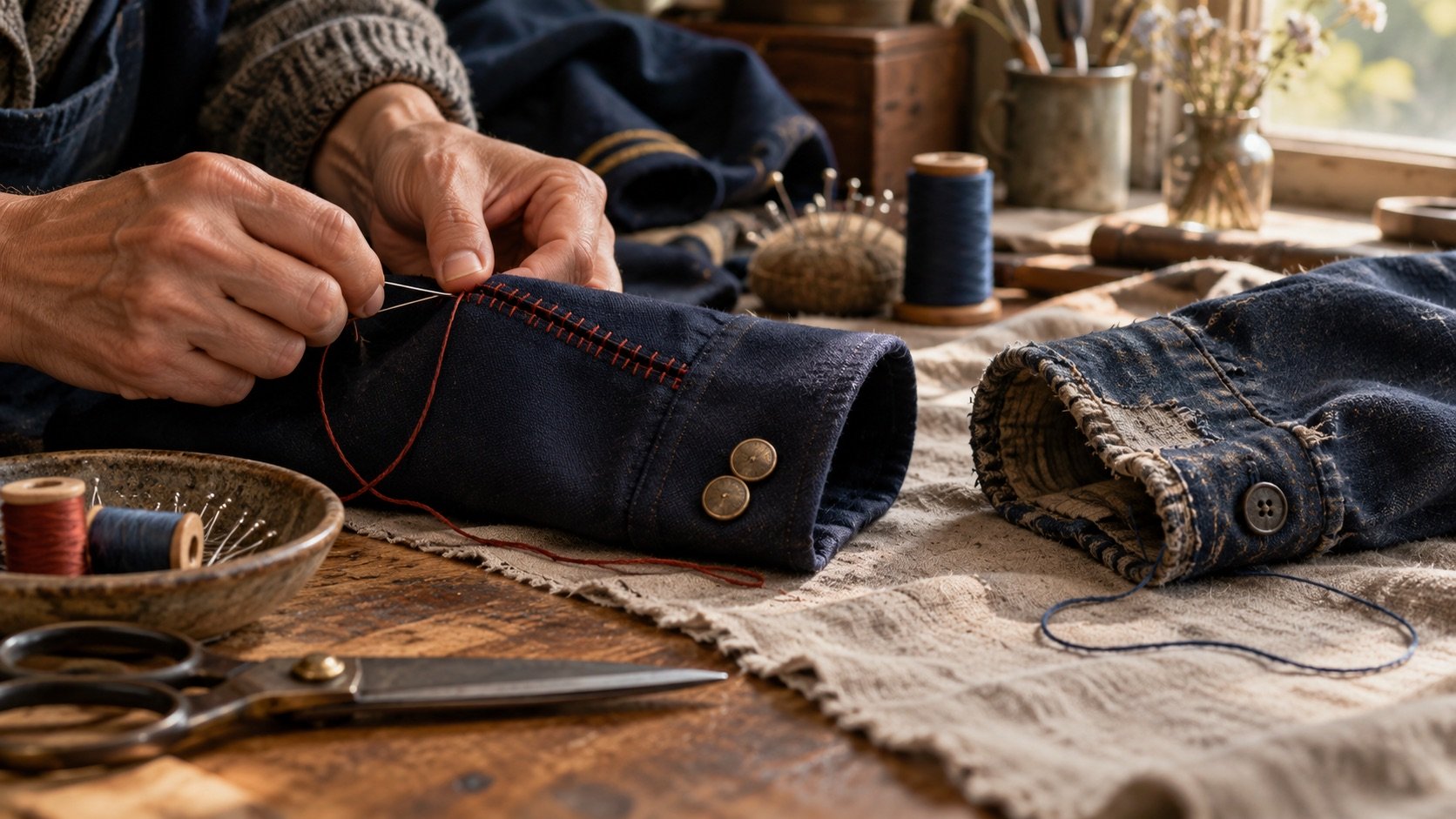
When Sol brought in his uniform, the tear was already trying to become a pocket.
“Please make it disappear,” he said, offering her his left arm. A small blue thread clung to his thumb. “I have a route in twenty minutes.”
Miri turned the sleeve over. The cloth had split at the elbow, where a driver leaned towards the sliding window to call a stop. The torn edges had curled into two stubborn lips.
“Disappear costs extra.”
“I’ll pay.”
“That’s what everybody says before they see the price.”
He smiled, but kept his arm close to his body. Miri fetched the box of patches from beneath the counter. Her stall was only wide enough for a stool, a machine and the standing fan that pushed loose cotton across the floor. A strip of yellow tape marked the queue. Her own left cuff had snagged on the counter that morning; she kept the loose edge turned towards her palm while she served customers.
Sol touched the sleeve. “No patch on the outside.”
“If you keep reaching through that window, it’ll tear again.”
“I know.”
She waited. Outside, a market trader rolled up a shutter with a noise like a hand cranked through gravel. The clock above Miri’s machine said seven forty-three. She switched on the machine. Her first customer was due at eight; Miri had promised to replace a zip, but had not yet found the right one.
“Is the window stuck?” she asked.
“It’s old. When it jams, I pull it in with this arm.” He showed her, elbow folded, shoulder angled. The fabric pulled taut across his back. “The other drivers pull with both hands. I have to hold the wheel.”
“Show me,” Miri said.
He leaned sideways, one hand on an imaginary wheel, the other at the window latch. The motion pulled the sleeve taut along the back seam.
“That’s where it catches,” he said. “Not on the elbow. Just before it.”
She rubbed the thin cloth between her fingers. It had gone shiny from the metal frame.
Miri nodded. “Then the sleeve needs room to bend.”
“Can you make it look like nothing happened?”
“I can make it look like a shirt.”
“That’s the dream.”
She threaded a needle while the machine warmed. Sol watched her tie the knot twice, neat and quick. “My daughter says you can mend anything.”
“Your daughter has not brought me a zip.”
He laughed properly this time. Then he took off the shirt, turned the sleeve inside out and laid it on the counter, the cuff pointing towards her. The cloth was thinning on both sides of the tear. Miri chose a scrap of orange cotton, soft from washing, and slid it beneath the split.
“That’s bright,” he said.
“It’s inside.”
“You’ll see it.”
“You’re the one wearing it.”
He considered the little square of colour. “Fine.”
Miri pinned the patch in place. She stitched from the middle out, giving the sleeve a little more ease where his arm bent. The machine made its small, steady clatter. Sol stood with one hand on the counter, keeping the shirt from shifting. Once, he reached to help and nearly pulled the fabric out of line.
“Hold there,” she said. “Don’t rescue me.”
“I’m not.”
“Your hand says otherwise.”
He moved it to the far edge. She finished the seam and turned the shirt right side out. The repair did not show until she bent the elbow. Then the cloth opened and closed around the orange patch, which flashed once and vanished.
Sol put the shirt on. He rolled his shoulder, raised his arm and reached for the imaginary window. The sleeve held.
“There,” Miri said. “You can go.”
He rubbed the outside of the cuff with his thumb. “I thought I’d feel it.”
“You can feel the sleeve. You just can’t feel the hole anymore.”
The clock said seven fifty-eight. Sol hurried towards the market entrance, then stopped to let a woman pass with a crate of eggs. He held the door with his repaired arm. The shirt pulled once at the shoulder and settled.
“Miri.”
She looked up from the zip she had finally found.
“If the patch comes through, I’ll bring it back.”
“If the patch comes through, I’ll charge you extra.”
He touched the inside of his sleeve. “Fair.”
After he left, Miri moved the box of patches closer to the machine. The zip customer would be early. She rolled her own left sleeve above the wrist. A thin line had opened there, where the cuff caught on the corner of the counter each morning.
She cut a square of orange cotton, folded it once, and pinned it inside.



No published comments yet.