
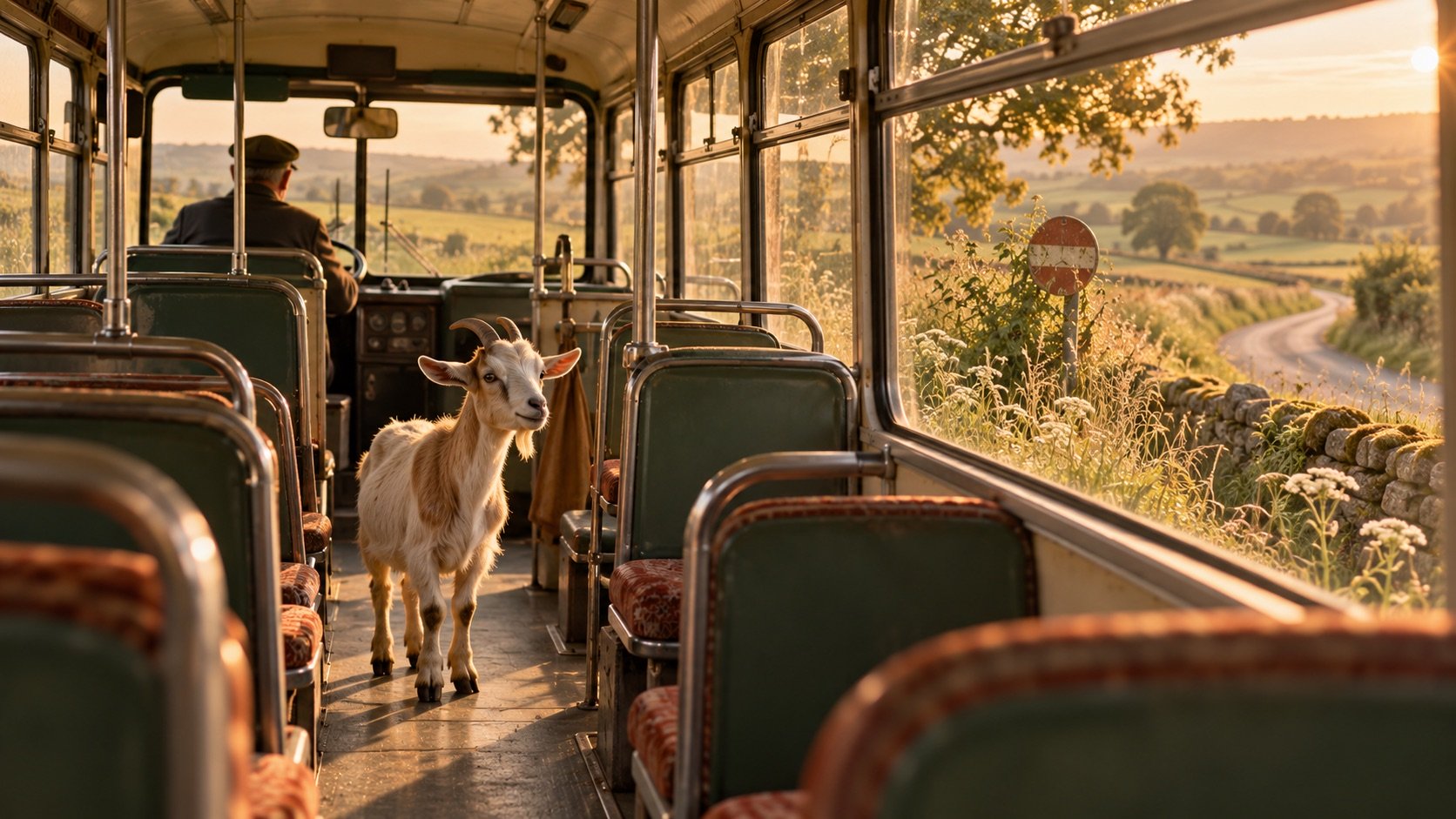
The goat boarded at the library stop and took the seat behind the driver.
I opened the doors again. It looked at me through the glass partition. Its left horn was shorter than its right, and a red thread hung from its collar.
“You can’t sit there,” I said.
The goat chewed.
The bus was already four minutes late. I had a schedule clipped above the wheel, a paper cup of coffee wedged beside it and a dozen passengers who had all chosen the same morning to stand in the aisle. Nobody offered to remove the goat. A woman in a yellow coat shifted her handbag onto her lap. A man carrying a ladder moved one foot to the side.
“Is it yours?” I asked him.
“No.”
“Yours?” I asked the woman.
She leaned forward, studied the goat, and shook her head. “It looks familiar.”
“From where?”
“Somewhere with a fence.”
The goat swung its head towards the window. I put the bus in gear.
At the next stop, two passengers climbed aboard and one climbed off. The goat stayed put. At the one after that, a little boy pointed at it and said, “Your goat’s on the bus.”
“It isn’t my goat,” I said.
His grandmother gave the goat a long look. “It’s not mine either.”
“Then whose is it?”
She shrugged. “Not mine.”
The goat had the kind of face that made a person feel they had forgotten an appointment. I checked the mirror. It sat with its hooves together, looking down the aisle. The red thread on its collar had unravelled another centimetre.
At the roundabout, I took the left fork. The schedule said right, but the roadworks sign had shifted in the night and a truck was parked across the lane. I eased the bus around the cone. The goat leaned with the turn, as though it had expected it. On the far side of the roundabout a narrow lane ran between a bakery and a row of garages. A blue gate stood at its end. The goat watched it until the bus straightened.
“You know the route?” I asked.
It looked at me in the mirror.
The passengers began to talk about it. One called it Professor. Another said the goat was a she, and her name was Gloria. The boy’s grandmother said she had seen it on a farm. A man near the back was sure it had got on at the depot.
“It was at the library,” I said.
“Maybe it went to return a book,” the woman in yellow said.
The goat made a sound like a cough. The man with the ladder laughed. It was the first laugh on the bus.
At Market Street, the goat stood. I signalled and opened the doors. A passenger got off. The goat remained upright, head just below the handrail.
“This is your stop,” I said.
It stepped over the passenger’s feet and came towards me. I leaned back. It passed the driver’s seat, turned once in the aisle and stood by the front doors.
“You’re getting out here?” I said. “This isn’t a farm.”
The doors began to close. I pressed the button to hold them.
The goat stepped down onto the pavement.
No one followed it. I waited, hand on the brake. The goat looked along the street, then back at the bus. Its ears moved once. The red thread flicked at its throat.
“Well?” I said.
It walked towards the open market, where the first stalls were unfolding their awnings. A woman carrying a bucket of marigolds made room. The goat passed between the buckets and disappeared behind a stack of empty crates.
I closed the doors.
“Did you charge it?” the man with the ladder asked.
“It got off before the fare inspector.”
“That’s not an answer.”
“It’s the only one I have.”
The bus moved on. At the end of the route, I was six minutes late. The schedule did not mention the goat. I wrote nothing on it. I drank the cold coffee and turned the bus around.
At the library stop, the goat was waiting.
The same red thread still hung from its collar, frayed to a single strand. It climbed the steps and settled behind the driver, folding its legs neatly beneath it.
“You again,” I said.
The goat chewed.
There was a stop coming up that did not appear on my route. The narrow lane between the bakery and the garages had no shelter, no sign, just a patch of dust where the pavement widened. I had driven past it for three years. At the corner, the goat rose.
I put on the indicator.
The passengers leaned towards the windows. I opened the doors.
The goat walked down, crossed the lane and stopped beside a blue gate. A woman in paint-splashed trousers came out carrying a bowl. She put it on the ground. The goat lowered its head and drank.
I waited until it had finished. The woman looked up at the bus and lifted the bowl in thanks.
The doors closed. The passengers settled. I turned the indicator off and took us back to the route.
The schedule stayed clipped above the wheel, four minutes behind.
No published comments yet.