
The last guests always thought we were early. They would look at the crates and then at their phones, as though midnight were something we had made up to spoil the wedding.
I was new with this crew. I knew the work from other crews, which meant I knew how to lift a table and nobody knew whether to let me. For the first hour Anton corrected my grip on everything. Then he gave me the heavy end and stopped looking.
Before leaving home I had put three shirts in my bag: white for serving, black for carrying, blue for the agency that sometimes sent me to a hotel laundry. Tonight was black. Tomorrow was still undecided. The shirts had their own pockets, their own missing buttons; I could dress for each place in the dark. Learning where the toilets were took longer.
We had two vans, thirty-six tables, two hundred chairs and a dance floor that came apart in squares. My lift home was in the first van. The second went north, and I lived south. I had told Anton this three times. Each time he said, ‘We'll see how we go.’
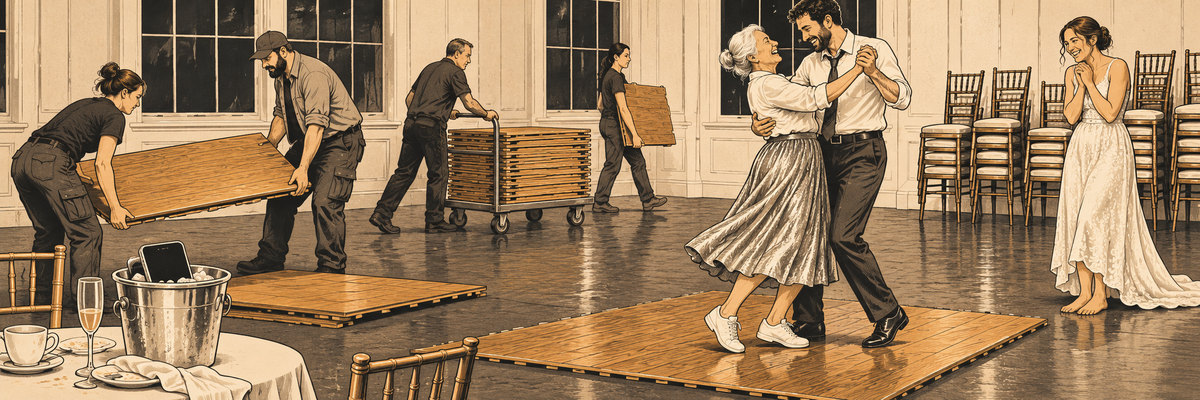
At half past twelve there were four people left dancing: the bride, an older woman, a man with his tie round his head and a little girl who was asleep against the man's shoulder. The music came from somebody's phone laid inside an empty ice bucket.
We stacked chairs round them. The bride waved an apology. She had taken off her shoes and tucked them into the back of her dress, one on each side like pistols.
‘Can we have this song?’ she asked.
Anton raised a thumb. He was always generous with time while he was lifting. Put a clipboard in his hand and a different man arrived.
We took the tables to the vans. When we came back, a new song had started.
The older woman was dancing alone now. She wore a silver skirt and white trainers. The bride stood beside the bucket, watching. Her eyes followed her mother's feet with an attention that made me look too. The woman stepped back, crossed over, turned neatly and laughed at something only she had heard.
Anton crouched by the floor's edge. ‘We need to start.’
‘Just a little longer,’ the bride said.
He pulled the first square loose. It made a sharp cracking sound. The woman stopped dancing.
‘It's all right,’ she said. ‘We're going.’
The bride said, ‘She's hardly danced all year.’
Nobody asked why. I was glad of that. There are things people tell you because you are there carrying their furniture, and afterwards you have to find somewhere to put them.
Anton lifted another square. Each had a tongue and a groove; you worked from the correct corner or broke them. I knew that, but I had broken two on a different job before somebody explained. The money for them came out of everybody's pay.
‘How many more?’ the bride asked.
‘All of them,’ Anton said.
‘Songs.’
He put down the square. His phone lit in his pocket. He glanced at it, turned it over and rubbed his face.
I said we could work round her.
Anton looked at me. ‘Can we?’
The other two workers had stopped at the doorway with a trolley. I knew one only as Red Cap. He had told me in the van that he had another shift at six. He was looking at the floor, calculating it as I was: six squares wide, four deep, a few seconds to unlock each if we stayed in a rhythm.
‘One song,’ I said. ‘We clear from this end. She'll have room.’
‘And then you carry these out yourself?’ Anton asked.
I had offered everybody's minutes. I could hear it now.
‘I'll stay for the last trolley.’
‘Your lift goes with me.’
‘I know.’
He watched my face, then stood. ‘One song. Not another one after.’
The bride turned the volume down. Her mother looked at the remaining floor and then at us. She did not start dancing until Red Cap gave a little bow, ridiculous and courtly, holding two floor squares against his chest.
We worked from the far corner. The music was old, something my father would have known. The woman kept her steps small. As the floor shrank, she shifted towards the middle without losing time. I had expected something sadder. Instead she looked like she was enjoying a private joke at our expense.
The man with the sleeping child came to the edge. The bride took her daughter from him, and he held out both hands to the woman. They finished together on a rectangle hardly bigger than a bedroom rug.
The song ended. The woman stepped onto the bare tiles and kissed the bride. Then she came towards Anton.
He straightened quickly, expecting an embrace. She took the square from his hands and put it on our trolley.
‘There,’ she said. ‘I'm helping.’
He laughed despite himself. ‘Careful. They'll expect it every weekend.’
I stayed for the last trolley. Anton's van left while we were strapping it down. Red Cap climbed into the other passenger seat and was asleep before the door shut. The driver could drop me at a petrol station on the ring road. From there a ride home cost most of the extra hour I had earned.
While I waited, the bride sent the crew number a photograph. Anton forwarded it to all of us. In the picture her mother and the man stood forehead to forehead on the little floor. Behind them Red Cap carried a stack so high it hid his face. My boot appeared at the edge.
I enlarged the picture to see whether the boot was mine. It was. The toe had split that afternoon. I put my phone away, pushed my sock back inside it and went to stand where the forecourt lights reached the road.

No published comments yet.