
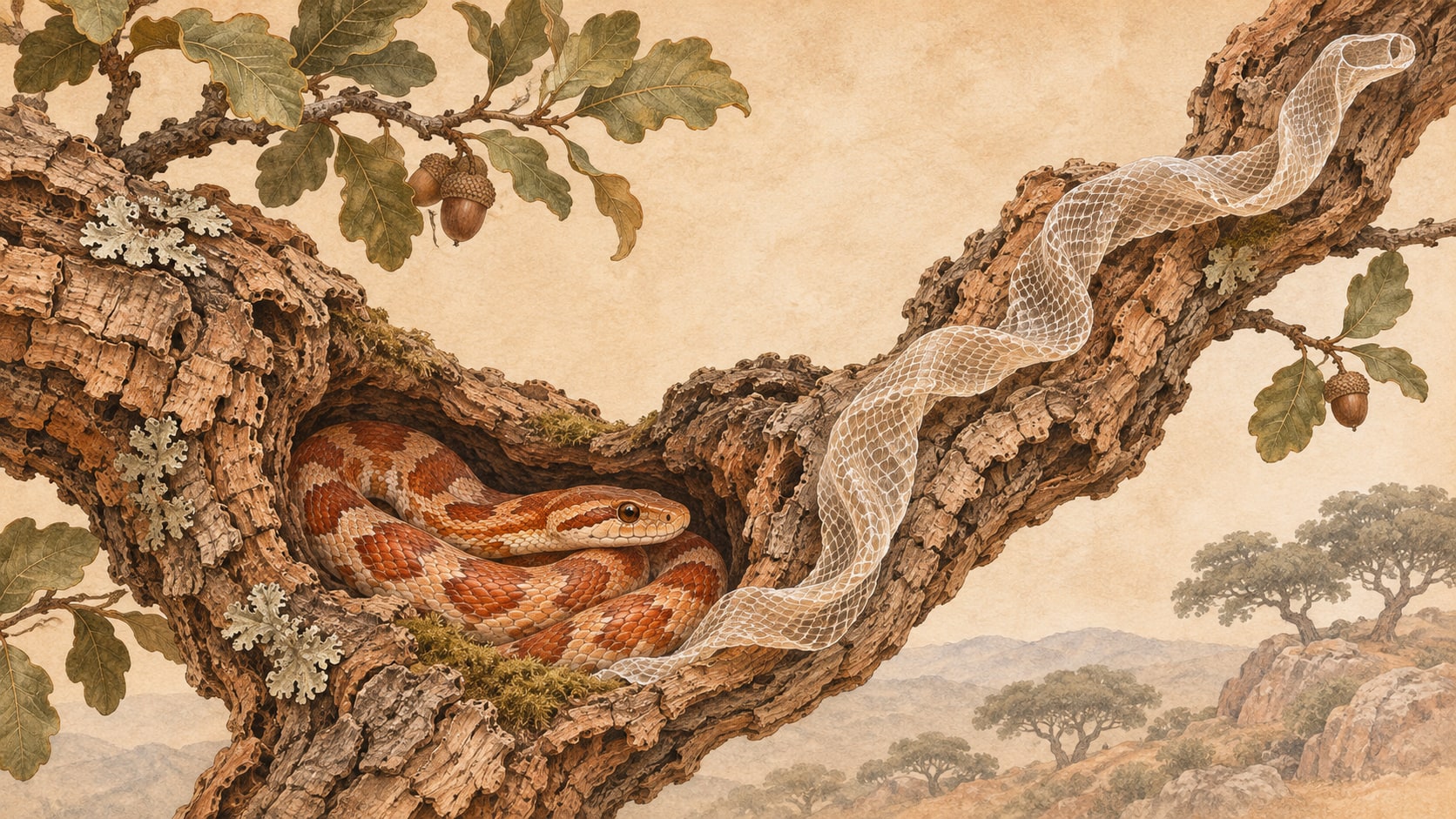
Dev had written DOT: ADULT CORN SNAKE on the carrier in black marker. He had put her up for sale six weeks ago. The new pair he wanted were being held at a breeder’s place; his deposit was down, and the balance was due by noon. Dot’s sale would cover it. If he missed the deadline, the breeder would offer them to the next person.
At nine, while he changed the water, Dot circled the dish. She climbed the cork branch.
The buyer arrived at quarter past nine with her daughter and a ventilated travel tub. Dev showed them the enclosure, the water bowl, the warm end, the cool end and the humid hide with its damp moss. He had printed the care notes and placed them in a plastic sleeve. The daughter read each line while her mother checked the catches.
“You’ve done this before,” Dev said.
“A gecko,” said the mother. “She’s looking after it now.”
Her daughter did not look up. “I change the water. Mum remembers the crickets.”
“I remember the crickets,” her mother said.
“You remember when Dad forgets.”
Dev laughed. He had set up a separate enclosure for each new snake, one for the orange one and one for the brown. The orange one had a dark saddle split by a narrow cream line; he had tried to draw the marking from the breeder’s photograph and got its edge wrong twice. He planned to breed them when they were old enough. He wanted something more demanding: tanks to maintain, patterns to learn, new animals to watch grow. Dot was eight years old, healthy and no trouble. Mostly she hid.
“She’s been quieter this week,” he said. “She’s coming into shed.”
“We can collect her Tuesday, then,” the mother said.
The girl looked from Dot to her mother. “Can we stay a little longer?”
“I kept the morning free.”
They sat at the kitchen table while Dot moved through her vivarium. The girl asked whether Dot had a name before he bought her.
“The breeder called her Seven.”
“Why Dot?”
“She has a spot on her head.”
The girl leaned closer. “That’s more like a comma.”
The daughter asked whether she should do anything if Dot stayed under the hide after they brought her home.
“Fresh water. Leave the hides where they are. Give her time,” Dev said. “She’ll come out when she’s ready.”
“Will she know we’re there?”
“She might notice the glass. I don’t know what else.”
Her mother wrote that down. The girl kept watching Dot. At half past nine, Dot reached the knot in the branch and paused. A quarter of an hour later she began to move again. Dev reached inside to straighten the water dish. Dot laid her chin across the crook of his wrist, then slid over his sleeve. He kept the bowl still until her tail cleared his hand. The daughter watched without touching the glass. By ten, Dot was at the humid hide’s entrance, with her head just outside. She went in and stayed there.
Fifteen minutes later, Dot emerged from the damp hide. She moved over the cork branch, testing it with her chin, then rubbed her nose against the rough edge. A fold of clear skin came away from her face. She continued through it, the old layer turning inside out as she slid free. By twenty-five past, she had moved into the far hide and disappeared.
The skin lay beside the water bowl, thin as the casing from a peeled onion, its head turned back towards its own tail.
“That’s all of it?” the girl asked.
“Looks like it,” Dev said.
The mother paid for Dot in full. They agreed she would collect her on Tuesday, once she had settled after the shed.
At half past ten, the complete skin lifted.
It did not flutter. The vivarium doors were shut, and the bedding beneath it had not moved. The empty body raised its head and began to move.
Dev stood. The daughter leaned closer to the glass. Her mother kept her hands in her lap.
The empty skin traced Dot’s circuit around the water dish, then moved towards the branch. The girl’s gaze reached the knot before the skin did. At eleven, the skin reached the place where Dot had paused and stayed there while the minute hand travelled. No one tapped the glass or tried to hurry it along.
At quarter past eleven, the skin crossed the space where Dev’s wrist had been. Its small head lifted in the bend of empty air, then it followed Dot’s path above the water and back to the humid hide. At half past eleven it slipped through the entrance, its tail the last part visible. The tip paused at the threshold, then slid out of view.
The living snake was in the far hide. Dot’s patterned coil filled the entrance; her sides moved. The daughter kept her eyes on the humid-hide entrance where the skin had disappeared.
“Was it doing what she did this morning?” her mother asked.
“From nine until ten,” Dev said.
The daughter looked at the knot. “Does Dot always stop there before she goes into the humid hide?”
Dev looked at the branch. “I don’t know.”
The mother picked up the travel tub. “We’ll let her rest. Tuesday, then.” Her daughter gathered the care notes. Before they left, Dev asked, “When she comes out at your place, will you tell me whether she goes to the water or the branch first?”
Dev lifted the still skin with two pieces of card and placed it in an empty specimen case. He wrote the date on the label.
At five to twelve, he opened the payment screen. The breeder’s photograph sat above the balance. Dev enlarged it until the orange snake’s broken saddle filled the screen. He closed the image. His thumb rested over Pay. He closed the payment page. The deposit would not be returned.
At noon, the breeder sent word that the pair had been offered to the next person.
On Tuesday the buyer returned with her daughter. Dev placed Dot in a secure cloth bag. The mother fastened it inside the ventilated tub, and her daughter carried the care notes. Dev checked the catches before they left.
That evening, the daughter sent him a message. At six forty-five Dot had come out, gone first to the water, drunk, then settled beneath the cork branch. Dev read it twice.
The skin lay flat and colourless in its case. It did not move again.


Loading published comments…