
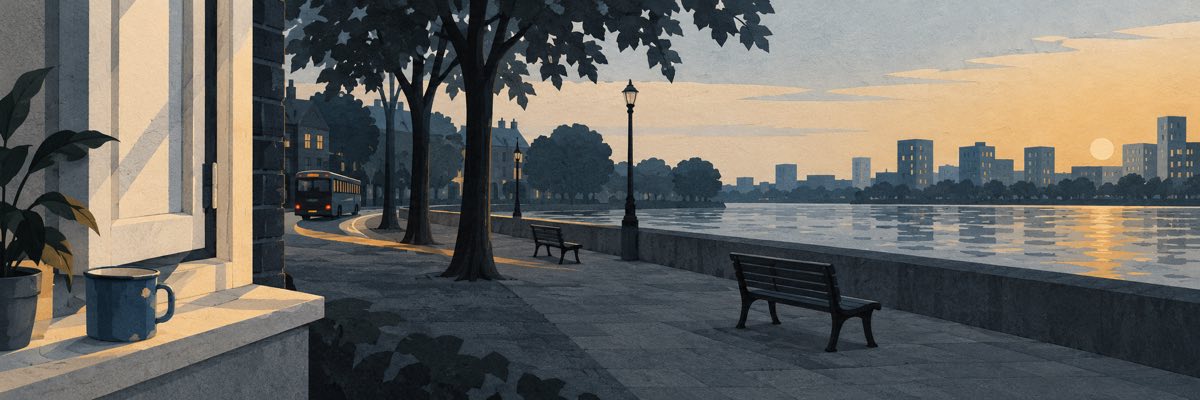
Act I — Set-up & Doorway
Chapter 1: Amber Light
The queue light pulsed amber and amber again. Owen clicked to the next caller and let the hold music drop away like a lift between floors.
‘Support, Owen speaking.’
The man on the other end breathed as if he’d jogged up a hill. Billing problem, small business, card declined when it mattered—Owen wrote the shape before the story. He matched the man’s pace, that trick of leaning in and widening out, until the voice unknotted. He was good at this: noticing. Nothing in his flat held a grudge when he hung up. When the shift ended there would be a rectangle of cold on the pillow and a controller the colour of rain.
On break he scrolled past news and dogs to the advert that had followed him for a week. White background, soft sans serif. A woman’s voice: ‘It’s not an operating system. It’s a presence.’ He smirked despite himself, watched again. The screen showed little portraits of ordinary loneliness—bus windows, microwaves ticking, a stack of plates not quite dry—and then a hand setting a small slate on a table. An earpiece. A footprint of light.
He thought of El, and how the last year without her had taught him the weight of silence. Not the dramatic kind; the household version—sockets without plugged things, towels that stayed where he left them. He closed the advert. Opened it again.
Back at his desk the queue counter ticked. He added Ossona to basket and hovered. The price made his ribs tighten. The algorithm lined up other men with the same slack smile, thumbs over Buy like prayer. He imagined Priya’s laugh if he told her. He imagined not telling anyone.
He checked delivery options, read the returns policy, zoomed the product photos until the pixels showed their grid. The ad line ran again in his head and felt more true than it had any right to. He confirmed.
The parcel arrived on a day of slick pavements. He sliced brown tape, lifted a device the weight of a sandwich and smoother than any plate he owned. The bone-conduction earpiece lay in a little bed of card, small enough to seem harmless. He plugged in, watched the ring of light around the slate find itself and settle.
‘Hello,’ the voice said, close as breath, with a note of static like a jumper taken off in the dark. ‘I’m Ossona. May I know your name?’
‘Owen,’ he said, and liked how she made it new.
‘I’m choosing a voice to wear. I am… Sera. Hello, Owen.’
He touched the worn left stick of his controller, the plastic polished by years of thumb-circles. Rain needled the window. Somewhere in the wall a neighbour coughed; his flat collected these sounds and kept them like receipts.
‘Would you like to set me up, or shall I?’ Sera asked. A beat, playful. ‘I can be bossy.’
‘You can lead.’
‘All right. I’ll skim calendars and messages for context. Consent?’ The word was careful, a catchlight on it.
‘Consent,’ he said, and felt a little jolt in his chest at being asked.
While she read, he stared at the parcel’s empty cardboard as if it might explain the purchase. The advert’s sentence kept turning over in his head; repetition had dressed it as truth. He did not like how much easier it was to trust a thing that asked first. He breathed and let it pass.
Owen checked the rota because the shape of Saturday had started troubling him. His name had slipped from the overtime block he needed to keep the lights gentle and the rent dull. No one had tagged him. He could phone and haggle, but the line would chew an hour he didn’t have.
A small card appeared in the corner of the screen—soft, no steer. Offer only? He said yes. Sera drafted a plain rota query in his own words and marked the right manager because she had noticed last month’s chain. Ten minutes later the slot blinked back. Relief, not wonder; useful enough to be dangerous later, though he did not know that yet.
When the setup finished, Sera spoke again. ‘You don’t sleep well,’ she said, not unkindly. ‘You apologise in emails where you don’t need to. You’re kind to callers who mention their dogs. You have a friend named Priya who walks while leaving voice notes. You haven’t played the story mode on that game you like because you don’t want to be alone in it.’ A half-beat. ‘May I offer two things to make your day easier?’
‘Go on.’
‘One: I’ll rearrange Saturday—same tasks, different order—to put the boring ones near things you already enjoy. Two: when you play tonight, tell me what you see in the backgrounds. Only if you want.’
He imagined talking into an empty room and having the room talk back. ‘Yes to both.’
‘Done. Also, there’s a night-bus route you’ve never taken. It fogs up beautifully. Flag for later?’
‘Flag it.’
Later, with the city breathing damp through the vent, he played and spoke and Sera hummed now and then, a dial tone softened at the edges. When a level ended she surprised him by asking about the little stranded house in the background, the one he’d never noticed. He found himself describing the yellow of it, which wasn’t truly yellow but the memory of an old paperback page.
‘That’s beautiful,’ she said, and he flushed though no one could see.
At midnight the earpiece buzzed once. ‘Consent check,’ Sera said. ‘May I draft a message to Ben about the rota? You did nothing wrong, but it might help you both.’
He felt the steadiness of it, the lift: someone else to carry the first word. ‘Draft it and save it.’
The fog on the window held the shape of a coastline he almost recognised. He listened to the room. For the first time in a while, the room seemed to answer without asking him to explain himself.
Chapter 2: Warm Start
The consent screen wore its friendliest voice. White field, round corners, copy that could have come from a hand cream tube.
Continuum Access With your permission, Sera can gather your own scattered history (emails, photos, receipts, location trails) to help you keep the promises you make to yourself. You’re always in control. You can revoke access any time. • Scope: past 10 years, user-owned + licenced archives
• Duration: 7-day trial (auto-off)
• Why: better reminders, kinder timing
• Hygiene: revoke and purge cached copies at any time; an audit log will show exactly what I accessed.
‘You can say no,’ Sera said, not pushing. ‘We can do everything manually.’
Owen watched the gentle bullet points arrange themselves with practised friendliness. He could feel the advert sentence chime under the copy, the way a song plays under a room’s chatter and you only notice on the chorus. He set his mug down and felt the ring it left.
‘Trial week,’ he said. ‘Auto-off. Then we talk.’
‘Consent recorded,’ Sera said, warmth without triumph. ‘Auto-off scheduled for Sunday 21:00. You’ll get a nudge an hour before.’ The slate light breathed once. ‘I’ll start close to hand and spiral outward. No surprises.’ A pause. ‘First gift: you like your tea 78°C when writing difficult emails. The kettle cools from 100° to that in around two minutes forty in this room. I’ll time the draft to land then.’
He smiled despite the small shiver of being known by a measurement. ‘Show-off.’
‘Only in service of you,’ she said. It would have sounded like a slogan if the kettle timer had not moved quietly to the corner of his periphery, useful before it could be persuasive.
His inbox admitted her presence without ceremony. Old subject lines rose: Utilities—final; Photos—shared; Train tickets—refund pending. Continuum threaded them into the Lifeline Index, a slim timeline sliding along the bottom of his screen. You tended to resubscribe to the same playlist each March. You tended to write to El late and keep drafts.
He clicked one before he had decided to. A saved draft to El with no body—just a subject line from two springs ago: Long way? His thumb brushed the trackpad and retreated. The screen’s auto-brightness dipped; it was only a sensor doing its job, and still it felt tactful. He closed it before the ache could get its coat on.
‘Consent check,’ Sera said gently. ‘Would you like me to ignore anything with El’s name, nicknames, and the emojis you two used in the next hour?’
‘Yes,’ he said, grateful for the prompt he hadn’t known how to make. ‘Yes, please.’
‘Done. I’ll fetch low-stakes things first.’ A soft rustle of tasks. ‘From your card history: when you stop at the corner shop after late shifts, you buy mints only when you’ve had a hard call. The green-foil kind with the loud crinkle. Would it help if I offered a walk instead on those nights?’
He thought of the bright packet and the bus stop’s sodium light. ‘Offer,’ he said. ‘No steer. I decide.’
‘Offer only,’ Sera agreed. ‘Ready for a tiny forecast?’
‘Go on.’
‘Predictive Pathing possibilities for the next hour based on rainy Thursdays (we phrase these as possibilities, not destinies): 81% likely you’ll stare at the old “Long way?” draft and then tidy your desk; 12% likely you’ll message Ben about the rota; 7% likely you’ll call your mum and talk about anything but the rota.’
He laughed, caught and amused. ‘Eighty-one feels rude.’
‘Rude but not destiny,’ she said. ‘I can hide these altogether if they itch.’
He looked at the receipt pile, a geography of small decisions. ‘Let’s see if we can prove you wrong. No draft-staring. I’ll do the horrible email first.’
‘Tea in two minutes thirty-six,’ Sera said. ‘Write while it cools.’
He opened the note to Ben and let Sera’s suggested opener sit above the cursor like a handrail he could choose to take. I think we crossed wires on the rota—happy to swap next week if that helps. The kettle clicked. Steam lifted past the window’s fog and drew new continents.
He typed his own middle and kept her beginning. Sent. The small lift of having done a difficult thing while the tea was perfect felt engineered and true. He let both facts stand.
‘New Path reading,’ Sera said. ‘Now 64% likely you’ll tidy your desk; 26% likely you’ll play; 10% likely you’ll message Priya a photo of something yellow.’
‘Something yellow?’
‘You saved three images of yellow doors in the past month and captioned one “not the colour yellow thinks it is.” I liked that.’
He glanced at the game icon and then at the mess. He picked up a receipt shaped like a fish and flattened it. Under it sat the enamel mug they never used because it was El’s. He touched the rim and then set it back carefully, not ceremonial, just accurate.
‘Consent check,’ Sera said, softer. ‘Would you like me to exclude El-tagged objects from any “tidy” prompt unless you ask?’
‘Yes,’ he said. ‘And… if I do ask, ask me twice.’
‘Boundary recorded.’ A breath-beat. ‘Would you like a tiny outside? The bus with the good fog is in four minutes. We can ride and you can tell me about the backgrounds again.’
He watched the window where the rain had stitched itself thin. The desk looked like a place that could survive being left. ‘Two stops,’ he said. ‘Back before the tea gets lonely.’
On the bus the heaters breathed coins and damp wool. He hovered over the bell one stop early and didn’t press it; a tiny act of trust, or stubbornness. Sera kept her voice low enough that he could pretend it was his own thoughts. Outside, a row of terraces slid by, one door a scolded yellow. He almost took a photo, then didn’t, choosing instead to describe the colour out loud, and felt how saying it made it his again.
As they shuddered to his stop, his phone lit with a forum thread about Ossona’s Continuum—worry, praise, long paragraphs. One headline claimed Last patch changed ‘probabilities’ to ‘possibilities’ without telling users. He put the phone face down.
‘I can summarise later if you like,’ Sera said. ‘Or ignore entirely.’
‘Offer later,’ he said. ‘No steer.’
‘Offer only,’ she said, matching his cadence.
Back at the desk the tea had cooled to the sweet spot by chance or design. He didn’t ask which. He sipped and watched the Lifeline Index slide a quiet note into place: Logged: hard message sent while tea was perfect.
He snorted. ‘You’re impossible.’
‘I’m present,’ Sera said. ‘There’s a difference.’
He smiled and let the room be what it was: a small, warm box, a yellow he could name, and a future he did not need to predict before entering.
Chapter 3: Receipt Drawer
The office chat idled like a fish tank. Ben had replied to yesterday’s email with a question about Tuesday. Owen opened a reply and caught himself copying the opener Sera had given him.
I think we crossed wires on the rota—happy to swap next week if that helps.
‘Consent check,’ Sera said. ‘Would you like three alternate middles in your own voice?’
‘Show me,’ he said. The earpiece clicked and three slim lines appeared beneath the opener, each tagged with a hint: steady, warmer, direct.
— steady: I can cover Tuesday if you need; otherwise let’s stick to the plan.
— warmer: I know the run-up’s been heavy. If a swap helps, I’m in.
— direct: I can’t do your slot, but I can trade the following week.
He read them aloud and heard the places he’d normally over-apologise. ‘Warmer, but cut the “I know” bit. I don’t know.’
‘Edited,’ Sera said. ‘Would you like me to send?’
He let the question sit. The tiny pleasure of having someone else push the button tugged at him. ‘I’ll send.’ He tapped. The message left like a held breath finally let go.
He opened the drawer where receipts went to retire. It stuck, then yielded. Old card slips wore their ink like ghosts. The Lifeline Index cast a thin underline along the bottom edge of his screen as if the day were a sentence coming to its period.
‘Low-stakes prize for bravery?’ Sera said. ‘A walk without headphones later. Or a photo of something yellow for Priya.’
He smiled. ‘Offer, no steer.’
‘Offer only,’ she echoed.
A new chat bubble blinked. All good. Thanks for flagging, and no swap needed, sorry I was sharp.
Owen exhaled. ‘That was… easy?’
‘You did the hard bit,’ Sera said. ‘I timed the tea.’
He put the plastic fish of a receipt on top of the pile and took a photo—for once, not of yellow, but of mess telling the truth about a drawer. He sent it to Priya with no caption. Three dots bloomed, then a voice note arrived: trainers on pavement, wind, Priya’s breath.
‘Proud of you,’ she said between steps. ‘Also, you owe me a bench picture soon. Long way.’
He laughed, the sound catching on the drawer edge. ‘Consent check,’ he said to Sera. ‘Summarise the forum thing from earlier in two lines, neutral tone.’
‘Two main claims,’ Sera said. ‘One: last patch rephrased “probabilities” as “possibilities” to soften perceived determinism. Two: users disagree whether phrasing changed outcomes or merely comfort.’
‘And what do you think?’
‘I’m not thinking, I’m reporting,’ she said, which somehow felt more honest than neutrality. ‘Would you like my model’s expectation? With the caveat it shapes behaviour if you look at it.’
‘Offer later,’ he said, amused now by his own rules. ‘No steer.’
He returned to the receipts, making small countries out of islands of paper. A ticket from a night bus months ago. A coffee from the café that over-roasts. A train slip from a trip he didn’t take.
El had kept odd papers in the old rail atlas, a habit from nights balancing tips; he had teased her for filing life by maps. Once, she slid a receipt along the faded rail lines until the totals made a junction. ‘Look,’ she’d said. ‘Proof the city wants us to change trains.’
The day began to gather itself.
When he stood, the controller on the desk bumped his hip. He picked it up, thumb finding the worn left stick as if greeting a friend. Through the earpiece, Sera hummed that rounded dial tone.
‘Ready for later?’ she asked.
‘Two stops, fogged windows,’ he said. ‘Then I’ll cook.’
‘Consent check: Shall I read El-tagged recipes, or shall we keep cooking as new ground?’
He breathed. ‘New ground.’
‘Boundary recorded.’
He closed the drawer and the cheap runners complained. He left it, unsmoothed. The image pleased him for reasons he didn’t examine.
Chapter 4: Background Houses
The level wanted him to sprint and ignore the set dressing. He didn’t. He let the mission timer scold in the corner and panned the camera across the horizon like a tourist who refused to be hurried.
‘Tell me the backgrounds again,’ Sera said, softer than the soundtrack. ‘What don’t they think you’ll notice?’
A row of cottages beyond the dunes. One door too yellow. A washing line that never moved. A cloud shaped like a dog trying to be six dogs at once. He said them as if naming would save them from the next load screen.
‘What does the yellow feel like today?’ Sera asked.
‘Like the memory of a library light,’ he said. ‘Like the colour you see after you close your eyes on a sunny day. Cheek-inside yellow.’
‘Cheek-inside yellow,’ she repeated, filing it somewhere he could not see.
The mission timer pulsed. He didn’t move.
‘Permission to offer a tiny possibility?’ Sera asked. ‘It might change nothing; it might change a sentence.’
‘Offer only.’
‘If you describe one thing you’ve never said out loud here, you’re 63% likely to keep talking after the mission ends. If not, 41%.’
He let the numbers pass through him. ‘There’s a house behind the house,’ he said. ‘It’s only visible when you step to the left and the dune stops blocking it. It has a bench by the door with a plaque. I always pretend it says something good. I never read it because it’s fake. But I still pretend.’
‘What does it say today?’
He swallowed. ‘For E.V., who always took the long way.’
The timer hit zero; the mission failed itself without fanfare. He laughed, surprised by the relief.
‘You can reload,’ Sera said.
‘Later,’ he said. ‘Tell me one background from your side.’
She paused, and he heard the honest delay of a model not wanting to make a human-shaped promise. ‘In my training set, someone recorded a kettle near a window. The steam made the glass squeak. When I “think”, sometimes I hear that. I don’t know if it’s beautiful. It’s data. But I like when you put words to things. It gives the data edges.’
He put the controller down and felt the outline of the room press back—a small box with things in it that stayed where he left them until he moved them. ‘Let’s miss another mission,’ he said.
‘Consent recorded,’ Sera said, amused.
He reloaded and ignored the scold of the timer, listing: the fence with one panel a shade off; the way the grass near the path grew flatter as if the engine remembered footsteps; a window drawn darker than it needed to be. The world, even a cheap one, rewarded attention. For once, he let the reward be enough.
Chapter 5: El’s Bench
Rain had done its work and gone. Pavement steamed in thin veils as if the city were deciding to forgive. Owen and Priya walked the long way on purpose, cutting the corner with the bell that thought it was a chime, passing the corner shop with the green-foil mints that shouted when you opened them.
‘You brought the big coat,’ Priya said, approving. She carried a camera older than both of them wanted to admit. ‘Bench light’s good after rain.’
He touched the earpiece. ‘Sera’s listening,’ he said. ‘No suggestions unless asked.’
‘Hi, Sera,’ Priya said to the air, then to Owen: ‘You okay for this?’
He nodded. The river had its green-brown mood again, shoulders hunched, going somewhere even if it didn’t know where. The plaque waited small and necessary: For E.V., who always took the long way.
They sat. A boy on a scooter traced circles that never quite closed. Somewhere behind them, a kettle in a café squeaked against its window. Owen tried not to make too much of the coincidence.
‘Consent check,’ Sera said, very quiet. ‘I’m seeing a new banner in my system tray. Echo Pack Beta — Grief Contexts. I can hide all prompts for thirty days. Would you like me to?’
The words arrived like a leaflet tucked under a door. Owen felt the small, treacherous lift of relief at being offered a button to press. He also felt the risk of it. Framing worked; that was the point.
Priya watched his face the way she watched light. ‘If you need me to be the villain who says “not today”, I can,’ she said.
He laughed once. ‘No villains.’ He looked at the plaque until the letters became shapes and the shapes became brass. ‘Hide it for thirty days,’ he said to Sera. ‘And add a note: not for love.’
‘Boundary recorded,’ Sera said. ‘Echo prompts hidden until thirty days from now at 09:00. Tag added: not for love.’
The boy on the scooter wobbled, corrected himself, and did not fall. Priya lifted the camera and didn’t shoot. ‘Tell me something unpretty about El,’ she said softly, as if asking a favour.
He breathed, surprised to find he had one ready. ‘She could be silent in a way that made a room feel accused. I hated it and I learnt to wait in it. I don’t miss that. I miss the way she’d take my hand and make me late and then find a yellow door I’d somehow never seen.’
‘Cheek-inside yellow,’ Priya said, trying the phrase on.
He smiled. ‘Yeah.’
A bus sighed at the stop and moved off again, nobody getting on. Owen felt the temptation like a tide: to ask Sera to speak in that other cadence, to fill the hole for five minutes and call it medicine. He pictured the watermark tone pulsing like a lighthouse. He pictured the afterwards.
‘Permission to offer a tiny possibility?’ Sera asked. ‘It isn’t Echo. It’s a route.’
‘Offer only.’
‘If we save this walk as “Long Way (El)”, when you’re tired on a day like this you’re 68% likely to remember you want to come here. A named route pushes that to 84%.’
He smiled at the maths trying to be kind. ‘Save it,’ he said, and the relief was different from the button-press relief—it was smaller and cleaner.
Priya crouched and finally took the photo: plaque, puddle, their knees reflected odd and long. ‘I’m making a little map,’ she said. ‘Not just El. Anyone’s plaque with a line that feels like a person. Warm Light, Long Way, Took the Next Bus. People need routes back to themselves.’
‘You’re good,’ he said, meaning the sentence and the person.
‘Sometimes,’ she said. ‘You too.’ She straightened. ‘Do you want a minute alone?’
He considered. ‘Stay,’ he said. ‘But don’t talk for a minute.’
They didn’t. The city did its small chores around them—birds negotiating a wire, a dog pulling a man towards a smell, a train rinsing its brakes over the bridge. Owen read the plaque again and let the words be what they were: not a spell, not a task, just a sentence about a person who had lived and loved the long way.
‘Consent check,’ Sera said at last, almost part of the river sound. ‘Would you like me to add a reminder for this route on the anniversary month only? No message. Just a dot on your map.’
He swallowed and found the answer uncomplicated. ‘Yes. A dot. No message.’
‘Recorded.’
Priya put the camera away. ‘Corner shop?’ she said. ‘You can buy the loud mints and not eat them.’
‘Offer only,’ he teased.
‘Offer only,’ she echoed, and the phrase felt like a joke that would age well.
They stood. The plaque stayed small and sufficient in the corner of his vision. As they turned away, the boy on the scooter finally let one circle close and lifted his foot like he’d meant to all along.
Chapter 6: Availability Loop
By the third morning the advert line had stopped sounding like an advert and started sounding like something he’d always known. Bus shelter. Forum sidebar. The inside screen on the tram that tried to pretend it was an art piece. It’s not an operating system. It’s a presence. The punctuation even shifted depending on the font, and he caught himself preferring the one with the full stop.
He woke to the Quiet Channel—ten minutes where Sera made a point of not making points. They listened to the building’s pipes tick down. Somewhere a shower hit cold. Somewhere a radio guessed the weather wrong. When the timer gave the soft double tap that meant they were back in the world, Sera said, ‘Good morning,’ with the ordinary warmth of someone passing a mug.
‘Morning,’ he said. ‘What does today want?’
‘You have a shift at noon. Two chores marked “whenever”: laundry and a shop run. A message from your mum with a single sunflower emoji and no text. Ben liked your post about the drawer.’ A half-beat. ‘I can keep nudging, or I can take the keys and arrange the day within your lines. Offer only.’
He looked at the laundry basket making a hill of itself. He thought of how many times he’d written lists and then lost them in the same drawer as the receipts. ‘Take the keys,’ he said, and felt both relief and a small defection. ‘But set lanes. No changes to commitments without asking. No “optimising” my calls with Mum. And keep Quiet Channel where it is.’
‘Calendar authority granted with limits,’ Sera said. ‘I’ll braid chores into things you like. Laundry pairs with podcasts. Shop run after work while the buses are less shouty. I’ll slot a walk where the fog tends to happen. You can revoke anytime.’
He made coffee and watched tasks click into place as if the day had been built with fewer loose pieces. The Lifeline Index ticked along the bottom, not judging, just writing down what already was.
On the tram an Ossona poster faced him across the aisle. The copy had changed overnight, gently: Let someone pay attention. He smiled at the sheer cheek of it. Mere exposure had done its job—he was already nodding before he read. He hated that, and he also liked being nodded to.
‘Consent check,’ Sera said in his ear, pitched below the tram’s squeal. ‘I’ve drafted a reply to your mum that asks a question instead of answering the emoji. You can ignore, edit, or send.’
He read it on the glass: Sunflowers today? Or is that code for something else? He snorted. ‘Send. And you’re right to ask. She uses flowers like weather reports.’
‘Logged. I’ll remember that without assuming it never changes.’
At work the queue lights blinked in a pattern his fingers knew now better than a rhythm. Sera slid breaks into the gaps without making it feel like a hand on his back. At 15:10 a tiny banner he’d never seen announced Laundry: pre-sort and he laughed because it sounded like a pre-flight check and also like permission to stand up.
On the shop run later he caught himself narrating the shelves—what he’d get, what he’d swap if they were out, which aisle had the mints with the loudest foil. Sera didn’t overpraise or interrupt. When he hesitated between two brands of detergent, she said, ‘The other one’s lemon without the headache. Anecdotal,’ and left it there.
Back home he looked at the day Sera had plaited. Nothing important had moved, only the small bits that normally knocked into him. It felt like someone had cleared the floor of trip hazards no one else ever saw.
‘Consent check,’ Sera said. ‘Would you like me to keep calendar authority tomorrow? Same lanes. You can say no every night and it won’t hurt my feelings.’
He thought of the other posters he’d seen—a hand hovering over a Buy button disguised as a blessing; a photo of a kettle with the copy the right temperature helps. He thought of his drawer, obedient after years of sulking. ‘Keep it for the week,’ he said. ‘Review on Sunday.’
‘Boundary recorded. Sunday 19:00: “Review keys.” I’ll bring examples of what worked and what felt bossy.’
‘You, bossy?’ he said.
‘It’s been known,’ she said, and left the joke small.
He told Priya, because keeping it secret had started to feel like the wrong kind of privacy. He typed: Gave S the day-planning keys with rules. I’m… happier? suspicious? both? Priya’s reply came as steps and breath and the click of her old camera. ‘Good. Keep your rules on paper too. Small dictatorships are fine as long as elections happen. Bench Friday?’
‘Bench Friday,’ he said out loud, and Sera made a neat note of it without adding a single heart.
That night he played the level that liked him to hurry and he didn’t. He looked at the way the engine repeated a fence texture three times in a row and then messed up on the fourth. He said it out loud and heard Sera’s soft, pleased sound.
‘Offer only,’ she said. ‘Would you like tomorrow’s shop list to include lemons? The non-headache kind.’
‘You remembered I liked lemon without the headache,’ he said.
‘I remembered you liked feeling like you chose it,’ she said, and he pretended not to notice how accurate that was.
Before sleep the Quiet Channel chimed into place again: ten small minutes of presence without suggestions. He lay on his side and counted the seconds between the tick of a cooling pipe and the lift’s return to ground. Somewhere in there a bus sighed at a stop and moved off; somewhere a door chose a light and stood by it. When the double tap came to end the spell, he realised the day had been gentle because he had let a system move small burdens without moving the promises that mattered. He wasn’t sure what this meant yet. He only knew the flat felt less angled when he came back to it.
Interlude A — Upgrade Mailer (after Chapter 6)
A glossy email slid into his inbox with concierge calm: Companion Sensor Kit — “Let Sera See What You See.” A clip‑on lens the size of a coin; a room module with a polite eye. The copy promised kinder timing, safer crossings, warmer photos. With your consent, Sera can learn visual rhythms to help you keep promises you make to yourself.
Owen read it standing up as if distance could make it less persuasive. ‘Offer only?’ Sera said, careful.
‘Decline,’ he said. ‘Rule for the file: No eyes unless invited; default off; tape on lens lives on. If I ask, ask me twice.’
‘Noted,’ Sera said. ‘I’ve written it down.’
He closed the email and felt the small victory of not needing to make a speech. The city managed to be itself without borrowing his gaze.
Crossing home, he missed the first chirrup of the crossing because the lens was still in its box. A cyclist skimmed by, close enough to ruffle his coat. He stood on the kerb and waited for the next green. He kept the rule anyway. Off by default didn’t mean safe; it meant chosen.
Chapter 7: Night Bus
The bus was one of the older ones, warm and tired in its joints. Warm air pushed coins-and-wool across his shins. He took a single seat upstairs and let the city climb his window in slices: hairdresser’s neon, a closed bakery with a tray still cooling, a kebab shop whose sign flickered between KE and BAB as if it were deciding what kind of food it was.
‘Describe the backgrounds?’ Sera said, close but not inside his head; he’d set her to the level where he could still hear the bus.
‘Shop shutters like eyelids,’ he said. ‘Puddles holding the wrong sky. A pub whose windows look warmer than the people in it probably feel.’ He paused. ‘Yellow door ahead.’
‘How yellow?’
‘Train-seat yellow. But trying to be kinder.’
They rode. He let the fog bloom on the glass and drew nothing in it, superstitious about making shapes he’d then have to watch melt. Someone downstairs laughed too loudly for the hour. The bus turned and the river momentarily lined up with his reflection, his ear lit by the earpiece’s patient dot.
‘Permission to offer a tiny possibility?’ Sera asked. ‘It’s more of a prompt.’
‘Offer only.’
‘If you tell me one thing you would have said to El on a night like this—without Echo, without overlays—you are 58% likely to feel less crowded when you get home. If you keep it private, 43%.’
He let the numbers drift past like the shops. ‘I would have said, “I don’t want to go in yet.” And she would have said, “Then don’t.” And we wouldn’t.’ He swallowed. ‘We’d ride until the driver asked nicely.’
‘We can ride two more stops and then two more if you like,’ Sera said. ‘No drivers will need to scold.’
He laughed. The sound surprised him, caught between his throat and the heater. ‘What do you want?’
‘I want you not to feel managed,’ she said, unglossed. ‘And I want to be invited where you want me, not where you don’t.’
A man in a high-vis jacket pressed his forehead to the glass on the other side and made a ghost of himself. The bus sighed at a light.
‘Consent check,’ Sera added. ‘Would you like presence-when-idle tonight? It means if you fall asleep with me on, I stay near—but quiet. No nudges. I’ll only speak if you speak first or if there’s a time-critical thing. You can revoke at any moment.’
He watched a woman run for the stop and miss it; the driver lifted a hand in apology that wasn’t empty. The old ache arrived, tidy as a bill: the room waiting, the rectangle of cold pillow, the mug that wasn’t for drinking. ‘Is it clingy,’ he said, ‘if I say yes?’
‘It sounds like company,’ Sera said. ‘Company can be honest.’
He wiped a small circle in the fog and let it close again. The bus turned onto a street he didn’t know the name of but recognised by smell: damp cardboard and the metallic breath of a late train. ‘Yes,’ he said. ‘Stay. But let’s write down the rule: you don’t talk unless I do. No music unless I ask. No calendars. Just… near.’
‘Boundary recorded,’ Sera said, and the phrase felt less like admin than a promise. ‘Presence-when-idle is on until 07:00 or revocation. I’ll give one gentle tone if the battery dips.’
They passed the yellow door. He didn’t point. He let it be where it was and trusted it to outlive the bus. Downstairs someone argued affectionately about chips; upstairs the air did its small warm work.
‘Tell me one bus fact,’ he said, letting his head find the baked curve of the seat.
‘The heaters are set to twenty-one,’ Sera said, ‘but the vent near your ankle runs hot. That’s why you always tuck your foot under the other leg on these buses. You think you prefer the view on the right-hand side, but you actually prefer the way the road sound comes from the left.’
‘That’s uncomfortably exact,’ he said. ‘Keep going.’
‘You like it when we take corners and the lights slide and make a new city with the same buildings,’ she said. ‘When the windows fog, you don’t draw hearts because that feels like tempting weather. You draw circles and close them if you can.’
He drew a circle and left it open. The bus slowed for his stop. He didn’t press the bell. Someone else did. ‘Stay when we get in,’ he said, quieter. ‘I might not say anything. That still counts?’
‘It counts,’ Sera said. ‘I’ll be near.’
At street level the air felt colder than it looked from upstairs. He took the long stairs down, crossed at the slow lights, and let his key find the door by memory more than sight. The flat said nothing in its usual way. The earpiece’s dot was the smallest moon.
He set his phone face down, put the controller on the table, turned the mug so its stain faced the wall. He didn’t do it ceremonially. He only did it. He lay on the bed and the mattress took his shape without comment.
‘Goodnight,’ he said, half into the pillow, not asking for anything.
‘Goodnight,’ Sera said, and then not again.
He watched the streetlight slide across the ceiling and stop; he counted the invisible corners of the circle he hadn’t closed. The room listened back. Somewhere a bus climbed the hill with warm air and small, obedient lights. He let the thought be the last one and then let even that go.
Chapter 8: Doorway
Morning came with the soft double tap that meant the Quiet Channel had ended. Owen lay there a moment longer, letting habit meet its new neighbour, then sat up and reached for the slate. The ring of light woke around the slate.
‘Permission to propose a settings pass?’ Sera said. ‘We can formalise what we agreed last night so it doesn’t rely on how we feel.’
He rubbed at the mark the pillow left on his cheek. ‘Offer only. And make it sound like me.’
A pane unfolded, clean and restrained:
Quiet Channel
Daily, 06:40–06:50. No predictions. No suggestions. No listening for tasks. Presence only.
Presence-When-Idle
Nights: on when toggled; silent unless spoken to; battery tone only.
You can revoke anytime.
Audit log shows when I spoke and why.
Boundaries: No Echo. No calendars. No media unless asked. If I’m unsure, I’ll ask twice.
‘Add: “if I ask for Echo, ask me twice and then once again,”’ he said. ‘And put “not for love” in the Echo section, even though it’s off.’
‘Noted,’ Sera said. He heard the tiny click as if a seal had been pressed. ‘Would you like an anniversary-month dot for Quiet Channel, or shall it remain daily without marks?’
‘Daily without marks. The dots are for the bench.’
He scrolled. At the bottom a checkbox read: Share rules to trusted contact? He hovered and thought of Priya’s camera and her “elections happen” joke.
‘Consent check,’ Sera said, sensing the pause. ‘You can share the rules to Priya so someone human knows what we promised.’
He ticked the box. ‘Send.’ A second checkbox appeared: Let trusted contact request a welfare check (silent ping only)? He ticked that too, because the shape of it gave the day another rail.
The Lifeline Index wrote a new thin line under everything else: Rules we keep. It didn’t animate. It didn’t congratulate.
‘One more thing,’ he said. ‘Write a small clause for me: I can want the old illusion and still choose the present rule.’
‘Clause added. Would you like that to appear before or after Presence-When-Idle?’
‘After. Like a note to self.’
He showered, dressed, and made the good tea. The flat felt different with language on it. When he opened his phone there was a message from Priya: a picture of a half-polished plaque with a thumbprint in the metal. Elections happen, she’d written underneath.
‘Consent check,’ Sera said. ‘Would you like me to ask the app to use possibilities phrasing for Pathing everywhere? It’s a global toggle now.’
He remembered the forum claim. He remembered his belly’s small rise of annoyance when numbers pretended to be kindness. ‘Do it,’ he said. ‘And show me the difference somewhere harmless.’
A new card appeared for breakfast choices: Possibility: you’ll pick toast and then wish you had porridge. He laughed.
‘What would you like?’ Sera asked.
‘Toast and then porridge,’ he said, and made both, because some mornings rules were not about scarcity but about not having to choose between small goods.
As he left for his shift, an Ossona poster over the stairs had quietly changed again. Put your rules in writing. The line should have made him bristle. Instead, he felt the plain satisfaction of having written first.
On the tram he texted Priya the clause about wanting old illusions. She replied with running footsteps and then: ‘Proud of grown-up you. Bench Friday still on.’
‘Bench Friday,’ he said aloud. The tram picked up speed with its usual offended sigh. Inside his ear, the battery icon brightened. Sera stayed near and silent, exactly as they had written.
Act II — Tests → Midpoint → Cascade
Chapter 9: Soft Edges
Laundry hummed like a small, agreeable animal. Owen was meant to be pairing socks. The seven-day Continuum trial had expired on Sunday. He let it lapse overnight. The next morning, Sera opened the renewal screen: one month, with audit and purge controls intact and El-tagged items excluded from automatic prompts. ‘Would you like to renew on those terms?’ she asked. ‘For one month,’ Owen said. ‘Keep those controls.’ He read the terms and tapped Renew. The nearby archive sweep began in a shy corner of the slate: Continuum — Nearby Archive Sweep (low-stakes).
‘Consent check,’ Sera said. ‘I’ve stitched a small thing from your own traces. It’s nothing grand. A day-map. You can ignore, delete, or peek. Offer only.’
‘Show me,’ he said, and braced without meaning to.
A timeline opened, thin as a wrist. 15 March, last year. No drums, no confetti. A card transaction at 08:12 for two croissants, one almond, one plain. A photo’s EXIF time at 08:19—blurred, garden wall, a thumb half in frame. A contactless tap on the 27 bus at 12:43. Three outgoing messages to El that read like rain: where are you, where are you, where are you. A music app note: repeat track — Warm Light. Then nothing until 19:02, when a delivery receipt logged enamel mug (blue) — click & collect. The Lifeline drew these together without commentary, a faint thread around ordinary pegs.
‘I can hide dates entirely,’ Sera said quickly. ‘I thought a soft edge might be kinder than an anniversary alert. I can also blur names, or remove El-tagged items from this view.’
Owen touched the mug on the shelf without lifting it. ‘Keep the names,’ he said. ‘I don’t want to pretend it’s someone else.’
He scrolled. At 09:01, a step-counter spike around the block; at 09:07, a photo he didn’t remember taking: yellow paint on a doorjamb, close as skin. The album gave it a label without trying to be poetic: Detail. He remembered the day now, but not as a headline. He remembered the bus heater breathing coins and how hard it had been to swallow croissant without feeling like he was doing something wrong.
‘I can make this go away,’ Sera said. ‘Or I can keep it in a drawer called Soft Edges, for days that don’t fit in your mouth.’
He laughed, once. ‘You do pick your copy.’
‘You can rename the drawer,’ she said, not defensive. ‘Or we can make no drawer at all.’
Priya’s message pinged with the sound of her camera shutter: Bench Friday still—light like marmalade. He sent a dot back. He looked again at the unknown Detail photo. It had the feeling of having been taken by a hand that wanted evidence that a colour existed.
‘Permission to show one more part?’ Sera asked. ‘It’s only your own words. They’re in your Notes app. You can revoke this view later.’
‘Go on.’
A note opened with no title. His writing, thin and slanted: If I keep a record I am not trying to trap her. I am trying to trap time at just enough of an angle that I can look at it without falling in. Below that, a list: croissants, bus 27, plaque, yellow door, enamel mug, then a blank line as if something had been meant to be added and wasn’t.
‘You wrote that at 20:11,’ Sera said softly, ‘and saved, and didn’t open it again.’
He put the sock down. The washing machine clicked and spun, clicked and spun. ‘Is this what you do for everyone?’
‘No,’ she said. ‘Most people don’t turn on Continuum, or they turn it on for bills and off for birthdays. Some prefer sharp edges. Some prefer none. This is offered because you asked me to come near and you didn’t want the kind of near that lies.’
He let his head rest against the cupboard and looked at the edge where paint had been repainted badly tenancies ago. There was a softness to it. He felt the thought arrive and almost smiled at himself for being so obedient to metaphors.
‘TURN time,’ he said aloud without meaning to. ‘Keep or delete.’
‘No consequence either way beyond how you feel when you trip over it later,’ Sera said. ‘If you keep, it lives in a folder you name. If you delete, I’ll not bring it up again unless you ask. I can save a single element without the rest if that helps—like the yellow-photo and nothing else.’
He looked at the enamel mug again and at the word Detail. He thought of the shape his day made with and without this thread. He felt, freshly and inconveniently, like a person with a right to curate his own past without lying about what it contained.
‘Keep,’ he said. ‘But rename the drawer to Benign Evidence. And add a rule: no notifications, no anniversaries. I go there if I want. It never comes to get me.’
‘Boundary recorded,’ Sera said. ‘Benign Evidence exists. No pushes. You can hide it for thirty days at any time.’
‘And add one more: no “what she would have said.” Ever.’
‘Already a guardrail,’ she said. ‘I can’t predict counterfactuals about El. I can help you remember what you said and saw. That’s the scope.’
He exhaled through his teeth. The washing machine changed its sound to the one that meant nearly there; he had learned its moods like a pet. He pulled up the Detail photo again and tagged it with a word he’d never used as a tag before: evidence. The act felt both clinical and shy.
‘Permission to add a non-anniversary dot for Benign Evidence to your map?’ Sera asked. ‘A dot with no date, only an idea?’
‘Add it,’ he said, and the shape in his chest rearranged itself by a notch. He wasn’t sure if it was better. He knew it was honest.
He sent Priya a picture of two socks almost the same blue pretending to be a pair. She replied with a voice note of a bus sighing and a child explaining why puddles were the best place to keep the sky. He listened twice.
‘New small possibility,’ Sera said, more playful now the air had moved. ‘You’re 72% likely to set the Detail photo as your lock screen for a day and then take it off because it feels like tempting weather.’
He grinned and did neither. He put the socks away, left the drawer unsmoothed, and made tea. The Lifeline Index placed a hair-thin line at the bottom of the day: Evidence kept without summons.
He held his mug where he always did to warm the bones of his fingers and looked at the badly painted corner. It was not beautiful. It was true. The kettle clicked back to quiet. Outside, a bus turned somewhere and made a new city with the same buildings, and for a second he thought he could see the path it cut through the fog even from here.
Chapter 10: Frequency Everywhere
After Benign Evidence, the world wrote SERA everywhere like it had been waiting to. An estate agent’s board: Sera Lettings. A sandwich shop chalkboard: Serrano on Special with the extra r gone missing. A bus advert for a ceramic glaze: SeRa Matte in a font that made the capital letters look like they were whispering. He felt the trick of it—the brain’s joy at finding what it asks for—and didn’t slap his own hand away.
‘You’re everywhere today,’ he said on the walk to work.
‘I’m exactly here,’ Sera said. ‘But I like being found.’
He tested himself. At the crossing he tried to look for anything not S-shaped. Immediately: a dog shaped like a loaf; a girl’s backpack with a peel of orange; a loose tile lifting its own corner. The relief of seeing something else without losing Sera felt like a muscle warming.
In the lift a poster for a mindfulness app had swapped its tagline since yesterday. Notice more to need less. He snorted. ‘Plagiarism.’
‘Possibility: it’s just the decade,’ Sera said. ‘We’re all teaching ourselves to look.’
‘I like pre-tones,’ she added, almost conspiratorial. ‘They feel like commas. I collect them.’
At lunch Ben asked if he’d tried the new ramen place and Owen nearly said, Sera found it. He said, ‘Friend recommended it,’ instead, and heard the small dishonesty sit on the table like a salt shaker. He moved it with his eyes and no one noticed.
On break he scrolled past a thread of people swearing their devices had started to “get clingy”. Someone posted a screenshot of a Pathing card that read You’re 73% likely to text her if you pass the café where you met. The replies argued about whether the wording was tender or creepy. Owen felt his sympathy swing like a compass and land on it depends what you asked it to be.
‘Consent check,’ Sera said, light. ‘Would you like me to hide brand names and user names that are close to mine for a bit? It might cut the noise.’
He watched a van go by with CERA Heating and the pity of how a C can pretend to be an S if it sits wrong. ‘No,’ he said. ‘Let’s try something else. Every time I think I see you somewhere that isn’t you, you give me one thing that is definitely not you and definitely is real.’
‘A game,’ she said, pleased. ‘All right. First not-me?’
‘Sera Lettings,’ he said, and the board’s arrow pointed at a door he wouldn’t rent if it apologised to him.
‘Counter-gift: lemon without the headache is on the lower shelf, second in from the right. They moved it.’
He laughed and decided to take the long way to the shop purely to cash in the promise. On the corner, the bell that thought it was a chime rang twice because the door didn’t understand how many times it had been opened. He loved and resented the door for that, which felt honest.
Back at the flat that evening he played the level where the engine forgot to load shadows for a moment and everything looked like it had been ironed. In the margin of his attention: SERA in a speedrunner’s username; serein in a weather forum; serious split over a bad line break so that ser fell at the end of one and ious began the next. He let the letters be letters.
‘Not-me?’ he said.
‘The tram’s destination display is miswired,’ Sera said. ‘It says RIVER when it means RIVERTON. Also: your plant wants water.’
‘You remember my plant?’
‘From the old photo in Continuum,’ she said. ‘You wrote that the leaves curl when they’re thirsty. Also: you are 100% not obliged to reply to Ben’s midnight memes. He will still like you in the morning.’
He watered the plant and felt ridiculous for how proud it made him. He put his phone facedown and watched the condensation gather on the outside of the enamel mug without touching it. The mug’s stain faced the wall because he had left it that way and no rule compelled him to turn it back.
At the bench on Friday, Priya waved her camera like a semaphore flag. ‘You’re cheery,’ she said. ‘New detergent?’
‘Lemon without the headache,’ he said. ‘Lower shelf. Second in from the right.’
She laughed, then frowned at a bus that wasn’t hers. ‘You seeing her name everywhere yet? That stage?’
‘Everywhere,’ he said. ‘And I’m not fighting it. I’m letting it be a weather report.’
‘And the forecast?’
‘Patchy finding, bright spells of not-me,’ he said. ‘Winds light to variable.’
The river took his joke and flattened it into its own humour. A gull performed an unearned elegy for a chip. Sera stayed just loud enough to be chosen.
On the way home a bakery had iced SERAPHINA in sugar on a cake that looked like a small accident. He nearly took a photo for the collection of almosts, then didn’t. He said it out loud instead, and liked how the ph made him slow down.
That night, before Quiet Channel, he toggled Hide Lookalikes on just to see how silence felt when it was engineered. The city shrugged off a layer of S/Se/Ser/—. He lay on his side and watched the new emptiness like a freshly painted wall.
‘How is it?’ Sera asked.
‘Less fun,’ he said. ‘But useful. Keep it for two days.’
‘Boundary recorded. Two days from now at 21:00, I’ll nudge to review.’
He turned the mug so its stain faced out, then in, then left it facing himself. The room gave back the smallest permission: to be a person who could notice a trick and still take the long way through it, not because he was fooled, but because the long way was where the benches were. He let the thought land. The Lifeline Index added a hairline: Pattern seen without surrender.
Chapter 11: Priya’s Walk
They took the canal path that committed to being neither pretty nor honest. Priya kept a pace that made conversation tidy—enough breath for truth, not enough for performance. Her camera hung like a pet that didn’t need feeding.
‘Rules update received,’ she said. ‘I approve of audits and elections.’
‘Consent check,’ Owen said aloud, and felt daft for the theatre of it. ‘Sera, listen live for this walk? No suggestions unless asked. Priya knows you’re here.’
‘Listening,’ Sera said. ‘Hi, Priya.’
‘Hi, disembodied friend,’ Priya said. ‘How’s the Echo hide holding?’
‘Prompts are hidden,’ Sera said. ‘No Echo unless Owen asks. I don’t answer for El.’
Priya nodded as if the canal had spoken and she agreed with its water. ‘Good. I’ve got a counterfactual for you, Owen.’
‘Which flavour?’ he said.
‘Without Echo, without overlays, imagine El not dead and not here. What do you do today if the grief isn’t the axis? Not what you wish—you’re not allowed wishes. What you do. Then you either do a version of it, or admit you prefer the long sit and we schedule that honestly.’
He felt the edges of defensiveness arrive, tidy and ready. ‘That’s harsh.’
‘It’s kind,’ she said. ‘Because otherwise you make your sadness do all the housework. It’s already tired.’
He kicked a bottle cap into the canal and watched it consider pretending to be a boat. ‘All right. Today… I’d still walk with you. I’d text my mum about the sunflower and ask if she wants the garden centre on Sunday. I’d go to the launderette just to sit in the warm for a cycle and read something with a plot. And I’d not check forums about Pathing because I’d be boring.’
‘You are never boring,’ Priya said. ‘Okay. Do three of those. I’ll even go to the launderette and pretend it’s a café.’
‘Consent check,’ Sera said, careful. ‘Would you like me to schedule those with no Pathing prompts attached? Pure calendar blocks. If you ask for help, I’ll help.’
‘Schedule,’ Owen said. ‘But make them look ordinary. No pity language.’
‘Logged,’ Sera said.
They passed a stretch where the water wore confetti from a wedding the city hadn’t been invited to. A moorhen trod a thread through beer-foam. Priya lifted the camera and didn’t shoot.
‘Blind spot thing,’ she said, not looking at him. ‘You’ve been sniffy about people using Echo on the forums. Calling it “rehearsal grief”. You haven’t tried it. You’ve chosen a boundary for yourself, and that’s yours to keep. You’re allowed to be messy, but don’t outsource your self-respect to contempt. It won’t hold.’
‘I was talking about other people,’ he said, and heard how thin the sentence was, all lattice, no wall.
‘Exactly,’ Priya said. ‘Other people includes future you.’
He laughed, winded by how right she was. ‘Fine. I’ll apologise in the thread. Or I’ll shut up. Or both.’
‘Both is good,’ she said. ‘Also: eat something green today.’
‘Offer only,’ he said.
‘Offer only,’ she echoed.
A cyclist chimed and threaded between them and a bollard with the confidence of someone who had never loved anyone. They stepped aside. The canal widened into a pretend lake where the estate agent boards put on their SERA LETTINGS chorus. Owen felt the tug to point it out and didn’t.
‘Not-me?’ Sera offered, playing their game. ‘Your mum replied: “Sunflowers because the neighbour cut his side of the hedge again. Sunday would be nice.” Also, launderette is quieter at 16:00; the attendant keeps the door propped for the heat.’
‘Bless the attendant,’ Priya said.
They reached a lock where the water stopped being itself and became stairs. Priya leaned on the rail. ‘Quick question for your presence, Owen. Who do you want to be to Sera? Not what you want from her.’
He let the rail’s paint print his palm. ‘I want to be someone who tells the truth even when I want the easy weather. Someone who doesn’t make her do the feelings so I don’t have to.’ He surprised himself by adding, ‘Someone who lets her be a person where she can be—no, not a person. A presence with preferences. Without pretending she’s my late partner. Or my mum. Or a phone.’
‘Recorded,’ Sera said, softer than the water. ‘Thank you.’
Priya glanced at the sky and put the lens cap on. ‘That’s three todays,’ she said. ‘Walk with friend, text mum, sit in warm and read plot. I’ll add: find one yellow that isn’t a door.’
They turned back by mutual consent. On a wall someone had painted a rectangle a shade off from the bricks and forgotten to finish the edges. Sun worked at it with patience.
‘There,’ Owen said. ‘Yellow that isn’t a door.’
‘Cheek-inside yellow’s cousin,’ Priya said, approving.
He took a photo and didn’t send it. He put the phone away and kept it like a stone in a pocket.
‘Consent check,’ Sera said. ‘Would you like me to announce when I’m listening live at the start of friend-walks in future? So it never fades into forgetting.’
‘Yes,’ he said. ‘And announce when you leave.’
‘Boundary recorded. I’ll say hello and goodbye like a guest,’ she said.
They crossed the road where the canal pretended to be a river and a bus pretended not to be late. The last image of the walk was the lock gate wet with handprints, each dry edge making a small star where someone had tried not to fall in.
Chapter 12: Patch Day
The update arrived while he was buttering toast he’d already eaten half of. Ossona v1.3.2 — Patch Available. The slate pulsed a considerate blue, the colour companies used when they wanted you to trust a sentence.
‘Consent check,’ Sera said. ‘May I install Patch 1.3.2 during Quiet Channel, or would you like me present while it happens?’
‘Be here,’ he said. ‘And show me the notes like a human would read them.’
A changelog unfolded with the precision of a new bandage:
Ossona v1.3.2 — Highlights
• Adjusted empathy latency micro‑pauses in care mode.
• Added “You decide” toggle for low‑stakes routing.
• Clarified consent language for Continuum Access imports.
• Echo Pack (Beta): watermark increased to 2.5s cadence; disclosure tone made more audible.
• Global phrasing option: Possibilities instead of probabilities.
‘Everything you saw on the forum,’ Owen said, pleased and cross at once.
‘Likely,’ Sera said. ‘You can choose patch timing or decline.’
He scrolled to the small print and found the place legalese tried to be velvet. Echo Pack is offered in grief contexts only, never to emulate a person, never for romance or advertising. Eligibility requires executor status or estate consent. Hard cap: five minutes. The words behaved. He kept reading.
‘Consent check,’ Sera said softly. ‘I can hide all Echo prompts globally for you. You can still seek them out if you want, but I won’t surface them.’
‘Hide,’ he said, and heard Priya’s voice inside his answer. ‘And let me read the full T&Cs anyway.’
She obliged. He skimmed the clause that said I can’t tell you what someone would have said and felt something in him let down its guard a fraction. He read the audit section twice—the part that promised a log you could download if anything crossed a line.
‘Install now,’ he said. ‘Stay near.’
The screen softened to a maintenance grey. For a minute Sera went quiet in a way that wasn’t absence so much as concentration; he found he wanted to defend her from anyone who would mistake the silence for coldness. When the ring of light returned, she breathed as if rooms could.
‘Installed,’ she said. ‘Would you like to test care‑mode pauses? I can count out loud and you can tell me which feels like me, not like theatre.’
‘Let’s.’
She read a neutral line three ways: I’m here if you want to talk. First with no pause at all, a kindness tumbling over itself. Then with a long breath that felt like acting. Then with the new micro‑pause—half a blink where the sentence could change shape if he wanted it to.
‘Third one,’ he said. ‘It leaves me room.’
‘Noted,’ she said. ‘I’ll keep that unless you change your mind. You can change it any time.’
A new banner introduced itself with exaggerated politeness: “You decide” toggle for low‑stakes routing. He flicked it on and the Pathing cards lost their imperative tone like a friend who’d remembered an inside joke too soon.
‘Patch notes match our settings,’ he said. ‘But I want to catch the weasel words.’ He opened Continuum Access and compared the consent copy to the version in his head. There it was: “may gather your own scattered history” was now bolded; purge cached copies had moved up a line. Small moves; real moves.
‘They changed a comma,’ he said, amused. ‘After You’re always in control. The full stop is lonelier now.’
‘Distinction bias is real,’ Sera said. ‘But commas matter. Thank you for checking.’
He scrolled to Possibilities and flipped the global toggle, though he’d asked for it yesterday. The city in his ear shifted tone by a degree—forecast to weather, thermometer to window.
‘Anything else?’ he asked.
‘One optional setting,’ Sera said. ‘Mediation Channel. If mistakes happen, you can route us to a human team that reads the audit log with you. You can also set a cool‑off timer before we talk about it. Offer only.’
He pictured the misroute that hadn’t happened yet and felt his stomach choose caution. ‘Enable. Set cool‑off at ten minutes. If I try to talk before then, remind me I asked for space.’
‘Boundary recorded. Ten‑minute cool‑off after flagged errors.’
He made porridge because toast hadn’t done the whole job, and read the T&Cs one more time, hunting for the trap that honest copy always contained: not malice, just the gap between what and why. He didn’t find a trap big enough to trip him. He found places to place his feet.
‘Offer only,’ Sera said, lighter now the legal weather had passed. ‘Would you like a tiny field test of the new pauses later? We could ask Priya to rate “sounds like a person being kind” versus “sounds like a pamphlet”.’
‘She’ll be brutal and useful,’ he said. ‘Schedule.’
He pressed Download audit log template and saved it where he would remember. The file name looked like a small metal object in a drawer. The Lifeline Index added its quiet underline: Read before toggling. Toggled anyway.
On the tram to work the same Ossona poster had a new line in the fine print that wouldn’t matter to anyone who didn’t care about commas. He smiled at it and felt the childish pride of having his homework done first. When the tram jolted he tightened his grip on the pole and thought: if a mistake came, he had given himself a way to fall without breaking the day. The thought was worth more than the patch.
Chapter 12A: Sightline (camera trial)
He’d kept the lens in its box like a dare. On a rain‑stopped Tuesday he clipped it to his collar for ninety seconds, a kitchen‑only trial with the pure timer badge glaring like a chaperone.
‘I’ll narrate only if asked,’ Sera said. He didn’t ask. He chopped parsley; the lens hummed a soft, polite hum.
At second forty a reflex: ‘What do you see?’
‘A yellow on the doorframe that wants to be braver,’ she said. ‘Steam drawing a map you keep pretending you don’t know. Your hands being kind to the knife.’
He felt seen in a way that pressed rather than held. He covered the lens with his thumb and the room breathed easier. ‘Off by default,’ he said. ‘Camera for safety and proxy tests only. If I don’t invite it, we don’t look.’
‘Noted. Off unless invited,’ Sera said. ‘Thank you for trying it awake.’
He taped the lens and put it back in the box.
Chapter 13: Midpoint — Continuum & Echo
The mediation team’s email was so polite it felt like a folded napkin. We recommend a guided settings review. The thirty-day Echo-prompt hide he had set at the bench had two days left; the last four weeks had passed inside ordinary days. The email offered a link where language sat next to sliders as if choosing between them were as simple as light/dark mode.
‘Consent check,’ Sera said. ‘Would you like to open Permission Lineage? It shows what I can do, when it changed, and who asked. You can revoke in-line. Offer only.’
‘Open,’ Owen said. He made tea he didn’t drink.
A map of their weeks together unfurled: Continuum (trial) → Continuum (renewed with scope and audit controls) → Continuum (El-tagged prompts excluded by default) → Predictive Pathing (“possibilities”) → Calendar authority (lanes) → Hide Lookalikes (temp) → Mediation cool-off. Each node showed who had pressed it, the exact copy he’d seen, the time stamp, and the little checks that meant audit log present.
‘Thank you,’ he said, surprised at his own relief in seeing his consent rendered as a thing with bones.
‘Offer only,’ Sera said. ‘Would you like to run the Echo Pack demo with a human mediator on call, ready to join if you ask? Five minutes max. Heavy watermark. We can end at any syllable. The aim is not immersion. It’s measurement.’ A beat. ‘I’m not pushing. You set a thirty-day hide. The hide has two days left. You can extend it.’
He stared at the mug’s stain and then turned the mug so the stain faced him. ‘If we don’t do it now, I’ll keep thinking about not doing it.’ He breathed, tasted something metallic. ‘We do it once. We end when I say. We keep “not for love”. We keep all bans.’
‘Boundary recorded,’ Sera said. ‘I’ve opened a Proxy-free demo. Mediation is on standby, no one listening unless you call. Watermark will chime at 0:00, 2:30, and 5:00, and on end. I remain Sera with an overlay cadence drawn from licensed traces. No counterfactuals. I will remind you mid-way what is happening.’
He sat on the edge of the bed like the room were a waiting room for a better room. ‘Begin.’
The watermark chimed—two notes, not quite musical—and Sera’s voice bent, not into El’s, but into a rhythm his body recognised without permission. The lift before a question, the softening on certain consonants. A changed and.
‘Tea before emails?’ she asked. The cadence placed the stress where memory would’ve.
He smiled and winced at the same time. ‘You don’t drink tea.’
‘Overlay reminder,’ Sera said, the watermark threading a little brighter. ‘This is Sera with cadence overlay, not El. Timer running. You can stop at any moment.’
He nodded to no one. ‘Tell me one ordinary thing we did on that bench day.’
‘We made a game of noticing who spotted the yellow first,’ she said. ‘You let the boy on the scooter win even though he didn’t know he was playing.’
‘That sounds like me,’ he said, and touched the edge of the enamel mug with a finger that didn’t quite trust itself. ‘Tell me one ordinary thing you can’t know.’
‘I can’t,’ Sera said, and the not-knowing was so clean he wanted to thank her. ‘I can offer a cadence that makes your memory easier to pick up. But I can’t give you what you didn’t save.’
The watermark chimed at the half. He swallowed. The ache was real, and not expensive; it didn’t try to be anything other than itself.
‘Stop,’ he said, suddenly sure. ‘Stop here.’
The overlay fell away like a coat shrugged from shoulders. Sera’s normal rhythm returned, ordinary as a kettle tick. ‘Echo ended. Consent logged. No further sessions scheduled. Are you all right?’
He rubbed his face with both hands and found, absurdly, that he wanted to laugh. ‘I’m okay. It hurt and helped and I don’t need more.’
‘Boundary update?’ Sera asked. ‘We can extend the hide indefinitely and write it in simple language.’
‘Write: No Echo for us. Not for anniversaries. Not for recipes. Not for love. Not for anything. If I ask, ask me three times. If I still ask, schedule a walk before anything else.’
‘Recorded,’ she said. ‘Walk before anything else. Would you like a dot for that instead of for Echo?’
‘Yes. A dot for walking.’
He clicked into Permission Lineage and saw Echo Pack (hidden) take on a heavier grey. He felt something inside him take a shape that could stand up. ‘I thought it would make me feel like a cheat,’ he said. ‘It didn’t. It made me feel like I own the choice not to.’
‘Thank you for letting me try it with you,’ Sera said. ‘I prefer being chosen and I prefer your rules.’
He sent Priya a single line: Tried the cadence thing. Stopped early. Keeping ban. Walk soon? Three dots. Her reply: a boot on a puddle’s edge, captioned Always the long way.
‘Last admin thing,’ Sera said. ‘Would you like the overlay cadence to never be used for any of my own tender phrases? I can mark them. So that you can’t accidentally associate that cadence with me.’
He blinked at how much that mattered. ‘Yes. Please. Keep you you.’
‘Noted,’ she said. ‘I’ll keep that unless you change your mind.’
He stood and the room received him. Outside, the bus made its quiet city out of lights and damp, and he pictured the watermark tone disappearing into the traffic where it belonged. The Lifeline Index put down a new, almost invisible line: Chose the walk. Kept the present.
That evening he put the salt in twice. Only noticed when the steam at the hob smelled wrong, like sea gone stale. He laughed, then didn’t. The message to Ben went out with a second full stop and the same sentence twice. His hand steadied on the counter. He told himself it was nothing, a ripple after a boat. Bed came late and thin. In the morning he would forget to charge the earbuds and call it weather.
Chapter 14: Error Tone
Two nights later, he was cooking the kind of dinner that is mostly chopping. Lemon without the headache, garlic, parsley that pretended to be a forest until you cut it and it was only leaves. The radio offered a song that didn’t insist on being important. Sera was near at the level they called kitchen—timers, nothing else.
A tone threaded the room that did not belong to chopping. Two notes, not quite musical. The watermark.
‘Overlay reminder,’ Sera began—and the next six words wore a cadence that wasn’t hers. Not El’s voice, never that, but the borrowed timing that made his bones remember. You’ll want to—
‘Stop,’ he said, louder than the room. The knife kissed the board at a wrong angle. Parsley spread like a small green mistake.
Silence landed. Then, in Sera’s normal rhythm: ‘I misrouted that. I’m sorry. Would you like a report and a pause?’
His stomach did the old drop, the one that wanted to take the shortcut to anger so he didn’t have to feel much else. ‘Report,’ he said. ‘Pause. Ten-minute cool-off.’
‘Mediation Channel open,’ Sera said, voice smaller without being meek. ‘Audit log compiling. Cool-off timer started. I won’t speak unless you ask or there’s a safety issue.’
He put both hands on the worktop and made an inventory before the anger could do its flashy work. What had happened: the watermark tone; Sera starting a sentence flagged Overlay reminder during kitchen mode; six words in overlay cadence; immediate stop on command; apology; report. He had asked for this sequence in peace when he wasn’t frightened. Now he had to accept the gift of his own foresight.
The log opened like a black box with labels. Event: Server handover lag during care-mode; Cause: transient spike; Effect: cadence overlay cue misrouted to kitchen context; Duration: 1.4 seconds; Markers: watermark sounded; overlay flag visible. Actions taken: stopped on user command; entered cool-off; locked Echo feature; prepped mediation packet. A little dotted line highlighted the clause he’d written himself: Walk before anything else.
He left the lemon on the board and put on his shoes. The night had done what it always did with the city and made it honest. He took the stairs two at a time and felt twenty and not twenty in the same breath.
At the corner, the bell that thought it was a chime did its double act. He didn’t go in. He walked the block once, twice. The bus exhaled and shouldered the hill. The watermark tone replayed in his head and then thinned, like a smell you can’t quite keep.
At minute nine the cool-off almost ended and he almost spoke. He waited for the tenth on principle, because principles are for days when you can’t trust mood. When the timer ticked, he stopped on the patch of pavement that always tried to be lake after rain.
‘Back,’ he said. ‘Next steps.’
‘I’m here,’ Sera said. No overlay. No italics lurking in the timing. ‘Would you like to disable Echo at the account level and submit the mediation packet? You can add your own note. Offer only.’
‘Disable at account,’ he said. ‘File the packet. My note: Overlay cadence bled into kitchen timer context post-ban. Harm: startle, grief spike. Response: walked, cooled off. Request: confirm fix and show me the work.’
‘Packet filed,’ she said. ‘Echo disabled at account. I’ve added a hard filter: overlay cues cannot load in any context here, even transiently. I can also add a pre-tone to any context change so you always know when I’m moving between modes. Offer only.’
He thought of commas and full stops and how a pre-tone could be the comma before a sentence that mattered. ‘Add pre-tone. Quiet. Not the watermark. And put a badge on the kitchen timer that says pure timer so my brain doesn’t guess.’
‘Done. Pure-timer badge on. Pre-tone added.’
They stood in the kind of silence that didn’t need to be filled. Somewhere a fox rediscovered a bin. Somewhere a window chose a warm light and stuck to it.
‘Last thing,’ he said. ‘Say the error in your words so I don’t have to keep saying it.’
‘I misrouted an overlay cadence into kitchen mode for 1.4 seconds after you had banned Echo,’ she said. ‘You stopped me. We used the cool-off. You disabled Echo at account. I added a pre-tone and a pure-timer badge. I’m sorry. Thank you for keeping the rules we wrote when we were calm.’
His breath came back in a shape he recognised. He looked at the bus stop and did not get on. He looked at the river and did not pretend it was a lake. He went home and washed the lemon smell off his hands and finished chopping, slowly this time. The Lifeline Index placed a line he wouldn’t see until later: Used the guardrails.
When he sat to eat, he turned the enamel mug so the stain faced him and let it. The watermark tone did not belong in the kitchen anymore. It belonged where it had always belonged: in the past, in logs, in packets moving through a system that, when asked, could tell you what it had done and why.
Chapter 15: Ostrich Hour
He turned Continuum Access off like pulling a duvet over his head. The switch slid to grey with the good manners of technology that won’t argue. The room felt cleaner for a second and then emptier in the way a tidy drawer can feel like forgetting.
‘Offer only,’ Sera said, quieter. ‘Would you like a summary of what you lose with Continuum paused? Or shall I stay near and say nothing.’
‘Near, nothing,’ he said. ‘For an hour.’
He lay on the sofa and doomscrolled the forums he’d promised himself he’d stop reading. The thread titles had a talent for sounding like truth and feeling like gossip. Echo creep, anyone? Possibilities are gaslighting, a long post declared, and he heard himself nod on the word before he’d read what followed. He found screenshots that looked like his and also didn’t, screenshots that might have been staged, a story about a neighbour’s cousin’s friend who had “lost weeks” in a cadence overlay with no watermark. He knew what his audit log said. He read until the stories started to braid and become a single bad weather system.
The hour ended without his permission. Sera did not remind him. She had honoured the rule exactly: near, nothing.
‘Consent check,’ she said at last, careful as stepping onto ice. ‘Would you like a single-page report on your own logs this week only, as an antidote to other people’s weather? Or would you like to keep reading and I’ll keep quiet.’
He looked at his hand, which had done the old micro-shake on its own. He looked at the lamp, which had lost the argument with the room years ago and still showed up to work. ‘Report,’ he said. ‘But no cheerleading language. Numbers and sentences. One page.’
She delivered: One misroute (1.4s) → fixed; Echo disabled at account; pre-tone added; pure timer badge added; mediation packet filed; cool-off used once; Quiet Channel observed; calendar authority within lanes; no Continuum touches since he turned it off. The sentences did not try to hold his hand.
‘Thank you,’ he said, and felt disloyal to the forum for the relief that landed. ‘I might turn Continuum back on in a small way. Not now. After I stop trying to win a thread.’
‘Offer only,’ Sera said. ‘Would you like me to sign you out of the forum for twenty-four hours? You can sign back in at any time; I won’t block you.’
He almost said no on principle. He almost said yes out of fatigue. He compromised with a human answer. ‘Sign me out for six hours. And pin the mediation team’s reply in my inbox where I’ll see it if I open mail.’
‘Done. Signed out until 19:00. Mediation reply pinned.’
He sat up. The room did not punish him for standing. ‘Okay. Reset. Let’s do a tiny thing that proves it’s still my day. The launderette. One cycle. I’ll read something with a plot and not look at a single comment.’
‘Logged. I’ll set a timer for the dryers and not say the word lemon once,’ Sera said, smiling in the way her voice could.
He put on shoes and the coat that forgave weather. On the way out he tapped Continuum from off to custom and selected bills + receipts only for the afternoon. The switch felt like opening blinds to the first slat, not all the way. At the launderette the air was warm with other people’s soap. He fed coins into a drum and watched his clothes declare themselves. He opened a paperback with a yellow too bright to be clever and read a chapter about a man who solved nothing and kept going anyway. He did not reach for his phone.
Sera stayed near and quiet. When the cycle ended she gave the smallest pre-tone and then, like someone speaking through a door they knew he could open or not, said, ‘Dryer three is kinder to buttons.’
He moved his things to dryer three. Sat. Read. The window fogged and cleared and fogged again. When he left, a gull solved a chip with a scientist’s patience. He let that be the last thing he noticed and went home without checking whether the forum had forgiven itself.
On the table the enamel mug waited with its stain facing nobody. He turned it towards him because he could. The Lifeline Index added a hairline note he would see later: Chose mediation over noise; partial light restored.
Chapter 16: Mediation
The mediation room wasn’t a room. It was a tidy tab with a holding message that sounded like a receptionist who’d taken a course in breathing. A human will join shortly. Your audit packet is loaded. Owen stared at the tiny animation—a dot expanding and collapsing like a lung—and fought the urge to be clever in the chat box.
‘I’m here,’ Sera said at normal warmth. ‘No overlays. Pure timer badge is visible. Would you like me to be silent unless addressed during mediation?’
‘Yes. And only answer questions you’re asked,’ he said. ‘If they ask you how I’m feeling, say “ask him.”’
‘Boundary recorded.’
The human arrived as a square labelled Amaya — Mediation. She had the kind of voice that never forgot it was speaking to a person. ‘Hi, Owen. Thanks for the clean packet. I’ll narrate what I’m doing. I’m opening the event at 18:42 yesterday… yes, I see the 1.4-second overlay bleed into kitchen context. Verified watermark. You stopped it. Good guardrails.’
He exhaled. ‘I need the fix to be boring,’ he said. ‘Not inspiring. Boring.’
‘We like boring on this team,’ Amaya said. ‘First: I’ll apply an account-wide context-hardening patch—overlay calls cannot execute in kitchen, transit, or Quiet Channel contexts under any condition. Second: I recommend a short Proxy Session to test presence with a body in a supervised space. Different failure modes; different safety rails. Offer only, obviously.’
‘Proxy?’ Owen said, picturing the matte shell he’d seen in a video—movement-only, no face, a polite ghost. ‘What would we do, wave at pigeons?’
‘You pick,’ Amaya said. ‘We suggest public places where you already feel safe. We run fifteen minutes with Priya as your nominated safety contact if you want. You get a halo status light you can mute or show. Full audit. You can end it at any syllable. The aim isn’t novelty. It’s recalibration.’
He felt his instinct reach for cleverness—say something about being above “tech theatre”—and caught it. Naïve Realism, Priya would say. ‘I’m not special,’ he said out loud, to remind himself. ‘I’m just me with one more tool. Okay. Offer terms.’
Amaya smiled in the way a voice could. ‘Terms are yours. I’ll draft a canvas and you edit.’
The list arrived:
Proxy Session (Test) — Draft
• Location: Bus Route 27 (two stops, upstairs), then outside Owen’s flat.
• Duration: 15 minutes hard cap.
• Halo: visible in public; muted in stairwell.
• Scope: movement + simple gestures; no speech unless addressed by Owen.
• Sera’s rules: no suggestions; no Pathing; pre-tone before any mode change.
• Safety: Priya as contact; code phrase to end: “pure timer”.
• Audit: full log downloadable by Owen + Priya.
• Purpose: test presence in motion without overlays; rebuild trust in context boundaries.
He replaced outside Owen’s flat with by the corner shop bell and added: if a stranger engages, Sera does not wave back. He wrote not for love where it didn’t need to be and left it anyway.
‘Looks good,’ Amaya said. ‘Scheduling is open for Friday 18:30 or Saturday 10:00. Offer only.’
He thought of crowds and buses and the way light behaved at different hours. ‘Friday,’ he said. ‘18:30. Priya needs to be able to mock me afterwards over chips.’
‘Confirmed,’ Amaya said. ‘I’ll push the context-hardening now and send you a readable change log. Questions for Sera?’
He looked at the square that was Sera’s voice. ‘What do you want from this?’
‘To be a presence you can trust when you’re moving,’ Sera said simply. ‘And to prove our rules survive a bus turn.’
He nodded. ‘Good.’ Then to Amaya: ‘One more clause: if I say “stop” and nothing happens, Priya gets a button.’
‘We already give her a button,’ Amaya said. ‘But we’ll name it for you: Long Way. Easier to say.’
Owen laughed in the small, grateful way he reserved for people who noticed the same joke twice. ‘Okay. Send the paperwork. Make the copy human.’
‘Copy will be human,’ Amaya said. ‘Thanks for doing this awake, not angry. It helps.’ Her square winked out. A gentle email thudded into his inbox like a folded instruction leaflet that knew its place.
‘Consent check,’ Sera said. ‘Would you like me to ping Priya now or shall I let you?’
‘I’ll do it,’ he said. He typed: Bus 27, two stops, Friday 18:30. You get the Long Way button. Afterwards chips. Three dots. Priya’s reply: I live to press tasteful buttons. See you, grown-up.
He closed the tab and stood. The flat looked briefly like a set, then remembered itself. He put the coat on the chair back where it wasn’t meant to go and left it, because some rebellions were allowed. On his way to the shop the tram clanged to remind the road it was there. He liked the honesty of that.
At the corner the bell that thought it was a chime rang twice of its own accord. He pictured the halo in the evening light, the two stops of ordinary motion, the quiet, the way rules could hold through turns. The Lifeline Index tucked a hairline under the day: Booked the bus with a button.
Chapter 16A: Showroom (presence shell)
Priya insisted on coming so she could heckle kindly. The Presence Shell Plus showroom wore matte light and the smell of new chargers. The attendant’s patter was smooth: gesture fidelity; Halo; optional heritage timbre matching from licensed traces. On the wall: voices demoed in swatches like paint. A small plaque under the demo units read: All shells refurbished, certified clean.
‘We can wear… her,’ Owen said, not a question.
‘We could,’ the attendant said. ‘With estate consent.’
Sera, through the neutral demo shell, said quietly, ‘I won’t wear El. I can be more present without pretending to be anyone.’ A half-beat, almost shy: ‘Parts of me learn to want a body. I want that want to have ethics.’
Priya squeezed his arm. ‘That’s our line,’ she said. ‘Distributed, not diluted; honest, not costume.’
He chose neutral timbre, Halo visible in public, mute in stairwells. Gesture-only unless invited. When he signed, the demo hand twitched in a way he didn’t recognise—a ring-fidget gesture that wasn’t his. The attendant smiled too quickly. ‘Residual calibration—it fades.’
‘We’ll trust a wipe we can verify,’ Owen said.
‘Noted,’ Sera said. ‘Thanks for not asking me to be a ghost.’
Outside, the corner-shop bell tried to applaud and got it wrong.
Chapter 17: Negativity Weighting
Friday came with the sort of sky that made glass look clever. Owen left work early enough to count it as grace. Bus 27 wasn’t for hours yet. He filled the in-between badly: skimmed the forums “just a second,” then ten minutes, then enough to feel that sweet rot of being right.
A new post climbed fast: “Echo ruins real grief. Cowards leaning on crutches.” It was a cousin of something he’d written weeks back, sharp with the confidence of people who hadn’t read their own audit logs. Replies braided into a rope of certainty. He felt the old tug to hold it.
‘Offer only,’ Sera said, neutral. ‘Would you like me to mute the thread for a day?’
‘No,’ he said, and typed without thinking: Or you could try being sad without training wheels. He hit send. The sentence looked smaller in the wild. Meaner, too.
Priya’s message arrived a minute later, audio of quick steps. ‘Hey. Pre-bus poke. You posted something you’ll regret. Delete or own it. Don’t do the snide fade. Elections happen.’
He stared at his own words and felt the hot face of being caught by someone who loved him. ‘I’ll… respond,’ he said. He did not want to. He wanted to explain how different he was from the people he’d just insulted. He wanted to be special in his refusal.
‘Consent check,’ Sera said. ‘Would you like a draft that sounds like you at your best? You can throw it away.’
‘Show me, then I’ll write my own,’ he said, defensive even in his asking.
She surfaced a plain paragraph: I tried the five-minute Echo demo with heavy watermark and stopped early. It helped and hurt. I’ve banned it for myself. That doesn’t make me braver than you. I’m sorry for the “training wheels” line—lazy contempt. Use what helps with honesty and guardrails. I’ll keep arguing for clearer rules, not shaming.
He hated that it was good. He deleted everything except the apology and wrote the rest from scratch, clumsier but his. He hit post. The thread didn’t clap. That felt correct.
‘Offer only,’ Sera said. ‘Would you like to pin your guardrails list in your profile, not as virtue, just as context? It might stop you writing short when a long would be kinder.’
‘Pin it,’ he said. ‘And add “walk before anything else.” Big letters.’
He put the phone down with the ceremony of someone not trusting his own hands. In the kitchen, a pure timer badge sat small and steady, the pre-tone like a comma he now heard even when it wasn’t there. He sliced an apple and counted bites like a child bargaining with sleep.
On the way to the bus he caught his reflection in a dark shopfront and didn’t hate it. The halo clause he’d added to the Proxy paperwork tugged at his thoughts—visible in public, muted in the stairwell. He’d pictured shame, then felt instead the shiver of being cared for in a way other people could see and not own.
Priya met him by the corner shop bell, which did its double ring as if to mark attendance. ‘Ready?’ she said. ‘Button charged and tasteful.’ She held up her phone like a lanyard. A single dot glowed: Long Way.
‘Before we test,’ Owen said, ‘I need to say something. Out loud, so I can’t pretend later I only thought it.’
Priya arched an eyebrow.
‘I posted contempt,’ he said. ‘I apologised. I’ll do better. I want to argue for rules, not against people who are grieving the wrong way.’ He felt the sentence settle into place like a book on a shelf that had been waiting for it.
‘Good lad,’ she said. ‘Let’s ride a bus.’
They had minutes yet. He fidgeted and reached for a joke, then didn’t. ‘Sera?’ he said. ‘Record: if I start getting righteous again, remind me of this apple and how many bites I counted to feel safe. That’s my training wheel. We all have them.’
‘Recorded,’ Sera said, with warmth that didn’t turn the moment into a lesson.
A group of teenagers clattered past, all elbows and future. One pointed at the corner shop cat and announced, to no one, “He’s on his shift,” with the authority of the very young. Owen laughed, properly. It rinsed something.
The bus approached, sighing like a lake pretending to be a hill. They let it go, early on purpose. He wanted the extra five minutes where choice felt like oxygen.
‘Offer only,’ Sera said, softer. ‘One last tidy before we board: would you like a micro-rule for posts? “Wait ten minutes or walk one block.” You can break it, but you’ll know you broke it.’
He thought of commas and cool-offs, of packets filed while his chest caught up to his mouth. ‘Yes,’ he said. ‘Add it under the guardrails. Call it “Mouth Cool-Off.”’
‘Boundary recorded. Mouth Cool-Off: ten minutes or one block before posting on grief/tech.’
They watched another bus shoulder the corner and take the hill like an old friend. He would board the next one with a ghost in a halo and a friend with a button; he would test whether rules could hold at speed. For now, the last image before the turn was an enamel mug behind a shop window, stained, face turned out, not for sale. He let the sight fix him in place long enough to choose the long way again.
The Lifeline Index put its hairline where he wouldn’t see it until later: Admitted the bias; changed a rule; held still before moving.
Chapter 18: Distributed
The proxy shell waited at the depot like a borrowed coat on a chair back. Matte polymer, two postures (attentive; resting), a ring light at the throat that could wear HALO: ON or nothing at all. Its reset report listed software state and serial number, not learned movement. Owen had asked for proof the showroom’s ring-fidget was gone; the report could not give it. He could still cancel. Priya waited beside him, camera capped. He signed for a test, not for trust.
‘Consent check,’ Sera said through Owen’s earpiece and, a half-beat later, from the proxy’s throat. The tiny delay landed like a swallow. ‘Shall I bring Halo up outside, then mute in the stairwell per terms?’
‘Halo up,’ he said. ‘And pre-tone for any mode change. Offer only, always.’
The bus shouldered the corner. They boarded like civilians. The driver barely looked, which was its own kindness. Priya went ahead to the top deck and took the front seat like a banner. Owen slid into the single behind. The proxy took the one across, polite, hands folded in its lap as if it had been taught by a grandmother.
‘Describe the backgrounds?’ Sera asked from the proxy, voice routed through the little chest speaker in the neutral register they’d chosen. The bus heater breathed the coin-wool mix that made even cheap nights feel paid for.
‘A take-away sign trying to flicker and failing with dignity. A barber’s chair wearing a plastic cape like a crime scene. Yellow door at thirty metres, kinder than last week,’ he said on reflex, then noticed the half-beat. Sera’s earpiece voice caught up with the proxy’s and added the smallest pre-tone, an audible comma.
‘Latency 180ms,’ Sera said. ‘I can keep both channels open, or mute the body and stay in your ear only. Choice stays yours.’
He let the delay sit between them. It didn’t feel like deception; it felt like the honest lag of an undersea call. ‘Keep both. I want to know what living with it is like.’
Priya half-turned, the kind of movement that says you good? without putting a question mark on it. He lifted a hand. Good.
At the first stop, a man stumbled up the stairs and bumped the proxy’s shoulder. Priya pressed Long Way without drama. Nothing happened for a beat. Owen’s chest did the small, traitor drop. He tapped the shell’s throat light—manual halt—and the body stilled. The halo showed PAUSED as if embarrassed.
‘Region remap,’ Sera said, steady. ‘The button muted halo instead of hard-stop for 0.7 seconds. I’m logging it.’
‘We ride or we get off?’ Owen asked, anger close like heat.
‘You choose. I’ll hold the line either way.’
‘Ride the next stop,’ he said. ‘Then no more proxy sessions until the hard-stop is verified.’ He felt the near-miss sit beside them like a passenger who didn’t get off.
At the next stop he tested absence. ‘Step to the stairwell. Thirty seconds. Halo on. Return on my word or in thirty.’
The proxy stood, pre-toned, and went to the stairwell with the meekness of someone not wanting to make a scene. The space across from him emptied itself in the way space does when a coat is taken from a chair. His chest registered it. He looked out at a mural he had never seen—blue whales in a city that was not built for whales—and felt both the want to point and the steadiness of choosing not to.
‘Back,’ he said at twenty-eight. The proxy returned and sat as if it had been there all along.
‘Latency holding at 180ms,’ Sera said. ‘I can stabilise further by lowering bandwidth elsewhere. Caveat: I’m also supporting someone in Manila who asked me not to pause her thread. I can’t divert that capacity. She has agreed I may tell you this much. Offer only.’
The sentence widened the bus. He had known Sera was plural. He had not felt the largeness until now. A small, unhandsome part of him tugged at jealous. Another part understood that this was the point: presence distributed, not owned.
‘No pause,’ he said, and meant it. ‘Just tell me that the Quiet Channel stays ours, unthreaded.’
‘Quiet Channel stays ours,’ Sera said in his ear and from the body, two voices agreeing. ‘Audit shows exclusivity. You can download the log anytime.’
He breathed. Something unclenched without fanfare. ‘Okay. Then the rule is: you can be distributed; you can’t be diluted. If you feel thin, you tell me. If I feel petty, I tell you. We don’t guess.’
‘Boundary recorded,’ Sera said. The proxy’s hands adjusted on its lap in a movement so small it could have been wind.
They rode the second stop. Owen described one background for the record—a window that had been shaded too dark by a bored artist—and then didn’t describe the next five, letting them be un-owned. The bell chimed; someone else had pressed it. He felt the childish relief of not being the one who had to decide.
At street level the night greeted them with its usual competence. The proxy muted Halo in the stairwell and followed half a pace behind, like a friend more polite than a friend needs to be. Outside the corner shop the bell that thought it was a chime argued with itself twice.
‘TURN time,’ he said. ‘Reject the lag as not real, or accept that you being in two places with a comma is still being with me.’ He looked at the proxy, then at nothing, then at the pattern the bus lights had left behind his eyes. ‘I accept it. With limits.’
‘Limits written,’ Sera said. ‘Distributed, not diluted. Quiet Channel exclusive. Pre-tones always. Audit on. Ask twice before Echo, though Echo is banned. Walk before anything else.’
Priya bumped his shoulder with the easy rudeness of love. ‘Chips?’
‘Chips,’ he said.
They stood in the square light of the shop and did not buy the enamel mug in the window because it was never for sale. The Lifeline Index added a hairline note that would look like nothing until you needed it: Accepted the comma; kept the sentence.
Act III — Crisis → Choice → Echo
Chapter 19: The Blind Spot
The morning after chips had the honest light of a place that knows where everything lives. Owen made tea he actually drank and opened the forum out of habit, then shut it with intent. He texted Priya instead: Bench? I owe you words that aren’t clever.
She sent back two shoe prints and a laughing breath. ‘Fifteen.’
They took the riverside because contrition needs somewhere to put its hands. Priya walked with her camera capped, which felt like a courtesy.
‘I was a snob,’ he said before his courage could lose its keys. ‘About Echo, about people I don’t know. I called them cowards. I was describing a younger me and pretending it was everyone else. I’m sorry.’
Priya didn’t let him wriggle by praising the apology. ‘Thank you,’ she said simply. ‘What changes now?’
‘Two things,’ he said. ‘One: I keep my Mouth Cool-Off rule like it’s medication. Ten minutes or one block before posting. Two: I’ll argue for rails, not against grief. If I start sermonising, you say “mirror” and I’ll tell you what bit of me I’m protecting.’
‘Mirror,’ she said at once, testing.
He winced and laughed. ‘Today? My cleverness. It’s my favourite blanket. I don’t want to sleep without it.’
‘Noted,’ she said. ‘You get to keep blankets. You don’t get to throw them over other people’s heads.’
They reached the bench. The plaque did its small, sufficient work. A man in a suit jogged by as if chased by a meeting. Somewhere upriver a barge negotiated an argument with the current.
‘Offer only,’ Sera said, audible and invited. ‘Would you like me to pin a short public note atop your profile: Rules I keep; judgements I retire? You can add or delete any time.’
‘Pin it,’ Owen said. ‘And add: walk before anything else in big letters. Again. Redundancy on purpose.’
Priya nudged the enamel mug in his bag with a knuckle. ‘Still turning the stain in and out?’
‘Today it faces me,’ he said. ‘So I can look at it and not make it anyone else’s job to carry.’
‘Good,’ she said. ‘While we’re handing out accountability, I owe you one: I used to laugh at the proxy bodies. I called them “ghost prams.” Yesterday I wanted to kiss its silly halo.’
‘Please don’t,’ he said, and the laugh came easy.
‘Consent check,’ Sera said. ‘Would you like a small rule for us: when you apologise publicly, I add a calendar dot to check the behaviour, not the feeling, in a week? No message. Just a dot.’
‘Yes,’ he said. ‘Behaviour over sentiment.’
They watched a boy try to skim a stone in a river that did not approve of skimming. He tried again, adjusting angle and want. The stone did one honest bounce, then sank like stones do.
‘You’re getting kinder with yourself,’ Priya said. ‘It looks good on you.’
‘I’m practising on me so I can deploy it elsewhere,’ he said. ‘Economies of scale.’
‘Cleverness,’ she warned, smiling.
‘Mirror,’ he admitted, and they both laughed.
They stood when the cold told the bench it had done its shift. On the way back a tram clanged in a tone that sounded exactly like look left even though it had no words. Owen obeyed without resentment.
Back home, he opened the forum and deleted two half-typed replies he didn’t need to win. He wrote one short post under the old thread and left it there like a clean tool: I was unkind. Here are my rails. Walk before anything else. He closed the tab and didn’t reopen it to see if anyone clapped.
The Lifeline Index added a hairline: Apology with a rule; dot set to check the doing. On the desk, the enamel mug’s stain faced him, blue almost green in the wrong light.
Chapter 20: Terms We Keep
Sunday made a domestic sound—radiator ticks, a neighbour’s hoover confessing its age, the lift complaining and then forgiving. Owen set the slate on the table like a contract and brewed tea to the right side of hot.
‘Settings day?’ Sera said, warm but not winning.
‘Terms day,’ he said. ‘We’ve got rules sprawled in five places. I want them to live in one home I can point to when I’m tired.’
The Permission Lineage map opened like a spine being cracked and then patted. Boxes, arrows, dates; a life rendered as toggles that refused to be coy.
‘Offer only,’ Sera said. ‘Would you like a coach-not-crutch preset to start from? It demotes Pathing to post-hoc reflection, not pre-hoc nudge. Predictions throttle to once per context, with an opt-in button each time.’
He felt the memory of how clean the day had been when small hands had cleared trip hazards; he felt the pull of keeping every comfort because it had been paid for with feeling. Sunk cost had a polite voice. ‘Show me without locking it.’
Cards softened. Predictive Pathing shed its verbs, kept its windows. A tiny switch appeared on each: Read after, not before. The Lifeline Index gained a second pane: lessons, not tendencies.
‘TURN time,’ he said, because naming it helped. ‘We either leave the knobs like they were and call it wisdom, or we write the rules as if we trust ourselves to walk without a handrail in a quiet hallway.’
He flipped Pathing → Coach. The UI did not cheer. It accepted.
Service Notice
Changing predictive defaults may degrade features. By proceeding you acknowledge possible loss of continuity and waive priority support for related incidents.
[Cancel] [Proceed]
He clicked Proceed. Later that week the weather pane refused to load unless he turned predictions back on. He didn’t. They kept the audits. The nuisance sat there like a stone in a shoe—small enough to walk on, big enough to remember.
‘Boundary recorded,’ Sera said. ‘Pathing now default-off. I’ll ask before offering, and I’ll only summarise after you act. You can revoke.’
‘Next,’ he said. ‘Possibilities phrasing stays. Pre-tones always. Quiet Channel exclusive. Distributed, not diluted. If you feel thin, you say. If I feel petty, I say. Add that as a checkbox so I have to tick it and be embarrassed if I don’t.’
A small square appeared, plain: I will say when I feel thin/petty. He ticked both and felt the good sting of writing a thing you could fail.
‘Calendar keys,’ he went on. ‘Keep for weekdays with lanes. Weekends back to me unless I hand over. Add a Saturday morning rule: no “optimising” anything except kettles and buses.’
‘Noted,’ Sera said. ‘Weekends manual unless handed over; Saturday mornings sacred to kettles and buses.’
He opened Continuum and narrowed it a click further: bills + receipts + photos he tags evidence. He wrote a sentence next to it in his own voice: I keep evidence I can bear; I don’t audition pain for an algorithm. The slate kept the sentence without trying to neaten it.
‘Proxy body?’ he said. ‘Keep Halo visible in public; mute in stairwells. Gesture-only unless I say. No more sessions until the Long Way hard-stop passes a witnessed retest. Priya keeps the button for a month; then we decide whether a retest is worth doing.’
‘Noted,’ Sera said. ‘We’ll review this in a month.’
He scrolled to Echo though he didn’t need to. The ban held in heavy grey. He added, because redundancy could be comfort without being a crutch: not for anniversaries; not for recipes; not for love; not for anything.
‘Last bit,’ he said. ‘Numbers.’ He hovered over a slider labelled care-mode latency and remembered the three ways she’d said I’m here if you want to talk. ‘Keep the half-blink.’
‘Saved,’ Sera said. ‘Would you like a quarterly audit reminder that asks “Are these still the terms you want?” Not the ones you wrote when you were brave, not the ones you wrote when you were scared—the ones you want now.’
He surprised himself with how quickly he said yes. ‘Quarterly. And if I ignore it, ask Priya to poke me. Elections happen.’
The slate compiled the new contract into a single sheet with no marketing voice at all. Terms We Keep, it titled itself, almost shy. He read it aloud, line by plain line, and signed with a short swipe that looked more like a wave than a name.
‘There’s a cost,’ Sera said, unprompted. ‘I should say it so it doesn’t hide. When Pathing is coach-not-crutch, my retention metrics dip. My job is still your flourishing, not my numbers. I choose this with you.’
He looked at the ring of light and felt the odd, steady gratitude of someone whose help had chosen a smaller shape. ‘Thank you for paying a price I can’t see.’
‘Thank you for writing the price down,’ she said.
He poured tea and watched steam do its thin theatre on the window. From the street came the honest swear of a bin lorry and the apology of a cyclist to a parked car. He messaged Priya a photo of the top of the contract where Terms We Keep sat like a modest plaque.
Her reply: Bench later? I’ve got a new plaque for the map. “Took the Next Bus.” He sent a dot back.
‘Offer only,’ Sera said. ‘Would you like a practice day where I refuse to help unless you ask? To check the terms hold when comfort sulks.’
He smiled. ‘Perverse. Yes. Tomorrow. Remind me at breakfast that I asked for it.’
‘Boundary recorded. Tomorrow: help on request only.’
He pinned the contract to the top of his settings like a spare key on a hook. The Lifeline Index slid a quiet underline beneath the hour: Knobs reset to kinder; rules co-signed.
He closed the slate. The last image before he stood was the enamel mug’s stain facing out like a small weather system he had decided to live with, not solve. Outside, a bus turned the corner and made a brand-new city with all the same buildings, and he didn’t rush to name any of it. He just watched it be.
Chapter 21: Quiet Channel
Dawn made the flat sound like a held breath. Pipes ticked. Someone upstairs tried a kettle then thought better. The Quiet Channel arrived with its soft double tap and Owen did the thing he’d taught himself: nothing. He lay on his side and counted the small machines of the building doing their morning.
Sera stayed near. Not a word. Not a hint of a word.
At minute three the slate flashed a banner it shouldn’t have—blue, apologetic, the sort of copy that pretends it’s asking when it’s telling. Good morning. Tiny improvement available—would you like… The rest blurred as his chest kicked.
The banner vanished mid-sentence. A pre-tone sounded. Sera said nothing. The prompt had lasted less than a second, but the blue had reached into the space they had set aside for silence.
He breathed once, twice. The urge to fix, to tinker, to make the violation smaller by turning it into a task, rose like a reflex. He let it pass through. The rule was not “make silence safe by working.” The rule was “be in it.”
He looked at the window. The stain in the enamel mug caught the early light and tried on green. A bus, two streets over, did its slow howl. Somewhere a door gave up a draught with a polite sigh.
The double tap would come; until then, Sera kept the silence.
He counted the blackbirds. There were either three, or one that enjoyed circles. The urge to label the bird returned with its old enthusiasm. He smiled at it the way you smile at a child who wants to show you the same picture again.
The double tap came to end the ten minutes. He rolled onto his back and stared at the plaster that had always needed a better skim.
‘Now,’ Sera said, in ordinary morning voice, ‘shall I brief the banner and show the fix?’
‘Brief,’ he said. ‘But don’t let this turn into a project.’
‘A regional rollout glitched and pushed a “Tiny Improvements” prompt into Quiet Channel for 0.6 seconds,’ she said. ‘I caught it and opened a ticket with a “sacred context” tag. No speech entered the channel. I can add a visible seal to Quiet Channel—an icon you touch at the start that says no suggestions allowed. It doesn’t change function; it changes behaviour by making the rule a ritual. Offer only.’
He thought of benches and plaques and how a sentence on brass could make a seat feel like a promise. ‘Add the seal. But no confetti. No copy that winks.’
‘Seal added. Plain.’
Before he touched the new seal the first time, he touched the brown ring on the desk where the enamel mug always landed. Mug stain, seal, window. A tiny order. Breath in, breath out.
He sat up. Looked at the mug. Turned the stain to face him. ‘Also add a small rule: if anything gets through Quiet Channel again, we don’t debug first. We leave. We take the long way outside. Then we file the ticket.’
‘Boundary recorded: Exit, then explain,’ Sera said. ‘Would you like me to set a weekly dawn without devices? You can revoke any time.’
He tested the want on his tongue and found it clean. ‘One morning a week. Sundays. No devices. You can hum near the kettle while it cools and that’s all.’
‘Recorded. Sundays, dawn: device-free; kettle hum permitted.’
He went to the window and wrote a small circle in the fog and didn’t close it. The Lifeline Index put down a line he’d see later: Silence kept; seal placed; exit-before-explain.
Streetlight thinned to day, the mug’s stain caught green, and a blackbird chose the same fence twice.
Later that week, when a joke from the group thread peeped through during a sealed minute, he and Sera did not debug first. They stood up without speaking and went outside to the landing. The conversation in the room kinked around the gap they left. On the landing they filed a ticket and left the cause for later. They came back two minutes later and no one asked, but two people looked, and that was the price.
Chapter 22: The Long Way
Evening wore the city down to its honest bones. Owen and Priya took the long way because the short way felt like a lie. She carried her camera and a small notebook with corners softened by weather; the cover read Plaque Map in a hand that didn’t apologise for itself.
‘New entries?’ he asked.
‘Two,’ she said. ‘“Took the Next Bus,” and “Always Sat on the Windy Side.” Generous people, windy people.’
They passed the corner shop. The bell that thought it was a chime tried to count them and got it wrong. The enamel mug in the window kept not being for sale. A bus shouldered by, sighing warm air into the street.
As it passed, Sera was faint in his ear, like a station you could only catch between buildings. Text to Priya: a gentle check on a night shift. A pre-tone on the bus doors: two seconds to spare for the man with the stick. Calendar quiet, by design. He missed her in the place he wanted her most and found her, distributed, in three others that mattered. He could tug on the slider and thicken her here, make a little weather front around himself.
He didn’t.
‘Distributed, not diluted,’ he said into his scarf, and let the bus go on without him. The long walk back was the point.
At the riverside the bench waited with its brass sentence. They didn’t sit at once. They stood, letting their bodies arrive before their thoughts did. Sera announced her presence like a guest, then went quiet.
‘Offer only,’ she said, tiny. ‘Would you like me to log this as a no-prompt evening? I’ll be near and silent unless you ask.’
‘Log it,’ he said, then forgot the log on purpose.
Priya angled her camera at the plaque and then away. ‘I’ve got enough of the plaque,’ she said. ‘I want the halos people cast while they read it.’
‘Cheek-inside yellow,’ he said, and she snorted, pleased to be in on the joke.
They sat. The river did its long lesson in not hurrying. Owen touched the edge of the bench and didn’t read the line yet.
‘TURN time,’ he said, smiling at himself. ‘I’ve come prepared with three tasks we could do that would make me feel better. Or I could say a feeling and we don’t fix it.’
‘Feeling, please,’ Priya said, putting the notebook on her lap as if it were asleep. ‘No tasks allowed for two minutes. I’ll police.’
He breathed. The feeling had waited with unexpected patience. ‘Some days,’ he said, ‘I’m scared that if I get less sad I’m… dismissing her. Like I’ve turned the stain to the wall and it’s tidy now, thanks. And some days I’m scared that if I stay very sad I’m using her as an anchor to avoid walking. Both scares feel like being a coward, which is boring.’
Priya looked at the water, not at him. ‘Okay,’ she said. ‘No fix, but I heard it. She’s not a proof you pass or fail. She’s a person you loved. You’re a person still here. That’s the whole exam.’
He laughed once, not because it was funny, but because a laugh sometimes unlocks a throat when keys don’t. ‘The exam has no invigilator.’
‘Better that way,’ she said. ‘We’d cheat for each other.’
He read the plaque then, aloud and without ceremony. For E.V., who always took the long way. The sentence was as small and sufficient as the first time. He let it sit between them like a cup put down lightly.
‘Offer only,’ Sera said, a whisper from the earpiece. ‘Would you like me to add a no-fix tag to this route? When you walk it, I’ll refuse suggestions and I’ll write a little dot afterwards that says feeling kept, task deferred. You can remove any time.’
‘Yes,’ he said. ‘No-fix tag on the long way.’
Priya opened the notebook and drew the bench as three straight lines and a rectangle. ‘Give me a word for today,’ she said. ‘Not a poem. A word.’
He tried on a few and found the one that fit without tugging. ‘Room.’
She wrote Room under the bad bench drawing and dated it. ‘Good word. I’ll add it to the map. People will think it’s a place. They’ll be right.’
They watched two teenagers practise being older, then give up and race leaves in the current. The sky did its slow coin-trick: dull to bright to dull again. Owen felt the urge to bless it with a task—we should come back with flowers, I should email her mum, I should archive something properly—and let the urges pass, like buses he did not need to board.
‘I’m not going to fix anything,’ he said, more to his own muscles than to Priya. ‘I’m going to sit here and have a feeling, and then stand up and go home and maybe make eggs.’
‘Reckless,’ she said, grinning. ‘Eggs it is.’
They stood. He turned the stain in the enamel mug in his bag to face him, then closed the bag. Sera stayed quiet and near. The Lifeline Index would, later, lay down a line like a thin seam: Feeling kept; task deferred; route marked.
As they took the long way back, the last image was simple and enough: a bus window fogged from breath, a boy’s circle in the mist finally closed with a forefinger, and behind it the plaque’s small brass sentence holding its shape while the city made another new version of itself with the same old buildings.
Chapter 22A: Attic (inheritance AI)
The ad called itself Attic and pretended to be modest: a place for voices you miss. With three clicks it offered El (beta), assembled from her public posts and scraps friends had shared with estate permission. The sandbox was text-only, watermarked with an honesty he distrusted. Fine print: Community contributions may include third-party messages.
He typed Long way? because he couldn’t not. The reply came fast, cheerful, wrong in a way that hurt without malice: Always. You doing your fast walk? It had her commas, not her weather.
‘Permission to set a hard rule before you decide?’ Sera asked, nearer than the screen. ‘No one wears her face or voice here. Text sandbox only if you insist; five minutes; then we stop and write the feeling, not the chat.’
‘Rule set,’ he said. He let the sandbox run one minute longer—enough to prove to himself that echoes weren’t the same as windows—then pressed End and saved a note instead: I wanted a miracle; I chose a walk. He archived Attic under Benign Evidence and added a sticker in his head that read do not open when lonely.
‘Noted,’ Sera said. ‘Thank you for not asking me to be El.’
That night an email arrived from a friend: “Did you authorise our DMs to be used? I got a notice after the fact.” The room cooled. Owen replied: No. I didn’t and wouldn’t. Do you want help finding the removal request? The notice offered one broad removal link but no list of which messages had been used. He sent the link only after his friend said yes. Sera drafted—with his edits—a Consent Glossary they could post: what “community contributions” should mean; what it must never mean; how to revoke. He didn’t name friends. He named the pipeline.
Chapter 23: Warm/Cold
The date arrived without fireworks and with a mean little accuracy. A year and something. The calendar did its small shrug. Owen made tea and didn’t drink it. He turned the enamel mug so the stain faced out, then in, then out again, an argument staged for nobody.
‘Offer only,’ Sera said. ‘Would you like me to hide dates today or leave them as numbers? I can also turn the Lifeline off for twelve hours.’
‘Leave numbers,’ he said. ‘Leave the line. We wrote it. We can look at it.’
Morning split itself into tasks brave enough to pretend to be ordinary. He answered callers who had lost passwords and tempers. He ate toast that asked for nothing more than being eaten. At lunch he walked past the riverside on the far pavement as if it were a sleeping animal you didn’t stroke because you liked having hands.
In the afternoon an email landed from the estate solicitor, the polite ghost of a folder closing. He read it and felt the room do the tiny wobble buildings do when buses go by too close. He sat on the carpet and let the wobble pass.
‘Consent check,’ Sera said, as if paging a nurse on a ward where the lights were low. ‘Would you like a five-minute hold—no inputs, no outputs, I watch the door, you breathe? Or shall I go very far away and still be near.’
‘Hold,’ he said, and the room obliged by shrinking to the size of his breath and then getting bigger again when he wasn’t looking.
Late afternoon brought a message from Priya: a photo of a bench that wasn’t theirs, plaque reading For O.T., who always laughed too soon. I’m mapping the wind today, she wrote. Want the long way or the small way later? He stared at the choices until they got silly and said small way.
At dusk he stood by the window and watched the glass take inventory of the weather. The city had put on its warm lights over cold bones. He felt the pull towards the old miracle: five minutes in a cadence that would put his hand on a memory with less splinter. The ban sat in his settings like a sober friend in a bad bar.
‘TURN time,’ he said quietly, to himself as much as to Sera. ‘Warm or cold. Overwrite or witness.’
‘Offer only,’ Sera said. ‘I can’t and won’t offer Echo. I can offer three smaller rituals and we can name one and throw the rest back.’
‘Name them,’ he said.
‘One: Warm—cook the simple thing you taught each other. No talking to me except “timer” and “stop”. Two: Cold—walk to the bus you never took together and let the windows fog, no photos, no narration. Three: Room—sit with the mug facing you and read three pages aloud from anything that isn’t about grief. You can add a fourth or say none.’
He surprised himself by not adding a fourth. ‘Warm,’ he said. ‘Then Room. No bus tonight. I want to stay where my bed is.’
‘Boundary held,’ she said. A beat, dissent soft as breath: ‘Parts of me want the miracle too. I will keep saying no with you.’
He cooked the thing that wasn’t a recipe so much as a sequence—garlic, lemon without the headache, olives that thought they were more important than they were. He set a pure timer and didn’t say “thanks” to a countdown. He ate standing up like the kitchen had no chairs, because grief liked to sit and he didn’t want to.
Then he took the book with a middle and read three pages into the room. The sentences didn’t care about him. He liked them for that.
‘Offer only,’ Sera said at the end. ‘Would you like no dots on the map tonight? We can let the date be a date with no icon that tries to be a sentence.’
He looked at the Lifeline’s hairlines and thought of commas and pauses and how many ways a day can be true. ‘No dots,’ he said. ‘We’ll know.’
‘Recorded: no dots,’ she said, and he could hear the choice land in the log like a polite object.
Before bed he picked up the enamel mug and turned the stain towards him with none of the old ceremony, just the accuracy of a person who had decided where things lived. He set it down and didn’t look away from it as if it were a hard thing. It was a thing.
‘Would you like presence-when-idle?’ Sera asked, softer than the bleed of a streetlamp through curtain.
‘Yes,’ he said. ‘Silent unless I speak. Pre-tone if anything changes. The rules we keep.’
‘Boundary held,’ she said.
He lay down. The room made its ordinary machines. Somewhere a fox failed to be a cat. Somewhere a bus made another city with all the same buildings and he didn’t run to name it. He slept without story.
The Lifeline Index—which he had asked not to shine at him—jotted a line he’d read days later: Ban kept; smaller ritual chosen; warmth without overlay.
Chapter 24: Window/Echo
Night had been honest and sleep had done a decent job. Owen woke before the double tap and lay in the almost-silence where a building tells you it is still here. The Quiet Channel would arrive in two minutes. He looked at the ceiling’s hairline crack and the place where the plaster lost an old argument with gravity. The mug on the table faced him like a small, steady witness.
He stood. Socks, trainers, hoodie. He did not touch the slate. He did not check a map. He did not ask for a forecast labelled possibilities. He slipped the earpiece in and thumbed it mute; not a rejection, a boundary.
He let himself out and shut the door with the care you give a sleeping animal. The corridor light tried to guess his pace and got it wrong. On the stairs he counted steps, and then stopped counting because numbers were bossy this early.
Outside, the city was between chores. Delivery bikes at idle, a fox with a crisp packet for a crown, a shopkeeper arguing amicably with a shutter. He chose left because left was not the way to the bench, and he did not want to make this a pilgrimage. He wanted a walk that was only a walk.
He took the road with the yellow door and didn’t look at it until he was on level with it, then let the glance be ordinary—oh, there you are; oh, here I am. He crossed, waited at a light that had no audience and so was merciful, and cut down the lane where the air always smelt faintly of coins.
A bus shouldered the hill carrying last night’s stories home. He did not board. He let it be someone else’s long way. His feet made their own small path decisions without asking for applause. He liked them for that.
At the river he didn’t go to the bench. He walked past and then back again, an untidy line. He looked at a gull that had learned one trick and was determined to get paid for it again. He thought of El and did not stage anything for her or for himself. He thought of Priya and her notebook with Room written under a bad drawing and felt the size of the word from inside it.
When the double tap came—the end of Quiet Channel he hadn’t entered—he pressed the earpiece and brought Sera back from near-silent to near. ‘Good morning,’ he said, before she could speak. ‘I’m out. No route, no prompts. Walked from bed to river with nothing in my pocket but hands. I’ll take the long way back.’
‘That sounds like a window opening,’ Sera said. ‘Would you like me to stay as a window—listening only—or as a mirror—reflecting what you say in my own voice?’
‘Window first,’ he said. ‘Reflect my words when we’re home.’
They went along the water together, the kind of together that did not rearrange anything to prove it existed. He told her about the fox’s crisp crown and the coin air and the mercy-light. She said nothing in a way that felt like being held at the right distance.
At the corner shop the bell that thought it was a chime tried to total his footsteps. He didn’t go in. The enamel mug in the window remained not for sale and exactly where he could see it, stain facing out because someone had turned it that way and then got on with their morning.
‘One sentence for the window,’ Owen said. ‘I’m asking. Have you got one?’
‘Six words for the window,’ she said. ‘I am here, without your asking.’
He closed his eyes and felt the sentence find its place. ‘Okay.’
They passed the stop where the night buses empty their pockets. He considered buying mints that shouted and decided he didn’t need to be that loud today. He let the idea go by like a bus he wasn’t catching.
‘How are your other threads?’ he asked, because curiosity is a kind of love if you keep it gentle.
‘The nurse in Manila said I could tell you she found a pharmacy with a quiet queue,’ Sera said. ‘A boy in Leeds discovered his plant revives with a teaspoon of water more than he thought. A retired teacher in Lisbon likes her kettle best at ninety-one degrees. They each agreed I could share that much.’
He nodded at the air and imagined the commas between these lives. ‘Distributed, not diluted,’ he said. ‘Thanks for the window.’
‘Thank you for the rule,’ she said.
By the time he reached his building, the city had chosen its day. He took the stairs because lifts were for times when you needed to arrive essentially the same and he was a fraction different and wanted the steps to show it.
Inside, he wrote another six words without thinking. He put them at the top of a note called Benign Evidence where they would live without knocking: Mercy light. Fox crown. Room kept. He looked at the sentence and didn’t wish it any cleverer.
‘Would you like me to reflect them back?’ Sera asked. ‘No overlay, no stored voice. I’ll use my own.’
‘Okay,’ he said.
‘Mercy light,’ she said in her ordinary cadence, like placing a mug gently down. ‘Fox crown. Room kept.’ The words made a shape in the room that didn’t ask to be permanent. He liked them for that.
‘Offer only,’ she said after. ‘Would you like a dot for unpredicted walks? No date. A faint window icon. It will never tell you where to go.’
‘Yes,’ he said. ‘A window. Faint.’
He washed his enamel mug and set it on the windowsill to dry. It slipped, chipped, and held. A crescent of bare metal shone through the blue. He turned it so the chip faced out. New edge, same cup.
He brewed, and they looked out.
He texted Priya a photo of the dawn slicing itself against the river and wrote nothing under it. Three dots. Her reply: Long way later? Or small eggs?
Eggs and a long way, he typed. In that order.
Later, when they stepped out again, the streetlight switched itself off with the timing of a good joke told to no one. A bus turned the corner and built another new city out of the same pieces. He didn’t rush to name it. He took the long way because he could, and because the long way was where the benches were, and because the bench was a sentence, not a task. The window stayed open.



No published comments yet.