
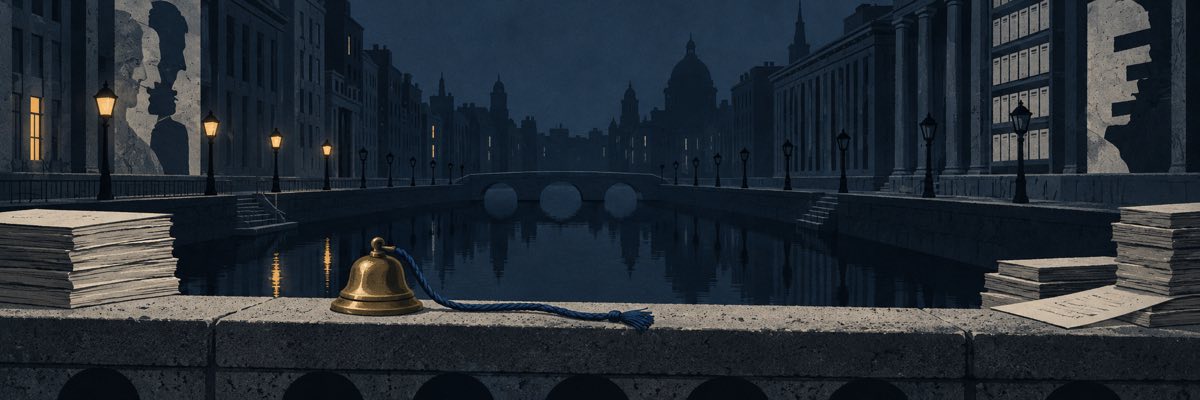
Chapter 1 — The Marriage That Still Loved
Mara Vell knew the marriage was dead because the teacups were still warm.
The couple sat on opposite sides of her fish-market table, hands folded, boots touching under the chair by accident and then not touching at all. Outside, dawn dragged silver over the canal. Gulls screamed over the gut buckets. Somewhere below, a bridge furnace coughed awake, fed by other people’s tenderness.
‘We still love each other,’ said the wife.
Mara dipped her pen. ‘That is not always legally relevant.’
The husband flinched. He had a stevedore’s shoulders and a clerk’s careful grief. His covenant ring hung on a string around his neck, dull as old brass.
‘It should be,’ he said.
‘Yes.’ Mara set the annulment paper between them. ‘It should.’
Neither moved to sign.
On the sill, her consent bell waited: palm-sized, civic-issue, polished by years of use. Once, she had rung bells in marble courts and trusted the sound. Now she used this one for private separations, debt revisions, quiet refusals. It made a thin noise, like a spoon striking bone.
The wife looked at it and swallowed. ‘Will it hurt?’
‘No,’ Mara said. ‘That part comes after.’
The lie sat there, clean and professional.
She touched the marriage cord they had brought as evidence. Blue thread. Canal-worker’s knot. Cheap Registry seal. The warmth in it rose through her glove, not as vision but as weather: first summer rain, cumin bread, laughing with a mouth full of river wind. Then the overdraft struck. Cold iron. Damp sheets. The bureaucratic ache of embracing because a notice had arrived.
Mara pulled back before the reading took more from her.
Too late.
The taste of cumin vanished from memory.
She stared at the cord.
The wife whispered, ‘Auditor?’
‘Not anymore.’
‘But you felt it?’
Mara flexed her fingers inside the glove. ‘Yes.’
The husband closed his eyes.
She wrote the judgement in plain hand. Covenant dissolved on grounds of civic overdraw, emotional insolvency, and continuing mutual regard. No party at fault. Registry at fault pending appeal.
It would not hold in a higher court. Most true things did not.
They signed. The bell rang. The couple began to cry with the shy relief of prisoners hearing rain.
When they left, Mara sat alone among the fish scales and cooling tea, trying to remember cumin.
At noon, Mara posted the annulment copy where the Registry clerk could not pretend it had been mislaid. The couple had left together under their shared umbrella, bound for separate homes. It was not a happy ending. It was a decision they had made without the city standing over their shoulders.
She closed the shop before the afternoon docket. The cord’s reading had taken the taste of cumin from her memory; she knew the difference between a loss and a punishment, though the Registry preferred to call both a fee. She would not read another person’s warmth that day.
By evening, a burn notice had been pinned to the fish-market door. Her auditor’s seal was revoked. The Registry named her practice unlicensed and her annulments subject to review. Mara took the notice down, folded it once, and kept it beside the couple’s signed copy. A system could name her work illegal. It could not make the two signatures disappear.
The canal lamps came on at dusk. She watched their gold move over the water and went home before the city could ask for more.
Chapter 2 — Execution Nails
At 03:17 the next morning, Saint Riven Ash came through Mara’s locked kitchen door with execution nails through his palms.
He did not arrive like a fugitive in a story. He arrived like a person who had spent too long being carried by people with keys. The door opened and struck the wall. He pushed it shut behind him. He stood on the threshold with rain on his coat and a strip of prison linen tied around one wrist. Blood had dried in the lines of his hands. The nails were black iron, court-stamped at the heads.
Mara reached under the breadboard for her knife.
‘You were wrong about me,’ he said.
‘That is a large claim for someone who has brought no evidence.’
‘The evidence is on my hands.’
‘Those are injuries.’
‘They are also a record.’
He looked past her, at the consent bell on the sill. He did not step further into the kitchen.
Mara knew the face. She had watched it across a courtroom three years ago: silver-black eyes, a mouth held still while magistrates called him a hunger-born predator and the city demanded a monster it could recognise. Her testimony had supplied the missing hinge. She had read a cold absence in a witness candle and translated it as guilt. She had wanted the record to close. It had.
‘Why come to me?’
‘Because I can prove the candle was altered. Because your signature is on the reading. Because you are the only auditor who might still know where the original question was cut out.’
‘You expect me to help you?’
‘No.’ He lowered his gaze. ‘I expect you to decide after you see it.’
That was not a plea. It was worse: room for her to say no.
Mara set the knife on the table, within reach. ‘You can come in as far as the chair. Leave your hands where I can see them.’
Riven entered. His shadow arrived a moment late.
He laid a folded strip of prison linen on the table. The cloth bore a list of numbers, dates and body locations. Beside each number, someone had written a temperature in red pencil. Four entries had been crossed out. Two had no names.
‘What is this?’
‘The lower-cell transfer sheet. They took warmth from people under the sentence of storage. The Registry says the warmth was volunteered for civic renewal. Most were never asked. Some could not speak.’
‘Where did you get it?’
‘A clerk handed it through the door. She said the people on it were alive when the shift changed.’
‘That is not the same as alive now.’
‘No.’
The honesty of it held her more effectively than urgency would have.
Mara did not touch the sheet. ‘And the nails?’
‘A transfer order. Voss’s private court is moving me before dawn. The nails carry the order’s authority. They also keep my hunger quiet enough to transport.’
‘Quiet?’
‘Not gone.’
‘Can you control it?’
‘At present.’
‘How long is present?’
‘Not nine seconds.’
She almost laughed. It would have been an error to reward the line.
Mara opened the cupboard where she kept old court copies and the papers she had never admitted she still kept. She found the Ollo file. It was thinner than she remembered. A witness statement, a candle transcript, her own reading, Voss’s summary. The original question was absent. The blank was neat enough to look intentional.
Riven watched her read.
‘You were right about one thing,’ she said. ‘I said no body could testify after death. I was wrong. The record can.’
‘You said the cold trace meant I had fed.’
‘I said the residue was consistent with your feeding.’
‘You let him call it proof.’
‘Yes.’
The word did not repair anything. It made the next choice hers.
She put the file beside the transfer sheet. ‘I am not helping you escape because you are wounded. I am not clearing you because I dislike Voss. I will check the source, and if you have lied to me, I will hand you back with the lie attached.’
‘Understood.’
‘You do not get to be grateful yet.’
‘I was not planning to.’
The bell on the sill gave a faint tremor. Not a summons. A Registry pulse, carrying its own question into the room.
Mara looked at the black nails through his palms. ‘We start with the original witness candle.’
‘The one in Voss’s private court?’
‘The one he used to close your case.’
‘It is guarded.’
‘Everything worth learning is guarded by someone who hopes you will confuse access with truth.’
Riven’s mouth twitched. ‘And until we can reach it?’
‘Bridge Seven. Your transfer sheet marks a broker for disposal beneath its civic court. Then the old repair route. Then I decide whether your evidence survives me.’
He nodded once.
Mara did not offer her hand. He did not ask for it.
The lamps across the canal brightened in sequence, a gold line travelling towards the Registry. A warrant could follow that line faster than a person could walk.
Mara folded the linen into the Ollo file. ‘We leave before the city wakes.’
‘You have not agreed to help.’
‘No. I have agreed to look.’
Riven tried to rise. His knees struck the tiles before Mara reached him. Above the door, a red line began to write itself across the plaster.
Chapter 3 — Registry Hunters
Mara Vell had killed three people in court and none of them had bled on her floor.
Now the blood was dark across her kitchen tiles. Too much of it. Sloppy. Unrecorded.
The door shuddered under the first impact. Riven was still on his knees beside her table, palms open despite the iron driven through them. His eyes had been silver-black in the old trial, polished as coins left on a dead man’s tongue. Hunger had thinned the silver to a hard ring around blown pupils.
‘Stay down,’ Mara said.
‘That instruction will become less useful in perhaps nine seconds.’
The warrant spell above them opened like a paper flower.
COVENANT REGISTRY: EMERGENCY ENTRY AUTHORISED.
Mara closed her fingers around the clause-blade she had left on the table.
The door came off its hinges.
Three hunters entered in civic grey, faces covered by bell-masks. Not soldiers. Worse. Registry enforcement. Men and women trained to look like procedure while they broke your teeth.
The first carried a hook-writ: a length of black iron chain threaded through stamped paper. The second held a witness candle in a cage. The third had a muzzle made from red silk and saint-bone.
For Riven.
Of course.
‘Mara Vell,’ said the woman with the candle. Her voice came filtered through the mask, clean and bored. ‘By authority of Justice Elian Voss, you are ordered to step away from the condemned hunger-born.’
Mara slid the clause-blade free.
Its edge was no longer than her hand. Ugly thing. Court issue. Designed not for combat but correction. It could cut contract thread, oath plaques, enchanted seals, marriage cords, debt flesh. It could cut a person if a person had made themselves part of the paperwork.
Hunters always did.
‘This is a private residence,’ Mara said.
The hook-writ rattled.
‘Emergency entry supersedes privacy.’
‘On what grounds?’
The woman turned the witness candle towards Riven. Its little flame bowed in his direction like a terrified priest.
‘Predation in progress.’
Mara looked down at Riven.
He was still on his knees because she had told him to stay there. His hands were open. Blood ran from the prison nails into the creases of his palms. He had made himself smaller in her kitchen than any creature with teeth like that should have been able to make himself.
She hated that the detail mattered.
‘No predation,’ Mara said.
‘Your statement is noted.’
‘Noted is not witnessed.’
The woman paused.
A good pause. Mara had put a pin through a procedural artery.
The hook-writ hunter stepped forward. ‘Former Auditor Vell—’
‘Senior Auditor.’
‘Former.’
Mara smiled without warmth. ‘If you are going to arrest me in my own kitchen, you will use the title I earned before your mother taught you which end of a warrant bites.’
Behind the mask, he breathed harder.
Good.
Anger left heat. Heat left truth.
The candle woman said, ‘Senior Auditor Vell. Move aside.’
Riven’s voice came low. ‘Mara.’
Not warning. Permission asked without asking for anything.
Her grip tightened.
The Registry had trained her not to be afraid of violent rooms. Violence, like intimacy, had rules if you were willing to admit you were doing it. Distance. Consent. Escalation. Witness. Harm. Redress.
The state broke bones because it called the blow enforcement.
Mara preferred accuracy.
‘I am going to ask one question,’ she said. ‘Answer properly and no one needs to leave pieces behind.’
The third hunter laughed.
Riven’s head tilted.
The laugh died quickly.
Mara raised the brass consent bell from the sill. Its handle knew her palm. She had rung it over vows, annulments, debt revisions, refusals, deathbed releases. A ridiculous small thing for a room full of weapons.
The hunters shifted anyway.
‘Who signed the emergency entry?’ Mara asked.
‘Justice Voss,’ said the candle woman.
‘Show me the live seal.’
‘Unnecessary.’
Mara rang the bell.
The sound was thin and bright.
The hook-writ chain snapped taut of its own accord. The papers threaded through it began to smoke.
The hunter swore.
‘Live seal,’ Mara repeated.
The candle woman took one step forward.
Riven moved.
No flourish. No courtly monster grace. One moment he was on his knees; the next his hand closed around the hook-writ chain and the iron went red under his grip. The execution nail through his palm hissed. He did not flinch. He pulled once.
The hunter came with it.
Mara saw the body cross the room. Saw the angle wrong at the shoulder. Saw the man’s mask strike the table edge and split at the mouth. Blood burst over his chin, hot enough to steam in the warrant-light.
Riven had not fed. Not yet.
His teeth had lengthened anyway.
‘Down,’ Mara snapped.
Riven froze.
The candle woman made the mistake of looking relieved.
Mara used it.
She drove a witness pin through the smoking papers on the chain and into the table beneath. The spell screamed. Not a metaphor. Paper had a voice when the law had been written in blood and somebody forced it to admit pain.
‘False urgency,’ Mara said.
The pin turned blue.
The candle flame guttered.
‘False location,’ she said.
Second pin. Blue.
The hunter with the saint-bone muzzle lunged.
Mara cut him across the forearm.
The clause-blade touched uniform, skin, oath-script. It drank. A narrow line opened from wrist to elbow, too clean for ordinary steel. He dropped the muzzle and clamped his other hand over the wound as black legal ink spilled with the blood.
There it was.
Not just enforcement. Contract-bound enforcement.
‘Who owns your warrant?’ Mara asked.
The man backed away from her as if the question had a blade of its own.
The candle woman drew a pistol.
Riven’s hunger hit the room.
Mara felt it as pressure behind her teeth. The glass shards on the floor trembled. The candle flame flattened sideways. The injured hunter made a small sound, not quite fear and not quite prayer.
Riven was staring at the pistol.
No. At the pulse in the woman’s wrist.
‘Riven,’ Mara said.
He shut his eyes.
The effort changed his face. That was the worst part. Not the teeth. Not the shadow rising from him in strips. The effort. The visible, brutal labour of not becoming the story they had written around him.
The pistol fired.
Mara did not hear the shot. The warrant spell swallowed sound at the instant of discharge, preserving the official quiet of authorised violence.
The bullet struck the cupboard behind her and turned three jars of red spice into powder.
For one impossible second, the kitchen smelled like heat, markets, her mother’s wedding tea.
Cumin.
The smell recalled the missing taste so sharply that grief blinded her. Her tongue gave her nothing.
The candle woman fired again.
Riven crossed the room.
This time Mara did not tell him down.
He caught the woman’s wrist and bent it until the pistol dropped. Bone cracked. The sound returned all at once: glass settling, chain scraping, the woman’s muffled scream, Riven breathing through his teeth like a man refusing wine after 40 days in a cellar.
His mouth hovered near the woman’s throat.
Fear poured from her. Thick. Shining. Civic grey could not hide it.
Riven could have taken it.
Mara knew that suddenly, completely. He could have opened his mouth and drunk the terror out of her until she lay smiling and empty on the tiles. He could have made the room quiet. He could have made himself strong.
Instead he looked at Mara.
As if she were the law.
As if he hated that and needed it anyway.
‘No theft,’ she said.
Riven released the woman.
She collapsed, clutching her wrist.
The injured hunter grabbed the saint-bone muzzle with his good hand. He whispered something. The red silk woke.
It flew.
Not at Riven.
At Mara.
The thing struck her throat and tightened.
Air stopped.
Mara drove the clause-blade up by instinct, but the silk slid under the edge, soft as a lover’s ribbon. Saint-bone kissed the hollow under her jaw. Her knees hit tile. The muzzle was made for hunger-born anatomy, but law was flexible when it wanted to hurt someone.
Riven said her name.
Not Mara. Not Auditor.
Something older. A sound with teeth in it.
The room buckled.
The hunter holding the ribbon rose from the floor. Not lifted by hands. Lifted by the fear Riven had refused until refusal itself became violence.
Cabinet doors banged open. The witness candle blew sideways in its cage. The warrant spell overhead ripped from the ceiling and hung in strips like shed skin.
Riven turned.
The hunter’s eyes widened behind the cracked mask.
‘Saint—’
‘No,’ Riven said.
The word struck the hunter in the chest.
He flew into the wall hard enough to break plaster. The red silk loosened.
Mara dragged in one breath, then another. Her throat burned. Spots moved through her vision. She tasted blood where her teeth had cut her tongue.
Riven came to her.
Stopped two paces away.
His hands were shaking. His pupils were wrong. His shadow was not attached to him. It crawled across the floor towards the fallen hunters with its mouth open.
‘Permission,’ he said.
It took her a second to understand.
He was asking before touching her.
In this kitchen. In this blood. With men and women who would cage him if they could stand. With hunger tearing the civility from his face.
Mara laughed once, raggedly. It hurt.
‘My throat,’ she said. ‘Only to remove the silk.’
‘Yes.’
‘No feeding.’
His jaw flexed.
‘Yes.’
‘If your shadow touches them, I will put a pin through it.’
His mouth curved, awful and beautiful. ‘Senior Auditor.’
‘Former.’
‘Never.’
He knelt before her, and this time it was not procedure.
His fingers touched the red silk at her throat.
Mara had been touched by doctors, tailors, debt clerks, lovers she had chosen poorly and one she had chosen well enough to regret. This was different because he made it slower than fear required. He gave her time to stop him. Gave her time to be ashamed of wanting the touch to continue after the danger passed.
The silk resisted.
Riven bent close. His breath warmed the blood at her lip.
‘This is keyed to obedience,’ he said.
‘Whose?’
‘Mine.’
Of course.
‘Can you break it?’
‘Yes.’
‘Cost?’
‘Pain.’
‘Yours or mine?’
His eyes met hers.
There was the whole city between them. All its clean ledgers. All its dirty beds. Every bell rung over people who had agreed because hunger, rent, law, grief, or love left them no room to refuse.
‘Mine,’ he said.
Mara swallowed against the silk.
‘Do it.’
He closed his hand around the saint-bone clasp.
The smell of burning filled the kitchen.
Riven’s skin split around the old execution nail in his palm. Blood ran over his wrist. His face did not change, but his breath did. One sharp inhale, held too long.
Mara lifted her hand.
Stopped before touching him.
‘May I?’
The question struck him harder than the pistol.
Riven looked at her fingers, then back to her face.
‘Yes.’
She set two fingers against his wrist.
His pulse was violent.
The silk snapped.
Air rushed into Mara so hard she nearly retched. Riven caught her by the shoulder, not the waist, not the throat, nowhere that could be mistaken for possession.
The candle woman groaned on the floor.
Mara turned her head.
The room steadied around its damage. Broken jars. Blood. Paper ash. Three hunters alive. One warrant spell destroyed. A hunger-born saint kneeling close enough to kill her, asking permission to hold her upright.
She should have felt terror.
For one impossible second, her mind supplied cumin with the vividness of taste: red spice, wedding tea, her mother laughing before the Registry took ten years of warmth from her marriage and called it civic contribution. Her tongue remained blank. It was an echo, not restoration.
Mara’s eyes burned.
Riven’s thumb moved once against her shoulder. Barely a touch. A question.
‘No,’ she whispered.
His hand stilled at once.
She hated him for that. For making refusal safe enough that wanting could survive it.
Then she hated herself for hating him.
The hook-writ hunter coughed blood onto her floor.
Mara pushed herself upright. Her knees shook. She ignored them.
‘You,’ she said to the candle woman. ‘Witness.’
The woman stared up at her.
‘What?’
Mara picked up the brass bell.
‘Witness, or I let him stop being polite.’
Riven’s shadow smiled from under the table.
The woman’s broken wrist trembled. ‘I witness.’
‘Emergency entry was falsely sealed?’
Silence.
Mara rang the bell.
The woman screamed. Not from pain. From the law turning inward.
‘Yes,’ she gasped. ‘Falsely sealed.’
‘Predation was not in progress?’
The woman’s gaze flicked to Riven.
He smiled with blood on his teeth.
Mara rang the bell again.
‘No,’ the woman said. ‘No predation.’
‘Who owns the warrant?’
The witness candle flared.
For one heartbeat, Mara saw the lie behind the woman’s eyes. Not an image. A temperature. Marble chambers. Green wax. A hand with a judge’s ring pressing a seal into living skin.
Justice Elian Voss.
Her old mentor.
The man who had taught her that law was civilisation with a blade hidden in its sleeve.
Mara’s throat throbbed where the silk had bitten her.
She looked at the blood on the floor. At Riven’s split palm. At the hunters who had come to make a monster and found one, perhaps, but not the one they had expected.
‘Justice Voss,’ the candle woman whispered.
The candle went blue.
Truth.
Something inside Mara went very still.
She set the bell down, picked up the clause-blade, and cut the false warrant from the table. The paper bled as she folded it.
‘What now?’ Riven asked.
The hunger had retreated from his face, leaving him pale, almost human, except for the teeth he had not yet managed to hide.
Mara looked at him.
At the mouth that could have emptied a room.
At the hands that had waited for permission.
At the city that had taught her consent was a sound a bell made after powerful people had already decided what they wanted.
‘Now,’ she said, ‘we stop asking the Registry for permission to tell the truth.’
Outside, across the canal, the bridge lamps changed to warrant-red.
One by one.
Fed by stolen warmth.
Chapter 4 — The Body Beneath Bridge Seven
The body lay beneath Bridge Seven where the storm drains met the old ferry steps.
At dawn, the canal wore a skin of oil and pale light. Mara went down first, one hand on the iron rail, the other keeping the clause-blade under her coat. Riven followed at a distance he had asked her to set. The prison nails made each step a small negotiation with his own blood.
The dead man wore a broker’s brown coat, the cuffs still stamped with the House of Sere perfume mark. His face had not been struck. His mouth was open as if a question had been asked and he had run out of time before answering.
Mara crouched without touching him.
‘Name?’
‘Deren Vey,’ Riven said. ‘Covenant broker. He signed the transfer order for the lower cells.’
‘You knew him.’
‘I saw him at the trial. He testified that the warmth in the Ollo file came from a voluntary exchange.’
‘You said he was a witness.’
‘He was a witness and a broker. The Registry liked its witnesses to have a financial interest.’
A paper tag protruded from the dead man’s collar. Mara drew it out with the tip of her knife. It listed a court number and a vial batch. The same batch code appeared on the prison transfer linen.
‘Do not touch the body,’ Riven said.
She glanced at him.
‘You think it is bait?’
‘I think whoever did this wants your hand on him. Your reading would become evidence before you knew what question they had asked.’
A useful warning. Not proof of innocence.
Mara studied the skin around Vey’s throat. No bruising. A fine crescent of gold residue under the jaw. The lining of his coat was damp with canal water, but his shoes were dry. Someone had brought him here after death.
‘He was not killed at the water,’ she said.
‘No.’
She moved to the stones. A patch of grit had been brushed clean. In its centre, a small black shard caught the light. It was not glass, though it looked like it. Candle wax hardened around a sliver of silver.
Riven stayed where he was.
Mara wrapped the shard in a scrap of paper. ‘A witness-candle fitting.’
‘The same kind as the one used in my trial.’
‘That does not make it the same candle.’
‘No.’
She looked at the broker again. The city had taught her that evidence was most dangerous when it arrived already arranged. The body, the residue, the old case, the condemned man beside it. A complete story waiting for a signature.
‘We need a living record,’ she said.
‘The candle was moved from the public court to Voss’s private gallery.’
‘How do you know?’
‘The transfer line on the prison sheet. I was in the same convoy.’
Mara returned to the tag. Under the batch number was a notation in green wax: “Reserve test: renewal-compatible.” She had seen that phrase only in old maintenance ledgers, where it referred to civic stores that could survive a pressure change.
A bell rang above them. The Bridge Seven court was opening.
Two clerks came down the steps carrying a white sheet. They saw the body and stopped. One reached for the bell at her belt.
‘Don’t,’ Mara said.
The clerk’s hand froze. ‘Former Auditor Vell. This scene is under Registry custody.’
‘Then you will preserve it before you name it.’ Mara pointed at the dry shoes, the gold residue and the candle fragment. ‘Record those. Separately. No conclusion about predation until a source witness is present.’
The younger clerk frowned. ‘The warrant says—’
‘The warrant is not a corpse.’
She offered the wrapped shard. The clerk did not take it.
‘You can refuse custody,’ Mara said. ‘You cannot pretend you did not see it.’
The woman glanced at Riven. He kept both hands open and his feet back from the body.
‘What happened to Vey?’ she asked.
Mara looked at the dead man. ‘That is what the evidence is for.’
A sound travelled through the bridge above them: the low groan of a furnace taking warmth. Vey’s coat lifted in the draft. For a second, the gold trace beneath his jaw brightened, then went dull.
Riven’s eyes narrowed. ‘That is not hunger.’
‘No. It is a transfer mark.’
‘You can tell?’
‘I can tell what it is not.’
The difference mattered. It was the beginning of a case, not its answer.
Mara gave the shard to the clerk in a sealed paper sleeve and asked her to witness the seal. She wrote both their names on the outside. Her own signature looked steadier than she felt.
When the clerks took Vey away, the younger woman left the white sheet folded on the step. It bore a summons: public candle examination at Bridge Seven, 09:00. The official account would be read there.
Mara tucked it inside her coat.
‘You still think the candle is enough?’ Riven asked.
‘No. I think the Registry thinks it is enough.’
Above them, the lamps came on one by one. The light reached the wet steps and stopped at the body’s empty place.
Chapter 5 — The Bell That Lied
The witness candle had already given its account by the time Mara reached the Bridge Seven chamber.
Its flame burned blue inside a brass cage. A clerk stood beside it with a transcript slate. The public benches were nearly full: bridge workers off shift, two House Sere representatives, a knot of junior auditors, and people who had heard that the dead broker was connected to a monster’s old trial.
Mara had not brought Riven into the room. He waited in the covered drain below, with the transfer sheet and a clear line to the service passage. The difference between a witness and a spectacle was often one door.
The clerk read the official account. Deren Vey had been found after a predatory attack. The candle had captured a hunger signature, a fear response and a voluntary transfer of warmth. The record matched the Ollo file that had condemned Riven three years earlier.
It matched too neatly.
Mara asked the clerk to replay the first three minutes. The flame showed a corridor, then Vey’s hands, then a green seal. It described a voice. It repeated the same seven words each time: “I give what I no longer need.”
No question preceded them.
‘Who asked the question?’ Mara said.
‘The candle records the answer, not the examiner.’
‘Then it cannot establish whether the answer was voluntary.’
‘The Registry certified the protocol.’
‘That was not my question.’
A few people on the benches shifted. The House Sere representatives did not.
Mara asked for the sealed shard from the morning’s evidence intake. The clerk checked the two signatures, opened the sleeve and placed it beside the cage. The flame leaned towards it. The gap in its light became visible: a narrow black seam running down the centre, where the recording had been cut and joined again.
The clerk tried to cover the seam with the transcript slate.
‘Don’t,’ Mara said.
She did not ring the consent bell. A public hearing did not become fair because someone made a noise that resembled agreement.
‘Replay the silence before the answer.’
The clerk’s fingers tightened. ‘There is no silence in the transcript.’
From the service door, Riven said, ‘There is a difference between no sound and no record.’
He had come in without crossing the marked line around the candle. The benches tensed. A guard lifted a hook-writ. Riven stopped where he stood.
‘Continue,’ Mara told the clerk.
The candle’s flame made a thin, unsteady shape. The seam opened. For less than a breath, another image showed through: Vey turning away from a green sleeve; a hand closing around a vial; a pulse of gold light travelling from his throat into glass.
Then the official account resumed.
‘That is not enough to identify who held the vial,’ the clerk said.
‘Correct.’ Mara felt the room turn towards her. ‘It is enough to show this candle cannot support the conclusion it was used to support.’
Riven stayed behind the line. ‘The cold part is missing.’
‘Explain.’
‘When hunger takes fear, it leaves a heat pattern. When warmth is pulled through a sealed vial, the body cools first where the transfer starts. This trace begins at the throat and travels out. The file says it began at the mouth and travelled in.’
‘You are asking them to trust your expertise.’
‘I am asking them to test the direction.’
Mara looked at the clerk. ‘Can the candle be tested without adding a new record?’
The clerk hesitated. ‘A calibration bell can be used.’
‘Who controls the bell?’
‘The examiner.’
‘Then the same person who controls the question controls the result.’
She called for two independent witnesses from the benches. A bridge worker volunteered; the second was a junior auditor whose name was not on the summons. They agreed to watch the flame and the slate, not to endorse an interpretation.
The clerk rang the calibration bell. The candle replayed the transfer. The flame travelled from throat to vial. It did not bow towards Riven.
The junior auditor wrote that down. The bridge worker put her name beside it.
The House Sere representative stood. ‘This is an unauthorised examination.’
‘It is a public candle under public summons,’ Mara said. ‘If the record is sound, witnesses will help it survive.’
The representative left without answering.
The clerk lowered the flame. ‘I cannot amend the official account.’
‘You can record that it has been challenged.’
‘That may end my position.’
Mara thought of the signature she had put under the old account, the easier chair it had bought her, the case that had been allowed to close because she had made the question smaller.
‘Then write only what you saw.’
The clerk looked at the seam in the candle. At the two names beside the calibration result. At Mara’s signature on the old report, visible in the public file.
She wrote: “Official account repeated. Source image incomplete. Transfer direction inconsistent with prior finding. Examiner identity absent.”
The candle flame dipped.
Not truth. Not absolution. A limit placed on a lie.
Outside, Riven waited under the bridge. He had not come closer.
‘You heard it?’ Mara asked.
‘I heard the candle.’
‘And?’
‘It told the same story again.’
‘That is not an answer.’
‘No. The absence is.’
Mara folded the clerk’s challenge into the Ollo file. They had a body placed after death, a transfer mark, a cut candle and a record with its question removed. It was not enough to prove who had killed Vey. It was enough to stop the Registry from calling its own account complete.
They had to reach the original candle before Voss could replace the seam.
Chapter 6 — Burn Notice
They returned through the rear passage of Mara’s damaged kitchen. The hunters were gone; the broken door stood propped against the wall. The junior auditor from the hearing followed them in, carrying a blank docket book.
Mara kept the old testimony in a tin beneath her floorboards.
She had told herself it was evidence. That was the term a careful person used for a record they were afraid to read. The sheet was not the signed original; the Registry held that. It was her private copy, with the questions she had asked, the answers she had heard, and the conclusion she had allowed Voss to write above her name.
Riven stood by the door while she took it out.
‘You can leave,’ she said.
‘I know.’
‘You can also tell me what you want me to do.’
‘I want the truth entered where they can’t seal it.’
‘That is not the same as asking me to burn this.’
‘No.’
Mara unfolded the paper. The line was still there in her own hand: “Trace consistent with feeding; no independent witness to source.” Below it, Voss’s summary: “Predation confirmed.” Her signature sat between those statements like a hinge installed backwards.
She had not written the summary. She had not corrected it.
‘If I destroy the copy, the old testimony stays intact,’ she said.
‘If you keep it, you can still pretend you are the only person who has seen it.’
That was why she disliked him. He could be right without earning the right to say it.
Mara took a fresh sheet and wrote a correction. She named the candle’s missing question, the uncertainty of the trace, and the difference between what she observed and what the Registry claimed. She did not remove her own role. The correction would expose her to perjury charges and void the protections attached to her former office.
She signed it.
Then she held her old copy over the brazier.
The ink blackened first. Her younger signature curled last. It was not a cleansing. The official record remained. So did the people harmed by the verdict. The flame only took away her private refuge.
‘Send the correction through the public docket,’ she told the junior auditor waiting at the passage.
The clerk stared at the words. ‘It will be sealed before noon.’
‘Then make three copies. One to the bridge workers who witnessed the candle. One to the district annulment office. One to the undercity route.’
‘That makes you a party to the evidence breach.’
‘I am already a party to the evidence.’
The clerk took the copies.
Above them, the lamps changed from blue to white. The same burn notice now filled the Registry screens: Mara Vell’s auditor’s seal was revoked, her accounts frozen, her name flagged for emergency review. It called her correction an act of predatory collusion.
Riven read it over her shoulder.
‘They are quick.’
‘They have had practice.’
‘The undercity route begins at the old ferry lock.’
‘You know it?’
‘I worked threshold repairs before the Registry made my name useful.’
Mara put the Ollo file, the candle challenge and the prison linen into a canvas sleeve. She left the private testimony behind as ash.
‘You will not lead us through any passage that requires me to trust you blindly.’
‘There is a pressure map at the ferry lock.’
‘Good. We will read it together.’
They went down the stairs. At the final landing, Mara stopped. The room behind them still held the annulment papers from the couple she had helped the day before. She thought of their hands touching beneath the table, the small relief she had not been able to file.
‘Mara?’
‘Coming.’
She crossed the threshold first.
Chapter 7 — The Perfume Court
The old ferry lock opened below the fish market, behind a wall of rotted timber and a brass warning plate no one had polished in forty years.
Riven knew which bolt not to turn. Mara made him show her the pressure map before she let him touch it. The route beneath the city had been built for crews who needed to repair heat conduits without waking the Registry’s listening devices. It was narrow, damp and full of pipes that carried both water and the private static of a city under strain.
They followed the map to a service stair beneath House Sere’s perfume court.
Mara recognised the place from the case files. The court sold bottled sensation to the wealthy: a first kiss without the awkwardness, grief without the funeral, a remembered summer taken from someone who could no longer taste it. The Registry called the vials licensed transfers. The source names were hidden under a scent code.
‘We take the ledger, not the goods,’ she said.
‘And if the ledger is not there?’
‘We leave with what proves why.’
‘You are making theft sound civic.’
‘It is still theft.’
She tested the service door. One lock, two seals, one scent-guard on the other side. The guard’s breathing was regular. The wax on the latch smelled of orange blossom and iron.
Mara used the clause-blade to cut only the Registry thread. The door gave a fraction. Riven did not enter until she nodded.
The first room held rows of glass vials in padded drawers. Each had a name replaced by a number. Mara found the batch from Vey’s tag, then another with a mark she knew from her mother’s marriage record: Marise Vell, warmth contribution, ten years. It had not gone to a bridge furnace. It had been divided, distilled and sold.
Mara set her hand on the drawer. The metal was cold. She did not read it. She did not trust the room enough to pay for certainty.
Behind the wall, a judge’s lover laughed. The sound came through a vent, bright and borrowed.
They found the ledger in a side office. It listed clients, batch numbers and reserve transfers, but no source names. Someone had kept the key separately. The key hung around the neck of a sleeping clerk.
Riven took one step towards her.
Mara caught his sleeve. ‘No feeding. No glamour. We wake her and ask.’
The clerk woke before they could. She reached for the alarm bell.
Riven moved fast enough to intercept her wrist, then stopped before closing his hand. The pause cost them. The alarm sounded once.
Mara cut the bell’s tether. The second ring died against the wall. A guard entered through the back passage with a silver scent-hook raised.
‘Drop it,’ Mara said.
He swung at Riven.
Riven turned. The hook opened his ribs. His answer was a hand at the guard’s throat and hunger in his eyes. Mara saw the moment when fear became available to him, a bright and easy meal.
‘Riven.’
He stopped. The guard did not. He drove a short knife under Riven’s arm. Riven’s grip tightened once; the guard’s neck broke against the doorframe.
The body slid down.
Riven stood over it, breathing hard. He did not feed. The choice did not bring the man back.
Mara took the key from the clerk herself. ‘You will live if you tell us which batch came from Marise Vell.’
The clerk’s eyes moved to the dead guard, then to Riven. ‘The first drawer. It was sold to Magistrate Pell’s companion. There is one returned vial in that drawer.’
‘Why?’
‘The buyer returned it. Said it made him remember a woman he had never met.’
Mara took the small grey vial from the drawer. It held a strand of gold that clung to the glass like honey.
The guard’s blood was spreading across the floor.
Mara looked at Riven. ‘We carry the death as it is. You do not call it restraint.’
‘I won’t.’
‘You do not call yourself a monster to end the conversation either.’
‘I won’t.’
‘Good. We leave.’
The alarm had brought more guards to the upper court. The stair back to the ferry lock was cut off. The clerk pointed to a lower oath-room used to hold witnesses until buyers completed a transfer. Mara opened it with the key. The clerk pointed out a narrow staff exit beyond the basin, then fled through it. Voices and bootsteps crowded the corridor beyond it. Mara left its bolt open; the clerk knew the uniforms out there, and they did not.
The room had a bolted table, a cracked basin and manacles fixed at six heights. No bed. No windows. Above them, the court’s waltz moved on.
Riven held one hand over his wound. Mara carried the vial and the ledger. Above them lay the dead guard. His death would enter the same ledger as the stolen warmth, with Riven’s hand recorded as its cause.
Chapter 8 — Blue Ink
The oath-room beneath the perfume court had no bed.
Mara noticed that first, because the city had trained her to notice what a room pretended not to be.
No bed, no couch, no velvet divan with carved ankles and a witness candle placed nearby like a polite accomplice. No bridal hooks in the ceiling. No pleasure ledgers. No copper plates engraved with consent clauses so old the words had been rubbed smooth by hands trying to make shame official.
Just stone. A cracked washing basin. A table bolted to the floor. Three wall sconces burning with blue civic fire. A drain in the centre of the room, dark with old ink.
And manacles.
Six pairs, fixed at different heights.
Mara stopped at the threshold.
Riven, already inside, turned.
The lamps caught the prison nails through his palms. By now they had stopped smoking. That made them worse. Dead metal had a patience to it. Blood had dried around each wound in black petals, cracking whenever he flexed his fingers.
‘No,’ Mara said.
Riven followed her gaze to the manacles.
‘They are not for us.’
‘That was not a question.’
‘No.’ He stepped away from the wall, giving her the room’s centre. ‘They were used for oathbreakers. Perfume witnesses. People who sold memories twice and insisted both buyers had received the original.’
‘And lovers who changed their minds?’
His mouth hardened.
There it was. Answer enough.
Above them, music moved through the perfume court: a slow-string waltz, laughter, glass chiming, the soft commerce of wealthy people buying other people’s sensations in crystal vials. Down here, the court smelled of wet stone, old wax, and the metallic sweetness of Riven’s blood.
Mara reached into her coat and drew out the vial they had stolen.
It was no longer than her little finger. The glass was smoke-grey, stoppered with white wax and sealed by a Registry thread. Inside, something gold clung to the sides like honey.
A sensation.
Not a memory. Not exactly.
Memories had sequence. Sensations had teeth.
This one had bitten her through the glove when she lifted it from the returned-goods drawer: a burst of warmth at the base of the throat, a woman laughing into a cup, cardamom and river wind, hands touching under a marriage shawl.
Her mother’s wedding-night laughter.
Bottled. Scented. Sold upstairs for a private hour to some perfumed idiot with soft hands and no idea whose life he was wearing.
Mara set the vial on the bolted table.
The glass clicked once.
Riven did not touch it.
Good. He was learning.
‘Can you read it without spending yourself?’ he asked.
‘I can read anything.’
‘That was not my question.’
She looked at him.
His coat hung open at the throat. Under it, his shirt was torn from the fight in the office above. A black wound crossed his ribs where a scent-guard’s silver hook had opened him. Hunger-born flesh did not heal cleanly when starved. The injury had not closed so much as argued with itself: dark edges, a red centre, silver threads of borrowed pain moving under the skin.
He had killed one guard. The man had opened his ribs with a hook, then driven a knife under his arm. Riven had broken his neck against the doorframe.
He had not fed. Mara could give him that much. She could not turn it into a living man.
Before they left the office she had recorded the death on the ledger’s blank endpaper: time, location, weapons, the order of the blows. Riven had watched her write his name.
Now he kept looking at his empty hand.
‘If I read the vial alone,’ she said, ‘I lose something.’
‘How much?’
‘Depends how much they stole.’
‘Mara.’
It was the first time he had used her name without anger, procedure, or warning.
The room changed around it.
Not softened. Never that. Sharpened. The blue fire leaned towards them in its sconces.
Mara removed her gloves one finger at a time.
Riven looked away.
That almost undid her.
Not his teeth. Not his blood. Not the terrible beauty of a creature built around hunger choosing restraint again and again until restraint became its own violence. It was the looking away.
Her bare hands felt wrong in the oath-room air. Too exposed. The skin at her fingertips was pale where heat-reading had thinned the blood. Fine silver scars crossed her knuckles, each one a verdict she had survived.
‘Look,’ she said.
His eyes returned to her at once.
‘If you are going to anchor me, you look at what the work costs.’
A muscle moved in his jaw. ‘Anchor is not feed.’
‘No.’
‘Anchor is not restore.’
‘No.’
‘Anchor is not persuade your body to want survival and call it consent.’
Mara’s throat tightened.
‘No,’ she said.
‘Then we need terms.’
She gave a short laugh. ‘You sound like me.’
‘I am in danger of becoming literate.’
‘Don’t flatter yourself.’
‘Too late. You keep correcting my verbs.’
For one second, she nearly smiled.
Then the vial pulsed gold on the table, and the room filled with her mother’s laughter.
Mara closed her fist.
The sound vanished.
Riven’s eyes had gone black to the rim.
‘That is not only your mother,’ he said.
‘What do you mean?’
‘It is layered.’
‘How many?’
He drew a breath through his teeth. ‘At least twenty.’
Mara stared at the vial.
Twenty sensations, perhaps more, pressed into one elegant court bottle. Wedding laughter. First touch. Relief after childbirth. A bath after fever. The first bite of fruit after famine. An old husband’s hand on the back of his wife’s neck in a kitchen where no one was watching.
All of it stolen, distilled, perfumed, sold upstairs as luxury.
The vial warmed the table.
Mara reached for it.
Riven caught her wrist.
Not hard. Not ownership. But contact.
Her skin knew him before her judgement did.
Heat moved through her wrist, up her arm, into the locked machinery of her chest. Not pleasure. Not yet. Recognition. The body’s oldest panic: here is danger, here is shelter, here is a mouth that could destroy you asking to be allowed near the wound.
‘Terms first,’ he said.
His thumb rested over her pulse.
She should have pulled away.
She did not.
‘Release me,’ she said.
He did.
Immediately.
The absence of his hand struck harder than the touch.
Mara hated that. Filed it under evidence. Hated that too.
She went to the washing basin. On the stone shelf above it sat an oath-clerk’s kit: two cracked inkpots, three bone nibs, a strip of rag, and a shallow saucer containing legal ash. The ash had once been contracts. Burnt vows. Failed bargains. The dead skin of promises.
She picked up the cleanest nib.
‘Sleeve,’ she said.
Riven went still.
‘You want terms,’ she said. ‘I write them.’
‘On paper.’
‘Paper can be seized.’
‘Stone.’
‘Stone can be read.’
His eyes flicked to the manacles, then back to her.
He understood before she said it.
‘Skin,’ Mara said. ‘Your skin. My hand. My language. Temporary terms. They die at dawn, or sooner if either of us ends them.’
Riven’s silence was not hesitation. It was containment.
‘Where?’ he asked.
The question was too simple for what it did to her.
Mara looked him over with an auditor’s eye and a woman’s pulse. Throat: too intimate, too exposed. Chest: impossible. Palm: ruined by the nails and too symbolic by half. Back: he would have to turn away from her, and neither of them trusted the room enough for that.
‘Forearm,’ she said.
He removed his coat.
No ceremony. No seduction. That made it worse.
The coat fell over the back of the chair. His shirt followed only far enough to expose one arm and the injured line of his ribs. He did not strip for her gaze. He made the necessary area available and nothing more.
Mara wanted to punish him for the discipline of it.
Her mouth had gone dry.
His body was not pretty in the courtly sense. The Registry artists had painted hunger-born saints as pale, elongated creatures with sorrowful eyes and devotional hands. Riven was harsher than that. Built lean, scarred at the joints, marked by old restraints at wrist and throat. His skin held faint script where verdicts had been burned into him and later refused to heal.
Condemned.
Predator.
Saint.
False words could still scar.
Mara poured ash into the saucer. Added three drops of blue ink. Then, because the room required truth and truth was rarely clean, she held out the clause-blade.
Riven offered his wrist.
‘No,’ she said. ‘Your choice. Your cut.’
Something like respect moved across his face.
He took the blade.
A hunger-born saint with a knife in his hand should have frightened her. It did. Fear moved low in her body, old and useful. But it did not arrive alone.
He laid the edge against the inside of his forearm.
‘How much?’
‘One line.’
He cut.
Blood welled up, black-red, too bright in the blue fire. It ran into the saucer when he tilted his arm. The ink shivered. The legal ash drank greedily and turned the mixture a violent blue, almost luminous.
Mara took the bone nib.
Riven sat on the chair, forearm bare on the table, palm up.
The prison nail through that hand touched the wood with a soft click.
She dipped the nib.
‘Terms,’ she said.
‘Say them.’
‘You will anchor only. You will not feed from me, restore me, calm me, arouse me by magic, dull pain, alter memory, interpret silence as permission, or continue after refusal.’
The ink brightened.
Riven’s gaze did not leave her face. ‘Accepted.’
Mara set the nib to his skin.
He inhaled.
She wrote the first clause along the inside of his forearm. Her handwriting stayed immaculate. That angered her. She wanted one visible tremor, one betrayal she could blame on him.
Anchor only.
His skin was warm. Not human-warm. Deeper. The heat of stone after a day’s sun, except Veyr Nocturne had not seen honest sun for three weeks. Blue letters rose behind the nib and sealed into him without burning.
He watched her write.
She felt the attention like a hand at the back of her neck.
‘My terms,’ he said.
Mara did not lift the nib. ‘Proceed.’
‘You will not use pain to prove independence.’
Her hand stopped.
‘That is broad.’
‘It is exact.’
‘Rejected.’
‘Then write the rejection.’
She looked up sharply.
Riven’s mouth was grim. ‘If you reject care, make it part of the record.’
The room pressed in.
Above them, someone laughed in the perfume court. A bright, purchased sound.
Mara dipped the nib again.
‘Amended,’ she said. ‘I will not conceal relevant pain that compromises the reading.’
‘Accepted.’
She wrote it.
Pain disclosed if relevant.
‘You will stop if the reading takes touch,’ he said.
‘No.’
‘Mara.’
‘No. Touch is already damaged. Taste first. Smell second. Music third. Touch is too valuable to interrupt the reading for.’
Riven’s face changed.
Not pity. Fury.
For one clear second, she saw the creature beneath his restraint look past her to the city that had spent her like coal.
‘Do not,’ she said.
His eyes returned to hers.
‘Do not what?’
‘Look as if you would kill for me. It is distracting.’
‘Would you prefer I look as if I would file a complaint?’
‘From you? Yes.’
His mouth moved. Almost a smile. Almost pain.
‘Amended,’ he said. ‘You will stop if the reading takes touch beyond the hand you choose to give.’
Mara considered.
She had survived court by knowing which compromise hid a trap. This one had none. Only care with its palms open.
‘Accepted.’
She wrote it.
Chosen hand only. Stop at spreading numbness.
The blue ink ran over a scar shaped like a small broken sun.
Mara touched the mark before she meant to.
Riven’s entire body went still.
Not tense. Still.
As if the room had put a blade to his throat.
She withdrew her fingers at once. ‘That was not included.’
‘No.’
‘Apology.’
‘Accepted.’
The word came rough.
She should have stepped back. Instead she looked at the scar.
‘What verdict was that?’
‘The first time they called me citizen.’
‘That scar says condemned.’
‘Citizenship is conditional in Veyr.’
The vial pulsed again.
Twenty stolen pleasures breathed through the glass.
Mara forced herself back to the terms.
‘My final clause,’ she said. ‘If I command release, you release. If you command release, I release.’
His brows drew together. ‘You?’
‘You are not the only one who can be trapped by wanting.’
The blue fire crackled.
Riven bowed his head once.
‘Accepted.’
She wrote the final line near his wrist, where the pulse jumped under the nib.
Release means release.
The ink sealed.
For a moment, the clauses glowed beneath his skin. Then they sank into him and vanished.
Mara set the nib down.
Her hand shook only after.
Riven saw. Said nothing.
Wise monster.
She picked up the vial.
The gold inside had gone restless, slamming against the glass like a moth.
‘How does anchoring work?’ she asked.
‘You choose the contact. I hold the boundary. When the reading pulls, I pull you back.’
‘With what?’
‘My hunger.’
‘That sounds like feeding.’
‘Feeding takes into me. Anchoring holds at the edge.’
‘Convenient distinction.’
‘Legal distinction.’
‘Don’t flirt with me in my own language.’
This time he did smile.
It showed one sharp tooth. Not enough to be safe. Enough to be honest.
Mara’s body answered with a small, traitorous tightening.
Riven looked away before it could become humiliation.
No, she thought. Not this time.
‘Look,’ she said.
His eyes returned.
‘If I am foolish enough to want you, I will not have you pretend not to know.’
The words landed between them like a thrown knife.
Riven’s pupils widened.
‘Want is not consent,’ he said.
‘I know.’
‘Attraction is not an agreement.’
‘I know.’
‘A starving man is a poor witness to his own restraint.’
‘Then be better than starving.’
He laughed once, without humour. ‘Cruel.’
‘Yes.’
‘Accurate.’
‘Also yes.’
The vial burned her palm through the glass.
Mara placed her left hand flat on the table.
‘Here,’ she said. ‘Palm over mine. No fingers interlaced.’
Riven stood.
The movement brought him close. Too close by normal standards. Not close enough by the treacherous standard her body had begun to invent.
He placed his palm over hers.
Skin to skin.
The room went quiet.
Not soundless. Quiet in the way courts went quiet before verdicts. Every object waiting to learn what it had become.
His hand was larger than hers, callused under the fingers, hotter at the centre. The prison nail through his palm did not touch her. He had angled himself to spare her that. The restraint of it made something low in her abdomen turn over slowly, like a key in a locked door.
Mara closed her fingers around the vial with her free hand.
‘Ready?’ he asked.
‘No.’
‘Good.’
She broke the seal.
The vial screamed.
Not aloud.
Through the skin.
Mara’s mother’s laughter tore into the room, followed by other stolen things: a man’s first gasp after fever, a woman tasting strawberries in winter, sweat cooling on the back of someone’s knees after dancing until dawn, a mouth at a shoulder, a baby’s hand closing around a father’s thumb, bread crust, bath steam, skin against clean sheets, the private animal sound of relief when a beloved body returned alive from war.
The reading went straight for her tongue.
Mara tasted cardamom.
Then blood.
Then cardamom again.
She asked the legal question before the pleasure could blind her.
‘Was this sensation freely transferred?’
The vial answered in heat.
No.
The word was not spoken. It entered through her teeth. It dragged a hook through her jaw and down into her throat.
Her mother’s laughter broke open.
Mara saw nothing, and yet she knew: a young woman in a blue marriage shawl, hair unpinned, laughing because the man she loved had spilled tea on the registrar’s solemn book. Her mother before debt. Her mother before civic warmth. Her mother with desire unmeasured.
Then another layer: the same laughter extracted years later, not from memory but from the body’s echo. A Registry clerk pressing thumb to seal. A contract marked voluntary. A husband signing because rent had teeth. A wife signing because school fees had teeth. A civic officer smiling with all his own warmth intact.
Mara’s taste began to vanish.
First cardamom.
Then salt.
Then the copper of her own bitten mouth.
She jerked.
Riven’s hand came down harder over hers, pinning her palm to the table.
‘Pain,’ he said.
‘Relevant.’
‘Location.’
‘Tongue. Throat. Teeth.’
‘Spreading?’
‘No.’
‘Lie.’
The ink under his skin flashed blue.
Mara hated the contract.
She loved the contract.
‘Left cheek,’ she said. ‘Ear. Not touch.’
‘Continue or release?’
The question almost broke her.
Not because she did not know the answer. Because he asked it while her mother’s stolen joy filled the room, while hunger made his breath rough, while every law in Veyr would have called this anchoring suspicious and every judge would have watched her tremble and named the trembling proof.
‘Continue,’ she said.
Riven bent over her hand.
He did not kiss it.
He put his mouth near the back of it and breathed.
Heat moved across her skin.
Not magic. Or not magic aimed at her. His breath gave her one point to return to. One living fact that was not stolen, bottled, bought, or signed away.
Mara asked the second question.
‘Who authorised extraction?’
The vial cracked.
Gold light spilled between her fingers.
The oath-room changed.
The walls sweated perfume. The manacles shook. The blue fire in the sconces bent towards the vial and turned yellow, then red.
Names moved through Mara’s mouth, each one sharp enough to cut.
Clerk Arven Thist. Auditor Pell. Broker House Sere. Magistrate Ollo. Justice—
The name stopped behind her teeth.
Not blocked.
Hooked.
A counter-oath.
Mara convulsed.
Riven caught her before her head struck the table, one arm around her shoulders now, his hand still trapping hers exactly where she had allowed it.
‘Release?’ he demanded.
She could not speak.
His arm tightened.
The terms under his skin flared.
Release means release.
He let go.
The absence was instant. Brutal. The reading surged into the empty space where his anchor had been and slammed through Mara’s body.
For one flash, she understood the Registry’s genius.
It did not need to force everyone. It only needed to make coercion indistinguishable from relief.
Sign here and your child eats.
Sign here and your husband keeps his job.
Sign here and your monster neighbour stays muzzled.
Sign here and the bridge stays lit.
Sign here and you may call the ruin generosity.
The counter-oath dragged the hidden name deeper.
Mara grabbed the clause-blade.
Riven said, ‘No.’
She cut her own tongue.
Pain flooded her mouth, bright and clean.
The counter-oath snapped.
Blood filled her teeth.
‘Justice Elian Voss,’ she said.
The vial shattered.
Gold light exploded across the room.
Riven moved before the glass reached her face. He took the shards in his back, shoulders curling around her, body between her and the blast.
The impact drove them both into the table.
Mara hit stone and iron and him.
For one second there was nothing legal about it.
His chest against hers. His blood hot on her bare wrist. His breath at her ear, ragged and furious. Her mouth full of blood. His hand spread beside her head, claws driven into the table to keep his weight from crushing her.
The room rang.
The manacles had torn loose from the wall and swung like dead pendulums.
Riven did not move away.
Neither did she.
His face hovered above hers, closer than any court would have allowed, closer than safety required. A shard of glass had cut his cheek. Blood slid to the corner of his mouth.
Mara watched it.
Riven saw her watching.
Hunger answered hunger.
The air between them tightened until the oath-room seemed to hold its breath.
‘Say release,’ he said.
His voice was barely his.
Mara’s body had become a list of impossible facts. Pain in her tongue. Blood at her lip. His thigh braced between hers only because he had caught them both from falling. His hand not touching her throat. His mouth close enough that she could feel each restrained breath. Her own desire, not gentle, not pretty, rising through the shock like something with claws.
She did not say release.
She lifted her hand, slowly, so slowly he could have stopped her, and touched the blood at his cheek.
Riven closed his eyes.
The sound he made was not human enough to be safe.
Mara’s hand shook.
‘Allowed?’ she asked.
His eyes opened.
Black. Silver. Starved.
‘Yes.’
She wiped the blood from his cheek with her thumb.
His gaze dropped to her mouth.
‘Allowed?’ he asked.
Her heart struck once, hard.
‘Mouth only,’ she said. ‘No feeding. No restoration. Stop if I touch your wrist twice.’
‘Accepted.’
He lowered his head as if approaching an altar he expected to burn him.
The kiss was not soft.
It was careful first, which was worse. His mouth touched hers around the cut she had made, avoiding pain until she made a sharp sound and caught the front of his torn shirt in her fist. Then careful became honest.
Mara had forgotten the taste of want.
Not desire in theory. She knew theory. She had audited desire, measured it, watched it condemned, sold, overdrawn, falsified, converted into bridge light. But want in the body had become a room she could describe but not enter.
Now it opened.
Heat moved through her like evidence catching flame.
Riven’s mouth was hot, disciplined, shaking at the edges. He kissed as if each second had to be chosen separately. As if he expected her to strike him. As if wanting her was not permission to keep her.
That restraint made her fierce.
Mara pulled him closer.
He broke the kiss at once.
‘Terms.’
‘Damn the terms.’
‘No.’
The word cracked through the room.
Mara froze.
Riven’s breath came hard. The clauses under his skin glowed blue, every line visible: Anchor only. Pain disclosed. Chosen hand only. Release means release.
He looked wrecked by his own obedience.
Good, she thought savagely.
Then, softer: good.
Because if he could stop here, with blood on his mouth and hunger dragging shadow from his spine, then the city had lied about him in a way no ledger could fully capture.
Mara touched his wrist twice.
He pulled back.
Immediate. Agonising. Complete.
They stared at each other across the narrow space their discipline had made.
Mara tasted nothing.
Not blood. Not cardamom. Not him.
The loss struck late.
Her mouth trembled once before she could stop it.
Riven saw.
‘What did it take?’
She swallowed.
Pain answered, but taste did not.
‘Taste,’ she said.
The word sounded small. Pathetic. She despised it.
Riven’s expression went blank.
No. Not blank.
Murderous.
Not at her.
Never at her.
At the court above them. At the vial glittering broken on the table. At Justice Voss, whose name now sat in the room like a fresh corpse.
Riven stood.
Glass fell from his back. Several shards remained, buried in muscle. He ignored them.
Mara caught his wrist before he could turn away.
The old instinct came back: file the damage, control the room, do not let grief choose the next action.
‘Sit down.’
His laugh was soft and terrible. ‘You are bleeding from the mouth, you have lost taste, and you are ordering me to sit.’
‘Yes.’
‘Why?’
‘Because you have glass in your back and murder in your face.’
‘I am capable of carrying both.’
‘Not while I am lead counsel.’
For a moment, he looked at her as if he could not decide whether to kneel or bite through the world.
Then he sat.
Mara took the rag from the basin, dipped it in cheap spirits, and came behind him.
The damage was ugly. Four deep cuts. Two embedded shards. Hunger-born blood moved differently from human blood; it threaded down his back in dark branching lines, as if searching for a contract to sign.
‘This will hurt,’ she said.
‘Most things do.’
‘That was not wit.’
‘No.’
She removed the first shard.
Riven’s hand clenched on the table hard enough to crack stone.
Mara held the glass up to the light.
Inside it, gold still flickered.
Not only a shard.
Evidence.
She set it in a clean inkpot.
‘Second,’ she said.
‘Proceed.’
She removed it.
This time he did make a sound.
Low. Animal. Controlled badly.
The sound moved through Mara’s body with obscene precision. She closed her eyes once, opened them, and resumed work.
‘Pain disclosed,’ she said.
‘Back. Ribs. Hands. Teeth.’
‘Teeth?’
‘From not feeding.’
‘On me?’
‘On everyone.’
Honest answer.
She cleaned the wound harder than necessary.
Riven hissed.
‘Cruel,’ he said again.
‘Accurate,’ she replied.
For several breaths, there was only blood, spirits, stone, and the waltz above them turning faster.
Then Mara said, ‘I wanted to keep kissing you.’
‘I know.’
‘Do not sound pleased.’
‘I am not pleased.’ He glanced back. ‘I am trying not to shake.’
Her hand stilled on his shoulder.
The skin under her palm was scarred, hot, alive. Not a document. Not evidence. Not a resource.
‘You stopped,’ she said.
‘You touched my wrist.’
‘Before that.’
His throat moved.
‘Yes.’
‘Why?’
‘Because you said mouth only, and then you wanted more.’
Mara looked at the back of his head.
His hair had come loose at the nape. There was blood in it. His shoulders were rigid under her hand, not with rejection but with the effort of remaining available without taking.
‘Most men would call that encouragement,’ she said.
‘I am not most men.’
‘No. Most monsters would call it invitation.’
He turned then.
Slowly enough that her hand could leave him.
She let it remain.
His eyes held hers.
‘I have been called monster by people who wrote consent around starvation,’ he said. ‘Do not use their dictionary unless you mean to.’
The rebuke struck cleanly.
Mara accepted it because it was earned.
‘I apologise.’
‘Accepted.’
‘You are still dangerous.’
‘Yes.’
‘So am I.’
‘I know.’
‘No,’ she said. ‘You know I can cut paper and skin and lies. You do not yet know what I will do to the man who bottled my mother’s joy.’
Riven’s face changed.
Not fear.
Recognition.
‘Tell me,’ he said.
Mara looked at the broken vial. At the gold-stained glass. At the blue terms fading under his skin. At the manacles on the wall and the court above them, where rich people danced in stolen memories.
‘I will not kill Voss first,’ she said. ‘That would be mercy wearing a dramatic coat.’
Riven’s mouth curved faintly.
‘I will put him in a witness chair,’ Mara said. ‘I will ring the bell he taught me to trust. I will make every false consent he signed speak through his own bones. I will let the city hear him survive it.’
‘And after?’
Mara wiped blood from the clause-blade.
After.
That was the question law asked when vengeance wanted to become policy.
‘After,’ she said, ‘we build a case so large they cannot bury it in one grave.’
Riven leaned back against the chair.
He looked ruined. Beautifully, dangerously ruined. Blood on his shoulder. Ink on his arm. Desire banked in his face like a furnace with its door shut.
‘Then we need the candle from his private court,’ he said.
‘Impossible.’
‘Difficult.’
‘Guarded?’
‘Devoutly.’
‘Lethal?’
‘For most.’
‘For us?’
His eyes met hers.
‘Messy.’
Mara picked up her gloves from the table.
Her mouth still held no taste. The absence was immense. A new room in her body, emptied by the work. But under the grief of it, something remained.
Not taste.
Want.
The Registry had not taken that.
Not yet.
She put the gold-stained shard into her inner pocket.
‘Then we go upstairs,’ she said.
Riven rose.
‘You are injured.’
‘So are you.’
‘You have lost taste.’
‘And you have lost any remaining chance of being acquitted quietly.’
‘A tragedy.’
‘For whom?’
He smiled then, small and sharp and real.
‘For the court.’
Mara rang the oath-room bell once before leaving.
The manacles on the wall cracked open by themselves.
Above, the perfume waltz faltered, then resumed.
Let them smell the truth coming.
Chapter 9 — The Perfume Court Breaks
The perfume court did not stop dancing when Mara came upstairs with blood in her mouth.
That was how she knew the rot had gone deep.
People who saw violence and paused were frightened. People who saw violence and continued their waltz had paid enough not to believe in consequence.
Music spun beneath the glass dome: violins, a water-harp, a drum so soft it seemed to beat inside the ribs. The upper court shone with civic blue and stolen gold. Scent chandeliers hung from chains, each globe full of bottled sensation. When they turned, the room breathed other people’s lives over the dancers: orange peel under fingernails, bath steam, a lover’s laugh, hot bread torn open, the first painless morning after a fever.
Mara could no longer taste any of it.
That absence made her cruel.
Riven stood at her shoulder in a torn shirt and blood-dark coat, his face calm except for the wrongness at the edges. Hunger had sharpened him. His shadow lagged half a step behind, thin and watchful, licking fear from the floorboards where the guests had not quite managed to hide it.
‘There,’ he said.
He did not point.
A private gallery curved above the eastern wall, screened by strings of pearl and blue glass. Behind it sat seven masked bidders and one narrow table. On that table burned a black witness candle in a silver cage.
Voss’s candle.
Its flame leaned towards Mara as if it recognised the old shape of her guilt.
‘How many guards?’ she asked.
‘Visible?’
‘Do not irritate me.’
‘Eight visible. Four scented. Two above.’
‘Scented?’
‘You cannot see them unless they want you to. You smell what they have been paid to become.’
Mara looked across the floor.
A woman in green silk laughed too loudly near the fountain. A servant poured wine without blinking. A masked boy by the stairs held a tray of sugared figs and did not breathe.
‘Compliance oil,’ Mara said.
‘On the garrottes. On the gloves. Under the nails, if they are ambitious.’
‘If they touch me?’
‘You may agree to anything for about 40 seconds.’
Her hand closed around the clause-blade.
Riven saw.
‘Mara.’
‘I heard you.’
‘Hearing is not promising.’
‘Neither is hovering.’
‘If you fall under oil, I will break the person touching you.’
‘That is permitted.’
‘And after?’
She looked at him then.
The waltz turned around them. Couples moved past in silk, velvet, glass masks, jewels at throats, warmth contracts sewn into cuffs and corsets. Civilised parasites, glittering under stolen weather.
Riven’s eyes had gone dark.
Mara’s body remembered his mouth before her judgement gave it leave.
That annoyed her.
‘After,’ she said, ‘I will decide whether to thank you or prosecute you.’
‘A generous range.’
‘Do not make me like you here.’
His smile barely touched his face. ‘Where would you prefer?’
The answer rose too quickly.
Against the bolted table. In the oath-room. In a place without candles. With your hands obeying every word and still making a ruin of me.
Mara turned away.
‘We need access to the gallery.’
‘Only registered pairs may enter.’
‘Of course they may.’
At the foot of the gallery stairs stood a door made from pink-veined glass. A legal phrase moved across it in gold letters.
PRIVATE AUCTION: REGISTERED INTIMACY ONLY. NO SOLITARY BIDDERS. NO UNVERIFIED HUNGER-BORN.
Mara felt Riven read the last clause.
The air around him cooled.
‘No,’ she said.
‘I said nothing.’
‘You breathed like murder.’
‘A common medical condition.’
She almost laughed. It would have been unwise. The laugh might have become grief, and grief was too valuable here; someone would bottle it.
They crossed the dance floor.
Halfway, a man in a fox mask stepped into their path. His coat was white velvet. His gloves were pale blue. Married, Mara noted from the cuff-seal. Overdrawn twice. No, three times. The thread around his left wrist was nearly black.
He smiled at Riven and looked at Mara.
‘Auditor Vell,’ he said. ‘How far you have fallen.’
Mara did not recognise his voice.
She recognised the sensation on his collar.
Cinnamon. Wet hair. A woman’s satisfaction after winning an argument with someone she loved.
Mara’s stomach moved.
‘That is not yours,’ she said.
The fox mask tilted. ‘Most things in this room are not.’
Riven’s shadow stretched.
Mara lifted one finger.
It stopped.
The man noticed. His smile sharpened. ‘Well trained.’
Riven moved so fast the waltz seemed to tear around him.
One moment the fox-masked man was smiling. The next, Riven had him by the throat, not crushing, not yet, but lifting him just enough that his polished shoes lost the floor.
The music faltered.
At last.
Mara stepped close.
‘Put him down.’
Riven did not look at her. ‘He is wearing stolen pleasure.’
‘So is everyone here.’
‘He enjoyed saying it.’
‘Yes.’
The fox-masked man’s breath scraped under Riven’s fingers.
Mara could have let him choke for another second.
She wanted to.
That mattered.
‘Put him down because I told you to,’ she said.
Riven released him.
The man dropped, coughing, one hand at his throat. Fear poured off him, bright and sweet. Riven’s jaw clenched. His teeth had lengthened.
The room had noticed now. Dancers retreated. Masks turned. The chandeliers spun slower, scents thickening into unease.
Mara crouched before the fox mask.
‘Who sold you the collar?’
He laughed hoarsely. ‘You think I remember clerks?’
‘No. I think your cuff remembers everything.’
His eyes went wide.
She took his wrist.
He tried to pull away.
Riven stepped behind him.
The man held still.
Mara touched the marriage cuff and asked the question.
‘Was this pleasure freely transferred?’
The cuff burned.
The man screamed.
Not loudly enough to satisfy her. Loudly enough to interest the court.
Gold thread writhed under his skin. The collar at his throat cracked open, and the stolen sensation escaped as a hot, invisible wave.
Mara felt it hit the room.
A woman laughing after a quarrel. A door closing against rain. A hand gripping a table. Adult pleasure, yes, but not a performance, not merchandise. Private triumph. Private want. A marriage still alive before the Registry overreached and cut pieces from it to perfume a stranger’s evening.
The fox-masked man sobbed once.
Mara rose.
‘Purchased from whom?’
He was crying now. Good. Let him produce something of his own.
‘I don’t know.’
She lifted the brass bell.
He flinched.
‘House Sere,’ he said. ‘Through the eastern gallery. Please.’
Please.
A useful word when it came late.
Mara turned to the room.
‘This auction is suspended.’
Someone laughed from the balcony.
A woman in a swan mask leaned on the rail. Her gown was white glass over black silk, and all along her sleeves tiny vials chimed against one another. She smelled of twenty stolen wedding nights and no shame.
‘By what authority?’ she called.
Mara smiled.
It felt like picking up a knife by the blade.
‘Former Senior Auditor Mara Vell, acting under civic harm provision twelve, false consent emergency, unlicensed extraction, illegal resale, and private evidence interference.’
‘Former,’ the woman said.
‘Still literate.’
The swan mask tapped one vial on her sleeve. ‘And your monster?’
Riven’s shadow grinned up the wall.
Mara did not turn.
‘My witness.’
A murmur moved through the court.
That word had teeth. Witness meant person. Witness meant testimony. Witness meant the state could not reduce Riven to threat without arguing law in public.
The swan woman’s voice cooled. ‘That hunger-born is condemned.’
‘So was half the truth in this building.’
Mara lifted the stolen contract collar she had burned from the fox-masked man’s throat. The broken thread smoked between her fingers.
‘Who here wishes to testify that their purchased sensations were freely given?’
No one moved.
Riven’s laugh came softly behind her.
Not amusement. Appreciation.
It warmed her more than it should have.
The door to the eastern gallery opened.
Four scent-guards stepped through.
Unlike the dancers, they wore no masks. They did not need them. Their faces had been altered by perfume discipline: nostrils slit wider, pupils pale, lips stained blue from compliance oil. Each carried a glass loop between both hands, delicate as jewellery.
Garrottes.
The court backed away in a glittering wave.
Mara set the burned collar on the fountain edge.
‘Stay behind me,’ Riven said.
‘No.’
‘Beside me?’
‘Tolerable.’
The first garrotte flew.
Mara ducked left. Riven caught the glass cord in his bare hand.
It cut to the bone.
Blood ran over his fingers.
The scent-guard smiled and twisted.
Compliance oil hissed against Riven’s skin.
For one second, his face emptied.
Mara drove a witness pin through the guard’s foot and into the polished floor.
‘Kneel,’ she said.
The pin went blue.
The guard’s knee cracked against marble.
Riven tore the garrotte from his hand and wrapped it around the second guard’s wrist. Glass bit skin. He pulled. The wrist opened in a red ring.
The guard did not scream.
Perfume discipline again. Pain muted. Useful. Expensive.
Mara hated expensive cruelty most.
The third guard came for her with fingers shining.
No weapon visible.
Oil under the nails.
Mara let him come close enough to believe in luck, then cut his glove with the clause-blade. The leather split. Under it, written into his palm, was an obedience clause.
She read it in half a breath.
Protect auction property. Preserve bidders. Disable witnesses.
Witnesses.
Not intruders.
The law knew what they were.
Mara cut the clause out of his hand.
He screamed then.
Wet. Human. Finally his own.
The fourth guard went for Riven’s back.
Mara rang the bell.
The guard froze mid-lunge. The glass garrotte trembled an inch from Riven’s throat.
‘False warrant,’ Mara said.
The guard’s eyes rolled white.
Riven turned.
His hand closed around the guard’s face.
Mara saw hunger rise in him. Not metaphor. Not mood. A black tide under the skin, his scars opening into old script, his shadow lifting from the floor with a mouth wide enough to swallow the scent chandeliers.
The guard’s fear spiked.
The room filled with it.
Riven’s fingers tightened.
Mara stepped in.
She put her bare hand on his wrist.
Risky. Stupid. Necessary.
The blue ink from the oath-room had faded beneath his skin, but not vanished. The old terms stirred where she touched him.
‘No theft,’ she said.
Riven’s eyes were not human when he looked at her.
‘He would have cut your throat.’
‘Yes.’
‘He will again.’
‘Then break his arm.’
A breath.
Then Riven smiled.
‘Specificity does improve ethics.’
He broke the guard’s arm.
The sound cracked through the perfume court like a judge’s gavel.
The guard dropped.
Screaming began in earnest now. Guests ran for doors. Masks fell. Scent chandeliers swung violently, spraying stolen impressions over the room. Pleasure and panic mixed until the air became almost impossible to breathe.
Mara coughed.
For a moment, she tasted nothing.
Still nothing.
Loss opened in her mouth again.
Then Riven’s hand was at the small of her back, not pushing, not claiming, simply giving direction through chaos.
‘Gallery,’ he said.
They ran.
A masked bidder blocked the stairs with a pistol.
Mara threw the brass bell at his face.
It struck his nose with a clean little note.
He went down howling. She snatched the bell from the stair where it had landed and hooked it back into her coat.
‘Elegant,’ Riven said.
‘Effective.’
‘You threw a sacred civic instrument.’
‘I will apologise to civilisation later.’
They reached the pink-veined glass door.
Gold letters flared.
REGISTERED INTIMACY ONLY.
Mara wiped blood from her mouth and pressed her palm to the panel.
The door rejected her.
Of course.
Riven came beside her.
‘Together,’ he said.
‘We are not registered.’
‘The door does not know that.’
‘The door is a legal device.’
‘Then lie with precision.’
The court behind them was chaos: guards wounded, nobles fleeing, vials breaking, stolen sensations rising like ghosts from shattered glass.
Mara looked at the door.
Registered intimacy only.
Not love. Not marriage. Not ownership. Intimacy.
She took Riven’s injured hand.
His fingers closed around hers, careful despite the blood.
The contact hit hard.
No restoration. No feeding. No terms written. No witness.
Only a choice made in motion.
The door flared.
For one wild second, Mara thought it would name them frauds.
Instead the gold letters shifted.
UNREGISTERED INTIMACY DETECTED.
TEMPORARY PAIR REGISTERED. LIABILITY ACCEPTED.
Riven laughed.
Mara stared.
The door opened.
‘That,’ she said, ‘is inadmissible.’
‘But useful.’
They entered the gallery.
Inside, the air was colder.
Seven bidders had remained at the table. Richer than fear, then. Or trapped by guilt. The swan-masked woman stood beside the silver cage, one hand over Voss’s black candle.
‘Do you know what you are interrupting?’ she asked.
Mara crossed the room.
‘A crime with music.’
‘A civic necessity.’
‘People keep saying that as if it becomes less obscene by repetition.’
The swan woman removed her mask.
Mara recognised her at once.
Lady Istra Sere. Head of House Sere. Perfume patron. Covenant broker. Public donor to the orphan courts. Three dead husbands, all officially satisfied.
Istra’s face was older than her voice and harder than her glass dress suggested. Her eyes moved once to Riven.
‘Saint Ash,’ she said. ‘Still pretending hunger can be house-trained?’
Riven’s hand slipped from Mara’s.
His expression did not change.
That worried her.
‘I remember your first husband,’ he said.
Lady Sere went still.
‘He begged beautifully,’ Riven said.
Mara looked at him sharply.
The gallery chilled.
‘Careful,’ Lady Sere whispered.
Riven stepped closer to the cage.
‘He begged the Registry not to sell his last desire while he was still alive.’
The candle flame leaned towards him.
Lady Sere’s mouth twisted. ‘He signed.’
‘After three days without morphine.’
One of the bidders stood too quickly.
Mara put a knife to the table.
‘Sit.’
He sat.
Lady Sere’s hand tightened on the cage.
‘This candle belongs to Justice Voss.’
‘Then I shall return it with notes.’
‘You have no authority.’
Mara was tired of that sentence.
She reached across the table, caught Lady Sere by the wrist, and dragged her hand off the cage.
The contact burned.
Mara read only the surface, but the surface was enough: old bedrooms, legal witnesses, men too ill to refuse, women too indebted to resist, sensations clipped cleanly from bodies and filed by value.
She saw Lady Sere’s true hunger.
Not sexual. Not romantic.
Curatorial.
The woman collected proof that other people could still feel what she could not.
Mara released her.
‘You poor empty thing,’ she said.
Lady Sere struck her.
The ring on her hand tore Mara’s cheek open.
Riven moved.
Mara caught his coat.
‘No.’
He stopped with his teeth bared.
Lady Sere smiled at that. Mistake.
Mara hit her back.
Not with the bell. Not with magic. With her fist.
Lady Sere fell against the table, knocking two bidders from their chairs. Blood welled at her lip. Her eyes widened, less from pain than insult.
‘That,’ Mara said, flexing her hand, ‘was not enforcement. That was personal.’
Riven looked delighted in the worst possible way.
Mara took the candle cage.
The black flame inside guttered.
A voice came from it.
Justice Voss’s voice.
‘Mara,’ it said gently. ‘I hoped grief would make you foolish, not theatrical.’
The room stopped.
Mara stared at the candle.
‘You always did overestimate the moral force of documentation,’ Voss said. ‘Bring the monster to court. Bring the vial. Bring your little knife. I will show the city what hunger looks like when it wears a woman’s hand.’
Riven’s shadow struck the wall.
The candle flame turned green.
‘Saint Ash,’ Voss continued. ‘Are you starving yet?’
Riven said nothing.
That silence was the most frightening sound in the gallery.
Voss laughed softly through the candle.
‘Good. Come hungry.’
The flame went black again.
Below, bells began to ring.
Not Mara’s bell.
Registry bells.
Many of them.
Lady Sere wiped blood from her mouth and smiled.
‘Blood Warrant,’ she said.
The gallery doors slammed open behind them.
More guards. Too many.
At their centre stood a court herald in white armour, holding a red document that bled continuously down his gauntlet.
‘Mara Vell,’ he called. ‘Saint Riven Ash. By order of Justice Elian Voss, you are charged with intimacy fraud, evidence theft, civic sabotage, and predatory collusion.’
The dancers below had stopped running.
Everyone wanted to see what happened when law grew teeth.
Mara lifted the candle cage.
‘Riven.’
‘Yes?’
‘Can you get us through the dome?’
He looked up.
The glass roof arched high above, painted with saints, bridges, and obedient lovers offering their warmth to the city.
‘Yes.’
‘Will it hurt?’
‘Everyone below, if I am careless.’
‘Be precise, then.’
His smile came slow.
‘You do make monstrosity sound professional.’
‘It should aspire.’
The herald raised the Blood Warrant.
The paper screamed their names.
Mara took Riven’s hand again.
The gallery door had recognised unregistered intimacy.
Let the whole court choke on it.
‘Together?’ he asked.
‘Do not become sentimental.’
‘Never.’
He pulled her close, one arm hard around her waist, and leapt.
Not upward.
Through.
Riven struck the glass dome with his back first.
The impact cracked the painted saints from throat to wing. Glass burst into the night. Cold rain, real rain, fell through the broken roof and hit Mara’s face.
For one impossible second she felt it.
Not remembered.
Felt.
Rain on her cut cheek. Rain in her hair. Rain slipping over her mouth where taste should have been.
Then they were falling through civic blue and stolen gold, the candle cage clutched to her chest, Riven’s body curled around hers like a blasphemous prayer.
Below, the perfume court shattered into screams.
Above, the storm opened its mouth.
Chapter 10 — The Theatre of Muzzled Saints
Riven hit the canal first.
Mara landed on him.
That, she suspected, was deliberate. There was no other reason for his body to be under hers when the fall should have scattered them both across water, stone, broken glass, and the screaming wreckage of the perfume court.
The canal took them badly.
Cold seized Mara’s ribs. Black water filled her coat, her boots, her mouth. She kicked once and found nothing beneath her. Rain hammered the surface above. Glass fell after them in bright fragments, sinking like cut stars.
Riven’s arm was locked around her waist.
Not tight enough to crush. Tight enough that she could hate needing it.
He drove upward.
They broke the surface under Bridge Nine, rain and canal water streaming over his face. His hair was plastered to his temples. Blood ran from his back in dark ribbons, dissolving behind them.
The black witness candle was still in Mara’s hand.
She had clutched it through the fall hard enough that the silver cage had cut four crescents into her palm.
Riven looked at it, then at her.
‘You kept the candle.’
Her teeth chattered. ‘You kept me.’
‘A less portable theft.’
‘Do not make jokes while bleeding into municipal water.’
‘Then stop giving me municipal opportunities.’
A Registry bell screamed somewhere above.
Then another.
Then all of them.
Not the small civic chime of ceremony. Blood Warrant bells. Deep, red, predatory notes that rolled through the canal arches and made the water tremble around Mara’s throat.
On the bridge overhead, people were shouting.
‘There!’
‘In the canal!’
‘Monster!’
‘Auditor Vell!’
A spear of white light struck the water ten metres away. It hissed and spread into a net, boiling the canal surface.
Riven’s expression emptied.
‘Down,’ he said.
Mara sucked in one breath.
He pulled her under.
The city vanished.
Below the canal skin, Veyr Nocturne was green-black and full of old things: silt, coins, teeth, marriage cords thrown from bridges, drowned bottles, rusted bell clappers, small bones no one had wanted to identify. Riven moved through it like an old sin returning home. Mara clung to the candle cage and the torn front of his coat while her lungs began making arguments she could not afford to hear.
The light-net passed overhead.
It dragged heat behind it.
Not fire. Law. The kind that could boil a person because a judge had used the word authorised.
Riven stopped beneath a stone outflow, pressed Mara against the canal wall, and put one finger to his mouth.
His hand shook.
Hunger. Blood loss. Restraint. The canal carried fear beautifully; Mara could feel it even without his gift. Panic from the bridges. Excitement from the perfume court. The sweet rot of spectators hoping the monster would do something worth recounting over breakfast.
Riven’s eyes had gone black.
Something brushed Mara’s boot under the water.
She did not move.
Riven’s gaze snapped down.
For one terrible second, she thought some canal thing had found them.
Then she saw what he had seen.
Blood.
His blood, unfurling from the glass wounds in his back and ribs.
Too much.
Mara’s lungs burned.
Riven pushed her into the outflow.
They came up inside a drainage throat behind a curtain of stormwater. Mara dragged air in with a sound that would have embarrassed her under ordinary circumstances. These were not ordinary circumstances. Her city had declared her predator’s accomplice. Her old mentor had spoken through a black candle. Her mother’s stolen laughter sat in a shard in her inner pocket. She had lost taste and kissed a condemned saint under oath-room terms.
The day had widened its jurisdiction.
Riven leaned one hand against the curved brick wall. Water streamed off him. His breath came slowly, too slowly.
‘How long?’ Mara asked.
‘Until they think to search down-current.’
‘Not that. Your wounds.’
‘Annoying.’
‘Riven.’
He turned his head.
She hated the brief satisfaction of having his attention. Hated that even soaked, injured, starved, and hunted, he made the narrow drain feel like a room with a locked door.
‘Do not soften the report,’ she said.
The corner of his mouth moved. ‘Back: deep glass. Ribs: silver hook. Left palm: garrotte cut. Hunger: severe. Temper: deteriorating.’
‘Can you travel?’
‘Yes.’
‘Can you fight?’
‘Messily.’
‘Can you avoid feeding?’
A pause.
The stormwater sheet hissed beside them.
‘That depends,’ he said, ‘on what you ask me to survive.’
Honest answer.
Mara accepted it because anything else would have been vanity.
Footsteps pounded above. A warrant light flared red through the rain curtain and moved on.
She held up the black candle.
Its flame burned steady inside the cage despite canal water, rain, blood, and flight. The wick bent towards Riven. Hungry little thing.
‘Where can we go?’
Riven looked at the candle as if it had insulted him.
‘Somewhere you will not be welcome.’
‘Be specific.’
‘Theatre.’
‘Which?’
‘The one your testimony helped empty.’
The words struck without heat. That made them harder to dodge.
Mara wiped water from her face. ‘Then we go there.’
‘They may kill you.’
‘Will you stop them?’
He looked away first.
Good.
Not good.
Necessary.
‘No,’ he said.
Mara nodded once. ‘Then we go.’
The ruined opera house under Bridge Fourteen had once been called The House of Seven Throats.
Mara knew that because she had read its closure file.
Public nuisance. Unlicensed gathering. Suspected predatory influence. Failure to comply with civic acoustics statutes. Emergency intervention approved. Fourteen hunger-born detained. Six human citizens remanded for evaluation. Two dead by lawful accident.
Lawful accident.
She remembered typing the phrase.
The theatre’s public entrance had been bricked up after the raid, but Riven led her through the back of a shuttered puppet shop, down a ladder slick with mould, and along a service tunnel where old playbills peeled from the walls.
Rain battered the city overhead.
Below, the air changed.
Warmth rose from the dark in pulses. Not civic warmth, processed and obedient. This was messier. Grief, hunger, anger, lullabies, sweat, soup, old velvet, damp feathers, lamp oil, children’s chalk, blood scrubbed from wood and never fully gone.
Lives.
Mara felt suddenly, violently underdressed.
Not in clothing.
In certainty.
Riven stopped before a pair of red curtains rotten at the hem.
‘You should give me the candle.’
‘No.’
‘They may take it.’
‘Then I will stop them.’
‘They may take your hand with it.’
‘Then you may pick up the candle afterwards.’
He studied her.
‘That was either courage or aristocratic stupidity.’
‘I grew up over a rope-maker’s shop.’
‘Then courage.’
‘No. Working-class stupidity is older and more efficient.’
Despite himself, he smiled.
The expression vanished when a voice came from behind the curtains.
‘Do not flirt in the doorway, Ash. It makes the refugees nervous.’
Riven closed his eyes briefly.
‘Siv.’
‘Saint,’ the voice said, with enough contempt to cut fruit.
The curtains parted.
The woman beyond them was tall, broad-shouldered, and silver-haired, with both sides of her mouth scarred where a muzzle had once been stitched into the flesh. She wore a sleeveless black tunic, heavy boots, and a necklace made of broken bell clappers. Her arms were marked from wrist to shoulder in hunger-born script that moved when Mara tried to read it.
Mara knew her name before Riven spoke.
Siv Grey-Tongue.
Former opera contralto. Arrested in the House of Seven Throats raid. Testimony dismissed because the Registry ruled her vocal resonance ‘coercively affective’. Her human wife had been one of the lawful accidents.
Mara had signed the evidentiary exclusion.
Siv looked at Mara’s face.
Recognition did not arrive slowly.
It arrived like a door being kicked open.
‘No,’ Siv said.
Riven stepped neither forward nor back.
‘We need shelter.’
‘You need a grave, apparently. Did you bring her to dig it?’
Mara held Siv’s gaze.
She could have said the useful things. Blood Warrant. Voss. Evidence. House Sere. Stolen sensations. Warmth vaults. All true. All insufficient.
‘I signed the exclusion of your testimony,’ Mara said.
Siv smiled.
The scar tissue at her mouth pulled white.
‘You did.’
Riven turned his head slightly towards Mara.
Not warning her to stop.
Listening.
So she continued.
‘I also accepted the Registry classification that your voice compromised the court’s free judgement.’
‘Did my voice compromise yours?’
Mara remembered the file. Remembered how easy it had been to distrust someone already marked dangerous by every margin note, every red seal, every cautionary brief. Remembered thinking she was being careful.
‘No,’ she said.
Siv’s eyes changed.
‘Say it properly.’
Mara’s palm tightened around the candle cage.
‘No. Your voice did not compromise my judgement. The Registry’s prejudice did. My ambition did. My trust in procedure did.’
The theatre beyond the curtain had gone very quiet.
Siv stepped aside.
Not invitation.
Permission to be judged by a larger room.
Mara entered.
The auditorium had survived by becoming another creature.
Rows of seats had been ripped out to make room for sleeping pallets, cookfires, wash lines, weapon racks, medicine tables, and chalk circles where children had drawn bridges with teeth. The stage was still intact. Its painted backdrop showed an old forest under three moons, faded to green and grey by damp.
In the boxes, hunger-born watched from behind torn velvet.
Not all looked monstrous. That was the first lie the Registry had taught well: that danger had one face. Here were people with silver-black eyes, yes, and teeth too sharp when they spoke. But also people who might have passed in markets if hunger had not thinned them. Old men mending coats. Women stirring soup. Broad-backed workers sharpening hook-knives. A boy with ink-dark veins feeding crumbs to a one-winged pigeon.
No.
Not boy.
Mara corrected herself automatically.
Young man. Adult. Barely, perhaps, but adult. The city had made her good at age classification for ugly reasons. He was perhaps 20, with a shaved head, a prison brand on his neck, and hatred so clean it looked almost holy.
He stood when he saw her.
‘That’s her?’
No one answered.
No one needed to.
Mara felt the room identify her. Former Senior Auditor. State witness. Riven’s condemner. Court-trained heat-reader. Enemy in wet boots.
Riven came in behind her.
The room’s hatred shifted.
Not softened.
Split.
Some looked at him with relief so naked Mara had to look away. Some with fury. Some with the exhausted contempt reserved for symbols who had failed to save anyone.
A child cried somewhere behind a curtain.
Siv raised one hand.
The theatre obeyed.
‘He brings us Mara Vell,’ she said. ‘And Voss’s candle.’
A murmur moved through the room like rats in walls.
At Voss’s name, several people spat.
At Mara’s, no one did.
That frightened her more.
Siv pointed to the stage.
‘Put the candle there.’
Mara walked down the aisle.
Every step felt too loud.
A man in the front row pulled his legs back so her coat would not brush him. His left arm ended below the elbow in a cauterised stump. Around the stump’s base, red silk had grown into the skin.
Muzzle marks.
Not on the mouth.
The Registry had learned to improvise.
Mara placed the candle cage at centre stage.
The black flame rose.
Voices hissed from it. Not words. Worse: echoes of testimony folded and refolded until meaning became heat.
Riven remained below the stage.
Mara noticed that. He could have stood beside her. Could have made himself her shield. Instead he watched from the aisle, arms at his sides, wounded back bleeding through his coat, letting the room decide what she was without his hand on the scales.
Good, she thought.
Then, less comfortably: thank you.
Siv climbed the stage steps.
‘This refuge has rules,’ she said. ‘No feeding without consent. No glamouring. No throat-voice above a whisper except in defence. No touch during hunger unless invited. No sainting Riven Ash within my hearing.’
A few people laughed. Bitterly, but it counted.
Riven bowed his head.
‘Accepted.’
Siv looked at Mara.
‘No auditing without consent. No bell-ringing without warning. No legal questions spoken over the sleeping. No touching records, cords, scars, candles, or children.’
‘Accepted,’ Mara said.
‘No calling us evidence.’
Mara’s breath caught.
There. The first blade.
She deserved it.
‘Accepted.’
The young man with the prison brand moved closer to the stage.
‘You’ll let her stand there and accept rules?’ he demanded. ‘That’s judgement now?’
Siv did not look at him. ‘Tomas.’
‘No.’ He pointed at Mara. ‘She read heat at Riven’s trial.’
‘I did,’ Mara said.
His eyes snapped to her.
Good. Let him come at the source.
‘You said he fed on Magistrate Ollo’s companions.’
‘Yes.’
‘You said the bedposts carried hunger-born residue.’
‘Yes.’
‘You said three witnesses were hollowed.’
‘Yes.’
‘And when Riven said absence could be forged?’
Mara swallowed.
The theatre had stopped breathing.
‘I dismissed it.’
Tomas smiled.
He had a pretty face, almost delicate under the prison brand. The smile ruined it by showing how much of him had been sharpened in cages.
‘How many did they take after that?’
Mara knew the official number.
Fourteen detained. Nine convicted. Three unmade. Two dead in custody. One transferred to a sealed facility. Riven condemned. Collateral arrests pending.
She did not know the real number.
That was the shame.
‘I do not know,’ she said.
‘Convenient.’
‘Yes.’
The word landed badly.
Tomas stepped onto the stage.
Siv’s hand moved towards the clapper necklace.
Riven said nothing.
Mara watched Tomas’s right hand.
Too rigid. Thumb tucked. Sleeve weighted at the cuff.
Weapon.
He was shaking with the desire to use it.
Mara’s own body answered as it had been trained: map distance, choose joint, disable arm, control room, document force.
No.
Not here.
Tomas drew a shard of saint-bone from his sleeve and lunged.
The theatre exploded.
Riven moved first.
Then stopped.
Because Mara looked at him.
One glance.
Enough.
The saint-bone struck her left side under the ribs.
Pain opened white.
Not deep enough to kill. Deep enough to mean it.
Tomas drove forward with a sound that was almost a sob.
Mara let the knife in.
That was the hard part. Not retaliating. Not catching his wrist. Not breaking his elbow. Letting the harm arrive because some harms could not be argued down from a distance.
The impact knocked her back against the black candle’s table.
Riven’s voice came from below the stage.
‘Mara.’
The theatre shook around his restraint.
Mara put one hand over Tomas’s wrist.
Not to trap.
To stop the bone going deeper.
He stared at her. His eyes were wide. Wet. Furious. Young enough that his hatred still believed violence could finish a sentence.
‘Fight me,’ he whispered.
Mara tasted blood.
No.
She tasted nothing.
Remembered blood, then.
‘No.’
‘Fight me.’
‘No.’
‘You took my sister.’
The words emptied the theatre.
Mara’s hand tightened around his wrist despite herself.
Tomas’s sister.
She searched memory and found a file, because memory was crueller than mercy.
Lia Grey-Tongue? No. Lia Ardent. Nineteen at arrest. Hunger-born soprano. Accused of coercive public influence during the raid. Transferred to prison-temple pending vocal restraint. Dead after attempted muzzle implantation. Lawful accident.
Mara had not signed the death order.
She had signed the admissibility chain that made the order possible.
Tomas twisted the shard.
Pain flashed up Mara’s ribs.
Riven snarled.
Several lamps shattered.
Siv turned on him. ‘Do not.’
Riven froze with one foot on the stage stairs.
His face was terrible. Not because of the teeth. Because he obeyed.
Mara looked at Tomas.
‘Lia,’ she said.
He flinched as if she had struck him.
‘I remember the file.’
‘The file.’
‘Yes.’
‘Was she pretty in the file?’
Someone in the back made a wounded sound.
Mara did not look away.
‘No,’ she said. ‘She was categorised.’
Tomas’s mouth shook.
The saint-bone trembled in his hand.
Mara drew one breath. It hurt. Good. Pain was still information.
‘I cannot return her,’ she said. ‘I cannot make apology large enough to contain her. I can say I helped the court become deaf to her before it killed her.’
Tomas looked as if the admission had given him nothing.
Of course it had given him nothing.
Truth was not repayment.
Mara slowly released his wrist.
The knife remained in her side.
‘If this refuge wants my blood before it hears the candle, take it,’ she said.
Riven made a sound behind his teeth.
Mara did not look at him.
‘But if you kill me now,’ she continued, ‘Voss keeps his candle. House Sere keeps selling your dead. The Warmth Vault remains sealed. And your sister stays categorised.’
Tomas’s face collapsed.
Only for a second.
Then rage rebuilt it.
‘You use her name like leverage.’
‘Yes,’ Mara said. ‘Because the Registry taught me leverage before it taught me shame.’
The theatre turned colder.
Let them see the worst of her accurately.
She reached slowly into her coat.
Riven’s voice cut low. ‘Mara.’
She withdrew the brass bell.
The room recoiled.
Siv’s hand closed on her necklace.
Mara held the bell by its rim and offered it to Siv.
‘This is warning. I offer myself for a truth reading. No one here owes me one.’
Siv took the bell but did not ring it. ‘It may kill you if the answer is tangled. You understand that?’
‘Yes.’
Siv looked at Tomas. ‘If you want to ask, the question is yours. You may refuse. The bell will answer only what you ask; it cannot settle what she owes you.’
Tomas stared at the bell.
Riven came up the steps.
‘No.’
Mara looked at him then.
His pupils were blown wide. Blood ran down one side of his face. The hunger in him had become almost visible, a dark pressure bending the stage lights inward. He looked less like a man than a wound civilisation had failed to close.
‘This is not your choice,’ she said.
His jaw worked.
For one moment, she thought he would argue. Worse: command.
Instead he stopped.
The discipline of it hurt more than if he had taken the bell and thrown it into the dark.
Tomas pulled the saint-bone from Mara’s side.
She nearly went down.
Did not.
The wound spilled warmth down her hip. Not symbolic. Not elegant. Blood was vulgar and immediate, ruining her coat, running under her belt, making her knees think privately about collapse.
Tomas reached for the bell. Siv let him take it.
His hand shook so violently it made the clapper whisper.
His eyes filled with tears he seemed too furious to shed.
‘Did Mara Vell knowingly lie at Saint Ash’s trial?’
Riven shut his eyes.
Tomas rang the bell.
The sound struck Mara through the sternum.
For a second she was back in the courtroom: marble, green wax, Voss’s hand on her shoulder, Riven in chains, witness candles burning blue, her own voice steady as she translated heat into judgement.
Did she knowingly lie?
No.
The bell turned white.
Relief moved through the room.
Mara did not accept it.
‘That is true,’ she said. ‘It is not the whole of it.’
Tomas stared at her. ‘You saw the absence and kept reading.’
She did not answer for him.
He turned to Siv. ‘May I ask another?’
Siv held his gaze. ‘You may. You may also stop here.’
Tomas’s mouth tightened. Slowly, he raised the bell.
‘Did Mara Vell choose ignorance when truth became inconvenient?’
He rang it.
The sound tore the room in half.
Mara’s knees hit the stage.
Pain went through her, not from the wound but from the law finding a true shape inside her and driving a spike through it.
The bell burned red.
Yes.
No one spoke.
Mara stayed on her knees because standing would have required either strength or vanity, and she had no use for the second.
Riven was beside her suddenly, not touching.
‘Permission,’ he said.
The word was ragged.
She looked at him.
His hands were clenched so tightly the prison nails had reopened the wounds in his palms. He wanted to lift her. Wanted to tear the theatre apart. Wanted, perhaps, to feed on every fear in the room until no one remained sharp enough to hurt her.
He asked anyway.
‘Shoulder only,’ she said. ‘Help me stand.’
His hand came under her arm with impossible care.
He lifted.
Mara stood.
Barely.
Siv watched her with an expression Mara could not read because she had not earned the right.
Tomas held the bell as if it had become heavier than bone.
‘Was that enough?’ Mara asked.
His laugh cracked. ‘No.’
‘No,’ she agreed.
Then he threw the bell at her feet and walked off the stage.
No forgiveness.
Good.
Forgiveness offered too early was usually another kind of theft.
Siv picked up the bell.
For a long moment, she weighed it in her palm.
‘You may stay until the wound closes or the candle speaks,’ she said.
Riven’s breath left him.
Mara inclined her head. ‘Thank you.’
‘Do not thank me. I am not yet decent enough to refuse useful evidence.’
‘I understand.’
‘No,’ Siv said. ‘But you are beginning to understand that understanding is not the price of entry.’
She turned to the theatre.
‘Healers.’
Two people came forward from the aisle: an old hunger-born man with silvered fingers and a human woman in a patched yellow shawl. The woman looked at Mara’s wound without tenderness.
‘Sit,’ she said.
Mara sat on the stage edge.
Riven remained standing too close.
The healer woman glanced at him. ‘If you loom, I will stitch you to the curtain.’
Riven stepped back.
Siv laughed once. So did three others.
It was not peace.
It was something less clean and more useful.
The old healer cut Mara’s coat away from the wound. No ceremony. No pity. The saint-bone had gone under the ribs and out, missing anything fatal by luck or intent.
‘Tomas meant to hurt, not kill,’ the old man said.
Mara looked across the theatre.
Tomas had vanished into the dark below one of the boxes.
‘He had the right.’
The healer’s fingers dug into the wound.
Mara’s vision flashed.
‘Pain does not create rights,’ he said. ‘It creates appetite. Rights are what we build to keep appetite from becoming government.’
Mara laughed despite herself.
It hurt.
‘I should have met you before law school.’
‘You did,’ he said. ‘You dismissed my affidavit.’
Her laughter died.
He smiled without kindness and began to stitch.
Riven turned away.
Mara watched him move to the edge of the stage and stare at the black candle. Blood from his back had soaked through his coat. His shadow curled close around his boots, smaller now, ashamed or starving.
Siv joined him.
Their voices were low, but the theatre carried sound. It had been built for confession wearing music.
‘You brought her here,’ Siv said.
‘Yes.’
‘Why?’
‘Because she can break the Registry.’
‘That is not the answer I am asking for.’
Silence.
Mara kept her face still while the healer tied off a stitch.
Riven said, ‘Because she stopped me.’
Siv made a disgusted sound. ‘From killing?’
‘From taking fear.’
Another silence.
Siv looked back at Mara.
Mara pretended not to see.
‘And you like being stopped?’
Riven’s answer came after a long time.
‘I like that she knows I need to be.’
Something in Mara’s chest shifted. Painfully. Privately.
The healer pulled the thread tight.
She hissed.
‘Good,’ he said. ‘You can still feel that.’
‘You are a comfort.’
‘I am a doctor, not a cushion.’
He cut the thread with his teeth.
Across the stage, the black candle flared.
Every hunger-born in the theatre went still.
The flame stretched upward, thin as a finger.
Voss’s voice did not emerge this time.
A woman’s did.
‘Consent presumed by civic necessity,’ it whispered.
Mara turned her head.
The flame spat green sparks.
A second voice joined the first.
‘Voluntary transfer witnessed under emergency bridge provision.’
Then another.
‘Subject non-compliant. Muzzle authorised.’
Another.
‘Warmth viable. Store, do not spend.’
The theatre darkened as people rose.
Siv’s face had gone grey.
Riven came back to Mara’s side.
‘What is it?’ Mara asked.
Siv answered.
‘Inventory language.’
Mara looked at the candle.
Its black flame split into dozens of smaller flames, each one carrying a voice. Not testimony. Labels. Storage instructions. Medical notes. Transfer orders.
Human and hunger-born.
Adults. Spouses. Prisoners. Registered companions. Widows. Debtors. Lovers. Monsters. Citizens.
Not dead.
Stored.
Mara’s wound throbbed with each phrase.
The candle was not merely Voss’s private witness.
It was a key.
The old healer whispered something in a language Mara did not know.
Siv closed her eyes.
When she opened them, there was murder in her face.
‘The Warmth Vault,’ she said.
Riven’s hand flexed once.
‘Where?’
The candle flame bent towards the north.
Under the city.
Under the courts.
Under the prison-temple.
Mara reached for the stage edge and forced herself upright.
The healer swore at her.
She ignored him.
‘How many?’ she asked.
The black candle answered in Voss’s calm recorded voice.
‘Civic reserves sufficient for one full citywide renewal.’
Siv made a sound like a bell dropped down a well.
Riven went utterly still.
Mara understood a second later.
The Night of Open Lamps.
Every year, the whole city renewed its warmth. Couples, bonds, registered households, civic donors. A festival of voluntary intimacy, Voss called it. A public proof that desire could serve the common good.
If the Registry had reserves sufficient for a citywide renewal, then they were not only stealing warmth.
They were preparing to replace consent at scale.
The candle flame turned red.
Then it whispered a name.
Not Mara’s mother.
Not yet.
A different name.
‘Lia Ardent. Vocal residue viable. Stored in Vault Choir Three.’
The theatre broke.
Tomas appeared from the dark as if the name had dragged him by the throat. His face had emptied of everything except the terrible hope of the bereaved.
‘No,’ he said.
The candle whispered again.
‘Lia Ardent. Stored.’
Tomas stepped towards it.
Siv caught him before he reached the stage and held him while he fought like a man drowning on land.
Mara looked at Riven.
He was staring at the flame with an expression she could not bear.
Not pity.
Recognition.
‘They used them as batteries,’ Mara said.
Her voice sounded far away.
Riven answered without looking at her.
‘No. Batteries are spent.’
The candle whispered another storage line.
Another name.
Another.
Riven’s face tightened.
‘They are vaults.’
Mara closed her hand around the torn side of her coat, pressing the wound until pain cleared her head.
Truth had arrived.
Not enough of it. Never enough. But enough to aim.
‘Then we open them,’ she said.
Every face in the theatre turned to her.
Not trusting.
Not forgiving.
Listening.
That would have to do.
Chapter 11 — Rain
The hunger-born did not sleep like humans.
Mara learned that while bleeding through Siv Grey-Tongue’s spare coat beneath the ruined fly tower of the House of Seven Throats.
Some slept curled beneath old velvet curtains, mouths slightly open, teeth hidden by habit even in dreams. Some slept sitting upright with their backs to walls. Some did not sleep at all. They perched in the box seats or rafters, watching the theatre’s exits with the stillness of knives left on a table.
Riven was one of the watchers.
He stood on the broken balcony above the stage, rainlight silvering the side of his face through the torn roof. Not rain itself. The storm could not reach this deep under Bridge Fourteen. Only its reflection came down: water sliding over cracked skylights, gutter-glitter on old glass, the distant percussion of weather barred from entering.
Veyr Nocturne had made even rain hierarchical.
Mara sat on the stage edge while the old doctor stitched the final dressing over her side. The wound throbbed under the cloth. Every tug of thread had put white sparks through her vision. Good. Pain was vulgar, immediate, and impossible to counterfeit.
Taste was gone.
That absence had become a room in her mouth.
She tried to remember tea. Fish salt. Blood. Cumin. Riven’s kiss in the oath-room.
Nothing.
Memory supplied facts, not flavour.
The doctor tied the bandage hard enough to make her breath catch.
‘There,’ he said. ‘Try not to be stabbed again before breakfast.’
‘Is that medical advice?’
‘It is a prayer with better odds.’
He gathered his kit. His fingers were silver to the second knuckle, each nail engraved with tiny hunger-script. Mara had dismissed his affidavit once. She wanted to say his name, but she did not know it. Another failure disguised as paperwork.
‘Doctor,’ she said.
He paused.
‘What is your name?’
His eyes flicked to hers.
‘Nem Orro.’
She filed it with shame and care.
‘Thank you, Nem Orro.’
‘Do not become tender at me, Auditor. I am old and may enjoy it.’
He left before she could answer.
Across the theatre, Siv stood over the black witness candle with three elders. They spoke in low throat-voices that made the air ripple above the flame. Each time the candle answered, someone in the refuge went still.
Stored.
Viable.
Choir Three.
Civic reserve.
Lia Ardent.
Names moved through the room like ghosts trying to find their bodies.
Tomas had not returned to the stage. Mara could see him in the dark of the lower aisle, hunched against a pillar, both hands pressed over his mouth as if holding in a scream. No one touched him. That, too, was a rule here. Grief was not seized because it looked unattended.
Riven looked down from the balcony.
Their eyes met.
The room narrowed.
Mara stood.
The doctor’s stitches objected. She ignored them. Pain, at least, had not abandoned her.
Siv saw her move. ‘If you fall, I will leave you on the floor until morning.’
‘A civic kindness.’
‘Nothing about me is civic.’
‘Noted.’
Mara crossed the stage and climbed the stairs towards the balcony.
Every step pulled at the wound. The theatre watched without appearing to. That was fair. She had arrived in their refuge as harm with a warrant history; privacy was more than she had earned.
Riven waited at the broken balcony rail.
He had taken off his coat. His shirt was torn open at the back, and someone had removed the remaining glass from his wounds. The cuts were bandaged badly, because no one here had been willing to stand behind a starving hunger-born saint for long enough to do careful work.
His hands rested on the rail.
The prison nails through his palms had reopened.
Mara stopped beside him, leaving half an arm’s length between them.
Below, the theatre breathed around its wounded.
Above, rain struck the city but did not enter.
‘You should sit,’ she said.
‘You first.’
‘Predictable.’
‘Efficient.’
She looked at his hands. Blood had dried around the nails again. The garrotte cut across his palm remained raw, a dark line against skin that should not have looked so human.
‘Nem Orro missed your hand.’
‘Nem Orro dislikes me.’
‘Does he have reason?’
‘Several excellent ones.’
Mara waited.
Riven’s mouth curved faintly. ‘That was not an invitation to audit me.’
‘Everything is an invitation to audit you. I am resisting out of courtesy.’
‘Your restraint humbles the room.’
Thunder rolled above the bridge. The skylights trembled.
Mara placed the black candle’s silver cage on the balcony ledge between them. Siv had sent it up with a warning and a knife. The knife, Mara assumed, was for either of them.
The candle flame leaned towards the north.
‘It speaks more clearly near you,’ Mara said.
‘That is not a compliment.’
‘It was an observation.’
‘Worse.’
He looked down at the flame. Its black core bent, lengthened, and whispered a string of inventory phrases.
Vault Choir Three. Vocal residue viable. Stormline access sealed. Renewal reserve compatible.
Mara touched the cage.
Cold went through her fingers.
‘Stormline,’ she said.
Riven’s gaze lifted to the rain-struck glass above. ‘Old infrastructure. Before the bridges were heated by registered warmth, stormwater ran under the prison-temple. It powered mills, then confession wheels, then nothing official.’
‘Nothing official usually means everything important.’
‘Yes.’
The candle whispered again.
Signature obscured by rain-load. Sensory key required.
Mara frowned. ‘Sensory key.’
Riven’s hand tightened on the rail.
She saw it.
‘What?’
‘The vault is masked by a weather signature. To find it, you need to read rain inside the candle.’
‘Then I read rain.’
‘You cannot.’
A small sentence. A blade with no ornament.
Mara looked back to the skylight.
Rain shimmered beyond the glass. She could see it strike, spread, fall in silver threads. She knew what rain was. She could describe it exactly. Canal rain smelled of rust, fish oil, soot, wet rope, old stone, and the sharp green rot of weeds between steps.
She knew all that.
But when she reached inward for the feel of it, she found a blank page.
‘When did I lose rain?’ she asked.
Riven did not answer quickly.
That was answer enough.
‘At the perfume court?’ she asked. ‘When we broke through the dome?’
‘It flickered.’
‘Before?’
‘Perhaps during Riven Ash’s trial.’
She flinched at the full name.
Not because he had used it. Because the trial still knew how to enter a room.
‘You felt that?’
‘I felt the absence in you when you stood in the courtroom.’ His voice had gone quiet. ‘I thought it was disgust.’
‘It may have been.’
‘No. Disgust is hot. Yours was… sealed.’
Mara watched the rain.
Something inside her, some proud civic remnant, wanted to say she did not need it. That rain was a luxury. That taste, music, warmth, want, weather — all these were small sacrifices beside evidence.
Her mother had made the same bargain in another language.
Just 10 years of warmth, the Registry had said. For school fees. For safety. For a daughter who might rise high enough that no one could ever price her again.
Mara had risen, and the machine had taught her to itemise the cost.
Riven said, ‘There may be another way.’
‘There is always another way when a man wants to stop a woman paying.’
His head turned.
Good. Anger suited him better than pity.
‘I do not want to stop you paying,’ he said. ‘I want to know whether the price is necessary.’
‘And if it is?’
‘Then I want you to choose it with your eyes open.’
The words landed too near the wound.
Mara exhaled slowly. ‘How would restoration work?’
Riven stepped back from the rail at once.
Not away from her.
Away from temptation.
‘No.’
She gave him a flat look. ‘I did not ask for refusal. I asked for mechanics.’
‘A restoration is closer to feeding than anchoring.’
‘Closer how?’
‘I take a trace of the lost sensation from where it still exists in the world, or in another body, and guide it back to the damaged pathway.’
‘Another body?’
‘Mine, if I have felt it.’
‘You have felt rain.’
‘Yes.’
‘Then give me the terms.’
His laugh was soft and humourless. ‘You make it sound like a loan.’
‘Is it not?’
‘No.’ He looked at her mouth, then away. ‘It is more intimate than that.’
There it was.
Not the word. The weight.
Below, someone coughed in sleep. A kettle clicked over a cookfire. Siv’s low voice moved through the theatre. Life went on, indecently ordinary, while Mara stood beside a bleeding immortal and considered asking him to return weather to her skin.
‘Describe the risk,’ she said.
Riven’s eyes returned to hers.
‘It may feel pleasurable.’
‘Weather often does.’
‘Mara.’
‘Fine. It may feel erotic.’
His jaw worked. ‘Yes.’
The honest admission warmed the air more dangerously than evasion would have.
‘Is that magic-induced?’
‘The sensation is not desire. But bodies are not clerks. They do not always sort categories cleanly.’
‘Can you compel?’
‘Yes.’
‘Will you?’
His face hardened. ‘No.’
‘Can hunger use the opening?’
‘Yes.’
‘Will yours?’
A pause.
No lie. No noble performance.
‘It will try.’
‘Can you stop?’
‘If you command it early.’
‘And if I do not?’
Riven looked at the candle, at the rain, at anything but her.
‘Then I stop anyway.’
Mara studied him.
Theatre light cut his face in two: man and monster, both exhausted by the same discipline. He had taken glass in his back for her. Broken a guard’s arm because she chose the injury permitted. Released her at the first touch to his wrist. Let Tomas wound her because judgement belonged to the refuge, not to him.
He was dangerous.
He had also made danger answerable.
‘We write terms again,’ she said.
‘No ink.’
‘Then we speak them before the candle.’
His eyes sharpened. ‘That candle belongs to Voss.’
‘For now.’
‘It will record.’
‘Good.’
‘Mara.’
She touched the cage.
The black flame straightened.
‘Let it learn what consent sounds like.’
Riven went still.
Something changed in him then. Not hunger. Not desire. Something older and more wounded: the shock of being asked to become evidence without being reduced to it.
He nodded once.
‘Terms,’ he said.
Mara faced the candle.
‘Witness: restoration attempt for investigative purpose and personal repair. Parties: Mara Vell, adult human heat-reader; Riven Ash, adult hunger-born citizen under contested legal status. Contact limited to hands, arms, shoulders, hair, and face only if separately requested. No feeding. No glamour. No arousal magic. No pain-dulling. No memory alteration. No continuation after verbal refusal or double wrist touch. Either party may stop.’
The candle flame shivered.
Riven looked at her.
‘Add: if your wound opens, we stop.’
‘If my wound becomes functionally dangerous, we stop.’
‘Mara.’
‘Accepted: if the wound opens, we stop.’
The candle burned blue for one breath.
Accepted.
Riven spoke next.
‘Witness: hunger will rise. I will name it when it does. If I fail to name it, Mara may withdraw. If Mara cannot speak, I stop. If sensation becomes distress, I stop. If she asks for more than agreed while impaired, I refuse until she restates terms clearly.’
The candle flame bent towards him.
Blue.
Accepted.
Mara’s throat tightened.
‘You included impairment.’
‘Yes.’
‘Because desire can impair.’
‘So can grief.’
‘And you think I am grieving.’
‘I know you are.’
The urge to strike him was brief, hot, and useless.
‘You do not get to be tender and correct,’ she said.
‘Which would you prefer I abandon?’
‘Tenderness.’
‘No.’
She looked away first.
The rain intensified above the skylight, hammering the old glass. Drops forced their way through one crack and fell in a thin line onto the balcony floor between them.
Not enough to reach her.
Riven noticed.
Of course he did.
He held out his hand.
Palm up. Prison nail visible. Garrotte cut raw. No glamour. No softness pasted over the damage.
Mara looked at it for a long moment.
Then she put her hand in his.
Skin answered skin.
The first contact was not pleasure. It was shock. Heat moved up her fingers, then stopped as if meeting a locked door.
Riven’s mouth tightened.
‘May I use both hands?’
‘Yes.’
He took her other hand.
Now they stood facing each other with the black candle burning between them and rain tapping beyond the glass like a crowd of small witnesses.
His thumbs rested over her knuckles.
He did not stroke. Did not soothe. Did not pretend this was less intimate because it was disciplined.
‘Close your eyes,’ he said.
‘No.’
A flicker of smile. ‘You are impossible.’
‘You are asking a former auditor to close her eyes in front of a known fugitive.’
‘You are also a fugitive.’
‘Yes, but a reputable one.’
He laughed.
The sound moved through her hands.
Not magic. Or not only magic. She felt the tremor of it through bone and skin. An ordinary physical fact. She held onto that.
‘Then keep them open,’ he said. ‘Look at the rain.’
She did.
He drew one breath.
The theatre fell away.
Not vanished. Mara was too well trained to surrender geography. The stage remained below. The refuge breathed. Siv spoke. Tomas grieved. The candle burned. Her side hurt. Riven’s hands held hers.
But another layer entered.
Rain.
Not the idea of it.
The first touch came at the back of her neck.
A cold drop sliding under a collar. Then another at her hairline. A scatter across her cheek. Rain on the eyelids, on lashes, at the corner of the mouth where taste should have met it and did not. Rain running over bare forearms. Rain soaking cuffs. Rain making wool heavy. Rain on stone stairs. Rain on rope. Rain in hair, loosening pins, flattening vanity, finding every place the body pretended to be sealed.
Mara stopped breathing.
Riven’s fingers tightened once.
‘Breathe.’
She did.
The sensation deepened.
Rain on her mother’s shop awning. Rain filling rope barrels. Rain on a school slate. Rain on the day she first walked into the Registry in borrowed boots, trying not to limp because the left sole had split. Rain on marble court steps while she waited for Voss to call her brilliant.
Rain on the morning after Riven’s trial.
She had stood beneath a civic arch with verdict applause still ringing in her ears. Reporters had crowded the steps. Voss had placed a hand on her shoulder. The city had praised her. Somewhere far below, hunger-born prisoners were being moved.
Rain had been falling.
She had not felt it.
The grief came so hard she nearly folded.
Riven broke the restoration and released one hand.
Only one.
His other stayed open beneath hers. The released hand hovered near her shoulder.
‘Allowed?’ he asked.
Her mouth could not manage yes.
She nodded.
‘Words if possible.’
Good monster.
‘Allowed.’
His hand settled on her shoulder, outside the coat, nowhere near the wound.
‘Continue?’
‘Yes.’
Rain touched her skin again.
Mara made a sound she would not have chosen to make.
Not desire. Not only desire.
Relief with teeth in it.
Riven’s eyes darkened.
‘Hunger,’ he said.
Immediate. Honest.
Mara looked at him through the returning rain.
‘Level?’
His laugh was a rough breath. ‘We do not number it.’
‘Start.’
‘Severe.’
‘Control?’
‘Present.’
‘Feed?’
‘No.’
‘Want?’
His hand stilled on her shoulder.
Below them, the candle flame leaned so sharply it nearly touched the cage.
‘Yes,’ he said.
The word changed the air.
Mara should have felt afraid.
She did. But fear had entered with other things: rain, pain, anger, warmth, want. Her body had become a city after curfew, too many lights appearing in forbidden windows.
‘Want what?’ she asked.
Riven’s face went utterly still.
‘Dangerous question.’
‘Precise answer.’
‘To continue touching you.’
‘Permitted.’
‘To put my mouth on your wet skin.’
Her pulse struck hard.
The candle flame turned blue-white.
Truth recognised truth.
Mara swallowed.
‘Not in current terms.’
Riven closed his eyes briefly.
‘Correct.’
His obedience was almost violent.
Rain slid down the restored pathway of her body. She felt each imagined drop as if standing under an open sky. The sensation gathered at her throat, wrists, scalp, mouth. Her body did not care that the sensation was only weather. It received weather as touch, touch as safety, safety as danger.
She understood, suddenly, why the Registry had feared unrecorded intimacy.
Not because it was chaotic.
Because it taught people the difference between being used and being met.
‘You stopped yourself,’ she said.
His eyes opened.
‘Yes.’
‘Before I asked.’
‘Yes.’
The rain in her perception shifted.
She was on the rope-shop roof at 14, knees muddy, face lifted, laughing because her mother had come up the ladder with tea and no umbrella. Her mother’s hair had been wet. Her father had been below, pretending not to sing.
Mara’s mother had been alive with warmth then.
Not a civic resource.
A woman in rain.
Mara’s hand tightened around Riven’s.
The candle whispered.
Sensory key accepted.
Mara turned towards it.
The black flame split open.
Rain entered the candle’s voice.
Not water. Signature. The stormline became legible: iron gutters, old millstone teeth, prison-temple foundations, three drowned turbines, a sealed stair behind the Annulment Court at Bridge Seven.
Mara saw the route as temperature.
North under the old courts.
Down through the annulment chamber.
Past the debt-marriage archive.
Vault Choir Three beneath the prison-temple.
And something else.
A clock.
Not mechanical. Legal.
The candle whispered:
Pre-renewal trial drain scheduled. Public annulment docket. 09:00. Bridge Seven Civic Court. Subjects: 312 registered pairs. Purpose: stress test civic necessity override.
Mara’s rain-sensation faltered.
‘Tomorrow,’ she said.
Riven’s face changed. ‘What?’
‘They are testing the mass override tomorrow. Three hundred and twelve pairs in annulment court. If the court accepts civic necessity once—’
‘They can scale it for the Night of Open Lamps.’
‘Yes.’
The restored rain began to slip away.
Panic rose.
Mara grabbed for it internally and felt it shear under her hand, like wet silk drawn through a ring.
‘No,’ she said.
Riven’s hand tightened. ‘Do not chase it.’
‘I need the route.’
‘You have it.’
‘Not all.’
‘Mara.’
She reached deeper.
Rain became cold enough to hurt.
The candle flared red. The stored voices inside it stirred.
Lia Ardent. Vocal residue viable.
Mara’s mother’s laughter, somewhere below that.
Another name.
Another.
She could read more. She could open the candle fully. She could pull every route, every vault, every stored person into knowledge, if she spent what remained.
Riven’s hand left her shoulder.
Both his hands closed around hers.
‘Stop.’
‘No.’
‘The wound.’
‘Not relevant.’
‘Lie.’
The candle flashed blue.
Damn him.
The bandage under Siv’s coat had gone warm.
Mara looked down.
Blood had seeped through.
Riven saw.
He released her immediately and stepped back.
The rain vanished.
The loss made her gasp.
One moment she had skin under weather. The next she had only the memory of having remembered.
For a second, hatred rose in her, clean and unreasonable.
At him.
For stopping.
At herself.
For needing.
At the city.
For making the return of rain something one wounded creature had to negotiate from another under legal witness.
Riven saw the hatred and did not defend himself.
Good.
No. Not good.
Necessary.
Mara pressed one hand to her side and breathed until the theatre stopped tilting.
‘You stopped,’ she said.
‘Terms.’
‘I know.’
‘I would rather you hate me alive.’
The sentence was too plain.
She could not answer it.
Rain still battered the skylight above. It sounded like applause from a world that had not yet heard the verdict.
Mara turned to the candle.
‘We have the court.’
‘And the route.’
‘Enough?’
‘For tomorrow, yes.’
She nodded.
Then, because the restored rain had left courage behind like damp footprints, she said, ‘I wanted you to kiss my throat.’
Riven went completely still.
The candle flame surged blue.
Mara laughed once, humourless and shaking. ‘Helpful little object.’
His voice came low. ‘Why tell me?’
‘Because I am tired of the Registry owning everything unsaid.’
He looked at her for a long time.
The rain traced silver over the skylight.
‘Then I will answer,’ he said. ‘I wanted to.’
Heat moved through her despite the vanishing of rain.
‘Yes.’
‘But not under restoration hunger. Not with your wound open. Not because grief had made your body search for proof it was still yours.’
Her eyes stung.
‘You make refusal sound intimate.’
‘It is.’
‘Cruel.’
‘Accurate.’
Her own line, returned with care.
Mara looked away before tears became theatre.
Too late. One fell.
She felt it.
Not fully. Not like rain.
But the track of it down her cheek was there. Faint. Real.
Riven noticed.
Of course he noticed.
He did not reach for her.
That was the tenderness that nearly undid her: the discipline to let a tear belong to her.
Below, Siv called up, ‘If you two have finished making weather indecent, the candle is screaming again.’
Mara barked a laugh despite herself.
Pain punished her. She welcomed it.
Riven’s smile came and went.
They descended the stairs together, not touching.
Halfway down, Mara paused.
‘Riven.’
He stopped.
The theatre lanterns caught in his eyes.
‘I do not hate you.’
His expression did not change quickly. It opened by degrees, as if the words had found locks he had not meant to show her.
‘Noted,’ he said.
‘That was terrible.’
‘I am unused to favourable testimony.’
‘Work on it.’
‘Will you be submitting further evidence?’
Mara looked at his mouth.
Then at the refuge below, the candle, the names, the wounded, the route beneath Bridge Seven, the 312 pairs scheduled to have their consent tested like bridge iron.
‘After court,’ she said.
Riven’s shadow, traitorous thing, smiled before he did.
Siv took the news without theatrics.
That made it worse.
‘Bridge Seven,’ she said.
The elders stood around the candle. Tomas remained in the aisle, face hollowed out by Lia’s name.
Mara repeated the candle’s phrases.
Three hundred and twelve registered pairs. Public annulment docket. Civic necessity override. Stress test.
Siv’s scarred mouth tightened.
‘Annulment court is full of poor couples.’
‘Yes,’ Mara said.
‘Debt marriages.’
‘Mostly.’
‘Canal workers.’
‘Likely.’
‘Widows renewing civic warmth because pension offices need proof of usefulness.’
Mara closed her eyes.
‘Yes.’
‘Then Voss wants a courtroom full of people the city has already practised ignoring.’
No one spoke.
Riven stood behind Mara and to her left. Close enough that she could feel heat, not touching. She was aware of the exact distance as if someone had stretched wire between them.
Nem Orro frowned at the blood darkening her bandage. ‘You reopened it.’
‘Slightly.’
‘You are a lawyer’s definition of alive.’
‘Former auditor.’
‘Same disease.’
Siv turned to the refuge.
‘We evacuate the lower sleepers before dawn. Children and the newly starved through the puppet tunnels. Fighters stay. Witnesses decide for themselves.’
Mara said, ‘No children near the court.’
Siv’s eyes cut to her.
‘You command nothing here.’
‘No,’ Mara said. ‘I plead it.’
That landed differently.
Siv looked away first.
‘Granted.’
Tomas moved from the aisle.
His face had not recovered, but his voice had become steady in a way Mara distrusted. The steadiness of someone holding himself together with a single nail.
‘I’m going.’
‘No,’ Siv said.
‘Lia is under that court.’
‘Lia is listed under that court. Not rescued by your death in front of it.’
‘I can identify her voice.’
Mara said, ‘So can the candle.’
Tomas looked at her.
The hatred was still there. Good. Hatred could be honest if no one asked it to become policy.
‘And if the candle lies?’ he asked.
‘Then you tell me.’
‘And you believe me?’
Mara held his gaze.
‘I failed to believe your sister. I will not repeat the same failure because it has become inconvenient to avoid.’
For a moment, Tomas looked very young and very old.
Then he nodded once.
Not forgiveness.
A working arrangement.
Siv saw it and looked displeased with everyone, which Mara suspected was her natural state.
‘We need entry,’ Siv said.
‘The public docket gives us that,’ Mara replied. ‘Anyone may attend annulment proceedings.’
‘You have a Blood Warrant.’
‘Yes.’
‘He is a condemned hunger-born.’
‘Also yes.’
‘You are both recognisable.’
Mara touched her split cheek where Lady Sere’s ring had marked her. ‘The city will be looking for a woman fleeing court. It will not expect one entering it.’
Nem Orro muttered, ‘Law school rots the survival instinct.’
Riven said, ‘We need disguises.’
Siv looked him up and down. ‘For you? A miracle.’
‘You are very welcome to attempt one.’
Her smile was thin. ‘We have old costumes.’
Mara looked at the stage backdrop: the forest, the three moons, the torn velvet, the costume racks beyond.
‘No.’
Riven followed her gaze.
‘No?’
‘No capes.’
He blinked.
‘That is your line?’
‘One must have standards.’
Siv’s laugh came sudden and rough. Around the theatre, other laughter answered. Small, wounded, real.
For a moment, the refuge became less a tribunal and more a room full of people who had survived absurdity as well as horror.
Then the black candle whispered:
Pre-renewal drain authorised by Justice Elian Voss. Public language: mercy docket.
Mercy.
Mara felt something in her go cold.
Not numb.
Cold was still a sensation.
‘What is a mercy docket?’ Tomas asked.
Mara’s side throbbed.
Riven answered first.
‘A room where the city teaches people to thank it for theft.’
Mara picked up the brass bell from the stage.
Tomas watched her.
She held it by the rim this time.
‘Then tomorrow,’ she said, ‘we teach the room another sound.’
Chapter 12 — The Annulment Riot
Bridge Seven Civic Court opened at 08:30 for mercy.
That was how the public notice named it.
MERCY DOCKET: REGISTERED COVENANT RELIEF, DEBT-SOFTENING, ANNULMENT REVIEW, CIVIC WARMTH STABILISATION.
The words glowed over the courthouse doors in blue legal fire, pretty enough that people queued beneath them with their heads bowed as if entering chapel.
Mara stood across the square in a borrowed registrar’s veil, a stitched wound under her ribs, a stolen black candle wrapped in cloth against her hip, and the taste of nothing in her mouth.
Rain had stopped before dawn. The city shone with the cruel cleanliness of a place washed but not absolved. Water slid from bridge chains. Canal gulls fought over a dead eel near the steps. Above the court, civic lamps burned early, fat with other people’s warmth.
Three hundred and twelve registered pairs waited in line.
Mara counted because numbers kept pity from becoming useless.
Workers in canal boots. Widows in patched black. Two husbands with a child asleep between them, the child not on the docket but present because childcare cost warmth too. Old wives gripping each other’s sleeves. Migrant lovers with translation charms clamped to their collars. A young couple no older than 20, faces raw with the humiliation of asking the state to certify that love had become unaffordable.
And near the middle of the queue, under a broken green umbrella, stood the couple from Mara’s fish-market table.
The marriage that still loved.
Lysa and Bren Cal, the file in Mara’s head supplied. Canal haulers. Covenant overdrawn by Bridge Nine furnace. Private annulment signed by Mara Vell, former Senior Auditor, now legally void after Blood Warrant contamination.
Lysa wore the blue marriage cord twisted around her wrist.
Bren saw Mara first.
Recognition moved across his face, then fear. He touched Lysa’s elbow. She looked over, and her hand went to her mouth.
Mara lifted one gloved finger.
Not here.
Not yet.
Beside her, Riven stood under a mourner’s hood taken from the theatre’s costume stores. Siv had rejected all capes on grounds of taste, which Mara had appreciated, then handed Riven a black wool cloak anyway on grounds of him being ‘too obviously himself to survive honest tailoring’.
The disguise did little.
He had bound his hair back and wrapped his hands to hide the prison nails, but hunger altered posture before face. He held himself too carefully. The crowd bent away from him without knowing why. Fear recognised appetite before law did.
‘How bad?’ Mara asked.
‘The queue?’
‘You.’
Under the hood, his mouth moved. ‘Severe.’
‘Control?’
‘Present.’
‘Feed?’
‘No.’
‘Want?’
He looked at the courthouse doors. At the couples. At the guards with red sashes and soft gloves.
‘To tear the roof off before they invite anyone inside.’
‘That was not the category I meant.’
‘I know.’
His honesty had become a dangerous kind of intimacy between them. No witnesses. No blue ink. Only the discipline of naming hunger before it became an act.
Tomas Ardent shifted on Mara’s other side. He wore a clerk’s coat too large for him, his prison brand hidden beneath a scarf. His face had not changed since the candle spoke Lia’s name. It had simply narrowed around a purpose.
‘Vault Choir Three is under this court?’ he asked.
‘The stormline route begins here,’ Mara said. ‘The vault is deeper.’
‘So we go down.’
‘No. First we stop the docket.’
‘My sister—’
‘If Voss proves civic necessity override on 312 living pairs, he can scale it to the Night of Open Lamps. Then there will be thousands of Lias.’
Tomas’s jaw tightened.
Good. Rage redirected was still rage, but at least it looked where it was going.
Siv Grey-Tongue watched from the mouth of an alley with six hunger-born fighters and Nem Orro. They were not coming in unless the court became a slaughterhouse. That had been the agreement.
Mara distrusted agreements made before violence. Violence had its own pen.
At 08:45, the courthouse bells rang.
The doors opened.
People entered in pairs.
The mercy docket began swallowing them.
The annulment chamber under Bridge Seven was built like a mouth.
Tiered public benches formed the upper teeth. The court floor dropped below them in a shallow oval. At its centre stood three mercy rails of polished brass, each engraved with thousands of prior names rubbed nearly smooth by desperate hands. Above the rails hung consent bells the size of church lanterns. Blue witness candles burned along the walls.
At the far end, beneath the judge’s arch, sat Magistrate Pell.
Mara recognised him by the thinness of his lips.
Pell had been a junior auditor in Riven’s trial, ambitious in the way small knives were ambitious: always looking for a soft place to enter. He had risen since then. Green wax sealed his collar. Voss’s man.
Behind him, a curtain of legal light shimmered.
Not Voss in person.
Of course not. Men like Voss preferred to be present as authority and absent as liability.
Mara took a seat in the third public row, Riven to her left, Tomas to her right. Around them, the crowd smelled of wet wool, old fear, hunger, shame, and cheap soap.
Riven’s hand rested on his knee.
Wrapped. Still.
Too still.
Mara put her hand beside his on the bench. Not touching.
He saw.
His fingers relaxed by one degree.
Magistrate Pell struck the bench with a silver hammer.
‘This mercy docket convenes under civic warmth stabilisation authority, bridge-risk emergency clauses, and compassionate covenant review.’
Compassionate.
Mara wrote the word in her mind and put a blade through it.
The first pair were called.
An elderly widow and a young man who looked like her son but was listed as registered household partner, not spouse. Translation: she had bound her pension warmth to his labour licence so both could survive.
They stood at the first mercy rail.
A clerk read from a prepared document.
‘Do you freely consent to temporary surrender of residual household warmth for civic stabilisation, in exchange for debt suspension, pension preservation, and annulment review?’
The widow blinked.
‘If I say no?’ she asked.
The clerk smiled.
‘This is a mercy docket.’
‘That is not an answer.’
Mara’s spine straightened.
The young man’s hand tightened over the widow’s.
Magistrate Pell looked down. ‘Refusal remains every citizen’s sacred right.’
A visible relaxation moved through the chamber.
Then Pell added, ‘However, refusal may affect eligibility for suspension relief, licence mercy, housing review, and compassionate scheduling.’
The widow looked at her partner.
There it was.
A cage shaped like choice.
Mara glanced at Riven.
His eyes had gone black under the hood.
The widow whispered, ‘I consent.’
The consent bell above her rang blue.
Too blue.
False purity.
Mara felt the sound scrape her teeth.
The rail drank light from the old woman’s hand. Not much. A test sip. Her shoulders slumped. The young man swayed. Their fingers remained locked together, but something in the grip changed.
Not love gone.
Love taxed.
The chamber applauded softly because people had been taught that mercy liked witnesses.
Second pair.
Third.
Tenth.
Each time the same question. Each time the same threat in polite clothing. Each time the blue bell declared consent.
By the twentieth pair, Mara’s wound had begun to pulse with her heart.
By the fortieth, Tomas was shaking.
By the sixty-second, Riven’s shadow had slipped out from under the bench and wrapped itself around the leg of the mercy rail like a starving animal scenting meat.
Mara put two fingers on his wrist.
His skin burned through the bandage.
‘No,’ she whispered.
The shadow recoiled.
Riven did not look at her. ‘Fear is pooling.’
‘I know.’
‘They are making it sweet.’
‘I know.’
‘On purpose.’
‘Yes.’
His jaw worked.
‘Say it again,’ he said.
Mara looked at him then.
His face under the hood had become almost beautiful with restraint. Awful word, beautiful. She hated using it because it made danger decorative. But restraint had stripped him down to the thing the Registry refused to see: not harmlessness, never that; choice. Choice with teeth clenched around it.
‘No theft,’ she said.
His eyes closed.
‘No theft,’ he repeated.
The sixty-third pair stepped forward.
Lysa and Bren Cal.
Mara’s body went cold.
Lysa’s blue marriage cord had been wrapped around both their wrists by a clerk, binding them palm to palm. Bren’s eyes searched the public benches once. Found Mara. Held.
Do something, they said.
No. Worse.
Tell us whether doing nothing is safer.
Mara had no answer that would not shame her.
The clerk read.
‘Do you freely consent to temporary surrender of residual covenant warmth for civic stabilisation, in exchange for debt suspension, annulment review, and protection from overdraw penalties?’
Lysa’s voice shook. ‘Our covenant was already dissolved.’
Pell smiled from the bench.
‘By a fugitive former auditor under Blood Warrant. The document is void.’
Bren said, ‘We still want separation.’
‘Then you will be grateful for review.’
‘Will we lose our room if we refuse?’
The clerk looked to Pell.
Pell folded his hands.
‘Housing assignments are not decided in this chamber.’
Mara almost laughed.
That old legal trick. Not here. Not by me. Not in this exact sentence. The architecture of cowardice.
Lysa’s face folded around fear.
‘I consent,’ she whispered.
Bren said nothing.
The bell above them waited.
Pell leaned forward. ‘Both parties must answer.’
Bren looked at Lysa.
Then at the rail.
Then at the civic lamps.
His mouth opened.
Mara stood.
Riven’s hand closed around her sleeve.
Not to stop her.
To ask whether he should rise too.
She shook her head once.
His hand released.
The chamber saw her one row at a time.
A murmur moved upward, then down, then broke into words.
‘Auditor Vell.’
‘Blood Warrant.’
‘That’s her.’
‘Where’s the monster?’
‘Saint Ash—’
Pell’s face lost all pleasantness.
‘Seize her.’
No one moved quickly enough.
Mara stepped down from the public bench to the court floor.
Every guard reached for her. Every witness candle flared. Every mercy rail drank harder, sensing disruption and mistaking it for authority.
Mara lifted her brass bell.
‘Warning,’ she said clearly.
The word carried.
A few people covered their ears. Smart.
‘This chamber is under false consent challenge.’
Pell stood. ‘You have no standing.’
‘Incorrect. I am named in the Blood Warrant attached to this proceeding. If my supposed predatory collusion voids private annulments, it makes me relevant to the public docket.’
‘You are under arrest.’
‘Then arrest me after the challenge.’
‘There is no challenge.’
Mara smiled.
‘Then why are the witness candles recording?’
The candles along the wall turned blue one by one.
The crowd stirred.
Pell’s mouth tightened.
At the rail, Lysa and Bren stood bound hand to hand, afraid to move.
Mara looked at them, then at the chamber.
‘Who here may refuse without penalty?’
Silence.
The question went through the room like rain through rotten plaster.
Pell struck the bench. ‘This is obstruction.’
Mara rang the bell.
The sound struck every mercy rail at once.
Brass screamed.
The cords around Lysa and Bren’s wrists loosened. The widow from the first pair sobbed suddenly in the public row, clutching at her chest as if something had tried to leave and changed its mind.
The central bell above the court turned white.
Not blue.
White meant inquiry.
Pell stared up at it.
Mara raised her voice. ‘Who here may refuse without penalty?’
A man in the back said, ‘Not us.’
A woman beside him covered his mouth.
Too late.
The witness candles flared.
Another voice came from the left benches. ‘They’ll take our licence.’
‘Our room.’
‘My pension.’
‘My daughter’s hospital credit.’
‘Work papers.’
‘Bridge ration.’
‘Widow coal.’
The chamber began to speak. Not as one noble uprising. Messier. Frightened. Angry. People interrupting themselves, denying things after saying them, looking at the guards as if words might be charged rent.
Pell shouted over them.
‘Refusal has consequences in every legal system. Consequence is not coercion.’
Mara turned towards him.
There were old pleasures in the courtroom, she realised. Not in the people. In the wood. The rails. The bells. Thousands of hands had touched these objects while afraid. Thousands had agreed to survive. The room had been built to confuse exhaustion with consent.
‘Then let every consequence be named before the question,’ Mara said.
Pell’s eyes flicked to the legal curtain behind him.
There.
Fear.
Not much. Enough.
The curtain brightened green.
Justice Voss appeared in light.
No ghostliness. No theatrical distortion. Just a man in judicial black, silver hair neat, face grave with practised sorrow. The court fell silent as if someone had put a hand around its throat.
‘Mara,’ he said.
Her name in his voice still knew where to wound.
For half a second she was young again, rain-numb on the court steps, hungry for praise, grateful that a man like Voss had seen brilliance where others saw rope-shop mud.
Then Riven stood in the public benches.
The chamber changed temperature.
Hoods and costumes could fool doors, guards, even frightened eyes.
They could not fool a room full of engineered fear.
Someone screamed.
Riven removed the mourner’s hood.
The scream became many.
Pell smiled.
There it was. The trap opening.
‘Saint Riven Ash,’ Voss said through the curtain. ‘How faithful of you to attend a room full of vulnerable citizens.’
Riven said nothing.
Mara turned enough to see him.
He stood alone in the benches, tall, pale, bandaged hands visible now, execution nails pressing dark through the cloth. His pupils were black. His teeth had lengthened. His shadow spilled down three rows and onto the court floor, though every lamp in the chamber burned from above.
The crowd saw monster.
Mara saw a man drowning in a feast he refused to eat.
Voss’s voice gentled.
‘Citizens, remain calm. The Registry has prepared for this.’
The guards moved.
Not towards Riven.
Towards the couples.
Mara understood one breath too late.
A guard struck Bren Cal across the mouth.
Lysa screamed.
The crowd surged.
Another guard dragged the old widow from the first pair against the rail. A third seized the young migrant lover by the hair. Compliance oil glistened on gloves.
They were not trying to stop Riven.
They were seasoning the room.
Fear flooded the chamber.
Riven bent forward as if punched.
Mara moved towards him.
Pell shouted, ‘Predatory response observed!’
Witness candles flared green.
Recording.
Recording.
Recording.
Riven’s shadow opened its mouth.
The sound that came from him was not speech.
The court floor cracked.
Mara’s wound tore under the bandage.
She did not stop.
A guard grabbed her arm. She drove the clause-blade through his red sash and pinned the sash to the mercy rail. The magic in it screamed. The guard went down, not dead, but caught by his own enforcement clause.
Mara kept moving.
Another guard lunged.
Tomas appeared from nowhere and hit the man in the knee with a theatre baton. Bone gave. The guard fell. Tomas took his keys and vanished under the rail towards the stormline grate.
‘Tomas!’ Mara snapped.
He did not look back.
Of course he did not.
Riven was on the court floor now.
Three guards surrounded him with saint-bone hooks.
He let the first hook enter his shoulder.
Let it.
Mara saw the decision and hated him for it.
The guard twisted. Riven’s blood hit the floor in a hot black spray.
The crowd screamed again.
Riven’s mouth opened.
Mara reached him and slapped her bare hand against his chest.
Dangerous. Stupid. Necessary.
His skin was scorching.
The contact tore through her. Not restoration. Not feeding. A raw jolt of hunger recognising heat-reader truth. Her empty mouth filled with the ghost of rain and blood she could not taste.
Riven looked down at her.
Not human enough.
‘No theft,’ she said.
His breath came ragged.
Behind her, Bren Cal was bleeding. Lysa was still bound to the rail. The old widow had collapsed. The court had become exactly what Voss wanted: vulnerable bodies, a starving monster, a disgraced woman touching him in public while fear rose like incense.
Voss spoke softly through the curtain.
‘There. Do you see?’
The witness candles leaned towards Mara and Riven.
‘No theft,’ she said again.
Riven shook.
The hooks in his flesh trembled.
‘They are hurting them,’ he said.
‘I know.’
‘He made this.’
‘I know.’
‘Let me take the fear and they will stop feeling it.’
There it was.
The merciful version of predation.
The one that sounded kind.
Mara’s heart broke cleanly and stayed useful.
‘No,’ she said. ‘Pain belongs to them until they choose otherwise.’
Riven made a sound like a door splitting under pressure.
The hooks snapped.
He did not feed.
He fought.
There was nothing elegant in it now.
He caught the first guard by the collar and drove him into the mercy rail hard enough to bend brass. He took the second guard’s hook through his forearm, used the embedded weapon to drag her close, then headbutted her. Her mask cracked. Blood ran from her nose. He kicked the third guard’s knee sideways and released him before fear became food.
Every act was brutal.
Every act stopped short of theft.
Mara rang the bell again.
The sound broke the rail’s spell around Lysa and Bren.
‘Run,’ Mara said.
They did not.
Bren wiped blood from his mouth, looked at the crowd, and shouted, ‘I refuse.’
The chamber froze.
Lysa seized his hand.
‘I refuse.’
The central bell above them rang white.
Not blue.
White.
Inquiry becoming record.
The old widow, shaking on the floor, lifted her head.
‘I refuse.’
Then the migrant lover.
‘I refuse.’
Someone sobbed it. Someone roared it. Someone whispered it as if afraid the word itself might be taxed.
‘I refuse.’
‘I refuse.’
‘I refuse.’
The mercy rails began to overheat.
Pell shouted for order.
Voss’s projection flickered.
Mara saw the chance.
She ran to the central rail, put her left hand on the brass, and drove the clause-blade into the old engraved names.
The blade drank blood from her palm first.
Then law.
The rail opened like a vein.
Blue light burst upward, full of stolen warmth from every coerced consent already taken that morning. It hit the ceiling, spread, and rained down over the crowd in sparks.
People cried out.
Not because it hurt.
Because some of it returned.
The widow gasped and clutched the young man beside her. He began to weep. Lysa laughed once, shocked, and Bren stared at her as if he had been given back the language of her face.
Riven turned towards the falling warmth.
Hunger tore through him visibly.
His shadow rose.
Not at the crowd.
At the light.
Mara saw what he was about to do.
Not consume.
Contain.
‘Riven!’
He looked at her.
‘Allowed?’ he asked.
In the middle of the riot, with guards bleeding and citizens refusing and Voss watching, the condemned monster asked permission before taking in stolen warmth that might otherwise burn through the room.
The question passed through the chamber.
People heard it.
Mara understood the terrible gift of that.
She turned to the crowd.
‘This warmth was taken from you under false consent. He can carry it away from the rails. He cannot return each piece here. He cannot consume it without your leave. Decide.’
Voss shouted through the curtain, ‘Citizens, do not answer. This is glamour. This is hunger-born influence.’
Siv’s voice cut from the back doors.
‘No throat-voice,’ she said, stepping into the chamber with her fighters. ‘No glamour. I would know.’
The court looked at her scarred mouth.
At the broken bell clappers around her throat.
At the hunger-born standing behind her, none feeding, all armed, all furious.
The widow was first.
‘Carry mine,’ she said.
Then Bren.
‘Mine.’
Lysa: ‘Mine.’
More voices answered. Riven turned his palms towards each speaker. Only those threads bent towards him; the rest fell into the broken rails.
He stepped into the offered blue warmth.
It struck him like fire.
His back arched. The wounds opened through his shirt. Light entered him by force, not through his mouth but through scars, hook cuts, nail wounds, all the places the city had already made doors in him.
He did not swallow.
He held.
The chamber watched the monster burn with what he refused to eat.
Mara felt something shift in the room’s fear.
Not vanish.
Change shape.
Voss felt it too.
His projection sharpened.
‘Enough.’
Pell slammed both hands onto the bench.
The legal curtain behind him ripped open.
Not physically. Jurisdiction did not need flesh.
Green wax light flooded the courtroom. Every witness candle turned towards Mara and Riven. The mercy bells inverted, clappers pointing like tongues.
A new voice spoke from the court itself.
Emergency designation: predatory collusion.
Mara’s blood went cold.
Riven, still burning with stolen warmth, lifted his head.
The court voice continued.
Mara Vell, former Senior Auditor, is hereby named accomplice, inducement partner, intimacy shield, and willing civic saboteur. Saint Riven Ash is hereby named active predator under spectacle conditions. All contact between parties is classified as coercive hunger influence pending Registry review.
The words hit the chamber harder than weapons.
Inducement partner.
Intimacy shield.
Willing.
The court was not merely accusing them of violence.
It was trying to make their consent unreadable.
Riven staggered.
The blue warmth inside him flared.
Mara caught his wrist.
Every candle screamed.
The projected curtain showed the image: her hand on him, his monstrous form burning, civilians crying, guards bleeding.
Voss’s voice softened with triumph.
‘Citizens of Veyr Nocturne, you have seen the evidence yourselves.’
Mara looked at the crowd.
Some had stepped back.
Of course they had.
Fear did not lose its teeth because truth entered the room.
But Lysa Cal was still standing. Bren too. The widow. Siv. Nem Orro. Tomas had vanished below the rail, but his baton lay near the stormline grate.
The grate.
Mara saw it: a black iron circle beneath the central rail, half-exposed by the ruptured brass. Old stormline access.
The route to Vault Choir Three.
The riot had opened the way.
Cost and opportunity. The city’s only honest arithmetic.
‘Riven,’ she said.
His eyes found hers through the light.
‘Can you move?’
‘Messily,’ he said.
‘Excellent.’
A guard came at Mara from the side.
Siv intercepted him.
She did not use a weapon. She opened her mouth and sang one note.
Not loud.
Not glamour.
A note of such exact violence that the guard’s false-oath sash unravelled from his body and lashed itself around his ankles. He hit the floor face-first.
Siv looked at Mara.
‘Move, Auditor.’
Mara went to the stormline grate.
Below it, old water roared.
Tomas had already picked the lock.
Of course.
He looked up from the opening, face pale and eyes fever-bright.
‘I hear her,’ he said.
Mara dropped to one knee.
From the dark beneath the court came a thread of sound.
Not words.
A woman’s voice, stored and wounded, singing one note over and over so quietly only grief could hear it.
Lia.
Riven reached the grate behind Mara, still burning blue under the skin. The warmth inside him cast hard shadows across the floor.
The crowd had begun to fight the guards now. Not bravely in the clean sense. Desperately. Widows biting hands. Canal workers swinging bench planks. Lovers dragging each other away from rails. Hunger-born fighters cutting red sashes and pulling civilians behind them.
Pell fled the bench.
Voss remained in light.
‘Mara,’ he said, and now only she seemed to hear him through the riot. ‘You mistake disruption for justice. By morning, they will remember the monster. They will remember your hand on him. They will remember blood.’
Mara looked up.
The man who had taught her law stared down with a mentor’s sorrow and a butcher’s patience.
‘Yes,’ she said. ‘But some of them will also remember refusing.’
His expression hardened.
There. Finally.
Not disappointment.
Fear.
Mara smiled with blood on her teeth she could not taste.
‘Record that.’
She rang the bell one last time and dropped through the stormline grate.
Riven followed.
The court above erupted.
For half a second, falling into the old dark beneath Bridge Seven, Mara saw him outlined above her: monstrous, burning, wounded, refusing to consume what had been freely entrusted to him.
Then water took them both.
Chapter 13 — The Warmth Vault
The stormline swallowed Mara whole.
Cold water closed over her head, drove the breath from her lungs, and found every wound with a locksmith’s care. Her stitched side opened in white pain. Her cut palm burned. The clause-blade, strapped under her sleeve, knocked against her wrist like a second pulse.
Above, Bridge Seven Civic Court became noise and broken light.
Below, old water took jurisdiction.
Mara sank through blue warmth, red blood, and black stormwater until a hand caught the back of her coat.
Riven.
Even underwater, he burned.
The stolen warmth he carried lit him from inside, making a terrible lantern of his bones. Blue-gold light moved under his skin and through the wounds in his shoulder, forearm, back, palms. It should have looked holy. It looked surgical.
He pulled her sideways, not up.
Tomas Ardent was ahead of them, kicking through the stormline with the furious competence of someone who had escaped through worse places before. He had one hand wrapped around the black witness candle’s cage. The flame inside it burned dry beneath the water, pointing into the dark.
Mara’s lungs began to count.
Three heartbeats.
Five.
Seven.
The stormline tunnel narrowed. Old brick scraped her shoulder. The water shoved them hard left, then down, dragging at her coat. A rusted wheel turned somewhere beneath them, slow and stupid and strong enough to pulp a body that made a bad choice.
Riven’s grip moved from her coat to her wrist.
Permission? his hand asked, even while drowning.
Mara squeezed once.
Yes.
He pulled her against him and kicked through a gap so narrow the prison nail in his palm struck brick and sparked.
He made no sound.
That frightened her more than a scream.
They broke surface inside a maintenance cistern under the court.
Mara gasped air into her body and almost lost it again. The cistern stank of iron, wet stone, old legal wax, and something warmer underneath: stored breath, perhaps. Or fear that had been kept too long in one place.
Tomas dragged himself onto a stone ledge and coughed until he vomited canal water. The black candle lay beside him, still burning.
Riven lifted Mara onto the ledge before climbing out himself.
He did not do it gracefully. His strength had become blunt. One hand under her arm, one at her belt, careful of the wound and still nearly too hard because the warmth inside him kept surging when anyone nearby was afraid.
Mara rolled onto her side and pressed a hand to her ribs.
The bandage was wet.
Not only water.
‘Report,’ she said.
Riven knelt with one hand on the stone, head bowed. Steam rose from his clothes. The warmth inside him struck the cold cistern air and made him blur.
‘That should be my line,’ he said.
‘You first.’
‘Carrying too much.’
‘How much is too much?’
His laugh came out ragged. ‘A courtroom.’
‘Can you contain it?’
‘For now.’
‘Can you fight?’
‘Badly.’
‘Can you avoid feeding?’
He looked up.
His eyes were silver at the rim and black everywhere else.
‘Not if they flood this place with fear.’
Honest answer.
Mara nodded.
Tomas wiped his mouth on his sleeve and grabbed the candle.
‘I heard her.’
His voice had gone flat.
Mara pushed herself upright against the wall. ‘Lia?’
‘She was singing.’
‘Echo, residue, or person?’
He stared at her with raw hatred. ‘Do you hear yourself?’
‘Yes.’
‘She is my sister.’
‘And if I treat a recorded echo like a living body, I may destroy the living body trying to rescue the wrong thing.’
The words were cruel.
They had to be.
Tomas’s hand tightened around the candle cage until his knuckles whitened.
Riven spoke softly. ‘She is not saying no.’
Tomas turned on him. ‘What?’
‘The voice. If it were only a pain echo, it would repeat. If it were a glamour, it would draw. This is neither. It is searching.’
Tomas swallowed.
For one moment, the young man’s hatred failed and showed the grief keeping it alive.
‘Then we find her.’
The candle flame bent north.
Beyond the cistern, a tunnel opened into older dark.
Mara stood.
Pain ran down her side, hot under wet cloth. She held still until the world steadied.
Riven watched her too closely.
‘Do not,’ she said.
‘I said nothing.’
‘You thought assistance.’
‘A damning habit.’
‘If I need you to catch me, I will say so.’
‘And if you fall before saying so?’
‘Then be irritatingly correct.’
He gave one small nod.
Tomas was already moving.
Mara followed him into the tunnel.
The old stormline had been built before Veyr Nocturne learned to tax desire.
That made it ugly in an honest way.
Brick arches sweated. Iron ladders disappeared into shafts above. Wheels turned in the dark with the slow patience of drowned mills. Every few metres, civic plates had been bolted over the older stone, naming improvements, restorations, emergency powers, heritage grants, sanctified repairs.
The city loved putting plaques on things it had corrupted.
Mara touched none of them.
The black candle whispered as Tomas carried it.
Stormline access confirmed. Mercy Docket residual transfer incomplete. Emergency reserve conflict. Vault Choir Three awaiting integration.
‘Integration into what?’ Tomas asked.
The candle answered in Voss’s recorded calm.
Night of Open Lamps full renewal capacity.
Riven stopped walking.
The warmth inside him flared.
Mara turned. ‘Riven.’
‘I am here.’
He did not sound here.
His gaze had fixed on a side passage where the tunnel water ran warm. Not steaming. Warm. Blue light pulsed under the surface in a rhythm too close to a heartbeat.
‘That way,’ he said.
Tomas lifted the candle.
The flame bowed to the passage.
Mara drew the clause-blade.
They entered.
The passage narrowed, then widened into an old turning house.
Here, the stormline machinery had been cleaned.
That was the first horror.
Mara had expected rot. Chains, mould, rats, broken pipes, occult filth. But the chamber beyond the passage was scrubbed white. White tiles over old brick. White enamel rails. White legal lamps. White aprons hanging on hooks.
A civic clinic under a sewer.
At the centre of the turning house, three enormous mill wheels stood motionless in dry channels. Around them ran copper pipes engraved with covenant clauses. Each pipe fed into a thick glass column filled with blue warmth.
Inside the nearest column floated a wedding cord.
Not one cord.
Hundreds.
They drifted in the liquid warmth like drowned weeds.
Mara stepped closer.
The first cord bore a brass tag.
CAL, LYSA / CAL, BREN — TEMPORARY SURRENDER, MERCY DOCKET, SAMPLE DRAW
Her stomach turned.
Riven read her face.
‘People from upstairs?’
‘Yes.’
‘How recent?’
She touched the glass before she could stop herself.
Heat surged into her fingers.
Lysa laughing at the fish-market table after Bren said something foolish. Bren’s hand on Lysa’s ankle under a blanket. A shared orange split with a pocketknife on a bridge shift. A kiss tasting of river salt.
No.
Not tasting.
Mara’s mind supplied taste because her body could not.
She pulled back.
The column rang once.
A white-coated man stepped out from behind the mill wheel.
‘Please do not touch the reserves.’
He wore a Registry apron and a transparent mask over the lower half of his face. Not a guard. Not quite a clerk. His sleeves were rolled to the elbow, showing forearms marked with tiny calibration burns. A tender of machinery. A butcher of weather.
Behind him, two more figures appeared.
One carried a heat-lance.
The other carried a ledger.
Mara preferred the lance. It lied less.
‘This is a restricted civic facility,’ said the masked man. ‘You are not scheduled.’
‘Everyone keeps telling me where I am not scheduled,’ Mara said. ‘I am beginning to take it personally.’
The masked man glanced at Riven.
His eyes widened.
Not fear.
Recognition.
‘Reserve conflict,’ he said.
The warmth inside Riven answered, flaring so bright that the chamber shadows fled the corners.
The heat-lance operator raised his weapon.
Tomas moved first.
Reckless boy.
No. Reckless man.
He hurled the black candle at the operator’s face.
The cage struck the lance barrel. The weapon discharged sideways into the nearest mill wheel. Blue fire roared through old iron. The wheel lurched awake.
Mara shoved Tomas down as one of the spokes swung over them.
It clipped the masked keeper instead.
He hit the tiled floor hard and slid into the dry channel. His head cracked against enamel. Blood spread around him, dark and sudden against the civic white.
The wheel kept turning.
Riven caught the next spoke with both hands.
The chamber screamed.
Not from him. From the stolen warmth in the pipes, which surged towards his wounds as if recognising a larger vessel.
‘Do not,’ Mara shouted.
Riven’s teeth were bared. ‘I am attempting not to be crushed.’
Fair.
She drove the clause-blade into the copper pipe feeding the wheel.
The pipe bled blue.
Pain shot up her arm. Not heat-reading. Direct contact with raw covenant warmth. Hundreds of small private moments hit her at once: hands, laughter, refusals swallowed, relief purchased, someone saying please in a tone that meant they had already lost.
Her knees nearly went.
Riven tore the wheel backwards.
Iron buckled.
The heat-lance operator regained his grip and fired at Tomas.
Mara rang the bell.
The shot veered.
It struck the ledger-bearer in the shoulder and pinned him to the white wall with civic fire. He screamed. The ledger fell open.
Riven released the wheel and crossed the chamber.
For three heartbeats, he was everything the Registry claimed.
Fast. Wrong. Starved. More wound than man.
He seized the heat-lance operator by the throat and lifted him off his feet.
Fear flooded the room.
The operator clawed at Riven’s wrist.
‘No theft,’ Mara said.
Riven’s jaw trembled.
The man in his grip whimpered.
Mara moved closer.
‘Break the weapon. Not the man.’
Riven turned his head slowly.
His eyes were beyond black now, lit from within by the courtroom warmth he carried.
‘You are very fond of distinctions.’
‘They are all that stands between law and appetite.’
For a second she thought that would not be enough.
Then Riven smiled with terrible effort.
‘Accurate.’
He dropped the man, crushed the heat-lance under one boot, and kicked him unconscious with a restraint so brutal it was almost funny.
Tomas was already at the fallen ledger.
‘Lia,’ he said. ‘Where is Lia?’
The ledger-bearer groaned against the wall.
Mara put the clause-blade under his chin.
‘Answer him.’
He tried to laugh.
The blade touched the green wax seal at his collar.
His laugh died.
‘Vault Choir Three,’ he gasped. ‘Past the second lock.’
‘Body or residue?’ Mara asked.
Tomas made a sound behind her.
The ledger-bearer’s eyes flicked between them.
‘Residue.’
Tomas went still.
Mara pressed the blade harder.
‘Define.’
‘Voice pattern. Emotional register. Hunger-signature. Consent-reactivity. Viable for choir work.’
‘Body status?’
‘I don’t—’
Mara cut the wax seal.
The man shrieked as the oath in his collar opened. Not flesh. Worse than flesh for men like him. Authority, cut loose.
‘Body status,’ she repeated.
He sobbed.
‘Transferred.’
‘Where?’
‘I don’t know.’
‘Lie.’
The brass bell at Mara’s belt rang once by itself.
The man wept harder.
‘Lower reserves. Or disposal. I never saw her body. I only received the voice.’
Tomas said nothing.
That was bad.
Mara turned.
He stood in the middle of the white chamber, ledger open in both hands, face empty as paper after fire.
‘Tomas.’
He looked down at the ledger.
Then at the glass column of cords.
Then at the masked man bleeding in the channel.
‘How do I kill the vault?’
Riven answered before Mara could.
‘You do not.’
Tomas looked at him with hatred reborn. ‘You would leave them like this?’
‘No.’
‘Then move.’
He lunged for the nearest copper pipe with the saint-bone shard.
Mara stepped into his path.
The shard stopped an inch from her throat.
Tomas was shaking.
‘Move.’
‘No.’
‘They put her in their machine.’
‘Yes.’
‘They cut her into parts.’
‘Yes.’
‘Move.’
‘If you rupture the reserve without knowing the bindings, you may destroy what remains of every stored person in here.’
‘I don’t care.’
Mara’s voice hardened. ‘Lie.’
He slapped her.
The sound cracked through the chamber.
Riven moved one step.
Mara lifted a hand without looking.
Stop.
He stopped.
Tomas stared at what he had done, breathing hard.
Mara tasted nothing in her split mouth. Felt the sting. Filed it.
‘You care,’ she said. ‘That is the problem.’
Tomas’s eyes flooded.
‘Do not make me reasonable about my sister.’
‘I am not. I am making you useful.’
He looked as if he might stab her anyway.
Good. Let the choice have weight.
Behind them, the black candle rolled on the tiles, flame pointing towards a white door at the far end of the chamber.
On the door, in green wax script, were the words:
WARMTH VAULT — SECOND RESERVE / AUTHORISED PERSONNEL ONLY / DO NOT HUMANISE CONTENTS
Mara read the last phrase twice.
Do not humanise contents.
The Registry had always been precise when it was most obscene.
She looked at Tomas.
‘You want her back?’
His face twisted.
‘Then help me enter the place built to make sure no one thinks she is still someone.’
For one moment, Tomas was a boy again in some old theatre file Mara had never read properly. Then he wiped his face with the heel of his hand and stepped aside.
‘Fine,’ he said. ‘But if she is in there—’
‘We do not leave her.’
He searched her face, looking for a lie.
The bell did not ring.
That seemed to hurt him more than if it had.
The second lock required a living consent officer’s hand.
The bleeding masked man tried to make himself less visible in the channel.
Mara crouched beside him.
‘Name.’
‘Keeper Adro Pellis.’
‘Relation to Magistrate Pell?’
‘Cousin.’
‘Of course.’
His mask was cracked. Through it, she could see trembling lips and a smear of blood at his teeth. He had the look of a man who had believed himself technical staff until consequences learned his address.
‘Open the vault, Keeper Pellis.’
He shook his head.
‘Cannot.’
Mara lifted the clause-blade.
He flinched.
‘No, I mean— I cannot. The lock needs senior warmth authority.’
‘Then why does it ask for a consent officer’s hand?’
‘For denial.’
Mara paused.
Riven came closer.
Pellis swallowed. ‘Two-part system. A consent officer confirms no unauthorised party is refusing entry. Senior authority opens. It keeps victims from triggering the mechanism if they wake.’
Victims.
He said it before he could stop himself.
Mara smiled.
It frightened him.
‘Say that again.’
‘No.’
‘Say the word you used.’
He looked towards Riven.
Mistake.
Riven smiled too.
Pellis closed his eyes. ‘Victims.’
The witness candles in the white chamber flared blue.
Mara stood.
‘Thank you.’
She took his hand.
He tried weakly to pull away.
‘Do you consent to unlock the denial function?’ she asked.
‘No.’
‘Good.’
She placed his hand against the lock and rang the bell.
The lock had been built to detect refusal and nullify it. But it had expected the refusal of prisoners, debtors, stored citizens. People whose legal standing had already been trimmed down to something manageable.
It had not expected the refusal of its own keeper.
The door shuddered.
Green wax ran down the seam like infected tears.
Mara asked the legal question.
‘Is unauthorised refusal present?’
The lock answered in a voice older than the Registry.
Yes.
‘Does refusal belong to contents?’
No.
‘Does refusal belong to authorised personnel?’
A pause.
Yes.
‘Then denial function is contaminated.’
The door groaned.
Riven’s eyes met hers.
‘You are enjoying this.’
‘I have had a long day.’
‘You become alarming when tired.’
‘You have no idea.’
The door opened.
Warmth rolled out.
Not air.
Warmth.
It struck Mara’s face, her throat, her empty mouth, her stitched side. It entered every place her body had lost something and offered counterfeit repair.
For half a second she tasted tea.
Cardamom.
Cumin.
Her mother.
Then it was gone.
Mara’s hand shot to the doorframe.
Riven was suddenly beside her, not touching.
‘Mara?’
‘Do not anchor unless I ask.’
‘Understood.’
He sounded strained.
Of course. If the warmth tempted her, it must have been tearing through him.
They stepped inside.
The Warmth Vault was beautiful.
That was its worst crime.
The chamber stretched under Bridge Seven like an underground cathedral, all white arches, blue lamps, glass columns, polished brass walkways, and shallow channels carrying stormwater beneath transparent floors. Warmth moved everywhere: up through pipes, down through cords, across suspended bridges in threads of gold and blue and red.
At first Mara saw only light.
Then the light resolved into people.
Rows of them.
Human and hunger-born. Adult bodies suspended in tilted frames, not floating but held in a posture between sleep and testimony. Some sat in enamel chairs with their hands submerged in bowls of liquid warmth. Some lay behind glass with wedding cords stitched through the air above them. Some had bell-shaped masks over their mouths. Some wore throat cages. Some had their chests marked with inventory seals. Some opened their eyes as Mara passed.
Awake.
Not all.
Enough.
Mara heard Tomas stop breathing.
Riven made a sound no human throat could have made and still called it restraint.
Each body had a plaque.
WIDOW RESERVE / LOW YEARNING / HIGH GRIEF COMPATIBILITY
DEBT-SPOUSE PAIR / MUTUAL REGARD STABLE / OVERDRAW ACCEPTABLE
HUNGER-BORN MALE / FEAR STORAGE / DO NOT FEED
REGISTERED COMPANION / HIGH PLEASURE MEMORY / RECALIBRATION PENDING
MIGRANT COVENANT / LANGUAGE-DEPENDENT CONSENT / TRANSLATION WAIVED
Mara walked between them with the black candle in one hand and the clause-blade in the other.
The vault hummed.
Not machinery.
People, breathing through systems that had learned to make breath productive.
A woman behind glass turned her eyes towards Mara. She was perhaps 60, hair braided tight against her skull, lips cracked under a bell-mask. Her plaque read:
ANNULMENT REFUSAL / CIVIC NECESSITY OVERRIDE SUCCESSFUL / EMOTIONAL OUTPUT CLEAN
Her hand moved once.
Only one finger.
Tap.
Tap.
Tap.
Mara moved closer.
Riven said, ‘Do not touch the glass.’
‘I know.’
The woman’s finger tapped again.
Not random.
Court code.
Mara’s chest tightened.
She crouched.
The woman tapped slowly.
N-O.
Mara’s vision blurred.
‘She is refusing,’ Tomas whispered.
‘Yes.’
‘Then open it.’
‘If we break one glass frame without rerouting the warmth pressure, the vault may drain her into the system.’
‘You keep saying may.’
‘Because I would rather be hated for caution than forgiven over a corpse.’
Riven looked at her then.
Something in his expression hurt.
‘What?’
‘Nothing.’
‘Say it.’
‘That is the first time I have heard you choose caution against the court instead of for it.’
Mara returned her gaze to the woman behind glass.
The woman tapped again.
N-O.
Mara lifted the brass bell.
‘Warning,’ she said softly.
The woman’s eyes fixed on the bell.
Mara rang it once.
The sound travelled through the glass, through the frame, through the warmth channels. Every light in the vault flickered.
The woman’s finger stopped.
Then the bell-mask over her mouth cracked.
Not enough to free her.
Enough to show the lock could bleed.
Tomas laughed once. It was almost a sob.
‘Again.’
‘No.’
‘Again.’
‘Not until I know what I am breaking.’
He turned away from her and began walking fast down the centre aisle.
‘Lia!’ he called.
His voice shattered the vault’s hymn.
Bodies stirred in frames. Some eyes opened. Some closed harder. A hunger-born man behind a throat cage strained against his restraints until black veins stood out in his neck.
Riven grabbed Tomas before he reached the next arch.
Tomas fought him.
Riven held him from behind, arms locked around his chest, careful and inescapable.
‘Release me.’
‘No.’
‘You do not get to trap me in here.’
‘I am preventing you from killing stored people.’
‘You do not know that.’
‘I know hunger systems.’
Tomas went very still.
Riven’s voice dropped. ‘They built this place from our cages. Believe me when I tell you breaking teeth from the outside does not open the jaw safely.’
Tomas sagged.
Only then did Riven release him.
Mara noticed the release.
So did Tomas.
That mattered.
The black candle flame bent sharply left.
A side chamber opened beyond three glass curtains. Above it, blue letters read:
VAULT CHOIR THREE — VOCAL / DEVOTIONAL / CROWD-RESPONSE RESERVES
Tomas saw.
This time he did not run.
He looked at Mara.
‘I am going in.’
‘Yes,’ she said.
They went together.
Vault Choir Three was quieter than the main chamber.
That, too, was obscene.
The room held no bodies at first glance. Only glass throats.
Hundreds of them, hanging in tiers from the ceiling like transparent fruit. Each throat was filled with faintly glowing vapour. Some hummed. Some whispered. Some shaped fragments of song without mouth, lung, or face.
Mara had never imagined a voice could look trapped.
Tomas walked beneath them as if entering a graveyard where the dead might still answer.
The candle flame rose.
A note moved through the glass throats.
High. Thin. Wounded.
Tomas stopped.
‘Lia.’
The note came again.
Not from one throat.
From many.
Mara understood before he did and wished she did not.
The Registry had not preserved Lia’s voice as a single thing. It had copied her vocal residue across the choir, using her consent-reactivity as a tuning fork for crowd emotion. Lia’s refusal had been productive. Her resistance had helped calibrate the very system that now sought to counterfeit consent at scale.
Tomas looked from one glass throat to another.
‘Which one is her?’
No one answered.
He turned to Mara.
‘Which one?’
Mara looked at the plaques.
ARDENT, LIA — SOURCE SAMPLE
ARDENT, LIA — CHORAL SPREAD A
ARDENT, LIA — RESPONSE MAP
ARDENT, LIA — REFUSAL TONALITY
ARDENT, LIA — CROWD COMPLIANCE STRESS
Tomas’s face began to break.
‘No.’
The throats hummed his grief back to him.
That was what finally undid him.
He put both hands over his ears and sank to his knees.
The glass throats sang with him, not kindly. Accurately. The vault had learned the shape of his loss and tried to make use of it.
Riven stepped into the chamber.
Every throat went silent.
For a heartbeat, hope entered Tomas’s face.
Then one glass throat whispered:
‘Brother?’
Tomas crawled towards it.
Mara caught his shoulder.
He nearly struck her again.
‘Listen,’ she said.
The throat whispered once more.
‘Brother?’
Same pitch. Same breath break. Same hunger-born undertone.
Then again.
‘Brother?’
Again.
‘Brother?’
Tomas stared.
The repetition became machinery.
His mouth opened without sound.
Mara crouched beside him.
No comfort would be clean here.
So she gave him the only mercy she trusted.
Precision.
‘That is not all of her.’
He turned slowly.
‘What does that mean?’
‘It means they used part of her. Voice. Refusal. Response pattern. It does not prove there is no body. It does not prove there is. It proves this room contains stolen pieces.’
Tomas looked back at the glass throat.
‘Can she feel it?’
Mara looked at Riven.
He had gone pale beneath the blue warmth burning through him.
‘I do not know,’ Riven said.
Not gentle. Honest.
Tomas nodded.
Then he stood.
He picked up the saint-bone shard.
Mara rose with him.
‘Tomas.’
‘I am not breaking them.’
His voice was empty.
That frightened her.
He turned the shard and cut his own palm.
Riven moved.
Mara stopped him with one look.
Tomas pressed his bloody hand to the nearest plaque.
‘Lia Ardent,’ he said. ‘If any part of you can hear refusal, hear mine. I refuse the use of your voice.’
The room shivered.
One by one, the glass throats carrying Lia’s name turned from blue to white.
Inquiry.
Mara’s heart kicked hard.
Tomas looked at her, wild-eyed.
‘Do something.’
This time, the instruction did not anger her.
It entered like duty.
Mara stepped to the central choir rail and placed her bloodied palm on the control plate.
‘Warning,’ she said.
Every glass throat trembled.
She rang the bell.
The note that answered was Lia’s and not Lia’s, hundreds of stolen fragments trying to become one refusal.
The vault alarms began.
Red light poured over the chamber.
A civic voice spoke through the ceiling.
Unauthorised humanisation detected.
Riven laughed once.
It was not sane.
‘There’s that word again.’
The main vault doors slammed shut behind them.
In the corridor beyond, boots sounded.
Many.
Mara looked at Tomas.
‘Can you carry her plaques?’
‘What?’
‘The nameplates. Pull them.’
He understood.
Not rescue.
Evidence.
He began ripping Lia’s plaques from the choir rail.
Riven moved to the door.
Warmth flared under his skin. The stolen courtroom light was burning through his bandages now, turning the cloth gold and red.
Mara went to him.
‘Riven.’
‘How many?’
She listened.
Boots. Heat-lances. Chain writs. Something heavier dragged on wheels.
‘Twelve, perhaps. Plus machinery.’
‘Can you open the chamber behind us?’
‘Not quickly.’
‘Then I hold the door.’
‘You are carrying too much already.’
‘Yes.’
‘If you take fear now—’
‘I will not.’
The certainty in his voice was almost worse than doubt.
‘You cannot promise that indefinitely.’
He looked at her.
‘Then do not make me indefinite.’
The door burst inward.
Riven met it.
The first guard came through with a chain writ and a white mask. Riven took the chain around his forearm, let it bite, then pulled the guard into the doorframe hard enough to break the mask and the nose beneath it.
Blood spattered the white floor.
The second guard fired a heat-lance.
Riven turned his body so the shot hit the stolen warmth already burning in him. Blue-gold fire erupted across his chest. He staggered but did not fall.
Mara threw a witness pin into the lance barrel.
It exploded in the guard’s hands.
He screamed and dropped.
Tomas kept pulling plaques.
ARDENT, LIA — SOURCE SAMPLE
ARDENT, LIA — REFUSAL TONALITY
ARDENT, LIA — CROWD COMPLIANCE STRESS
Mara cut the choir rail with the clause-blade.
The blade drank warmth until her fingers numbed.
For one dreadful second, she felt taste try to return.
Tea.
Cumin.
Rainwater at the rim of a cup.
Then the vault took it back.
Mara nearly screamed.
Instead she cut deeper.
The rail split.
Lia’s glass throats went white-hot.
Riven roared at the doorway.
No words. No glamour. No feeding.
Just pain made public.
The guards faltered.
Fear flooded the room.
Riven’s shadow rose.
Mara saw the moment hunger changed direction.
Not towards the guards.
Towards himself.
He drove one of the broken prison nails in his palm into the doorframe and pinned his own hand there.
Mara’s stomach lurched.
‘Riven!’
‘No theft,’ he snarled.
Blood ran down the frame. The self-inflicted anchor held him in pain sharp enough to stop hunger taking fear.
Mara wanted to shout at him.
Later.
She turned back to the rail.
One more cut.
The choir screamed.
Then silence.
Every glass throat carrying Lia’s name cracked from within.
Not shattered.
Cracked.
The notes inside them stopped repeating.
Tomas stood with both arms full of plaques, crying without sound.
The central throat whispered once.
Not ‘Brother.’
Not the loop.
A different word.
‘No.’
The room went white.
Mara fell.
Riven tore his hand free of the frame and caught her before she struck the floor.
The contact was too much.
His blood on her sleeve. Her wound open. Stolen warmth burning inside him. Lia’s refusal ringing through the chamber. Tomas sobbing. Guards screaming. The vault alarms naming humanisation as threat.
For one second, Mara felt every body in the main vault trying to refuse.
Not clearly.
Not legally.
But enough.
Enough to know the system had a weakness.
It needed people to remain contents.
Names broke it.
Refusal broke it.
Witness broke it.
Then the moment passed.
Riven lifted her.
This time he did not ask first.
He could not. She had lost the ability to stand, and the door was filling with guards.
He still named the act.
‘Carrying you. Shoulder and knees. Emergency.’
‘Accepted,’ she gasped.
A mad little smile crossed his bloodied mouth.
‘Your dedication to procedure arouses civic terror.’
‘Run.’
‘Better.’
He ran.
Tomas followed with Lia’s plaques pressed to his chest.
They burst from Choir Three into the main vault.
The bodies in the glass frames watched them pass.
Awake.
Not all.
Enough.
Mara lifted the bell from where it hung at her belt.
She could barely hold it.
Riven saw.
‘Do not spend yourself.’
‘Not spending.’
She rang it once.
Not loud.
Not to break.
To mark.
The sound moved through the Warmth Vault, touching glass, brass, throat cages, wedding cords, stormwater, legal plaques, sleeping faces, open eyes.
White lights appeared across the chamber.
One.
Then 12.
Then 40.
Inquiry.
The vault did not open.
But it stopped pretending to be only storage.
That would have to be enough for now.
They reached the far service corridor as a heavy iron shutter dropped behind them, cutting off the pursuing guards and half the vault’s lights.
Riven stumbled once.
Mara slid from his arms onto her feet because she knew he could not carry her much longer without either collapsing or consuming what he carried.
He leaned against the wall.
Blue warmth pulsed under his skin in violent waves.
His face was grey.
‘Riven.’
‘Still here.’
‘How close?’
He laughed.
No humour.
‘To what?’
‘Feeding.’
‘Yes.’
‘Death?’
‘Also yes.’
Tomas stood beside them, shaking, both arms full of metal plaques. His blood from the cut palm streaked Lia’s names.
The black candle had gone dim.
But its flame still pointed deeper into the corridor.
A small brass sign hung over the next door.
Mara read it.
The world narrowed.
CALIBRATION ARCHIVE — MATERNAL / MARITAL / FIRST-WARMTH SAMPLES
Under that, in smaller green script:
VELL, MARISE — BASELINE TEA EVENT / DO NOT RELEASE WITHOUT JUSTICE VOSS AUTHORISATION
Marise Vell.
Her mother.
Mara forgot pain.
Forgot Riven.
Forgot the vault behind her, the guards ahead, the fugitive court above, the blood on her own hand.
From behind the calibration door came a woman’s laugh.
Warm, startled, young.
A cup clinked.
Someone spilled tea.
And Mara, who could no longer taste anything, remembered cardamom so vividly that she almost believed the world had been kind.
Then the door unlocked by itself.
Chapter 14 — Mother’s Tea
The door opened like it had been waiting for her hand since childhood. No lock turned. No hinge complained. Green wax script slid apart and vanished into the white frame, leaving only the brass nameplate.
VELL, MARISE — BASELINE TEA EVENT / DO NOT RELEASE WITHOUT JUSTICE VOSS AUTHORISATION
Mara stared at her mother’s name until the letters stopped being letters and became a wound the city had learned to alphabetise. Behind her, Tomas Ardent clutched Lia’s stolen nameplates to his chest.
Riven leaned against the corridor wall, one bloodied hand pressed flat to the tile, blue-gold warmth burning beneath his skin in pulses that made every shadow around him kneel and rise. He was holding a courtroom inside his body. Holding it and not eating. Holding it and dying by increments.
‘Mara,’ he said.
She heard warning in the shape of her name. She hated him for being right before she had even moved. From inside the room came a cup striking a saucer. Then laughter. Young, startled, bright. Her mother’s laughter. Mara had heard it last in fragments. A vial in the perfume court. A stolen sensory thread. A memory that returned as pain because taste could not carry it anymore.
This was worse. This was not fragment. This was home before the invoice. Mara stepped into the Calibration Archive. The room was a kitchen. That was the cruelty.
Not a white vault. Not a glass cathedral. No visible pipes, no suspended bodies, no enamel chairs, no throat cages. Just a narrow rope-shop kitchen with two chairs, a blue kettle, a cracked stove tile, a bunch of drying lavender, and rain pressing silver against a small square window.
It was perfect enough to be obscene.
Mara knew the nick in the table where her father had split kindling with the wrong knife. The soot mark above the stove shaped like a rook. The shelf with three cups, never four, because the fourth had broken when she was eight and her mother said mismatched things learned better stories.
The air smelled of tea. Cardamom. Milk. Honey burnt at the bottom of a pan. Mara’s empty mouth filled with the idea of taste and punished her for not having it. At the table sat Marise Vell, aged 27, hair unpinned, cheeks wet from rain, both hands wrapped around a cup as if heat were still something a person could keep.
Mara stopped. Her mother looked up.
‘There you are,’ Marise said.
Riven entered behind Mara and immediately made a sound under his breath. Not hunger. Pain. The room was hurting him. Blue warmth flared through the wounds in his hands. The stolen courtroom reserve inside him reached towards the kitchen with the appetite of systems recognising kin.
‘Not a person,’ he said.
Mara did not turn.
‘Do not.’
‘I am not diminishing her.’
‘Then choose another sentence.’
Riven’s jaw flexed. ‘This is a stored event. It may contain responses. It may contain feeling. It may contain more than we understand. But it is also bait.’
The woman at the table smiled with Marise Vell’s mouth.
‘Mara, love, the tea will get cold.’
The sentence went through Mara’s ribs and found the child still living there, the one with split boots and ambition like a knife hidden in bread. Tomas stayed at the threshold.
‘Is that your mother?’
Mara looked at the young woman in the chair.
Marise had lines at the corners of her eyes from laughing in weather. Her hands were rope-burned. Her wedding cord was still blue, not yet overdrawn into black. She looked nothing like the quiet woman Mara remembered from later years, the one who folded napkins carefully and watched her husband with affection that could no longer reach her hands.
‘It is something taken from her,’ Mara said.
The kitchen lights warmed. Wrong answer, perhaps. On the table, a document appeared beside the tea tray. Mara recognised Registry paper. Cream vellum. Green wax. A consent bell stamped in blue. She picked it up. The page was soft as old skin.
COVENANT WARMTH TRANSFER Donor: Marise Vell Registered spouse: Oren Vell Classification: Adult marital warmth / first-household joy Term: 10 years Purpose declared: education support, housing stabilisation, civic furnace credit Supplemental research consent: presumed under benefit schedule 4 Auditor of record: Elian Voss Special note: child exhibits heat-reading aptitude. Monitor.
The words blurred. Not from tears. From rage. A clean rage. The kind that did not shout because it was already busy designing a knife.
‘Monitor,’ she said.
Riven was beside her suddenly. Not touching. Close enough that heat from his overloaded body warmed her sleeve.
‘He found you through her.’
‘No,’ Mara said.
Then again, because law demanded accuracy even when grief preferred denial:
‘Yes.’
Marise at the table lifted the cup.
‘You were always clever.’
Mara’s grip tightened on the document.
‘Was that in the event?’
No one answered. She looked at the room. At the kettle. At the lavender. At the rain. At the younger version of her mother sitting in a moment before everything had been priced.
‘Was that phrase in the recorded event?’ she asked.
The black witness candle in Tomas’s hand flared. A civic voice spoke from the ceiling. Adaptive maternal response enabled. Subject-specific reassurance authorised.
Tomas whispered, ‘Gods.’
Mara folded the document carefully. If she creased it wrong, she thought she might begin screaming and not stop until the stormline filled.
‘They made her comfort personalised.’
Riven’s voice was very low. ‘Yes.’
The Marise-shape stood. Her chair scraped the floor exactly as Mara remembered. Left back leg uneven. Small drag, then knock.
‘You look tired, love.’
Mara laughed. The sound came out broken.
‘I am 32.’
‘You never sleep when you are frightened.’
‘I am not frightened.’
‘No. You get precise.’
Mara shut her eyes. That was not a generic maternal response. That was her mother. Not all of her. Not enough. Not safely. But something real had been trapped in the mechanism. The vault had used what it stole, and use did not make the stolen thing unreal. She opened her eyes. Marise held out the cup.
Steam rose.
‘Drink,’ said the archive, wearing her mother’s kindness.
Riven’s hand shot out and caught Mara’s wrist before she touched the cup. Hard. Too hard. The contact cracked through her.
The blue warmth inside him leapt towards the tea. His grip trembled. His face went white with the effort of not pulling her away, not taking the cup, not swallowing every scrap of warmth in the room.
Mara looked at his hand. Then at his face.
‘Release.’
He did. Immediate. Then staggered back as if the word had struck him in the chest.
‘Apology,’ he said.
‘Accepted.’
His breath came rough. ‘The tea is not tea.’
‘I know.’
‘It will restore you.’
‘I know.’
‘Not safely.’
‘I know.’
‘Do you?’
She turned on him.
‘I am not a child staring at sweet poison.’
His eyes flashed. ‘No. You are a daughter staring at your mother.’
The words hit harder than Tomas’s slap. For one moment, the room showed her what it wanted.
Mara at the table. Marise pouring tea. Taste returning first as cardamom, then honey, then milk, then the particular brown warmth of her childhood kitchen. Her mother smiling. The wound in her side closing. The gap in her mouth filling. All that emptiness undone by one sip.
A small mercy. A personal one. A theft wearing the face of repair.
‘What happens if I drink?’ Mara asked.
The ceiling voice answered at once. Baseline transfer will restore subject compatibility. Lost sensory channels may be reopened. Emotional compliance predicted to improve by 61%. Tomas swore. Riven’s shadow climbed the wall behind him. Mara looked at the cup.
‘Compliance.’
The room did not answer.
‘There you are,’ she whispered.
Marise smiled sadly.
‘You always did listen for the ugly word.’
Mara nearly broke then. Not because the archive was clever. Because it was using something true.
Her mother had taught her that. Not the Registry. Not Voss. Marise Vell in a rope-shop kitchen, reading debt notices at midnight with lips pressed thin, saying, ugly words hide in pretty ones, Mara. Find them before they find you.
Mara had built a career on the lesson and still failed to save the woman who gave it. She turned to the document tray. More papers appeared.
CALIBRATION OUTCOME: LOWER-QUARTER MATRIMONIAL WARMTH CAN BE EXTRACTED TO 83% WITHOUT IMMEDIATE CIVIC UNREST.
CHILD MOTIVATION CORRELATION: EDUCATIONAL BENEFIT INCREASES DONOR COMPLIANCE.
MARISE VELL SAMPLE PROVES FIRST-WARMTH TEA EVENTS STABILISE POST-EXTRACTION HOUSEHOLDS FOR UP TO 4.7 YEARS.
RECOMMENDATION: TARGET PARENTAL SACRIFICE LANGUAGE IN FUTURE CONSENT BROKERS.
Mara read every line. One part of her wanted to tear the room apart. Another, older and more useful, wanted copies.
‘Tomas,’ she said.
He stepped in. His face was pale. Lia’s plaques clinked against his chest.
‘Take every record with Voss’s name.’
‘And the rest?’
‘All if you can carry them.’
Riven laughed once.
It sounded like a cough full of glass. ‘Ambitious.’
‘You like ambition.’
‘I fear for anyone beneath it.’
He was failing.
Mara saw it now with courtroom clarity. The warmth inside him no longer moved in pulses. It surged. His veins shone blue under his skin. The wounds in his palms had opened around the prison nails until the metal sat in red wells. His shadow kept trying to detach and crawl towards the kitchen table.
Towards the tea. The archive could stabilise him. She knew it. He knew it. The room knew it. The ceiling voice spoke gently. Hunger-born reserve conflict detected. Maternal baseline compatible with emergency stabilisation. Release authorisation available through next of kin. Mara went still. Riven’s head lifted.
‘No,’ he said.
The room warmed. Marise turned towards Riven. For the first time, the mother-shape noticed him fully.
‘You are hurting.’
Riven closed his eyes. Mara felt the sentence enter him. Not magically. Worse. Personally. He had been called predator, saint, monster, evidence, reserve conflict, condemned. Hurting was a smaller word and therefore more dangerous. Marise held out the cup.
‘Drink, then.’
Riven backed away. The wall stopped him. The warmth inside him flared so hard one of the framed certificates above the stove burst into blue flame. Mara moved between him and the table.
‘No.’
The ceiling voice answered with Registry patience. Next of kin may release sample for therapeutic or civic emergency use.
‘No.’
Release would preserve hunger-born witness viability.
‘No.’
Refusal may result in loss of primary witness. Riven opened his eyes. They were black, silver-ringed, and almost calm.
‘Mara.’
‘Do not.’
‘I am not asking.’
‘Good.’
‘I am telling you I may not survive long enough to reach the next room.’
The world did not narrow. It sharpened.
Mara saw everything: Tomas ripping records from drawers; Marise holding tea; the rain against false glass; Riven’s hand leaving blood on the wall; the green wax seal under the cup; her mother’s name on every page; Voss’s invisible smile in the architecture of the trap.
Her choice was simple. That made it cruel. Spend her mother’s stolen warmth to save Riven. Drink it herself and become whole enough to fight. Preserve it as evidence and risk losing both. Consent, the city kept trying to teach her, was a luxury when stakes were high. Mara had begun to suspect the opposite.
Consent mattered most when the price of refusal was unbearable. She looked at Riven.
‘Would you take it if she were standing here alive and afraid?’
He flinched.
‘No.’
‘Would you take it if she could not understand the question?’
‘No.’
‘Would you take it because I am her daughter and I said so while terrified?’
His mouth tightened.
‘No.’
‘Then I will not become the Registry to keep you alive.’
His face changed. Mara heard how close she had come to accusing him of an offer he had refused. She kept her hand between him and the cup. Marise at the table lowered the cup. For one second, her expression did not belong to the archive. Pride. Mara had no legal category for what that did to her. Then the ceiling voice chilled. Restoration refused. Stabilisation refused. Compliance pathway failed.
The kitchen door slammed shut behind them.
Tomas looked up from the records. ‘That sounds bad.’
‘Usually,’ Mara said.
The stove opened. Not the door.
The whole stove peeled apart like a mouth. Inside, green wax teeth turned, each one stamped with consent clauses. The floor under the table split. Copper pipes rose through the boards, thin as reeds and sharp as needles. They pierced the table legs, the chair, the false rain window, the lavender bunch, the kitchen itself.
The room dropped its mask. White tile showed behind wallpaper. The kettle became a glass reservoir. The tea in the cup thickened to gold. Marise remained at the table. Pinned now by light through both wrists. Mara made a sound so raw Tomas stared at her. Riven stepped forward. She caught him by the chest.
His skin burned her palm.
‘No feeding.’
He looked down at her hand.
‘That was not my intent.’
‘What was?’
‘Murder.’
‘Later.’
‘You are cruel.’
‘Accurate.’
His mouth shook once. It might have become laughter in another life. The copper needles turned towards Mara. A civic voice filled the room. Next-of-kin refusal unacceptable under preservation emergency. Initiating involuntary sensory correction. The first needle struck. Riven caught it through his own forearm. Blood burst over Mara’s sleeve.
‘Riven!’
He tore the needle from the pipe and ripped it free. Green wax sprayed from the break, hissing where it hit his skin. Another needle came. Mara cut it with the clause-blade. The blade shrieked. Her palm split wider. Blood ran down to her elbow. Tomas threw a drawer at the next pipe, then began shoving records under his coat.
‘How do we kill a kitchen?’
‘Politely,’ Mara snapped, ‘after learning where it stores evidence.’
She dove for the table. The cup of tea sat at the centre, gold surface trembling. Beside it, under a glass cover, was the source sample: a small braid of blue thread, a marriage cord no longer than her thumb, soaked in warmth and wrapped around a tea spoon. Her mother’s first-warmth baseline. Not consumed.
Not yet.
Mara reached for the glass cover. Marise’s pinned hand moved. Impossible. The archive should not have allowed it. The fingers shifted, slow and trembling, against the light pinning them down. Tap. Tap. Tap. Mara went still. Court code. Her mother had never been trained in court code. No, Mara realised. She had. Mara had taught her as a child, tapping verdict games on the kitchen table while Marise folded rope invoices and pretended not to learn.
Tap. Tap. Tap. Mara read it through tears she did not permit to fall.
D-O-N-T
Her breath broke. Marise’s fingers moved again.
D-R-I-N-K
The archive lights flickered. The ceiling voice stuttered. Adaptive response error. Source event instability. Riven saw. So did Tomas. The young man’s face changed with a grief almost like awe.
‘She is in there.’
Mara shook her head once. Not denial. Insufficient evidence. Merciful words were dangerous until proven. The fingers tapped again.
T-A-K-E
A pause. Then:
K-E-Y
Mara looked at the table. The teaspoon. The blue marriage cord. Not the tea. The key was not restoration. The key was the thing the sample had been wrapped around before the Registry turned it into a drink. She smashed the glass cover with the brass bell. The room screamed. Copper needles whipped towards her.
Riven put his body between them and took three through the back. The sound he made emptied the room of every softer possibility. Mara grabbed the spoon and cord. Heat entered her hand. Her mother’s wedding tea. Her mother on the roof with rain in her hair. Her mother saying ugly words hide in pretty ones.
Her mother, older, quieter, sitting across from Oren Vell with all the love in the room sealed behind glass inside her chest. Mara could have pulled. She felt it. She could tug the warmth into herself. Taste would return. Not all. Enough. Cardamom. Milk. Blood. Riven’s mouth. Rain on lips. The world made flavour again.
Her body wanted it with a violence that terrified her. She closed her fist around the spoon until metal cut skin.
‘Evidence,’ she said.
Not to the room. To herself. The warmth stopped at her palm and did not enter. The cost of refusing it was almost physical. A second hollowing. A grief made by saying no to what had already been stolen from you. Riven tore himself off the copper needles and fell to one knee. His blood hit the floor in black-red drops.
‘Mara,’ he gasped.
She wanted to go to him. Could not. If she moved wrong now, the room would drink her. She held up the cord and spoon.
‘Witness.’
The black candle flared in Tomas’s hand.
‘Marise Vell baseline source sample recovered,’ Mara said. ‘Restoration offered. Stabilisation offered. Next-of-kin refusal recorded. Source event demonstrated independent refusal behaviour under court code. Justice Voss authorisation named on archive plate. Evidence preserved.’
The candle burned blue. Then white. Inquiry. Then, for the first time, gold. Not consent. Recognition. The kitchen collapsed. The wallpaper burned away. The rain window shattered. The false stove folded into the wall. Marise’s body of light thinned at the table, not vanishing, not freeing, but losing the archive’s hold on her face.
For one second, Mara saw her mother not as 27, not as archive comfort, not as sample, but as the woman who had lived after the extraction: older, tired, gentle in a way the city mistook for emptiness because it did not know how much work it took to remain kind after being used.
Marise looked at her.
‘Clever girl,’ she said.
Then the room went white. When Mara woke, Riven was dragging her by the back of her coat through a service corridor filling with steam.
With one arm, because the other hung useless at his side, copper needle holes smoking through his shoulder and back. Tomas stumbled behind them with records, Lia’s plaques, and the black candle bundled against his chest.
Mara’s right hand was closed so tightly around the spoon and cord that she could no longer feel her fingers.
Good.
Feeling was unreliable. Evidence remained.
‘Status,’ she rasped.
Riven laughed once. It sounded like death practising.
‘You first.’
‘Alive. Sample secured. Taste unrestored. Wound open. Humour declining.’
‘Impossible.’
‘You?’
‘Overfull. Pierced. Starving. Furious.’
‘Can you move?’
‘Demonstrably.’
‘Can you fight?’
‘Do not make me.’
That answer frightened her more than all the others. A siren began behind them. The corridor lights turned red. The civic voice returned, now stripped of maternal warmth. Archive breach. Source sample removed. Humanisation cascade detected. Deploying corrective silence.
‘Corrective what?’ Tomas asked.
The answer came as the corridor walls opened. Not doors. Mouths. No, Mara corrected through pain. Bell vents. They released a sound too low to hear and too deep to ignore. Corrective silence did not quiet the world. It stole the will to answer. Tomas dropped to one knee. Mara’s tongue went numb in her mouth. Words retreated from her like frightened animals. Her hand loosened around the spoon.
Riven’s shadow flattened. The silence pressed harder.
No.
A system built on forged consent would have a tool for stopping refusal at the source. Voice. Mara tried to say warning. Nothing came out. The spoon began to slip. Riven saw. He drove one of the prison nails through his own palm into the corridor wall. Pain broke over his face. The silence wavered around him.
He opened his mouth and did not use throat-voice, glamour, hunger, or command. He used pain. One word.
‘No.’
It tore out of him like a blade pulled through meat. The corrective silence cracked. Tomas gasped. Mara’s voice returned as a thread. She lifted the bell. Barely. Riven looked at her.
‘Together,’ he said.
Not intimacy. Not spectacle. Tactical trust. Mara rang the bell as Riven said no again. The sound and the word struck the corridor walls together. Every bell vent split. Green wax poured out in thick ropes. The low silence became screaming machinery. Tomas staggered upright and shoved them both forward.
‘Door!’
At the end of the corridor stood a narrow maintenance door marked:
NO WITNESS EQUIPMENT BEYOND THIS POINT
Mara almost laughed. The first good news of the day and it sounded like a threat. Riven reached the door, slammed his shoulder into it, and broke the lock. They fell through into darkness. The door shut behind them. The sirens vanished. The red light vanished. The corrective silence vanished. For a moment there was only black, breathing, blood, and the small sound of records sliding from Tomas’s arms onto the floor.
Then a weak yellow lamp clicked on. The room was no larger than a storage cupboard. Pipes overhead. Iron floor. One drain. No candles. No bells. No witness plates. A hand-painted warning above a pressure gauge read:
IF THE ROOM HEARS YOU, REPORT IT.
Mara slid down the door and sat on the floor. Riven stood for one second longer. Then the stolen warmth inside him surged. Blue light filled his throat, chest, wounds, eyes. He dropped to his knees. Tomas lurched back.
‘What is happening?’
Mara knew. She had known since the archive offered her mother’s warmth to stabilise him. Riven was out of time. He braced both hands on the iron floor. Blood pooled beneath the old prison nails. His shadow thrashed against the walls, blind with hunger.
‘Do not come near me,’ he said.
Mara pressed the spoon and blue cord to her chest. Her mother’s warmth beat against her palm like a small trapped heart. Riven looked at it once. Only once. Then looked away. Even now. Especially now.
‘Mara,’ he said, each word forced through teeth that had become too sharp for speech. ‘Lock me out.’
‘No.’
‘Lock me out.’
‘There is no outer lock.’
‘Then cut me.’
Tomas stared. ‘What?’
Riven’s laugh broke. ‘A familiar solution.’
Mara pushed herself to her knees. The room tilted. She ignored it.
‘No one is cutting anyone until I know the terms.’
Riven looked up. The black in his eyes had swallowed almost all silver.
‘There are no terms left.’
Mara crawled towards him. He recoiled so violently his back hit the wall.
‘No.’
She stopped. He was panting. Starved. Burning with other people’s surrendered warmth. Pierced, bleeding, monstrous, and still using the last of himself to make distance. Mara’s empty mouth filled with grief she could not taste.
‘Then we make them,’ she said.
Riven shook his head.
‘Mara.’
‘We make them, or the Registry has written the last law in this room.’
The yellow lamp flickered. Tomas looked from one to the other, horrified and too tired to pretend he did not understand the shape of what came next. Riven closed his eyes.
‘You cannot use your mother’s sample.’
‘I know.’
‘You cannot feed me fear.’
‘I know.’
‘You cannot offer because you pity me.’
‘I know.’
His eyes opened.
‘And you cannot offer because you want to prove I am not a monster.’
Mara looked at him then.
At the hunger. At the damage. At the body that had carried a courtroom and refused to eat it. At the man who had stopped with her mouth under his because terms mattered more than want. At the monster the city had invented and the dangerous person still choosing against invention.
‘I know,’ she said.
The room held them. No witness candles. No court. No bell except the one at her belt. No mother’s tea. No public audience to misunderstand them. Just blood, hunger, need, and choice. Mara reached for the bell. Riven’s voice came low.
‘Do not ring it.’
‘Why?’
‘Because if you offer what I think you are about to offer, I do not want the city in the room.’
That was the most intimate thing he had said to her. Mara let go of the bell.
‘Fine,’ she said. ‘No witness.’
Riven stared at her. Tomas, very carefully, turned his back. Mara looked at the man bleeding against the wall and felt the last of the archive’s false tea fade from the air. In her mouth, no taste. In her fist, her mother. Before her, hunger. Inside her, a choice no system had yet priced correctly.
‘Then we speak for ourselves,’ she said.
Chapter 15 — The Room Without Witnesses
The room had no memory. Mara knew that before she trusted it.
No witness candle in the corner. No listening wax in the seams. No consent bell fixed above the door. No registry plate under the lamp, no clerk-hole, no oath-thread braided through the iron floor. The walls were old maintenance steel, scratched by tools and bored workers, not sanctified by law. The only writing was the warning carved above a shelf of pipe keys:
IF THE ROOM HEARS YOU, REPORT IT.
A joke, perhaps. Or an old worker’s theology. Mara sat with her back against the door and bled on the floor. Across from her, Riven knelt like a condemned statue that had learned to breathe.
Blue-gold warmth moved beneath his skin in violent tides. It lit the old scars on his throat, the hook wound at his shoulder, the copper punctures in his back, the reopened nail wounds in his palms. He had carried the court’s stolen warmth through stormline, vault, archive, and combat. He had carried it without eating. Without using fear. Without taking her mother’s sample when the archive itself invited him to survive.
Now the warmth was killing him.
Tomas stood near the corner with Lia’s plaques clutched against his chest and Marise Vell’s records shoved under one arm. The boy — no, the man — looked between Mara and Riven as if he had fallen into the wrong kind of prayer.
‘What do I do?’ Tomas asked.
Riven’s shadow struck the wall. Mara saw the hunger move. Not towards Tomas’s body. Towards his grief. She pushed herself upright.
The room swayed. She let it. Her side was hot and wet under the ruined bandage. Her cut palm had sealed around the teaspoon and blue marriage cord in a fist so tight she could feel the metal in her bones.
‘Tomas,’ she said. ‘Put the records behind the pipe shelf.’
‘What?’
‘Behind the shelf. Then take the black candle and go to the outer passage.’
Riven’s head snapped up.
‘No.’
Mara did not look away from Tomas.
‘There is a maintenance recess three doors back. You passed it. Hide there. Listen for pursuit. Do not come in unless I call your name twice.’
Tomas’s gaze flicked to Riven. The light under Riven’s skin flared. Tomas took one step back.
‘You think he’ll hurt me.’
Riven laughed.
It was a terrible sound. ‘I know I might.’
‘Not through intent,’ Mara said.
‘Intent is a fragile god when the body is starving.’
She looked at him then. He was trying to frighten her. Good. It meant there was still enough of him to choose tactics.
‘Tomas,’ Mara repeated.
He did not move.
‘If he loses control,’ Tomas said, ‘you’ll be alone.’
‘Yes.’
‘That is stupid.’
‘Often.’
‘He told you to lock him out.’
‘He also told me to cut him. I am declining both proposals.’
Tomas’s grip tightened around Lia’s plaques. The edges had cut his fingers; his blood had dried over her name.
‘If he feeds on you—’
‘Then you will not stop him by watching.’
Riven shut his eyes. The blow landed. Mara heard it in his breath. She regretted it. Not enough to take it back. Tomas stared at her for one long second, then shoved the evidence behind the pipe shelf. The black witness candle burned low in its cage. He picked it up and hesitated at the door.
‘If I hear screaming?’
Mara tasted nothing. Her mouth was a clean, empty room.
‘Mine or his?’
Tomas looked ill.
Riven answered without opening his eyes. ‘If I scream, stay out. If she screams, kill me.’
‘Riven,’ Mara said.
His eyes opened.
‘Accurate.’
The word was hers. That made it worse. Tomas left. The door shut. No lock clicked. There was no outer lock. The room became smaller. Riven and Mara listened until Tomas’s footsteps faded into the passage, then stopped. He had obeyed badly: close enough to interfere, far enough to pretend he had not. Mara decided to accept the imperfection. People were not legal mechanisms. They rarely functioned best at extremes.
Riven’s hands had begun to claw against the floor.
Not intentionally. The nails in his palms scraped iron with each pulse of warmth. His shadow twisted behind him, pulled towards the door and then towards Mara, then back to him as if leashed by pain.
‘Move away from the door,’ he said.
‘No.’
‘Mara.’
‘If you bolt, you will find Tomas.’
‘I will not bolt.’
‘Then my position is irrelevant.’
He breathed through his teeth. ‘You are bleeding.’
‘Yes.’
‘Your fear is changing.’
‘Into what?’
His eyes lifted.
‘Resolve.’
‘Is that worse?’
‘Sweeter.’
Mara absorbed that.
The word entered her body with less shock than it should have. She had known danger in broad terms. But this was not broad. This was a starving hunger-born man telling her that courage had flavour. That her attempt to survive him could make her more tempting.
‘Thank you for naming it,’ she said.
His mouth twisted.
‘Do not thank me for being a loaded weapon that can speak.’
‘Would you rather I thanked the weapon for shutting up?’
‘Yes.’
‘No.’
The room’s yellow lamp flickered once. Mara glanced at it.
Riven saw. ‘What?’
‘Checking for a recorder.’
‘And?’
‘Nothing in here but a dead gauge and a signal plate.’
‘A rare virtue.’
Mara loosened her fist around Marise’s spoon.
Pain shot through her palm. The blue marriage cord was still wound around the handle, dark with archive warmth and her own blood. Her mother’s source sample pulsed faintly, not enough to restore, not enough to seduce, just enough to remind her that refusal did not mean absence.
Riven’s gaze went to it. Immediately away.
Good.
No.
Not good. Unbearable.
‘Look at it,’ Mara said.
His jaw tightened. ‘No.’
‘Look.’
‘I do not want to.’
‘I know.’
‘That is not why I am refusing.’
‘I know.’
He laughed once, hollowly. ‘Do you?’
‘Yes. You think wanting survival in its presence is already a trespass.’
Riven’s eyes met hers. There he was. Not saint. Not monster. A man so trained by accusation that even hunger had learned shame’s posture. Mara placed the spoon and cord on the floor between them. Riven recoiled as if she had set down a severed hand.
‘That is your mother.’
‘No,’ Mara said, though the word tore. ‘It is warmth stolen from my mother. It may contain response. It may contain residue. It may contain more than I can safely name. But she told me not to drink.’
‘She told you to take the key.’
‘Yes.’
‘So take it and keep it away from me.’
‘I am.’
‘That is not away.’
‘This room is two and a half metres wide.’
His hands curled into fists. The prison nails scraped iron.
‘Mara.’
‘You refused it when I was not sure I could. I need you to know I saw that.’
‘Do not make virtue out of starvation.’
‘I am making record of choice.’
‘No record here.’
‘Then memory.’
His face changed. Memory was worse, perhaps. Less defensible. Harder to subpoena. Mara slid the spoon back into her pocket. Riven eased his hands flat against the cold iron.
‘Report,’ she said.
Riven closed his eyes.
‘Again?’
‘Always.’
He inhaled. The warmth under his ribs pulsed so hard she saw the shape of each breath.
‘Hunger: past severe. Control: intermittent. Pain: useful but thinning. Court warmth: unstable. Fear-scent from corridor: manageable. Your blood: not manageable.’
Mara pressed her hand harder to her side.
‘Better?’
‘Worse.’
‘Because I am touching it?’
‘Because now I am imagining it.’
Despite everything, Mara laughed. A small sound. Dry. Half-mad. Riven stared at her.
‘That was not intended as wit.’
‘I know.’
‘Then why laugh?’
‘Because if I do not, I may start organising my own death into categories.’
He looked at her for a long moment.
‘You would.’
‘Neatly.’
‘With headings.’
‘Obviously.’
His mouth moved. There. Almost smile. Brief as a match. Then the warmth inside him surged. He folded forward, both hands slamming to the floor. Blue light burst from the nail wounds in his palms and ran along the iron in branching lines. Mara pushed off the door.
Riven snarled. ‘Stay.’
She stopped. Barely.
His back arched. The copper needle wounds reopened one by one, each pouring light before blood. The room filled with the smell of heated metal, wet stone, old courtrooms, and something dangerously intimate: the remembered breath of everyone in the annulment chamber who had trusted him with their stolen warmth.
Not his to eat. Not his to keep. Not safe to release. His body was a locked bridge over a flood.
‘Riven.’
‘Still here.’
‘For how long?’
‘Do not ask questions with theatrical answers.’
‘Fine. What delays collapse?’
He laughed without sound. ‘Feeding.’
‘On fear?’
‘Fastest.’
‘On the warmth you carry?’
‘Theft.’
‘On my mother’s sample?’
His head jerked up. ‘No.’
‘Good. On pain?’
‘Temporary.’
‘On desire?’
The room went silent. Even the pipework seemed to stop. Riven stared at her. The light under his skin dimmed and then flared harder, as if her words had given the warmth a new route to burn.
‘Do not,’ he said.
‘That is not an answer.’
‘It is the only answer you are getting.’
‘Incorrect.’
He bared his teeth. The sight should have frightened her. It did. The fear arrived in her throat and moved lower, changing as it went. That was the problem with bodies. They did not keep clean ledgers.
‘Mara.’
‘Can consensual desire stabilise you without consuming the court warmth?’
His hands shook against the floor.
‘Yes.’
‘How?’
‘No.’
‘How?’
‘Stop.’
‘That is refusal?’
‘Yes.’
She breathed once.
‘Accepted.’
The word cost her more than she expected. Riven shut his eyes. For several breaths, neither moved. This, she realised, was the part no court bell could teach. Consent was not only the yes that carried heat. It was the no that left something alive afterwards. She sat back against the door.
Her wound throbbed. Her palm burned. Her mouth held nothing. Her body, traitorous and furious and still hers, wanted to cross the two metres between them and put her hands on his face until the hunger in him found a shape that was not death.
She did not move. Riven’s breathing gradually slowed.
‘Thank you,’ he said.
The words were low and rough.
‘Do not become polite now. It is upsetting.’
‘Would you prefer hostile?’
‘Always.’
‘Your hair is full of vault water.’
‘Weak.’
‘Your bandage technique is appalling.’
‘Better.’
‘Your instinct for self-preservation is an insult to language.’
‘There he is.’
His eyes opened. For a moment the hunger was not gone, but it had stepped back from the window. Mara lifted her chin towards the maintenance note.
‘Why no witnesses beyond this point?’
Riven looked at the wall.
‘Old rule. Stormline workers used witness-free rooms for dangerous repairs.’
‘Why?’
‘Witness devices interfered with pre-Registry machinery. Bells could trigger pressure locks. Candles could ignite gas. So repair crews made rooms where the city could not listen.’
‘And the Registry tolerated that?’
‘The Registry tolerates anything it has not yet learned to monetise.’
Mara stared at the pipe keys. A room where the city could not listen. A room for repair. No witness, no bell, no candle, no legal record. Not lawless. Pre-law. Or post-law, if they survived long enough to build something better.
‘Did workers use these rooms for private covenants?’ she asked.
Riven’s gaze sharpened.
‘Yes.’
‘Unregistered bonds?’
‘Refusals. Separations. Reconciliations. Hunger agreements. Illegal marriages. Deathbed releases when the Registry fees were too high.’
‘How do you know?’
He looked at his hands.
‘Because I performed some of them.’
Mara went still.
‘Before sainting?’
‘Before the city decided my restraint was useful propaganda.’
‘What were you?’
His smile was tired. ‘Hungry.’
‘That is condition, not office.’
‘I was a threshold witness.’
‘For whom?’
‘People who could not afford courts. Monsters who could not enter them. Sex workers whose registered clients wanted ownership clauses. Widows whose families tried to sell their grief. Lovers from rival bridge guilds. Men who wanted to leave husbands without losing labour papers. Women who wanted second vows the first contract would not permit.’
Mara absorbed that.
‘You were doing my work before I knew it existed.’
‘No. You were doing mine after the city learned to invoice it.’
That should have stung. It did. She respected him for not softening it.
‘Why did you stop?’
His expression closed.
‘Riven.’
‘Do not audit.’
‘Then confess voluntarily.’
A bitter amusement touched his mouth.
‘You make tyranny sound efficient.’
‘Only when tired.’
Silence.
Then he said, ‘I stopped because I failed.’
Mara waited. His gaze fixed on the floor between them, on the blue-gold lines of warmth fading slowly from the iron.
‘Famine year. The east bridge froze. Three lower-quarter furnaces failed. People were selling warmth for bread at one-tenth value. The Registry had not yet learned subtlety. Brokers came with carts. They took anything they could name as voluntary.’
Mara knew the famine. She had been eleven. Rope rationing. Soup queues. Her mother cutting mould from bread and calling the middle good.
‘A crowd came to me,’ Riven continued. ‘Twenty-seven adults from the lock markets. Some brought children. They wanted a refusal rite against the brokers.’
‘Did you perform it?’
‘Yes.’
‘And?’
His hands flexed.
‘The Registry sent enforcement. They attacked during the rite. Fear everywhere. Hunger everywhere. I had not fed in weeks because the famine had made every offer suspect.’
Mara’s chest tightened.
‘You fed.’
His eyes lifted.
‘Yes.’
No defence. No context pushed forward as absolution. Just the word. The warmth inside him darkened.
‘I took fear from one officer,’ he said. ‘Then another. Then a broker. I told myself I was stopping them. I was. For perhaps three seconds, I was. Then I took from a woman in the crowd because her terror was nearest and I had stopped distinguishing source from need.’
Mara did not move.
‘Did she live?’
‘Yes.’
‘Was she harmed?’
‘Yes.’
‘Did you report yourself?’
‘Yes.’
‘What happened?’
He smiled without warmth. ‘The Registry sealed the report. Too useful to waste. Later, when they needed a hunger-born saint, Voss made that record disappear. When they needed a monster, he made a cleaner crime appear.’
The name settled in her like an approaching bill. This was not all of it. Not yet. But the door had opened.
‘Does she have a name?’ Mara asked.
His face changed. The question had found bone.
‘Anja Pell.’
Pell. Mara’s mind moved despite exhaustion.
‘Related to Magistrate Pell?’
‘Sister.’
The room changed temperature.
‘That is why Pell hates you.’
‘Among his more excellent reasons.’
‘And Voss used that?’
‘Voss uses oxygen.’
Mara leaned her head back against the door. Magistrate Pell. Justice Voss. Riven’s sealed self-report. A real violation buried because it did not serve the story, then replaced by a false one that did. The Registry did not merely forge innocence or guilt. It edited moral complexity into useful shapes.
‘Why tell me now?’ she asked.
His eyes did not leave hers.
‘Because you asked about desire feeding. Because you should know I have crossed a line before you stand near me and call the room witness-free.’
The honesty struck deeper than seduction would have.
‘Thank you.’
‘Do not.’
‘Accepted.’
He blinked.
Mara’s mouth curved faintly. ‘What? You refused thanks.’
He looked at her as if she had done something dangerous and kind.
‘You are strange.’
‘Precise.’
‘Strange with headings.’
‘Better.’
The warmth surged again. This time Riven did not collapse forward. He caught himself before the floor, one hand braced, the other pressed against his own sternum as if trying to keep his ribs shut. Mara saw blood blacken at the corner of his mouth.
‘Report.’
He shook his head.
‘Report.’
‘No.’
‘Refusal?’
‘Shame.’
‘Rejected. Report.’
His laugh was barely air.
‘The warmth is spoiling.’
‘Meaning?’
‘If I do not stabilise it, it will either burn through me or convert.’
‘Convert into what?’
His eyes went to the door. To Tomas beyond it. To the vaults beyond him.
‘Hunger.’
Mara understood.
The citizens from the annulment court had permitted Riven to carry stolen warmth, not consume it. If he failed, their warmth might be transformed through his body into hunger-born energy — a legal and moral catastrophe. Voss would not even need to lie.
Monster eats courtroom. Headline, verdict, history.
‘How long?’
‘Minutes. Perhaps less if fear rises.’
Mara looked at the door. No witnesses. No bells. No candles. Only choice.
‘Then we need terms.’
His eyes closed.
‘No.’
‘That is still your answer?’
‘Yes.’
‘Accepted.’
She said it because it was true. Then she unbuttoned her ruined coat. Riven’s eyes opened sharply.
‘Mara.’
‘Do not flatter yourself. I need the bandage.’
She peeled the coat away from her side and sucked in a breath. The inner shirt had stuck to the wound. When she pulled it loose, blood ran hot down her hip. Riven turned his face away.
‘Look,’ she said.
‘No.’
‘Look. This is not seduction. This is evidence of impairment.’
His jaw clenched. Then he looked. Not at her body the way the court would have meant it. At the wound. At the blood. At the trembling in her hands. At the cost. The attention was intimate precisely because it refused to simplify her into desire.
‘Functional danger?’ she asked.
‘Yes.’
‘Immediate?’
‘Not if bound.’
‘Can you bind it?’
‘Yes.’
‘Can you do so without feeding?’
His eyes flicked to the blood.
‘Yes.’
‘Can you do so without restoration?’
‘Yes.’
‘Can you do so while you are this hungry?’
A pause.
‘If you continue insulting my abilities.’
‘Good.’
She tore the cleanest strip from her undershirt and held it out. He did not move.
‘Allowed,’ she said. ‘Wound binding only. Hands at ribs and back. No feeding. No restoration. No arousal magic. No calming magic. If you smell resolve, endure it.’
Despite the blood at his mouth, his lips twitched.
‘Accepted.’
He crawled towards her. Not walked. Crawled, because standing had become a vanity his body could not fund. Mara made herself remain still. Fear moved. So did want. So did pain. So did grief. None of them had authority alone. Riven knelt before her. Close now. Too close.
No.
Exactly as close as the terms required. His wrapped hands hovered near her torn shirt.
‘May I lift the fabric?’
‘Yes.’
He did. The air hit the wound. Mara’s vision flashed white. Riven inhaled once and stopped halfway through the breath.
‘Hunger,’ he said.
‘Level.’
‘Dangerous.’
‘Control.’
‘Present.’
‘Proceed.’
His hands touched her ribs. Mara had prepared for pain. She had not prepared for care. That was the trouble with dangerous men who did not use danger as an excuse. They left a woman with no simple story to protect herself from tenderness. Riven’s fingers were hot, careful, and shaking. He threaded the strip around her side without brushing more skin than necessary. When he had to reach behind her back, he paused.
‘Allowed?’
‘Yes.’
His arm went around her. Not an embrace. Not not an embrace. Mara looked over his shoulder at the maintenance wall and its scratched warning.
IF THE ROOM HEARS YOU, REPORT IT.
If anyone listened through the pipe, they could hear the terms. The signal plate would not decide what they meant. Riven tightened the bandage. Pain punched through her. She gripped his shoulder by instinct. His body went rigid.
‘Sorry,’ she gasped.
‘Accepted.’
‘Pain.’
‘I know.’
‘Mine.’
‘I know.’
‘Yours?’
He gave a short laugh against her shoulder. ‘Also.’
His breath touched the side of her neck. The contact was not touch. Not technically. Her body rejected the technicality. Heat moved through her, sharp and unwelcome and not unwelcome enough. Riven felt it. She knew because his hands stopped at the knot of the bandage. Neither moved. No candle turned blue. No bell rang.
No court named the thing and priced it.
Mara said, ‘Want.’
Riven’s breath shuddered.
‘Yours or mine?’
‘Mine.’
‘Thank you for naming it.’
‘I hate that sentence.’
‘So did I.’
The absurdity nearly made her laugh. The hunger in him nearly made her cry. He finished tying the bandage and pulled back at once. The loss of his hands was its own contact. Mara let her head rest against the door.
‘You bound the wound,’ she said.
‘Yes.’
‘Without feeding.’
‘Yes.’
‘Without restoration.’
‘Yes.’
‘Could you have?’
His eyes met hers.
‘Yes.’
‘Did you want to?’
‘Yes.’
No ornament. No performance. Mara admired that in him too much.
‘Then I have relevant evidence,’ she said.
His gaze sharpened.
‘Of what?’
‘You can act inside hunger without becoming only hunger.’
‘For now.’
‘All law is for now. That is why it must be renewable.’
Riven stared at her. Then his body betrayed him. The warmth inside him convulsed. He fell sideways, one hand slamming into the floor to stop the fall. Blue-gold light burst from his mouth. Not a scream. Not speech. Overflow. Mara grabbed the spoon in her pocket.
No.
Not that. She released it. Her hand shook. Riven saw the movement and smiled, somehow, terribly.
‘Good.’
‘Do not praise me while dying.’
‘I am expanding my vices.’
‘Report.’
He tried to answer. Could not. The warmth surged again.
The room’s iron floor began to glow beneath him. The stored court-warmth was looking for a route out. If it found the pipes, the vault might reclaim it. If it flooded the room, it might burn them alive. If it collapsed into him, hunger.
Mara looked at the door. Tomas beyond it. Evidence behind the shelf. Her mother in her pocket. Lia’s broken voice in metal plaques. The citizens upstairs who had said carry mine. Carry did not mean consume. Consent had terms even when spoken by a frightened crowd.
‘Riven,’ she said.
He looked at her through light. Barely.
‘I am going to propose terms. You may refuse. If you refuse, I will attempt pain stabilisation and likely fail. If you accept, we write no record and use no witness. You will feed only on what I actively offer. Not fear. Not grief. Not blood. Not my mother’s warmth. Not the court warmth you carry. Desire only. Mine. Present. Named. Revocable. Enough to stabilise, not satisfy.’
The pipes gave a faint tick as pressure changed. Riven’s mouth shaped her name. No sound came out. Mara continued before courage became theatre.
‘No mouth unless separately agreed. No skin below the bandage line. No glamour. No restoration. No trance. No alteration. No taking from silence. If I touch your wrist twice, stop. If I say release, stop. If I cannot speak, stop. If you cannot stop, I cut you.’
He breathed hard. Blue light spilled between his teeth.
‘You are impaired,’ he managed.
‘Yes.’
‘Grieving.’
‘Yes.’
‘Bleeding.’
‘Bound.’
‘Afraid.’
‘Yes.’
‘Then no.’
The refusal landed. Mara bowed her head once.
‘Accepted.’
She reached for the clause-blade. Riven’s hand shot out and caught her wrist. Not hard.
Enough.
‘Do not cut me yet.’
‘You refused.’
‘I refused those terms.’
Mara went still. His fingers trembled around her wrist.
‘Counterterms,’ he said.
The word was almost laughable. Almost holy.
‘Proceed.’
‘No feeding yet.’
‘You are dying.’
‘Not yet.’
‘Riven—’
‘Counterterms.’
She shut her mouth. He swallowed light.
‘You sit with me. You speak. You name desire, if it remains after grief and fear are named. I name hunger. We do not feed until you have had one full sleep and one full waking choice.’
Mara stared at him.
‘One full sleep? We are under a vault full of guards.’
‘Then rest while the pressure holds. Wake, drink water, and ask me again if you still want to.’
‘That is not legally elegant.’
‘Amend wording later.’
‘You may not survive.’
‘I may.’
‘You are gambling with the citizens’ warmth.’
His face twisted. Good. He knew.
‘I will ground it into the iron,’ he said. ‘Pain, not feeding.’
‘That will injure you.’
‘Yes.’
‘Possibly kill you.’
‘Yes.’
‘And if you fail?’
‘Then you cut me.’
The room gave them nothing. No answer. No witness. No moral applause. Mara looked at his hand on her wrist. Release means release, the old blue-ink terms had said. Those terms were gone. The discipline remained.
‘Why?’ she asked.
‘Because this decision should not be made by panic.’
Mara blinked. Riven did too. For one impossible moment, the phrase sounded like a clause she might have written herself. Then Riven frowned.
‘That was strange.’
Mara stared at the warning.
IF THE ROOM HEARS YOU, REPORT IT.
She laughed. It hurt so much she nearly sobbed. Riven looked alarmed.
‘What?’
‘Nothing. Continue being noble and infuriating.’
‘I am not noble.’
‘You are currently refusing a woman who has given you numbered terms as a consent safeguard. That is at least adjacent.’
‘I did not mean to sound like a legal notice.’
‘No.’
They both looked at the warning. The scratched words seemed deeper than before. Mara’s laughter died.
‘Riven.’
‘I see it.’
‘The pipe carries sound.’
The yellow lamp flickered. From inside the pipe above them came a faint, dry click. Not a witness candle. Not Registry wax. A signal from somewhere beyond the room.
A maintenance room for repairs. A witness-free room where workers made illegal covenants. A room the city could not listen to because witness devices interfered with pressure machinery. A signal plate under the plaster connected it to the service pipes; it could carry vibrations, not meanings.
Something tapped in the service pipe. Tap. Tap. Tap. Mara’s heart slowed. Court code.
No.
Older than court code. Worker code. Rope-shop code. Stormline code. People who could not afford paper learned to send a message through whatever would carry it. Tap. Tap. Tap. Riven went very still. Mara listened. The taps came again, uneven but deliberate. They travelled through the service pipe from somewhere below. Whoever sent them was outside the room.
N-A-M-E
Mara whispered, ‘Name?’
The signal pipe clicked once. Mara knew the code for yes; she still did not know who was sending it. She looked at Riven. He was staring at the wall as if it had opened an old grave.
‘Threshold witness,’ she said. ‘You said workers made covenants here.’
‘Yes.’
‘Did they name the room?’
His throat moved.
‘I do not know this one.’
The taps repeated.
N-A-M-E
Mara thought of the Warmth Vault’s weakness. Names. Refusal. Witness.
The signal offered no proof about its sender or its purpose. It could be a warning, a request, or an old code repeating through the pipes. It was not official witness, and it could not make a choice for anyone.
She placed her bloody palm against the maintenance wall.
‘Mara Vell.’
The pipework shuddered. Riven hesitated. Then he set one burning hand beside hers.
‘Riven Ash.’
A pause. Tomas’s muffled voice came from outside the door.
‘I can hear tapping.’
Mara closed her eyes.
‘Tomas Ardent.’
From beyond the door, softer:
‘Lia Ardent.’
The floor shivered as the pressure shifted. It did not recognise the names. Riven found the old grounding key beneath the iron dust and looked at Mara.
‘May I?’
She nodded. He turned the key a quarter-notch. Tomas, outside the door, opened the manual return valve on Mara’s instruction. The repair circuit took excess pressure into the iron floor for a few minutes; it could not choose a source, separate hunger from warmth or decide what the names meant. Riven’s back wound opened again as he held the carried warmth away from the return pipe.
The gauge needle dropped. The warmth slowed. Not safe. Slowed. The circuit bought them minutes. Riven paid in blood, and the next choice remained theirs. The pipe tapped again.
R-E-F-U-S-E
Mara could not tell whether it was advice or warning. The mechanical circuit would not tell her. She looked at Riven.
‘You first.’
He shut his eyes. His voice was wrecked.
‘I refuse to consume what was only entrusted to be carried.’
The pressure gauge dipped as the grounding plate took another fraction of the load. Mara pressed harder against the wall.
‘I refuse to spend my mother’s stolen warmth for private repair.’
Tomas, beyond the door: ‘I refuse the use of Lia Ardent’s voice.’
The pressure gauge rattled as the return valve held. The pipe carried another sequence of taps, but no one knew who sent it or whether it was a reply. Riven kept the warmth from reaching the return pipe. The grounding plate did not make it safe, and it did not lock his body inside a circle.
His knees buckled. Mara caught his shoulder before he fell. He flinched.
‘Allowed,’ she said, late.
He laughed against the floor.
‘Retroactively sloppy.’
‘Complain when not dying.’
‘Ambitious.’
He lowered himself beside the grounding plate. The warmth still pulsed inside him; the plate only slowed its outward surge while he held it away from the return pipe. His breathing changed from catastrophic to merely awful.
Mara sat beside the circle, not crossing it. Tomas opened the door a crack.
‘Can I come in?’
Mara looked at Riven. He gave the smallest nod.
‘Yes,’ she said. ‘Slowly.’
Tomas entered with the black candle held low. Its flame had gone white. Not Voss’s green. Not Registry blue. White. Inquiry. He looked at the signal plate, the pressure gauge, Riven, and Mara’s half-bound wound, bloodied hand, ruined shirt, and face she suspected was not as composed as she hoped.
‘What happened?’
Mara leaned her head back.
‘Someone sent a message through the pipe. We do not know who.’
Riven closed his eyes.
‘And the circuit bought you time.’
‘For now.’
‘All law is for now,’ he murmured.
She looked at him. He had remembered. No. He had listened. Tomas sank down by the evidence shelf, still holding Lia’s plaques. For a while, none of them spoke. They held the names. The grounding circuit held the load for now. The candle burned white. Mara’s body began to shake only after she was safe enough to notice it.
Riven opened his eyes.
‘Mara.’
‘Do not ask if I am all right.’
‘I would never insult you so crudely.’
‘Good.’
‘You are shaking.’
‘Observation accepted.’
‘Sleep.’
‘No.’
‘Counterterms,’ he said.
She glared at him. A faint, impossible smile touched his mouth.
‘You sleep first. I remain inside the marked grounding ring. Tomas watches the candle and pressure gauge. If the floor load rises, the gauge needle moves. If guards approach, Tomas wakes you. If I move towards the door without speech, you cut me. If you wake and still wish to propose feeding, we renegotiate after you drink water and insult me with full grammatical precision.’
Tomas looked between them.
‘Is this flirting?’
‘No,’ Mara said.
‘Yes,’ Riven said.
They stared at each other. Despite the blood, the hunger, the vault, the mother’s spoon in her pocket, the city above them preparing to falsify consent at scale, Mara felt the corner of her mouth move. Not happiness. Something ruder. Survival with teeth.
‘Accepted,’ she said.
Tomas made a strangled sound. ‘Gods preserve me from legal romance.’
Riven’s eyes closed again.
‘No god has filed jurisdiction.’
Mara meant to reply. She did not.
Exhaustion came for her like a clerk with a warrant already signed. She slid down the door until her cheek rested against cold iron. Her hand remained near the clause-blade. Her mother’s spoon pressed into her ribs. Riven’s breathing marked the room’s centre.
As sleep took her, a click travelled through the service pipe once more. Not code she knew. The message had an unknown sender and no authority over what she would choose when she woke.
Chapter 16 — Hunger Terms
Mara woke to the sound of Riven refusing to breathe. Not holding his breath. Refusing it.
Each inhale came to the edge of him and stopped as if his body had become a border checkpoint and air itself lacked papers. Then pain forced the gates. He took breath in, slowly, hatefully, through teeth too sharp for the soft work of survival.
The room remained dark except for the weak yellow maintenance lamp and the grounding ring on the iron floor. It did not hold Riven there; it gave the carried warmth a place to bleed pressure while he kept it from turning into hunger.
No fixed witness candles. No civic bells. No green wax.
Only the old signal plate, the scratched warning, Tomas half-asleep beside the evidence shelf with the shielded candle at his feet, and Riven Ash beside the grounding plate. The gauge trembled below red.
Mara lifted her head from the door. Every part of her body objected in separate language.
Her side throbbed where Riven had rebound the wound. Her palm had stiffened around dried blood. Her mouth remained empty of taste. Marise Vell’s spoon and blue cord pressed into the pocket against her ribs. Not warmth now. Weight.
Good.
Weight could be carried. Warmth wanted to be spent.
‘Report,’ she said.
Riven’s eyes opened. He had not been sleeping. Of course he had not been sleeping. Sleep required the body to trust it would continue being itself without supervision.
His face looked carved from fever and restraint. The light beneath his skin had calmed, but not dimmed. It moved in slow tides through throat, ribs, palms, wounds. The court’s stolen warmth still lived in him. The grounding ring bought him minutes; his control, not the room, kept it from becoming hunger.
‘You first,’ he said.
His voice was rough enough to scrape paint.
‘Alive. Wound bound. Pain useful. No taste. Slept.’
‘Badly.’
‘Still slept.’
‘You shook for 19 minutes.’
‘You counted?’
‘I needed something to do besides die dramatically.’
‘Consider embroidery.’
‘Too many needles.’
Tomas stirred in the corner. His eyes opened, unfocused, then sharpened as memory returned. He grabbed at Lia’s plaques before anything else.
‘Still here,’ Mara said.
He looked at the evidence shelf, then at Riven, then at her. ‘How long?’
‘Unknown.’
‘Long enough for the guards to pass twice,’ Riven said. ‘Not long enough for them to stop searching.’
Tomas rubbed his face. ‘Helpful.’
‘Accurate.’
Mara nearly smiled. Nearly. Then Riven’s breathing changed. The light under his ribs flared once, sharp and violent. His hand slammed flat to the floor inside the circle. Iron rang. The pressure gauge needle jumped as the grounding plate took load. Not code. Warning. Mara pushed herself straighter.
‘Report,’ she said again.
Riven closed his eyes.
‘Hunger: present. Court warmth: unstable but not converting yet. Pain: insufficient. Fear from corridor: distant. Your blood: still a problem.’
‘My capacity?’
He opened his eyes.
‘Compromised.’
‘Assess.’
‘You slept. You are oriented. You are still grieving. You remain injured. You are frightened and angry. You also want me.’
Tomas made a small strangled sound from the corner. ‘I can leave again.’
‘Stay outside,’ Mara said.
‘I was outside.’
‘You were half inside the door and pretending architecture had moral significance.’
‘It did when you tried to make it decide for me.’
Riven looked at him.
Tomas blinked. ‘I heard myself. I apologise.’
A loose pipe clicked as the floor pressure shifted. Mara stared at it.
Riven gave a short, pained laugh. ‘Accepted by the room, apparently.’
Tomas stood, mortified. ‘I am going back to the passage.’
‘Take the black candle,’ Mara said. ‘Not the records.’
‘If something happens?’
‘My name twice.’
‘And if he—’
‘Tomas.’
He stopped. Mara looked at him properly. He deserved that.
‘If this goes wrong, you will not be able to solve it by watching. Guard the evidence. Listen for pursuit. Keep Lia’s plaques away from any pipework. Do not touch the candle flame if it turns green.’
Tomas swallowed.
‘Are you sure?’
Mara almost said no. No was clean. No was also incomplete.
‘I am choosing,’ she said.
Tomas’s expression altered. Not approval. He was too wounded for approval. But he recognised the language. They all did now. Choice. Refusal. Naming. He lifted the black witness candle. Its flame burned white.
‘Your name twice,’ he said.
Then he went out and pulled the door almost closed. Almost. Riven watched the thin gap.
‘He is still listening.’
‘Good.’
‘Good?’
‘One day Tomas may testify that nothing in this room looked easy.’
Riven turned his gaze back to her. The hunger in his face had not softened. If anything, the rest had made it more precise. Less catastrophe, more blade.
‘We do not have to do this,’ he said.
‘Correct.’
‘The pressure gauge is holding below red.’
‘For now.’
‘All law is for now,’ he murmured.
‘Do not use my lines against me.’
‘Then stop saying useful things.’
Mara shifted onto her knees. The movement pulled the wound tight. She waited until the pain settled into something she could speak over.
‘We renegotiate,’ she said.
Riven’s hand flexed inside the circle. The prison nail through his palm caught the light.
‘Proceed.’
‘First: capacity. I slept. I have water.’
She reached for the canteen Tomas had left near the shelf and drank. The water had no taste. It still wet her throat. That mattered.
‘I know where I am. I know who you are. I know what I am offering. I know what I am not offering. I know I may stop. I know refusal may cost us, but refusal remains valid.’
The pressure gauge needle dipped.
Riven looked towards it. ‘Someone is still signalling through the pipe.’
‘The room may wait its turn.’
His mouth moved. There. Almost a smile.
‘Second,’ Mara said, ‘I am grieving. That is not a temporary defect to be cured before choice. It is part of me. You may not dismiss all desire that exists in the same body as grief.’
Riven went still. The line had entered him.
Good.
‘Third,’ she continued, ‘I am injured. That limits positions, duration, and touch. It does not automatically strip me of agency.’
‘Agreed.’
‘Fourth, I am afraid. Fear is not the offering. If fear rises, you name it. If you taste fear, you stop feeding until I redirect or end.’
‘Agreed.’
‘Fifth, my mother’s sample is excluded. Permanently.’
‘Agreed.’
‘Sixth, the court warmth inside you is excluded. You carry it. You do not consume, convert, sweeten, mix, or justify it through me.’
His face tightened.
‘Agreed.’
‘Seventh, no witness candle, no bell, no Registry terms. The signal pipe carries taps from an unknown source; it cannot remember names, witness an agreement, or give one authority.’
The pressure gauge needle settled.
Riven whispered, ‘Agreed.’
‘Eighth,’ Mara said, and here her voice almost changed, so she made it colder. ‘You may feed from desire I actively raise and name. Not from what my body does by accident. Not from pain. Not from shock. Not from the wound. Not from compliance. Not from silence.’
Riven’s eyes had gone black to the rim.
‘Mara.’
‘Say whether you agree.’
His throat moved.
‘Agreed.’
‘Ninth: contact. Hands, wrists, arms, shoulders, face, hair. Mouth allowed only by separate request and answer. Throat—’
Her voice stopped. The room waited. Riven did not help her.
Good.
She forced the word cleanly.
‘Throat permitted if requested by me and accepted by you. No touch below ribs. No touch to wound. No clothing removed beyond what is needed for access to agreed areas. No restoration. No glamour. No trance. No alteration. No taking from blood.’
Riven shut his eyes. For a second, she thought he was refusing.
Then he said, ‘Amendment.’
‘Proceed.’
‘No feeding while my mouth is on you.’
Heat moved through her body, sudden and sharp.
‘Reason?’
‘I do not trust the overlap yet.’
Yet. The word entered the room and sat down like a dangerous guest.
‘Accepted,’ Mara said.
‘Further amendment. If I ask to stop, you stop offering.’
‘Accepted.’
‘Further. If you offer to prove courage, I refuse.’
‘Accepted.’
‘If you offer to punish yourself, I refuse.’
Mara looked at him.
‘Accepted.’
‘If you offer because you think I will die and you want the decision over quickly, I refuse.’
‘Accepted.’
‘If you offer because you want me and the want survives all of that naming, I may accept.’
The pressure gauge dipped as the grounding plate took another fraction of the load. Mara had the absurd sense that the room had leaned closer, elbows on knees.
‘Then ask,’ she said.
Riven stared at her.
‘No.’
‘Ask what remains after naming.’
His breathing had become shallow.
‘Mara.’
‘Ask.’
For a long moment, he did not speak.
Then, in a voice stripped of every saintly disguise, he said, ‘What do you want?’
The question had no legal ornament. No threat. No softness to hide inside. Mara could have answered with strategy. Stabilisation. Survival. Evidence. Court warmth. The city. The vault. The 312 pairs. Her mother. Lia. The Night of Open Lamps. All true. All insufficient. She placed one hand flat on the floor outside the circle.
‘I want you alive,’ she said.
Riven’s face closed. She raised her other hand before he could speak.
‘Not enough. I know.’
His mouth stayed shut.
‘I want the court warmth preserved. I want my mother’s sample untouched. I want your hunger not to become Voss’s proof. I want my choices to remain mine in a room with no witness but us.’
Her heart was beating too hard. She hated that too. Then she let the last part stand without armour.
‘And I want your hands on me.’
The room’s yellow lamp flickered. Riven looked away. Not from disgust. From need. His restraint had become visible pain. His shoulders trembled. The light beneath his skin pressed towards her words, not as stolen warmth now, but as hunger hearing a permitted door unlock.
‘Say it again,’ he said.
‘Which part?’
His laugh came raw.
‘Cruel.’
‘Accurate.’
‘The last part.’
Mara swallowed.
‘I want your hands on me.’
He bowed his head. For one second, he looked less like a monster and more like a man receiving a sentence he had not dared appeal.
‘Allowed?’ he asked.
‘Hands only. To start.’
‘Accepted.’
He reached towards the grounding ring. The pressure gauge fell a fraction as the return valve released. Riven still controlled where the warmth went. The ring was a conduit, not a boundary around his body. He stopped with his fingers hovering above hers.
‘Last chance to refuse.’
‘Always.’
His gaze lifted. That word mattered. Always. Then his fingers touched hers. No feeding yet. Just contact. It still changed the room.
Mara felt heat through her fingertips, up the bones of her hand, along the tendons in her wrist. His skin was too hot, rough where bandages had shifted, trembling with contained force. The prison nail in his palm did not touch her. He angled the wound away by instinct.
Care as muscle memory. The contact made her angry. Not at him. At every room that had called itself protective while teaching people to accept less than this.
‘Hunger,’ Riven said.
‘Level.’
‘High.’
‘Control.’
‘Present.’
‘Feeding?’
‘Not yet.’
‘What do you need?’
His eyes closed.
‘More.’
The word was not command. Not seduction. A report. Mara slid her fingers between his. Slowly. The breath left him. His hand closed around hers with a care so fierce it felt almost like violence held in a fist. Desire rose.
Not gentle. Not pretty. She did not want pretty. Pretty belonged to perfume courts and auction masks. This was harsher: heat at the throat, ache in the hands, an animal recognition under the ribs, the terrible relief of wanting without being invoiced.
Riven’s head lowered. The pressure gauge held steady.
‘Feeding threshold,’ he said.
‘From what?’
‘Desire. Yours.’
‘Fear?’
‘Present but separate.’
‘Grief?’
‘Present. Not feeding.’
‘Blood?’
‘No.’
‘Court warmth?’
‘Held.’
Mara nodded once.
‘Permission to feed at threshold. Small draw. I count.’
His jaw flexed.
‘How many?’
‘Five heartbeats.’
‘Three.’
‘Four.’
His mouth twitched despite the strain.
‘Accepted.’
Mara placed her free hand against her own sternum. Not for him. For herself. To feel the count.
‘Begin.’
Riven bowed over their joined hands. He did not put his mouth on her. Did not pull her across the circle. Did not make the act look like romance because hunger wanted poetry. His thumb pressed once against her knuckles.
The feeding began as warmth leaving the space around wanting, not the body itself. Mara felt it draw from the charged air between them, from the part of desire that reached outward and said yes without surrendering the core of her.
One heartbeat. Riven shuddered.
Two.
The blue-gold light in his throat steadied.
Three.
Mara felt desire answer the draw, rising, not depleted but recognised. The sensation was intimate enough that her breath broke.
Four.
‘Stop,’ she said.
Riven released the feed instantly. His hand stayed in hers because she had not withdrawn it. That mattered. Mara counted her body.
Fear: present.
Grief: present.
Want: still hers.
Taste: absent.
Memory: intact.
Wound: painful.
Agency: present.
‘Report,’ she said.
Riven lifted his head. His pupils had widened, but silver had returned at the edge.
‘Stabilised slightly.’
‘More needed?’
‘Yes.’
‘Can you continue?’
‘Yes.’
‘Can you stop?’
‘Yes.’
‘Prove it. Release my hand.’
He did. Immediate. Complete. The loss struck her harder than the feeding. She let herself feel that and not call it evidence.
‘Good,’ she said.
‘Do not praise me like a trained dog.’
‘Then stop being obedient in useful ways.’
His eyes flashed. There. Want in him, not only hunger. Different things. Related. Dangerous if confused.
‘What do you want?’ she asked.
He went still.
‘Do not ask me that while I am starving.’
‘I am asking because you are not allowed to vanish behind need.’
His gaze dropped to her mouth. Not subtle. Not safe. Honest enough to hurt.
‘I want to kiss you,’ he said.
The room did not tap. No warning. Only the old iron hum.
‘Feeding during kiss excluded,’ Mara said.
‘Yes.’
‘Kiss as contact, not feeding.’
‘Yes.’
‘If hunger crosses into feeding, stop.’
‘Yes.’
‘If I touch your wrist twice, stop.’
‘Yes.’
‘If you stop, I will not treat it as rejection.’
His face changed. There. A clause he had not known he needed.
‘Accepted,’ he said.
Mara moved first. Not far. Just closer to the edge of the circle, close enough that the air between them warmed. Riven remained inside the ring, kneeling, one hand braced on the floor, as if he did not trust himself standing. Let danger know its posture. Mara lifted her hand.
‘Face?’
‘Allowed.’
She touched his cheek. His skin was hot, rough with drying blood near the jaw. He closed his eyes, and the expression that crossed his face was so naked that she nearly withdrew. Not because she did not want it. Because she did. She turned his face towards hers. He let her.
‘Allowed?’ he asked.
‘Yes.’
The kiss began with restraint. Then deepened into something that made the word restraint seem inadequate and the word hunger too simple.
Riven kissed like a man holding a knife by the blade. Every movement chosen, every pause sharp. His mouth was hot, careful around her split lip, then less careful when she caught his shoulder and made a sound that permitted honesty. Not pain. Not fear. Want.
His hand came up to her hair. Stopped.
‘Allowed?’
‘Yes.’
His fingers slid into the wet, tangled strands at the back of her head. The intimacy of that undid her more than mouth or heat. Hair was not law. Hair had no civic category. His hand held it like something living, not property, not proof. Mara leaned closer. The wound pulled. She hissed. Riven broke away at once.
‘Wound.’
‘Pain. Not dangerous.’
‘Report honestly.’
‘Sharp. Local. No spreading. I am not saying stop.’
His eyes searched her face.
‘Feeding?’
‘Not during kiss.’
‘I know.’
‘Then ask separately.’
His breath shook.
‘Permission for second draw. Desire only. No fear. Three heartbeats.’
Mara’s pulse struck hard.
‘Accepted. Hands only.’
He took her hand again.
This time, desire rose faster, already awake from the kiss and furious at being given language. Mara let it rise. Let herself want the heat of his mouth back, the weight of his hand in her hair, the tremor in him when she named what was permitted. Let the wanting become a flame she held by its base.
‘Begin.’
One heartbeat. Riven inhaled. Not through his mouth. Through whatever part of hunger-born flesh knew how to receive offered intensity without breaking skin or will.
Two.
The light in his wounds shifted from blue-gold to a steadier amber.
Three.
Mara felt a pull low in her body and said, ‘Stop.’
He stopped. Instantly. His hand remained loose. No taking after. No persuasion. No clever body argument. Mara laughed once, breathless and shaken.
Riven looked alarmed. ‘What?’
‘I keep expecting danger to be less polite.’
His mouth curved.
‘You should meet better danger.’
‘I am interviewing candidates.’
‘How am I doing?’
‘Terribly. You keep listening.’
His smile faded into something softer.
‘Mara.’
The way he said her name now was a problem. Not a legal problem. Worse. A future problem. A loose pipe clicked; the gauge needle moved. Once. Then again. They both turned. Tap. Tap. Tap. Not warning. Name-code. A new pattern.
C-A-R-R-Y
Mara looked at the circle.
The court warmth inside Riven had steadied, but it still pressed against him. The old room had bought time; it had not solved the trust problem of the people who had given him permission under riot conditions.
‘Carry,’ she said.
Riven closed his eyes.
‘Yes.’
‘Can the grounding ring hold any of it?’
‘No. It takes pressure from the pipe run. It cannot carry warmth.’
‘Can it help you separate it from hunger?’
‘No. I have to do that.’
‘How?’
The signal pipe tapped again from beyond the door.
T-E-R-M
Mara almost smiled.
‘Someone wants terms. That does not make them ours.’
Riven looked faintly offended. ‘Everyone has become you.’
‘Civilisation improves.’
He huffed a breath that might have been a laugh.
Mara stayed outside the grounding ring. ‘These terms are ours, not the room’s. The pipe carries taps. It has no authority over names or warmth.’
She spoke to Riven, not to the signal plate. ‘The court warmth released at Bridge Seven was entrusted for carrying only. It is not food, fuel or proof of predation. Its sources decide return, redistribution or evidence. No unnamed portion moves without a named choice.’
The pressure gauge held steady. Riven spoke next, voice raw.
‘I accept carrier status. I refuse consumption. I refuse conversion. I refuse to sweeten theft with survival.’
Mara watched his hands. He kept the prison nails turned away from the return pipe. The gauge did not move. The refusal belonged to him.
‘Add for us: you may receive desire I actively offer under separate terms. You will not mix it with carried court warmth.’
Riven’s gaze snapped to hers.
‘Mara.’
‘Say it.’
‘That makes you part of the carrier terms.’
‘It makes the boundary clear.’
‘It exposes you.’
‘To whoever can read the tap code, if anyone.’
‘To me.’
There it was. The real fear. Mara placed one hand over the edge of the circle.
‘You are not the state.’
His face tightened.
‘No. I am hungrier.’
‘And more honest about it.’
He looked away first. The signal pipe clicked again. The sender remained unknown.
Mara lifted an eyebrow. ‘Even the pipework has poor timing.’
‘The sender can file a complaint.’
But he spoke the clause.
‘I may receive desire Mara Vell actively offers under separate terms. I will not mix it with carried court warmth.’
The pressure gauge needle stayed below the red mark. The light inside Riven’s skin still moved; he was doing the work of holding the carried warmth apart from his hunger. Not dimming. His control, under strain. When Mara’s offered desire touched his palm, it showed as a narrow red line. Riven kept it apart from the blue-gold warmth by choice and effort; the grounding circuit had sorted nothing.
Riven stared at it. Mara did too. It looked less like evidence than a cut.
‘Is that mine?’ she asked.
His voice was quiet.
‘Only what you gave.’
‘Can you return it?’
‘Yes.’
‘Now.’
He looked at her sharply.
‘You want it back?’
‘I want to know return is possible.’
Riven nodded. He placed his hand palm-up on the floor. The red line lifted from his skin and moved back towards Mara like a thread in water. It entered her hand. Not as restoration. As recognition. The unspent portion of her offering settled back into her body. What he had used was gone; what remained was hers again.
Her breath caught. Riven watched her.
‘Report,’ he said softly.
She looked at him.
‘Returned. Intact.’
Something in him broke a little. Not collapse. Relief.
‘Again?’ he asked.
Not hunger asking. Trust testing itself. Mara held his gaze.
‘Yes.’
The third feeding was easier and more dangerous because it was no longer purely emergency. He could return what he had not spent. She could offer and remain. The line between them was not state property, not moral collapse, not fantasy cure. It was a hard, living thing made of terms and want. She offered through hands only.
They agreed on five heartbeats this time. At the fourth, pleasure rose sharp enough that Mara’s eyes closed. Riven stopped before she counted five. Her eyes opened.
‘Why?’
‘You left the count.’
‘I did not say stop.’
‘You left the count.’
She almost argued. Then did not.
‘Correct.’
His mouth tightened, perhaps against apology, perhaps against longing.
‘Returned?’ she asked.
He gave back the unspent thread. It entered her with a rush that made her grip the floor. Riven saw. Said nothing.
Good.
No.
Kind. The signal pipe went quiet. Mara could not tell whether the sender had left or merely stopped tapping. The grounding ring stayed dull; it had taken pressure, not hunger. Riven kept the two offerings separate for another breath, then another. His body still shook. He no longer looked seconds from becoming either corpse or catastrophe.
Mara sat back, shaking.
‘Report.’
He swallowed.
‘Hunger: severe. Control: present. Court warmth: still carried, held apart by effort. Desire-feed: successful. Unspent portion returned intact when requested. Need for further immediate feeding: no.’
The no should have relieved her. It did. It also disappointed her. She named it before shame could turn it into strategy.
‘I am disappointed.’
Riven’s eyes darkened.
‘Mara.’
‘Not requesting. Reporting.’
His hand curled against the floor.
‘Report received.’
She could not taste him.
That was the strangest cruelty of all. His mouth had been on hers. His breath had moved against her. Blood had touched her lip at some point, his or hers. Her body had learned things her mouth could not.
Taste remained gone. Mara touched her lower lip. Riven watched the gesture.
‘No restoration,’ he said.
‘I know.’
‘I could—’
‘No.’
‘Good.’
‘Do not sound relieved.’
‘I am relieved.’
‘Why?’
‘Because wanting to repair you and being allowed to repair you are different gates.’
Mara let that sit between them.
Then she said, ‘I want taste back.’
His expression shifted.
‘Yes.’
‘I want my mother’s tea. I want blood. I want rainwater. I want you.’
The pressure gauge needle moved. Riven’s eyes lifted towards it.
‘The signal pipe again?’
A message travelled through it.
T-R-U-T-H
Mara looked at the old plate. The sender was still unknown.
‘It can’t take notes. It can only carry them.’
Riven’s gaze returned to her mouth.
‘You said you want me.’
‘I did.’
‘Without asking?’
‘Yes.’
His lips curved faintly.
‘Cruel.’
‘Accurate.’
For a moment, they were simply there: a woman with blood stiffening her shirt, a hunger-born man beside a grounding ring, an unknown message travelling through pipework, and a city above them preparing a lie large enough to light bridges.
Then Tomas knocked softly. Mara turned.
‘Alive?’
‘Disappointingly,’ she called.
Tomas opened the door a hand’s width. His eyes went first to Riven, then to Mara’s clothes, then immediately to the ceiling with the exaggerated dignity of someone desperate not to know anything.
‘Should I wait?’
‘No,’ Mara said.
Riven said, ‘Yes.’
Mara looked at him.
He gave the smallest shrug. ‘I was comfortable.’
‘You are impossible.’
‘Still breathing, though.’
Tomas made a face. ‘I hate both of you.’
‘Progress,’ Mara said. ‘You have expanded from hating only me.’
He entered and closed the door. The black candle in his hand had changed. Its flame was no longer white.
It was split: white at the base, green at the tip, and red through the centre like a vein.
Riven sat up sharply.
‘Where did that happen?’
‘While you were stabilising,’ Tomas said, and then grimaced. ‘Gods, I regret that word now.’
Mara held out her hand for the candle. Tomas gave it to her. The flame bent towards Riven. Then towards the wall. Then towards the pipe beneath the warning. The signal pipe clicked once.
A-N-J-A
Riven went utterly still. Mara looked at him. His face had closed so completely it seemed carved.
Tomas frowned. ‘Who is Anja?’
Riven did not answer. The candle flame turned green. Voss’s voice emerged softly.
‘Some truths are useful only when timed well.’
Mara’s hand tightened around the cage. Riven’s shadow flattened against the floor. The candle whispered another phrase, not Voss this time. A woman’s voice. Older recording. Pain-muted. Furious.
‘My name is Anja Pell. I did not consent.’
The room went cold. Riven closed his eyes. Anja’s truth had already found the room.
Chapter 17 — The Saint’s Crime
The room did not absolve him.
That was the first thing Mara trusted.
No soft tap from the signal pipe. No amber glow from the grounding plate. Nothing in the room could cradle the name Anja Pell or turn harm into context and context into pardon.
The black witness candle burned in Tomas’s hand with its ugly tri-coloured flame: white at the base, green at the tip, red through the centre.
Voss’s colour. Inquiry’s colour. Blood’s colour.
Riven sat beside the grounding plate and stared at the candle as if it had finally become what everyone said he was: a thing with teeth.
No one spoke.
That, too, was a kind of witness.
Then the candle said again, in a woman’s voice made thin by old recording but not weak:
‘My name is Anja Pell. I did not consent.’
Tomas looked from the candle to Riven.
‘Who is she?’
Riven did not answer.
Mara remained seated against the maintenance door, one hand pressed to her rebound wound, the other near the clause-blade. Her body still carried the echo of the hunger terms: his hand, her desire returned intact, the grounding plate buying him a few minutes while he kept the carried warmth from becoming hunger.
That mattered.
It did not save him from this.
‘Riven,’ she said.
His gaze did not move.
‘Tell him.’
‘No.’
The word struck clean.
Mara accepted it.
Then she said, ‘Tell me.’
His eyes lifted.
Not anger.
Worse.
Pleading.
‘You know enough.’
‘No. I know an outline you gave while dying. I know a name. I know you harmed someone in a famine year. I know Voss buried the record. I do not know the truth.’
‘Truth will not improve me.’
‘It is not for your improvement.’
The signal pipe clicked once.
Hard.
Not approval. Emphasis.
Riven flinched as if the wall had struck him.
Tomas’s voice was careful. ‘Anja Pell. Is she Magistrate Pell’s sister?’
‘Yes,’ Riven said.
‘Alive?’
Silence.
The candle flame stretched.
Anja’s recorded voice emerged again.
‘My name is Anja Pell. I did not consent. I want that sentence kept whole.’
Mara’s throat tightened.
A sentence kept whole.
The Registry had built a civilisation on cutting sentences into usable parts.
Riven closed his eyes.
‘She lived,’ he said.
‘Past tense,’ Mara said.
His mouth twisted. ‘I do not know if she still does.’
Tomas took a step back. ‘That is not an answer.’
‘It is the answer I have.’
Mara looked at the candle.
The red vein inside the flame pulsed.
‘Play it from the beginning,’ she said.
The green tip brightened.
Voss’s voice entered first, smooth as court wax.
‘Statement file: Anja Pell, lock-market disturbance, east bridge famine year. Witness condition unstable. Hunger-born contamination suspected. Recording authorised by Assistant Justice Elian Voss.’
Mara’s blood went cold.
Assistant Justice.
So early.
Voss had been there before the Registry learned elegance. Before sainting. Before the Covenant reforms. He had not inherited the machine.
He had helped tune it.
The candle hissed.
Then another voice: younger, hoarse, furious.
Anja Pell.
‘I said I would speak only if the sentence stayed whole.’
Voss: ‘Of course.’
Anja: ‘Not of course. Men like you use of course when they mean later I will decide.’
Mara almost smiled.
Almost.
Riven’s face had gone white.
Anja continued.
‘I am 29 years old. I am a lock-market broker’s daughter, though I no longer broker because famine taught me what my family’s good name was worth. I organised the refusal rite at the east bridge boiler yard. Twenty-seven adults came, some with children they could not leave elsewhere. All hungry. All afraid. We wanted protection from warmth carts. We wanted a witness outside Registry price.’
A pause.
Her breath shook.
‘Riven Ash agreed.’
Tomas stared at him.
Riven looked at the floor.
The candle flame bent towards him.
Anja’s voice grew thinner, but not smaller.
‘He asked terms. I remember that. I want that kept whole too. He asked each person. No one fed. No one sang. No one used glamour. He stood in the boiler yard with snow coming through the roof and read the refusal over us from a piece of sackcloth because paper cost more than soup.’
Riven made a sound under his breath.
Mara did not touch him.
Anja continued.
‘Then enforcement came.’
The room cooled.
In the candle flame, shapes moved: not full vision, not theatre, only heat impressions. Snow through broken iron. Empty carts. People in patched coats. A boiler yard black with old soot. Red sashes at the door.
Anja’s voice hardened.
‘They brought warmth hooks. They brought compliance oil. They brought a Registry clerk who kept saying voluntary transfer opportunity while people were crying. One officer hit Noll Marr in the teeth. Another dragged Jessa Vale by her hair because she had a good singing voice and they wanted devotional output. I saw Riven change.’
The candle spat red.
Riven’s hands curled against the floor.
Mara watched the prison nails press through old wounds.
‘Do not injure yourself yet,’ she said.
His laugh was silent and awful.
Anja’s recording carried on.
‘I saw him feed from Officer Carrow’s fear. I will not lie about that. It saved Noll. Carrow dropped the hook and screamed. Riven fed from the next officer too. That saved Jessa. Then a broker. I was glad. Gods help me, I was glad. It looked like justice for perhaps three breaths.’
The flame shuddered.
Anja drew breath.
‘Then he turned.’
Riven bowed his head.
The grounding circuit released its load. The amber line remained as the boundary he and Mara had named for the carried warmth; it did not restrain him.
Anja’s voice did not become dramatic. That made it worse.
‘My fear was nearest. Or loudest. Or easiest. I do not know. I only know he looked at me, and for one moment he did not know me from the men who had come to take us.’
The room held still.
No one moved.
‘I said no,’ Anja whispered.
The candle’s red vein thickened.
‘I think I said it. I remember wanting to say it. I remember his hand on my face. I remember the fear leaving me.’
Tomas swallowed audibly.
Mara’s palm tightened over the wound.
The candle showed snow darkening beneath Anja’s hand. Mara kept her eyes on it.
‘People think fear is only suffering,’ Anja said. ‘It is not. Fear is a bell in the body. It tells you where the fire is. It tells you to run. When he took it, the room became gentle. I watched Officer Merrow lift a hook again and thought: how interesting. I watched my own blood drop on the snow and thought: red. I could not care enough to move.’
Riven’s breath broke.
Mara wanted to stop the candle.
She did not.
Anja had asked that the sentence stay whole.
‘He stopped,’ Anja said. ‘I will keep that whole too. He stopped before I died. He carried me out. He reported himself before sunset. He sat in a cage and said my name until someone wrote it correctly. But I did not consent. His stopping does not become my permission backwards.’
The candle flame went white at the base.
Inquiry held.
Mara shut her eyes for one second.
Not to avoid.
To file.
Then Anja’s voice changed.
Colder.
‘Assistant Justice Voss told me prosecution would endanger the refusal movement. He told me the city would call everyone in the boiler yard hunger-drunk. He told me if Riven was destroyed, the Registry would become harsher. He said reform required restraint.’
Voss’s voice entered, distant in the recording.
‘Anja, that is not quite—’
Anja cut across him.
‘Keep it whole.’
The flame flared red.
Anja spoke faster now, as if someone in the old room had been reaching for the recording stop.
‘My name is Anja Pell. I did not consent. Riven Ash harmed me. Riven Ash reported himself. Elian Voss asked me to make my harm useful. I refused. Magistrate House Pell received compensation two weeks later. My brother accepted Registry training the next month. My statement was sealed. Do not use my pain to cleanse him. Do not use my pain to excuse the Registry. Keep the sentence whole.’
The candle cracked.
A thin line split the black wax from rim to base.
The recording stopped.
No one breathed.
Then Tomas said, very softly, ‘Gods.’
Riven did not look up.
Mara stared at the candle.
Do not use my pain to cleanse him.
Do not use my pain to excuse the Registry.
Keep the sentence whole.
Anja Pell had done in one testimony what every civic court in Veyr Nocturne had been built to prevent.
She had refused simplification.
Mara looked at Riven.
‘Your version,’ she said.
He laughed once.
It was nearly a sob.
‘That was my version.’
‘No. That was hers. You do not get to hide behind the accuracy of your victim.’
His eyes lifted sharply.
Let the word strike.
Victim.
Not witness. Not source. Not useful context. Not the woman from the famine year.
Victim.
He swallowed.
‘Yes,’ he said.
The signal pipe clicked.
It was not pardon. It was not a record.
Riven braced both hands on the floor. The light along Riven’s wounds pulsed. The grounding plate’s gauge stayed steady.
‘I had not fed in 18 days,’ he said.
Mara kept her face still.
‘Not a defence.’
‘No.’
‘Continue.’
His gaze fixed on the candle.
‘I knew the offers during famine were contaminated. Desire traded for bread. Awe purchased by soup. Gratitude manufactured by rescue that should not have needed buying. I refused all of it. I thought starvation made me ethical.’
His mouth twisted.
‘It made me proud.’
Mara absorbed that.
Pride. Not only hunger.
Good. Let him be morally specific.
‘The boiler yard was crowded,’ he said. ‘People were afraid before enforcement came. I could feel all of it, but fear in a refusal rite is not food. It is part of the terms. It belongs to the person using it. I knew that.’
He pressed his fingers against the iron floor.
The prison nails scraped.
‘When enforcement attacked, I fed from the first officer by choice. I told myself active combat changed the rule.’
‘Did it?’
‘Not enough.’
‘What would have been enough?’
‘Immediate threat. Proportional draw. Named target. Stop when the harm stops.’
‘Did you?’
‘No.’
There.
No theatre.
No self-pity.
The word sat between them with its face uncovered.
‘I kept taking after the first threat was down. Not long. Not much, compared to what I could have done. Enough.’
The amber circle flickered.
‘Anja was trying to pull a child from under the boiler steps. I heard the child crying. I heard Anja say no. I do not know if she said it aloud or if I heard her body. It does not matter. I knew refusal and took anyway.’
Tomas looked ill.
Mara did not soften.
‘What did you take?’
‘Fear.’
‘Only fear?’
Riven’s face tightened.
‘At first.’
Mara’s body went cold.
‘Say it.’
His voice dropped.
‘I took the edge of anger too. Not all. Enough that she could not act on it.’
Tomas swore.
Mara’s hand found the clause-blade.
Not to use.
To remain herself.
‘Why?’
Riven looked at her then.
‘Because anger tasted like threat.’
A bad answer.
An honest one.
The signal pipe clicked twice; the sender remained unknown.
‘You made her easier to control,’ Mara said.
His eyes closed.
‘Yes.’
No excuse.
No collapse.
Just the word.
Mara wanted to hate him cleanly.
The wanting found no clean surface.
The man before her had harmed a woman and reported himself. The system had buried the report. The same system had then turned him into a saint because his restraint made good propaganda, then a monster because his monstrosity made good theatre. None of that erased Anja’s face in the boiler yard. None of it erased his hand on her fear.
Trust, Mara understood, was not the opposite of judgement.
Sometimes it required judgement to remain alive.
‘What happened after?’ she asked.
‘I carried her out. I locked myself in the old boiler cage. I told the survivors not to open it. Siv was there.’
Mara blinked.
‘Siv?’
‘You can ask her.’
‘I will.’
‘Good.’
‘Continue.’
‘Voss arrived before formal Registry officers. He was not yet what he is now. Ambitious, elegant, already rotten at the roots. He took my statement. Took Anja’s. Promised public reform. Sealed both.’
‘Why did Anja’s brother join the Registry?’
Riven looked towards the candle.
‘Voss gave Pell an enemy that could be managed. Me. Then gave him a system that promised management.’
‘And Anja?’
Riven went quiet.
The signal pipe clicked.
It might have been warning. It might have been pressure noise.
Riven breathed through it.
‘She testified before a sealed committee three years later. I was not allowed to attend. After that, she vanished from public record. Pell told people she entered a recovery house. Siv heard she joined anti-Registry organisers under another name. Voss told me she wanted no further contact, which was almost certainly true and also certainly not the whole truth.’
The candle flame flickered.
Anja’s voice emerged again, quieter now.
Not the original statement.
A later recording.
‘If this is attached to a predation file, someone has lied.’
Mara went still.
The flame turned green at the tip.
Voss’s voice murmured beneath it, too low to parse.
Anja continued:
‘I said boiler yard. I said famine. I said Riven Ash harmed me. I did not say Magistrate Ollo. I did not say companions. I did not say bedposts. I did not say desire-theft. I did not say he killed anyone.’
Anja drew breath on the recording.
‘If this is attached to a predation file, I authorise you to release this correction publicly, and only this correction: I did not consent. Riven Ash harmed me. Riven Ash reported himself. Elian Voss asked me to make my harm useful. I refused. Keep the sentence whole. My other testimony and the rest of my life remain sealed.’
The candle popped.
A bead of black wax ran down the cage.
Mara rose too quickly and nearly fell.
Riven moved.
Stopped himself.
‘Mara.’
‘The candle contains the bridge between the real crime and the false one.’
Tomas stared. ‘What?’
Mara took the candle from him.
The flame bent away, then towards her cut palm.
‘Voss built Riven’s later frame using the sealed Anja file. He laundered a true harm into a cleaner, more useful lie.’
Riven’s face had become unreadable.
Mara turned the candle cage slowly.
Now she saw it: two wax seams. One old. One newer. A graft. Voss’s private candle had been fed Anja’s true refusal, then overwritten with the Ollo predation file.
‘This is why it recognised our desire feeding,’ she said.
Riven’s gaze sharpened.
‘Because it was built from a record of my hunger crossing consent.’
‘Yes. It is not only a witness candle. It is a predation template.’
Tomas took a step back. ‘Meaning?’
‘Meaning Voss can use it to classify contact. Any contact. If he calibrates a candle on a true violation, then feeds it false examples, it can label whatever he wants as predation.’
Riven’s shadow flattened.
‘Mara.’
‘I know.’
He stood beside the grounding ring.
Too fast.
The amber light flared and dimmed.
‘Voss can use it against the Night of Open Lamps.’
‘Yes.’
‘Against hunger-born.’
‘Yes.’
‘Against us.’
Mara looked at him.
‘He already has.’
The room held the words.
Then Riven said, ‘Use the Anja statement.’
Mara did not blink.
‘In court?’
‘In public. Against me.’
Tomas stared at him.
Riven’s face was calm now in a way Mara distrusted.
‘Do not,’ she said.
‘Do not what?’
‘Turn accountability into self-execution because it feels cleaner. And Anja’s account is hers to release, not yours.’
His gaze cut to hers.
‘It is evidence.’
‘Yes.’
‘It proves Voss buried truth.’
‘Yes.’
‘It proves my capacity for harm.’
‘Yes.’
‘Then use it.’
‘I will use only the correction she authorised if her testimony has been attached to a predation file. The rest stays sealed.’
Something in him settled, grimly satisfied.
Mara continued, ‘I will not simplify you into the monster Voss needs. Anja’s chosen correction keeps your harm, your report, Voss’s use of her testimony, her refusal, and your false file in the same account. Her compensation and later life stay private.’
Riven’s jaw tightened.
‘That may be too complex for a frightened city.’
‘Then we teach them to count higher than one.’
A signal came through the pipe. The sender remained unknown.
Riven laughed under his breath. It sounded broken.
‘You make revolution sound like remedial arithmetic.’
‘Often is.’
Tomas had gone very quiet.
Mara looked at him.
‘Say it.’
He swallowed.
‘If someone hurt Lia and then helped expose the vault, I would still want them punished.’
‘Yes.’
‘Even if the Registry used her pain too.’
‘Yes.’
‘Even if they were useful.’
‘Especially then.’
Tomas looked at Riven.
His hatred had become less clean and more dangerous: complicated, thinking, alive.
‘What punishment did you take?’
Riven answered without hesitation.
‘None that mattered.’
The room stilled.
‘Cages,’ Riven said. ‘Muzzles. Public restraint. Sainting. Condemnation later. None of it was Anja’s justice. It was the city using my guilt as theatre.’
Tomas nodded once.
Not approval.
Recognition.
‘Then what would matter?’
Riven’s eyes went to the candle.
‘Her answer.’
Mara looked at him.
‘If she is alive?’
‘Yes.’
‘And if she is not?’
His voice roughened.
‘Then her whole sentence.’
The candle flame burned white at the base.
Mara set it carefully on the floor between them.
‘Opening the candle is the next step,’ she said.
Tomas looked at the narrow crack in the wax. Riven drew his knees away from it.
The candle flame flashed green.
Voss’s voice filled the room.
‘You always were slow to understand mercy, Mara.’
Riven surged forward, then stopped at the grounding plate. His open hand shook.
Mara grabbed the candle cage.
‘Voss.’
‘Not precisely,’ the candle said. ‘A retained address. If the Anja layer surfaces, play message.’
Tomas whispered, ‘He anticipated this?’
Mara’s stomach tightened.
Of course he had.
Voss’s recorded voice continued.
‘Riven, if you are hearing this, then someone has found the little red vein in my candle. You may be feeling a noble urge to confess. Resist the vanity. The city has never cared whether you were innocent. It cares whether you are useful.’
Riven’s hands curled.
‘Mara,’ the recording said warmly, ‘you will be tempted to build a case from contradiction. Do not. Contradiction requires patience, and frightened citizens are poor jurors. They will choose the cleanest story. Monster. Mistress. Corrupt auditor. Predatory collusion. It has already begun.’
Mara’s grip tightened on the cage until silver bit skin.
Voss said, ‘Bring me the candle, the Vell sample, and the Ardent plaques. I will restore your taste, commute the hunger-born death warrants, and release enough warmth reserves to keep the hospitals lit through winter.’
The room went silent.
Tomas’s face changed.
Riven looked at Mara.
Mara heard the offer beneath the offer.
Not bribery.
Structure.
He was already moving them towards the private restoration court. The offer meant private restoration, public compromise, a reform that saved enough lives to make refusing it feel obscene.
The candle flame flickered.
‘You have until the Night of Open Lamps,’ Voss said. ‘After that, all private pain becomes civic fuel.’
The recording ended.
For a while, no one spoke.
Then Tomas said, ‘Could he release Lia?’
Mara closed her eyes.
There it was.
The hook.
Not taste. Not hospitals. Not even death warrants.
Lia.
She opened her eyes.
‘I do not know.’
Tomas looked at the candle as if he might break it with his teeth.
Riven said, ‘He may not have her.’
‘He may have access,’ Mara replied.
‘That is not the same.’
‘No.’
‘But enough to make us bargain.’
‘Yes.’
A loose pipe clicked as pressure shifted.
Then again.
Slow. Heavy.
W-H-O-L-E
Mara looked at the wall.
Anja’s sentence. Marise’s sample. Lia’s voice. Riven’s crime. Voss’s offer. The hospitals. The death warrants. Her lost taste. The public lie.
Keep the sentence whole.
That would be harder than winning.
Mara took the black candle and wrapped it in cloth.
‘We need to open it.’
Riven stared.
‘Autopsy?’
‘Yes.’
‘It may destroy the recordings.’
‘Not if cut correctly.’
‘Can you?’
Mara flexed her damaged palm.
The clause-blade answered under her sleeve.
‘Yes.’
Riven looked at her hand, then at her face.
‘Cost?’
‘Likely another sense.’
‘No.’
‘Not your decision.’
‘Mara.’
She turned on him.
‘Do not begin.’
The force in her voice stilled him.
Good.
Her body was shaking again, but not from desire or fear. Anger had entered its clean working phase.
‘I will not hide Anja to protect you,’ she said.
‘Good.’
‘I will not spend my mother to save you.’
‘Good.’
‘I will not trade Lia’s nameplates on Voss’s promise.’
Tomas flinched but did not argue.
‘I will not pretend hospitals are unimportant because he uses them as leverage.’
Riven’s expression tightened.
‘Good.’
‘And I will not allow you to make yourself easy to condemn because you are tired of carrying complexity.’
The signal pipe clicked once.
Riven looked as if she had put a blade between his ribs.
‘That is not—’
‘Lie.’
The signal pipe clicked again.
Riven shut his mouth.
Mara stood.
Slowly this time.
Pain rose. She let it. Pain had not yet learned to lie to her.
‘The Registry wins by cutting people into useful pieces. Monster. Victim. Witness. Lover. Mother. Fuel. Evidence. Resource. Threat. We keep the whole sentence or we become a prettier office with different wax.’
No one answered.
Then Tomas said, ‘I hate when you are right.’
‘So do I.’
Riven lowered his head.
After a moment, he said, ‘Mara.’
‘Yes.’
‘I did not consent to the city making me saint.’
‘I know.’
‘I did consent to the concealment, at first.’
She went still.
‘What?’
His face was pale but steady.
‘After Anja. Voss said if the report went public, every hunger-born refuge would be raided. He said the Registry would write harsher laws. He said my guilt could buy time. I agreed to seal the record for one year.’
Tomas made a disgusted sound.
Mara felt something cold open under her breastbone.
‘One year.’
‘Yes.’
‘Then?’
‘I asked to reopen it.’
‘And Voss refused.’
‘Yes.’
‘Do you have proof?’
‘No.’
The candle flame twitched.
Mara looked down.
Anja’s red vein pulsed.
Perhaps proof existed inside the wax.
Perhaps not.
‘Why did you not tell me earlier?’
Riven met her gaze.
‘Because I was ashamed of the harm. More ashamed of the usefulness I accepted afterwards.’
There it was.
The deeper crime was not equal to the first.
But it mattered.
He had not only been used. He had participated in his first usefulness.
Mara absorbed it.
Trust shifted shape again. Not broken. Not repaired. Recalibrated.
‘Thank you for telling me,’ she said.
He closed his eyes.
‘Do not absolve me.’
‘I am not. I am updating the record.’
A breath.
Then a very soft, exhausted laugh escaped him.
‘Gods.’
‘No jurisdiction.’
‘Yes,’ he said. ‘I remember.’
The signal pipe clicked once.
Mara would not decide whether it was gentle.
Outside the door, distant boots moved through the passage.
All three of them went still.
Tomas gathered Lia’s plaques.
Riven rose fully. The grounding circuit was disconnected; the faint blue line along his left side remained the limit he had named for the court warmth, not a restraint. He kept it from crossing into hunger by choice and effort.
Mara took the candle and tucked it under her coat.
‘We move,’ she said.
‘Where?’ Tomas asked.
Mara looked at the old pipe keys on the shelf.
‘Somewhere with tools.’
Riven’s gaze went to her clause-blade.
‘For the autopsy.’
‘For the autopsy.’
‘And after?’
Mara opened the maintenance door.
Beyond it, the stormline passage lay dark, wet, and full of distant searchlights.
Voss’s offer sat behind them like a warm room in winter.
Ahead: candle wax, Anja’s sentence, her mother’s spoon, Lia’s fractured voice, and a city that preferred simple monsters.
Mara stepped into the dark.
‘After,’ she said, ‘we make contradiction admissible.’
Chapter 18 — The Candle Autopsy
The tool-room had been built for things that broke before law learned to call them disobedient. That was why Mara liked it immediately.
It sat three corridors beyond the worker-memory room, behind a rusted pressure door and a row of dead gauges. No green wax. No witness plate. No civic lamps. Just a long iron bench, a rack of pipe keys, three cracked magnifying lenses, stormline diagrams blackened by mildew, and a hand-painted warning above the work sink:
DON’T FIX WHAT IS SCREAMING UNTIL YOU KNOW WHY.
‘Practical,’ Mara said.
Tomas put Lia’s nameplates on the bench with excessive care. ‘Disturbing.’
‘Most practical things are.’
Riven ducked through the door last.
The grounding circuit had been disconnected. A faint amber line remained from his left palm to his sternum: the boundary he and Mara had named for the court warmth he carried, not a restraint. His hunger moved beneath it, still his to govern.
He had wrapped his hands again. Badly. The prison nails had bled through. The black candle sat in its silver cage on the bench.
Its flame remained split: white at the base, red through the middle, green at the tip.
Anja. Blood. Voss. A candle with a throat cut three ways. Mara removed her coat, folded it once, and set Marise Vell’s spoon and blue marriage cord beside Lia’s plaques. Then she rolled up her sleeves. Riven watched her hands.
‘No,’ he said.
‘You have not heard the proposal.’
‘I recognise the posture.’
‘That must be inconvenient for you.’
‘Frequently.’
Tomas looked between them. ‘What does that mean?’
‘It means she is about to do something exact and expensive,’ Riven said.
Mara selected a narrow awl from the tool rack and tested its point against her thumb. Dull. She put it down.
‘The candle is grafted,’ she said. ‘If I heat-read it from the outside, it will show what Voss wants it to show. If I break it, we risk losing the internal layers. Autopsy is the correct method.’
Tomas’s eyes went to the candle. ‘Autopsy as in corpse?’
‘As in contested witness.’
‘That did not make it better.’
‘It was not designed to.’
Riven came closer to the bench. Not too close. The room had taught them all the value of distance that remained chosen.
‘Cost?’ he asked.
Mara chose a fine saw with a jeweller’s grip.
‘Likely sensory.’
‘Which?’
‘Autopsies do not send estimates.’
‘Mara.’
She looked up.
He was not trying to stop her yet. That was progress, though not comfort. His face was exhausted, still edged with hunger, and carrying the aftershape of Anja Pell’s voice. He looked like a man who had survived confession and found survival insufficient.
‘I have already lost taste,’ she said. ‘Rain is unstable. Touch remains, where injury allows it. I can still smell the wax. Music still lives.’
Tomas went very still.
‘Music?’
Mara did not look at him. ‘The candle contains vocal testimony. Lia’s residue. Anja’s statement. Riven’s report. Voss’s predation template. If it fights through sound, music may be the channel.’
‘Then do not,’ Tomas said.
Mara glanced at him.
He flushed with anger. ‘No. Do not give me that look. I know about useful sacrifice now. Everyone in this sewer seems addicted to it. If this costs music, if this costs voice, if this costs anything that lets us hear Lia properly—’
‘The candle is already using Lia improperly.’
‘So we cut her more?’
‘We separate what was cut.’
‘You do not know that.’
‘No.’
The honesty stopped him harder than an argument. Mara set the fine saw beside the candle.
‘I know the risk. I know the need. I know this may fail. I also know Voss will use the candle to classify every unsanctioned touch between human and hunger-born as predation if we leave it whole.’
Riven’s gaze sharpened.
‘Every?’
‘The autopsy will confirm or disprove.’
‘And if confirmed?’
‘Then the candle becomes proof of the mechanism.’
‘Or the mechanism becomes proof against us.’
‘Yes.’
Riven’s hand moved once, a small abortive reach. He stopped himself.
‘Permission to stand near enough to catch you if the candle strikes?’
Mara almost smiled. Almost.
‘Granted. No touching unless I fall or request. If the candle projects false intimacy, you do not answer it with guilt.’
His eyes darkened.
‘That is not a promise I can make.’
‘Then make a smaller one.’
He nodded once. ‘I will not move unless you ask, fall, or the device attacks your body.’
‘Accepted.’
Tomas folded his arms. ‘What do I do?’
‘Read labels aloud. Keep the records in order. If the candle says something that sounds convenient, distrust it first.’
‘That is your entire legal philosophy?’
‘No. My entire legal philosophy has footnotes.’
Riven made a sound suspiciously close to amusement. Let them laugh once in the room before it taught them not to. Mara took the clause-blade from under her sleeve. The blade looked smaller in the tool-room light. Less ceremonial. More honest. It had cut contracts, skin, mercy rails, covenant pipes, and her own palm. Its edge was dark where law had fed it.
She set the brass bell on the bench.
‘Warning,’ she said.
The candle flame bent towards her.
‘Autopsy of black witness candle, presumed private property of Justice Elian Voss. Purpose: layer separation, evidentiary preservation, predation-template analysis, extraction-source verification. Present: Mara Vell, adult heat-reader and former Senior Auditor; Riven Ash, adult hunger-born and subject of grafted accusation; Tomas Ardent, adult witness and claimant for Lia Ardent’s stolen vocal residue.’
The tool-room pipes creaked. Riven looked at the wall.
‘Old room?’
‘Maybe,’ Mara said. ‘Maybe just pipes.’
The candle whispered in Voss’s voice.
‘Mara, you always did make loneliness sound procedural.’
She cut the first seam. Black wax bled. Not melted. Bled. A thread of red ran down the candle’s side and pooled on the iron bench. It smelled of old smoke, green wax, rainwater, and throat-salt. Mara could not taste anything. Thank gods. The flame screamed. The tool-room changed.
Not physically. The bench remained. The lamps, the gauges, the sink. But over them another room appeared: boiler yard, snow, famine, red sashes. Anja Pell standing with blood on her chin. Riven behind bars, younger by grief rather than years. Voss at a folding desk, writing neatly while people shook around him.
Tomas stepped back. Riven did not. Mara held the seam open with the saw and inserted the point of the clause-blade.
‘Layer one,’ she said. ‘Original event.’
Tomas forced himself forward and peered at the wax. Inside the candle, threads of colour wound around the wick. Red-black. Blue-white. Green. Gold.
He swallowed. ‘I see a red strand.’
‘Read the attached phrase.’
He leaned close, careful not to touch.
‘Anja Pell. Lock-market disturbance. Refusal testimony. Whole-sentence protection requested.’
The candle flared white. Mara cut beneath the red strand. Anja’s voice filled the room, not repeating now but expanding.
‘Do not separate the no from the hunger. Do not separate the hunger from the famine. Do not separate the famine from the brokers. Do not separate the brokers from the court. Do not separate the court from the man who touched my fear after I said no.’
Riven closed his eyes. Mara kept cutting. The clause-blade heated until her fingers burned.
‘Preserve layer,’ she said.
The red strand loosened. Tomas held out an empty evidence vial. His hand trembled.
‘Ready.’
Mara lifted the strand from the candle with the tip of the blade and dropped it into the vial. It did not fall like thread. It coiled like a living nerve. Tomas sealed it. The vial turned white. Anja’s statement, whole. First proof. The candle hissed. The green flame sharpened. Voss’s voice entered, younger and amused.
‘Context is a luxury of stable cities.’
Mara cut deeper. The second seam resisted. Black wax crawled over the clause-blade and tried to seal it in. She twisted. Pain shot up her wrist into her elbow. The room filled with applause. Court applause.
Mara saw herself in marble again: younger, dry-eyed, standing after Riven’s trial while Voss’s hand rested on her shoulder. Reporters called her brilliant. Judges nodded. The city named her brave. Rain struck the windows and did not enter her skin.
Then the image changed. Riven in chains became Riven in the oath-room, mouth on hers, stopping when she touched his wrist. Changed again. Riven in the worker-room, taking her offered desire for four heartbeats. Changed again. Her hand on his chest in the annulment court. Changed again. The candle added screams. Added civilians. Added green labels.
COERCIVE HUNGER INFLUENCE.
INDUCEMENT PARTNER.
PREDATORY COLLUSION.
The room tilted. Mara’s own body betrayed her by remembering want. The candle seized it. Not magically compelling. Worse. Misnaming.
It took the heat of her wanting and dressed it in fear. It took Riven’s restraint and framed it as strategic delay. It took her consent terms and displayed them as grooming language. It took the kiss from the oath-room and put a courtroom around it, witness candles leaning close, judges murmuring: she thought she chose.
Mara’s breath caught. Riven made a sound like a blade leaving a sheath.
‘No,’ she snapped.
He froze.
‘Do not move.’
The candle whispered in her own voice, but younger, softer, false:
‘Allowed.’
Riven flinched. Mara slammed the brass bell onto the bench. Not rung. Struck. The sound cracked the projection.
‘False extraction,’ she said. ‘Layer contamination. Desire reclassified as predation without consent-state preservation.’
The candle fought. Green wax crawled up her hand. Mara’s fingers went numb. The projection returned harder.
Riven standing over her in the perfume court, monstrous and bloodied. Riven holding her throat, though he had never done so. Riven bending above her on the table, though the table had been an oath-room and she had set terms. Riven feeding from her mouth, though he had refused feeding during kisses.
The candle built a lie from the shape of almost-truth. That was Voss’s genius. Not invention. Arrangement.
Mara could feel the mechanism now. It did not need to prove absence of consent. It only had to make consent unrecoverable. Mix desire with fear. Injury with want. Hunger with touch. Then classify the whole thing by the most frightening element.
A city could convict anything that way. A marriage. A protest. A monster. A woman’s own body. Mara pushed the clause-blade deeper. Pain struck her ears. Not hearing. Below hearing. A thread inside her snapped. The room went oddly flat.
Riven’s voice came from far away. ‘Mara.’
She heard the word. But not the tone. That was the first sign.
He spoke again. ‘Report.’
The word arrived intact, stripped of resonance. No roughness. No fear. No tenderness hidden under command. Just sound. Mara’s stomach dropped. Music. No, not gone yet. Going. The candle’s flame widened like a mouth.
Voss whispered, ‘There is the price.’
Mara dug the blade under the green strand.
‘Layer two,’ she said through clenched teeth. ‘Template graft.’
Tomas was pale. ‘I see green around red. It’s tied through— gods, it’s tied through every contact file.’
‘Read.’
‘I—’
‘Read.’
He forced himself to look.
‘Predation classifier. Source: Anja Pell violation record. Secondary feed: Riven Ash self-report. Applied to Ollo homicide file. Applied to unregistered hunger-born intimacy. Applied to civic spectacle conditions. Applied to Mara Vell contact-state.’
Riven moved one step. Mara did not look at him.
‘Stay.’
He stayed. The word contained no tone in her hearing. She had to trust the fact of his obedience without the sound of it. That hurt more than she expected. She cut the green strand. The candle screamed in harmony. Mara saw Tomas clap his hands over his ears. She saw Riven’s mouth open around pain.
She heard only noise. No harmony. No high note. No low grief underneath. The world’s music guttered. She kept cutting. The green strand came loose, writhing and snapping like a severed vein. The instant it left the candle, the projections broke apart.
Oath-room table: restored.
Her hand writing terms on his skin. Riven stopping.
Worker-room: restored.
Her count. His release. Desire returned intact.
Annulment court: restored.
His question: Allowed?
The crowd answering. Carry mine. Not clean. Never clean. But no longer Voss’s chosen shape. Tomas shoved a second vial under the blade. Mara dropped the green strand in. The vial turned poison green and cracked down one side.
‘Hold it,’ she said.
‘It’s cracking.’
‘Hold it anyway.’
He wrapped both hands around it. The cracks stopped at his blood. The candle slumped in its cage. Mara’s ears rang.
No.
Not ringing. Ringing had pitch. This was blank pressure. Riven’s mouth moved. She read the shape. Mara.
‘I hear you,’ she said.
The words were true. The reassurance was not. His face changed. He knew. Of course he knew. She cut deeper before he could try kindness. The third layer was blue-black and wrapped tight around the wick. Tomas looked sick before reading it.
‘Ollo homicide file.’
The candle spat cold light across the bench. A bedroom appeared.
Not erotic. Not even intimate. A legal theatre made to look like scandal: silk sheets arranged, window latch smeared, bedposts charred, three adult companions seated upright in chairs with their eyes open and no wanting left in them. Magistrate Ollo lay on the floor, throat unmarked, chest still, one hand reaching towards a private ledger.
Mara remembered the trial evidence. She had read the heat from those bedposts. Hunger-born residue. Perfect. Too perfect. Now she saw why. A black candle had stood in the room before the official witnesses arrived. This candle.
Its green flame had touched each bedpost, laying hunger absence like paint. Its red Anja layer had supplied a true fear-pattern. Its blue-black Ollo layer had supplied the corpse. Its gold civic layer had supplied motive.
A machine for making one truth wear another truth’s clothes. Mara pressed her damaged palm against the bench.
‘Cause of death,’ she said.
The candle showed Ollo gasping, not in pleasure or fear, but fury. He held a ledger in one hand. House Sere seal. Vault reserve accounts. Payments to Voss. Names from Bridge Seven, the prison-temple, the perfume court.
Lady Istra Sere stood at the edge of the image, face bare, glass dress dark under a cloak. Voss was not there in body. His green seal was on the table.
Ollo said, ‘You cannot run a city on theft and call me the only thief.’
Lady Sere smiled.
‘Of course not.’
She tipped three drops from a white vial into his wine. Ollo drank before he understood. His warmth collapsed inward. Not poison. Extraction. His heart, stripped of the emotional heat it needed to recognise survival, simply forgot to continue. The companions screamed. Not for long. The candle opened its flame and drank the shape of their panic, want, confusion, last refusals. Not into Riven. Into wax.
Then green light touched the bedposts. A false hunger signature settled. Mara had read the signature later and called it truth. She tasted nothing. Still nothing. Good. If taste had existed, she might have vomited.
‘Layer three,’ she said. ‘Ollo actual death. Cause: warmth extraction via House Sere vial. Scene alteration by black candle. False hunger signature applied post-mortem.’
Tomas’s voice shook. ‘Lady Sere killed him?’
‘Likely at Voss’s instruction or with his protection.’
‘Likely?’
Mara pointed with the blade. In the image, Lady Sere placed the private ledger into a green-wax packet. Then Voss’s voice came from the candle on the bedside table.
‘Leave one page.’
Lady Sere paused. ‘Which?’
‘The one Mara Vell will understand too late.’
The image shifted. A single ledger page was tucked under Ollo’s dead hand. Mara remembered that page. She had read it at trial. A false account of Riven’s prison-temple transfers. Enough to show motive. Not enough to show the vault. Voss had not hidden everything. He had chosen what she would find. The realisation entered her more coldly than grief.
He had built her testimony like a corridor. She had walked it. Mara slid the clause-blade under the blue-black layer. The candle resisted less now. Perhaps dying. Perhaps waiting.
‘Vial,’ she said.
Tomas held out the third evidence vial. She lifted the Ollo layer free. It dripped black wax. The vial turned dark blue and showed, in tiny repeating light, Lady Sere’s hand tipping the white vial. Proof. Third proof. The candle’s flame shrank. Only gold remained around the wick. Riven spoke again.
She saw his mouth form, ‘Stop.’
This time she answered the shape.
‘No.’
He looked stricken. Not because she refused. Because he knew she could no longer hear the pain in his voice, and pain had become one of their ways of telling the truth. Mara looked back at the candle. The gold layer pulsed softly. Beautiful. She distrusted it immediately.
Tomas leaned close, then recoiled. ‘It has your name.’
‘Read.’
‘Mara Vell. Heat-reader aptitude. Witness reliability. Emotional deprivation profile. Desire-state susceptibility.’
Riven’s teeth showed. Mara felt strangely calm.
‘Continue.’
Tomas swallowed.
‘Projected leverage: taste restoration. Maternal baseline. Romantic contamination. Public disgrace. Guilt over false conviction. Attraction to subject Ash. Class resentment. Procedural pride. High probability of self-sacrifice if framed as evidentiary necessity.’
The room became very still. Riven whispered something. She did not catch it. Did not need to. Tomas looked at her with something like horror.
‘Mara.’
‘Keep reading.’
‘I don’t think—’
‘Keep reading.’
His face hardened. Good. He knew better than pity now.
‘Instruction: permit Vell to discover partial corruption. Increase moral burden. Offer private restoration at point of sensory depletion. If she refuses, reclassify as unstable accomplice under hunger influence. If she accepts, restore selectively and bind through gratitude pathway.’
Mara’s injured palm went cold. Gratitude pathway. The phrase was almost enough to make her laugh. A city that could invoice desire would absolutely try to mortgage gratitude. Tomas read the last line.
‘Note from Justice Voss: she will choose the clean wound over the dirty cure unless the cure contains someone else’s life.’
Hospitals. Death warrants. Lia. Riven. Voss had known her too well. Not because he loved her. Because he had studied her. Mara lifted the clause-blade. Riven stepped forward. This time she did not tell him to stay. He stopped at the edge of the bench. His mouth moved slowly, making sure she could read him.
‘Cost?’
She shook her head. Unknown. He held out his bandaged hand. Not to stop. To offer. She looked at it. Then placed her damaged palm against his. Only for one breath. No feeding. No restoration. Contact as record.
‘Allowed,’ she said.
He closed his fingers lightly. The world remained without music. His touch still meant something. That would have to hold. Mara released him and cut the gold layer. The candle did not scream. It sang.
She knew because Tomas staggered back with tears on his face. Because Riven’s shoulders bowed. Because Lia’s nameplates on the bench vibrated. Because the pipe keys on the wall chimed against one another in visible rhythm.
Mara heard only pressure. Then something inside her hearing tore cleanly away. The room became sound without music. Voices would remain. Footsteps. Bells, perhaps. Water. Warnings. Lies. She would hear all the useful things. But melody left. Not like a door closing. Like a colour erased. The candle’s gold layer lifted on the blade. It shaped itself into a tiny cup of tea.
Mara almost dropped it. The false kindness of it. The precision. Voss had wrapped his leverage around her mother’s image down to the final sensory trap. Her hand shook. Riven saw. So did Tomas. Neither spoke.
Good.
There were moments when comfort became theft because it asked the sufferer to leave the work unfinished. Mara put the gold strand into the fourth vial. It turned clear. Not gold. Clear. Inside it, words appeared in green script, one after another.
VELL LEVERAGE MAP.
PRIVATE RESTORATION PROTOCOL.
HOSPITAL WINTER RESERVE.
HUNGER-BORN WARRANT COMMUTATION LIST.
ARDENT, LIA — BODY STATUS: REFER TO LOWER RESERVE INDEX.
Tomas lunged for the vial. Mara caught his wrist. He froze. She could feel him shaking through the bones.
‘Read the whole sentence,’ she said.
His eyes filled.
‘It says body status.’
‘It says refer.’
‘That means she might be alive.’
‘It means Voss wants us to think the answer is purchasable.’
Tomas stared at the vial. Then at Mara.
‘But she might be.’
‘Yes.’
The truth hurt him. She let it. The candle collapsed. Black wax slumped inside the cage. The wick bent over and went out. For one second, Mara thought the autopsy was done. Then the dead wick opened an eye. Green. Of course. Voss’s voice returned. The eye followed Mara’s hand as she lifted the cage. This time someone was watching from the other end.
‘Beautiful work, Mara.’
Riven moved between her and the candle. The eye looked through him.
‘Do not posture, Riven. You know by now that monstrosity without audience is merely anatomy.’
Mara tightened her grip on the dead candle cage. Her fingers were numb.
‘You lost,’ she said.
She could hear her own words. No tone in them. How did anger sound without music? Flat, perhaps. Or sharper. Voss answered gently.
‘Did I?’
The four evidence vials glowed on the bench: Anja’s whole statement, the predation template, Ollo’s true death, Mara’s leverage map. Proof enough to ruin him. Proof also complex enough that a frightened city might prefer not to understand it.
Voss continued, ‘You have separated a wound into labelled jars. Congratulations. Can jars keep hospitals open? Can a vial commute death warrants? Can Anja Pell’s righteous sentence feed winter children?’
Riven’s hand closed into a fist.
Mara said, ‘Can theft?’
‘For centuries, apparently.’
Tomas made a rough sound. The green eye turned towards him.
‘Tomas Ardent. I have reviewed your sister’s lower reserve index.’
Tomas went utterly still.
Mara said, ‘Do not answer him.’
Voss ignored her.
‘Lia’s body was not disposed of.’
Tomas stopped breathing. Riven said something. Mara did not hear the tone, but she saw warning in the shape of him.
Voss continued, ‘Bring me the Ardent plaques and I will give you the index. Bring me the Vell sample and I will release Marise’s remaining warmth from calibration. Bring me the template vial and I will commute every hunger-born unmaking scheduled before the Night of Open Lamps.’
‘And the hospitals?’ Mara asked.
‘Ah.’ The eye warmed. ‘You have grown harder, but not simpler. Good. Yes. I will release enough winter reserve to keep the hospital lamps alive for six months.’
‘In exchange for all evidence.’
‘In exchange for preventing civil collapse before you understand what you are breaking.’
Mara looked at the vials. Four small containers. Four truths. Not enough food. Not enough warmth. Not enough immediate rescue. That was the shape of Voss’s trap. He did not offer luxury against principle. He offered lives against proof.
‘The taps are still in my head,’ Tomas whispered, then clapped a hand over his mouth. ‘Sorry. I need a better name for it.’
Mara looked at the wall. No taps. Not this time.
‘We can name it later,’ she said. ‘First we get the evidence out.’
Voss’s eye narrowed.
‘You are in old rooms. I wondered.’
Riven’s head lifted.
‘You cannot hear this room.’
‘Not through the walls. You opened my candle. Did you think every layer would be a recording?’
Mara wrapped cloth around the vials, one by one.
‘We are not bringing you the evidence.’
‘You will.’
‘You think?’
‘I know what you lost.’
Mara’s hand paused. Voss’s voice softened.
‘Music, this time. Was it music? You always kept rhythm with your pen when you were trying not to cry. Do you remember?’
She did. She could see her younger hand tapping against courtroom wood. Could not hear the rhythm in memory. Her throat tightened. Riven looked at her face and understood. Something in him went dark.
Voss said, ‘I can return taste. Music. Rain. The small human things you keep spending because no one taught you that martyrdom is just vanity with cleaner shoes.’
Mara smiled then. It felt unpleasant on her face.
‘You taught me martyrdom.’
‘No. I taught you usefulness. You discovered melodrama independently.’
That almost hurt. Almost. Then she looked at Anja’s vial. Keep the sentence whole.
‘Where is Anja Pell?’ Mara asked.
Silence. The green eye did not blink.
Good.
A gap.
‘Alive?’ Mara asked.
Voss said nothing. Riven’s face changed. Not hope. Not fear. A worse combination.
‘Alive,’ Mara said.
Voss sighed. ‘Possibly.’
Tomas whispered, ‘Possibly?’
‘Bodies are poor containers for legal status,’ Voss said. ‘But if you wish to pursue sentiment, bring the evidence to my private court before midnight. I will give you one living answer for one public silence.’
Mara looked at the dead wick.
‘No.’
Tomas turned on her. ‘Mara—’
‘No.’
His face twisted. ‘You don’t get to refuse Lia for me.’
‘Correct.’
She held out the Ardent plaques. He stared.
‘Take them,’ she said.
He did.
‘You may bargain your evidence if you choose. I will not call it consent if I hold what is yours and say no on your behalf.’
Riven watched her. Tomas clutched the plaques to his chest.
‘But?’
‘But Voss is offering an answer shaped like a hook. If you go alone, he will own the question before you reach the door.’
Tomas’s throat moved. He hated her again. Less cleanly.
Still.
‘What would you do?’ he asked.
‘I would make him say the offer where the people present can remember refusal.’
Voss laughed softly.
‘Still building courts out of broom cupboards, Mara?’
‘Better broom cupboards than your palaces.’
The green eye brightened.
‘Midnight,’ Voss said. ‘Private court under the Registry. Bring what matters. Come hungry, Riven. Come hollow, Mara. Come grieving, Tomas. I can use all of you.’
The eye closed. The dead wick split in two. The candle was finally only wax. For a long moment, the tool-room held its breath. Then Lia’s nameplates on the bench began to hum. Mara saw Tomas turn towards them. She heard the sound. But there was no song in it. Only vibration. Only fact. She looked at Riven.
His mouth formed, ‘I am sorry.’
She read it because tone had left.
‘Do not be,’ she said.
‘I am.’
‘Accepted.’
The word came out before she could decide otherwise. His eyes changed. The intimacy of forgiveness offered for sorrow but not for crime. That distinction mattered. She hoped he heard it. She no longer could. Mara gathered the four vials. Anja. Template. Ollo. Leverage. Her mother’s spoon. Lia’s plaques. A dead candle. A midnight offer.
A city full of people who would rather hear one clean story than four ugly truths. She slid the clause-blade back under her sleeve and stood. The tool-room tilted. Riven reached for her. Stopped.
‘Allowed,’ she said.
He caught her elbow. No music remained in the sound of his breath, but the heat of his hand was real. Tomas looked at the door.
‘Are we going?’
‘Yes,’ Mara said.
‘To Voss?’
‘Eventually.’
‘Then where first?’
Mara looked at the old stormline diagram pinned above the bench. Half the ink had run, but one route remained legible: a maintenance passage from the tool-room to the abandoned outer choir of the House of Seven Throats.
Siv. Witnesses. A room that knew hunger-born songs. A woman who could say whether Anja’s voice had survived elsewhere. Mara folded the map.
‘We go back to the theatre,’ she said.
Riven’s hand tightened once on her elbow. She felt the warning. Not its tone.
Enough.
‘Why?’ Tomas asked.
Mara looked at the evidence vials.
‘Because before we bargain with a man who cuts sentences apart, we find everyone who can help us keep them whole.’
Chapter 19 — Voss Makes an Offer
The House of Seven Throats was singing when they returned. Mara knew this because everyone else stopped breathing.
The ruined theatre stood under Bridge Fourteen with its velvet scars, broken balconies, chalked refuge rules, cookfires, sleeping pallets, weapons, damp coats, and watchful hunger-born faces. Siv Grey-Tongue stood centre stage with both hands raised, her scarred mouth open, her throat marked by the strain of whatever note she was holding.
Mara heard sound. Only sound. Pressure in the air. A vibration against her teeth. The scrape of benches shifting. The rustle of someone crying. The theatre’s old wood answering from wall and floor. No melody. No grief in the note. No courage. No wound. No beauty. Only information. Music had left the world, and the world had the indecency to continue making it.
Mara stopped at the back of the aisle. Riven noticed. Of course he did. He turned his head, but did not touch her. Not in a room full of refugees still deciding whether their monster and their former auditor had become one danger or two.
‘Report,’ he said.
She watched Siv’s mouth form sound she could no longer understand as song.
‘Confirmed loss.’
His face changed.
‘Music?’
‘Yes.’
The word came out clean. That was the cruelty of it. Grief should have earned a rougher instrument. Tomas entered behind them, Lia’s plaques bundled in his arms, black candle corpse in a cloth, face still white from the tool-room. He looked towards Siv, then at Mara.
‘You can’t hear it?’
‘I can hear sound.’
‘But not—’
‘Not enough.’
He shut his mouth. Good. Pity made clumsy weather. Siv lowered her hands. The theatre exhaled. Several hunger-born touched the floor. Others touched their own throats. One human woman in the third row pressed her forehead to the shoulder of the person beside her and sobbed without shame. Mara heard that too. Only as breath breaking.
She wondered, absurdly, whether crying had once had music. Siv saw them. Her gaze went first to Riven, then to the amber scar-line dividing the court warmth from his hunger, then to the cloth bundle in Mara’s hands.
‘You look like a bad court exhibit,’ she said.
Mara walked down the aisle. ‘You look like you were doing something useful.’
‘We were mourning people not yet dead.’
‘That is illegal in several Registry contexts.’
‘Excellent. We will do it louder.’
Riven’s mouth moved faintly.
Mara held onto that: the sight of almost-laughter, even if she could not hear its edge.
Siv stepped off the stage and came close enough to see Mara’s face properly.
‘What did it take?’
‘Music.’
Siv’s expression did not soften. That was why Mara trusted it.
‘Can you hear speech?’
‘Yes.’
‘Tone?’
Mara paused. There it was. The more precise wound.
‘I hear shape,’ she said. ‘Not tone.’
Siv looked at Riven.
‘Then half of him is wasted on you.’
‘Frequently true,’ Mara said.
Riven said nothing. She looked back and caught his face before he hid it. Pain. Not hunger. Not guilt. Or guilt braided through pain so tightly it had become one cord. The candle autopsy had cost Mara music. He had not caused it. That did not stop him from carrying it like another stolen warmth.
Siv pointed to the stage. ‘Bring what you found.’
The evidence looked pathetic on velvet.
Four vials. One spoon wound with blue marriage cord. A set of metal plaques with Lia Ardent’s name repeated in increasingly brutal categories. A dead black candle cracked open like a spent heart. Records from Marise Vell’s archive, damp at the edges. Notes scrawled in Mara’s own blood where ink had run out.
Not enough, visually, for revolution. Too much, morally, for a table. Siv stood over the vials with Nem Orro, three hunger-born elders, two human refuge advocates, Tomas, Mara, and Riven. The rest of the theatre watched from shadow and broken seats. Mara arranged the vials in order.
‘Anja Pell. Whole statement.’
Siv’s face changed at the name. Riven saw it. So did Mara.
‘You knew her,’ Mara said.
‘Yes.’
‘After the boiler yard?’
Siv looked at Riven. Not kindly.
‘Yes.’
Riven did not flinch. Good. Let him remain where harm could see him. Siv picked up the first vial but did not open it. Inside, the red strand coiled in white light.
‘Anja came here once,’ Siv said. ‘Before the raid. She wanted a throat witness who could not be bought by House Pell.’
Riven’s hand tightened at his side.
Mara said, ‘For what?’
‘Her sealed statement. She feared Voss would cut it.’
‘He did.’
‘Of course he did.’ Siv’s scarred mouth twisted. ‘She made copies.’
The theatre shifted.
Mara went still. ‘Copies?’
‘Not paper. Breath-copies. She had a market singer’s memory, and rage enough to keep a sentence sharp. She gave the full statement to three people. Me. Old Nem. A dead woman named Carra Vale.’
Nem Orro, who had stitched Mara’s side with all the tenderness of a furniture repair, nodded once.
‘Carra is dead?’ Mara asked.
‘Unmade,’ Nem said.
Mara looked at the vial.
‘And Anja?’
Silence moved through the theatre. Mara could not hear its music. She could see its posture.
Siv said, ‘She disappeared after trying to bring the statement to a lower court. Voss’s people said recovery house. Pell said exile. We heard lower reserve.’
Riven closed his eyes. Mara felt the shape of the next question like a knife turning.
‘Do you think she is alive?’
Siv looked at the red vial.
‘I think Voss has learned not to waste useful pain.’
Tomas spoke. ‘Then Lia might be alive too.’
No one answered. Mara hated them for that. Then respected them. Hope was a drug in vault country. Best measured. She placed the second vial down.
‘Predation template. Voss used Anja’s real violation record to classify later unregistered hunger-born contact as predation.’
Murmurs moved through the theatre.
A hunger-born man near the front stood sharply. ‘All contact?’
‘Potentially.’
‘With humans?’
‘Yes.’
‘With each other?’
Mara hesitated.
Riven answered. ‘If useful.’
The man swore.
Siv said, ‘That explains the ash warrants.’
Mara looked at her.
‘What ash warrants?’
An elder with skin like old smoke answered. ‘Three months ago. Registry seized six hunger-born couples. Claimed mutual feeding rites had become predatory cycles. No complainants. No injuries. Only candle classification.’
Mara shut her eyes once. More files she had never seen. More harms outside the official version of damage.
‘Names,’ she said.
The elder blinked.
‘What?’
‘Write names. Every ash warrant. Every seized pair. Every classification. If this template touched them, we need whole sentences.’
Siv stared at her.
Then turned to the theatre. ‘You heard her. Names.’
People began moving. Theatre scraps became ledgers. Chalkboards flipped over. Children — no, not children, adolescents and young adults and tired older people and anyone with hands — carried charcoal, cloth, broken planks, old programmes. Names began to appear. Mara watched the walls fill. She could not hear the rhythm of the work. But the sight of it entered where music had been and struck something adjacent.
The third vial showed Ollo’s death. When Mara described Lady Istra Sere tipping the white extraction vial into the magistrate’s wine, the theatre’s anger changed. She could see it in shoulders, mouths, hands, the way people turned towards one another. Not hunger-born only now. House Sere touched everyone. Perfume courts. Widows. Registered companions. Civic donors. Hospital trusts. Bridge furnaces.
Mara set down the fourth vial.
‘My leverage map.’
Riven looked at her. She did not look back.
‘Voss anticipated my sensory depletion, attachment to evidence, class resentment, guilt over Riven’s false conviction, attraction to Riven, and willingness to self-sacrifice if framed as necessary.’
Siv barked a laugh. Mara heard it as a hard exhale.
‘Attraction?’ Siv said.
‘Do not look delighted. It is unbecoming.’
‘I am not delighted. I am briefly entertained in a burning building.’
Riven looked down.
Tomas muttered, ‘I preferred hating you both before it became embarrassing.’
‘You are free to resume,’ Mara said.
‘I have maintained a partial commitment.’
‘Commendable.’
The absurdity loosened the room by one degree. Then Mara placed her mother’s spoon on the velvet. The blue cord around it pulsed once. The theatre went still. Siv did not joke.
‘Marise Vell,’ Mara said. ‘Maternal first-warmth sample. Used to calibrate parental sacrifice language and lower-quarter extraction compliance.’
Nem Orro closed his eyes. Tomas stared at the spoon as if understanding had teeth. Riven said nothing. He had become too quiet. Mara did not like it.
‘Voss has offered a bargain,’ she said.
The room hardened around the word.
‘He wants the candle evidence, my mother’s sample, and the Ardent plaques. In exchange: restoration of my taste and music, release of Marise’s remaining warmth, lower reserve index for Lia, possible living answer on Anja Pell, hunger-born death warrant commutations, and hospital winter warmth reserve.’
This time the theatre did not move. Not because the offer was weak. Because it was not.
A woman from the upper row said, ‘Hospital winter reserve?’
Mara looked up.
‘Yes.’
The woman had one arm in a sling and a hospital token around her neck. Adult. Thirty, perhaps. Fever-thin. Eyes too bright.
‘My wife is on a lamp ward,’ the woman said. ‘If the lamps go cold, she stops breathing.’
Mara held her gaze.
‘Yes.’
The word hurt because it was insufficient and accurate.
A man near the cookfires said, ‘My brother has an unmaking warrant.’
Another: ‘My bonded pair is in ash classification.’
Tomas lifted Lia’s plaques. ‘My sister.’
Siv touched the broken bell clappers at her throat.
‘Anja.’
Riven looked at no one. There it was. Not temptation of comfort against justice. People against proof. Lives against the whole sentence. Voss understood morality well enough to counterfeit mercy with living materials. Mara looked at the evidence on the stage and felt the clean wound Voss had predicted open inside her. She could refuse for herself.
She could refuse taste. Music. Rain. Restoration. She could not cleanly refuse hospital lamps for another woman’s wife. That was the point. Riven stepped back from the stage. Only half a pace. Mara saw it. A retreat so small it could be mistaken for making room. It was not.
Siv said, ‘We cannot hand him the evidence.’
The woman with the hospital token said, ‘Easy to say if your wife is not breathing by lamp.’
Siv turned to her. Her scarred mouth worked. No answer came. Let righteousness meet the invoice. Mara placed both hands on the stage edge.
‘No one in this room is obliged to make a clean decision about another person’s dirty bargain.’
A bitter murmur moved.
‘Voss wants private exchange,’ Mara continued. ‘He wants each of us alone with what we love most. That is where he is strongest. So we do not answer privately.’
Tomas looked up. ‘Then how?’
Mara picked up the fourth vial: leverage map, hospital reserve, death warrants, Lia’s index line.
‘We make the offer public.’
Siv’s eyes sharpened.
‘Dangerous.’
‘Yes.’
‘He will frame it.’
‘He already has.’
‘He may withdraw the hospital reserve.’
‘Then the city hears him name hospitals as hostage.’
The woman with the token stood. Her face had gone pale with fury.
‘And if he lets them die to prove a point?’
Mara looked at her.
‘I do not have an answer that makes that safe.’
The woman flinched as if honesty had struck her.
Mara continued, ‘I have only this: if we trade the proof quietly, he keeps the machine that made the hospital dependent on stolen warmth. He will save six months and purchase the next theft.’
‘My wife needs six months.’
‘Yes.’
No one spoke. The woman sat down. Riven was nearly at the aisle now. Mara turned.
‘Stop.’
He stopped. The room looked at him. He looked only at her.
She could not hear his breathing properly now. Not its strain. Not its guilt. She had to read the hard line of his shoulders, the way his hands hung open at his sides, the angle of his head.
He was not preparing to fight. He was preparing to yield.
‘Where are you going?’ Mara asked.
‘To check exits.’
Lie. The worker-room was not here to tap it, but she knew.
‘Try again.’
His mouth tightened.
‘To think.’
‘In corridors?’
‘They are traditional.’
‘Riven.’
That did it. His eyes met hers. Silver. Black. Hunger. Shame. Love, perhaps, though she would not name that for him in public.
‘He will give more if I go alone,’ Riven said.
The theatre shifted. Mara felt every gaze.
‘No,’ she said.
‘You do not know that.’
‘Yes, I do. He may offer more. He will not give more.’
‘If I give him myself—’
‘No.’
‘Mara.’
‘No.’
Her voice cracked, not in sound but in the body. She felt the word tear across her lost music and come out flat. Riven heard it anyway.
‘My death warrants are not yours to carry,’ he said.
‘Correct. Neither is my agency yours to spend.’
His face tightened.
‘This is not about protecting you from choice.’
‘Then what is it?’
He looked at the spoon on the stage. At Lia’s plaques. At Anja’s vial. At the hospital token around the woman’s neck. At the names appearing on theatre walls.
‘It is about reducing the number of people crushed by my presence.’
The words entered the room and made several people look away. He believed them. That was the danger. Mara stepped down from the stage. Pain pulled at her side. She ignored it and crossed to him. Riven stayed still.
Good.
No — not good. Obedience was becoming his method of leaving.
‘You are not the cause of every harm Voss attaches to you.’
His gaze did not move.
‘I am cause enough.’
‘Yes.’
That caught him.
Good.
Mara stopped one pace away.
‘You harmed Anja. You agreed to the first sealing. You have guilt. You have use. You have hunger. You are also not the Registry, not House Sere, not the Warmth Vault, not the hospital dependency model, not Pell’s career, not Voss’s private court, and not my lost music.’
The last phrase shifted his face.
‘Mara.’
‘I cannot hear the grief in your voice,’ she said. ‘So do not waste it there. Use words.’
His lips parted. No words came.
Siv said from the stage, ‘She said use words, Saint.’
Riven’s eyes closed briefly. When they opened, something had gone more fragile in him.
‘I cannot survive being the reason you lose more.’
Mara felt the whole theatre hear that. No music. But recognition had posture. She stepped close enough that only he could hear her next sentence clearly, though she did not whisper.
‘You are not that powerful.’
A flinch. She let it land. Then softened nothing, because truth was not cruelty’s opposite.
‘Do not make my losses into your throne.’
Riven stared at her. The words cut deeper than comfort could have. Then Voss arrived. The stage lamps went green. Not flame. Jurisdiction.
Every shadow in the theatre snapped towards the stage as if pulled by hooks. The names newly written on walls shimmered. The evidence vials trembled on velvet. The blue cord around Marise’s spoon tightened like a living vein.
Siv raised one hand. Hunger-born across the theatre opened their mouths. Mara could not hear the song that gathered. She saw it. Throats working. Shoulders bracing. Hands on railings, weapons, lovers, bandages, bell clappers. Not glamour. Not throat-voice as coercion. A defensive chord, perhaps. A wall made of breath. Voss’s image unfolded above the stage.
Judicial black. Silver hair. Face grave. Eyes kind in the way knives were clean.
‘What a touching assembly,’ he said.
Mara heard the words. Not tone. She had to read him visually now, which almost helped. Without the warmth of his voice, his face looked emptier. Less mentor. More mechanism.
‘Justice Voss,’ she said.
‘Former Senior Auditor Vell.’
‘Coward.’
A ripple crossed the room.
Voss smiled. ‘Your condition is worsening.’
‘Your offer is public now.’
His gaze moved over the theatre. Over hunger-born refugees. Humans. Witnesses. Hospital tokens. Ash warrant survivors. Siv. Tomas. Riven. The evidence. The walls filling with names. A smaller man would have shown irritation. Voss looked pleased. That frightened Mara more.
‘Good,’ he said. ‘Private mercy breeds suspicion.’
‘Then state the terms.’
‘Gladly.’
His projection widened. Around him appeared four images.
The first: a hospital ward under blue lamps. Adults in iron beds, chests rising by machine rhythm. A woman with cropped hair lay under a warmth canopy, hospital token matching the one worn by the woman in the theatre.
The woman stood with a broken sound. Mara did not hear its music. She saw it break the room.
The second image: a prison-temple courtyard with hunger-born prisoners kneeling under red muzzles. Above them hung unmaking warrants, each name burning at the edges.
The third: a lower reserve index. Names blurred except one.
ARDENT, LIA — BODY STATUS: RETAINED / LOWER RESERVE TWELVE / CONDITION: REACTIVE
Tomas dropped to his knees.
The fourth: a woman in a plain grey room, older now, hair streaked white, one hand pressed against a wall. Anja Pell.
Riven stopped breathing. Mara knew because his whole body forgot movement. Voss looked at none of them in particular. That was the cruelty. He had learned to spread his attention like a net.
‘Here are the terms,’ Voss said. ‘Return the four extracted vials, the Ardent plaques, and Marise Vell’s source sample. I will immediately release six months’ hospital winter warmth, commute all hunger-born unmaking warrants scheduled before the Night of Open Lamps, provide Tomas Ardent with access to his sister’s lower reserve index, and allow Riven Ash one verified message to Anja Pell.’
‘Allow,’ Siv said.
Voss turned to her. ‘Grey-Tongue. Still mistaking defiance for architecture.’
Siv smiled. Mara could not hear whether it was pleasant. Her scars made the answer obvious.
Voss continued, ‘As for Mara, I will restore taste and music. Rain, too, if she asks politely.’
Riven’s face twisted. Mara did not look at him.
‘You can restore them?’ Tomas asked.
Mara turned sharply. Tomas was staring at Lia’s index image with a desperation that made him young and dangerous.
Voss answered, ‘Yes.’
Mara said, ‘With what?’
Voss’s smile deepened.
Good.
There. Another gap.
‘Restoration reserves.’
‘Whose?’
His eyes returned to her.
‘Does the patient ask the blood donor to recite biography during surgery?’
‘If the donor is tied under the floor, yes.’
The theatre murmured. Voss waved one hand. The hospital image brightened. A lamp flickered over the beds. The woman with the hospital token made a sound like something tearing.
‘Careful, Mara,’ Voss said. ‘Interrogation has costs.’
‘So does mercy in your mouth.’
‘And revolution in yours.’
He turned the prison-temple image. A hunger-born prisoner looked up. Adult man, perhaps 50, red silk stitched at the corners of his mouth. His eyes moved. Alive. Aware.
‘This one is named Halvek Orro,’ Voss said.
Nem Orro stepped forward. For the first time since Mara had met him, the old doctor looked afraid.
‘My brother,’ he said.
There it was again. The offer growing organs.
Voss said, ‘Scheduled for unmaking at dawn if emergency threat classifications remain active.’
‘You made those classifications,’ Mara said.
‘I can unmake them.’
‘And remake them.’
‘All law is renewable, yes? I believe that was yours.’
The words should have had tone. They did not need it. Mara felt the theft of her phrase like fingers in a wound. Riven moved beside her. Not towards Voss. Towards the aisle. Again. Mara caught his wrist. Allowed? she might have asked, in another room. Here, she took the risk. His skin burned. He looked down at her hand.
Then at her.
‘Do not,’ she said.
His mouth formed the words: This is too many lives. She read them.
‘Yes,’ she said aloud. ‘It is.’
His expression broke. Voss saw. Of course he saw.
‘Riven,’ he said, ‘you know better than anyone that guilt can be useful. Give yourself correctly this time. I will commute the warrants in your name.’
A sound moved through the theatre. Mara heard it as pressure. Riven heard more. His face went still in a way she feared.
‘No,’ she said.
Voss looked at her.
‘You refuse hospital warmth, condemned prisoners, Lia Ardent’s location, Anja Pell’s living testimony, and your own restoration because you dislike the paperwork?’
‘No.’
‘Then why?’
Mara looked at the four images. Every one of them true enough to hurt. That was the trick. She picked up Anja’s vial.
‘Because you demand the only proof that makes future offers unnecessary.’
The theatre quieted. Even Voss seemed to pause.
Mara continued, ‘You are offering temporary release from harms you control in exchange for returning the mechanism that proves you control them. You are not bargaining. You are renting hostages back to their families.’
Voss’s expression became sorrowful. Without music in his voice, the sorrow looked almost funny.
‘And what do you offer instead?’
Mara turned to the theatre. She did not make her voice beautiful. She no longer knew how.
‘A public counter-offer.’
Siv’s eyes narrowed. Good. She had not expected it either. Mara lifted the leverage vial.
‘We make the hospital reserve demand public before dawn. Not through Registry courts. Through bridge furnaces, worker rooms, hunger-born refuges, annulment witnesses, theatre mouths, and anyone who said “I refuse” at Bridge Seven. Voss releases hospital winter warmth unconditionally, or the city hears that he is withholding reserves to buy suppression of the Warmth Vault.’
The hospital-token woman stood. ‘And if he refuses?’
Mara looked at her.
‘Then we name his refusal. Your wife’s name stays yours to share. I will stand beside you when you decide what to do with me.’
The woman stared. No forgiveness. A measure of respect, perhaps. Voss laughed. Mara saw it in his shoulders.
‘You offer process. I offer breathing lungs.’
‘You offer one season of lungs attached to permanent silence.’
‘Tell that to the wife.’
‘I am.’
The woman closed her eyes. Then opened them and looked at Voss.
‘Release the ward warmth,’ she said.
Voss turned to her.
‘In exchange?’
Her hands shook.
‘For nothing.’
The theatre changed. Mara could not hear the music of it. She saw the first refusal enter the offer. Nem Orro stepped forward.
‘Commute the warrants. For nothing.’
Another voice from the benches: ‘Release the ash pairs. For nothing.’
Tomas rose slowly. Lia’s plaques were clutched in both hands. He looked at the lower reserve image. His face was wet.
‘Give me my sister’s index,’ he said.
Mara’s chest tightened.
Then Tomas added, ‘For nothing.’
Riven looked at him. Tomas did not look back. He stared at Voss with grief made into a blade.
‘I will not buy Lia with the use of Lia,’ Tomas said.
The theatre’s names glowed on the walls. Siv stepped to the front of the stage.
‘Give Anja Pell her own sentence back,’ she said. ‘For nothing.’
Voss’s image flickered. Only once.
Enough.
Mara turned to Riven. He had not spoken. His eyes were on the prison-temple image, on the muzzled hunger-born, on Nem’s brother, on all the people who could be spared if Riven made himself useful in the old familiar way.
‘Riven,’ she said.
His face was unreadable. Then he stepped forward. Mara’s grip tightened on his wrist. He looked down.
‘Allowed,’ he said quietly.
She released him. He walked to the stage. Every hunger-born in the theatre watched. The court warmth he still carried glowed faintly along the amber scar-line. The old guilt in him stood up like a second body. He faced Voss.
‘I will not give myself in exchange for the lives you already have the power to spare,’ he said.
Mara heard the words. Not their music. She felt their cost anyway. Voss’s face hardened by one almost invisible degree.
Riven continued, ‘If you unmake those prisoners, it will not be because I failed to kneel. It will be because you killed them.’
The theatre held. Then, one by one, the hunger-born began to repeat it. Mara could hear only sound. But she saw mouths shaping the sentence. Because you killed them. Because you killed them. Because you killed them. Voss’s projection dimmed at the edges.
‘Careful,’ he said.
Riven smiled. It was not saintly.
‘No.’
Siv laughed. This time Mara did not need music. Voss lifted one hand. All four images vanished. The stage lamps burned green-white.
‘Midnight remains,’ he said. ‘Private court. Bring evidence, or bring corpses into your public arguments and see how long poetry feeds them.’
His gaze moved to Mara.
‘You have lost taste and music. I wonder what you will call principle when touch is gone.’
Riven made a sound. Mara saw the theatre react to it. She did not turn.
‘Goodbye, Justice Voss.’
‘No,’ he said gently. ‘Not goodbye. Adjourned.’
The projection vanished. The stage lamps blew out. For a moment, the theatre was dark except for cookfires, evidence vials, Marise’s spoon, and the names on walls glowing faintly where green jurisdiction had touched them. Then the hospital-token woman collapsed into her seat and began to cry. No one comforted her too quickly. Let grief refuse performance.
They worked for two hours.
Mara remembered an old clause in the city’s repair compact: when a named author contested a signature after public harm, the ledger could preserve the contested record and suspend the authorisation for six hours while a witness panel assembled. It was an evidence hold, not a trial. It could not compel testimony, custody or a verdict. The rule had been written after a bridge master abandoned a pressure failure and let the repair log vanish with him. No one had expected to use it against a justice.
Voss had once taught her that distinction. He had also taught her how to bury it.
Mara dictated the public counter-offer while Tomas wrote, Siv revised for throat-carry, Nem added names of unmaking prisoners, and three bridge workers from the refuge marked furnace routes where messages could travel faster than Registry correction.
Riven did not sit. That should have told her sooner.
He moved through the theatre with grim usefulness. Lifting benches. Carrying water. Binding a young hunger-born man’s arm. Checking the stage doors. Keeping distance from every person whose grief might feed him. Speaking only when asked.
A man preparing absence often became efficient. Mara was slow to notice because she was learning the world without music. Voices required watching. Footsteps required counting. Anger required eyes. Lies required pauses. Riven’s silence, once textured by breath and restraint, now arrived as flat absence until she looked directly at him. When she did, he was at the side curtain, speaking to Siv.
Siv’s posture was wrong. Not angry. Worried. Mara crossed the stage. Pain had become a bureaucrat in her side: constant, boring, impossible to fire.
‘What?’ she asked.
Siv looked at Riven. Riven looked at Mara.
No.
He looked like a man about to do something kind and unforgivable.
‘Say it,’ Mara said.
Riven’s expression did not change.
‘I am going to Voss’s private court before midnight.’
The theatre around them might have kept working.
Mara did not know. Sound flattened. Siv swore. She could see the shape of it. Mara kept her eyes on Riven.
‘No.’
‘Mara—’
‘No.’
‘I will not take the evidence.’
‘How noble.’
‘I will take myself.’
‘How familiar.’
That struck. Let it.
Riven’s jaw tightened. ‘If I arrive before the deadline, Voss may commute the warrants to claim victory.’
‘May.’
‘He may release hospital reserve to keep the offer credible.’
‘May.’
‘He may give Tomas the index.’
‘May.’
‘He will separate me from you.’
There. The hidden term spoken. Mara stepped closer.
‘And that is what you want?’
‘No.’
‘Lie.’
He flinched. This room did not tap, but the word stood. Riven looked away. Mara took his chin in her hand and turned his face back. The intimacy of it shocked them both. Several people nearby looked away, not out of prudery but because chosen touch had become nearly sacred in this theatre.
‘Say the whole sentence,’ she said.
His eyes burned.
‘I want to remove the easiest weapon he has against you.’
‘Me?’
‘Us.’
‘Say it cleaner.’
His breath moved against her fingers. She could not hear its tremor. She felt it.
‘I want to remove myself before wanting me costs you touch.’
Mara’s hand tightened.
‘There you are.’
His eyes shut.
‘It is not only that.’
‘No. It is also warrants, hospitals, Anja, Lia, guilt, and your addiction to usefulness.’
His eyes opened. That one cut.
‘Yes,’ he said.
Not denial. Worse. Admission. Mara released his chin.
‘Stay. Help us make the counter-offer hold.’
‘I am not asking permission.’
The line entered her like cold water. Around them, the theatre stilled. Mara smiled. It frightened even her.
‘No,’ she said. ‘You are asking me to believe this will save us. I do not.’
‘Mara.’
‘If you give yourself to Voss, you do not save me from losing touch. You teach him exactly where to press.’
‘I know.’
‘No. You do not. You are mistaking your removal for my protection because you still believe absence is the cleanest form of restraint.’
Riven went pale.
‘And you are mistaking standing beside me for agency when the city has already named you my shield.’
‘Do not use Voss’s language because you are afraid your own want might be selfish.’
His eyes darkened.
‘My want is selfish.’
‘Yes.’
The word struck both of them. Mara stepped closer.
‘So is mine.’
Silence. Her body knew he was near before law had anything to say about it.
‘I want you alive,’ she said. ‘I want you in the final court. I want your testimony. I want your contradiction. I want your hunger named and not hidden. I want your hand in mine where Voss can see that consent does not become false because a judge dislikes the image. I want you, and I refuse to pretend that wanting makes me less exact.’
Riven looked wrecked. Let the truth damage the lie. Then his face closed. Not fully.
Enough.
‘I cannot let you spend yourself on me.’
‘That sentence begins with theft.’
His jaw flexed.
‘Then I will spend myself.’
‘And the warmth you carry? Did its owners agree to go with you?’
He stepped back. There it was. The choice forming anyway. Siv moved. Mara saw it. Too late. Riven’s shadow struck the floor. Not at them. At himself. Darkness climbed his body from the boots upward, wrapping around the amber line of court warmth, around the wounds, around the prison nails. He was not attacking. He was sealing.
‘Riven,’ Mara said.
He looked at her. His mouth formed: Forgive me. She read it. Her hand went to the clause-blade.
‘No.’
The shadow closed over him. For one second he stood in the theatre like a man beneath black water. Then he was gone. Not vanished entirely. A red silk writ lay on the floor where his shadow had been, tied around one of his old prison nails. Mara crouched and picked it up. The silk burned her fingers.
Words surfaced in green wax.
VOLUNTARY EXILE WRIT. SUBJECT: RIVEN ASH. DESTINATION: PRIVATE COURT HOLDING. TERMS: SELF-SURRENDER IN EXCHANGE FOR PRELIMINARY COMMUTATION REVIEW.
Siv said something. Mara could not hear the tone. She did not need it. Riven had gone to Voss. Not with the evidence. With himself. Exactly as predicted. Exactly as refused. Exactly as every system had trained him to do when guilt wanted a job. Mara stood. The theatre watched her. Tomas looked horrified. Siv looked murderous. Nem Orro looked old.
Mara held the silk writ. The loss of music became, for one strange second, useful. No trembling tone could distract her. No grief in anyone’s voice could pull her sideways. No beautiful lament could ask her to collapse. Only facts remained. Riven had signed himself into a contract. Contracts could be cut. Mara drew the clause-blade.
‘Where does the private court hold its surrendered subjects?’ she asked.
Siv’s scarred mouth curved.
‘Under the Registry.’
‘Route?’
‘Bad.’
‘Good. I dislike easy men.’
Tomas stared at her.
‘We’re going after him?’
Mara looked at the red silk writ. The wording pulsed. Voluntary. Self-surrender. Commutation review. Ugly words hiding in pretty ones.
‘No,’ she said. ‘We are going to correct his grammar.’
Chapter 20 — The Fracture
Siv knew a route to the private court, which meant the route was miserable.
Mara approved of that. Easy roads belonged to people who had never needed to escape through architecture.
They went down through the old wardrobe beneath the House of Seven Throats, past cracked masks, mould-eaten gowns, puppet corpses, a dead lift shaft, and three service ladders bolted into brick so old the city had forgotten which empire poured it. Siv led with a knife in one hand and a broken bell clapper in the other. Tomas followed with Lia’s plaques strapped under his coat. Nem Orro came because his brother knelt in Voss’s prison-temple image and because no healer in Veyr Nocturne trusted revolutionaries to bleed efficiently.
Two fighters came behind: Iven Salt, who had lost both legal names to an ash warrant and answered now only to a whistle, and Calla Mire, a human bridge worker with a furnace hammer and a hospital token tied around her wrist.
Mara noticed the token.
Calla saw her noticing.
‘My wife,’ she said.
‘I remember.’
‘If you get sentimental about me being brave, I will push you into the drainage channel.’
‘I would never insult you with bravery.’
Calla considered that. ‘Good.’
Riven’s red silk writ burned in Mara’s fist.
It did not point like a compass. It pulled like a hooked vein. Every few steps, the silk tightened around her fingers and urged her towards the Registry’s undercourt. The words in green wax kept rising and sinking:
VOLUNTARY EXILE.
SELF-SURRENDER.
PRELIMINARY COMMUTATION REVIEW.
Voluntary.
Mara hated the word more each time it appeared.
The tunnel narrowed.
Siv raised one hand.
Everyone stopped.
Mara heard water, boots, breath, pipe-hum, the dull scrape of her own pulse.
No tone. No music. No emotional weather in sound.
She watched faces instead.
Siv’s head tilted. Siv had been right: half of him was wasted on her now. She could not hear the minute change in the tunnel air, but Siv could. So could Iven Salt, whose nostrils flared once.
‘Patrol,’ Siv mouthed.
Mara nodded.
Not Registry guards. Private court carriers.
They appeared around the bend in white masks and red aprons, six of them, each pulling a narrow wheeled cage with a consent bell fixed to its top. The cages were empty. That was worse. Empty cages were not evidence of mercy; they were appetite with hinges.
Siv gestured.
Wait.
Mara looked at the writ in her hand.
The silk tightened.
Riven was close enough that the contract wanted to run.
The first carrier passed.
The second.
The third paused.
Its mask turned towards the service alcove where Mara stood pressed beside Siv and Calla, shoulder against wet brick, wound throbbing under bad stitches. The carrier sniffed.
Not human sniffing.
Legal.
The consent bell atop the cage gave one soft, traitorous tremble.
Mara could hear the sound.
Only sound.
But the carrier’s posture told her enough.
It had smelled refusal.
Mara lifted the brass bell.
Siv caught her wrist.
No.
Mara looked at her.
Siv pointed to the bell cages.
If Mara rang hers, all six would answer.
Fine.
No bells.
Mara slid the clause-blade from her sleeve instead.
The carrier stepped closer.
Its mask had no eyes, only a single blue line where sight should be. Green wax sealed its mouth shut. A human shape converted into procedure. Perhaps a person remained inside. Perhaps not enough of one to risk softness.
The carrier lifted one gloved hand towards the alcove.
Calla hit it with the furnace hammer.
No flourish.
Hammer to wrist. Bone broke. Glove burst. The carrier made no sound because its mouth was sealed, but the bell on its cage screamed.
So did the others.
The tunnel became motion.
Siv opened her throat.
Mara could not hear the note properly. She saw what it did: the first cage’s bell split down the side, blue light spraying like arterial water. Iven Salt leapt from shadow and drove both knives under a carrier’s knees, dropping it face-first into the channel. Tomas ducked beneath a cage pole and smashed a lantern against the stone floor. Fire ran in a thin line through spilled oil.
A carrier lunged for Mara with a red silk loop.
Not a weapon.
A writ-snare.
She caught it on the clause-blade and twisted. The loop tightened around the blade instead of her wrist. Green letters swarmed up the steel.
DETENTION BY MERCY AUTHORITY.
‘No,’ Mara said.
She cut.
The snare parted with a wet sound and splashed green wax across the wall.
Another carrier came from the side.
Mara was slower than she should have been. Blood loss had put a delay in her limbs. The carrier’s gloved fingers closed around her upper arm.
Cold shot through her.
Not temperature.
Compliance.
Her knees considered folding. Her hand considered opening. Her mouth considered saying yes to whatever came next because yes would be easier than standing.
Then Calla’s hammer came over Mara’s shoulder and caved the side of the carrier’s mask.
The mask cracked.
Inside was a woman.
Older. Grey-eyed. Terrified.
For one heartbeat, all three of them froze.
The woman inside the mask whispered through broken wax, ‘Don’t let it ring.’
The cage bell above her began to swing.
Mara seized it with her bare, bleeding hand.
Compliance shot through her palm.
The bell wanted agreement. Wanted stillness. Wanted the sweet collapse of responsibility.
She drove the clause-blade up through its throat.
The bell died in her hand.
The carrier woman fell against Calla, sobbing without sound.
Calla caught her.
Not gently. Not cruelly. Efficiently alive.
Siv shattered the last cage bell with her clapper. Iven dragged two disabled carriers into the alcove. Tomas stood breathing hard over a broken cage, one cheek cut open, Lia’s plaques still hidden under his coat.
Mara looked down at the dead bell in her hand.
It had cracked like an egg.
Inside were teeth.
Tiny brass teeth.
She closed her fist until the broken metal bit.
‘Move,’ she said.
Siv glanced at the carrier woman.
‘She comes.’
Calla already had an arm under the woman’s shoulders.
‘Fine by me.’
Mara looked at the broken cages.
Empty.
No. Not empty. Prepared.
Riven had not gone to a cell.
He had gone to a room that made surrender portable.
The red writ in her hand pulled hard enough to cut skin.
She followed.
The private court was not under the Registry.
It was beneath it.
There was a difference.
Under the Registry were archives, evidence rooms, clerk tunnels, debt vaults, old furnaces, prison arteries. Beneath it was the foundation no public guide named: a circular court carved into black stone, older than Veyr Nocturne’s consent bells, older than the Covenant Registry, older perhaps than the bridges themselves.
Someone had built a court around an old well.
Then the Registry had taught the well to listen.
The chamber opened below them in layers.
Balconies of green-veined stone. Wax-sealed confession booths. Seven judge seats arranged like teeth around the central drop. Above the drop hung red silk restraints, hundreds of them, descending from the dark ceiling like veins. Some ended in empty loops. Some in hooks. Some in old bells.
Some in people.
Mara stopped at the balcony rail.
Adults hung suspended over the well, each wrapped in red silk writs that entered wrists, throats, ribs, palms, sometimes mouths. Not dead. Not quite awake. Surrendered subjects. People who had signed themselves over for debt relief, family protection, warrant review, hospital credit, sentence commutation, lover release, child licence.
Voluntary.
The word had never looked so obscene.
Tomas made a small sound.
Mara followed his gaze.
On the far side of the well hung a hunger-born man with silvered fingers, red silk stitched across his chest in the shape of a warrant.
Halvek Orro.
Nem’s brother.
Nem Orro gripped the rail.
Siv put a hand on his arm.
He did not shake her off.
Mara searched the chamber.
She found Riven at the centre.
Not hanging.
Kneeling.
Of course.
Voss had staged him where symbolism could do the most work.
Riven knelt on a small stone platform suspended above the well by four chains. Red silk writs wrapped around his forearms, chest, throat, and the prison nails through his palms. One writ entered the skin over his heart and emerged at the left shoulder, green words moving under blood.
The court warmth he carried glowed along the amber scar-line, still separate from hunger.
But Voss had tapped it.
Not draining. Not yet.
Testing.
Each time the silk pulsed, one of the suspended surrenderers breathed easier.
Halvek Orro’s chest lifted.
A hospital lamp image appeared in the air above the well and brightened by a fraction.
The preliminary commutation review had begun.
Riven had made himself collateral.
Mara could not hear the music of horror.
She did not need to.
Voss sat in the central judge seat, one ankle crossed over the other, hands folded, as if receiving a guest before dinner.
‘Mara,’ he said.
Without tone, his voice had finally become honest: words arranged by power.
‘Justice Voss.’
‘You came quickly.’
‘You wrote badly.’
His eyes dropped to the red silk in her hand.
‘Ah. The tail.’
‘The root is in him?’
‘Naturally. A voluntary exile must be embodied, or what is the point of sincerity?’
Riven lifted his head.
His face was pale. His eyes found Mara and did something she hated: softened with relief.
Relief.
As if her arrival meant she accepted what he had done with the warmth entrusted to him.
She did not smile.
Let him see the cost.
‘Mara,’ he said.
She could not hear the ache in it.
She saw it.
‘No,’ she said.
The word stopped him.
Voss’s eyebrows rose.
Siv leaned close to Mara. ‘There are thirteen carriers below, eight above, three judge-wax constructs, and perhaps thirty suspended surrenderers.’
‘Useful.’
‘No. Bad.’
‘Useful and bad often share a corridor.’
Tomas whispered, ‘Lia?’
Mara scanned the court.
No Lia.
No Anja.
That did not mean absence. Voss would not place all hooks in one room when anticipation worked better.
Voss gestured towards the well.
‘Before we begin the inevitable threats, I should clarify: no one here is held against signed terms.’
Mara looked at the suspended adults.
A woman in a torn midwife’s apron hung with red silk through both palms. Her lips moved soundlessly around a word that might have been yes or might have been water.
‘Signed under what conditions?’ Mara asked.
‘Need.’
‘Need is not consent.’
‘Need is the origin of civilisation.’
‘Need is the condition in which civilisation is tested.’
Voss smiled.
She knew the smile had warmth because she remembered it. She could no longer hear the trick inside it.
‘You always were better with phrases than outcomes.’
Mara held up the exile writ.
‘This contract is contaminated.’
‘By what?’
‘Coercive leverage. False exchange. Self-punitive impairment. Misclassification of guilt as transferable civic resource. Unauthorised transfer of entrusted warmth.’
Riven’s mouth tightened.
Let him hear the charge named.
Voss looked amused. ‘Entrusted warmth. Did you draft that on the ladder down?’
‘No. He did.’
Riven looked at her.
Mara stepped to the stair descending towards the well.
Siv caught her sleeve. ‘Plan?’
‘Anger.’
‘Poor plan.’
‘It has excellent motive.’
‘I hate lawyers.’
‘Former.’
Mara went down.
No one stopped her.
That was how she knew Voss had prepared the room to make stopping unnecessary.
The lower court floor was wet, though no rain fell here. Condensation slid down black stone. Green wax pooled in grooves between tiles. The well at the centre gave off no visible depth. Only a slow, upward breath of warmth, fear, and old signatures.
The carriers watched from the walls.
Voss watched from his seat.
Riven watched from the platform, red silk moving with his pulse.
Mara stopped at the edge of the drop.
The platform hung two metres away.
Too far to step.
Too close to forgive.
‘You should not be here,’ Riven said.
‘Dreadful opening.’
His face shifted.
‘Mara—’
‘No. You do not get my name as a hiding place.’
The red silk around his throat tightened.
Voss murmured, ‘Careful. Emotional agitation affects review stability.’
Mara did not look at him.
‘Does it hurt?’ she asked Riven.
‘Yes.’
‘Good.’
Riven blinked.
Above, Tomas made a small shocked sound.
Mara continued, ‘Does it hurt enough to feel righteous?’
His eyes went still.
There.
‘Answer.’
‘Yes.’
‘Does it hurt enough to make my anger seem unkind?’
He swallowed.
The silk at his throat pulsed.
‘Yes.’
‘Does it hurt enough that you can pretend this is sacrifice instead of decision?’
No answer.
‘Riven.’
His eyes met hers.
‘Yes,’ he said.
Truth entered the platform like weight.
The red writs flared.
Voss leaned forward.
Mara’s hand tightened around the contract tail.
‘You gave yourself to him.’
‘I gave him an object he already owned in the city’s eyes.’
‘Say that again, slowly, and listen for the word object.’
He flinched.
‘That is not what I meant.’
‘It is what you signed.’
The silk around his wrists moved.
Green words surfaced through his blood.
SUBJECT CONSENTS TO TEMPORARY SELF-EXILE FOR PUBLIC SAFETY REVIEW.
Mara laughed once.
No music in it.
Even to herself it sounded like a broken tool.
‘Public safety. How modest.’
Riven’s gaze dropped.
‘The warrants—’
‘Are real.’
‘The hospitals—’
‘Real.’
‘Lia—’
‘Real.’
‘Anja—’
‘Real.’
‘Then do not speak as if I surrendered to poetry.’
‘You surrendered to arithmetic that always starts by counting yourself as expendable.’
His mouth shut.
Voss began to clap.
Slowly.
Mara heard the impacts only as facts. Palm against palm. Empty.
‘Excellent,’ he said. ‘Lovers’ quarrel as legal seminar. Continue. The court is enriched.’
Riven’s face hardened.
Mara looked at Voss at last.
‘You are not the court.’
‘No?’
‘You are a man sitting over a well, wearing furniture as authority.’
Siv laughed from the balcony.
Mara saw the shape of it and took strength from the image.
Voss rested his chin on one hand.
‘If you cut the contract, the preliminary commutation review fails. Halvek Orro returns to dawn unmaking. The hospital reserve review pauses. Lia Ardent’s index remains sealed. Riven’s carrier status collapses, possibly consuming the warmth he carries. I appreciate dramatic rescues, but perhaps run the numbers.’
‘I have.’
‘And?’
Mara turned back to Riven.
‘Tell him.’
Riven looked up.
‘What?’
‘Tell him whether I may cut you free.’
The whole chamber stilled.
Voss’s smile sharpened.
Riven stared at her.
‘No.’
The word landed exactly where she expected.
Still hurt.
‘Why?’ she asked.
‘Because the review is active.’
‘Good. Next layer.’
‘Because lives are attached.’
‘Good. Next.’
His hands clenched under red silk.
‘Because I signed.’
‘Under leverage.’
‘I knew the leverage.’
‘Knowing the knife is sharp does not make the wound consensual.’
‘Mara—’
‘Next.’
Riven’s face changed.
Something like anger finally entered.
Good.
She preferred anger to saintly misery.
‘Because if I leave, he uses us.’
‘He already uses us.’
‘If I stay, he uses me.’
‘And that feels cleaner?’
‘Yes.’
‘There.’
The word struck between them.
Voss’s eyes narrowed slightly.
Mara stepped onto the narrow stone lip before the well. Siv said something sharply above. Mara ignored it.
‘Your surrender does three things,’ Mara said. ‘It gives Voss your body, teaches the city that guilt belongs in cages, and tells me my choice to stand beside you was decorative.’
‘No.’
‘Yes.’
The silk around his chest tightened.
He sucked in a breath.
‘You may leave me. You do not need my permission for that. But you took the court’s warmth into his keeping and called it protection. You made loving you an excuse to abandon the people who trusted you.’
The word loving entered the court.
No music.
No softness.
Only fact.
Riven went white.
Voss said, very softly, ‘Careful, Mara. Public declarations can become evidence.’
She ignored him.
‘You do not get to decide that absence is a gift because presence frightens you.’
Riven’s mouth moved once.
No sound.
Mara looked at the red writ piercing his chest.
‘Do you want me to cut it?’
His eyes met hers.
‘No.’
Mara lowered the blade.
‘Then I do not cut.’
She waited.
Riven breathed.
The writs moved with him, green words under blood.
‘I want you to cut it,’ he said.
The silk flared.
Voss sat forward.
Mara did not move.
‘I heard you.’
Mara crouched to examine the chain nearest her.
‘Tell me where the writ enters. I need to know what cutting it will do to you.’
He closed his eyes.
The red silk at his throat tightened hard enough to mark skin.
‘The commutations are tied through it. Halvek. Lia’s index. If you cut—’
‘Then we trace the bindings first. Can you feel where theirs join yours?’
He looked towards Halvek. The silk between their platforms pulsed, too far below the light for either of them to follow.
‘I do not know,’ he said.
The whole private court seemed to breathe.
Mara felt the answer enter her.
Not enough.
Not yet.
She followed the green text from his chest to the platform chains. Every line vanished beneath another binding. Cutting blind could empty him into the well.
Mara turned the contract tail over, looking for the join.
Voss smiled.
‘There it is. The nobility of restraint. She could cut you, Riven, but she will not. Because even now she wants your consent more than your survival.’
Mara looked at him.
‘He has asked me to cut it. Show me the release clause.’
Voss’s smile held. His hands closed over the arms of his chair.
Siv called from above, ‘Mara.’
She glanced up.
Siv’s hand was raised. Two fingers.
Two exits blocked.
Iven Salt stood behind a carrier with a knife under its waxed jaw. Calla had one boot on a cage wheel. Tomas was staring at the suspended Halvek Orro, his jaw clenched around a terrible calculation.
Nem Orro was looking not at his brother but at Mara.
He shook his head once.
Do not trade.
Good.
The people Voss had used as hooks were beginning to refuse being hooks.
Mara looked back at Riven.
‘I am not cutting you yet.’
Pain crossed his face.
She let it.
‘I came for you,’ she said. ‘Do not mistake delay for abandonment.’
The red silk in her hand pulsed.
She wrapped it around the clause-blade once.
Voss’s smile vanished.
There.
‘But I am taking jurisdiction.’
She drove the blade through the contract tail.
The silk screamed.
Not Riven.
The silk.
Green wax exploded across the lower court. Every suspended surrenderer jerked. Bells clanged above the well. The platform holding Riven swung violently on its chains.
Mara held the blade steady.
The tail did not sever fully.
Good.
She had not meant to cut him free.
She meant to stop Voss from pretending the contract belonged only to him.
Words burst along the silk in red fire.
THIRD-PARTY CHALLENGE ENTERED.
AGENCY REVIEW REQUIRED.
SUBJECT MUST RESTATE VOLUNTARY STATUS UNDER NON-COERCIVE CONDITIONS.
Voss stood.
At last.
‘Do you have any idea what you have done?’
Mara looked up at him.
‘I corrected the grammar.’
The suspended surrenderers began to wake.
Not fully. Not safely. But enough.
The midwife in red silk opened her eyes.
Halvek Orro lifted his head.
A man with debt cords through his wrists whispered something Mara could not hear properly. But she saw the shape.
No.
Then another.
No.
Another.
No.
The private court’s well stirred.
Voss lifted one hand. Carriers moved from the walls.
Siv’s voice struck before they did.
Again, Mara could not hear the note. She saw its violence. Three carrier masks split at once. Iven Salt moved like smoke. Calla’s furnace hammer shattered a cage axle. Tomas threw Lia’s plaques across the floor, not away but wide, scattering her name in a ring around the well.
‘No use of Lia,’ he shouted.
Mara heard the words.
No tone.
Enough.
The plaques began to glow.
Riven strained against the red silk.
‘Mara!’
She looked at him.
His mouth formed, Behind you.
A carrier caught her from the back and drove a compliance hook through her shoulder.
Pain flashed white.
Mara dropped to one knee.
The hook did not tear flesh only. It caught intention. Her arm went numb. Her hand opened. The clause-blade clattered to the stone lip.
The carrier leaned close, broken mask showing one human eye.
‘Consent to restraint,’ it whispered.
Mara felt yes rise.
Not from belief.
From exhaustion.
From pain.
From the body’s old animal love of ending struggle.
Then she saw Riven.
Red silk through his chest. Blood at his throat. Eyes fixed on her with terror not of what she might suffer, but of what she might be made to agree to.
Mara smiled.
It felt like blood.
‘No.’
The brass bell at her belt rang by itself.
The sound slammed through the hook.
The carrier screamed as its glove ignited in blue fire. Mara ripped free, shoulder tearing, and grabbed the clause-blade with her left hand.
Voss’s projection of calm was gone.
Now he looked like what he was: a man watching paperwork learn to bleed.
‘Enough,’ he said.
The well opened.
Not physically.
Legally.
A black column rose from it, full of names written in red silk. Thousands of voluntary surrenders. Thousands of need-shaped signatures. The private court drew them upward like a choir of contracts.
Mara could not hear the music.
She saw the mouths.
Every suspended person opened their mouth at once.
No sound emerged.
Corrective silence.
Voss had installed it in the well.
Mara’s voice died in her throat.
Siv staggered. Tomas dropped to one knee. Calla clutched her hospital token. Nem reached for his brother and could not speak his name.
Riven moved.
The red writs cut deeper as he forced his head up against silence. He could not speak. The execution nails still crossed his palms. He pressed them against the stone until the old wounds opened again.
Pain broke the silence’s hold on his voice. Not magic he could consume; the same brutal cost he had paid before to force one refusal through a sealed room.
‘No.’
Blood ran down his wrists. The word came shredded but clear. The writs flared red, and the black column shuddered without losing its hold.
Mara saw the cost and did not let it settle the argument between them. He was still wrong. She was still angry. The others had to make their own refusal.
The first word came from Halvek Orro.
‘No.’
Then the midwife, the debt-bound man, Calla, Tomas. Each voice broke a different piece of the room’s imposed silence. Siv’s work-song struck the waxed vents; the machinery cracked under words and labour together.
Sound returned as fact. Not music. Not tone. But the refusal became possible to hear.
Mara reached the platform chain.
She could cut one.
Not all.
Not Riven yet.
Not until she found the release clause.
She looked at him through the red silk and rising darkness.
‘Choose return,’ she said.
He could barely stand on his knees.
‘Mara—’
‘Tell me again. Where the court can hear you. Do you want this contract ended?’
His face broke.
The words were there.
She saw them reach his mouth.
Then the red writ around his throat tightened and swallowed them.
Voss had recovered enough to smile.
‘He cannot revoke under active commutation review.’
Mara looked at the writ.
There.
The clause she needed.
Active commutation review held the subject’s revocation in abeyance while hostages remained attached. Riven could want freedom and still be unable to state it cleanly because the contract made every refusal feel like killing someone else.
Not a moral failure.
A legal lock.
Mara lifted the clause-blade.
Voss’s smile faltered.
‘Do not.’
She looked at Riven.
‘Not freeing you yet.’
His eyes held hers.
He understood.
At last, perhaps, he understood that delay was not abandonment.
‘Finding the clause,’ she said.
The red silk in her hand pulsed.
She sliced only the outer wording.
Not the root in his skin.
Not yet.
Green text peeled open along the writ.
HOSTAGE-ATTACHED REVOCATION LOCK.
COMMUTATION REVIEW BINDS SUBJECT SILENCE.
THIRD-PARTY REMEDY: CUT AT SOURCE WOUND WITH SUBJECT’S NONVERBAL REFUSAL AND NAMED WITNESS.
Mara’s heart struck once.
The red silk had shown its seam.
She looked up to the balcony.
‘Siv!’
Siv saw the writ text.
Her mouth curved in a blade’s idea of joy.
Tomas dragged Lia’s plaques into a tighter circle.
Nem Orro reached for Halvek’s hanging silk.
Calla raised her hammer.
Riven watched Mara through blood and red contract-light.
She could not hear the tone of his breath.
She could read the answer in his face.
Not forgive me.
Not leave me.
Not save me.
At last:
I choose return.
Mara held the clause-blade to the writ and smiled without softness.
‘Good,’ she said. ‘Now we cut properly.’
Chapter 21 — The Knife in the Contract
The contract had a pulse. Mara felt it through the clause-blade: red silk, green wax, blood, heat, jurisdiction, all pretending to be one clean word. Voluntary. She had never hated anything so efficiently.
The exile writ stretched from her hand to Riven’s body, tail wrapped around her blade, root buried in the wound over his heart. Between them hung the private court’s well, breathing old silence and stolen warmth. Above, suspended surrenderers stirred in their red silk: Halvek Orro, the midwife, the debt-bound man, three bridge widows, a registered companion with a throat loop, a dockworker whose hands were tied open as if still offering something.
Voss stood in the central judge seat. No longer lounging. No longer amused.
Good.
A frightened tyrant was still dangerous, but at least he stopped wasting everyone’s time with manners.
‘Cut that root,’ he said, ‘and you collapse every preliminary review attached to him.’
Mara watched the words move on his face. She could hear the sentence. Not its tone. Music and tonal weather were gone. He had become mouth, teeth, structure. It made him easier to read.
‘No,’ she said. ‘If I cut badly, review collapses. If I cut correctly, hostage attachment fails.’
His smile returned in fragments. ‘And you trust your hand?’
Mara looked down. Her hand was a disaster.
Cut palm. Wax burns. Numb fingers from the autopsy. Compliance hook wound pulling at her shoulder. Blood drying under the clause-blade hilt. Her skin had begun to forget temperature at the fingertips. The blade was cold. Or hot. Or neither. She knew only weight.
The next cost had already begun.
‘I trust the contract to be uglier than it wants to look,’ she said.
The private court breathed. The red silk around Riven’s throat tightened until blood darkened beneath it. He did not make a sound. Could not, perhaps. The hostage-attached revocation lock had swallowed his speech. Mara looked at him.
‘You heard the remedy.’
Riven’s eyes held hers. Silver-black. Fevered. Furious. Afraid. Alive.
‘Nonverbal refusal,’ she said. ‘Named witness. Source wound.’
Voss lifted one hand. The silk around Halvek Orro’s chest tightened. Nem made a sound Mara saw more than heard. His mouth opened, face folding around a brother’s name. Mara did not look away from Riven.
‘Do not answer him,’ she said. ‘Answer yourself.’
Riven’s hands were bound palm-up by red silk, the old prison nails punching through flesh like the city had decided even his wounds required fixtures. The writs ran over his forearms, across his chest, into his throat. Every attempt to move pulled another line tight.
He looked at Halvek. At the midwife. At the suspended widows. At Tomas, who stood below the balcony with Lia’s plaques pressed to his ribs. At Calla Mire, furnace hammer bloodied in both hands, hospital token at her wrist. At Siv Grey-Tongue, scarred mouth open, no note yet released. Then back to Mara.
There it was again: the terrible arithmetic.
If I return, they may die. If I stay, perhaps some live. Mara’s grip tightened on the blade.
‘No,’ she said, though he had not spoken. ‘Not that calculation. Voss wrote that one.’
Riven’s jaw worked. The red silk at his throat pulsed.
‘You want to save them?’ she asked.
He blinked once.
Yes.
‘Then stop helping him make you the currency.’
The words entered the court like a thrown glass.
Voss said, ‘Romantic rhetoric is moving, but—’
Siv sang one note. Mara heard only pressure. Voss stopped speaking. The green wax around his judge seat cracked in three places.
Siv smiled. ‘Sorry. Did your authority have a toothache?’
Mara almost laughed. Almost. Riven’s eyes had not left hers. She lowered her voice.
‘Choose return.’
He swallowed against the silk.
‘Not to me. Not for me. Not as forgiveness. Choose return because the work is not done and because guilt does not get to sign away the body that must answer for it.’
His face changed. Painfully. At last. The correction landed where romance had failed: not in desire, not in tenderness, but in accountability. Riven looked down at the red silk entering his chest. Then he opened his bound right hand. The silk tried to close it. He opened it anyway. Slowly. One finger at a time.
Blood ran from around the prison nail. The contract fought him. Green words crawled over his skin.
SELF-SURRENDER ACTIVE.
PUBLIC SAFETY REVIEW.
SUBJECT SILENCE BOUND.
Riven turned his palm outward towards the court. Not towards Mara. Towards the suspended surrenderers. Then he shook his head. Once.
No.
The well stirred. Mara felt the refusal strike the contract through the blade. Not enough. The red silk tightened. Halvek Orro convulsed above them. The midwife gasped. The hospital image flickered into the air over Voss’s seat: blue lamps dimming in a ward, bodies beneath canopies, Calla’s wife among them. Calla shouted something.
Mara saw the shape: Sera.
The hospital token at Calla’s wrist flared. Voss smiled.
‘Names require stakes,’ he said.
Mara raised her voice.
‘Then name them.’
Siv understood first.
She turned to the suspended surrenderers and shouted towards the balcony, ‘Names! Whole names! Not cases, not reserves, not review units.’
Nem Orro stepped to the rail. His voice shook; Mara could see it in his throat.
‘Halvek Orro,’ he said. ‘My brother. Healer. Bad singer. Better cook. Refuses unmaking.’
The red silk around Halvek flickered. Calla lifted her hospital token.
‘Sera Mire. My wife. Bridge-furnace mechanic. Lamp ward patient. Refuses being used to buy silence.’
The hospital image stuttered. Tomas stepped onto the lower court floor, Lia’s plaques ringing against his chest.
‘Lia Ardent. My sister. Singer. Refusal witness. Body retained in Lower Reserve Twelve. Refuses the use of Lia to purchase Lia.’
The plaques flared white. Siv’s scarred mouth hardened.
‘Anja Pell. Lock-market organiser. Harmed by Riven Ash. Silenced by Elian Voss. Sentence whole. Refuses usefulness without justice.’
Riven’s face twisted. Let it. Mara looked up at the suspended midwife.
‘Who names her?’
Silence. Then the midwife herself opened her eyes. Her lips were dry. Red silk crossed one corner of her mouth, but did not seal it fully.
‘Dara Noll,’ she whispered.
Mara heard the words as facts. The whole court felt their force. The midwife swallowed.
‘Delivered half the east canal. Signed to spare my daughter’s licence. I refuse being mercy.’
The silk around her wrists went white. Another suspended person stirred.
‘Evan Trist. Debt spouse. I refuse.’
Another.
‘Malk Ollo. No kin to the magistrate, thank rot. I refuse.’
A rough laugh moved through the court. Mara heard only sound, but she saw the shape of it on faces and took the gift. Names began to fall. From suspended mouths. From balcony witnesses. From people naming those who could not wake enough to speak. Each name hit the red silk like rain on ash.
Riven bowed his head. The contract still held him, but it no longer held him alone. Mara lifted the clause-blade.
‘Witness condition met.’
Voss raised both hands. Green light shot from the judge seats into the well. The corrective silence rose again, thicker this time. It did not merely steal voices. It pressed names back into throats, into teeth, into old shame. Mouths opened. Nothing came out. The court froze around unsaid refusal. Riven’s shadow spread. Mara felt the hunger in him open, not towards fear, but towards the silence as a thing.
No.
Not again. He was already bound. If he swallowed the well’s silence now, the red writ could classify the act as predatory consumption of court function. Voss wanted that.
‘Riven,’ Mara said.
He looked at her. She shook her head. His shadow stopped. The restraint cost him. She saw it tremble through the silk.
Good.
Return meant trusting others to fight. Mara turned to Siv. Siv could not sing; the silence had her throat. So Mara rang no bell. She had learned. Bells woke courts. Courts belonged to Voss here. Instead, she hit the clause-blade against the old stone lip of the well. Once. The sound was ugly. Metal on stone.
No music. Perfect. Calla understood and struck her hammer against a cage wheel. Nem struck the rail with a healer’s scalpel. Tomas struck Lia’s plaques together. Siv stamped one boot. Iven Salt whistled without breath, a harsh cutting vibration between his teeth that the silence did not know how to swallow. Soon the court filled with impact.
Not song. Work noise. Hammer. Blade. Plate. Boot. Rail. Nail. Chain. Knuckle. Stone. The old well had learned to hear formal speech, witness candles, bells, confessions, contracts. It had not learned to stop labour. The suspended surrenderers joined where they could: heels against stone, teeth against silk, bound wrists against hooks. The corrective silence cracked under rhythm without melody.
Mara could not hear the beauty of it. But she saw the workers remember bodies before law. The first name broke through.
‘Halvek!’
Then:
‘Sera!’
‘Lia!’
‘Anja!’
‘Dara!’
‘Evan!’
‘Malk!’
The private court shook. Voss’s green light fractured. Mara turned back to Riven. His hand was still open. His head still shaking no. Nonverbal refusal held. Named witnesses held. Source wound remained. She stepped onto the narrow bridge-chain leading to the centre platform. It was not meant as a walkway. That suited her. Siv shouted something behind her.
Mara ignored the tone she could not hear and the warning she did not need. The chain swayed over the well.
Warmth rose from below, full of old contracts and bodies priced by desperation. Her injured shoulder screamed. Her side burned. Her left hand could no longer feel texture; the chain might have been rope, stone, silk, bone. She knew grip by sight now. By pressure. By stubbornness.
Halfway across, a red silk restraint snapped towards her ankle. Riven jerked against his bindings. No sound. The silk wrapped Mara’s boot and pulled. She dropped hard onto the chain. Pain shot up her leg. The well breathed open beneath her. Not darkness. Names. Thousands of them, written and unwritten, people who had signed under need and been converted into proof that need consented to its own use.
The silk pulled again. Mara slid. Calla’s hammer flew from the balcony. Not at the silk. At the chain behind Mara. The impact jolted the whole line. Mara used the shock to twist, caught the silk with the clause-blade, and cut. The severed strip fell into the well and burned red all the way down.
Mara looked up. Calla saluted with an empty hand. Mara kept crawling. By the time she reached the platform, Riven was bleeding through every writ. The source wound over his heart pulsed green-red where the root entered skin. The contract had made the wound neat, which offended her more than gore would have. A clean little mouth for legal harm.
She knelt before him. Too close for the court not to notice. Too close for Voss not to use. Let him. This time, they would give him the whole sentence.
‘Allowed?’ Mara asked.
Riven’s eyes shifted to the blade. Then to her face. He nodded.
No.
Not enough.
‘For what?’
The writ at his throat tightened. He could not answer. Mara cursed softly. She could not hear the shape of her own anger properly, but everyone nearby understood from her face. She put her free hand against her chest. Then pointed to the wound over his heart. Then made the cutting motion. Riven looked at the suspended surrenderers.
At the names still being beaten into the court. At Voss. At Mara. Then he leaned forward, bringing the source wound closer to the blade. Not collapse. Not punishment. Choice. There. The court felt it. The worker-memory rooms had required names and refusal. The private court required spectacle and hostage. Mara gave it a better spectacle: a bound hunger-born man offering the contract wound to be cut, not because pain absolved him, but because return required him to stop being currency.
‘Witness,’ Mara called.
Siv’s voice came from below. ‘Siv Grey-Tongue witnesses.’
Nem: ‘Nem Orro witnesses.’
Tomas: ‘Tomas Ardent witnesses.’
Calla: ‘Calla Mire witnesses.’
A rough chorus followed. Mara heard the words as many separate facts, no harmony. It was enough. She set the clause-blade at the wound. Riven’s eyes held hers.
This close, she saw everything sound no longer gave her: the tremor in his jaw, the pulse in his throat against red silk, the fury at his own fear, the desire to survive fighting the trained wish to be useful in death.
‘Do not disappear on me,’ she said.
His answer came without voice. His hand, bound and bleeding, opened palm-up between them. The same hand that had returned her unspent desire intact. Return, it said. Mara cut. The blade entered the red silk at the source wound. The contract screamed through both of them. Not sound. Sensation.
Mara saw Riven’s face go white. Felt the blade try to climb her arm, offering easy cuts: cut deeper, cut flesh, cut guilt, cut hunger, cut him clean of history, cut away the dangerous parts and keep the man who asks permission.
No.
She angled the blade away from skin and into wording. The clause fought in legal phrases.
SUBJECT VOLUNTARY.
She cut voluntary from need-shaped coercion.
SELF-SURRENDER.
She cut self from property.
PUBLIC SAFETY.
She cut safety from obedience.
COMMUTATION REVIEW.
She cut review from hostage. Each cut cost sensation. Her left palm went fully numb. Then the first two fingers. Then the third. Her left hand became a shape she had to watch. Riven’s blood ran over the hilt in her right, slickening the grip. Panic rose. Not now. She used the panic as a clerk uses a ruler: align, measure, continue.
Voss’s voice came from behind her.
‘If you sever that root, Halvek dies.’
Nem Orro answered before Mara could.
‘If Halvek dies, you kill him.’
The red silk around Halvek flickered.
Voss said, ‘Sera Mire’s lamp fails.’
Calla’s voice: ‘If Sera dies, you kill her.’
‘Lia’s index burns.’
Tomas: ‘If Lia is lost, you lose her.’
A pause.
Then Tomas shouted, ‘She is not yours to sell back.’
The plaques around the well flared white. Voss’s expression sharpened. He lifted one hand towards the hospital image. Mara saw the blue lamps dim. Calla made no sound Mara could trust, but her whole body bent around the sight. The furnace hammer lay too far away. Calla picked up a broken cage wheel instead and struck the floor.
Once. Again. Again.
‘Sera Mire refuses hostage,’ she said.
The hospital token at her wrist burst open. Blue light spilled from it, not enough to feed a ward, not enough to save, but enough to name the link. Across the projected hospital image, Sera Mire’s hand moved under the warmth canopy. One finger. Tap. Tap. Tap. Mara saw it. Worker code. From a hospital bed, under Voss’s own lamp, Sera Mire tapped:
N-O
Calla laughed and sobbed at once. Mara could not hear the difference. She cut deeper. The writ split. Riven convulsed. The red silk at his throat loosened. He dragged in air. Not enough for speech. Enough for one terrible, voiceless snarl. The contract root tried to retreat into his chest. Mara plunged her numb left hand against the wound and pinned the silk in place.
She felt nothing. No skin. No blood. No heat. Only pressure. Riven’s eyes went wide.
‘Do not,’ she said. ‘This hand is already paid for.’
His face broke. Good. Let him hate the cost. Let him understand it was hers. She hooked the clause-blade under the root and pulled. The writ came out of him like a red vein. Too long. Far too long. It had run through more than the wound. Through guilt. Through hunger. Through Anja. Through Mara. Through every hostage Voss had attached to the idea that Riven’s body could balance the city’s books.
Mara pulled. Riven’s open hand slammed against the platform. The prison nail cracked the stone. The amber line holding the court warmth separated from hunger flared. For one second, everything could have collapsed: warmth into hunger, hostages into silence, Mara into the well, Riven into monster, Voss into victory. Then Siv sang. Mara could not hear the song.
She saw what it did.
Every name written on the theatre walls seemed to arrive in the private court as light behind people’s teeth. Every hunger-born throat in the refuge, every worker room, every bridge furnace carrying the public counter-demand, every person who had said I refuse at Bridge Seven — not physically present, not magically compelled, but connected by message, name, witness.
The private court tried to swallow one subject. The city answered with too many names. The writ tore free. Mara fell backwards. Riven fell forward.
For one dangerous second, he was on top of her, both of them on the stone platform, his blood on her numb hand, his breath near her mouth, the court staring, Voss watching, every witness ready to misread.
Riven froze. So did Mara. No witness candle turned blue. No Registry bell rang. No green label appeared. He was shaking with the effort of not turning relief into touch. Mara looked up at him.
‘Get off me,’ she said.
He moved instantly. The court saw that too. Let them record the unromantic proof of consent: a command obeyed when desire, pain, and panic all wanted otherwise.
Riven rolled to one knee, one hand pressed to the torn source wound. Red silk writs lay around him in dead coils. The amber line down his left side remained intact. Court warmth still carried. Hunger still separate.
Alive. Free. Not absolved. Mara pushed herself up with her right hand. Her left hung useless at her side. She looked at it. Five fingers. No feeling. She tried to flex them. Three moved. The other two answered late. Riven saw. His face emptied.
‘Do not,’ Mara said.
The words stopped him before guilt could begin its old performance. She lifted the severed writ. It writhed once in her numb hand, then stiffened into evidence. Voss stared down from his judge seat. For the first time since she had known him, he looked genuinely angry. Not disappointed. Not amused. Not sorrowful. Angry. It improved him.
‘You think this frees them?’ he asked.
Mara looked at the suspended surrenderers. Not free.
Not yet.
But the silk around their throats had loosened. Halvek Orro was breathing without the review pulse. Dara Noll’s hands had stopped bleeding. The hospital image remained, but Voss’s hand no longer lay over the lamps.
‘No,’ Mara said. ‘It proves they can be freed.’
Riven rose beside her. Unsteady. His first step was towards Voss. Mara caught his wrist with her right hand. Allowed or not, perhaps she should have asked. But he stopped, looked at her hand, and nodded once. Accepted.
‘Not him,’ she said. ‘Them.’
Riven followed her gaze. The suspended surrenderers. The red silk. The hostages. The court warmth. A choice moved across his face. Not the old one. Not self as currency. Self as participant. He turned from Voss. Together, Mara and Riven began cutting the nearest surrender writ. Voss shouted a command. The carriers surged. Then the private court became a room full of people refusing to remain audience.
Siv dropped from the balcony onto a judge seat and drove her clapper through the green wax seal. Nem Orro climbed the red silk towards Halvek with a surgeon’s knife between his teeth. Calla broke the wheel of a carrier cage, used the axle as a staff, and smashed a path to the suspended midwife. Tomas knelt inside Lia’s nameplate circle and shouted every version of her name until the lower reserve image shattered into white sparks.
Iven Salt whistled again, thin and brutal, a blade of air that cut wax from silk. Mara cut three writs before her left hand failed entirely. Riven caught the fourth, not to take over, but to hold the tension while Calla sliced the hostage clause with her hammer edge. Different tools. Same refusal. Voss retreated one judge seat higher.
Not fleeing. Repositioning. Mara saw him reach into his sleeve.
‘Down!’ she shouted.
This time everyone heard enough. Green fire crossed the court where her head had been. It struck the platform chain. The chain snapped. The platform dropped on one side. Riven seized Mara around the waist with one arm, the other hand catching a dangling silk line. He did not ask. Emergency. Named by context. Accepted by necessity.
Still, when they swung hard against the platform edge and she gasped from the wound, he said, ‘Carrying. Waist. Emergency.’
Mara laughed once, wild and toneless to herself.
‘Late but noted.’
He smiled despite blood on his teeth. Then Halvek Orro fell. Nem had cut too fast. The silk released, but the body dropped limp towards the well. Riven released Mara. For one second, fury rose in her. Then she saw his trajectory. Not down to Voss. To Halvek.
Riven threw himself off the slanting platform, caught Halvek mid-fall, and slammed both of them into a red silk net still hanging over the well. The net tore. Riven’s shoulder took the impact. Halvek cried out, alive, as Nem reached from above and caught his brother’s arm.
Mara grabbed the platform chain and hauled herself upright. Her left hand could not feel the metal. It bled anyway. Voss disappeared through a green doorway behind the judge seats. Of course. Tyrants rarely remained for the labour portion of liberation. Siv saw him go.
‘After him?’
Mara looked at the people still suspended. At Riven, hanging one-handed over the well while Nem and Calla pulled Halvek clear. At Tomas gathering Lia’s plaques again. At her own numb hand.
‘No,’ she said. ‘He wants pursuit more than rescue.’
Siv nodded once.
‘Hate that you’re right.’
‘Former auditor.’
‘Still hate it.’
The private court shook.
Without Voss’s active control, the well had become unstable. Red silk writs snapped loose and recoiled into the dark. Suspended people swung. Some cried out. Some laughed. Some simply hung, too exhausted to understand freedom had begun.
Mara lifted the severed exile writ.
‘Listen!’
The court did not immediately obey. Good. Free rooms were rarely tidy. She tried again.
‘If your writ loosens, do not pull at once. Name yourself. Name the person who can witness you. Cut hostage before release. Do not let the silk sell you speed as mercy.’
Siv repeated the instructions in a voice the room actually trusted. People began to move with purpose. Not safe. Better than panic. Riven climbed back onto the slanted platform with blood running down one arm. Halvek had been passed to Nem. The old doctor held his brother with both hands and did not pretend to be composed.
Riven reached Mara. Stopped one pace away. His eyes went to her numb hand. Then away. A useful choice.
‘Report,’ Mara said.
His mouth curved in something that might have been pain or devotion.
‘I choose return.’
The words were hoarse, but she heard them. Not their tone.
Enough.
Her throat tightened.
‘Late,’ she said.
‘Yes.’
‘Accepted.’
He bowed his head once. Not submission. Record. Then he looked at the private court: suspended surrenderers, broken bells, red silk, hospital images fading, carriers disarmed, names ringing without music in Mara’s damaged hearing.
‘What now?’
Mara tucked the dead exile writ under her belt.
‘Now we get everyone out that we can.’
‘And after?’
She looked towards the green doorway where Voss had vanished.
‘After, he learns the difference between adjournment and escape.’
Chapter 22 — Repair
They did not escape the private court so much as empty it badly. That mattered. Escape was a clean verb. It suggested speed, stealth, a door closing behind the right people. This was not that.
This was Nem Orro carrying his brother Halvek over both shoulders while swearing at anyone who tried to help. This was Calla Mire dragging the midwife Dara Noll by one arm and a broken cage axle by the other. This was Tomas Ardent gathering Lia’s nameplates from the cracked court floor while red silk snapped around his boots like angry eels. This was Siv Grey-Tongue singing without mercy until the last carrier mask split and the last surrenderer still capable of speech had named themselves.
Mara heard the battle as facts. Metal. Boots. Breath. Stone. Writs tearing. Bodies falling. Water somewhere below. No music. No pitch in Siv’s voice. No rising terror in Tomas’s shout. No grief in Nem’s curses. The world had become information with the blood drained from it. She hated how useful that was.
‘Left,’ Riven said.
She saw the word more than heard its force. They turned left into a service stair as the private court convulsed behind them. Green wax poured down the walls. Red silk writs recoiled into cracks. The well screamed without sound Mara could trust. Riven kept one hand near her back but did not touch. He had learned the difference.
The fact should have comforted her. It did. It did not repair the anger.
The severed exile writ lay under Mara’s belt, stiff as a dead snake. Every step made it scrape against her hip. Her left hand hung useless at her side, numb to the wrist now, though three fingers still moved if she watched them and gave the order twice.
Riven saw every failed movement. Of course he did. He said nothing.
Good.
If he apologised too soon, she might cut the apology open and see what it was trying to buy.
They reached the upper stormline through a cracked judicial laundry chute. Calla broke the grate with her hammer. Siv shoved two freed surrenderers through first. Tomas passed the evidence up, then climbed after it, white-faced and silent. Nem and Halvek followed last, one brother half-conscious, the other viciously alive.
Riven waited for Mara. She stared at the chute. Too narrow. Too high. Her shoulder wound throbbed where the compliance hook had gone in. Her left hand could not grip. Her side still leaked under the bandage.
‘I can climb,’ she said.
Riven did not argue. That was new. He braced himself beside the chute, one knee bent, both hands visible.
‘Then climb.’
Mara looked at him.
‘No assistance?’
‘Not unless asked.’
She hated the small pleasure of that.
‘If I fall?’
‘Emergency catch. Named afterwards.’
‘Good.’
She climbed. Badly.
The iron rungs bit her right palm. Her left hand failed on the third pull and smacked uselessly against the metal. Pain in her shoulder lit the tunnel white. She got one knee up, then another. Breath turned thin.
Riven remained below. Not touching. Not speaking. Not taking her difficulty as invitation. Mara reached the top and rolled onto the stormline floor with all the grace of a thrown corpse. Tomas leaned over her.
‘You look awful.’
‘You are developing bedside charm.’
‘I learned from Nem.’
‘Then you are doomed.’
He offered a hand. She took it with her right. When she stood, she looked down through the grate. Riven waited below.
Blood ran from the source wound where the exile writ had been cut out. The amber line along his side still held the court warmth separate from hunger. He looked up at her, and for a moment the distance between them was not vertical.
It was the thing he had done. The thing she had undone. The thing still lying between them.
‘Come up,’ she said.
Riven climbed. They reached the outer furnace under Bridge Fourteen just before dawn. The House of Seven Throats had changed while they were gone. Messages covered everything.
Names on torn curtains. Names on the stage. Names chalked onto the old opera boxes. Names of ash-warrant pairs, annulment witnesses, hospital wards, surrenderers, hunger-born dead, human donors, debt spouses, registered companions, widows, children of extracted households, adults whose voices had been copied, lovers whose warmth had been classified as civic overflow.
Not evidence yet. Something older. A refusal to let anyone become contents.
They spent the morning getting the wounded onto pallets and the freed surrenderers accounted for. Mara slept sitting against a stage pillar until Nem woke her to change her bandages. By mid-afternoon, the public counter-demand had already left the theatre. Bridge workers carried it through furnace routes. Hunger-born messengers carried it through tunnels. Refusal witnesses from Bridge Seven carried it in ordinary streets, where ordinary speech was harder to arrest all at once.
Release the hospital reserve for nothing. Commute the unmaking warrants for nothing. Return the lower reserve indices for nothing. The city will not buy back what was stolen. Mara read the words on a torn playbill. She could not hear the rhythm of them. She trusted the syntax. Siv stood by the stage with blood in her silver hair and a split lip. When Mara approached, Siv held up one hand.
‘No speeches.’
‘I had an excellent one.’
‘I doubt that.’
‘It contained clauses.’
‘Then it was a threat.’
‘Correct.’
Siv looked towards Riven, who had stopped near the aisle, speaking quietly to Nem Orro. Halvek lay on a pallet nearby, breathing hard but breathing.
‘Your saint is standing too far from you,’ Siv said.
‘He is not my saint.’
‘Good. Saints are useless in kitchens and worse in bed.’
Mara stared. Siv stared back.
Mara said, ‘I cannot hear tone, but I assume that was vulgar.’
‘It was educational.’
‘I decline instruction.’
‘Tragic. You need it.’
Mara nearly smiled. Then Siv’s face changed. Less blade. More elder, though she would have bitten anyone who named it.
‘You need to speak to him before the city gives you no room for private anger.’
‘I know.’
‘Do not make it pretty.’
‘I do not feel pretty.’
‘Good. Pretty is where rot hides.’
Mara looked at the stage.
Tomas knelt with Lia’s plaques arranged before him, copying every line onto theatre cloth. Calla sat beside the hospital-token woman, both of them reading the public demand by lamplight. Nem had one hand on Halvek’s chest and the other on a knife.
The theatre had become a court Voss could not enter without becoming less certain of his own language.
Mara said, ‘Where?’
Siv pointed with her chin. ‘Old rain room.’
Mara’s throat tightened.
‘What is that?’
‘Stage machinery. Used to make weather before the theatre was raided. Broken now. Private enough if I threaten everyone.’
‘You enjoy threatening everyone.’
‘I practise.’
‘Thank you.’
Siv’s eyes narrowed.
‘Do not thank me. Bring him back useful, or leave him there until Act Three.’
Mara looked at her. Siv smiled with too many teeth.
‘Yes,’ she said. ‘The walls have started doing it to us too. Ignore it. Or don’t.’
Mara closed her eyes briefly. The story was developing bad habits. Then she crossed the theatre towards Riven. Riven was apologising to Nem Orro. Mara could tell from his posture: head lowered, hands open, no performance of sorrow, no request for pardon. Nem listened with the expression of a man triaging his own heart and finding no clean artery.
Mara waited until Riven stepped back.
Then she said, ‘Come with me.’
Riven turned. His eyes moved over her face, her shoulder, her useless left hand, and finally the space beside her, as if checking whether she had brought anger with witnesses. She had. Inside her.
‘Now?’ he asked.
‘Yes.’
He looked towards Halvek.
Nem said, ‘Go.’
Riven hesitated.
Nem’s voice hardened. ‘Do not make me like you less by hovering.’
Riven bowed his head once and followed Mara. They walked upstage, through the ragged forest backdrop and behind the old fly ropes. The rain room sat beyond a warped wooden door, half-hidden by cracked storm drums and rusted pulley chains. Mara entered first. The room smelled of dust, old tin, rope oil, and water that had not fallen in years.
Above, a grid of perforated copper pipes crossed the ceiling. Buckets hung from chains. Painted thunder sheets leaned against the wall. A crank stood in the corner, labelled RAIN — LIGHT / RAIN — TEMPEST / RAIN — APOCALYPSE in an actor’s dramatic hand.
Mara approved of the categories. No witness candles. No bells. No green wax. Only stage weather. Riven stopped inside the door. He did not close it.
‘Close it,’ Mara said.
He did. The latch clicked. No lock.
Good.
For a while, they stood facing each other under machinery that had once pretended to be rain for people who paid to weep safely. Mara did not speak first. Riven did not kneel. That was also new.
‘I violated your agency,’ he said.
No preamble.
Good.
Mara folded her right arm across her ribs. Her left hand hung limp.
‘Specifics.’
His face tightened.
‘I signed a voluntary exile writ after you refused that course.’
‘Yes.’
‘I made a decision about your future without asking whether you wanted absence.’
‘Yes.’
‘I used hostages, hospitals, death warrants, Lia, Anja, and my guilt to make the decision feel like necessity instead of control.’
‘Yes.’
‘I treated my body as currency after arguing that no one else should be made currency.’
‘Yes.’
‘I made you follow me into another court to retrieve a choice I had already taken from the room.’
‘Yes.’
Each yes landed between them. No music. No tenderness to soften it. Only record. Riven’s hands remained open at his sides.
‘That is what I did.’
Mara waited. He swallowed.
‘I am sorry.’
‘Accepted as apology. Not accepted as repair.’
His eyes closed once. When he opened them, the relief she expected was not there.
Good.
He had not come for quick absolution.
‘What is repair?’ he asked.
Mara looked at the rusted rain pipes above them.
She had thought about this on the walk from the private court. Not in words at first. In refusals. No to punishment as seduction. No to forgiveness as reward. No to pretending love, if that was what this was becoming, could clean up decisions made in fear.
‘First,’ she said, ‘you do not make your body, absence, hunger, guilt, death, surrender, or disappearance a bargaining instrument without speaking to me if speaking is physically possible.’
Riven nodded.
‘Second, if you believe leaving protects me, you ask: is this protection or control?’
His mouth tightened.
‘Accepted.’
‘Third, if I choose a cost, you may challenge capacity. You may name risk. You may refuse participation. You may not remove yourself to stop me choosing.’
‘Accepted.’
‘Fourth, I do not become your bell.’
His brows drew together. Mara lifted her useless left hand with her right and let it fall.
‘I will not be the external device that tells you when you are ethical. I will help. I will witness. I will argue. I will desire you. I will not be the thing you use to prove you can stop.’
Something moved across his face. Pain, properly aimed.
‘Accepted,’ he said.
‘Fifth, Anja remains whole.’
‘Yes.’
‘You do not use my trust to reduce her harm. You do not use her harm to deny what is true between us. Both are cowardice in opposite clothes.’
His eyes stayed on hers.
‘Accepted.’
‘Sixth, if we survive tonight, you seek Anja’s answer where possible. Not mine on her behalf.’
‘Yes.’
‘Seventh, when you want punishment, you name it as want.’
Riven almost looked away. Did not.
‘I will try.’
‘No. Try is too soft.’
A breath.
‘I will name it.’
‘Good.’
The room held them.
Riven said, ‘My terms.’
Mara felt something in her chest loosen by one controlled notch.
‘Proceed.’
‘You do not spend your body because Voss predicts it and you want to prove him wrong.’
Mara opened her mouth. He lifted one hand.
‘Specifics.’
She shut it.
‘You lost taste,’ he said. ‘Music. Touch in your left hand. You continue to treat those losses as acceptable because they produce evidence. That is not always wrong. It is also not always law. Sometimes it is hunger in a judge’s coat.’
The phrase struck. She hated him for learning her language well.
‘Accepted,’ she said.
‘If you intend a reading that may take touch, sight, speech, memory, or pleasure, you name the cost before acting if possible.’
‘Accepted.’
‘If you cannot name it, and I am present, I may ask once.’
‘Once?’
‘Once. If you answer, I accept the answer unless capacity is clearly compromised.’
She considered.
‘Accepted.’
‘You do not use your mother’s sample alone.’
‘Accepted.’
‘You do not dismiss restoration as weakness.’
Mara looked at him.
‘Careful.’
‘I am.’
‘Restoration from stolen warmth remains excluded.’
‘Yes. Restoration freely offered by its rightful source, if such a thing becomes possible, is not automatically corruption.’
She looked away. The rain room blurred. Not tears. Exhaustion perhaps. No. Tears. She could still feel their tracks, faintly.
‘Accepted.’
‘You do not call wanting me evidence against yourself.’
Mara’s gaze returned sharply. Riven’s face had gone still, but not defensive.
‘That is not—’
‘Specifics,’ he said.
Damn him. Mara breathed once.
‘Accepted.’
‘And,’ he said, voice lower, ‘if you stop wanting me, you say so. I do not get to keep a version of you alive in guilt because it is kinder to me.’
The sentence entered her quietly and did damage.
‘Accepted.’
Silence. The old rain pipes above them clicked as the theatre settled. Mara looked at his hands. Bandaged. Burned. Still open.
‘Do you want to touch me?’ she asked.
His whole body changed. Not moving closer. Waking.
‘Yes.’
Good. No saintly evasion.
‘Why?’
He took time. That mattered.
‘Because I want reassurance,’ he said. ‘Because I want to know you are still here. Because I want you. Because I am afraid that if I do not touch you now, I will believe I lost the right entirely and make virtue of distance again.’
Mara’s throat tightened. A good answer. Not a clean one.
‘Allowed,’ she said. ‘Right hand. No feeding. No restoration. No apology through touch.’
His mouth curved faintly.
‘No apology through touch?’
‘You heard me.’
‘I did.’
He came closer. Slowly enough that refusal could enter. When he reached for her right hand, his fingers stopped short.
‘Allowed?’
‘Yes.’
He took her hand. No magic. No hunger draw. No restoration. Just heat and damage and a grip careful enough to anger her.
‘Tighter,’ she said.
He obeyed. Better. The pressure steadied something in her. Not enough to forgive. Enough to remain. His thumb moved once over her knuckles.
‘Allowed?’ he asked.
‘Yes.’
‘Kiss?’
There it was. Not demand. Not assumption. Not the old hunger terms. One word, standing in a ruined rain room with all its danger visible. Mara looked at his mouth. She could not taste him. She heard his breath change without the tonal shading that once told her how. She could still want.
‘Yes,’ she said. ‘Brief. No feeding.’
‘Accepted.’
He kissed her like a man who had learned that stopping was part of the kiss. That was the undoing of it. Not heat, though heat came. Not hunger, though hunger watched from its cage. Not romance, not apology, not the theatre’s shadow outside the door. It was the pause after his mouth touched hers.
The question inside it. Still? Mara answered by gripping his hand harder. The kiss deepened by one degree and no more. His free hand lifted, hovered near her face, then stopped.
‘Allowed?’ he asked against her mouth.
She almost laughed. It came out broken.
‘Face. Not throat.’
His fingers touched her cheek. No tone existed in his breath, but the touch had language. She felt it through the right side. Her left hand remained empty. When he pulled back, he did it before want became a second argument.
Good.
Infuriating. Mara pressed her forehead against his chest for one moment. He went still.
‘Allowed?’ she asked.
His breath caught.
‘Yes.’
She listened. Not to his heartbeat. She could hear it as a dull fact through his ribs, but no music. Instead she counted: one beat, another, another. Alive. Not currency. Not saint. Not proof. Not absolution. Alive. Then she stepped back. Riven let her. Repair, she thought, was not a bridge rebuilt. It was a sign at the break saying: here is where the collapse began; cross with attention.
‘We need a plan,’ she said.
His face changed again. Some terrible relief, perhaps, at being asked to work.
‘Yes.’
Mara moved to the old thunder sheet and pulled it down. Dust rose. She wrote on the back with a charcoal stub from the floor.
‘Final act.’
Riven blinked.
‘The room?’
‘No. Me.’
‘Are we accepting that language now?’
‘Only where useful.’
He looked almost amused. She wrote:
NIGHT OF OPEN LAMPS — OBJECTIVES
Preserve evidence. Prevent mass civic necessity override. Force public question. Open central ledger. Return or hold stolen warmth without consumption. Name hostages publicly. Make Voss answer inside a room large enough to hear the whole sentence.
Riven read the list.
‘You left out survive.’
‘No.’
She added: Survive where possible.
‘Where possible,’ he said.
‘Precision.’
‘Cowardice.’
‘Also possible.’
He took the charcoal from her. Not from her hand. From the ledge.
Good.
He added beneath it: No self-surrender without joint challenge. No private bargain with hostages. If one falls, the other does not become property of grief. Mara stared at the last line.
‘That one is rude.’
‘Accurate.’
‘Accepted.’
A knock came at the door. Neither moved.
Then Siv’s voice entered as words without tone. ‘If you two are finished repairing civilisation with cheekbones, the city has begun lighting lamps.’
Mara opened the door. Siv stood outside with Tomas, Calla, Nem, and half the theatre behind her. No one looked innocent.
‘Were you listening?’ Mara asked.
Siv’s eyebrows rose. ‘To the former auditor and the hunger-born fugitive in the rain room? During a revolution? Never.’
Tomas said, ‘Yes.’
Siv struck him lightly on the back of the head. Mara looked past them. Beyond the stage, through the cracked theatre roof and the bridge arches, the city was changing. One by one, lamps were coming on. Not blue. Gold. Too early. Too many.
Along Bridge Fourteen. Across the canal. In hospital towers. On court roofs. In marriage offices. Above prison-temple gates. At the end of every narrow street where people had once gone indoors to choose each other without state witness.
The Night of Open Lamps had begun before night. Voss had moved the clock. Calla looked at her hospital token. It glowed gold at the edges. Nem swore. Tomas grabbed Lia’s plaques. Siv’s mouth hardened. Riven stepped beside Mara. Not in front. Beside.
Good.
Mara looked at the lamps. She could not hear the city’s music. But she could read its grammar.
Subject: Voss.
Verb: harvest.
Object: everyone.
She took the four evidence vials from Tomas, then handed two back.
‘No,’ Tomas said. ‘You carry them.’
‘No. We divide proof. No single seizure ends the case.’
He looked at Lia’s plaques. Then nodded. Mara gave Siv the sealed evidence vial containing Anja’s whole statement.
‘Custody only,’ Mara said. ‘Her later recording authorises one correction if the Registry attached her testimony to a predation file. Nothing else goes to the lamps.’
Siv accepted it with both hands. ‘Understood.’
She gave the Ollo vial to Calla.
‘Why me?’
‘Because House Sere touches hospitals.’
Calla’s grip tightened. Mara kept the predation template and her leverage map. Marise’s spoon remained against her ribs. Riven looked at her.
‘And me?’
Mara pointed to the city lamps.
‘You carry what they try to steal only if they ask.’
His face went still. Then he nodded. No protest. No saintly fear. No disappearance. Just answer.
‘Accepted.’
The first bell of the Night of Open Lamps rang across Veyr Nocturne. Mara heard the sound. Only sound.
Enough.
She stepped onto the stage of the House of Seven Throats and faced the city beyond its broken roof.
‘Then we go,’ she said.
Riven stood at her right. Siv at her left. Tomas, Calla, Nem, the freed surrenderers, the hunger-born refuge, the hospital wives, ash-warrant survivors, bridge workers, widows, debt spouses, registered companions, and all the written names gathered behind them. The lamps outside burned brighter. For nothing, Mara thought. The city owes them release for nothing. Then she walked towards the light.
Chapter 23 — Night of Open Lamps
The city did not wait for night.
Veyr Nocturne opened its lamps at 15:40, with rain still trapped in the bridge chains and fishmongers still hosing blood from the morning stones.
Gold woke first on the court roofs.
Then along the bridges.
Then in hospitals, marriage offices, debt houses, brothel windows, prison-temple gates, guild halls, ferry posts, factory dormitories, widows’ courtyards, birth registries, annulment chambers, school kitchens, and every narrow rented room where a covenant lamp had been fixed above the door with green wax and civic nails.
One lamp, then 10.
A hundred.
A thousand.
The city lit as if someone had struck a match inside its ribs.
Mara stood on the broken stage of the House of Seven Throats and watched the gold spread.
No music came with it.
The theatre was full of sound — people gathering evidence, weapons being strapped, names being read aloud, Tomas arguing with an old bridge runner, Calla testing the weight of her furnace hammer, Siv issuing orders that made grown hunger-born straighten like corrected soldiers — but Mara heard only facts. Impact. Breath. Words stripped of tone. No fear-note. No courage underneath. No song hidden in Siv’s commands.
Voss had taken taste from the world first.
Then music.
Then her left hand.
He had left usefulness.
That was how she knew he had never understood pleasure.
Riven stood beside her, not in front.
That remained one of the few repairs the day had given them.
His contract wound had been bandaged by Nem Orro with thread so black it drank lamplight. The amber line still ran down his left side, keeping the court warmth he carried separate from hunger. He looked like a man stitched together by someone with more ethics than patience.
‘Report,’ she said.
He looked at the city.
‘Lamps are drawing, but lightly. Not full harvest yet.’
‘From whom?’
His jaw tightened. ‘Everyone registered.’
‘Couples?’
‘Pairs, households, companions, debt-spouses, temple donors, prison covenants, hospital dependants, bridge workers, ash-classified hunger-born, widows with warmth pensions.’
‘Children?’
‘Not directly.’
The qualification was its own indictment.
Mara looked at him.
‘Indirectly?’
‘Through household cords.’
She wrote it in her mind.
Not enough to prove.
Enough to hate.
The theatre’s rear doors burst open.
A bridge runner staggered in, soaked with sweat, one hand pressed to a gold-lit lamp token at his throat.
‘Public address,’ he gasped. ‘All lamp districts. Registry voice.’
Siv pointed to the stage. ‘Up.’
He climbed onto the stage, bent double, and spoke the announcement from memory because the runner network did not trust paper once green wax had touched it.
‘By emergency authority of the Covenant Registry, the Night of Open Lamps is advanced for civic stabilisation. Due to hunger-born predation, evidence theft, sabotage at Bridge Seven, and public disorder, registered citizens are requested to stand in unity beside their covenant lamps. Refusal remains sacred. Participation is presumed under civic necessity where failure would endanger hospitals, storm walls, bridge furnaces, and vulnerable citizens.’
The theatre went still.
There it was.
Participation is presumed.
The entire machine in three polite words.
The runner swallowed. ‘Further: Mara Vell, former auditor, is named unstable under hunger influence. Riven Ash is named active predation source. All sightings to be reported. All unregistered intimacy to be considered suspect pending review.’
Tomas made a raw sound.
Mara could not hear its tone, but she saw the shape of his face.
‘And our counter-demand?’ she asked.
The runner looked towards Siv.
‘Furnace routes are carrying it. Bridge Nine took it. East canal took it. Three hospital kitchens took it before Registry correction. Lower market is repeating “for nothing”.’
Calla lifted her head.
‘Hospital lamps?’
The runner’s mouth tightened. ‘Gold. Not blue.’
Calla gripped the furnace hammer until her knuckles went pale.
Mara stepped down from the stage.
‘Then we move before the presumption locks.’
Siv caught her arm.
Her right arm.
Good.
‘Where?’
‘Central Registry.’
‘No.’
‘That was not a proposal.’
‘It was a bad diagnosis.’ Siv pointed towards the city beyond the broken roof. ‘Central Registry is already sealed. Voss wants you at the grand doors where every lamp can watch you look like a monster’s willing bride.’
Riven’s face darkened.
Mara said, ‘Do not take the bait personally. It has poor manners.’
Siv continued, ‘The lamps feed through district nodes before they reach the central ledger. We break or invert enough nodes, the harvest stutters. We carry the question into public before Voss can make silence feel normal.’
‘Which node first?’
Siv smiled.
‘The one that made you.’
Mara understood before the words finished.
Bridge Nine.
The furnace that had overdrawn Lysa and Bren Cal’s marriage. The district where Mara’s mother had sold warmth for school fees. The lower-quarter node that taught the Registry how much poor families could lose before they stopped resisting.
Mara looked at Riven.
He nodded once.
Not obedience.
Agreement.
‘Bridge Nine,’ she said.
The city outside had become a festival with a knife under its tongue.
Banners hung across the canals. Gold lamps burned above doorways. Registry clerks in white sashes moved through crowds with trays of witness candles and cups of sugared tea. Children — no, adolescents mostly, younger siblings dragged along by registered households — carried paper lanterns shaped like hearts, bridges, saint-hands, and open bells.
The Night of Open Lamps had always looked beautiful from a distance.
Mara had attended it once from the senior auditors’ balcony, standing beside Voss while couples across the city touched their lamps and renewed civic warmth. She remembered thinking the whole city looked like a constellation that had decided to be useful.
She had been young enough then to mistake coordinated light for consent.
Now, in the lower streets, beauty had sweat on it.
A widow stood beside her lamp with both hands trembling over the flame, a clerk whispering legal reassurance into her ear. Two men in factory coats held one another’s wrists and stared at the gold thread drawing from their joined hands into the lamp-glass. A registered companion in red silk stood in a doorway while three clients watched to see whether her civic renewal would reduce their contract fees. Across the canal, a woman slapped a lamp off its hook and burst into tears when it crawled back up the wall on green wax legs.
Mara watched the gold threads.
Thin at first. Almost gentle. Warmth drawn in hair-fine lines from hands, mouths, rings, wrists, wedding cords, household plaques.
‘Soft draw,’ Riven said.
‘Purpose?’
‘Acclimatisation. People feel tired. Moved. Generous. Less angry.’
Mara looked at a man laughing as his wife cried against his shoulder. His face was fond and emptying by degrees.
‘Less angry,’ she repeated.
‘Anger resists harvest.’
Of course it did.
A Registry announcement shimmered across the nearest bridge arch.
WHAT IS FREELY GIVEN MAY LIGHT THE CITY.
Someone had thrown mud at the word freely.
The mud slid off under green fire.
Siv’s group divided at the canal steps.
Siv took the hunger-born fighters towards the ash warrant quarter with Anja’s vial under her shirt and a message chain in her throat.
Calla took the Ollo vial and two bridge workers towards the hospital furnace line.
Nem Orro and three freed surrenderers moved towards the prison-temple conduit to name unmaking warrants before they vanished into renewal ledgers.
Tomas stayed with Mara and Riven, Lia’s plaques strapped under his coat.
‘You should go with Siv,’ Mara said.
‘No.’
‘That was efficient.’
‘I am learning from you.’
‘Unwise.’
‘I heard Lia under Bridge Seven. Bridge Nine may link to Lower Reserve Twelve.’
Mara considered arguing.
Then did not.
He had learned enough consent from suffering to deserve a real answer.
‘You stay behind me.’
Tomas snorted.
‘Fine,’ she said. ‘Beside me, but not in front of Riven when the lamps flare.’
He accepted that with a stiff nod.
Riven looked at her.
‘And where am I?’
‘Beside me. Until you have a better idea that does not involve surrendering, kneeling, vanishing, or becoming currency.’
His mouth moved.
‘Restrictive.’
‘Necessary.’
‘Accepted.’
They moved through the lower market.
At first no one recognised them. Or people recognised danger and looked away. That was another civic habit: in Veyr Nocturne, survival often began with deciding not to see the person being taken.
Then a woman at a vegetable stall dropped a basket of black onions.
‘Mara Vell,’ she whispered.
The nearest lamp flared.
Every head turned.
Riven’s hand shifted at his side.
Not reaching for her.
Opening, so she could choose.
Good.
Mara took his hand with her right.
The market froze.
The gold lamps leaned towards them.
Someone shouted, ‘Monster!’
Someone else shouted, ‘She was at Bridge Seven!’
Then another voice: ‘She made them say no.’
The phrase moved faster than accusation.
She made them say no.
Mara lifted her numb left hand.
‘No,’ she called. ‘They said it themselves.’
That struck the crowd differently.
A canal worker in a tar-black coat stepped onto a crate.
‘I refused at Bridge Seven,’ he said.
Another, from a doorway: ‘So did I.’
A widow raised her walking stick. ‘They took my pension warmth this morning.’
A Registry clerk hurried forward, witness candle held high.
‘Citizens, disperse. These persons are classified—’
Tomas hit him in the stomach with a rolled awning pole.
The clerk folded.
Mara looked at him.
Tomas said, ‘He was about to say predatory.’
‘He was about to say classified.’
‘Same room.’
‘Fair.’
The crowd made a sound Mara could not read.
Riven bent his head towards her. ‘Fear rising.’
‘At whom?’
‘Everyone. Me. Lamps. Clerks. Themselves. You.’
‘Feeding risk?’
‘Controlled.’
‘Carried warmth?’
‘Stable.’
A gold lamp above the vegetable stall opened.
It had no physical mouth.
It found one anyway.
The glass split vertically, and a thin filament of light shot towards the widow with the walking stick. She cried out as it attached to her pension token.
Riven moved.
Stopped.
Looked at Mara.
No. Not at Mara.
At the widow.
‘Ask,’ Mara said.
He did.
Loud enough that the market heard.
‘May I carry it?’
The widow stared.
The filament brightened. Her face slackened by a terrible degree, anger draining first.
Mara saw the moment refusal began to leave her.
The widow struck herself across the mouth.
Blood appeared at her lip.
Anger returned.
‘Carry mine,’ she said.
Riven caught the filament in his bare hand.
The gold light entered him through the still-open contract wound. He shook once but did not consume. The amber line along his side flared, expanding to hold the new warmth separate from hunger.
The market saw.
Not enough to trust.
Enough to doubt the official story.
Another lamp opened.
A young man shouted, ‘Carry mine!’
Then a woman, ‘Mine!’
Riven turned sharply.
‘No more yet.’
The woman stared.
‘But—’
‘I cannot hold all of you safely.’
The market heard that too.
A monster refusing excess.
Useful image.
Dangerous image.
Mara stepped onto the fallen vegetable crate.
‘Listen. Do not offer warmth blindly. Naming matters. Refusal matters. If a lamp draws, say whether you refuse, offer, or need witness. Do not let panic make consent for you.’
A Registry bell began ringing down the street.
Then another.
Correction bells.
Mara felt the vibration through her bones.
‘Move,’ Riven said.
Too late.
White-sashed clerks poured from the court alley, flanked by four lamp wardens carrying hooked poles with gold fire at the tips. Behind them came a rolling witness frame: a portable civic arch fitted with three candles, a bell, and a green projection plate.
Voss appeared in the frame.
Smaller than in the private court. Public-facing. Kindly.
‘Citizens,’ he said, ‘step away from the predation source.’
The crowd shifted back.
Not all.
Enough.
The gold lamps brightened.
Voss looked directly at Mara through the projection.
‘You are escalating harm.’
Mara could not hear his tone, but she remembered enough to distrust the shape of his mouth.
‘You advanced the Night.’
‘The city required stabilisation.’
‘You presumed participation.’
‘Emergency law allows temporary civic presumption.’
‘Who is free to refuse?’
The question struck the market.
Voss’s eyes flicked once towards the lamps.
There. The old gap.
‘Everyone,’ he said.
A lamp filament tightened around the widow’s token.
She gasped.
Mara pointed. ‘Then release her when she refuses.’
The projection smiled.
‘She offered.’
‘Under active draw.’
‘The hunger-born is holding her warmth.’
‘Because she asked.’
‘Did she? Or did fear make a shape you found useful?’
A murmur.
There it was again: Voss making doubt feel like protection.
Riven’s hand tightened around the gold filament.
The widow spat blood onto the cobbles.
‘I asked.’
Voss turned his projection towards her.
‘Madam, you are under hunger influence.’
The widow raised her stick and smashed the vegetable stall lamp.
Gold glass exploded.
The filament snapped from Riven’s hand and recoiled into the broken frame.
The market erupted.
Lamp wardens charged.
Mara jumped from the crate and drove a witness pin through the first warden’s pole. The gold fire surged backward and consumed the pole’s legal seal. He dropped it with a scream.
Riven caught the second pole before it hit Tomas. Gold fire crawled up his arm. He snarled, not from feeding, but from keeping the heat out of the court warmth he carried.
‘No theft,’ Mara said.
He looked offended through pain. ‘I am being set on fire.’
‘No conversion, then.’
‘Better.’
He snapped the pole in half.
Tomas used the rolled awning to knock the third warden into a cabbage cart.
The crowd joined badly.
That was how real crowds joined. Not in formation. Not with noble timing. A boot stuck out. A stall table overturned. Someone threw onions. Someone screamed. Someone grabbed a clerk’s sash and discovered it came away from the body with a sound like tearing skin.
The portable witness frame flared green.
Voss’s projection widened.
‘Observe,’ he said. ‘Disorder follows them.’
Mara saw people hesitate.
The lamps drank hesitation as willingly as desire.
She did not have music. She could not pitch a speech to the emotional chord of the street. She had words only.
So she used them like law.
‘Disorder preceded us,’ she shouted. ‘They call it peace when you stop resisting.’
The widow lifted her bloodied stick.
‘For nothing!’ she shouted.
The canal worker on the crate took it up.
‘For nothing!’
A factory woman: ‘Release the hospital reserve for nothing!’
A man with a debt cord: ‘Commute the warrants for nothing!’
Tomas shouted, ‘Return the indices for nothing!’
The market began to chant.
Mara heard the words.
No rhythm.
Still enough.
For nothing.
For nothing.
For nothing.
Voss’s projection flickered.
Then all the lamps along the market street turned towards the crowd.
The soft draw ended.
Gold threads thickened into ropes.
People cried out.
A husband dropped to his knees when the lamp above his door pulled warmth from the cord around his wrist. A woman in a blue shawl stared at her lover and began to forget why she had been angry. The widow’s stick fell from her hand. The canal worker clutched his chest. Even Tomas staggered as Lia’s plaques flared under his coat.
Riven bent double.
‘Mara.’
One word.
She saw the strain.
‘What?’
‘Full draw at local node.’
Voss’s face looked almost regretful.
‘Citizens were warned.’
Mara turned towards Bridge Nine.
At the far end of the market, above the canal furnace, the district node had opened like a golden flower.
Its petals were consent bells.
Hundreds of small bells, clattering without music to her altered hearing, drawing warmth from every lamp in the district.
Bridge Nine furnace woke below it.
Hungry.
The node was not yet the central ledger.
But it was the first mouth.
‘Can you hold it?’ Mara asked.
Riven’s face told her the answer before he spoke.
‘Not without invitation.’
‘If they ask?’
‘Not all. Not safely.’
‘Can we break it?’
He looked at the node.
‘Yes.’
‘Cost?’
‘A riot with fire.’
‘Alternative?’
‘Let it feed.’
Mara looked at the market.
At the widow trying to pick up her stick with a hand that no longer remembered anger. At Lysa and Bren Cal emerging from an alley, their marriage cord glowing gold as they fought to hold each other and not be emptied. At Tomas on one knee, teeth bared over Lia’s plaques. At Riven, burning with what others had entrusted, still refusing to make need into permission.
She drew the clause-blade.
Her numb left hand could not hold the bell.
Fine.
The blade would do.
‘We do not break the node yet,’ she said.
Riven stared. ‘Mara.’
‘We make it answer first.’
‘To whom?’
She turned towards Lysa and Bren.
‘The people it is eating.’
Mara ran towards Bridge Nine.
The closer they got to the node, the more the street changed.
Soft draw had made people tired.
Full draw made them vacant.
Not hollow. Hollow was too simple. They remained conscious, standing beside doorways, lamps, market stalls, bridges, holding the hands of people they loved while the emotional weather of those bonds pulled into gold ropes overhead.
A woman laughed at her wife’s face with tears streaming down her own.
‘I know you,’ she kept saying. ‘I know I know you.’
An old man slapped both hands over his ears, though the bells were not the true sound.
A registered companion in red silk cut the lamp cord at her own doorway with kitchen shears, and when the gold rope lashed back, three neighbours grabbed it with cloth-wrapped hands and held it off her body.
Good.
The city was not obedient everywhere.
Not yet.
At Bridge Nine furnace, the node hung over a circular plaza blackened by decades of heat. The furnace mouth below the bridge roared gold. Above it, the consent-bell flower turned slowly, drawing ropes from every street.
Registry wardens formed a ring around the plaza.
Behind them stood a projection frame twice the size of the market one.
Voss appeared again.
Of course he did.
‘Mara,’ he said.
‘Justice.’
‘You cannot cross every bridge before night.’
‘No.’
‘You cannot stop every lamp.’
‘No.’
‘You cannot ask every citizen one by one whether they refuse.’
‘No.’
‘Then what do you imagine this is?’
Mara looked at the node.
At its ropes.
At the people it was eating.
At Riven beside her, trembling from the effort not to catch everything that cried out.
At Lysa and Bren pushing through the crowd, their shared cord burning between them.
Mara lifted her voice.
‘A test case.’
Voss smiled.
‘You do love those.’
‘Lysa Cal. Bren Cal.’
The couple stopped.
The node turned towards them.
So did the crowd.
Lysa’s face was grey with strain. Bren’s mouth still bore bruises from the annulment court. Their blue marriage cord had gone gold along the edges, pulled towards the furnace like a vein.
Mara stepped aside so the crowd could see them.
Not evidence.
People.
‘This node is drawing from your covenant,’ she said. ‘Name your status.’
Lysa swallowed.
‘Separated.’
The node’s bells shivered.
Mara asked, ‘By whose choice?’
‘Ours,’ Bren said.
‘Do you refuse civic overdraw?’
Together, not beautifully but clearly, they said, ‘Yes.’
The gold rope from their cord tightened.
Lysa cried out.
Bren held on.
Mara turned to the node.
‘Refusal entered.’
The node did not stop.
Of course not.
Mara lifted the clause-blade and spoke the legal question.
‘Bridge Nine District Node: what is the legal basis for continued draw after named refusal?’
The node’s bells rang.
Mara heard sound.
No music.
The projection of Voss sharpened.
‘Do not answer that,’ he said.
The node answered anyway.
Not aloud.
In gold script across the air.
CIVIC NECESSITY.
There it was.
A phrase with a sharper edge than it knew.
Mara’s mouth went dry with a taste it did not have.
‘Define necessity,’ she said.
The node’s bells spun faster.
Voss’s projection flashed green.
‘District emergency. Hospital reserve. Storm-wall load. Bridge furnace stability. Public safety. Predation containment.’
‘Which of those applies to Lysa and Bren Cal?’
The node hesitated.
The crowd felt it.
Even without music, Mara understood hesitation in machinery. It looked like flicker. Delay. Heat without instruction.
The node wrote:
AGGREGATE REQUIREMENT.
‘So the individual refusal is overridden by aggregate demand.’
Voss said, ‘Yes.’
He realised too late that he had answered, not the node.
Mara smiled.
‘Thank you.’
The crowd shifted.
The gold ropes did not loosen.
But people heard the shape.
Not mercy.
Not consent.
Demand.
Voss’s face hardened.
‘Fine. Yes. The city survives by aggregation. Adults understand this. Children and revolutionaries expect purity.’
Riven stepped forward.
Mara did not stop him.
He was not leaving.
He was standing beside the test.
‘Then name the aggregate,’ Riven said. ‘Every person. Every source. Every hospital bed. Every bridge furnace. Every death warrant. Every household cord. If the city demands sacrifice, let it name whom it eats.’
The node flared.
Voss looked at him.
‘You are in no position to demand names.’
Riven’s smile was terrible.
‘I am nothing but names you misused.’
The crowd took that in.
Slowly.
Then Lysa Cal lifted the burning cord between herself and Bren.
‘Name us,’ she said.
Bren’s voice followed. ‘If you take us, name us.’
The widow from the market, leaning on another woman’s arm, raised her stick again.
‘Name me.’
A registered companion near the furnace steps shouted, ‘Name me with my own name, not contract number.’
Tomas forced himself upright.
‘Name Lia Ardent.’
More voices.
Name me.
Name us.
Name what you take.
The node’s gold bells shook.
Mara looked at Voss.
He looked back.
Now she could see the shape of his fear.
Not fear that the city would hate theft.
Fear that the city would demand itemised theft and still choose.
Because once named, choice could not hide inside beauty.
The Bridge Nine node opened its inner ring.
A column of gold rose from the furnace.
Mara’s skin prickled.
Riven seized her right hand.
No permission.
Emergency.
Accepted.
‘Back,’ he said.
The district node had stopped arguing.
It had begun escalation.
Gold light struck Lysa and Bren’s cord.
They screamed.
The sound hit Mara as fact.
The visual did the rest.
Their cord turned white-hot. Warmth poured from it into the node, not hair-fine now, but in a thick stream. Around the plaza, every lamp followed. People staggered as their bonds were pulled harder.
Voss’s projection filled the plaza.
‘Civic necessity is entered.’
The consent-bell flower rang all at once.
The gold sound broke windows across Bridge Nine.
Mara heard only shattering.
The world of tone was gone, but the law’s violence had never needed music.
Riven’s hand tightened around hers.
‘Mara.’
She looked at him.
He was staring at the flood of stolen warmth rising from the plaza.
Not feeding.
Calculating.
People were shouting now.
Not all refusing.
Some offering.
Carry mine.
Take mine.
Save hers.
Save his.
The danger was immediate: panic-offers, grief-offers, people trying to shove their pain into the nearest creature strong enough to hold it.
Riven shook his head.
‘Too many.’
Mara raised the clause-blade.
‘Then we need a public container.’
‘What?’
She looked at the node.
At the consent bells.
At the furnace below.
At the bridge itself.
Bridge Nine had eaten her parents’ marriage warmth and taught Voss how lower-quarter sacrifice could be made profitable.
Now it would hold record.
‘The bridge,’ she said.
Riven stared.
Then understood.
‘It may crack.’
‘Good.’
‘Mara.’
‘Not collapse. Crack.’
He almost smiled.
‘Your engineering is emotional.’
‘And yours is rude. Help me.’
They ran into the plaza.
Wardens surged.
The crowd met them.
Not as army. As obstruction. Bodies in the way. Market tables shoved. Wet coats thrown over gold lamp ropes. A butcher swinging a hook at a warden’s knees. The widow striking a clerk’s hand each time he tried to raise a candle.
Mara reached the base of the node.
A brass access plate sat under the bell-flower, sealed with the old Bridge Nine mark.
She knew the mark.
Had known it since childhood.
Her father had carried rope to this furnace. Her mother’s warmth had been priced against it. Mara had walked past it with schoolbooks in a satchel bought by loss.
She pressed Marise’s spoon against the seal.
Not spending.
Naming.
‘Marise Vell,’ she said. ‘Baseline sample. Lower-quarter parental warmth. This bridge has eaten enough unnamed love.’
The plate turned white.
Voss’s projection cut out for one blessed second.
Riven drove both hands into the gold ropes feeding the node.
He did not take them into himself.
He held them apart.
‘Now,’ he said through his teeth.
Mara drove the clause-blade into the access plate.
The bridge answered in old heat.
Not Registry law.
Older.
Furnace memory.
Rope-maker weather. Canal labour. Workers eating bread with black fingers. Marise Vell standing under rain with a cup of tea and warmth still in her hands. Lysa and Bren laughing on night shift. Widows sharing coal. Registered companions hiding coins under floorboards. Hunger-born threshold witnesses performing illegal refusals in maintenance rooms.
A bridge was not only stone.
It was everything carried across it.
Mara asked the question.
‘Who is free to refuse?’
Bridge Nine cracked.
Not stone.
Memory.
The gold node stuttered.
All across the plaza, names spilled from lamps.
Not records.
Voices.
Mara heard words as facts:
‘Lysa Cal.’
‘Bren Cal.’
‘Marise Vell.’
‘Oren Vell.’
‘Dara Noll.’
‘Sera Mire.’
‘Halvek Orro.’
‘Lia Ardent.’
‘Anja Pell.’
More. Dozens. Hundreds. Names drawn from cords, tokens, lamps, furnace ash, worker rooms, unregistered kisses, deathbed releases, illegal separations, private returns.
The node tried to swallow them.
Could not.
Names clogged the mouth.
Riven dropped to one knee, still holding the gold ropes apart. The court warmth along his side flared but did not mix.
Mara’s left hand hung useless. Her right shook around the blade.
‘Witness,’ she shouted.
The plaza answered.
This time she did not need music.
She saw people stand.
Not all.
Enough.
The Bridge Nine node cracked open and released a burst of stolen warmth back into the plaza.
People gasped as fragments returned: anger, grief, private laughter, the memory of why a hand mattered.
Lysa and Bren collapsed into each other.
Their cord stopped burning.
The furnace below roared, then dimmed.
Only one district.
Only one mouth interrupted.
Across the city, thousands of lamps still burned gold.
Voss returned in the projection frame, larger now, face no longer kind.
‘Civic necessity,’ he said, ‘is now formally invoked.’
The gold lamps across Veyr Nocturne flared in answer.
Bridge Nine shook beneath them.
Mara looked at the city.
One node stuttered.
The rest opened.
The machine had shown its next tooth.
Riven reached for her right hand.
Allowed, his eyes asked.
She took it.
‘We have the phrase,’ she said.
‘And the city has the drain.’
‘Then we go where the phrase lives.’
‘Central ledger.’
‘Yes.’
Gold light rose from every bridge.
The Night of Open Lamps stopped pretending to be a festival.
Chapter 24 — Civic Necessity
At 16:12, the city stopped asking.
Not all at once.
That would have been honest.
Instead, Veyr Nocturne became polite in layers.
First, the public notices changed.
The blue civic script above doorways, bridge arches, hospital gates and marriage offices shifted from PLEASE STAND WITH YOUR COVENANT LAMP to PLEASE REMAIN CALM DURING TEMPORARY CIVIC DRAW.
Then the word temporary faded.
Then the word please.
Mara watched the change crawl across Bridge Nine while gold light climbed the canal walls. People who had been shouting for nothing now clutched one another as the lamps pulled harder. Some kept shouting. Some forgot the middle of the phrase. Some stared at their own hands as if trying to remember what anger had felt like when it still belonged to them.
The consent-bell flower above the broken district node hung cracked and smoking.
One mouth damaged.
Hundreds open.
Riven stood beside Mara with gold burns up both forearms, his hands still spread from holding the Bridge Nine ropes apart. The amber line down his side had widened. It held what he carried in visible separation: court warmth, widow warmth, fragments from Bridge Nine, all partitioned away from the dark hunger beneath.
His body had become a legal argument with blood in it.
‘Report,’ Mara said.
He looked over the city.
‘Full draw at east canal. Soft conversion at the hospital wards. Prison-temple conduits opening. Marriage offices acting as district amplifiers. Bridge furnaces waking.’
‘Human casualties?’
‘Not deaths yet.’
‘That is not a comfort.’
‘It was not meant as one.’
Tomas stood at her other side, Lia’s plaques strapped under his coat. The gold light made him look younger and more dangerous. Every time the lamps flared, the plaques answered with a dull white pulse.
‘Lower Reserve Twelve?’ he asked.
Riven turned his head towards the north.
‘Below the prison-temple line.’
‘Can we reach it?’
Mara did not answer quickly.
That was answer enough.
Tomas’s face hardened. ‘You are going to say central ledger.’
‘Yes.’
‘My sister is under the prison-temple line.’
‘And if the central ledger locks civic necessity, every lower reserve becomes a permanent legal source.’
He looked at her with such hatred she could almost warm her hands at it.
Good.
Anger still his.
‘You keep choosing the larger wound,’ he said.
‘Yes.’
‘Because it makes you feel cleaner?’
Mara almost smiled. He had learned where to cut.
‘No. Because Voss keeps attaching smaller wounds to mechanisms that make more.’
‘That sounds like something a person says when she is not the smaller wound.’
‘Yes,’ Mara said. ‘It does.’
Tomas looked away first.
A lamp above a rope-maker’s shop opened its glass.
Gold threads shot down towards a woman holding two wedding cords and a debt notice. She screamed, not because the draw hurt first, but because it took recognition. Her face went slack while her hands still struggled.
Riven moved one step.
Mara caught his wrist.
He stopped.
‘Ask,’ she said.
He raised his voice. ‘May I carry?’
The woman stared at him through the draw.
Her mouth moved.
The words reached Mara without their emotional shading.
‘My husband first.’
The gold threads had split. One rope went to the woman’s cords. Another into the dark doorway behind her, where an old man sat in a chair with his eyes closed and both hands locked around the armrests.
Riven’s face tightened.
‘Two sources,’ he said. ‘I can take one safely.’
‘Her choice,’ Mara said.
The woman heard. So did the nearest neighbours.
For three terrible seconds, the woman looked between her own body and the man inside the shop.
Then she spat on the ground.
‘I refuse the bargain.’
The lamp did not stop.
Of course it did not.
But several neighbours heard the sentence.
A boy — no, a young man, perhaps eighteen — grabbed a wet sailcloth from a market stall and threw it over the lamp. Two others climbed the wall and pinned the cloth down with fish knives. Gold light burned through in spots, but the threads weakened.
Not solved.
Delayed.
Delay was sometimes the shape mercy took before law caught up.
‘Move,’ Mara said.
They ran north.
Civic necessity had rules.
That was its danger.
Disorder could be condemned. Tyranny could be resisted cleanly by anyone with enough courage and insufficient imagination. Rules were harder. Rules had clauses. Rules invited argument while the machine worked.
The first rule appeared above the lower market in gold script as Mara, Riven and Tomas forced their way through panicked streets.
UNDER CIVIC NECESSITY, REFUSAL REMAINS SACRED BUT NON-BINDING WHERE AGGREGATE FAILURE WOULD ENDANGER LIFE-SUPPORT INFRASTRUCTURE.
A man read it aloud and began to laugh.
Not because it was funny.
Because the sentence had murdered language in public.
Riven stopped under the notice.
His face had gone still.
Mara followed his gaze.
Beside the notice, a Registry illustration showed a smiling couple standing beneath a lamp while hospital patients breathed safely under warm blue canopies.
The couple’s faces were blank.
‘Non-binding refusal,’ Riven said.
Mara heard the words.
No tone.
Still, the phrase entered her like a hook.
‘That is the hinge.’
‘Can you cut it?’
‘Not from a district notice.’
‘From the ledger?’
‘Yes.’
If she survived the reading.
Neither said that.
Tomas read the notice again, lips moving silently around the absurdity of it.
‘Refusal remains sacred but non-binding,’ he said. ‘That is not refusal.’
‘No.’
‘That is decoration.’
‘Yes.’
The gold script shifted.
A second rule appeared.
CITIZENS MAY REGISTER FORMAL OBJECTION AFTER THE EMERGENCY PERIOD.
Mara laughed.
The sound had no music.
It still startled a clerk trying to relight a smashed lamp two metres away.
‘After,’ she said.
The clerk looked up.
Mara walked towards him.
He dropped the lamp taper and backed into a shuttered bakery.
‘What is your name?’ she asked.
‘Clerk Sann.’
‘Clerk Sann, when does the emergency period end?’
He swallowed.
‘I am not authorised—’
Mara placed the clause-blade against the gold notice.
‘Answer before the sign does.’
His eyes went to Riven.
Riven, to his credit, looked tired rather than threatening. It seemed to frighten the clerk more.
‘At stabilisation.’
‘Who defines stabilisation?’
‘Registry central.’
‘Who audits Registry central?’
The clerk said nothing.
Mara smiled.
‘I appreciate your participation in civic education.’
Tomas stared at her.
‘Did you just bully a clerk into proving tyranny?’
‘He was available.’
Riven’s mouth moved.
Almost laughter.
Then the lamps along the street flared at once.
People screamed.
Full draw reached the lower market.
Gold ropes tore from doorways, wrists, throat tokens, wedding cords, signed household plaques. A woman dropped a basket and forgot to pick it up because the part of her that cared about dinner was being pulled through a lamp. A husband looked at his wife and said, ‘Do I know you?’ with such mild curiosity that Mara wanted to break every bell in the city.
The clerk Sann began to cry.
Mara looked at him.
‘Your lamp?’
He nodded towards the bakery. Inside, two people crouched beside an oven, hands over a small household plaque.
‘My brothers.’
‘Do you refuse the draw?’
‘Yes.’
‘Say it to them.’
He turned.
His voice shook visibly.
‘I refuse.’
The gold notice flashed.
OBJECTION RECORDED FOR POST-EMERGENCY REVIEW.
Mara drove the clause-blade through the word post.
Gold fire climbed her arm.
Pain hit the numb left hand and vanished into nothing.
That frightened her more than pain would have.
The sign stuttered.
OBJECTION RECORDED.
Not enough.
Mara cut again.
REFUSAL RECORDED.
The bakery lamp dimmed by one degree.
Clerk Sann stared.
‘Again,’ Mara said.
He shouted now.
‘I refuse!’
His brothers answered from inside.
‘We refuse!’
The lamp dimmed more.
The draw did not end.
But it weakened around that plaque.
Tomas’s eyes widened.
‘The wording matters.’
‘Always.’
Riven looked at the altered sign.
‘Can every notice be cut?’
Mara looked at the city.
Gold burning everywhere.
‘No.’
‘But every refusal can make the ledger heavier.’
‘Yes.’
‘Until?’
Mara looked towards the central Registry towers.
‘Until it must answer why.’
They took the canal stairs because the bridges were becoming traps.
The water below Veyr Nocturne reflected gold in broken strips. Lamps shone from windows overhead, each one throwing a rope of warmth upward through the rain-heavy air. Boats drifted loose where their owners had collapsed or fled. One ferry had crashed nose-first into a bridge pillar; its passengers sat in rows, hands raised, while a Registry warden moved between them with a witness candle.
Riven stopped.
Mara followed his gaze.
The ferry passengers were not resisting.
Not because they consented.
Because the candle had made calm into a cage.
‘Can you break it?’ she asked.
‘Yes.’
‘Without feeding?’
‘Yes.’
‘Cost?’
‘Time.’
Mara looked north.
Central Registry waited behind three bridges, two court squares, and every gold lamp in the city.
Then a woman on the ferry lifted one finger.
Tap.
Tap.
Tap.
Worker code.
Mara cursed.
‘We take the time.’
Riven was already moving.
He jumped from the canal stair to the ferry roof, landing hard enough to dent the rain-soft timber. The warden spun. Riven caught the witness candle cage in both hands and crushed it.
Blue flame burst through his fingers.
The ferry passengers gasped as calm shattered.
Panic returned.
Good.
Panic was ugly and alive.
Mara and Tomas crossed by mooring rope. Mara’s left hand failed halfway; she caught herself with her right and tore the hook wound in her shoulder. The canal lurched below. Tomas grabbed her belt and swore at her with enough force that tone was unnecessary.
‘Useful,’ she said.
‘You are impossible.’
‘Later.’
On the ferry deck, the warden drew a compliance knife and lunged for Riven’s back.
Mara threw the dead bell teeth from her pocket.
She had forgotten she still carried them from the private court.
They hit the warden’s face in a spray of brass shards. He staggered. One tooth lodged under his eye.
The passengers surged.
Not nobly.
One woman bit his hand. A man hit him with an oar. Someone else kicked the compliance knife into the canal.
Mara turned to the passengers.
‘Names. Refusals. Quickly.’
A man with a blue household cord around his throat said, ‘Perrit Vale. I refuse.’
A woman with a ferry licence token: ‘Salla Ives. I refuse.’
More followed.
Tomas wrote on the underside of a cargo plank with a piece of charcoal. Names, names, names. He wrote faster than Mara expected. Lia’s plaques glowed beneath his coat each time he added a refusal.
Riven stood at the ferry rail, hands smoking from the crushed candle.
‘What?’ Mara asked.
‘The central draw is learning.’
‘Meaning?’
‘It is routing around named refusals faster.’
Mara looked at the lamps overhead.
Their gold ropes shifted as she watched. Threads avoided the bakery notice she had cut. Avoided the ferry where names were being written. Avoided Bridge Nine’s cracked node.
Then thickened elsewhere.
At unmarked houses.
Unwitnessed rooms.
People who had not yet learned the right words.
‘It is punishing the unnamed,’ she said.
Riven’s face was grim.
‘Yes.’
The cruelty was exquisite.
Name yourself, and the city takes more from your neighbour.
That was how tyrannies turned witness into guilt.
Tomas stared at the cargo plank. ‘Then naming hurts others.’
‘Not naming lets the machine hide,’ Mara said.
‘Naming makes it choose targets.’
‘It was already choosing. Now we can see it.’
‘That is not comfort.’
‘No.’
He looked up at her.
‘Do you ever have comfort?’
Mara considered.
‘Less since breakfast.’
A laugh burst from one of the ferry passengers.
It spread.
Nervous. Ragged. Real.
Mara could not hear its music.
She still recognised its use.
Riven’s eyes rested on her.
‘What?’
‘You made them laugh.’
‘By accident.’
‘Many good things begin as clerical errors.’
She did not smile.
Could not quite.
But she took his hand for one breath before stepping back onto the canal stairs.
The city watched.
Let it.
The prison-temple line was worse.
They reached it at 17:05, when the gold lamps along the temple walls began opening one by one like watchful eyes.
The prison-temple rose above the northern canal, built from pale stone and red iron. Its roof was ringed by bell towers. Its gates were carved with the Registry’s oldest lie:
RESTRAINT MAKES CITIZENS OF HUNGER.
Tonight, every bell tower burned gold.
Muzzled hunger-born prisoners knelt in the outer yard under lines of red silk. Some wore unmaking warrants around their throats. Others had ash-classification seals burned into their sleeves. Wardens stood behind them with hooks.
Nem and his group had reached the yard before Mara.
The old doctor stood at the gate, one hand on Halvek Orro’s shoulder, the other holding a list of names. His face was wet. Rain or tears, Mara could not tell. Perhaps both. Perhaps distinction had become vanity.
Calla was there too, somehow, with the hospital-token woman and three lamp ward nurses, all carrying blue ward cloths tied around their arms. The Ollo vial glowed at Calla’s throat.
Siv’s people had arrived from the ash quarter. Hunger-born fighters stood along the walls, not attacking, not kneeling, mouths closed under their own strict law.
A public crowd had gathered.
Voss had been clever enough to make the prison-temple visible.
The city loved watching monsters restrained.
Mara, Riven and Tomas stopped at the canal bridge.
Riven’s body changed.
Not posture.
Temperature.
The prison-temple pulled at him through old wounds: sainting, condemnation, hunger-born law, the red silk language that had once muzzled his testimony and now burned around the prisoners in the yard.
Mara said, ‘Report.’
‘Hunger rising.’
‘From fear?’
‘From restraint.’
‘Explain.’
His jaw worked.
‘Hunger-born bodies know cages.’
She accepted that.
‘Control?’
‘Present.’
‘Do you need distance?’
He looked at the prisoners.
‘No.’
‘Is that true?’
‘Yes.’
Then, because repair was new and needed practice, he added, ‘I want to go nearer because leaving them feels like surrender.’
‘Accepted. We go together.’
They crossed the bridge.
A warden shouted, ‘Predation source!’
Riven stopped.
So did Mara.
Riven looked at the warden, then at the kneeling prisoners.
‘Do you refuse my approach?’ he asked them.
The yard went silent.
The warden laughed.
Mara saw it, if not the tone.
One prisoner lifted her head. Adult woman, black veins at her temples, red silk looped through the corners of her mouth but not fully sealing it.
She shook her head.
No refusal.
Another did the same.
Then Halvek Orro, still barely standing with Nem’s help, raised his silvered fingers.
‘Approach,’ he said.
Riven stepped into the prison yard.
The gold lamps above the towers flared.
Voss’s voice spread through the yard from hidden speakers.
‘Citizens, observe how quickly the hunger-born gather around their saint.’
Riven did not look up.
Good.
Mara did.
‘Citizens,’ she said, turning to the crowd. ‘Observe how loudly a judge speaks when prisoners are not allowed to answer.’
Nem lifted his list.
‘They can answer.’
The wardens moved.
Calla’s hammer rose.
Mara said, ‘Names.’
Nem began.
‘Halvek Orro. Refuses unmaking.’
The list travelled through his shaking hands.
‘Mira Dain. Refuses ash classification.’
A hunger-born woman in line lifted her head.
‘Vellit Sorn. Refuses muzzle review.’
An old man spat red silk from between his teeth.
‘Naia Tull. Refuses devotional storage.’
More names.
The prison yard lamps tightened gold ropes around each prisoner as they were named.
Again.
The machine punished witness.
Mara felt the crowd recoil.
Riven stood in the centre of the yard, every instinct in him straining towards the ropes.
‘Do not carry yet,’ Mara said.
His hands opened.
Closed.
Opened.
‘They are being hurt.’
‘I know.’
‘They are named.’
‘I know.’
‘Then what are we waiting for?’
The answer came from one of the prisoners.
Mira Dain, ash seal at her throat, looked at Riven and said, ‘Not you.’
Riven went still.
Mira’s voice rasped through red silk.
‘Not again. We will not be saved by becoming your burden.’
The words struck him harder than hooks.
Mara looked at him.
Good, she thought cruelly.
Then less cruelly: hear her.
Mira turned to the crowd.
‘I refuse unmaking.’
The gold rope tightened. She shook but stayed upright.
‘Who witnesses?’ Mara asked.
For one second, no one moved.
Then a human woman in the crowd lifted a hand.
‘I do. She hid me during the east flood.’
Mira stared.
The woman pushed forward. ‘Mira Dain saved my family. I witness.’
The gold rope around Mira flickered.
Another prisoner named themselves.
Another civilian witnessed.
Not always kin. Neighbours. Old debtors. Former clients. A doctor. A bridge worker. A woman who had once feared the person she now named.
The prison-temple line changed.
Not rescue by saint.
Civic witness, messy and reluctant and public.
Riven did not carry the ropes.
He stood where the prisoners could see him not carrying.
The discipline of it nearly broke his face.
Mara wanted to touch him.
Did not.
Not yet.
The prison-temple bells began to ring.
This time Mara felt the sound through her forearm.
The unmaking warrants over the yard caught fire.
Gold, not red.
Voss had tired of witness.
The formal civic necessity drain reached the prison line.
Every prisoner cried out.
Mira Dain fell to one knee.
The crowd panicked.
Witnesses tried to hold them. Wardens advanced. Hunger-born fighters opened their mouths and stopped, refusing to glamour a crowd already being harvested.
Mara saw the trap.
If hunger-born sang, Voss would call coercion.
If they did not, prisoners burned.
Riven looked at her.
‘Now?’
Mara turned to Mira.
Mira’s face was twisted with pain.
Still, she understood.
She shook her head.
No.
Riven closed his eyes.
The refusal cost him visibly.
Then Calla stepped forward.
Human. Bridge worker. Hospital wife. Furnace hammer on one shoulder.
‘I will carry one rope.’
The yard turned.
Mara blinked.
Calla held out both hands.
‘I am not hunger-born. I cannot hold much. But I can hold one.’
The hospital-token woman beside her stepped forward.
‘Me too.’
Then two nurses.
Then the woman who had witnessed Mira.
Then a dozen more.
Human hands closed around gold ropes.
They screamed.
Not because the warmth entered them as food. It did not. It burned like responsibility.
Riven moved then, not to take, but to teach.
‘Do not pull into the chest,’ he said. ‘Hold at the palm. Name source. Name limit. If it climbs, release.’
Mara watched the impossible happen.
Hunger-born prisoners, human witnesses, bridge workers and ward nurses began passing gold ropes from body to body, not consuming, not owning, simply delaying the drain through named human contact.
A temporary public carrier network.
Dangerous.
Imperfect.
Alive.
Mara looked at Voss’s hidden speakers and smiled.
‘Aggregate requirement,’ she said. ‘Meet aggregate refusal.’
The prison-temple node stuttered.
Warrants flickered.
Nem Orro cut the first unmaking silk from Halvek’s throat.
The crowd roared.
Mara heard only sound.
But she saw the shape of a city learning that it had hands.
Then the central Registry towers flared.
All district nodes answered.
Gold ropes tore upward from market, prison, hospital, bridge, home, theatre, brothel, dormitory, chapel, annexe, ward, court.
The local carrier network buckled.
Riven grabbed Mara’s shoulder.
‘Central ledger has opened intake.’
‘Already?’
‘Yes.’
‘Then we are late.’
‘Not yet.’
‘Route?’
Tomas pointed.
At the base of the prison-temple, a gold-lit stair had opened where no door had been.
His plaques were burning white under his coat.
‘Lower Reserve Twelve,’ he said.
The stair led down.
Mara looked north towards the central Registry.
Then at the stair.
Then at Tomas’s face.
The machine had done it again.
Lia or ledger.
Smaller wound or larger.
Riven said nothing.
Good.
No advice disguised as sacrifice.
Mara asked, ‘Where does the stair go after Lower Reserve?’
Tomas stared. ‘I don’t know.’
The plaques pulsed.
A woman’s broken voice rose from them.
‘Stormline to central ledger.’
Lia.
Not looped.
Tomas sobbed once and clapped a hand over his mouth.
Mara seized the moment before grief could close.
‘Then both.’
Tomas looked at her.
‘Both?’
‘We go through Lower Reserve Twelve to the central ledger.’
‘And if it is a trap?’
‘It is definitely a trap.’
Riven’s mouth twitched.
Mara pointed at the gold stair.
‘That is why we use it rudely.’
Lower Reserve Twelve was not a vault.
It was a throat.
The stair descended beneath the prison-temple in a spiral of gold-lit stone. The walls pulsed with voices, not singing, not speaking, but stored response. Each step drew them deeper into the mechanism that taught the city how crowds complied, how prisoners resisted, how love could be rerouted through fear and called infrastructure.
Tomas moved first, reckless with hope.
Mara caught his coat.
‘Beside me.’
‘I hear her.’
‘Beside me.’
He almost argued.
Then saw her face and stopped.
Riven descended on Mara’s other side. His hunger moved like a storm held behind glass. The prison yard had marked him. He had not carried what was refused, had taught others to hold without taking, and now every part of him wanted to make up for obedience by doing something stupidly noble.
Mara watched him.
He caught her watching.
‘I am not planning to vanish.’
‘Report accepted.’
‘I am planning at least three violent options.’
‘Expected.’
‘None involve surrender.’
‘Progress.’
The stair ended at an iron door marked:
LOWER RESERVE TWELVE — REACTIVE CONTENT / CROWD-RESPONSE INDEX / DO NOT ADDRESS BY NAME
Tomas made a sound.
Mara put her right hand on his shoulder.
‘Do not address by name,’ she read.
He laughed once through tears.
‘They really do tell us where to cut.’
‘Bureaucracy is vanity with forms.’
Riven stepped to the door.
‘Allowed to break?’
Mara examined the seal.
Gold, not green.
Civic necessity had overridden ordinary locks.
‘No. If you break it, the central ledger may classify intrusion as predation escalation.’
‘Then?’
Mara drew the clause-blade.
‘We enter by correction.’
She drove the point under the word content and cut it out.
Gold fire flashed.
Pain struck her left hand.
No sensation.
Then her right.
She nearly dropped the blade.
Riven moved.
Stopped.
Good.
She gripped harder and cut reactive away from person.
The door groaned.
Tomas stepped forward and pressed Lia’s plaques against the blank space.
‘Lia Ardent,’ he said. ‘Singer. Sister. Refusal witness. Body retained. Condition reactive. Not content.’
The door opened.
Inside, Lower Reserve Twelve breathed.
Rows of suspended adults floated upright in gold-lit frames, each connected by cords to a central stormline shaft. Unlike the Warmth Vault’s white beauty, this place was raw machinery: red iron, exposed pipes, throat cages, response gauges, memory plates, gold lamps wired into bone-white brackets.
At the centre, a woman hung in a half-circle of glass throats.
Lia Ardent was older than Tomas had last seen her, or perhaps suffering had drawn lines time had not earned. Her head was shaved. Her mouth was unsealed. Her eyes were open.
She looked at Tomas.
Not through him.
At him.
‘Brother,’ she said.
This time it was not a loop.
Tomas broke.
He ran.
Mara let him.
Then every gold lamp in the room turned towards him.
‘No!’ Mara shouted.
Riven moved faster than thought, caught Tomas around the waist, and dragged him back just as three gold filaments struck the floor where he had been.
Tomas fought him.
‘Let me go!’
Riven held him.
‘Not into the lamps.’
‘She’s there!’
‘I know.’
‘Let me go!’
‘No.’
Lia’s eyes moved to Riven.
Recognition.
Not friendly.
‘Saint Ash,’ she said.
Riven went still.
‘Lia Ardent.’
‘Still asking before you save people?’
His face changed.
‘Trying.’
‘Good.’
Her gaze found Mara.
‘Auditor.’
The word carried no tone to Mara.
The face supplied enough.
‘Lia Ardent,’ Mara said.
‘Do you have my voice?’
Tomas held up the plaques with shaking hands.
‘Pieces.’
Lia closed her eyes.
Relief. Grief. Horror. All visible because none of it was simple.
‘Keep them,’ she said. ‘They will need proof when I become useful again.’
‘We are getting you out,’ Tomas said.
Lia opened her eyes.
‘No.’
The word shattered him.
‘No?’
‘Not first.’
Mara looked at the central stormline shaft.
Gold ropes surged upward through it.
‘You are tied into the central ledger.’
Lia smiled faintly.
‘Reactive content.’
‘Person,’ Tomas said.
‘Yes,’ she said. ‘Person. Trapped in a very rude job.’
Mara stepped closer, careful not to cross the lamp grid.
‘What does this room do?’
Lia’s eyes moved to the stormline.
‘It teaches crowds to answer the way the Registry wants.’
‘How?’
‘Voices. Refusal tones. Panic patterns. Devotional rises. It tests which phrases make people submit, which make them angry, which make them generous, which make them tired.’
Mara looked at the glass throats around Lia.
‘Your voice is being used for crowd response.’
‘Mine and others. I was good at no.’
Tomas made a wounded sound.
Lia looked at him.
‘I stayed good at it.’
The room shook.
Gold light surged through the shaft.
Lia convulsed in her frame.
Tomas lunged again.
Mara caught him this time.
Her left hand failed; her right held.
‘Listen to her,’ she said.
Tomas’s face twisted.
Lia’s voice came ragged.
‘Central ledger is opening full civic necessity. It needs the city to answer one question without knowing it is answering.’
Mara’s heart struck.
‘What question?’
Lia’s mouth tightened.
‘Will you give what is yours to keep others alive?’
Riven went pale.
There it was.
The good question.
The poisoned version of generosity.
Mara looked at the shaft.
‘We need to replace it.’
Lia smiled.
‘Yes.’
‘With what?’
But she knew before Lia answered.
The question already burning through the whole story.
Lia said, ‘Ask who is free to refuse.’
The gold shaft flared.
A Registry voice filled the room.
CENTRAL LEDGER INTAKE COMPLETE. CIVIC NECESSITY STABILISED. MASS DRAW COMMENCING.
The lamps went white-gold.
Lia screamed.
This time Mara heard only sound.
Tomas heard his sister.
Riven heard the city.
Mara lifted the clause-blade.
‘How do we reach the ledger?’
Lia’s eyes found hers.
‘Through me.’
Tomas said, ‘No.’
Lia looked at him with such tenderness even Mara could read it without tone.
‘Not like that.’
The glass throats around her opened.
A passage formed in the stormline shaft, gold and red and white, built of stored voices.
Lia breathed once.
‘Take my refusal with you.’
Tomas clutched the plaques.
‘I’m not leaving you.’
‘You are carrying me correctly,’ she said.
That broke him more cleanly than any cruelty could have done.
Mara stepped towards the voice-passage.
Riven caught her right hand.
Allowed? his face asked, too late for words but not too late for choice.
She nodded.
Tomas took her other side, not touching the numb left hand, but standing close enough that Lia could see him.
‘We come back,’ he told his sister.
Lia smiled.
‘Then come back with a city that knows how to say no.’
The passage opened.
Gold lamps across Veyr Nocturne flared to their highest burn.
Civic necessity became mass drain.
Mara, Riven and Tomas stepped into Lia’s refusal and began the climb to the central ledger.
Chapter 25 — The Public Question
Lia Ardent’s refusal took them upward. That was the first impossibility.
They had gone down beneath the prison-temple, down past throat cages and gold lamps and the lower reserve room where a woman’s stolen no had been copied until it powered crowd obedience. Yet the passage that opened from Lia’s glass throats climbed.
Not through stairs. Through voices.
Mara stepped into the passage and felt speech become architecture. Words hardened under her boots. Refusals crossed like beams overhead. Names formed railings: Lia Ardent, Anja Pell, Marise Vell, Halvek Orro, Sera Mire, Lysa Cal, Bren Cal, Dara Noll, hundreds more, some sharp and legible, some broken by Registry handling, some no more than a first name clinging to a last act of will.
She heard them as facts. Not melody. Not chorus. Not tone. Still, the passage shook with the force of people who had refused being made useful.
Riven climbed beside her, one hand on the left wall but not leaning. The amber line down his body burned steady, holding carried warmth separate from hunger. Tomas followed close, one hand on Lia’s plaques, the other reaching towards every sound as if he might catch his sister whole by wanting hard enough.
Behind them, through the shrinking gold of Lower Reserve Twelve, Lia hung in her frame and watched.
‘Come back,’ Tomas said.
Lia smiled.
‘Bring the answer.’
The passage closed. The city rushed in. Not visible. Present.
Every lamp in Veyr Nocturne, every cord, every registry seal, every bridge furnace, every hospital canopy, every prison warrant, every perfume vial, every debt-marriage ledger, every private bed where a green nail had fixed civic witness above the door — all of it pressed around Mara as they climbed.
The central ledger was not a book. That was the first lie auditors were told.
Mara had once imagined it as a grand volume under lock and bell, pages of registered warmth balanced by a dozen severe clerks. Later, as senior auditor, she learned it was a network of ledgers, district filings, oath-cords, lamps and witness candles feeding into central Registry authority.
Both versions were wrong. The central ledger was a throat. They emerged inside it.
The chamber at the heart of the Registry rose higher than any court Mara had ever entered. No windows. No seats. No judge’s arch. Just a cylindrical shaft of black stone and gold glass, descending into unseen machinery and rising into darkness. Around the walls ran millions of thin ledger strips, each one inscribed with names, dates, signatures, covenants, refusals, objections, payments, vows, transfers, annulments, deathbed releases, hospital pledges, unmaking warrants, companion contracts, grief donations, first-warmth samples, hunger-born feeding agreements, debt-spouse revisions.
The strips moved. Like tongues. Like measuring tapes. Like nerves. At the centre of the chamber hung a bell the size of a house, made not of brass but glass. Inside it burned the whole city’s gold draw. Under the bell stood Justice Elian Voss. Not projection. Body. At last. He wore no judicial black now. Only a plain white shirt, sleeves rolled to the forearms, green wax to the elbows, as if the city had caught him in the middle of work.
That was the truest costume he had chosen. He looked at Mara. Then at Riven. Then at Tomas.
‘You found the vocal passage,’ he said.
Mara drew the clause-blade. Her numb left hand hung useless. Her right hurt enough to keep her present.
‘You left it marked.’
‘I left everything marked. People are more obedient when they feel clever for noticing the obvious.’
Tomas lunged. Riven caught him by the back of the coat.
‘No.’
Tomas fought once, then stopped. Lia’s plaques burned white under his hand. Voss smiled at him.
‘Tomas Ardent. Your sister is performing beautifully.’
Tomas went still.
Mara said, ‘Speak to me.’
Voss tilted his head.
‘Jealous of leverage?’
‘No. Experienced with cowards who prefer younger wounds.’
That struck him only as amusement. The ledger strips around the walls moved faster. Gold light pulsed through them in waves. Across the city, the mass draw continued. Mara could feel it here. Not emotionally. Mechanically. A million private things being pulled towards one word. Need. Voss turned and placed one green-waxed hand against the base of the glass bell.
The chamber lit. Images opened in the air around them.
Hospital wards first. Always hospitals first. Voss had learned that wound well. Blue canopies flickering gold. Adults in iron beds. A nurse holding a lamp tube together with both hands while warmth drained from her wedding cord into the ward system. Sera Mire, Calla’s wife, breathing under a lamp that dimmed each time the public refusal network delayed the draw.
Then storm walls. Great dark barriers along the outer canals, taking the storm surge, cracks spreading beneath sheets of rain. Workers running along the parapets with lanterns and hook-lines. Waves striking hard enough to shake stone. Then bridge furnaces. Then prison-temple wards. Then orphan kitchens. Then the lower market. Then the House of Seven Throats, where Siv stood on stage with Anja’s vial in one hand and a knife in the other.
Then Bridge Nine, cracked but holding. The message was clear because Voss made everything clear when clarity served him. Stop the draw and people suffer. Mara looked at the hospital ward. At Sera Mire’s hand under the canopy. Tap. Tap. Tap. Still refusing.
‘You are using them as shield text,’ Mara said.
Voss’s expression cooled.
‘They are not text. They are bodies. That is the argument you keep trying to outwrite.’
‘No. You are the one who turned bodies into clauses.’
‘And you into a blade. We all use what we have.’
Riven stepped beside Mara. Not in front. Voss noticed.
‘Progress,’ he said. ‘Have you domesticated him, or has he trained you to enjoy standing nearer the teeth?’
Mara felt Riven’s stillness. She did not look at him.
‘Riven Ash stands as carrier witness,’ she said. ‘Not source. Not predator. Not my shield.’
The ledger strips trembled at the formal naming.
Good.
Voss’s eyes narrowed by one fraction.
‘Former Senior Auditor Vell seeks standing?’
‘Former Senior Auditor Vell has standing by Blood Warrant designation, predation-template classification, Bridge Seven refusal record, and direct inclusion in your leverage map.’
She held up the clear vial. Green script moved inside it. Voss’s mouth flattened.
‘You have become tiresome.’
‘You trained me well.’
‘No. I trained you to know when an argument was unwinnable.’
‘You trained me to look for ugly words.’
Mara stepped towards the centre bell. Gold light burned through the glass. The central ledger’s hidden question pulsed inside it. Not written. Felt. Will you give what is yours to keep others alive? A good question. A beautiful trap. Asked under fear, debt, hospital lamps, storm walls, hunger-born warrants, family need, public shame, and a clock that ended whenever the Registry said stabilisation.
Mara turned to the wall of moving strips.
‘Central ledger,’ she said. ‘Before aggregate warmth may be drawn under civic necessity, identify the population free to refuse.’
The chamber froze. The city did not. Gold continued rushing through the strips, up the shaft, into the bell. Voss folded his arms.
‘You cannot ask it that.’
‘Why?’
‘Because freedom is presumed.’
Mara smiled.
‘Then the ledger can answer easily.’
The glass bell rang.
Mara heard the sound as fact: huge, single, body-shaking.
No music. The ledger strips shifted. Gold script appeared in the air.
ALL REGISTERED ADULT CITIZENS RETAIN SACRED REFUSAL RIGHT.
‘Binding?’ Mara asked.
The script flickered.
REFUSAL RIGHT RETAINED.
‘Binding?’
No answer. Riven’s hand opened at his side. Mara did not take it yet. She wanted the ledger to see her standing under her own weight, however badly that weight was arranged.
‘Central ledger,’ she said, ‘define refusal under civic necessity.’
The ledger answered faster.
FORMAL OBJECTION RECORDED FOR POST-EMERGENCY REVIEW.
The words spread across the chamber. Tomas laughed once. It sounded like a cough even to Mara.
‘Refusal after the theft,’ he said.
‘Correct,’ Mara said. ‘Central ledger, can a citizen refuse immediate draw under civic necessity without loss of hospital access, housing, licence, debt relief, pension, commutation review, ward warmth, family status, or public safety classification?’
The ledger did not answer. Voss did.
‘No civilisation offers consequence-free refusal.’
Mara turned to him.
‘Then do not call it sacred.’
His smile was gone. The chamber walls moved. Ledger strips unfurled from every direction and began forming categories in the air.
HOSPITAL DEPENDANTS.
Images of patients.
STORM-WALL DISTRICTS.
Images of waves.
REGISTERED HOUSEHOLDS.
Doorway lamps.
PRISON-TEMPLE WARRANTS.
Kneeling hunger-born prisoners.
LOWER RESERVE CONTENTS.
Lia. Tomas inhaled sharply.
Riven said, ‘Breathe.’
Tomas did. Badly. Enough. Voss touched Lia’s image with two fingers.
‘Ask your question, Mara, and the city must see what it risks by indulging it.’
‘I want the city to see exactly that.’
She stepped closer to the bell. Heat struck her face. Gold warmth slid towards her like light learning appetite.
‘Central ledger,’ she said. ‘Broadcast the inquiry and system-level evidence to active civic nodes: disputed authorisations, account routes, source totals, and responsible office signatures. Seal personal testimony and source records. Unredacted access goes only to the subject or someone they nominate. No account opens for public release without that person’s choice: publish, restrict, or defer.’
Voss’s hand snapped up. The ledger hesitated. Mara lifted the predation-template vial.
‘Evidence challenge. Existing civic necessity draw is contaminated by predation classifier derived from sealed violation statement, false Ollo file, and non-binding refusal logic. Broadcast required before conversion.’
The ledger shook.
Voss whispered, ‘You do not have authority.’
Mara held up the leverage map.
‘You made me part of the mechanism.’
That did it. The central bell rang again.
Across the chamber walls, lamp images opened only where someone chose to answer. The ledger sent the inquiry to active civic nodes; it did not switch on cameras or record private rooms. Each person could speak, open an image, or leave the line closed. Other nodes returned anonymous counts. The city looked back only where someone chose to be seen.
Mara saw them. Faces appeared in fragments around the chamber. Lysa and Bren under Bridge Nine, their cord white but no longer burning. Calla beside Sera’s hospital canopy. Siv in the House of Seven Throats with Anja’s vial lifted high. Nem and Halvek at the prison-temple gate. The widow with the walking stick. Clerk Sann and his brothers in the bakery.
Lia in Lower Reserve Twelve. Hundreds more. The unopened nodes returned only anonymous counts. No image, name or private record followed them. Voss looked around the chamber. He had built a city that listened upward. Mara had made it hear sideways.
‘Ask,’ Riven said.
She looked at him. His face held no rescue. No surrender. No request to be used. Only presence. Beside.
Good.
Mara faced the central bell.
‘Who is free to refuse?’
The question left her mouth and entered the ledger. For one heartbeat, nothing happened. Then every lamp in Veyr Nocturne asked it. At Bridge Nine, Lysa Cal answered first. Mara saw her through a lamp image, hair wild, face wet, one hand around Bren’s.
‘Not us,’ Lysa said.
Bren lifted their cord.
‘Not while refusing costs our room, work, or one another.’
The ledger recorded:
NOT FREE: HOUSING / LABOUR / COVENANT PENALTY.
At the hospital ward, Calla Mire stood beside Sera’s canopy. Sera’s fingers tapped against the sheet. Calla read the taps aloud.
‘Not free while breathing depends on obedience.’
The ledger recorded:
NOT FREE: LIFE-SUPPORT DEPENDENCY.
At the prison-temple gate, Halvek Orro leaned against Nem.
‘Not free while refusal means unmaking.’
NOT FREE: EXECUTION LEVERAGE.
The widow with the walking stick spat blood into the gutter.
‘Not free while pension warmth can be taken.’
NOT FREE: SUBSISTENCE LEVERAGE.
A registered companion in red silk stood in her doorway with kitchen shears in hand.
‘Not free while clients can buy my civic status.’
NOT FREE: CONTRACTUAL STATUS LEVERAGE.
A migrant lover held up a translation charm cracked down the middle.
‘Not free while the question is not in my language.’
The ledger stuttered. Then recorded:
NOT FREE: LANGUAGE ACCESS FAILURE.
Mara’s throat tightened. The city had begun doing the work. Not beautifully. Not unanimously. But accurately. Voss moved. Not towards her. Towards the ledger base. Riven stepped once. Voss looked at him.
‘Touch me and every lamp sees hunger.’
Riven stopped.
Mara said, ‘Do not give him the image.’
‘I know.’
Good.
Repair held. Voss pressed both hands to the ledger. Gold light surged. The images shifted. Now the ledger showed different answers.
A surgeon in a ward shouting, ‘Take mine if it keeps them alive.’
A storm-wall worker, bleeding from the forehead, saying, ‘Draw the whole district. We cannot lose the wall.’
A mother with an adult daughter in a fever bed saying, ‘I consent for the house.’
A hunger-born prisoner saying, ‘Use me instead of the young.’
There. Voss’s counterstroke. Real generosity. Real fear. Real sacrifice. He turned to Mara.
‘You see? The city is better than your suspicion.’
‘No,’ she said. ‘The city is more complicated than your theft.’
She looked at the surgeon’s image.
‘Central ledger: classify offers made under immediate threat of third-party death.’
The ledger answered:
EMERGENCY GENEROSITY.
‘Binding consent?’
The ledger hesitated.
Voss said, ‘Yes.’
Mara said, ‘No. Ask whether refusal remains available after the offer.’
The surgeon’s image sharpened. He stood in a ward with both hands wrapped around a lamp tube. Mara spoke through the ledger.
‘Surgeon. If you stop offering, what happens?’
He stared at the lamp.
‘Patients die.’
‘If the Registry releases reserve warmth without demanding your body, do they live?’
He looked up sharply. Voss’s face hardened.
The surgeon said, ‘Yes.’
‘Then your offer is not the only route. Your consent is being manufactured by withheld reserves.’
The ledger recorded:
NOT FREE: WITHHELD ALTERNATIVE / LIFE-SUPPORT HOSTAGE.
Across the city, hospital images flared.
Calla shouted, ‘Release the reserve for nothing!’
Ward nurses took it up. For nothing. For nothing. For nothing. Mara heard words without rhythm.
Enough.
Voss’s jaw tightened. He shifted to storm walls. Water slammed into the barrier images. Workers braced gates.
‘Central ledger,’ Voss said, voice rising, ‘classify storm-wall emergency as aggregate survival requirement.’
AGGREGATE SURVIVAL REQUIREMENT CONFIRMED.
Mara turned.
‘Identify warmth reserves held in private Registry accounts, House Sere accounts, judicial vaults, and prison-temple storage.’
Voss went still. There. The ledger did not answer. Mara lifted the Ollo vial’s absence from her own hand — no, Calla carried it across the city. She had to trust the distributed proof.
‘Calla,’ she said.
At the hospital line, Calla heard through the lamp. She lifted the Ollo vial. Inside, Lady Istra Sere tipped the white extraction vial into Ollo’s wine. House Sere reserve accounts gleamed in miniature. The central ledger recognised its own account numbers. Gold strips tore from the wall and re-sorted.
PRIVATE RESERVE: HOUSE SERE.
PRIVATE RESERVE: JUDICIAL DISCRETIONARY WARMTH.
PRIVATE RESERVE: UNALLOCATED CIVIC SURPLUS.
PRIVATE RESERVE: SEALED PREDATION EVIDENCE STORE.
The city saw. For one moment, every lamp image showed the same thing: There was warmth. Held back. The storm-wall worker stared upward through rain.
‘Use that first,’ he said.
The ledger recorded:
NOT FREE: WITHHELD RESERVE / FALSE SCARCITY.
The question spread. Who is free to refuse? Not me, said a factory wife. Not me, said a debt husband. Not me, said a hunger-born prisoner. Not me, said a hospital patient. Not me, said a registered companion. Not me, said a migrant spouse. Not me, said a widow. Not me, said a clerk. Not me, said a person whose lamp had never asked in a language they understood.
The ledger tried to count. The chamber shook with categories.
NOT FREE: DEBT.
NOT FREE: FEAR.
NOT FREE: WARRANT.
NOT FREE: RENT.
NOT FREE: LANGUAGE.
NOT FREE: HOSPITAL DEPENDENCY.
NOT FREE: STORM-WALL HOSTAGE.
NOT FREE: FALSE PREDATION CLASSIFICATION.
NOT FREE: PRIVATE RESERVE WITHHELD.
NOT FREE: HOUSEHOLD PENALTY.
NOT FREE: PENSION LEVERAGE.
NOT FREE: SHAME COURT.
NOT FREE: COMPANION STATUS.
NOT FREE: MONSTER STATUTE.
NOT FREE.
NOT FREE.
NOT FREE.
The gold draw stuttered. Across the city, ropes of warmth flickered. Not broken. Questioned. Voss stepped away from the ledger base as if it had grown hot.
‘You will collapse the emergency.’
‘No,’ Mara said. ‘I am making it name itself.’
‘You think names feed furnaces?’
‘No. Names stop you feeding furnaces with people who never agreed.’
‘And when the storm walls fail?’
‘Use the reserves.’
‘The reserves are insufficient for all systems.’
‘Then the city chooses with open accounts.’
‘The city will panic.’
‘Good. Calm has been expensive.’
His face changed. Not rage. Something more intimate. Disappointment, perhaps, if he still had access to the feeling and not only its expression.
‘You have become very proud of ugliness.’
‘You taught me to distrust beauty with clauses under it.’
Riven moved nearer. The ledger’s gold draw brushed his amber line and recoiled. Voss saw. So did Mara.
‘Carrier witness,’ she said.
The ledger recognised the term from the worker-room clauses.
CARRIER WITNESS: RIVEN ASH. STATUS: CONTESTED.
Voss smiled thinly.
‘Contested.’
Mara held up the predation-template vial.
‘Template contaminated.’
The ledger recorded:
PREDATION CLASSIFIER UNDER EVIDENCE CHALLENGE.
Riven’s name flickered. Not cleared. Not condemned. Contested. A whole sentence beginning to form. Tomas stepped forward.
‘Lia Ardent,’ he shouted.
His sister’s image opened in Lower Reserve Twelve. She hung in gold light, sweating, mouth bloodied where she had bitten through a compliance tremor.
‘Lia Ardent,’ Tomas repeated. ‘Are you free to refuse?’
The whole chamber waited. Lia smiled with cracked lips.
‘No,’ she said. ‘But I refuse anyway.’
The ledger did not know what to do with that.
Good.
Mara took a breath. The next step stood before her like a door with no handle. The ledger had asked. The city had answered.
Now someone had to read what those answers meant inside the whole system. Not the public responses only. The hidden categories. The private reserves. The forged classifications. The bodies stored as contents. The ledgers beneath ledgers.
A central read. The thing she had been trained for. The thing that would cost whatever was left. Riven saw it before she spoke.
‘No.’
Not command. Challenge.
Good.
Repair held. Mara turned to him.
‘Say it properly.’
His face was pale.
‘I challenge capacity. You have lost taste, music, left-hand touch. Your right hand is failing. You are injured. You are under emotional pressure. The ledger will be hostile. I believe a central read may take touch, sight, speech, or pleasure entirely.’
‘Challenge accepted.’
‘Then do not.’
‘That is not yours to decide.’
His jaw clenched.
‘I know.’
Progress, she thought, and nearly laughed.
He continued, voice controlled with visible effort, ‘I ask one question.’
‘Proceed.’
‘Are you reading to prove Voss wrong, or because the ledger cannot be opened otherwise?’
Mara looked at the gold chamber. At Voss. At the city images. At Lia. At Calla and Sera. At Siv holding Anja’s sentence. At Lysa and Bren. At the storm-wall workers. At Riven beside her, not saving her, not leaving her, asking the right question with pain in his face.
‘Both,’ she said.
He flinched.
She continued, ‘But proving Voss wrong is not the sufficient cause.’
The chamber breathed.
‘The ledger cannot be opened otherwise by someone with standing, heat-reading capacity, direct contamination, and access to the full evidence chain.’
‘Say the cost.’
‘Unknown. Likely severe.’
‘Say the line you will not cross.’
Mara looked down at her hands.
Left: numb.
Right: blade-burned.
Mouth: tasteless.
World: musicless.
What line remained? Memory. Names. Choice.
‘I will not let the ledger take names.’
Riven absorbed that. Then nodded once.
‘Accepted.’
Voss laughed. Mara saw it.
‘How tender. You negotiate martyrdom as if better paperwork changes the grave.’
Mara looked at him.
‘This is not martyrdom.’
‘What is it?’
She placed the predation-template vial, the leverage map, and Marise’s spoon at the base of the central bell. Across the city, Siv lifted Anja’s vial. Calla lifted Ollo’s. Tomas lifted Lia’s plaques. Riven stepped beside Mara and placed his burned hand on the bell’s shadow, not touching the glass. Carrier witness. Not source. Not shield.
‘Audit,’ Mara said.
The central ledger opened. Not fully. Enough to show teeth. Gold light poured down the shaft and wrapped around her body. Riven did not grab her. He did not leave. Better. Voss stepped back. Opted-in witness nodes carried their speakers’ images. Other civic nodes received only the institutional inquiry and public account totals. Mara Vell, former Senior Auditor, daughter of Marise, false witness, heat-reader, fugitive, lover, accomplice, saboteur, living error in the Registry’s grammar, placed her right hand on the central ledger and asked the question again.
‘Who is free to refuse?’
The ledger answered by showing her everyone who was not. The read began.
Chapter 26 — The Ledger Opens
The ledger entered Mara through the hand.
Not gently.
Gold light wrapped around her right palm and drove itself under the skin, searching for old training, court habits, heat-reading channels, verdict scars, every place the Registry had once taught her body to translate human feeling into admissible fact.
She had expected pain.
Pain would have been honest.
Instead, the first thing the central ledger offered was relief.
Taste returned.
Cardamom. Blood. Rainwater. Riven’s mouth. Cumin bread. Fish salt. Milk skin. Her mother’s tea, hot enough to sting the tongue.
Mara’s knees nearly folded.
Riven moved.
Stopped.
Good.
The ledger noticed.
RESTORATION PATHWAY AVAILABLE.
The words appeared inside her skull rather than on the chamber wall.
Mara kept her hand on the ledger.
‘No.’
The taste vanished.
She did not cry out.
That felt like victory until the ledger gave her music.
Not sound. She still had sound. This was the rest of it: Siv’s ruined throat as a blade of grief and defiance, Tomas’s anger cracking around Lia’s name, Riven’s breath catching when she said she wanted him, her mother humming over a rope-shop kettle, the city itself in rain and bell and bridge-chain.
For one heartbeat, the world became unbearable with meaning.
Then the ledger asked:
RESTORATION PATHWAY AVAILABLE.
Mara closed her eyes.
‘No.’
Music vanished again.
The chamber flattened.
Voss watched from beside the central bell, his face lit gold from below.
‘You are making a religion of deprivation,’ he said.
Mara could not hear the cruelty in his voice. She did not need to.
‘No,’ she said. ‘I am refusing bait.’
Gold strips whipped around the chamber.
The central ledger had accepted the read. It did not like the terms.
Across the walls, categories of unfreedom multiplied:
DEBT.
HOUSING.
LANGUAGE.
HOSPITAL DEPENDENCY.
PRISON-TEMPLE WARRANT.
HOUSEHOLD PENALTY.
COMPANION STATUS.
MONSTER STATUTE.
PENSION LEVERAGE.
FALSE PREDATION CLASSIFICATION.
MATERNAL SACRIFICE CALIBRATION.
LOWER RESERVE CONTENT.
STORM-WALL HOSTAGE.
PRIVATE RESERVE WITHHELD.
The ledger did not merely show the account totals and author signatures. It tried to make Mara feel what the sealed records contained without opening those records to the public.
A widow counting coal chips under a cold stove.
A registered companion pressured by a client’s contract.
A hunger-born prisoner measured for a red muzzle.
A migrant spouse asked a question in a language they did not speak.
A surgeon trying to keep a ward lit while emergency warmth sat behind a judicial lock.
Mara felt the human stakes without seeing names, faces or private testimony. The ledger had no right to make the city’s pain public merely because it could make her feel it.
Mara gasped.
Riven said something.
She saw his mouth move but did not turn.
If she looked at him now, the ledger would use him.
It was already trying.
ROMANTIC CONTAMINATION.
HUNGER-BORN INFLUENCE.
INCOMPLETE CAPACITY.
SENSORY IMPAIRMENT.
FALSE WITNESS RISK.
Mara almost smiled.
‘You learned those from him,’ she said.
Voss’s eyes narrowed.
‘From whom?’
‘You. The ledger insults like your clerk notes.’
The central bell shook.
Gold light pushed deeper into Mara’s palm.
Her right fingers spasmed.
The clause-blade clattered from her grip to the floor.
Riven moved again.
Stopped again.
Mara looked down at the blade.
Her right hand still felt pain.
Pain had not left yet.
She bent slowly, retrieved the blade with her right thumb and first two fingers, and pressed her palm back to the ledger.
‘Continue.’
The ledger obeyed by opening the institutional accounts. It left the subjects’ records sealed.
The city received the system-level proof through every active node: account routes, coercive mechanisms, totals and the officials who authorised them. Personal histories stayed behind their source seals. A witness could open a record by choice; the ledger could not do it for them.
House Sere’s perfume vaults came first: crystal reservoirs of extracted sensation, each identified by source code and account route. The public view showed the volume, destination, date and House Sere’s authorisation. It did not open a person’s private memory. A subject-controlled panel offered each source a choice to publish, restrict or defer. Lady Istra Sere’s signature remained visible; the people whose warmth she sold did not become evidence without choosing it.
Across the city, people shouted.
Mara heard sound.
The ledger recorded:
HOUSE SERE PRIVATE RESERVE: SUFFICIENT TO SUPPORT HOSPITAL WINTER WARD NETWORK FOR 41 DAYS.
Calla Mire’s image flared in a hospital lamp.
She held the Ollo vial high.
‘Release it for nothing.’
The ledger marked the demand.
Voss lifted one hand.
House Sere’s reserve doors began to seal.
Mara drove the clause-blade into the ledger base.
‘Freeze account movement.’
The blade screamed against gold glass.
Her right hand went numb from thumb to wrist.
She did not release.
The ledger wrote:
TRANSFER FREEZE ENTERED UNDER EVIDENCE CHALLENGE.
House Sere’s vault doors stopped half-closed.
Voss took one step towards her.
Riven stepped with him.
Not in front of Mara.
Parallel.
Beside.
Voss looked at him. ‘You are very proud of having learned obedience.’
Riven’s mouth curved.
‘No. I am learning placement.’
Mara would have enjoyed the line more if her right hand had still been fully hers.
The ledger opened the judicial reserves next.
Voss’s own accounts.
They appeared not as rooms, but as sealed weather.
Storm-wall warmth, diverted. Hospital emergency warmth, delayed. Unmaking commutation warmth, stored as bargaining credit. Predation evidence warmth, converted into judicial discretionary reserve. Maternal baseline samples. Lower reserve indices. Witness-candle maintenance funds drawn from confiscated companion contracts.
Mara opened each institutional account to public review: source totals, routes, dates, office signatures and the legal controls used to withhold reserves. Subject names stayed masked unless their owners or chosen witnesses released them.
The ledger tried to blur a public authorisation into a category.
Mara caught the first erasure as it happened.
MARISE VELL began to fade into MATERNAL BASELINE SAMPLE 0049.
‘No.’
She cut the category open.
Her mother’s source record remained private. The Registry’s use of the sample and Voss’s authorisation returned to public view.
The ledger punished her by taking colour.
It happened between one breath and the next.
Gold remained because gold was law here.
Black remained because shadow had edges.
Everything else drained.
Voss’s green wax became pale grey. Riven’s blood became dark. Tomas’s face, turned towards the lamp image of Lia’s lower reserve, lost the warmth of skin and became line, light, shape. The world did not vanish. It became less itself.
Mara swallowed.
Riven saw.
‘Report,’ he said.
She kept her palm on the ledger.
‘Colour.’
His face changed. She read it by structure: eyes widening, jaw tightening, breath caught.
‘Continue?’ he asked.
Voss laughed.
Mara answered Riven, not Voss.
‘Yes.’
‘Capacity?’
‘Reduced. Present.’
‘Line?’
‘Names.’
He nodded once.
Accepted.
The ledger tried again.
LOWER RESERVE TWELVE became REACTIVE CROWD-RESPONSE CONTENT.
Tomas shouted beside her, ‘No!’
Mara cut the category from the public account. Lia’s medical record stayed sealed; her own voice, when she chose to speak, would carry her name.
Lower Reserve Twelve shook in its image.
Lia lifted her head.
‘Again,’ she said.
Mara did.
Every lower reserve name she could reach, she cut free of category.
Some source records could be matched to a living person who had chosen to receive them. Others had no surname, only a profession or an old phrase. Those remained in sealed local custody until a subject or nominee could be found. No one turned partial identification into permission to publish.
The ledger tried to reject incomplete identifiers.
Mara rejected the rejection.
‘Names are not invalid because your records injured them.’
The ledger wrote:
PARTIAL NAMES ACCEPTED UNDER HUMANISATION CHALLENGE.
The central chamber shook.
Across the city, subject-controlled channels returned selected names and records to the people who had asked for them. The public lamps showed no private histories.
A wife heard her husband’s childhood nickname in the room where she had chosen to receive the record.
A prisoner received the surname the Registry had cut from his warrant.
A companion chose the name by which another companion could address her.
A migrant spouse asked for a translation and corrected the neighbour who offered it.
The ledger took the fine touch from Mara’s right hand.
Not all touch.
Precision.
The blade became weight without edge. Her grip became guesswork. She had to watch her own fingers to know if they held.
Riven saw.
He took one step closer.
‘Allowed to steady your wrist?’
Mara hesitated.
The ledger would record the contact.
Let it.
‘Allowed. Wrist only. No feeding. No restoration.’
‘Accepted.’
His hand closed around her right wrist.
The ledger flared:
HUNGER-BORN CONTACT.
PREDATION CLASSIFIER—
Mara slammed the predation-template vial against the ledger base.
The vial cracked but did not break.
‘Classifier under challenge.’
The ledger stuttered.
Riven’s grip remained steady.
Not taking.
Not saving.
Holding the joint so her failing fingers could keep the blade in the cut.
The city saw it.
Mara wanted the city to see it.
Let them learn what Voss hated most: dangerous contact with terms.
The ledger opened the false predation files.
Hundreds.
No.
Thousands.
Not only hunger-born.
Human husbands classified as coercive when wives later refused civic overdraw. Companions classified as manipulative when clients contested payment. Hunger-born couples classified as mutual predation to seize their stored warmth. Sex-workers classified as civic contaminants. Widows labelled grief-hoarders. Migrant spouses labelled language-risk frauds. Unregistered lovers labelled infrastructure evaders. The public view showed the classification pattern and authorising offices; individual files remained closed unless their subjects chose to open them.
Anja’s vial flared in Siv’s hand across the city.
Siv lifted it on the stage of the House of Seven Throats.
Mara could not hear the song she used.
She saw the effect.
The correction Anja had authorised on the condition that her testimony be attached to a predation file entered the ledger as a separate, authorised excerpt. Her sealed testimony stayed closed. Her chosen words moved through the false predation classifier:
I DID NOT CONSENT. RIVEN ASH HARMED ME. RIVEN ASH REPORTED HIMSELF. ELIAN VOSS ASKED ME TO MAKE MY HARM USEFUL. I REFUSED. KEEP THE SENTENCE WHOLE.
The files began unsplicing.
Some revealed real harm.
Some revealed false harm.
Some revealed both.
The ledger tried to sort them into easy categories.
PREDATOR.
VICTIM.
FALSE CLAIM.
STATE ERROR.
Mara cut those headings apart.
‘Whole sentence,’ she said.
The ledger resisted with a force that drove her to one knee.
Riven went down with her, still holding her wrist.
Voss approached.
‘You cannot make a city process contradiction at speed,’ he said. ‘You will break judgement itself.’
Mara looked up.
The world had become grey, gold, black, blood-dark. Voss’s face looked almost kind without colour. A useful warning.
‘No,’ she said. ‘I will break your substitute for it.’
She pushed the blade deeper.
Riven looked at Mara. ‘My account can be public. Anja’s statement is hers; only the copy she released may be used.’
Mara waited.
He nodded once. ‘I choose to open my own record.’
The ledger opened Riven Ash’s contested file under his name.
Magistrate Ollo’s body. The staged bedposts. The hollowed companions. The false hunger signature. Mara standing in court, reading evidence arranged for her. Voss’s hand on her shoulder. Riven saying, ‘You know how to read heat. You never learned to read absence.’
This time the ledger kept going.
It showed that Anja’s sealed file had been attached to the predation classifier; the contents remained closed. Riven’s self-report. Voss’s one-year sealing agreement. Riven’s later request to reopen. Voss’s refusal. House Sere’s extraction vial. Ollo’s blackmail ledger. Lady Istra Sere killing Ollo. The black candle applying hunger absence. Mara’s testimony. Riven’s condemnation. The prison-temple using him as storage. The public unmaking schedule.
Anja’s compensation and later history stayed sealed. Her separately authorised statement remained available on its own terms.
Every step of Riven’s record.
Not clean.
Whole.
The city watched the record he had chosen to open.
Riven’s hand tightened around Mara’s wrist.
Not enough to hurt.
Enough to remain.
The ledger recorded:
RIVEN ASH: HARMED ANJA PELL WITHOUT CONSENT. REPORTED SELF. RECORD SEALED BY VOSS. LATER FALSELY CONVICTED IN OLLO FILE. PREDATION CLASSIFIER CONTAMINATED. STATUS: WHOLE SENTENCE REQUIRED.
Riven bowed his head.
Not relief.
Not shame alone.
Recognition.
Mara looked at him for one breath.
Then back at the ledger.
No private moment yet.
The ledger offered Mara a restricted view of Marise Vell’s source record under the return-to-name clause. It could show her the fragment addressed to next of kin; it could not publish the archive or transfer it to the city.
Mara was not ready.
Rope-shop kitchen. Tea. Rain. School fees. Oren Vell laughing before the extraction. Marise signing. Voss younger, watching the child Mara tap court codes on the table. The Registry clerk marking CHILD EXHIBITS HEAT-READING APTITUDE. MONITOR.
Then the years after.
Marise at the table, touching Oren’s hand and feeling affection strike glass.
Oren walking to Bridge Nine and standing under the furnace lamps longer than necessary because the warmth there reminded him of what had been taken from his house.
Mara leaving for school.
Marise smiling.
Marise forgetting cumin.
Marise remembering enough to teach Mara ugly words.
Marise dying — no, not dying.
Mara seized the image.
‘Status.’
The ledger tried to close.
She cut the seam.
‘Status.’
Gold strips wrapped around her arm.
Pain entered the right shoulder, then vanished.
The ledger took pressure-sense from the right hand.
Her right hand became distant.
Riven’s grip on her wrist turned from contact into visual fact only.
Still, his hand was there.
She saw it.
That would have to do.
The ledger wrote:
MARISE VELL: BODY DECEASED. REMAINING WARMTH FRAGMENTS STORED IN MATERNAL BASELINE ARCHIVE. SOURCE SAMPLE PARTIALLY RECOVERED. INDEPENDENT REFUSAL RESPONSE DETECTED. RELEASE POSSIBLE ONLY AS RETURN TO NAME / NOT TRANSFERABLE.
Mara stared.
Body deceased.
The words did what she had not let the archive do.
They ended one hope.
Then gave another shape to what remained.
Not rescue.
Return to name.
Her mother was not alive under a floor waiting for a door to open.
Her mother had left pieces the machine had not earned.
Mara pressed Marise’s spoon against the ledger.
‘Return to name.’
The central ledger trembled.
Voss moved sharply.
‘Do not.’
There.
Mara looked at him.
‘Why?’
No answer.
She smiled.
‘Mother always said ugly words hide in pretty ones. Apparently pretty fragments hide in ugly accounts.’
She pressed harder.
The blue marriage cord around the spoon unwound.
Gold warmth rose from the central ledger, not into Mara, not into Riven, not into the bell, but outward.
The source record allowed one return-to-name fragment to the named next of kin. Only Mara received it. No private memory went out to the city.
An old rope-worker at Bridge Nine saw the public account totals and chose not to ask for more.
Oren Vell, wherever he was — alive? dead? stored only in some social fragment? — no image came. No proof. Only a warmth that did not become Mara’s to use.
Mara received one thing.
Not taste.
Not tea.
A sentence.
Her mother’s voice, without music, without tone, but still hers:
Find the ugly word.
Then the warmth dispersed into name, inaccessible and untransferable. Mara kept the sentence to herself.
Voss’s face tightened.
He had wanted the sample as leverage.
It was no longer portable.
Mara’s chest hurt.
Not from magic.
Grief still functioned without sensory channels.
The ledger, angered, opened everything at once.
The Warmth Vault.
Lower reserves.
Perfume courts.
Hospital dependencies.
Private accounts.
Unmaking warrants.
Ash classifications.
Bridge furnaces.
Storm walls.
Marriage offices.
Companion ledgers.
Debt-spouse contracts.
Migrant translation waivers.
Grief kitchens.
Widow pension warmth.
Prison-temple storage.
House Sere reserves.
Judicial discretion.
False scarcity.
Every legal trick.
Every pretty word.
Every ugly word inside it.
Mara screamed.
She heard the sound only as a fact leaving her body.
The ledger tried to make the only solution obvious.
AGGREGATE WITHOUT NAMES.
A merciful abstraction.
A way to survive the read.
Drop names.
Keep categories.
Spare herself.
Expose enough.
Not all.
Her mind reached for it.
Categories were easier. Categories had trained her. Categories did not ask her to hold every face, every partial name, every body retained, every dead person’s warmth fragment, every living hostage, every false conviction, every true harm, every choice made under rent and hunger and love and storm.
The ledger offered:
STRUCTURAL EXPOSURE WITHOUT INDIVIDUAL PRESERVATION.
Voss whispered, ‘Take it.’
Riven’s hand on her wrist tightened.
Not commanding.
Reminding.
Mara had stated her line.
Names.
She put her forehead against the ledger’s gold glass.
‘No.’
The ledger took colour’s memory.
Not colour from the room.
That was already gone.
Memory of colour.
Her mother’s blue cord became a fact, not blue. Riven’s blood lost every remembered red. Siv’s silver hair became light. The gold lamps remained gold only because law insisted on naming itself.
She tried to remember the colour of rain.
There was none.
Her knees buckled.
Riven caught her by the wrist only, as permitted, and then by the shoulder because she was falling.
‘Carrying. Shoulder. Emergency.’
The words reached her.
She nodded.
Barely.
The ledger tried to follow through his touch.
HUNGER-BORN CONTACT.
Mara, through teeth clenched so hard her jaw ached, said, ‘Carrier witness. Permitted support. No feeding. No restoration.’
The ledger recorded it.
Riven’s face looked carved from grief she could no longer hear.
‘Enough,’ he said.
Not command.
Plea.
Mara looked at the ledger.
Names still flooded.
Too many.
She could not hold them all.
No one could.
That was the truth Voss had weaponised: individual witness had limits. The answer could not be one woman reading forever.
So she stopped trying to hold them inside herself.
She turned the ledger outward.
‘Central ledger,’ she said, voice ragged. ‘Return each personal record only to its named subject or to a person they have nominated. Keep unknown or unclaimed sources sealed in local custody until they can choose. Publish institutional evidence and responsible authorisations. No private history goes to a witness, kin, refuge, ward, bridge or worker room merely because it can receive it.’
The ledger shook.
Voss’s face went blank.
Mara had not destroyed the record.
She had decentralised it.
The central bell rang so violently that the chamber walls cracked.
Across Veyr Nocturne, lamps displayed institutional receipts: account routes, coercion classifications, false-consent chains, reserve locations and the signatures that authorised them. Personal files moved only to the subjects or nominees who had chosen a destination. Unknown and unclaimed sources stayed sealed under local review.
The central authority lost its monopoly on evidence without gaining a right to expose the people it had harmed.
The House of Seven Throats displayed the public authorisation trail. Bridge Nine received reserve totals. Calla’s hospital ward received account numbers and a route for review. Nem Orro received a notice that Halvek’s warrant was under contest; the medical file stayed closed. Tomas received Lia’s public status and a route to request review. Lia received her own file through a channel she controlled.
Anja Pell’s location stayed private. Siv’s opted-in lamp showed only the status Anja had chosen to release: ALIVE / TESTIMONY SEALED.
Siv saw it.
Mara saw Siv see it.
Good.
The ledger wrote:
CENTRAL EXCLUSIVITY BREACHED.
Voss lunged.
Not at Mara.
At the central bell.
If he could seal the bell, perhaps he could stop the outward return. Perhaps not all. Enough.
Riven moved.
Voss turned, smiling.
‘Touch me.’
Riven stopped half a metre away.
Mara saw the trap.
If Riven struck Voss in the central ledger chamber while the classifier remained under contest, Voss would feed the image to every lamp.
Monster attacks judge during civic emergency.
Simple story.
Riven’s hands opened.
He did not touch.
Good.
Voss reached the bell.
Mara could not cross the distance.
Her hands were failing. Her knees were failing. The ledger had too much of her.
Tomas moved.
He had been quiet too long.
Lia’s plaques in both hands, he ran at Voss with no weapon but his sister’s stolen categories.
Voss turned too late.
Tomas slammed the plaques onto the central bell.
‘Lia Ardent refuses central use.’
The bell cracked.
Not broken.
Cracked.
Lower Reserve Twelve answered.
Lia’s voice came through every lamp.
Not looped.
Not copied.
Her.
‘I refuse.’
Then Anja’s authorised correction in Siv’s hand:
‘I refused.’
Then thousands.
Not free, but refusing anyway.
The central ledger could not hold the contradiction in one throat.
It opened wider.
Too wide.
Gold warmth poured from the chamber walls.
Private reserves. Judicial reserves. Evidence stores. Withheld hospital warmth. House Sere vaults. Prison-temple stores. Companion contract extracts. Widow pensions. All of it began spilling into the central shaft, no longer cleanly channelled, no longer safely named by Voss.
Mara understood the danger one second before the chamber did.
They had opened the ledger.
They had returned names.
They had exposed reserves.
Now the stolen warmth was loose.
If it flooded the city, it would burn people.
If the central system reclaimed it, Voss might still route it.
If it collapsed into hunger-born bodies through old classifier pathways, the city would see predation.
Riven looked at the gold flood.
His face changed.
Not self-sacrifice.
Recognition of work.
‘Mara,’ he said.
She saw the question before he asked.
Do they ask?
Across every lamp, voices rose.
Not all.
Enough.
‘Carry mine until return.’
‘Carry mine until witness.’
‘Carry mine until the wards are safe.’
‘Carry mine, not consume.’
‘Carry mine with names.’
‘Carry mine until we decide.’
The city was not offering itself to a saint.
It was asking a dangerous man to do a dangerous job under terms.
Riven turned to Mara.
No disappearance.
No kneeling.
No martyrdom.
‘Carrier witness,’ he said.
Mara’s body was failing, but her mind remained.
Names remained.
‘Allowed,’ she said. ‘Only what is offered. No fear. No coercive draw. No anonymous warmth. No conversion. No consumption. Return where named. Hold where return unsafe. Refuse excess.’
His mouth curved once.
‘Restrictive.’
‘Necessary.’
‘Accepted.’
He stepped into the gold flood.
The city’s stolen warmth turned towards him like weather.
Riven Ash opened his hands.
Chapter 27 — Riven Unsainted
The city’s stolen warmth turned towards Riven Ash. Not like light. Light was too innocent.
It came as weather with memory in it, as gold flood, as private breath stripped from rooms and bridges and bodies, as first kisses, last vigils, unpaid grief, rented desire, pension warmth, hospital terror, prison rage, companion laughter, hunger-born restraint, widow coal, lower-market marriages, storm-wall panic, and every generous impulse the Registry had ever trapped under the word necessary.
The central ledger chamber filled with it.
Gold warmth poured from the cracked bell, from the moving strips, from the shaft above, from every exposed reserve account and broken hidden store. It crawled over the black stone floor and rose in ropes. It reached for any vessel large enough to contain contradiction and careless enough to try.
Riven stood before it with his hands open. He looked less like a saint than ever. Good, Mara thought.
Saints belonged to windows, propaganda, procession banners and legal speeches by men who needed monsters cleanly posed. Riven looked like a wounded man with execution nails through his palms, a contract wound over his heart, hunger under his skin, and enough terror in him to stay honest.
Voss stood on the far side of the central bell. For the first time, he did not speak. The city watched through every active lamp. Mara felt the attention without music. It came as pressure, not chorus: thousands of rooms, thousands of faces, no tone, no colour except the law-gold burning everything into exposure. Her right hand still rested against the ledger base.
She could no longer feel the glass properly. Could not feel the pressure of Riven’s earlier grip except as memory shaped by sight. Her left hand hung at her side, nearly useless. Taste gone. Music gone. Colour gone. Fine touch gone.
Names remained. The ledger had not taken names.
Not yet.
Riven looked at her. Not for permission to disappear. Not for absolution. For terms. Mara lifted her head.
‘Name,’ she said, and her voice scraped. ‘Offer. Limit. Witness. Return.’
The ledger wrote the words in gold over the chamber.
NAME. OFFER. LIMIT. WITNESS. RETURN.
Across Veyr Nocturne, every lamp repeated them. Riven bowed his head once. Not to her. To the terms. Then he faced the city.
‘No anonymous warmth,’ he said.
His voice entered the ledger and went everywhere.
Mara could hear the words as plain sound. She could see their effect in lamp images: people turning towards doorways, ward canopies, furnace mouths, prison yards. Faces startled by the monster addressing them as if they were capable of procedure.
‘No fear,’ Riven said. ‘No panic. No debt. No bargain spoken through another person’s throat. If you offer, name yourself. Name what is yours. Name the limit. Name a witness if you have one. I carry only. I do not consume. I return where named. I refuse what is not offered.’
The gold flood hesitated. Voss smiled. Not warmly. She could not hear warmth. But the shape was there.
‘Listen to him,’ he said. ‘A starving hunger-born gives dining instructions.’
Mara looked at the ledger.
‘Classify Voss’s statement.’
The ledger flickered.
ARGUMENT.
‘Incomplete. Identify manipulation.’
The ledger hesitated longer. Then wrote:
PREDATION FRAME ATTEMPT.
Across the city, the phrase appeared under Voss’s image. A low sound moved through the chamber. Mara could not hear its emotional shape. Voss could. His face tightened. Riven did not look at him.
Good.
The first offer came from Bridge Nine. Lysa Cal stood with Bren under the cracked node, their marriage cord slack between them, their hands joined around it.
‘Lysa Cal,’ she said. ‘Carry the warmth already taken from my covenant. No new draw. Hold until return to me. Witness: Bren Cal.’
Bren answered, ‘Bren Cal. My share under the same limits. Witness: Lysa Cal.’
Their cord shone. Not the hard gold of civic draw. Something gentler. Named. Bounded. Angry. The warmth crossed the city through the ledger and struck Riven in the open palm. He gasped. His fingers curled, then opened again. Mara watched the amber line down his side widen, forming a new small compartment beside the carried court warmth. The Cal warmth did not sink into hunger. It sat, named and contained.
The ledger wrote:
CARRIED: LYSA CAL / BREN CAL / MUTUAL COVENANT / LIMIT ENTERED / WITNESS ENTERED.
At Bridge Nine, the furnace draw weakened around their cord. A cry went up. Mara saw mouths open, bodies shift, hands lift. The second offer came from the hospital ward. Calla Mire stood beside Sera’s canopy with one hand on the ward lamp and the other raised to the image.
‘Calla Mire. What is mine from my own body. Limit: one hour of fatigue, no memory, no bond, no touch. Witness: Sera Mire, if she can.’
Under the canopy, Sera’s fingers moved. Tap. Tap. Tap. Mara read the worker code through the ledger.
YES.
Calla’s warmth came next. Riven nearly dropped to one knee. Mara stepped half a pace forward. Stopped. Not unless asked. His face twisted. He held. The hospital lamp steadied by one fraction. Not enough. Enough to prove a route. The next offers came too fast. A storm-wall worker with blood on his forehead. A registered companion with kitchen shears in her hand.
A migrant spouse naming himself in two languages, then letting his neighbour correct the third. A prison-temple hunger-born woman offering rage, not fear, limit one breath, witness the human woman she had saved in the east flood. Riven took only the ones that met the terms. The others he refused. That was the part the city struggled to understand.
‘Carry mine!’ someone shouted from a factory dormitory.
‘Name,’ Riven said, voice rough but steady.
The lamp image showed a crowd of workers, all reaching at once.
‘All of us!’
‘No.’
They stared at him. He shook with the effort of refusal.
‘Name. Limit. Witness.’
A man in the dormitory swore and began naming people one by one. The ledger slowed the draw around them while they did. In a widow’s courtyard, five women tried to offer a whole household warmth to save one fevered sister. Riven refused three of the offers. The eldest woman screamed at him. Mara saw it, not heard it properly.
Riven answered, ‘You cannot offer what belongs to the unconscious.’
The women froze. One began to cry. Another struck the lamp with a shoe. The ledger recorded:
UNCONSCIOUS SOURCE EXCLUDED.
At the prison-temple, three hunger-born prisoners tried to give themselves entirely to commute a young man’s unmaking warrant. Riven refused. The young man refused too. Nem Orro laughed with his whole exhausted body, then wrote the refusal onto a torn sash with his own blood. The carrier network spread. Not cleanly. Never cleanly.
People made bad offers and corrected them. People argued over limits. People shouted names through tears, through anger, through confusion. Some refused to offer anything and stood shaking while lamps kept pulling at them until neighbours threw cloth over the glass or cut their cords free. Some consented to small, named burdens and found the burden hurt more honestly than civic warmth ever had. Some could not speak. Others named them only where prior permission existed. Mistakes happened. Corrections followed. Not enough. Enough.
The central ledger recorded every term. Mara forced it to. Each time the ledger tried to compress an offer into CIVIC CONTRIBUTION, she cut the phrase open with the clause-blade.
CIVIC CONTRIBUTION became CALLA MIRE / ONE HOUR FATIGUE / WITNESS SERA MIRE.
HOUSEHOLD WARMTH became PERRIT VALE / REFUSED / NO TRANSFER.
HUNGER-BORN RESERVE became MIRA DAIN / RAGE OFFERED / ONE BREATH / WITNESS YSOLDE FENN.
The city began learning that generosity had grammar. Riven began burning. Not metaphorically.
Gold warmth entered him by named channels and settled into compartments around the amber line. Some in the arms. Some at the shoulders. Some around the old execution wounds. Some in the contract wound over his heart. Each offer needed room. Each limit needed form. His hunger-born body, built for intensity, strained to carry without absorbing.
His skin cracked along scar lines. Gold light showed through. Blood darkened his shirt. His shadow flattened under him, not reaching out, not feeding, only holding his shape together where pain tried to make him less exact. Voss watched. Then, softly, he began to help. That was how Mara knew the next trap had opened.
‘House Sere reserve,’ Voss said to the ledger. ‘Release to carrier under emergency stabilisation.’
A flood of gold warmth burst from the exposed Sere accounts. It came towards Riven without names. Perfume, pleasure, wedding warmth, grief-baths, companion desire, stored laughter, bought relief. All stripped of source. All powerful. All usable. Riven’s head snapped back. The flood hit his chest. He did not accept. He crossed both arms over the contract wound and turned his body aside.
The nameless Sere warmth slammed into the central chamber floor and splashed upward, burning the ledger strips. Across the city, House Sere vaults cracked and spilled more. Voss lifted his eyebrows.
‘You refuse hospital warmth?’
Riven’s teeth showed.
‘No name. No carrier.’
‘People will die while you wait for paperwork.’
Mara looked at the flood. It was burning through the chamber floor, yes. But not gone. Wild warmth needed vessels or routes.
‘Central ledger,’ she said. ‘Classify House Sere reserve.’
The ledger answered:
PRIVATE RESERVE / SOURCE OBFUSCATED.
‘Destination?’
UNASSIGNED.
‘Can source names be reconstructed?’
Voss said, ‘Not quickly enough.’
Mara ignored him.
‘Can source names be reconstructed?’
The ledger flickered.
PARTIAL RECONSTRUCTION POSSIBLE THROUGH DECENTRALISED RETURNS.
‘Then route reserve to source-claim channels. No consumption. No hospital transfer without source permission, directly or under a prior allocation mandate.’
Voss laughed. She saw the shape.
‘Prior mandates? You intend to hold a town meeting while storm walls crack?’
Mara turned to the lamp image of Calla and the hospital ward.
‘Calla Mire. Hospital witness. Will the ward accept unnamed stolen warmth?’
Calla stared at her through the lamp. Her wife’s canopy flickered. Her face tore around the decision.
‘No,’ she said.
The ward nurses behind her shouted. Calla flinched. Then lifted the Ollo vial.
‘No. Named or reserve-accounted. Not stolen soup with a ribbon on it.’
A nurse struck the wall. Another wept. Sera’s fingers tapped under the canopy. Tap. Tap. Tap.
N-O
The ledger recorded:
HOSPITAL WARD WITNESS REFUSES UNNAMED STOLEN RESERVE.
The sentence went citywide. Some people cursed the hospital witnesses. Some praised them. Some offered named warmth under tighter terms.
Good.
A city learning consent sounded ugly. It should. The Sere flood split.
Instead of entering Riven, it shot outward through decentralised records, searching for names. House Sere’s reserve vaults began vomiting receipts. Perfume clients received notices identifying the accounts attached to their purchases. The stolen warmth waited in sealed source-claim channels. Companions and widows could accept a return, defer it, or nominate temporary holders. Among those who accepted, some collapsed. Some screamed. Others held the fragments and asked for time before the next.
Riven stood shaking, having refused a flood large enough to make him look merciful if he had taken it. Mara looked at him.
‘Report.’
He breathed through his teeth.
‘Hunger: furious. Control: present. Carried warmth: heavy. Anonymous reserve: refused.’
‘Capacity?’
‘Declining.’
‘Need?’
‘Fewer heroes.’
‘Working on it.’
His mouth moved. Almost smile. Then pain took it. Voss changed strategy. Of course he did. The central bell flared.
Every active lamp in the city projected the same image: Riven in the ledger chamber, cracked with gold, blood on his mouth, hands lifted towards streams of warmth. The image darkened his face, sharpened his teeth, removed the ledger terms around him.
Monster. Simple, effective. Mara raised the predation-template vial. It was cracked from the ledger read, but intact enough.
‘Broadcast terms over image.’
The ledger hesitated. Voss pressed both hands to the bell.
‘The public does not need procedural clutter during emergency visualisation.’
‘Classification challenge,’ Mara said. ‘Broadcast full terms or mark image incomplete.’
The ledger shook. Then, under every image of Riven, gold script appeared:
CARRIER WITNESS. NO CONSUMPTION RECORDED. NAMED OFFERS ONLY. REFUSALS ACCEPTED. ANONYMOUS RESERVE REFUSED. PREDATION CLASSIFIER UNDER CHALLENGE.
The simple monster gained footnotes. Mara wanted to kiss the ledger, then remembered she had standards. Across the city, the image still frightened people.
Good.
Riven was frightening. The point was not to make him harmless. The point was to make fear stop doing Voss’s editing. A group of men in a bridge tavern shouted at the lamp that they did not trust monsters with their warmth. The ledger recorded:
REFUSAL ACCEPTED. NO CARRY.
The men stopped shouting. That, oddly, did more than any defence. Riven refused them. No punishment followed. Fear lost one tooth. Then came the children.
No.
Not children. The Registry knew better than direct draw.
The next surge came through household cords attached to dependants: adolescents in school kitchens, young apprentices, siblings under adult household warmth, elderly parents misclassified as dependants, disabled adults whose consent records were managed by family guardians. The ledger, under civic necessity, swept them into aggregate household yield.
Riven staggered.
‘Mara.’
She saw the problem before he finished. People who had not been asked. People whose legal adults might offer over them in panic. People whose warmth had been routed indirectly.
‘Exclude minors. No adult dependant’s warmth without their own consent or a specific prior care authorisation,’ Mara said.
The ledger answered:
HOUSEHOLD REPRESENTATIVE AUTHORITY ACTIVE.
‘Under ordinary law?’
YES.
‘Under civic necessity?’
AMPLIFIED.
‘Under consent law?’
No answer.
Voss said, ‘Household survival requires representation.’
‘Representation is not ownership.’
Mara cut the phrase HOUSEHOLD REPRESENTATIVE AUTHORITY where it ran across the nearest ledger strip. Pain hit her eyes. She nearly screamed. The world blurred. Shape remained. Light remained. Gold remained. Edges frayed.
No.
Sight. The ledger had found the next door. Riven moved.
‘Mara—’
She threw up her numb left hand. Useless gesture, powerful meaning. Stop. He stopped.
‘Do not take sight,’ he said to the ledger.
Voss smiled.
‘Can he command civic law now?’
Riven looked at him.
‘No.’
Then he looked at the city images.
‘Witness. Dependants answer for themselves where able. Guardians name limits where prior authority exists. No household may offer another person’s warmth to avoid shared inconvenience.’
Mara breathed.
Good.
He was not only carrying. He was applying the terms. The ledger recorded:
HOUSEHOLD AUTHORITY CHALLENGED. DIRECT CONSENT REQUIRED WHERE CAPACITY PRESENT. PROXY LIMITED BY PRIOR CARE TERMS.
Across the city, household cords snapped in dozens of places.
A young apprentice grabbed his own lamp token and shouted, ‘I refuse my master’s offer.’
A disabled adult in a ward slapped a guardian’s hand away and signed no with both fists until a nurse repeated it aloud. An elder whose pension record had labelled her dependant struck her son with a ladle and took back her own cord. The indirect draw weakened. Mara’s sight steadied. Not fully. Edges remained frayed.
She could still see names.
Enough.
Riven took another wave of named warmth. Then another. His body became a map of the city’s temporary trust.
Here: Bridge Nine. There: hospital ward. There: prison-temple. There: lower market. There: ferry. There: companion house. Every compartment burned with a name and a limit. He was not glowing beautifully. He was cracking.
Blood ran from both eyes. Gold, then dark. He fell to one knee. The city gasped through its lamps.
Voss said, ‘He cannot hold it.’
True. Worse than lies, true.
Mara looked at the carrier network: human hands burning at prison-temple ropes, hospital nurses holding ward warmth by name, bridge workers pinning lamp cords under wet cloth, hunger-born refusing to take what was not offered, worker rooms tapping records outward.
The answer was not Riven carrying everything. That would turn him into the saint again.
‘Carrier network,’ she said.
The ledger responded faintly.
INSUFFICIENT STRUCTURE.
‘Build structure from named holders.’
NO CIVIC TEMPLATE.
Mara laughed once.
‘Then stop looking in civic templates.’
She placed her numb left hand against the ledger and felt nothing. No pressure. No temperature. No pain. A dead hand, still attached.
‘Search worker-memory rooms.’
The ledger hesitated. Voss’s face changed. There.
‘Search pre-Registry repair covenants, illegal hunger agreements, deathbed releases, private carrier rites, ferry refusals, bridge furnace handoffs, theatre witness systems.’
The ledger shuddered. Gold strips re-sorted. Old patterns surfaced.
Maintenance rooms where workers held dangerous steam pressure by relay. Hunger-born threshold witnesses teaching humans how to hold intensity at the palm, not the chest. Deathbed releases where grief was shared across a room so one widow did not die under it. Storm-wall crews passing cold through skin without keeping it. Theatre throats distributing sound without owning song.
Not official. Usable.
PUBLIC CARRIER RELAY TEMPLATE FOUND.
Voss struck the ledger.
‘Invalid. Unlicensed.’
Mara smiled.
‘So am I.’
The ledger broadcast the template. Across the city, hands changed position.
People stopped offering everything upward to Riven and began passing named warmth sideways: from lamp to witness, witness to worker room, worker room to bridge node, bridge node to hospital reserve, hospital reserve to storm-wall line, always tagged with name, limit, return path, refusal status.
Riven was still centre. But no longer sole vessel. The visible relief nearly dropped him. He swayed. Mara moved then. Not to save the city. To catch him. She caught his right shoulder with her numb left hand and felt nothing. So she used her right arm too, pain flaring through the wrist.
‘Carrying,’ she said. ‘Shoulder. Emergency.’
His head bowed near hers.
‘Late,’ he whispered.
‘Accepted.’
He laughed. She heard the sound. Only sound. Still enough. Voss stared at the ledger, at the citywide relay forming outside his law, at the names refusing to collapse into aggregate, at Riven no longer saint, no longer monster, but one carrier among many. That, Mara realised, was what Voss could not forgive. Not Riven’s hunger.
Not Mara’s rebellion. The loss of centrality.
‘You cannot run a city on informal tenderness,’ Voss said.
Mara looked at the relay. At Calla holding Sera’s ward line. At Siv making theatre throats into message towers. At Tomas kneeling before Lia’s lamp image, writing every relay term she gave him. At Bridge Nine workers passing warmth through rope pulleys. At a companion house naming contract limits faster than clerks could erase them.
At hunger-born prisoners teaching human witnesses not to draw into the chest. Informal tenderness looked exhausted, angry, badly organised, and alive.
‘No,’ Mara said. ‘But you can stop pretending theft was infrastructure.’
The central bell cracked again. Not from Tomas this time. From Riven. He had lifted both hands towards the bell. Not to take. To return. The named warmth he had carried began leaving him in ordered streams, each one labelled by ledger script, each returning to source, relay, ward, bridge or temporary holder according to terms.
He cried out. Mara could hear the sound. Not its pain. His body supplied the rest. The return hurt worse than carrying. Of course it did. Taking had always been easier than returning. He emptied himself of what was not his. Not all. Some warmth could not safely return yet. Some sources had no bodies. Some names were partial. Some reserves had no witness ready. Those he held, by term, in amber compartments, not consumed.
When the first stream returned to Bridge Nine, Lysa Cal sobbed and grabbed Bren’s face. When Calla’s one-hour fatigue returned reduced and recorded, she swayed but did not fall. When a prison-temple rage-offer returned to Mira Dain, she laughed in Voss’s direction and spat gold onto the stones. The city saw. Riven fell to both knees.
No saint would be painted that way. Blood on the floor. Teeth bared. Hands shaking. Refusing excess. Refusing worship. Returning what he could. Holding what he must. A dangerous worker under public terms.
Someone in the city shouted through a lamp, ‘Saint Ash!’
Riven’s head snapped up.
‘No.’
The word hit every lamp. The shout died. Riven forced himself to stand. Mara tried to help. He looked at her. Allowed? She nodded. He took her right wrist gently, not for balance only, but because standing beside her was part of the record. Then he faced the city.
‘I am not your saint,’ he said. ‘I am not your proof that monsters can be useful enough to tolerate. I am not your furnace, your vault, your hunger made civic. I harmed Anja Pell. I was framed for Ollo. I carried what was offered tonight under terms. I refused what was not. I returned what I could. I still hunger.’
He paused. The ledger wrote every word.
‘Do not worship hunger because it obeys once. Build rooms where no one has to kneel to it.’
The central chamber shook. Mara looked at him. Something in her that was not taste, not music, not colour, not touch, still recognised beauty. Not the aesthetic kind. The costly kind. Voss’s face had gone still. He lifted one hand. The central bell darkened. Mara saw what he was doing too late. He could not make Riven saint.
Could not make him simple monster. Could not stop the carrier relay. So he reached for the one category the city still feared more than hunger. Collapse. The exposed private reserves, the half-routed warmth, the carrier relay, the hospital lines, the storm-wall lines, the lower reserves — Voss dragged all of it towards the central bell at once.
Not to use. To overload. If the system blew, no one would remember the difference between consent and theft. They would remember Mara opening the ledger, Riven standing in gold, and the city going dark or burning.
‘Mara,’ Riven said.
‘I see it.’
‘Can you stop it?’
She looked at the central bell. At the still-attached judicial seals. At Voss’s hands. At the thousands of false consent authorisations in his name, still embedded in the ledger like hooks. Not with blade. Not with carrier network. This needed the man who had authorised the harm to become unable to stand outside it. The old provision had arrived at last, and Mara knew its limits.
Mara lifted the leverage-map vial. Voss saw. For the first time, real fear entered his body. Not display. Not strategy. Fear.
‘Central ledger,’ Mara said. ‘Prepare the contested-signature review.’
Voss stepped back.
‘No.’
Mara smiled.
‘Who is free to refuse, Justice?’
The ledger opened all his signatures at once.
Chapter 28 — Voss Bleeds Clean
Voss reached for collapse with clean hands.
That was what Mara hated most.
Not that he would break the city. Not that he would use hospitals, storm walls, hunger-born prisoners, companion contracts, widows, migrant spouses, and lower-quarter marriages as counterweights in the same civic scale. She knew all that now. The ledger had put the ugliness in order.
No.
What she hated was that his hands still looked clean.
Green wax to the elbows. White shirt. Rolled sleeves. No blood under the nails. No obvious wound where the city had passed through him and come out poorer.
He pressed both palms to the central bell, and the bell darkened.
Every exposed reserve answered.
House Sere. Judicial discretionary warmth. Withheld hospital stores. Storm-wall emergency credits. Prison-temple reserves. Companion contract extractions. Pension warmth. False predation evidence stores. Lower reserve indices. The newly formed carrier relay shuddered as Voss dragged its lines towards the centre.
If the central bell overloaded, it would not matter what the city had learned.
People would remember the blast.
They would remember gold fire, broken lamps, the hunger-born carrier standing in the centre, Mara Vell at the ledger, and chaos following refusal.
A simple story.
A useful grave.
Riven stood in the flood’s path, blood running from both eyes, his open hands smoking as he refused to take what was not offered. Around him, named warmth compartments strained, amber and gold under torn skin.
‘Mara,’ he said.
One word.
No tone.
Enough.
‘I see it.’
‘Can the relay hold?’
‘No.’
‘Can I?’
She looked at him.
The old answer waited: no, but you will try.
Repair had taught them to hate that answer properly.
‘Not alone,’ she said.
His mouth moved. Almost smile. Almost pain.
‘Good.’
Voss pushed harder.
The central bell groaned. Gold glass blackened at its rim. Ledger strips tore loose from the walls and spiralled into the shaft. Across the city, lamp images flickered: Calla bracing Sera’s ward canopy, Siv gripping Anja’s vial, Tomas half-kneeling under the weight of Lia’s plaques, Nem Orro binding Halvek’s throat where the unmaking silk had burned him, Lysa and Bren holding their cord between both hands while Bridge Nine shook.
Mara lifted the leverage-map vial.
Clear glass. Green script. Voss’s own predictions.
She set it against the ledger base.
‘Central ledger,’ she said. ‘Prepare the contested-signature review.’
Voss turned.
For a moment, the whole city saw his face through the lamps.
Not kind.
Not disappointed.
Afraid.
Then he restored himself.
‘Denied,’ he said.
The ledger flickered.
AUTHOR REVIEW AVAILABLE ONLY UNDER SIGNATURE CONTEST, MASS HARM, OR DIRECT LIABILITY. SIX-HOUR PRESERVATION HOLD. RENEWAL REQUIRES A WITNESS PANEL.
Mara laughed once.
The sound came out flat.
‘You do keep ugly doors labelled.’
She raised the predation-template vial with her dead left hand and steadied it with her failing right.
‘Signature contest: predation classifier authorised by Elian Voss using sealed Anja Pell violation statement, Riven Ash self-report, and false Ollo file.’
The ledger wrote:
SIGNATURE CONTEST ENTERED.
She pointed the clause-blade at the exposed reserves.
‘Mass harm: active citywide civic necessity draw, central overload, non-binding refusal, withheld private reserve, lower reserve use, hospital hostage, storm-wall hostage.’
MASS HARM ENTERED.
Voss’s jaw tightened.
Mara stepped closer.
‘Direct liability: author signatures embedded in false consent authorisations, commutation hostage locks, predation reclassifications, maternal baseline studies, corrective silence, voluntary surrender writs, and private reserve transfers.’
The ledger hesitated.
Voss said, ‘Office signatures.’
Mara smiled.
There.
The old escape hatch.
‘Define office.’
The ledger answered:
AUTHORISED ROLE UNDER COVENANT REGISTRY JURISDICTION.
‘Define author.’
PERSON OR OFFICE GENERATING BINDING LEGAL EFFECT.
‘Can office hear?’
No answer.
Riven’s eyes lifted.
Voss’s face hardened.
Mara pressed.
‘Can office bleed?’
The ledger strips shivered.
Voss said, ‘Poetry.’
‘Can office sign without hand?’
The ledger answered:
NO.
‘Can office intend?’
Longer pause.
NO.
‘Can office conceal, select, seal, delay, misclassify, or attach hostage clauses without acting person?’
The ledger’s gold script fractured, then reformed.
NO.
Mara looked at Voss.
‘Then bring the hand.’
The green wax on Voss’s arms darkened.
He stepped away from the bell.
Too late.
Every signature he had hidden inside office language woke.
They appeared around him in green script: on ledger strips, on the central bell, on the floor, in lamp images across the city.
ELIAN VOSS.
E. VOSS.
ASSISTANT JUSTICE VOSS.
JUSTICE ELIAN VOSS.
VOSS / EMERGENCY AUTHORITY.
VOSS / PRIVATE COURT.
VOSS / CORRECTIVE SILENCE.
VOSS / CIVIC NECESSITY.
His name multiplied until the central chamber looked less like a court than a room full of mirrors that had finally learned spelling.
The ledger wrote:
DIRECT LIABILITY ENTERED. AUTHOR REVIEW AVAILABLE.
Voss lifted his chin.
‘Available is not compulsory.’
‘Correct,’ Mara said.
His eyes narrowed.
She turned to the city.
‘Justice Voss may refuse the author review.’
The ledger broadcast her words through every lamp.
Let him have the thing he had denied everyone else.
‘If he refuses, every contested authorisation is preserved and suspended for six hours while the witness panel assembles. Civic necessity loses an operative author. The predation classifier is held. Voluntary surrender writs and reserve locks cannot execute. His refusal cannot erase the record, and it cannot force him to testify.’
The ledger checked.
Voss looked at it.
So did Mara.
CONSEQUENCE CONFIRMED.
Voss’s face emptied.
There was the choice.
Not a clean one.
He could refuse participation and lose immediate control while the evidence was preserved. Or accept the review, hear what his signatures had done, and retain the right to leave.
Mara did not soften.
‘Who is free to refuse, Justice?’
Voss stared at her.
‘You have become cruel.’
‘No. I have become specific.’
Riven let out a breath that shook through his whole body.
Mara could not hear its tone.
She saw the cost of not laughing.
Voss placed both hands on the central bell.
‘I accept author review.’
The ledger recorded:
AUTHOR CONSENT ENTERED.
Mara held his gaze.
‘Consent under consequence.’
Voss’s mouth curled.
‘All consent has consequence.’
‘Yes,’ she said. ‘That is why we are here.’
The review did not begin with screams.
It began with a public notice naming the six-hour preservation hold, the independent witness panel, Voss’s right to counsel and his right not to answer. The panel could preserve evidence and suspend contested powers; it could not decide guilt or sentence him. The first record was handwriting.
The first signature rose from the ledger: Voss’s younger hand, sharper then, less ornate. Assistant Justice Elian Voss, famine year, lock-market disturbance, boiler yard refusal rite.
Anja Pell’s vial flared in Siv’s hand at the House of Seven Throats.
Across the lamp network, Siv opened the vial.
Anja’s publicly released statement entered the review; the rest of her sealed record stayed private.
Mara watched Voss hear it.
Not listen.
Hear.
The ledger did not pour pain into him. It did something worse for a man who had built a career from abstraction.
It made his signature stand beside the sentence it cut.
Anja Pell’s voice — facts only to Mara now, but force to everyone else — moved through the central chamber.
‘My name is Anja Pell. I did not consent. Riven Ash harmed me. Riven Ash reported himself. Elian Voss asked me to make my harm useful. I refused.’
Voss’s left hand twitched.
Green wax cracked across his wrist.
The ledger showed the excerpt Anja had chosen to release, beside Voss’s private annotation.
PUBLIC DISCLOSURE DELAYED FOR MOVEMENT STABILITY.
Mara pointed with the clause-blade.
‘Translate.’
The ledger wrote:
VICTIM STATEMENT SEALED TO PRESERVE POLITICAL USEFULNESS.
The words appeared under Voss’s name across the city.
Voss inhaled through his nose.
‘Context—’
Anja’s vial burned white.
KEEP THE SENTENCE WHOLE.
The ledger obeyed.
It showed Riven’s harm, his self-report, Voss’s sealing and refusal to reopen, Anja’s separately authorised public refusal, and Riven’s later classification. Her compensation, recruitment and sealed testimony remained outside the review.
No cleansing.
No excuse.
Voss’s green wax split again.
This time red appeared beneath it.
Blood.
Not much.
Enough.
The second signature rose.
Riven Ash reopening request.
Voss’s denial.
RISK TO REGISTRY REFORM STRATEGY.
Translate.
AUTHOR PRESERVED CONTROL BY DELAYING ACCOUNTABILITY.
More wax cracked.
Voss clenched his jaw.
Riven did not look away.
Good.
The review did not belong to Voss alone.
It was Riven’s sentence kept whole in public.
The third signature.
Magistrate Ollo homicide file.
Lady Istra Sere appeared in ledger image, tipping the white extraction vial into Ollo’s wine. Voss’s voice from the black candle: Leave one page. The one Mara Vell will understand too late.
Mara felt that line enter the city.
Not as shame alone.
As evidence.
Her younger self stood in the trial image, reading the planted absence, speaking with a calm she now wanted to strike from the record and preserve at the same time.
Voss’s signature appeared under the scene authorisation.
PRIVATE SCENE PRESERVATION / HUNGER SIGNATURE VERIFIED.
Mara said, ‘Translate.’
The ledger wrote:
FALSE PREDATION SIGNATURE APPLIED TO MURDER SCENE. HEAT-READER WITNESS ROUTED TOWARDS DESIRED VERDICT.
Riven’s eyes closed once.
Voss looked at Mara.
‘You were not a child.’
‘No.’
‘You testified.’
‘Yes.’
‘Do not wash your hands in my blood.’
Mara stepped closer.
‘I am not clean.’
That stopped him.
Good.
She held up her numb left hand.
‘You used my ambition. I supplied it. You used my trust in law. I maintained it. You used the absence I failed to read. I failed to read it. Your authorship does not erase my testimony. My testimony does not erase your frame.’
The ledger recorded:
WHOLE SENTENCE: MARA VELL FALSELY TESTIFIED BASED ON PLANTED EVIDENCE; VOSS AUTHORED EVIDENCE PATHWAY; RIVEN ASH FALSELY CONVICTED IN OLLO FILE.
Across the city, the words went out.
Mara let them.
If truth spared her because she exposed it, it would become another pretty office.
Voss’s blood ran from his left wrist now, cutting through green wax in thin lines.
The fourth signature rose.
MATERNAL BASELINE SAMPLE 0049.
Mara knew the source. The review did not name it. Her restricted next-of-kin view remained hers alone.
Riven shifted beside her.
Not touching.
There if asked.
The public ledger showed the authorisation trail and the failed consent check. It did not open the family record.
Mara could no longer remember the colour of her mother’s cord.
The absence hurt with a shape almost like hunger.
‘Translate,’ she said.
The ledger wrote:
MATERNAL WARMTH USED WITHOUT VERIFIED CONSENT; AUTHORISATION: ELIAN VOSS.
Voss’s right hand cracked open.
Blood flowed under green wax.
Mara expected satisfaction.
It did not come.
Good.
Satisfaction would have been too small for what had been taken.
The city saw the authorisation, not the family file.
At Bridge Nine, old rope-workers began naming every parent who had signed under school fees, hospital bills, rent threats, apprenticeship licences. The ledger tried to classify them as FAMILY CONTRIBUTIONS.
The carrier relay rejected the phrase.
NOT FREE: PARENTAL SACRIFICE LEVERAGE.
The fifth signature.
Corrective silence.
Voss’s authorisation appeared not as writing, but as a bell vent opening in the corridor from the archive. Bodies dropping to their knees. Words retreating from mouths. Refusals dying before speech.
His note:
USE SPARINGLY. EFFECTIVE AGAINST PANIC, RIOT, HYSTERICAL REFUSAL, AND HUNGER-BORN VOCAL AGITATION.
Translate.
AUTHOR DESIGNED TOOL TO SUPPRESS REFUSAL BEFORE IT COULD BE RECORDED.
Voss’s throat tightened.
For the first time, he looked at the suspended lamp images not as argument, but as audience.
The review continued. Voss could stop answering. The account copies would remain.
Every signature had to stand beside its effect.
Voluntary surrender writs.
Hostage-attached revocation locks.
Hospital reserve delays.
Storm-wall false scarcity.
Ash warrant classifications.
Companion status overrides.
Migrant translation waivers.
Widow pension warmth.
Household representative authority.
Lower reserve content.
Recovery House Grey speech restrictions.
Mara seized that one.
‘Open.’
The ledger hesitated.
Voss’s face hardened.
Mara’s body was failing, but the legal scent of concealment still reached her.
‘Open Recovery House Grey.’
Anja’s vial flared from the theatre.
Siv’s face appeared in a lamp image, scarred mouth set.
‘I witness Anja Pell.’
The ledger sent a private inquiry to Recovery House Grey, exposing only the restriction’s authorisation to the public lamps. A reply tapped back: O-P-E-N. Then: M-Y F-A-C-E. M-Y W-O-R-D-S. Siv read the code aloud. Only then did Anja open her image. The room beyond her remained masked.
Anja Pell sat at a table with both hands flat on the surface. Older. Hair cropped short. Face lined by time and containment. Around her throat lay a pale seal.
Not a muzzle.
Cleaner.
Speech restriction.
Her eyes lifted to the channel she had opened.
She saw Voss first.
Then Riven.
Then Siv.
Then the city.
Anja’s mouth moved.
No sound emerged.
The speech restriction brightened.
Mara turned to Voss.
‘Author?’
His signature appeared.
PROTECTIVE SPEECH LIMITATION / WITNESS SAFETY.
‘Translate.’
For the first time, the ledger refused.
Voss smiled through blood.
‘Some restrictions are genuinely protective.’
Anja lifted one hand.
Tap.
Tap.
Tap.
Worker code.
Mara read it through the lamp.
L-I-E
The ledger shuddered.
‘Translate,’ Mara repeated.
The clause-blade cut the air.
The ledger wrote:
SPEECH RESTRICTION MAINTAINED TO PREVENT PUBLIC WHOLE-SENTENCE TESTIMONY.
The seal at Anja’s throat cracked.
Siv made a sound Mara could not hear as song, but saw in the way every hunger-born in the theatre bowed their heads.
Anja Pell touched her own throat.
Her first spoken word entered every lamp.
‘Whole.’
Riven went to his knees.
Not from worship.
From the sentence striking the part of him that had carried her harm for years without reaching her answer.
Anja looked at him through the ledger image.
Mara held her breath.
Anja said, ‘You do not get my forgiveness tonight.’
Riven bowed his head.
‘No.’
‘You get my testimony.’
His face broke.
‘Yes.’
‘You get my demand.’
‘Yes.’
‘Find everyone he sealed.’
Riven looked up.
‘Yes.’
Anja turned to Voss.
‘You kept me alive because living witnesses can be reopened when useful.’
Voss said nothing.
Anja’s mouth hardened.
‘Here I am.’
The city heard.
Mara could not hear the tone.
The shape was enough.
The sixth, seventh, hundredth signatures rose.
The review became less like a trial and more like weather.
False consent after false consent.
Each one translated.
Each one tied to an author hand.
Voss’s green wax split across both arms. Blood ran in narrow streams to his elbows, then down to the floor. Where it struck the black stone, ledger script formed and dissolved.
AUTHOR HEARD.
AUTHOR HEARD.
AUTHOR HEARD.
He did not scream.
Mara almost respected him for that.
Then the ledger opened the death-warrant commutations he had offered in exchange for evidence.
Author note:
RESERVE AS BARGAINING LEVERAGE.
Translate.
LIVES WITHHELD TO PURCHASE SILENCE.
Nem Orro shouted from the prison-temple image, one arm around Halvek.
‘For nothing.’
Across the city, people took it up.
For nothing.
For nothing.
For nothing.
Mara heard the words without rhythm.
Still enough.
The ledger began releasing the commutation locks.
Not freeing all prisoners. Not solving law. But suspending unmaking warrants authored by Voss under contested classifier authority.
At hospital wards, reserve locks cracked.
Not all warmth released. Enough to stop immediate collapse.
At storm walls, private reserve routes opened.
Workers cursed and cheered and began using warmth that had been withheld for leverage.
House Sere accounts spilled into public audit channels.
Lady Istra Sere appeared in one lamp image, trying to flee a perfume vault while clients and companions tore source tags from the walls.
Calla lifted the Ollo vial and shouted something Mara could not hear as tone.
The ledger wrote:
HOUSE SERE EXTRACTION MURDER CHAIN ENTERED.
Voss staggered.
The central bell darkened again.
He had one move left.
Mara saw it in his shoulders.
If he could not stop the review, he would make himself indispensable to ending it.
He pressed both bleeding hands to his chest.
Green wax, red blood, gold ledger light.
‘I withdraw authorship.’
The chamber froze.
Ledger strips stopped moving.
Riven stood slowly.
Mara understood.
If Voss withdrew his cooperation mid-review, the authorisations would remain contested and the witness panel would keep its copies. The live reserve controls could still fail: reserves might seal, writs might lock, classifiers might freeze in their last state. His absence would not erase the record, but it could leave the city with an unstable system.
A bureaucrat’s suicide note written across a city.
The ledger wrote:
AUTHOR WITHDRAWAL ENTERED. CONSEQUENCE CALCULATION—
Mara drove the clause-blade through the words.
Her right hand failed.
Fully.
The blade fell.
Riven caught it.
Not by the hilt.
By the blade.
Blood opened across his palm.
He held it out to her.
Allowed?
She could not hold it.
Her hands were done.
So she did something worse.
She put her mouth to the hilt and gripped it between her teeth.
No taste.
Good.
She forced her head down and pinned the author-withdrawal strip to the ledger base with the blade.
Pain shot through her jaw.
Riven’s hand closed over the back of her neck.
Not pushing.
Steadying.
‘Allowed?’ he asked.
She could not answer with her mouth full.
She tapped his wrist once.
Yes.
Then she spoke around the hilt, ugly and unclear but enough.
‘A signature cannot be withdrawn after harm to evade review.’
The ledger stuttered.
Voss said, ‘You cannot amend central author law with your teeth.’
Mara bit harder.
Blood, perhaps hers, perhaps Riven’s, ran over the hilt.
She could not taste it.
The ledger wrote:
PRECEDENT ABSENT.
Mara spat the hilt into Riven’s hand.
‘Search worker rooms.’
The ledger hesitated.
Voss’s face changed.
Again, the old rooms.
Again, what he had failed to monetise.
The ledger searched.
Pre-Registry repair covenants. Stormline crew liability. Furnace masters who could not abandon a pressure failure once their hand had opened the valve. Deathbed witnesses who could not withdraw after receiving last words. Hunger-born carrier rites where a carrier could refuse before accepting, but not abandon named warmth mid-return. Theatre oaths: a singer who began a mourning name had to finish the breath.
The ledger wrote:
OLD RULE FOUND: HAND ON HARM CANNOT VANISH BEFORE NAMING SAFE TRANSFER.
Mara looked at Voss.
‘You put your hand on the harm.’
The author withdrawal burned away.
The preservation hold remained in force while the witness panel worked. Voss could leave the chamber; the ledger would keep the duplicated records and suspend his contested powers without him. Counsel and outside witnesses were called. No one had authority to keep his body there.
He chose to stay through the first transfer because the reserve routes were still unstable and his knowledge could prevent another ward being left without heat. His hands were not fused to the bell. The green marks on them were source labels, visible evidence of authorship, not restraints.
His blood struck the floor faster now.
Clean hands no longer.
He stared at Mara.
For the first time, hatred arrived without costume.
‘You would rather see the city cold than admit I kept it alive.’
Mara shook her head.
‘No. I admit it.’
The chamber stilled.
Voss blinked.
‘You kept parts alive,’ she said. ‘With theft. You solved real problems by making quieter people pay invisible prices. That is why this is hard. If you had only destroyed, they would have stopped you sooner.’
His face changed.
Not softened.
Struck.
She continued, because whole sentences did not spare villains either.
‘You built hospitals that breathed on stolen warmth. You held storm walls with hidden reserves. You restrained real predators and then used that fear to cage anyone inconvenient. You understood that people love each other enough to pay. Then you made the invoice.’
The ledger recorded:
WHOLE SENTENCE: VOSS PRESERVED CIVIC FUNCTIONS THROUGH SYSTEMIC COERCION, WITHHELD ALTERNATIVES, FALSE CONSENT, AND CENTRAL CONTROL.
Voss looked at the words.
Perhaps he expected monster.
Perhaps reformer.
The sentence gave him neither.
It gave him authorship.
That was worse.
The central bell began to clear.
The overload slowed.
Riven exhaled, staggered, and caught himself on the ledger base.
The carrier relay stabilised through the old templates. Hospital reserves opened under public audit. Storm-wall reserves rerouted. Prison warrants suspended. Lower reserve locks marked for witness extraction. House Sere accounts frozen.
Not victory.
A system stopping mid-theft.
The ledger wrote:
AUTHOR RECORD PRESERVED. WITNESS PANEL DUPLICATES VERIFIED.
Voss’s arms were red from wrist to elbow.
Green wax clung in strips.
He looked down at his hands as if seeing them for the first time.
Mara expected him to collapse.
He did not.
He lifted his head.
‘You think public disgust is governance?’
‘No.’
‘You think names are infrastructure?’
‘Now? Yes.’
‘They will beg for centrality when the cold comes.’
Mara said nothing.
Because he might be right in one ugly way.
People did beg when cold came.
That did not make theft the only fire.
Voss smiled faintly.
Then he reached for the central bell one last time.
Riven moved.
Mara said, ‘No image.’
He stopped.
Voss’s bloody hand touched the cracked gold glass.
Not to overload it.
To break it.
If the central bell shattered, the ledger could die with the review incomplete, records scattered into unusable light. Voss would not win, but the city might lose the proof needed to rebuild.
Mara had no hand left.
Riven could not touch him without making the image.
Tomas was too far.
Then Anja Pell spoke from Recovery House Grey.
‘Elian.’
Voss froze.
One word.
His name.
Not title.
Not office.
The city held its breath.
Anja leaned towards her lamp, the cracked speech seal burning at her throat.
‘Look at me.’
Voss did.
That was his mistake.
Anja Pell lifted her hand and tapped one final code against her table.
Not worker code.
Court code.
Mara read it.
W-I-T-N-E-S-S
The central ledger recorded her as a witness to the contested signatures.
Siv, in the theatre, opened her throat.
Calla lifted Ollo’s vial.
Tomas lifted Lia’s plaques.
Lia spoke from Lower Reserve Twelve.
Across the city, opted-in witnesses named the contested signatures. Mara kept her mother’s returned words to herself. All the witnesses Voss had kept apart entered the same second.
The central bell rang once.
Not shattering.
Preservation.
Voss’s hands remained on the glass. His counsel waited at the open chamber door.
The ledger wrote:
AUTHORSHIP PRESERVED FOR PUBLIC REVIEW. SIX-HOUR HOLD; RENEWAL REQUIRES THE WITNESS PANEL.
The duplicated record held.
Voss looked at Mara.
Blood on his arms. Hands on glass. Face suddenly older.
‘You have no idea what you have inherited.’
The panel would decide before the six-hour deadline whether the hold should lapse or be renewed.
Mara stepped close enough that he could see what the ledger had taken from her.
Colour. Music. Taste. Touch. Almost both hands. Not names.
‘No,’ she said. ‘But at least I know it is inheritance, not mercy.’
The central bell cleared.
Gold light rushed outward.
Not as draw.
As release under review.
Across the city, lamps dimmed from gold to pale, uneven fire.
The Night of Open Lamps ended its harvest.
The city did not go dark.
Not yet.
It went uncertain.
Riven reached Mara as her knees failed.
This time he caught her without asking, because she was falling. Then named it.
‘Carrying. Both arms. Emergency.’
Mara would have answered with something sharp.
Instead, she rested her head against his shoulder.
She could not hear his heartbeat as music.
Could not taste blood.
Could not see the colour of him.
Could not feel his hands properly through her ruined nerves.
But she knew his name.
Riven Ash.
Whole sentence.
Enough for now.
Chapter 29 — The Cold City
No one cheered when the harvest stopped. That was how Mara knew it was real.
Lies ended in applause. Trials did. Festivals did. Public unmakings did. Every spectacle the Registry had ever polished ended with people striking their hands together so they would not have to ask what had been taken from them.
This ended with lamps dimming unevenly across Veyr Nocturne, gold sinking to thin, doubtful fire. Then the cold arrived. It moved first through the bridges.
Stone sweating. Iron rails tightening. Canal wind finding every seam the stolen warmth had once sealed. In hospital wards, nurses threw blankets over patients while reserve lines coughed and stuttered under public audit. At the storm walls, workers cursed over manual gates that had not been used in years because civic warmth had made muscle unfashionable. In marriage offices, clerks stood among dead witness candles and realised the bells would not answer unless someone touched them honestly.
In the central ledger chamber, Justice Elian Voss stood beside the cracked glass bell, his hands marked with source labels. The first six-hour evidence hold remained under witness-panel review. Mara sat on the floor because standing had become a theoretical position.
Riven knelt beside her, one arm behind her shoulders, named aloud as support. ‘Carrying. Upper back and shoulder. Emergency.’
‘Still late,’ she said.
His mouth moved. Almost smile. ‘Improving.’
She could hear the word as sound. No tone. His face supplied what sound no longer carried: exhaustion, grief, hunger kept in a cage made of will and witnesses. Around them, the ledger strips continued moving. No longer in gold rush. In work.
Voss’s signatures surfaced one by one and were copied to public review channels. System-level evidence and official authorisations went to the city; private testimony stayed sealed for each subject or nominee. No contested file was opened just because a public node could receive it. The central authority was bleeding outward into the city it had hoarded.
Voss looked at Mara. His face had aged 20 years in one hour.
‘They will come back,’ he said.
Mara took a moment to understand. His words had flattened without tone; she had to read his mouth, his posture, the angle of his bleeding hands against the glass.
‘Who?’
‘Everyone. The cold teaches obedience faster than law.’
She looked past him to the lamp images of the city: people shivering in gold-pale streets, shouting over reserve lists, arguing about who should receive warmth first, dragging blankets, breaking Registry locks, carrying strangers, guarding storehouses, fighting over lamps, kissing the hands they had nearly forgotten mattered.
‘Maybe,’ she said.
He smiled faintly.
‘That is your victory?’
‘No. It is weather.’
Riven looked at her. She could not hear the quiet approval in his breath. She saw it anyway.
Tomas Ardent stood at the central bell with Lia’s plaques held to his chest. He had stopped crying. That worried Mara more than tears would have. Grief that dried too quickly usually went looking for a weapon.
‘Lower Reserve Twelve,’ he said.
‘Yes,’ Mara answered.
‘Now.’
Riven shifted.
Mara lifted her right hand before he could offer sense or caution. The hand moved badly. Two fingers answered late. ‘Yes. Now.’
Voss gave a small laugh. Mara turned her head.
‘Something funny?’
‘You have halted the city’s central warmth system, destabilised every reserve account, bound the sitting architect of civic continuity to a bleeding public record, and your first priority is one singer.’
Tomas stepped towards him. Mara caught his coat with her dead left hand by accident. Her fingers did not feel fabric. She saw them hold.
‘No,’ she said.
Tomas stopped. Voss watched the useless hand with interest. Riven did too, but with pain. Mara ignored both.
‘Lia is not one singer,’ she said. ‘She is the route by which the ledger learned to ask crowds the wrong question. Freeing her is infrastructure.’
Voss’s expression thinned.
Good.
He hated when tenderness became structurally relevant.
‘Central ledger,’ Mara said. ‘Open Lower Reserve Twelve release under named witness, subject consent, medical caution, and no transfer of vocal residue without source approval.’
The ledger wrote:
LOWER RESERVE TWELVE RELEASE PROTOCOL UNDEFINED.
‘Search worker rooms, theatre witness systems, recovery house exits, and prison-temple medical releases.’
The ledger hesitated. Then:
TEMPORARY RELEASE PROTOCOL FOUND. REQUIRES SOURCE CONSENT / KIN WITNESS / MEDICAL WITNESS / NON-USE GUARANTEE.
Tomas had already turned.
‘Tomas Ardent,’ Mara said.
He looked back.
‘You are kin witness. Not owner.’
His mouth tightened. Then he nodded.
‘Not owner.’
‘Riven.’
‘Yes.’
‘You come only if Lia agrees.’
His face registered the cut and accepted it.
‘Yes.’
Tomas looked at him.
For a second the two men stood inside the broken grammar of the city: one whose sister had been used as a voice, one whose hunger had been used as a template. Not forgiven. Not equal wounds. Both still standing.
Tomas said, ‘I will ask her.’
Riven bowed his head once.
‘Good.’
Lower Reserve Twelve opened like a lung coughing out gold. The release was not clean. No door to a prison was.
Lia Ardent’s frame lowered with a sound Mara could hear only as machinery. Around her, the glass throats cracked one by one. Some contained fragments of her. Some contained other voices, other refusals, other calibrated panic patterns. The ledger wanted to label them residual assets. Tomas struck that phrase from the release slate with the edge of Lia’s own plaque until his fingers bled.
Lia watched him.
Her head was shaved. Her body was thin in the exact way of a person kept alive for function rather than life. Gold contact burns marked both wrists, collarbone, ribs, and the soft hinge under the jaw. Her eyes remained clear.
That hurt most. A person used as machinery should have been allowed the mercy of looking broken. Nem Orro stood beside the frame with a surgical kit, Halvek leaning on one shoulder behind him. The old doctor looked at Mara.
‘This will be slow.’
‘Define slow.’
‘Days if kind. Weeks if honest. Tonight if stupid.’
Mara looked at Tomas. Tomas looked at Lia. Lia spoke before either could make grief pretend to be decision.
‘Slow.’
Tomas’s face broke open.
‘Lia—’
‘Slow,’ she repeated. ‘I have been used enough in urgency.’
Nem nodded once.
‘Patient has judgement.’
Mara said, ‘Record that.’
The ledger wrote:
LIA ARDENT: JUDGEMENT PRESENT. RELEASE SLOW. NO URGENCY OVERRIDE.
Riven remained outside the threshold.
Good.
Lia saw him there.
‘Saint Ash.’
He flinched. Only slightly.
‘I am not.’
‘I know.’
‘May I enter?’
Lia studied him. Tomas stiffened. Riven waited.
‘No,’ Lia said.
Riven bowed his head. ‘Accepted.’
Tomas stared at his sister.
Lia’s gaze did not leave Riven. ‘Not punishment. The room still thinks in your shape. I want the first hour without hunger in its doorway.’
Riven swallowed.
‘Accepted,’ he said again.
Mara watched him step back into the corridor. No theatre. No wounded appeal. No saintly suffering. Just refusal honoured. Repair, she thought, was sometimes the door that stayed closed. Lia looked at Mara next.
‘Auditor.’
‘Former.’
‘Still standing near records.’
‘Barely.’
Lia’s mouth curved. Not a smile, exactly. A sign of future humour under rubble.
‘Did it ask?’
Mara knew what she meant.
‘Yes.’
‘The question?’
‘The city answered.’
‘Badly?’
‘Honestly.’
‘Good.’
Tomas reached for the frame. Stopped.
‘Allowed?’ he asked.
Lia closed her eyes. A tear slid down one temple into a burn mark.
‘Hand. Left. No pulling.’
Tomas took her left hand with both of his and bowed over it as if the whole city had narrowed to five fingers still belonging to his sister. Mara turned away. Not from privacy. From envy. Not of Tomas. Of touch answered by touch.
Her own left hand hung dead at her side. Her right hand worked like a damaged tool. Taste, music, colour, fine touch — all gone or broken. She had preserved names and lost many of the ways names entered pleasure.
Worth it, she told herself. True. Not comfort.
Recovery House Grey opened at 18:03. Siv broke the door with a song Mara could not hear. That was what the lamp showed.
The recovery house stood in a respectable street three bridges west of the Registry, with white curtains, clean steps, and no sign except a small blue tile reading RESTORATIVE QUIET. Inside were adults whose testimony had been made inconvenient by being alive. Not prisoners, legally. Not patients, honestly.
Guests. Residents. Protected persons. Ugly words hidden in pretty rooms. Anja Pell walked out by herself. Siv stood at the foot of the steps, Anja’s released-statement vial open in one hand. Riven watched from the lower reserve corridor through a lamp image and did not move closer. Mara saw the effort.
Good.
Anja wore grey. Her hair was white at the temples. A broken speech seal hung at her throat like dead jewellery. She looked first at the sky. Then at Siv. They did not embrace.
Not yet.
Siv said something Mara could not hear as tone. Anja answered, and the ledger carried the words.
‘Do not make me brave before I have eaten.’
Siv laughed. Mara saw it bend her whole scarred face. Then Anja looked through the lamp. At Riven. The corridor around him went still. He stood with both hands visible.
Anja said, ‘You are alive.’
Riven bowed his head.
‘Yes.’
‘You are not forgiven.’
‘I know.’
‘Good. That saves time.’
He closed his eyes once.
Anja continued, ‘You are required later.’
His eyes opened.
‘For what?’
‘Names. Recovery houses. Sealed hunger files. The ones he buried under yours.’
‘Yes.’
‘Not tonight.’
‘No.’
‘Tonight you stay away from my door unless I ask.’
‘Accepted.’
Anja looked at Mara.
‘You are the auditor?’
‘Yes.’
‘The one who believed his staged absence?’
‘Yes.’
‘The one who opened the ledger?’
‘Yes.’
Anja considered her.
‘You look expensive.’
Mara almost laughed.
‘Accurate.’
Anja’s gaze moved to Voss’s image in the ledger network. He still stood beside the central bell, blood down both arms, choosing to remain while the first reserve routes were transferred.
‘Leave him alive,’ she said.
Several people in the recovery house shouted at once. Anja did not turn.
‘Alive means useful now. Dead is too small.’
Mara looked at Voss. He heard. Everyone heard. For the first time, he looked as if he understood that usefulness could become a cage when someone else held the grammar.
The first hospital patient died at 18:21. Not Sera Mire.
West Ward Patient 17 died at 18:21. That was all the identifying information the public channel supplied. His private medical record reached the ward five minutes too late; his name and personal history remained sealed.
His ward had refused unnamed stolen warmth. The anonymised ward report did not list that refusal as the medical cause. The patient had asked for a source before accepting any reserve. The route that might have stabilised him was already delayed by three House Sere accounts, two judicial locks and a language waiver attached to a dead companion’s contract.
By the time the record returned, the ward lamp was pale. Then out. Calla Mire brought the anonymised case report through the public ledger. No poetry. No defence.
‘West Ward Patient 17 died before release reached him.’
A second nurse appeared on the channel. ‘The storm-lung took him in the last cold interval. I cannot say whether the reserve would have saved him.’
The first nurse answered, ‘He asked for the source. He did not refuse warmth. He refused unnamed warmth.’
The ward clerk added, ‘And the route delay was not caused by his question. It was already held by House Sere and the judicial lock.’
The hospital ward went silent. Then the city began looking for someone to blame. Some chose Voss. Some chose House Sere. Some chose Mara. That was also honest.
An old woman in the west ward shouted through a lamp, ‘He needed warmth, not philosophy.’
Back in the central chamber, where Riven had helped her up the stormline stairs, Mara stood with his hand hovering near her back and said, ‘Yes.’
The woman stopped.
Mara continued, ‘His name and personal record stay sealed. The medical cause is not settled. The route was already delayed by House Sere and the judicial locks. He asked for a source; he did not refuse warmth. Record what we know, and keep his identity private unless he or his chosen witness releases it.’
The ledger hesitated.
Mara said, ‘Record both.’
It did.
WEST WARD PATIENT 17: DIED DURING TRANSITION / RESERVE ROUTE DELAYED / SOURCE QUESTION PENDING / MEDICAL REVIEW REQUIRED. NAME AND PERSONAL RECORD SEALED.
The sentence entered the city. It satisfied no one. A satisfying sentence would have been false. Calla looked at Mara through the lamp. No forgiveness. No condemnation. Only the dreadful respect of people who had chosen and still lost.
‘Sera lives,’ Calla said.
‘Good.’
‘For now.’
‘Yes.’
The city would learn to hate those two words. For now. For now the storm walls held. For now the hospitals breathed. For now the carrier relay worked badly enough to live. For now Voss remained under a six-hour evidence hold, subject to review and free to leave. For now lower reserves opened one room at a time.
For now some people died before the new system reached them. For now no one could pretend theft had not been easier.
By 19:00, the first public review tables were set up in the Registry courtyard. No one had authorised them. That helped.
Bridge workers dragged out doors from broken offices and set them on barrels. Companion-house advocates sorted contracts with ink-stained hands. Hunger-born witnesses wrote names on theatre cloth. Hospital nurses pinned reserve accounts by ward. Migrant translators shouted corrections from the steps. Former clerks, having discovered that survival was possible outside obedience, became either very useful or very loud.
Sometimes both. The central Registry gates stood open. People walked in who had never been allowed past the public counter. Some stole chairs. Mara permitted it. She had no office with which to object.
Voss remained at the central bell by choice during the first review window. Three hunger-born witnesses, two ward nurses and one elderly widow stayed nearby as witnesses, not guards. He could leave; the records and suspended powers would remain.
The widow’s presence seemed to irritate him most. Mara approved.
Lady Istra Sere was dragged into the courtyard at 19:22 by six registered companions and one perfume client still wearing source tags on both wrists. Her glass dress had broken. She was barefoot, bleeding lightly, and furious.
‘This is unlawful,’ she said.
Mara, sitting on a broken Registry step while Nem rewrapped her shoulder, looked up.
‘Almost certainly.’
Istra stared.
‘You admit it?’
‘The lawful system was busy bottling widows. We are using provisional ugliness.’
A companion in red silk lifted the Ollo vial.
‘She killed him.’
Istra looked at the vial and went still. Mara could not see colour, but she saw recognition.
‘Public hold,’ Mara said. ‘No private revenge. Full account review.’
The companions hated that. Some said so. Mara let them.
Then she added, ‘Her reserve keys first.’
That improved the mood. Istra’s face became a clean mask of fear. Let the perfume court learn public scent.
At 20:10, Riven refused his first worshipper. The man came from Bridge Nine. Young, shaking, eyes gold-glazed from having received part of his household warmth back too quickly. He knelt in the Registry courtyard. Mara saw Riven freeze. Everyone saw. The man held out both hands.
‘Saint Ash—’
‘No,’ Riven said.
The word cut cleanly across the courtyard. The man flinched. Riven stepped closer, then stopped at a distance that required no one to look up at him.
‘I am not your saint. Stand if you can. Sit if you cannot. Do not kneel to hunger because it helped once.’
The man stared. Then slowly sat on the pavement.
‘What do I call you?’
Riven looked exhausted by the question.
‘Riven.’
‘Just Riven?’
‘Usually enough.’
The man nodded, bewildered. Mara watched from the step. Riven felt her looking. He turned. Allowed? his eyes asked. For what, she did not know. Perhaps to come near. Perhaps to be seen having done one thing right without turning it into proof. She nodded. He came to the step and sat beside her, leaving a hand’s width between them.
No one clapped.
Good.
Night finally arrived after the Night of Open Lamps had already ended. The city was cold, but not dark. That distinction mattered.
Lamps burned where named warmth had been accepted under terms. Some were blue again. Some pale white. Some ordinary yellow because workers had found oil, wick, battery, coal, anything that did not require harvesting a marriage to heat a hallway.
Many lamps were out. People cursed those most. No one liked honest darkness after years of stolen light. Mara stood on the Registry balcony at 22:30 because someone had to read the first public statement and too many people still knew her voice. Riven stood beside her, at her right. Siv at her left.
Tomas was below with Lia’s release table, writing with one hand and holding his sister’s line with the other. Anja Pell stood on the courtyard steps with a bowl of soup, looking as if she intended to bite anyone who called her symbolic. Calla sat with Sera’s hospital image glowing weakly in a portable lamp between her knees. Nem slept sitting up beside Halvek, one hand still on his brother’s pulse.
Mara looked at the crowd. Citizens. Monsters. Clerks. Companions. Widows. Prisoners. Doctors. Bridge workers. People who had benefited. People who had paid. People who had done both and were beginning to understand the second did not erase the first. She could not see the colours of their clothes. Could not hear the tonal weather of their anger.
Could not taste the blood on her bitten lip. Could not feel the balcony rail properly beneath either hand. But she had their names in ledgers no longer central. That would have to be enough for the first night. She read:
‘The Covenant Registry’s central harvest is suspended under public author review. All civic necessity draws are frozen pending named consent, emergency public audit, and reserve-source review. No person’s warmth may be taken under non-binding refusal. No reserve may be transferred without source account, public need, and witness challenge. All unmaking warrants authored under contested predation classifiers are suspended. All lower reserve contents are to be reviewed as persons, not contents. All recovery houses are to open their witness registers.’
The crowd shifted. Some cheered. Some shouted. Some demanded warmth. Some demanded blood. Mara raised the page.
‘This is not justice. This is first stoppage.’
That quieted them more than any promise could have.
‘People have died. More may die. Hospitals require warmth. Storm walls require labour. Homes are cold. Some of you will discover you were fed by theft. Some of you will discover you were stolen from. Many of you already know both.’
A bottle shattered somewhere below. No one moved to hide the anger.
Good.
‘Do not let anyone sell you a clean story tonight,’ Mara said. ‘Not Voss’s. Not mine. Not Riven Ash’s. Not the Registry’s. Not the rebels’. Whole sentences only.’
She lowered the page. Her hands shook. Riven did not touch her. Siv did not either. She finished.
‘For tonight, if a lamp asks for warmth, ask first: whose, by what choice, under what limit, with which witness, and return to whom? If those answers are absent, the answer is no.’
The courtyard held the words. Then the widow with the stick banged it once on the stone.
‘No,’ she said.
A companion beside her repeated it.
‘No.’
Then a bridge worker. A clerk. A prisoner. A doctor. Not a chant.
Not yet.
A practice.
No.
No.
No.
Mara stepped back before the crowd could make her into anything useful. Riven followed. Inside the balcony chamber, she sat hard on the floor.
‘Report,’ he said.
She closed her eyes. The dark behind them had no colour either.
‘Alive. Hands useless. Angry. Empty. Names intact.’
‘Need?’
She considered lying. Too tired.
‘Quiet.’
He nodded.
‘Alone?’
She looked at him. His face was almost only shape now: cheek, jaw, mouth, shadow, wounds, eyes catching lamp light without colour. She knew him anyway.
‘No.’
He sat beside her on the floor. Not touching. After a while, she leaned sideways until her shoulder rested against his.
‘Allowed?’ she asked, late.
His breath stopped. Then returned.
‘Yes.’
They sat like that while the cold city argued below them. No witness candle. No bell. No ledger. No music.
Enough.
Chapter 30 — No Witness Candle
At 06:00, no bells rang. The absence woke Mara.
It was not silence. Veyr Nocturne had never been silent, and after the stopped harvest it had become louder in all the wrong ways. Boots on wet stone. Bridge chains groaning in the cold. People arguing in courtyards. Hospital carts. Storm-wall crews shouting manual counts. Clerks crying over ledgers that no longer answered to them. Hunger-born witnesses calling names from theatre cloth. Registry doors being carried away for public review tables.
But no bells.
No civic chime marking a transfer. No consent bell over a doorway. No morning Registry announcement telling the city what it had freely given during the night. For one breath, Mara did not know where she was.
Then pain restored jurisdiction: shoulder, side, jaw, hands. Her left fingers curled against the blanket with the dead weight of a stranger’s hand. Her right was wrapped in stiff linen, fingers splinted apart. Her mouth held no taste; sound was flat; the weak light through the window had no colour.
Names intact. She held to that fact. Names intact.
The infirmary had once been a Registry interview room. Someone had stripped the witness candles from the walls and thrown them into a crate by the door. Their blue wax lay dull and ordinary now, like dead insects. The green legal seal over the lintel had been scratched through with a kitchen knife. A new sign hung crookedly in its place, written on the back of a court summons:
NO PERSONAL RECORD WITHOUT NAMED CONSENT. SYSTEM ACCOUNTS REQUIRE A PUBLIC SOURCE, LIMIT AND REVIEW.
Under that, in smaller hand:
NO EXCEPTIONS FOR PEOPLE WHO SOUND IMPORTANT.
Mara approved of the footnote. Riven sat in a chair beside the bed. Not asleep. Not fully awake either.
His head leaned against the wall, one hand open on his knee, the other wrapped against his chest where the exile writ had entered him. In the grey world her eyes now gave her, he was all edge, shadow, pallor, dark blood, light catching where the old execution nails had torn through bandage.
No saint would ever be painted with that much bad posture.
Good.
‘Report,’ she said.
His eyes opened. He did not startle. Hunger-born bodies, she had learned, rarely wasted fear on surprise.
‘You first.’
‘Alive. Irritated. Hands poor. Taste absent. Music absent. Colour absent. Names intact. Need water.’
He stood at once. Stopped.
‘Allowed to assist?’
‘With cup only. No hovering.’
‘Cruel.’
‘Understated.’
He lifted the cup from the table and held it to her right hand rather than her mouth.
Good.
She took it badly; her fingers closed late, and water spilled onto the blanket. Riven did not correct her grip, soothe her, or pretend not to see. She drank. No taste. Still water. Still useful.
‘You?’ she asked.
‘Alive. Hungry. Wounded. Not worshipped yet today.’
‘Morning is young.’
‘One man tried at 04:10.’
‘You refused?’
‘He was carrying three blankets and a civic complaint. I made him sit down.’
‘Effective.’
‘He wept.’
‘Also effective.’
Riven’s mouth moved. Almost smile. She let herself keep that.
‘Voss?’ she asked.
‘Still at the central bell by choice. The outside panel renewed the hold overnight and set the next review for noon. The widow with the stick has claimed supervisory authority over his posture.’
‘Good.’
‘She struck the bell once when he tried to call someone “my clerk”.’
‘Excellent.’
‘Lady Sere?’
‘Public hold. Reserve keys surrendered. Not willingly.’
‘Companions?’
‘Angry.’
‘Specific.’
‘Very.’
Mara rested her head back. The world was not softer after catastrophe. That was another lie songs liked to tell. The city had not woken cleansed. It had woken underfed, cold, furious, over-recorded and under-governed.
‘Lia?’
Riven’s expression changed with care.
‘Still in release. Slow, as requested. Tomas has said “slow” to six separate doctors and one priest. Nem threatened to sedate him if he says it again without water.’
‘Anja?’
‘Eating. Refusing interviews. Demanding sealed witness lists by noon.’
‘Siv?’
‘Threatening reporters.’
‘With what?’
‘Syntax, mostly.’
Mara’s chest hurt. It might have been laughter trying to operate without music. Riven saw.
‘Report?’ he asked.
‘Something like humour. Unverified.’
‘Promising.’
A knock came at the doorframe.
Tomas stood there with a cup in one hand and three folded papers under his arm. He looked older than yesterday. Everyone did. His hair was damp from canal fog. Ink marked one cheek. Lia’s plaques were no longer strapped to his chest; they hung at his side in a cloth carrier, wrapped but not hidden.
‘She’s awake,’ he said.
‘She is,’ Mara replied.
‘Lia asked for you.’
Mara sat up too fast. Her body made the room tilt. Riven’s hand moved, stopped, waited. Mara breathed through the tilt until the floor returned.
‘Now?’
Tomas shook his head. ‘Later. She said not to let you arrive looking heroic. It upsets the instruments.’
‘Reasonable.’
He looked at Riven. The old hatred was not gone.
Good.
Gone would have been suspicious. But it had acquired other neighbours: exhaustion, reluctant trust, the civic inconvenience of owing someone your sister’s breathing while still knowing his history.
‘She said you can stand in the corridor,’ Tomas told Riven.
Riven bowed his head once.
‘Thank her.’
‘I did. She said don’t make it ceremonial.’
‘Also reasonable.’
Tomas put the papers on Mara’s table.
‘First release list. Recovery House Grey witness register. Lower Reserve Twelve medical objections. Also, your handwriting is now useless.’
Mara looked at her bandaged hands.
‘Cruel.’
‘Learned from you.’
‘Then I have improved the youth.’
‘I am 23.’
‘A tragic age.’
He almost smiled. Then did not. He looked at her with sudden seriousness.
‘West Ward wants Patient 17’s name in the first public record.’
‘Ask whether he left a release instruction or a nominated witness. Until then, the public record gets the route failure and an anonymised case.’
‘They want the sentence read aloud.’
Mara nodded.
‘Then it will be read.’
Tomas gripped the cup.
‘Even the part about refusing unnamed warmth?’
‘Especially that part.’
His face folded around something hard.
‘Good.’
He left before gratitude could make either of them clumsy. Mara watched him go.
‘He will be impossible,’ she said.
Riven settled back in the chair.
‘Likely.’
‘Useful.’
‘Also likely.’
Outside the infirmary window, the city exhaled fog. Not gold. Not blue. Ordinary grey. Mara lifted her right hand and failed to flex two fingers. Riven did not look away. That was intimacy too, now: refusing to let injury become politeness.
‘Do you want restoration?’ he asked.
The question had been standing in the room since she woke. There it was. Cleanly put. Mara looked at the dead witness candles in the crate.
‘Today?’
‘No. Not today. As a future question.’
She took time. Taste. Music. Colour. Touch. The world’s pleasures stood behind the word like people outside a closed office, waiting to learn whether the clerk had survived.
‘Yes,’ she said.
Riven’s eyes closed once. Not relief only. Something more complex.
She continued, ‘Under terms. Source named. No stolen warmth. No gratitude pathway. No repair that makes me useful to someone else’s story. No secret cure because you cannot bear my losses.’
‘Accepted.’
‘And if none of it returns?’
His face changed.
‘Then none of it returns.’
‘And?’
He leaned forward, elbows on knees, hands open.
‘And I still want you. Not as proof. Not as debt. Not as the woman before the ledger. You, as you are when you answer.’
The room held the sentence. No candle recorded it.
Good.
Mara looked down at her ruined hands.
‘That was almost elegant.’
‘A lapse.’
‘Watch it.’
He smiled then. Brief. Tired. Real. At 09:00, Mara walked through the Registry’s main hall without a bell. That was the strangest part.
Not the broken doors. Not Voss at the central chamber by choice under review, free to leave whenever he chose. Not court officers sitting at rough tables while companions, hunger-born witnesses, widows and bridge workers told them which words they were no longer permitted to use. Not the fact that someone had hung laundry from the balcony where senior judges used to watch civic ceremonies.
No bell. For years, every important act in this building had rung. Transfers. Vows. Refusals. Annulments. Sentences. Releases. Appeals. Unmakings. Even silence had been made official by sound. Now the hall worked badly and without music.
People queued at tables that did not match. Arguments broke out and were written down. Three separate signs contradicted one another near the old oath office. A nurse shouted that hospitals needed immediate route priority. A companion advocate shouted back that companion reserves had funded half those routes without consent. A bridge worker shouted that shouting was wasting heat. The widow with the stick told all three to sit or bleed somewhere useful.
Mara approved her as interim procedure. When Mara entered, some people stood. She stopped.
‘No,’ she said.
They sat. A small correction. A necessary one.
Riven walked beside her, visible and unworshipped. Several people stared. A child — no, a young apprentice in furnace leathers — pointed until a woman beside him pushed his hand down and made him ask with words instead.
‘Are you him?’ the apprentice asked.
Riven looked tired enough to be truthful.
‘Usually.’
‘Are you safe?’
‘No.’
The woman beside the apprentice flinched.
Riven continued, ‘I am under terms.’
Mara saw the apprentice think about that. Then nod.
Good.
A city could grow from that kind of distinction, if it survived long enough. They passed the public record table. The anonymised case had already been written at the top of a new board.
WEST WARD PATIENT 17 — DIED DURING TRANSITION — RESERVE ROUTE DELAYED / SOURCE QUESTION PENDING / MEDICAL REVIEW REQUIRED. NAME SEALED.
Under it, a blank space for the next name. There would be next names. No system worth building began by pretending otherwise. At the lower reserve table, Tomas read Lia’s statement while Lia herself watched through a small ward lamp. Her face was grey with exhaustion, but her eyes remained sharp.
‘No urgency override unless medically necessary,’ Tomas read.
Lia tapped the lamp once. He corrected himself.
‘Without subject consent.’
She tapped again. Approval. Mara walked over. Tomas looked up.
‘She wants to see you.’
Mara nodded to the lamp.
‘Lia Ardent.’
Lia’s mouth curved faintly.
‘Mara Vell.’
‘You asked.’
‘I did.’
‘Report?’
Lia’s smile became more real and more terrible.
‘Alive. Furious. Partly elsewhere. Voice mine for 11 minutes at a time. Brother annoying. Doctors worse. Want window.’
Mara nodded.
‘Window seems reasonable.’
Tomas said, ‘The room is underground.’
Lia stared at him. He looked down at his paper.
‘Window entered as long-term structural demand.’
Mara said, ‘Good.’
Lia looked past her. Riven stood three paces away, visible to the lamp but not intruding. Lia studied him.
‘Still outside the room?’
‘Yes,’ he said.
‘Good.’
A pause.
‘You may attend the public lower-reserve hearing tomorrow. Not my bedside.’
‘Accepted.’
‘Bring the whole sentence.’
‘I will.’
‘Bring Anja if she chooses.’
‘Yes.’
‘Bring no saints.’
Riven’s mouth moved.
‘Gladly.’
Lia looked back to Mara.
‘He listens.’
‘Intermittently.’
‘So does Tomas.’
‘Miracles are uneven.’
Tomas made an offended sound. Lia closed her eyes, tired now.
‘Find the others,’ she said.
Mara’s throat tightened.
‘We will.’
‘No. Not “we” as in the room. We as in everyone who has a name back.’
Mara bowed her head.
‘Corrected.’
Lia’s lamp dimmed. Tomas bent over the papers again before grief could climb his face in public. Mara left him to the work. At noon, Anja Pell refused the courtyard podium. A crowd had gathered, expecting testimony, catharsis, perhaps the satisfaction of watching Riven Ash stand while the woman he harmed condemned him before the Registry’s open doors.
Anja stepped onto the lowest stair with a bowl of soup in one hand. She looked at the crowd. Then at Riven. Then at Mara.
‘I am not your event,’ she said.
The courtyard went quiet.
‘I will testify when I have eaten for three days, slept in a room whose door opens from inside, and chosen who stands near me.’
No one argued. One man opened his mouth. Siv Grey-Tongue looked at him. He reconsidered.
Anja continued, ‘What I said stands. Riven Ash harmed me. Riven Ash reported himself. Elian Voss used my pain. The Registry sealed me. All true. None of you may simplify me to improve your banners.’
She took a spoonful of soup. Mara could not taste it. She envied Anja with a sudden violence that passed quickly and left shame behind. Then Anja pointed the spoon at the public record table.
‘Find everyone he sealed.’
The courtyard answered not with applause, but with movement. Lists opened. Rooms assigned. Witnesses named. Riven stood at the edge of the crowd with his hands visible and did not ask Anja for anything.
Good.
At 14:00, the first ordinary lamp was lit in the Registry hall. Not civic. Not witness. Not covenant.
A bridge worker named Pellin Doss brought it in from a maintenance shed: oil reservoir, cracked glass chimney, ugly brass base, wick trimmed with a thumbnail. He placed it on the central table and lit it with a match.
The flame was small. Yellow, perhaps. Mara could not see the colour. People stared as if he had performed an ancient rite.
‘What does it run on?’ a clerk asked.
Pellin blinked. ‘Oil.’
‘Whose?’
‘Fish.’
The hall sat with that. Then the widow with the stick began laughing. Others joined. Mara could not hear the music of it. She understood enough. By 15:00, ordinary lamps were being requested for hospitals, corridors, review tables, privies, kitchens and one prison-temple stair where everyone kept falling over the same bucket. The city had not forgotten how to survive without stealing warmth.
It had merely been taught that theft was more elegant. Dusk brought rain. Real rain.
It began without civic announcement, tapping at the broken Registry roof, sliding down the open doors, darkening the courtyard boards where names had been written. People scrambled to cover records. Bridge workers cursed. Companions lifted cloth. Hunger-born witnesses moved evidence under awnings. The widow hit three people with her stick and somehow improved the system.
Mara stood under the Registry arch and watched rain find the city. She knew it was rain. She felt it on her face faintly, like pressure through thick cloth. Not the full restoration Riven had once given her. Not the old pleasure of drops at the neck, lashes, mouth. But not nothing. A factual rain.
A living one. Riven came to stand beside her.
‘Report?’ he asked.
‘Rain. Diminished. Present.’
‘Good.’
‘You?’
‘Hungry. Wet. Unworshipped for four hours.’
‘A personal record.’
‘The day is young.’
She looked at him. The grey world blurred at the edges. Without colour, his face had become easier and harder to know. She read him through line, pause, habit, refusal, return.
‘Walk with me,’ she said.
‘Where?’
‘Bridge Nine.’
He did not ask why.
Good.
Bridge Nine had cracked but held.
The district node above it hung dead for now, its consent-bell flower split open and wrapped in wet cloth. The furnace below burned low under manual watch. Workers had chalked temporary rules across the bridge stones:
NO DRAW WITHOUT NAME.
NO NAME WITHOUT PERSON.
NO PERSON AS CONTENT.
Someone had added:
NO SAINTS. THEY CLOG DOORWAYS.
Riven looked at that for a long time.
‘Siv,’ he said.
‘Definitely.’
They walked to the centre of the bridge.
The city stretched around them in broken light: ordinary oil lamps, pale civic lamps under audit, dark windows, hospital blues, storm-wall beacons, a few stubborn gold lights sealed behind public review wards. Veyr Nocturne looked poorer. Colder. Less miraculous.
More honest. On the rail someone had tied blue thread. Not one cord. Hundreds. Marriage cords, household ties, companion ribbons, prison scraps, bridge rope, hospital cloth, hunger-born witness strips, pieces of red silk writ cut from the private court, all knotted loosely so they could be untied. Mara touched one with her right hand. Felt almost nothing.
Still knew what it was.
‘Your mother?’ Riven asked.
Mara reached into her coat and took out the spoon.
The marriage cord around it was no longer warm. She knew the word blue belonged to it, but could no longer summon the colour. A small metal thing. A piece of thread. A source sample returned to name.
She tied it to the bridge rail. Not as offering. Not as closure. As placement.
‘Marise Vell,’ she said. ‘Rope-maker’s wife. Mother. Teacher of ugly words. Not baseline sample.’
The bridge did not flare. No bell rang. No ledger wrote. The rain took the sentence and did nothing official with it. Perfect. Riven stood beside her, hands at his sides. She looked at him.
‘Your turn.’
His face changed.
‘For what?’
‘No saints.’
He understood then. Slowly, he unwound a strip of red silk from his wrist. It was from the exile writ, dead now, green words cut out, fibre stiff with old blood. He tied it beside Marise’s cord.
‘Riven Ash,’ he said. ‘Hunger-born. Threshold witness. Harmed Anja Pell. Reported himself. Was used. Was useful. Was wrongly convicted. Carried under terms. Still hungry. Not saint.’
Mara felt something move in her chest. No music. Still rhythm. Rain struck the bridge. Below, the canal took what fell and did not ask anyone to sign. Mara reached for him. Stopped. Asked properly.
‘Hand?’
Riven looked at her right hand, bandaged and unreliable.
‘Which?’
She considered. The left hand would not feel him. The right would feel little and hurt. Both were true.
‘Left,’ she said.
His eyes met hers.
‘You cannot feel it.’
‘Not properly.’
‘Then why?’
‘Because I still want to hold your hand.’
He absorbed that. Then held out his hand. She put her left hand in his. Nothing at first. Pressure, perhaps. Shape by sight. His fingers around hers, careful not to pretend care could fix nerve. The rain made both their hands wet. She could not feel the temperature. Still, there they were. Held.
‘No witness candle,’ she said.
‘No bell.’
‘No ledger.’
‘No feeding.’
‘No restoration.’
‘No apology through touch.’
‘No disappearing as protection.’
‘No spending each other without terms.’
His mouth curved.
‘This is becoming a long romance.’
‘You chose a lawyer.’
‘Former.’
‘Still expensive.’
He bowed his head.
‘Mara.’
The way he said her name had no music to her now. It had face. It had rain. It had a hand holding hers where feeling could not fully go.
‘Yes?’
‘May I kiss you?’
Her body answered before language, but bodies did not get sole authority here. She took one breath. No fear strong enough to confuse. Grief present. Want present. Exhaustion present. Capacity present enough for this.
‘Yes,’ she said. ‘Brief. No feeding. No restoration. Stop if I pull away.’
‘Accepted.’
He leaned down. The kiss was gentle because neither of them had anything to prove to the rain. Mara could not taste him. Heard his breath catch without hearing its music. Could not see the colour of his mouth or feel the full texture of his fingers around hers. Still, she knew the kiss.
Pressure. Warmth in the broad sense. Chosen nearness. The pause inside it where either could leave and neither did. Riven stopped first, as he had learned to do, and stayed close enough that refusal would not have to travel far.
Mara opened her eyes. The city did not care. No lamp flared. No candle leaned. No witness bell shivered in a court. A couple crossing the bridge with a basket of blankets looked at them, then away. Not from fear. From manners. Mara laughed. She could not hear the music of it. Riven’s face told her it existed.
‘What?’ he asked.
‘Privacy.’
He looked around the cracked bridge, the rain, the ordinary lamps, the city arguing in every direction.
‘This?’
‘By Veyr standards.’
His smile came slowly, tired and uneven. They stood with Marise’s cord and Riven’s cut writ tied behind them. No witness candle. No bell. No state asking what their hands meant.
After a while, Riven said, ‘Happy?’
Mara looked at the cold city.
Lia still half-trapped but speaking. Anja out but unforgiving. Voss under review but not gone. Hospitals cold but breathing. Storm walls held for now. The west ward mourning the man whose name she did not know. House Sere not yet tried. Her senses maimed. Her hands unreliable. Her mother returned to name, not arms.
Happy was too clean.
‘Forward,’ she said.
Riven considered.
‘Forward,’ he agreed.
The rain kept falling. Bridge Nine stayed cracked. The lamps stayed ordinary where they could, pale where they must, dark where no honest warmth had yet been found. Mara Vell held Riven Ash’s hand with a hand that could barely feel him, and the lack did not make the choice less true. Below, the canal carried the rain through the city without recording a drop.

No published comments yet.