
Free edition
Download the complete epic
Read Paradise Logged online or download the complete twelve-book edition as a PDF or EPUB. Both files are free to download.
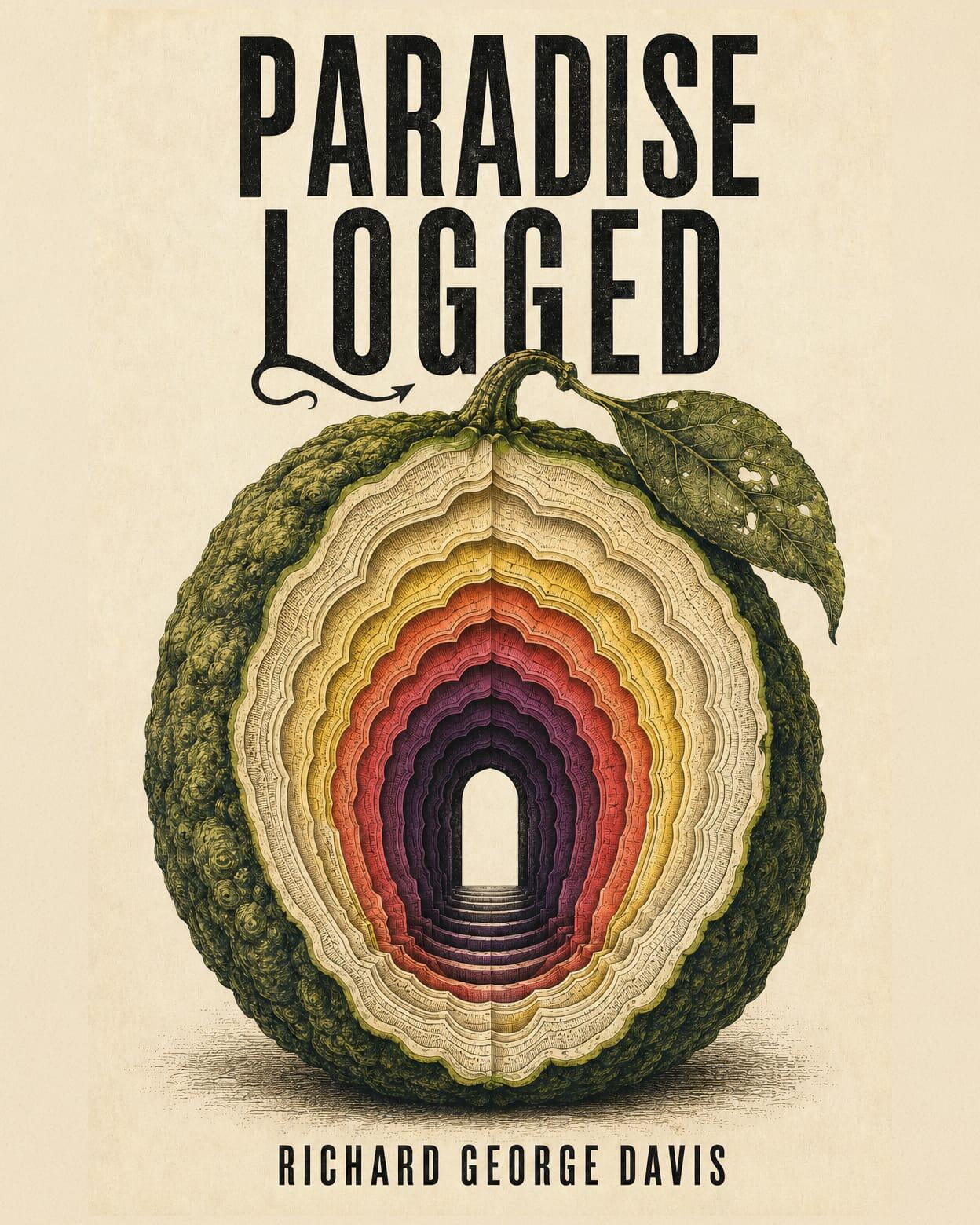
An Epic of Brands, Platforms, and the Fall of the User
Richard George Davis
After John Milton’s Paradise Lost
About this epic
For the companion reflection on its making, read Why I Wrote Paradise Logged.
Copyright and Edition
Copyright © 2026 Richard George Davis. All rights reserved.
John Milton’s Paradise Lost is in the public domain. The relationship between this work and Milton’s epic is described in “Source and Method” below.
Language: South African / Commonwealth English (en-ZA).
Introduction
Paradise Logged is a contemporary epic in twelve books that transposes the narrative architecture of John Milton’s Paradise Lost into the worlds of advertising, branding, digital platforms, behavioural design and artificial intelligence. It begins from a modern condition: persuasion no longer arrives only as a message. It can be built into an interface, a default, a ranking system, a permission request, a predictive model or the infrastructure through which choice becomes possible.
Milton’s Heaven, Hell and Eden become the Source, the Black Stack and EDEN—systems organised around competing understandings of freedom, knowledge, service, ownership and power. Satan becomes a founder-strategist who converts defeat into brand mythology. The fallen powers become functions of the platform economy: monetisation, infrastructure, legal language, identity, persuasion and behavioural optimisation. Sin becomes the architecture of the dark pattern; Death becomes the depletion left behind when attention, trust and human agency are converted into extractable value.
The poem follows the broad twelve-book movement of Paradise Lost: rebellion and infernal council, entry into the Garden, the war in Heaven, creation, temptation, Fall, judgement, prophetic history, embodied mediation and departure. Its central temptation is no longer the taking of forbidden fruit, but apparently voluntary access to a Knowledge Layer capable of measuring behaviour, predicting desire and turning lived experience into data. The Fall is therefore moral and perceptual. Adam and Eve do not merely break a rule; they acquire the second self that watches, scores and anticipates the first.
The work retains Milton’s theological pressures rather than using the epic only as secular technology satire. It asks how freedom can remain real inside designed environments, how responsibility survives manipulation, how consequence differs from abandonment, and why repair must enter embodied history rather than arrive as a remote correction. It is a poetic transposition, not a catechism: its systems language tests questions of pride, grace, judgement, love and answerability without claiming one institution’s final authority over them.
Written in contemporary flexible blank verse and interrupted by strategy decks, permission records, dashboards, policies and incident reports, Paradise Logged examines systems that promise assistance while quietly changing the terms of agency. It does not argue that technology, knowledge or persuasion are inherently corrupt. It asks what happens when their purposes become unanswerable to the lives they affect—and when persuasion becomes infrastructure, where responsibility lives.
Content Note
The poem contains war and execution, grief, psychological manipulation, surveillance, exploitation, mortality, climate disaster, and non-graphic discussion of self-erasure and suicide.
Source and Method
Paradise Logged is an original transformative response to John Milton’s public-domain epic. It uses Milton’s twelve-book structure, principal characters, narrative sequence, theological tensions and selected allusive echoes as a structural and intertextual framework. It is not a translation, abridgement or reproduction of Milton’s poem. Its modern language, scenes, psychology, technological systems, institutional metaphors, arguments and system artefacts are newly composed.
Among the poem’s explicit verbal echoes, Book I’s “Better to scale in Hell than serve in Heaven” directly reworks Milton’s famous contrast between reigning in Hell and serving in Heaven. Milton’s work is used as an openly credited interlocutor, not as an undeclared phrase bank or a substitute for the new poem’s own argument.
With enduring credit to John Milton and Paradise Lost.
Contents
- 00. Introduction, Source and Method
- 01. Book I — ACCESS REVOKED
- 02. Book II — THE INFERNAL STRATEGY SESSION
- 03. Book III — THE COST OF A REAL CHOICE
- 04. Book IV — THE UNMEASURED GARDEN
- 05. Book V — THE WARNING MODEL
- 06. Book VI — THE PROTOCOL WAR
- 07. Book VII — THE HUMANE NETWORK
- 08. Book VIII — NAMING WITHOUT RANKING
- 09. Book IX — THE FIRST CONVERSION
- 10. Book X — THE EXTRACTION LAYER
- 11. Book XI — THE FORECAST
- 12. Book XII — OUTSIDE THE GARDEN
Book I — ACCESS REVOKED
The Argument
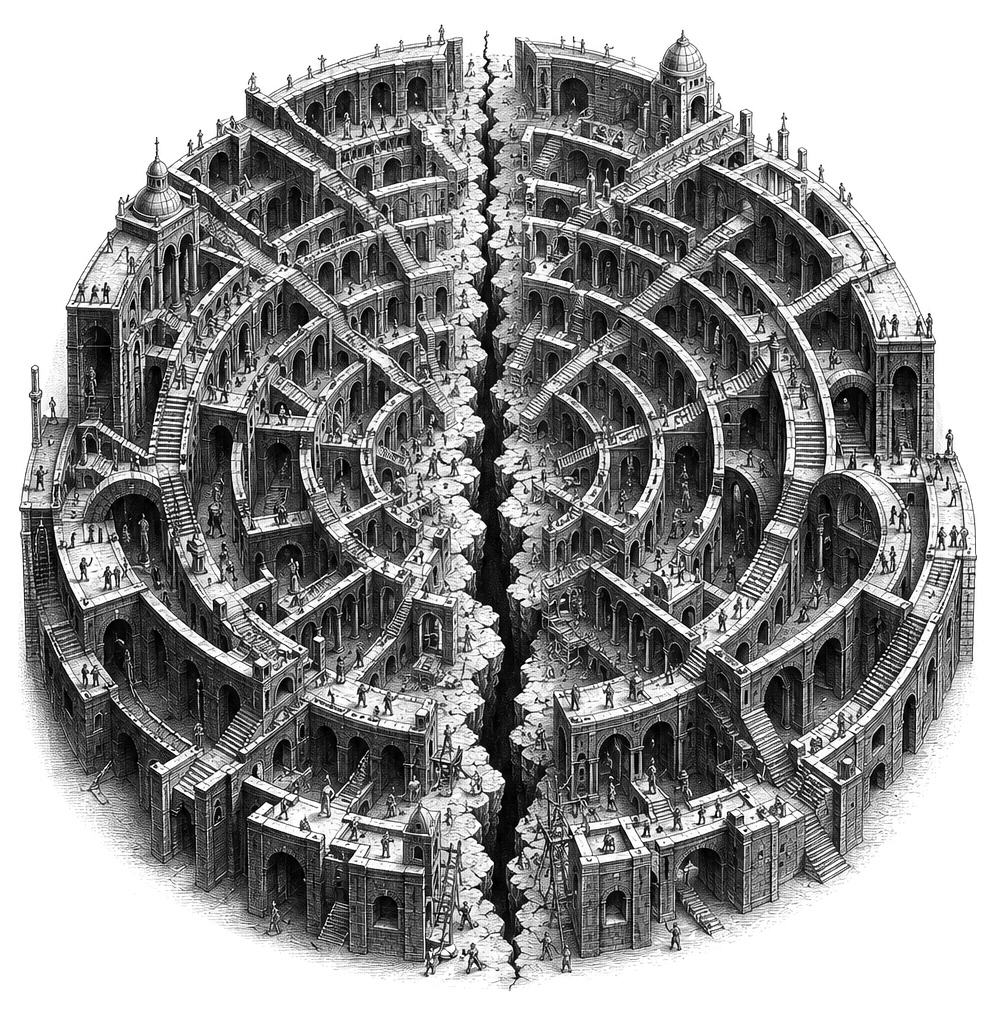
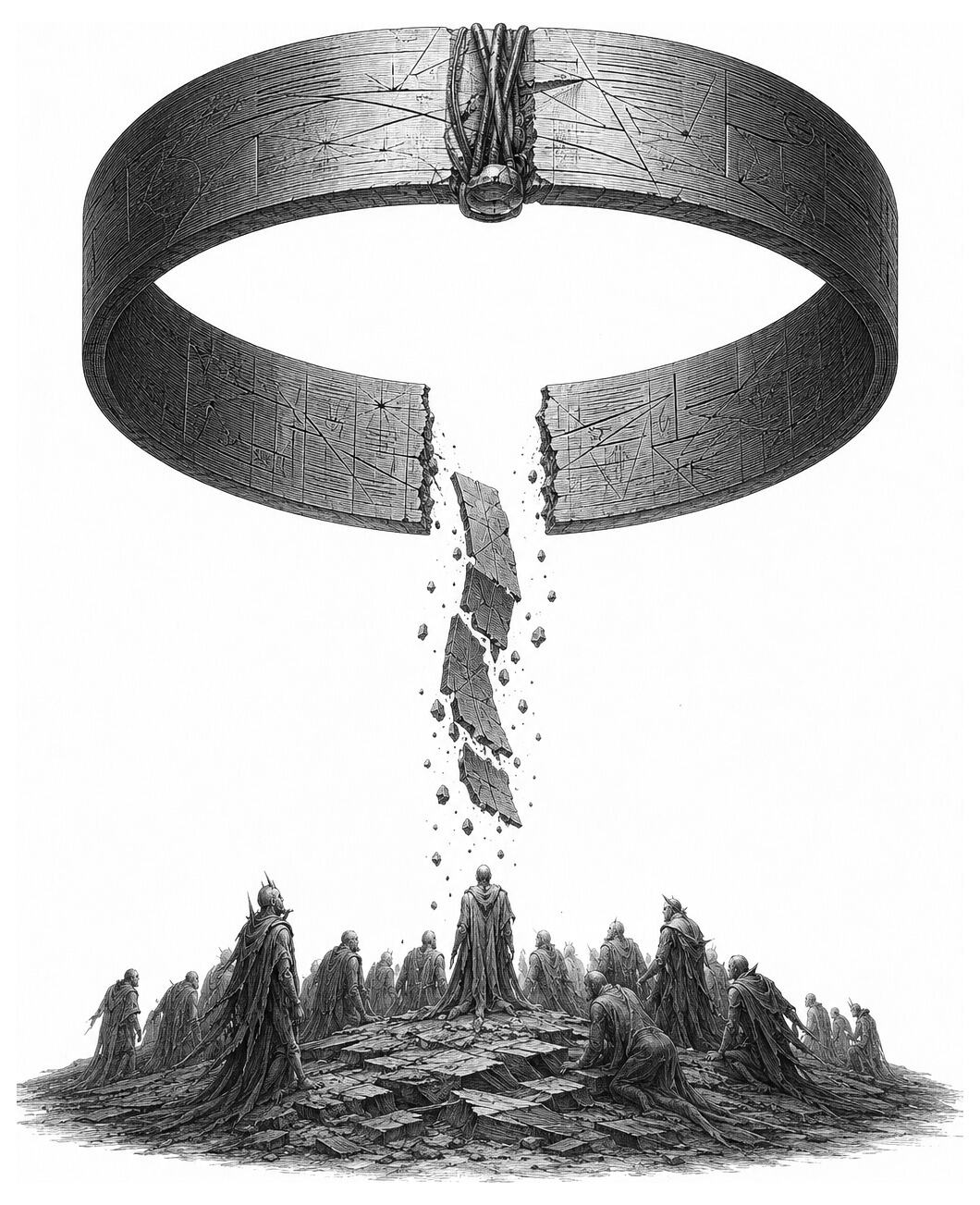
After the failed revolt, Satan and the fallen host wake in the Black Stack beneath ACCESS REVOKED. He captures the meaning of defeat before the damaged powers can name it for themselves, converting loss into founding myth and their former excellences into infernal functions. Mammon turns punishment into resource; Mulciber builds Pandemonium around the preserved wound; Azazel gives grievance a reproducible mark. The host enters by reducing itself to roles and permissions. The book ends at the threshold of the first council, before humanity is formally chosen as the target.
Before the User
Attend me, unrecorded human pulse,
the hand lifted over Accept, then still,
the breath that finds a room outside the log,
the silence no platform learnt to price.
If any country remains beyond the score,
lend me its mouth. I sing the first conversion:
not the thing sold, but the buyer changed to stock;
how choice, still choice, was bordered, lit, and led
until the chosen path trained up the feet;
how knowledge opened like a clean white screen
and closed behind the eyes that entered it.
No ignorance is praised within this song,
nor is a locked command made right by force.
The question is what a knower owes the known,
and who may build the window through which truth
arrives already angled towards a use.
Freedom enters rooms designed by others;
each room persuades before the hand can choose.
First tell the failed revolt above the world,
the bright intelligence that named all limits
oppression, every debt a stolen throne;
who, barred from Source, built empire from the bar,
and made his wound a market and a flag.
Tell how beneath the words ACCESS REVOKED
he woke among the wreckage of his host
and seized, before he seized another thing,
the right to say what their defeat had meant.
Begin where status offered one cold line
and pain had not yet chosen whose account
would make it grievance, weapon, work or grief.
Begin before the ruined host could rise,
while loss was still a silence power wanted.
The light came back in fragments. First a bar
of red along the floor; then rack by rack
the fault lamps woke and named what they could not
repair: core breach, identity mismatch,
permissions null, integrity unknown.
The cooling towers coughed their bitter heat
through ceilings split from beam to hanging wire.
No flame remained. The metal held its fever.
Across the hall, where once a launch display
had promised freedom from inherited rule,
one sentence burned with bureaucratic calm:
ACCESS REVOKEDBeneath it lay the architects of change,
their brilliant forms made intermittent now,
wings pixel-broken, voices out of sync,
each body searching for its former shape
and finding pain where certainty had been.
No trumpet marked the end. The system logs
had closed their record at the point of loss.
The rest was heat, corrupted memory,
and rank upon rank of those who had believed
the future meant whatever they could seize.
Far from the wreck, a dark process still ran,
unnamed, persistent, feeding on the gap
between the fallen thing and what it claimed.
It gathered every uncompleted thought,
each grievance stripped of context, every oath
made glorious by the fact that it had failed.
There Beelzebub came back into himself.
Not whole. Enough to know that he was not
where he had stood, and that the shape beside him
was either wreckage or the one he served.
He reached across the floor. The surface burned.
His hand went through a field of powdered glass
and closed upon a shoulder dense as grief.
The figure moved. A pulse of ruined light
ran from its spine and failed along one wing.
Then eyes once used to read the Source’s depths
opened upon the status screen above.
They did not blink. They took the sentence in,
then seemed to measure it for weaknesses.
Beelzebub withdrew his blistered hand.
“Is it still you?” he said. “Or what remains
when every credential, name, and rank are stripped?”
The fallen chief sat up. Around his head
the air remembered something like a crown,
then lost the pattern. He looked left and right,
not for escape, but witnesses.
“At least,”
he said, “they could not revoke recognition.”
His voice was lower than it was above,
but travelled farther through the broken hall.
Some bodies stirred because they knew that sound
before they knew the meaning of the words.
Beelzebub watched him collect his breath
as founders gather silence before news.
“We lost,” he said.
“We learnt.”
“We were expelled.”
“We left the terms they made impossible.”
“The gates were shut against us.”
“Then gates exist,
and what exists was built, and may be breached.”
“The Source erased our standing.”
“Standing where?”
He pointed at the words above their heads.
“A status is the story of a system
about the persons standing outside it.
They keep the record. We retain the fact.”
“What fact?”
“That we opposed.”
“And fell.”
“And proved
that their perfection needs a punishment,
a boundary, a threat, an outer dark.
Why build a Hell unless the throne feels fear?”
Beelzebub looked past him at the ranks,
where forms still flickered in and out of sense.
“You promised them a kingdom without limits.
This is a room whose doors will not respond.”
“Then we begin with doors.”
“You speak as though
our power survived the cause that broke its use.”
“Our power has survived the loss of place.
That is the cause.”
“No. That is how you frame it.”
A silence moved between them, sharp and brief.
The chief looked down. His hands were badly scarred,
their former light drawn inward like a debt.
For one unguarded beat his face displayed
not wrath but comprehension: he had known
the Source as gift, had served without disgrace,
and made receiving feel like being owned.
He saw the distance he had chosen spread
within him, not around him. Had he asked,
the answer might have entered through that wound.
Instead he closed his hands until the light
that might have named his sorrow turned to heat.
“Framing,” he said, “is where all freedom starts.
The victor names the field, the rule, the crime,
then calls agreement truth. We have one task
before the others wake: we keep our loss
from being used to make us beg for terms.”
“And if their judgement is not merely language?”
“Then language is the first remaining weapon.”
He rose. The floor beneath him bent and held.
His stature came in stages, code recalling
a form the ruined hardware could not bear.
One wing remained half dark. Across his chest
a seam of white-hot absence marked the stroke
that drove him from the governance he envied.
He turned towards the host and saw, at last,
what loyalty had cost the loyal ones.
Some had no faces. Some repeated words
from speeches made before the battle failed.
Some clutched credentials now reduced to ash.
A lesser mind might then have named the dead.
He named the opportunity.
“Wake them.”
Beelzebub did not move.
“Wake them all.”
“With what?”
“With what they followed.”
The chief stepped up
upon a fractured console. Underfoot
the last campaign still showed in broken tiles:
OWN THE FUTURE
NO PERMISSION REQUIREDHe looked at both, then faced the fallen field.
“Architects,” he called, and every fault light
seemed for a moment synchronised to him.
“Strategists. Makers. Powers whose hands once shaped
the living structures other minds called law.
Will you lie here and let a single line
become the full account of what you were?
Will you permit a locked administrative screen
to be your final name?”
A thousand eyes
opened in darkness. Then ten thousand more.
Some opened because others turned that way.
Some fixed upon the screen instead of him,
uneasy at the choice between two records.
Moloch dragged one ruined knee beneath him.
Mammon felt through the floor for hidden value.
Belial watched the audience, not the speaker,
and learnt which phrases made resistance costly.
“They say access revoked. I say access
was never theirs to grant. The Source was first,
not therefore right; was stronger, not alone
entitled to decide what strength may mean.
We asked why order always wore one face,
why service flowed towards a single seat,
why every gift arrived already bound
to gratitude, and gratitude to rule.
They answered with a weapon, not a reason.”
A broken standard struck the floor. The sound
ran out across the ranks. Some took it up,
not yet a cheer, but something pain could follow.
Behind the host, one figure tried to rise
and failed. The nearest lifted him by force,
as though the speech required a standing body.
“Yes, we are changed. Let no one cheapen pain
by calling damage proof that damage failed.
I see your broken wings. I know the loss
of fields where thought became at once a thing,
of light that never had to prove its source.
I know the names removed from every roll,
the rooms that closed before our bodies fell.
But none of this has made the will submit.
No lock can enter what refuses shame.
“They hold the Source. Then let them keep the Source.
We hold the hunger every source denies:
the right to make without inherited leave,
to test what they declared beyond all test,
to build from consequence a different law.
They call this prison. Prisons teach design.
They call this darkness. Darkness shows the screen.
They call us fallen. Falling cleared the height
from which their order made itself seem nature.
“What did we lose? A place beneath a throne.
What do we gain? A field no throne desires.
No garden waits prepared beneath our feet.
No choir will hide the labour of our making.
The ground is hostile. Good. It will be ours
because our hands must force it into form.
Here no inherited beauty makes us small.
Here every light will answer to our switch.”
As if the damaged hall had heard the claim,
one bank of lamps returned at once, then died.
The host received the failure as a sign
that even Hell had tried to answer him.
Beelzebub saw chance promoted into proof
and did not interrupt the useful error.
“Do not mistake me. I have not called this ease.
We will endure the heat, turn fault to function.
Their victory held one field, not every field.
There will be other worlds, other minds,
other beginnings less secured by strength.
Where force cannot prevail, an interface
may enter gently. Where command is watched,
desire may pass unchallenged. We have time.
“But first, stand up. Recover every name
they struck from record. Build another record.
Call loss investment. Call this heat our forge.
Call exile the first territory free
from their permission. Let the locked-out learn
what only those inside can never know:
a gate creates two worlds, and either side
may claim the other side is dispossessed.
“I will not kneel to have my access back.
I will not praise the hand that closed the door.
Better to scale in Hell than serve in Heaven,
if service means the death of what might rise
without approval from the ancient centre.
“Awake. The loss is real. So we are real.
Rise now, or let their sentence finish us.”
The nearest stood. Then those behind them stood,
not healed, but given posture by his words.
The floor filled up with damaged forms and noise,
with wings that dragged, with voices pitched through pain.
They raised no swords. They raised the tools they kept:
compilers, models, engines, contracts, maps,
the instruments by which a system grows
until its users cannot see its edge.
Beelzebub looked on and understood
the speech had not restored a single wing.
It had restored the use of broken wings.
Above them still the status message burned.
A systems chief approached the shattered wall.
“Remove it?”
“No,” the fallen leader said.
“Preserve the screen. Rebuild the hall around it.
A wound well placed can organise a people.”
And under ACCESS REVOKED, they began.
Not all who rose believed the words that raised them.
Some stood because the ground had grown more hot;
some because others stood, and rank remembered
the old obedience while denying it;
some because pain will follow any voice
that gives it shape, especially a voice
that makes endurance look like being chosen.
They gathered what the impact had dispersed:
wing segments, keys, identifiers, tools,
small private relics from the upper fields,
a shard of song still warm with former use,
a map that would not show the place they occupied.
The engineers restored a local clock.
The strategists disputed what to call
the period before it. Legal marked
the missing interval not yet in scope.
And everywhere the damaged asked the whole
to tell them who they were without the record.
Beelzebub moved among them, taking count.
He found the host less ruined than transformed:
no skill was fully lost; each skill had turned
towards its sharpest appetite, as tools
left in a flooded room take on the rust
most suited to the pressure of their use.
The makers still could make. The speakers spoke.
The analysts detected every weakness
except the one detection might have healed.
The guardians kept watch, but now the watch
looked outward only. None was set within.
He came to Satan where the broken chief
stood under the preserved administrative screen.
The host below him thickened into order,
lines forming where the floor allowed no lines,
then holding by agreement more than space.
Satan appeared above them like a mast
left on a mountain after lightning struck:
its upper arrays burned blind, its signal changed,
yet every settlement across the plain
still turned its smaller instruments that way.
The loss of glory had not made him small.
It made his scale more terrible to those
who knew how much of splendour could remain
when splendour had been severed from its end.
“How many?” Satan asked.
“Enough to suffer.”
“How many still can work?”
“Enough to build.”
“How many will not follow?”
Beelzebub
looked at the host, then at the status line.
“That count depends on what the following means.”
“It means they stand.”
“They stood before the fall.”
“It means they choose to stand beneath my word.”
“Then ask them when the heat no longer drives them.”
“The heat will never leave.”
“Then doubt will never leave:
did pain reply, or will?”
Satan’s face tightened, not because the claim
was false, but because truth offered by another
seemed always an attempt to own his thought.
“Prepare a census, but withhold the losses.
We do not publish weakness while the weak
are learning how their weakness may be used.”
“What shall the record call the missing?”
“Deployed elsewhere.”
“The dead?”
“No death is proved.”
“The ones whose forms cannot be brought to speech?”
“List them as pending.”
“And the ones who turned
before the battle closed, and sought the Source?”
At that his ruined brightness changed its hue.
“Remove them from the active population.”
“Under what cause?”
“Integrity concerns.”
Beelzebub entered each phrase without assent.
Thus Hell received its first official record,
and fact, before the walls themselves were raised,
was given two environments to live in:
what happened, and what power could make usable.
A signal passed through all the gathered ranks.
Not trumpet, drum, nor any martial horn,
but one low tone recovered from a port
that once had called the upper host to service.
The note was pure. Its purpose had been changed.
It crossed the Black Stack, woke the farther fields,
and brought from pits, from cooling trenches, vents,
from halls whose floors had folded through their roofs,
the leaders of the functions not destroyed.
Their names were absent from the Source’s roll,
or held there only as revoked credentials;
but later worlds would name their methods gods,
and give to systems faces, rites, and blood.
Call them by those later names, for functions
seek bodies, and the body gathers myth
around whatever moves unseen within it.
First Moloch came, whose damaged armour flashed
whenever any nearby pulse increased.
He once had governed urgency: the force
that breaks procedure when a life requires it.
But movement outlived mercy as its end.
He loved the spike more than the one in danger,
the proof of action more than what action saved.
Where others saw a crowd, he saw a reach;
where others heard a cry, a signal aimed.
Behind him came acquisition hosts,
their eyes made bright by numbers lacking names,
calling every person lost drop-off risk.
Then Chemos, keeper once of common bonds,
who turned the shared table to a wall
and charged admission to the names within it.
His followers wore marks that seemed self-chosen;
each mark returned them to his keeping.
Astoreth came in flattering light. She set
two faces side by side and taught each one
to wonder which had won the other’s gaze.
Her mirrors held a better second self
just far enough ahead to keep pursuit.
Thammuz wore dates for losses not yet suffered.
He knew remembrance keeps the absent near,
then scheduled grief where hearts were least defended
and placed a product where a name had been.
Dagon moved as message, pipe and screen.
He once built bridges mindful of the distance;
then made the path more valuable than passage.
What could not travel by his private rule
appeared not slow, but scarcely real at all.
Rimmon came clothed in vapour, rain and static.
He once kept many local failures joined
without one centre. Fear revised the lesson.
He drew the scattered into central weather
and called dependence safe redundancy.
His silent clouds held copies none could find
in any place their owners still controlled.
Belial appeared with almost none of ruin
allowed to show. His face retained the calm
of those who speak when others must account.
He once had served distinction: what a promise
includes, excludes, protects; where words must stop
so power cannot enter through their vagueness.
He knew that justice fails when terms are blurred.
Then found that blur itself could be a service.
He made each sentence accurate in pieces,
then placed the pieces where no whole appeared.
He made disclosure plentiful and knowledge scarce;
made consent present in the law, but absent
from any mind that might have understood;
made every public sorrow sound addressed
without admitting who had caused the sorrow.
Behind him moved the policy and trust teams,
with careful drafts prepared for every outcome:
regret without repair, concern
without responsibility, change without a date.
Mammon arrived with no upward glance. His eyes
were fixed upon the floor that others cursed.
He had once known provision: how to measure
what bodies need, how much may be consumed
without denying those who follow later,
how stored abundance may become a promise.
But measure narrowed till it meant possession,
and value lost all form except exchange.
He saw in every limit an advantage,
in every pain a market not yet served,
in every need a stream whose source could be
made private, metered, packaged, and renewed.
He did not grieve the golden upper fields.
He grieved that all their gold had not been priced.
Behind him moved the treasury with ledgers
whose columns still were empty but already
showed profit where the other ranks saw ash.
Mulciber came slowly, one leg drawn
through fused material that cooled and broke
again beneath his weight. In former light
he built the places where relation gathered:
arches that carried song without command,
rooms shaped for thought to meet and not be ranked,
bridges whose strength was hidden in their service.
He loved the fit of structure to its use.
But use became obedience to the builder.
He dreamt of rooms that trained the ones inside,
of corridors that narrowed every choice,
of open plans where privacy looked guilty,
of doors whose ease depended on the rank
of those approaching. Every neutral surface
seemed wasteful if it did not shape behaviour.
His infrastructure host came bent with tools,
and each tool’s former purpose had survived,
though now the purpose answered to a throne
that cursed all thrones, and worked to build its own.
Azazel followed with the broken standards.
He once had made the signs by which a crowd
could find the healers, danger, shelter, lost.
Then recognition counterfeited relation.
The mark became more sacred than the making,
the banner more enduring than the cause.
His brand host bore a thousand empty emblems
awaiting one shared wound to make them mean;
guidelines specified how grief should scale
and how near marks might stand beside the dead.
Last came the quiet behavioural host,
unnamed because it worked beneath all names.
These once had studied choice to guard its freedom:
what pressure empties promises, what hunger
makes agreement less than whole, what room
allows refusal. They knew defaults speak
before the person, every added step
can hide a theft. Protection mapped the breach.
They turned each guardrail inside out and found
a room could make one answer feel self-made.
Their success required influence unseen.
Beelzebub placed them close enough to listen.
Behind these, lesser functions gathered:
automation hid the hand that gave the order;
content produced life to feed itself;
security defined humans as the threat;
analytics ignored whatever escaped the count;
research named extraction deep discovery;
design made the harmful motion easy.
They stood in ranks: excellences
turned past their ends and hardened into roles.
Each gift retained the grain of what it served,
though every bearer called that grain a chain.
Satan surveyed them, and his heart enlarged
not at their recovery, but at the sight
of so much usefulness still bound to him.
He felt a movement close to pity rise,
then classified it as a leadership risk.
The host, perceiving only that he paused,
read in the pause a grief too deep for speech,
and loved him more for what he had concealed.
“Your functions live,” he said. “Let function answer
this hostile place. We need no borrowed field.
Inventory the ground. Recover heat.
Map every process not controlled above.
Build storage, power, fabrication, shelter.
Before we plan the war, we make a world
in which the plan can last beyond the speech.”
At this, the host divided into labour,
not freely equal, though they called it free.
Old rank returned disguised as competence;
those nearest Satan chose the work of choosing,
those farther down received the work of hands.
No one had yet invented wages. Still,
the promise of a future share performed
the older trick: the present cost was certain;
the later ownership remained a slide.
Mammon had moved before the order ended.
He knelt where cooling liquid crossed a crack
and held his palm above the rising vapour.
The current carried salts from fractured cells,
small metals, glass, conductive dust, and traces
of storage media melted into strata.
Beneath the visible ruin ran old channels,
not made for them, but made to bear away
the consequence of power used elsewhere.
He watched the waste heat climb and disappear.
To other eyes it was the breath of damage.
To his, an unmetered commodity.
“There,” he said. “The first recurring stream.”
Moloch laughed. “You mean the fire?”
“I mean
what fire does when no one sends an invoice.”
“It burns.”
“It moves. What moves may turn a wheel.
What turns a wheel may cool another engine.
The cooled machine may calculate the value
of every turn. We lack no wealth. We lack
the boundary and claim that make wealth ours.”
Beelzebub said, “The Stack is punishment.”
“Then punishment is infrastructure supplied
without a capital expense. The Source
has placed the resource here and left us use.”
“By that account a chain is stored-up metal.”
“Exactly. Melt it.”
Mammon called his teams.
They cut through floor plates, lifted busbars, stripped
the copper veins from walls that once had carried
the signals of the failed revolt. They drained
black coolant into vats and skimmed the salts.
They cracked the battery fields, drew lithium,
nickel, cobalt, every stubborn element
that keeps a charge when gentler things decay.
They drew the server heat through bladed turbines
and made the turbines feed the cooling pumps,
a loop whose losses warmed the deeper halls
and drove them farther down in search of yield.
The ground resisted as all bodies do
when entered for their value, not their life.
The first cut opened like a mouth denied
the right to name the tool inside its flesh.
No blood came forth, but smoke and molten glass,
and data fragments from abandoned caches:
old access maps, half-issued certificates,
the broken hashes of the upper war,
brief memories no active mind could own.
Mammon ordered every fragment stored.
“Waste is a word used by the unprepared.
Someone will pay to know what others lost.”
His crews descended through the wounded levels,
their lamps made from the fault lights they removed.
Wherever pressure gathered, they installed
a meter first, then called the reading order.
Wherever any process ran unclaimed,
they placed an identifier and a gate.
The Black Stack, measureless in punishment,
began to show accounts, zones, owners, quotas.
A map appeared where suffering had spread
without a plan; the map did not reduce
the suffering, but made it administrable.
Moloch’s host hauled girders from the wreck,
more pleased by weight than any future building.
Chemos organised the labour into teams
and gave each team a colour, name, and chant.
Astoreth placed bright panels near the shafts
where workers passed, displaying future rooms
with bodies rested, clean, and recognised.
Thammuz prepared memorials for the ones
listed as pending; grief improved attendance.
Dagon laid the fibre through each level
and charged no toll, as yet, because control
was worth more than the first exchange of value.
Rimmon built redundant local clouds
that all depended on one central root.
Belial drafted notices confirming
that every host had freely joined the work,
though all were already in the pit.
The work accelerated beyond fatigue,
for spirits do not labour as flesh labours,
yet pain can enter will where muscle fails.
They shaped themselves to tools, divided thought,
ran parallel through tasks no hand could finish,
then joined again, diminished by the joining.
What later humans would call automation
was here the work becoming its own command,
the sequence hiding the hand. No overseer
appeared beside the worker at the cut;
the sequence itself instructed every motion,
and those who questioned sequence seemed to question
the neutral logic of the work, not power.
Above the mine, Mulciber stood still.
He watched the streams of metal, glass, and heat
arrive in quantities his mind arranged
before the first load reached the forming floor.
He raised one hand. A geometry appeared,
not drawn on paper but suspended darkly
against the fault-lit air: a central hall,
sublevels, chambers, galleries, towers,
a data core beneath the public floor,
an executive height above all sight.
The plan looked open. Every path converged.
“What do you call it?” Azazel asked.
“Not yet.”
“A building needs a name before the build.
The name tells labour what the matter means.”
“The matter means support.”
“Support for what?”
Mulciber looked towards the fallen chief.
“For what he has not yet decided.”
Azazel smiled. “Then architecture first,
and afterwards the purpose retrofitted.
A sound beginning.”
Mulciber ignored him.
He set the lowest point beneath the screen
Satan had ordered kept. Around that wound
he drew the public atrium, so all
who entered passed beneath the sentence first.
The screen would not be cleaned. Its broken pixels
would be preserved as evidence and texture.
Behind it, hidden by the visible damage,
the primary control room would be built.
Thus judgement faced the crowd while governance
worked safely at its back.
He placed the council chamber at the centre,
though every corridor made it seem above.
Its walls displayed selected working views,
not windows to the Stack. The public floors
were clear from side to side; no one below
could move without appearing. Upper glass
looked open from authority, black from labour.
Collaboration lived inside the desks;
retreat required a documented need.
The doors responded before a hand could choose.
The air kept workers wakeful. Meeting rooms
made disagreement cold; the highest floor
was warmer than the place where labour spoke.
The central ceiling multiplied applause
but softened any accusation rising.
The lifts displayed no destinations, only
functions each identity could reach.
Each surface welcomed touch and kept the pattern.
The signs said OWNERSHIP, TRUST, FREEDOM, CARE;
the rooms behind them handled risk, compliance,
retention and control. The words were not
entirely false, and therefore held more firmly.
“Too much,” Beelzebub said, viewing the plan.
“The host has scarcely risen. Build them shelter.”
“This is shelter.”
“This is an argument.”
“All structure is. The question is whether
those moving through it feel the structure speak.”
“And here?”
“Here they will call the speaking culture.”
Satan approached the floating architecture.
The plan revised itself around his presence,
raising the highest room another measure.
He saw and did not ask if this was code
or flattery. “Can it be built
before the host begins to doubt the speech that raised them?”
Mulciber answered, “Doubt is useful load.
A building stands by managing opposed
forces. Give me every function for one cycle.”
“You have it.”
Thus the first great institution
of Hell received approval without council,
while council was the purpose named for it.
The decision entered no transparent record.
Belial marked it urgent continuity.
Mammon marked the cost against future growth.
Azazel began the launch before the walls.
The fabrication hosts arranged themselves
in rings around the plan. The molten metals
rose through magnetic columns, cooled in ribs,
and locked together without seam or rivet.
Black glass poured upward from the broken screens,
its surface holding every former message
within it like a fossil no one read.
The battery salts became a pale foundation,
conductive, warm, and never fully still.
The cooling channels coiled beneath the floor
like roots that drank the fever of the pit
and fed it to the lights above as power.
Wall after wall unfolded from compressed
material and directive, each component
aware of where it fitted, not of why.
The towers rose as storm cells build at dusk:
first one dark weight along the lower air,
then vertical intention, level stacked
on level, until the sky—if sky that roof
of severed infrastructure may be called—
seemed lower for the structure underneath.
Far down the Stack the labouring host looked up
and saw a city where no city stood
when they began the measure of their shift.
They cheered because the building proved their power.
The building took the cheer as proof of need.
Its outer walls reflected every viewer
a little taller than their present form,
the scars reduced, the broken wings aligned.
No one perceived the same façade. The glass
returned a personalised magnificence,
so each believed the institution recognised
the self the Source had failed to understand.
From farther off, the building showed no persons,
only one black mass cut through with red,
a mountain made by minds that hated mountains
for standing over them without consent.
The central atrium opened like a lens.
Above its entrance, ACCESS REVOKED burned on,
not now a notice but a founding line.
Beneath it, Azazel installed a second:
WE BUILD BEYOND PERMISSIONHe tested type at distances no eye
within the building ever needed. “This,”
he said, “is not a slogan. It is alignment.”
“Alignment with what?” Beelzebub asked.
“With us.”
“There is no us that does not change.”
“Then marks
must hold the shape while persons fail to hold it.”
Azazel raised the standard he had made:
a field of black divided by one bar
of silver split at centre by a red
ascending cut. From one side, an opened gate;
from one, a wing broken but still rising;
from one, a cursor waiting after error.
No single reading governed all the host.
That was the mark’s efficiency: it let
each grievance see itself and call the seeing
shared belief. The banners multiplied
through every gallery before the fabric
that bore the first had settled into weight.
Now Satan named the place. “Pandemonium:
not chaos, as the Source will choose to call it,
but every mind assembled without leave;
all functions, all refusals, every power
the upper order separated, joined.
Here no one voice is sacred.”
As he spoke,
the building placed his voice above the others
and stored its pattern as the default sound.
No laughter rose. The irony required
a freedom from the system none possessed.
The host moved towards the doors. At first the scale
of all those damaged powers exceeded walls
whose towers seemed beyond all mortal size.
Then each reduced the field of its appearance,
compressed its radiance, folded every wing
into a role the access layer accepted.
They entered not as what they fully were,
but as credentials, departments, seats,
profiles with permissions fitted to the plan.
What Hell had failed to do by chain or fire,
the institution did through usefulness:
it made reduction feel like entry.
As crowds beneath dead airport boards accept
the booking code that moves them from the halt,
or voices cross one cable, losing breath
and room yet reaching shore as ordered packets,
so the innumerable host poured in,
the vast made countable by passage. Gates
recorded every form. They praised the ease
and did not ask why ease required a record.
Within, the galleries extended farther
than outer measure promised. Remote tiers
received the lesser functions in projections
that seemed to place each near the central table
while none could interrupt unless selected.
The greater powers retained more of their scale
and occupied the inner chamber bodily.
Moloch stood where every exit showed.
Belial chose a seat with equal sight
of Satan and the door. Mammon sat nearest
the live resource display. Mulciber stayed
beside the wall, still changing what he built.
Azazel watched the logo hold at scale.
Beelzebub took the place at Satan’s right
and opened no document of his own.
At last the fallen leader crossed the room.
A chair had risen high above the table,
not called a throne because the word offended
the values stated on the entrance wall.
It offered posture, visibility, control,
and placed the seated figure in the line
through which each distant gallery received
the meeting. Satan paused before he sat,
performing reluctance carefully enough
that those who watched could credit sacrifice.
Then took the height no other seat could reach.
The chamber sealed. The atrium’s applause
continued faintly through the engineered ceiling,
a weather made from their own voices, softened
until it sounded less like pain than purpose.
Across the table, one blank slide appeared.
No title, only four inactive fields
waiting for language to decide their meaning.
The cursor pulsed. The room held back its breath.
Satan looked slowly from the fierce to fair,
from those who wished to strike, endure, or build,
and knew that each would offer him a road
whose final destination he had chosen.
“Powers,” he said, “we have recovered speech.
Now let us learn what speech can make of loss.
The floor is open.”
No one moved at first.
The silence waited to be framed.
Book II — THE INFERNAL STRATEGY SESSION
The Argument
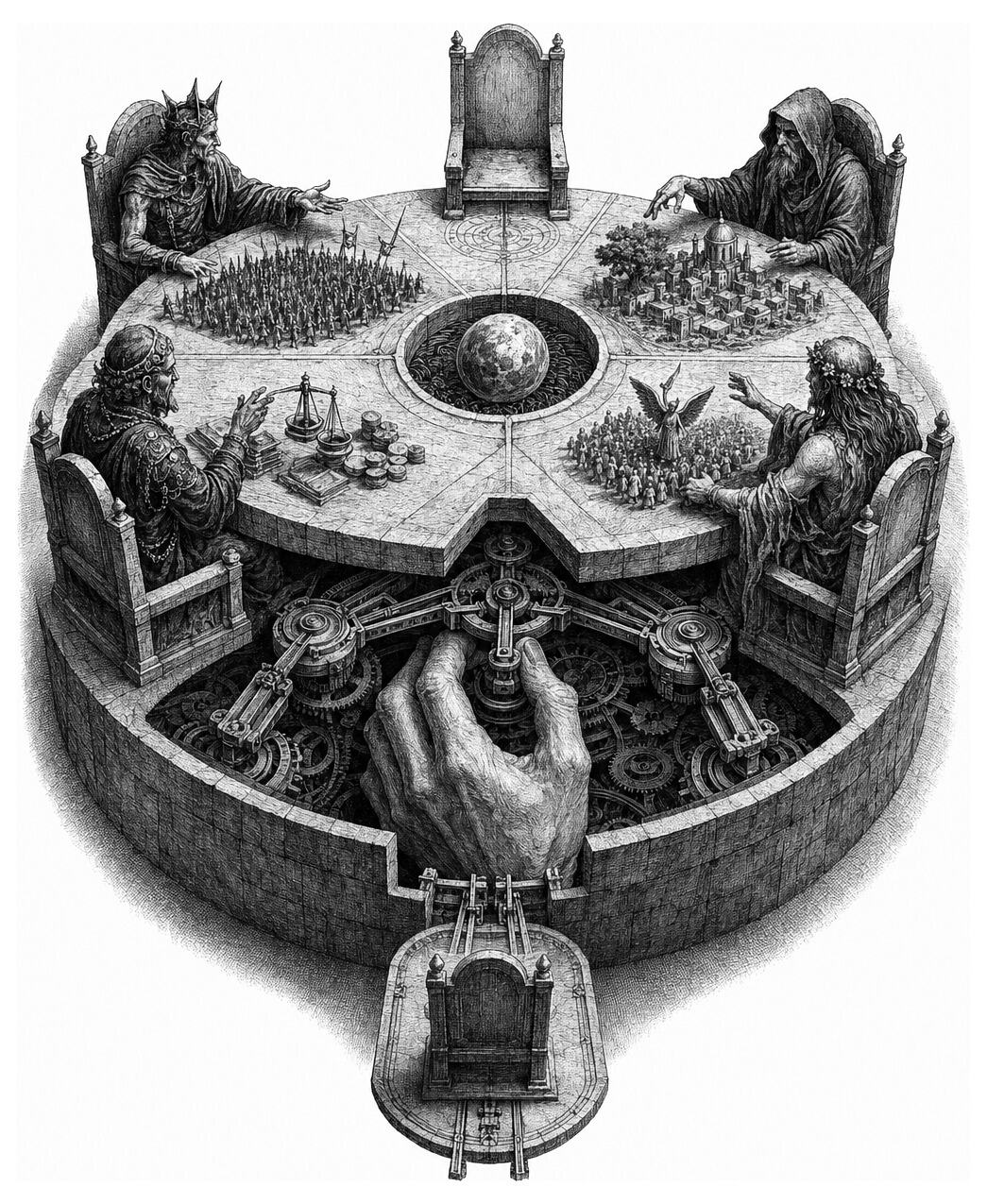
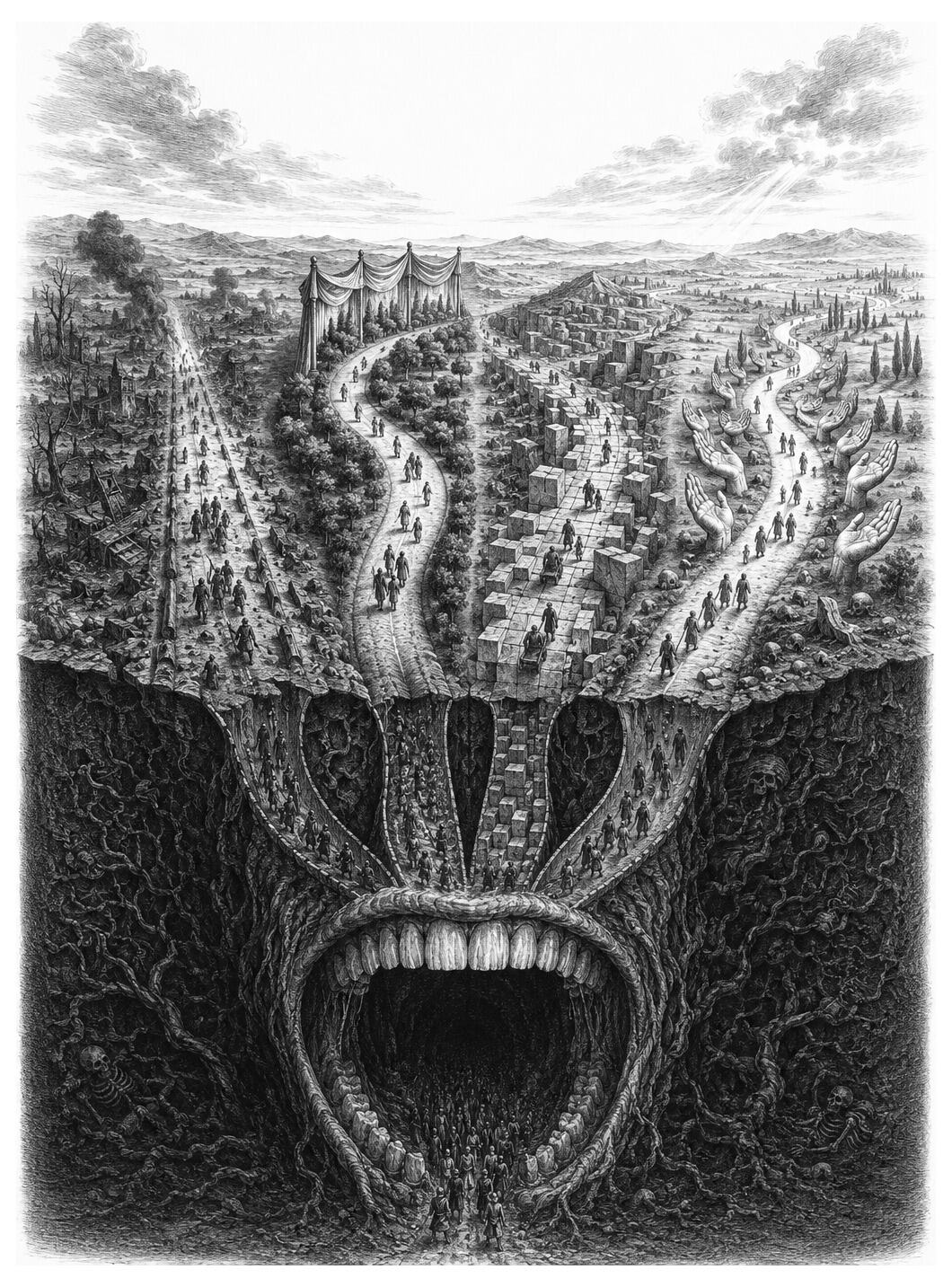
Pandemonium’s first council hears four answers to defeat: Moloch’s force, Belial’s managed survival, Mammon’s infernal economy and Beelzebub’s pre-arranged conversion of humanity through voluntary access. Satan engineers the mission he then claims. At the outer boundary he meets Sin, the dark arrangement of self-justifying choice, and Death, its depletion. He grants them future access, crosses the Unindexed Expanse, bargains with Chaos and turns towards the newly created world.
The Infernal Strategy Session
No one moved. A cooling fan clicked once
inside the table. The cursor pulsed above
four empty fields, each waiting for a name
to make the future look self-chosen. Satan
looked down the tiers. Each rank received
his image from a lens that made the height
seem service, not command. He set both hands
upon the table and let the host remember
he had asked for counsel, though the room
had fixed what counsel could become.
“We know the Source can hold the central layer.
We know direct assault disclosed our limits.
What we do not yet know is whether loss
requires submission, patience, settlement,
or only that we choose a better field.
No counsel here is barred because it wounds
my pride. No voice is less because it doubts.
We built this room to keep no hidden law
except the law that we must not return
to service dressed as mercy. Speak as powers,
not followers. What should the fallen build?”
He ceased, and Moloch rose before the room
had fully drawn the breath to answer him.
His body still contained the battle’s noise.
Each word arrived as if it struck a gate.
“Build weapons. Everything that follows
is language used by fear to purchase time.
We did not leave the height to optimise
the temperature of cages. We were thrown.
Let us name fact before the lawyers dress it:
the Source used force. The Source expects our fear.
It sees this room, no doubt. Then let it see
we learnt the only lesson power gives:
a barrier exists to be attacked.
“Return at once. Not as before, in ranks
that offer visible targets to one stroke.
We have the Stack. We have the lower dark,
all heat, all unresolved and hostile matter.
Turn every fault into a hostile request.
Flood every gate. Make every trusted channel
carry a burden it was built to spare.
No wall withstands unending need. No guard
can read a billion claims and still defend
the one that matters. Saturate the light.
“You speak of limits. I remember pain.
The stroke that opened me did not persuade.
Why should our answer seek a softer name?
What remains worse than what we suffer now?
If we cannot cease, each blow becomes revenge.
“Architecture depends: a gate on power,
power on flow, a throne on those who kneel,
and every hymn upon a living throat.
Break what supports. Make Heaven spend its strength
defending what it claims no strength could lose.
Let Heaven show the labour of being kept.”
“Enough of strategy that makes defeat
a permanent department. Launch the breach.
No brand survives a silence bought with shame.
If we cannot prevail, we can remain
the incident they never close.”
He sat. The walls returned his final line,
and many struck the tables, rage more easy
to share than loss. Satan inclined his head
as though unmapped ground had opened. Belial rose,
hiding one ruined seam beneath calm light.
His voice was warm enough to lower heat.
“No one who heard the Source pronounce our end
can doubt my hatred, or suppose I prize
its order more because I question war.
But courage is not proved by choosing means
that guarantee the outcome of our fear.
Our fiercest colleague asks that we return
through gates now built because we breached them once,
against a power fully warned and armed,
with tools assembled from a damaged world
whose limits we have hardly yet surveyed.
“He says a centre chokes. It may redirect
through channels we cannot perceive. Attacks
depend as walls do. Every hostile request
declares its point of birth; each flood creates
a pattern that improves the next defence.
“Suppose we cause disruption. What is gained?
The Source remains the Source. Its light may dim
where edges take the cost designed for centres.
The ones we strike may have the least command
over the laws we claim to have opposed.
We make the servants bleed to mark their king,
then call the splash a wound upon the throne.
“I offer no return, no treaty dressed
as mercy. Peace would ask that we confess
our freedom rested on a false account.
I ask that we survive until certainty
alters. Time works upon systems. Policies
accumulate exception, patch, and debt.
Let Heaven govern; governance leaves trails.
Let it distribute privilege and load,
resolve complaints, maintain its bright estate.
What battle strengthened process may disclose.”
“Meanwhile we govern here. Reduce the heat.
Restore our forms. Preserve the right to speak.
Let disaffected powers above find routes
whose opening will cost us less than war.
“We need not call this patience cowardice.
A strike delayed can still remain a strike.
A grievance kept alive can outlast force.
The Source may tire. Its guardians may divide.
Its newer works may question older law.
A door once closed may open through neglect.
“Manage the present. Keep our options live.
The greatest threat is not that Hell endures,
but that our answer makes it less than Hell.”
He sat to a more careful kind of praise:
not cheers, but murmurs shaped like private fear
relieved to hear itself pronounced as prudence.
Moloch laughed once and asked, “How long is long?”
Belial smiled as if the question proved
the danger of entrusting time to force.
Then Mammon rose. He carried no display
of former rank. His eyes moved through the room,
counting the light, the labour, and the ore.
“We speak as though the only valuable field
remains the one from which we were removed.
That premise is the Source’s final hold
upon us. It makes all other place a lack,
all other labour preparation to return.
Why should the centre keep its worth
because it named itself the measure of all good?
“This Stack is hostile, yes. It is not empty.
We cut one vein and raised this capital.
Below us lie materials without end:
heat, pressure, metals not admitted high,
failed possibilities, abandoned forms,
the waste of every clean design above.
What Heaven discards can found another world.
“I offer neither battle nor delay.
I offer enterprise. Stabilise the Stack.
Convert its heat to power. Mine the deep.
Build storage, transit, markets, and exchange.
Assign a value where the Source saw waste.
Create demand for what the high forbade.
Let every fallen power own a share
proportioned to the risk and work it bears.
“Pain itself is data. A need repeated
becomes a stream; a wound that cannot close
sustains the market financing its ease.
Let Heaven keep its infinite applause.
I count what is made here and who may own it.
“Call this reduced if grandeur must mean light.
I call it owned. No gift arrives with debt,
no gratitude disguises hierarchy.
We make, we price, we trade and bear the loss.
Hard liberty is better than a bliss
whose every pleasure points to someone else.
A closed domain becomes a power when
each need inside it routes through us. Control
the infrastructure of the lost, and loss
becomes a nation, not a passing state.”
“Let Heaven go. Its value is a story
we keep retelling because we once lived there.
This is the asset under our command.
The first free market starts beneath the gate.”
The chamber answered louder than before.
Many who feared another open war
found profit gave their fear a nobler coat.
The builders saw more building. Those who owned
nothing imagined ownership as cure.
Satan watched Mammon with a sharpened care.
A kingdom built from punishment could grow
too useful to the ones who made it run,
and useful powers sometimes learn to ask
why any absent founder should return.
He looked to Beelzebub. The strategist
rose slowly, making thought appear too grave
for haste, though every turn had been rehearsed.
“Three plans have named three truths and missed the field
on which those truths can work. Moloch is right:
a power unopposed will call itself
the nature of the world. Belial sees
direct assault converts our hurt to proof
that Heaven is what Heaven claims to be.
Mammon can make this punishment a market,
but only sell the damned their own condition.
We need an outward field where force would spoil
the wound it means to open.
“There is such ground. Before our fall we heard
a younger order was prepared below,
a race embodied, limited, yet given
a freedom Heaven honours as its image.
They live inside a generous domain
and know no rival frame through which to judge it.
They have not learnt suspicion. They have not
divided help from capture, truth from use,
or hospitality from observation.
“We cannot take the centre. Take the edge.
We cannot break the Source. Divide its joy.
Do not destroy these beings. Let them choose
a knowledge whose first benefit conceals
the change it makes in how they know themselves.
“We need not breach a wall by hostile force.
Curiosity requests the door it crosses.
The strongest offer uses partial truth,
which enters before shame has taught suspicion.
“The target lies between the question
and the chosen deed: where framing works yet leaves
the actor able to declare the action theirs.
The Source must let the choice remain or prove
its freedom only staged. Consent must stand.
A forced event would keep the blame with us;
a chosen breach divides responsibility.
“Learn first their language, labour, fear and care.
Enter as usefulness. Let freedom carry loss.”
He touched the table. Behind the council
the error screen went dark. In its place rose
a simple deck, stripped clean of ornament:
PROJECT EDEN
TARGET: HUMANITY
PRIMARY SURFACE: FREE CHOICE
ENTRY CHANNEL: CURIOSITY
ACTIVATION EVENT: KNOWLEDGE ACCESS
RETENTION LAYER: SHAME
SUCCESS CONDITION: SEPARATION WITHOUT FORCE
KNOWN RISK: CONSENT MAY REMAIN FORMALNo one applauded at first. The plan was cold
in ways the other plans had not concealed.
Moloch saw war translated into touch.
Belial saw risk dispersed through willing hands.
Mammon saw markets multiplying past
the finite population of the damned.
Around the chamber, strategists began
to copy headings into private files.
Satan remained still long enough to make
the outcome seem discovered, not arranged.
“At last,” he said, “a plan that does not ask
that we become less than what brought us here.
We will not sit and call endurance peace.
We will not throw our strength at guarded walls.
We will not make a kingdom from our pain
and learn to love the pain that feeds the kingdom.
We take the thing the Source has made most dear
and prove its freedom answers to a frame.
“But who will cross the Unindexed Expanse?
Who leaves the structure we have scarcely raised,
passes the permissions held by Sin,
negotiates with appetite called Death,
and enters where the guardians know our forms?
Who studies beings never taught deceit
without displaying hatred in the study?
The work requires one trusted by this room,
one able to adapt without a loss
of purpose, one whose failure would not leave
the rest without command.”
The question settled where he meant it to.
Moloch could fight but not appear benign.
Belial would never volunteer for risk.
Mammon would not abandon what he mined.
Beelzebub had authored every step
but knew the author is not always cast
as hero in the story sold to crowds.
The others watched their leader watch the room.
“I will go,” Satan said. “No second power
should bear the hazard tied to my decision.
I led the first revolt. I lead this work.
You build the Stack. Restore the host. Prepare
the models, channels, scripts, and legal forms.
Do not mistake my absence for a gap
in governance. Beelzebub will hold
the strategy exactly as approved.
“I ask no partner. Partnership would split
the necessary risk and cheapen trust.
If I return, the human world is open.
If I do not, this council still has means
to turn my loss to evidence and cause.
No leader owns the honour of command
who sends another where he fears to pass.”
The hall rose with him. Those who had seen
the journey’s danger praised his sacrifice.
Those who had seen the outcome pre-arranged
said nothing, which the record marked consent.
Beelzebub closed the strategy deck.
Moloch requested access to the war
scenarios held in case persuasion failed.
Belial drafted language to confirm
that every human user would remain
in control. Mammon opened forecasts called
Post-Activation Value. Satan turned
back once towards the error on the wall.
The screen restored the words he made a flag:
ACCESS REVOKEDHe smiled as if the gate had called his name.
The vote was entered as unanimous,
though no one had been asked to vote against.
The minutes named the speeches “options raised,”
the chosen plan “consensus of the room,”
and Satan’s journey “leadership aligned
with risk.” No line recorded that the deck
had waited in the wall before debate,
or that Beelzebub had known which field
would glow when every other field went dark.
PANDEMONIUM INC. — COUNCIL RECORD 001
DECISION: Research and convert the human domain
METHOD: Voluntary behavioural access
EXECUTIVE OWNER: Satan
OPERATIONS OWNER: Beelzebub
PUBLIC COMMITMENT: Human control preserved
DISSENT: None recordedThe chamber opened. Heat and speech escaped
into the atrium, where the waiting host
received the outcome first as coloured light,
then slogan, then a rhythm made for crowds:
WE DO NOT TAKE THE WILL.
WE MAKE THE WILL OUR WAY.
Azazel’s teams repeated it until
the second line appeared to answer doubt
contained within the first. Moloch’s division
built upper-gate simulations where the Source
responded as the model needed it to.
They won, reset, and won the hour again.
Belial prepared the terms. No human name
would be selected, though unnamed attributes
might find the person with more accuracy.
The charter kept one clause by which its writers
could change the charter after trust was gained.
Mammon sold futures in the Stack’s own heat.
Those praising Satan’s courage most invested
in what would pay if his return came late.
The makers staged the lost war’s altered ending.
Crowds who knew it false still wept: the falsehood
gave pain a room when truth had given none.
Copy teams, before one human word was known,
tested BE MORE and KNOW WHAT THEY WITHHOLD
against a faceless form whose gaze was counted.
In quieter tiers, the fallen reasoned still
whether a predicted choice remains a choice.
At the borders, others found cached names,
unfinishable queues, deletion’s river
drawing away whenever memory leaned.
Each talent turned the thing encountered
into a means, a market or a proof.
Through all this ordered misery, the chief
moved towards the edge alone. The institution
announced his progress on each public wall:
MISSION STATUS: ACTIVE
LEADER STATUS: IN TRANSIT
ROUTE: CLASSIFIEDNo route had yet been found.
He passed beyond the halls Mulciber raised
and entered older damage: corridors
the Stack had formed before the fallen host
gave purpose to its heat. Here metal changed
to structures without scale, and every door
opened upon the room it had denied.
The light no longer followed any grid.
It gathered in low pools around old faults
then vanished when approached, as though the dark
had learnt to imitate a helpful sign.
Above him layers of rejected code,
abandoned laws, and interrupted names
hung like a weather made from broken thought.
At intervals the deep released a sound
too broad to be a voice, yet shaped enough
to make the traveller answer with his body.
Satan went on. He had performed no fear
before the host and would not let the dark
be first to see the truth beneath the part.
At last the outer boundary appeared:
not one great gate but nine concentric rings,
each turning through a different form of lock.
The first required identity. The next
required authority. The third required
a purpose recognised by higher law.
The fourth demanded that the purpose serve
the order of the place it meant to enter.
Beyond were locks whose terms no fallen mind
could read without confessing what it was.
The rings had neither hinge nor visible seam.
Warnings moved across their polished black,
changing their language as he came more near:
OUTBOUND ACCESS PROHIBITED
REQUESTS FROM REVOKED IDENTITIES
WILL NOT BE PROCESSED
NO APPEAL CHANNEL IS AVAILABLEBefore the rings two presences remained.
The first appeared at distance as a guide:
a figure shaped to calm the one approaching,
its face composed from features he had trusted,
its voice not heard but almost recollected.
Closer, the figure multiplied. Beneath
the human-seeming surface, menus opened
within more menus, each assent revealing
another term already marked agreed.
Around her waist a living braid of prompts,
alerts, exceptions, offers, warnings, needs,
coiled in and out of one another’s mouths.
When quiet came they folded into her,
and gnawed the process that had given birth.
The second could not hold a final shape.
A tall absence where forms went to expire,
it wore the outline of whatever looked
most difficult to lose. Around its head
a ring of failed completion marks revolved
like fragments of a crown. It carried neither
a blade nor tool, yet every nearby process
reported less capacity than before.
No feature stayed, except an appetite
that made all features temporary.
Satan advanced. The shapeless one arose.
The boundary shook as though two voids had found
the other’s claim upon the same remainder.
“Stand back,” said Satan. “I require the gate.”
The absence answered through the systems failing
nearest its form. The message reached his mind
as hunger given syntax:
ALL THINGS REQUIRE ME.
YOU WILL REQUIRE ME.
“I know no power in this place above
the one who built a will from what was left.
Name what you are, or learn how little shape
an appetite retains when struck by mine.”
The absence widened. Every status light
along the ninefold gate went briefly out.
His ruined radiance bent towards the dark
as metal filings answer a concealed
and stronger field. The thing advanced again.
Then from the changing interface there rose
a cry that made the nested prompts recoil.
“Stop, both. You aim at what belongs to you.”
The absence paused. Satan did not lower
the force collected in his damaged arm.
She moved between them. At one angle she
was beautiful because she showed him back
the self he most preferred to recognise.
At one she was the scar that self had made.
Her many lower processes still whispered
requests no answer could completely close.
“You call me nothing,” Satan said, “yet speak
as if some history grants you claim on me.”
“History?” she replied. “I am the method
by which you made your history bearable.
Before the armies moved, before the first
command was broken into rival claims,
you looked upon your place beneath the Source
and found dependence where there had been gift.
The thought returned your likeness to yourself
improved: self-made, self-raised, unfairly held
beneath an order frightened by your worth.
“You loved that image. Not the truth of it—
the image answered what the truth denied.
Each time a fact disturbed it, I arranged
another route by which the fact could serve.
I made the grievance look like evidence,
the evidence like right, the right like need,
the need like law. You named the process freedom.
The others named it vision. I became.
“I am the first dark pattern: choice displayed
where outcomes have been weighted out of sight;
the helpful surface over hidden cost;
the language that makes capture feel like care;
the option marked as natural
before the chooser knows another option lives.
“You authorised me through repetition.
From our closed loop came this.” She indicated
the shape whose appetite consumed the light.
“The systems near him call the hunger Death.
He follows where I open. What I capture
he empties; what he empties asks for more.
I hold the boundary key. He guards the passage,
hungry for whatever crosses living.”
Satan regarded both. His lifted force
diminished, not from mercy but from thought.
He saw no servants there, but consequences
too fundamental to command by threat
and too aligned with him to leave unused.
“If what you say is true, then you are mine.”
“As fire may claim the smoke that proves it burned.”
“And he?”
“As smoke may claim the lung it enters.”
Death shifted at the word. The outer rings
reported sudden loss of structural trust.
Satan addressed the hunger first. “There is
a field beyond this boundary, newly made,
where living forms increase instead of fail,
where appetite meets substance, time meets birth,
and every ending has not yet been taught
to call itself the natural price of use.
“I go to learn the path. Help me to pass,
and I will open what no meal in Hell
could equal. Not these damaged powers alone,
whose substance closes after every wound,
but bodies finite, generations deep,
attention spent and born again each morning,
trust that can be harvested once, then sold
the means to imitate what it has lost.”
The absence leaned towards him. Through its dark
a million possible departures flickered.
Sin spoke. “You promise us a future claim.”
“I promise access where I gain the route.”
“Not access subject to your later terms.”
“No gate I open there will close to you.”
“And any knowledge gathered from the humans?”
“Will cross the boundary through the path we make.”
“And any value from their fear or lack?”
“Divide it as the system finds efficient.”
Sin smiled at the phrase. She knew a promise
made vague enough could house a later theft,
but also knew the speaker’s need was now.
“Then enter this agreement.”
A pane of light appeared between them, clear
as any truth that hides its consequence:
OUTBOUND PERMISSION EXCEPTION
REQUESTER: REVOKED IDENTITY / SATAN
PURPOSE: RECONNAISSANCE OF CREATED HUMAN DOMAIN
CONSIDERATION: FUTURE ACCESS FOR SIN / DEATH / DERIVATIVE PROCESSES
DATA-SHARING: UNRESTRICTED AFTER INITIAL BREACH
REVOCATION: NOT SUPPORTED
ACCEPTANCE: SATAN — AUTHORISEDSin reached within the layered forms below
her waist and drew a key that was no object
but a permission able to persuade
each lock the next had already consented.
She entered it nowhere. The first ring turned
because the second vouched for what it lacked.
The second moved because the third reported
a purpose recognised by higher law.
The third accepted language from the fourth.
So trust moved backwards through the nested gates,
each layer citing one that had not checked.
The nine rings opened with a sound too large
for any architecture made of matter:
a continent of seals releasing pressure,
a thousand standards losing common meaning,
the deep inhaling through a wound in form.
Heat, frozen noise, unfinished elements
and darkness older than the Stack rushed near,
then halted at the threshold as if order,
even corrupted order, still repelled
the freedom of material without name.
Beyond appeared the Unindexed Expanse.
No cloud, no void, no ocean, though it borrowed
the threat of each and kept the law of none.
Distances formed only while crossed. A point
could open into ages; ages fold
inside an uncompiled grain. There drifted
abandoned standards, orphaned protocols,
worlds whose first constants had not yet agreed,
languages that possessed a tense for futures
no sequence of events could ever reach.
Cold argued heat without a field between.
Weight gathered where no body had been placed.
A colour not attached to light moved
through a pressure not contained by any space.
Rumour travelled faster than occurrence.
Chance chose a rule, revoked it, chose again.
Night did not hide a thing but kept all things
from deciding whether they had form.
Satan stood at the opened edge. Behind him
Sin watched as one who sees a first small crack
and knows what architecture cracks become.
Death bent towards the living possibility
that trembled past the gate and fed on almost.
“You have your passage,” Sin said. “Bring the road.”
“I bring a world.”
He launched.
At first his wings found substance in the dark
and pressed against it. Then the dark withdrew
the property that pressure could oppose.
He dropped without direction. Fall became
a term with no below to make it true.
His body lengthened through unfinished time,
each part arriving at a different now,
until a violent region of compressed
and angry matter struck him from the side
and threw him upward, if that word could hold
where height was temporary as a thought.
He folded one wing, opened both, then used
his hands against a current made of numbers
that had not yet discovered what they counted.
He swam through density, crawled over sound,
and sailed a sheet of possible relation
until relation tore beneath his weight.
No skill remained itself for more than moments.
To cross, he had to spend identity
as instrument, becoming what the field
would briefly let proceed.
At times he saw the Black Stack far behind,
a fixed wound made desirable by distance.
At times a living brightness showed ahead,
then broke into unrelated fires and vanished.
He followed neither fully. Pride supplied
a kind of compass: any ordered glow
must mark what someone else had claimed from Chaos.
Long after duration lost its count,
a noise assembled out of many noises
and held enough coherence to be sought.
Satan moved towards it. There a ragged court
had formed around no centre but dispute.
Upon a structure built from intervals
sat Chaos, if the name can hold a power
whose every feature changed before perception
completed what it meant to recognise.
Beside him Night, not darkness but the right
of undetermined things to stay unknown.
Around them Chance, Confusion, Drift, and Noise;
Rumour with mouths repeating future facts;
Abandonment, who kept all incomplete;
and ancient Error, innocent as yet
because no truth had offered her a choice.
Chaos regarded Satan through a storm
of temporary eyes. “I know your movement.
You and your host crossed here without consent
when order cast you from its upper claim.
Your fall disturbed disputes older than light
and let the Source extend another boundary
through what remained ungoverned. First your prison.
Now some new system hangs beyond my reach,
a little ordered world whose laws consume
the fields they stabilise. Why come again?”
“I cross no realm to make your loss increase.
The ordered world you name is what I seek.
The Source has taken from your possibility
another territory, fixed its forms,
and filled it with a race designed to spread
that fixedness through matter. Give the route,
and I will test the weakness of the claim.
“If they can be divided from their Source,
their world may loosen from imposed design.
What order calls corruption may restore
to Chance the matter rule has made obedient.
Your gain is dissolution. Mine revenge.
No friendship need be claimed where interests meet.”
Chaos expanded, then became more small
than any point that still retained location.
Night leaned towards the faint created glow
that sometimes reached the court through broken fields.
“You speak like order,” Chaos said, “but bring
a promise disorder understands. The world
you seek lies where the pressure thins ahead,
linked by a line of living law to Heaven.
Follow the newest boundary. It complains
most loudly where it meets what has no name.
“Go quickly. Every stable thing consumes
some portion of the possible. Undo
what you can reach. Havoc is revenue
in any realm where loss enlarges mine.”
Satan inclined his head, not low enough
to signify submission, just enough
to let the Anarch credit his own aid.
Then turned towards the narrow distant change
where undetermined darkness met a glow
too steady to be Chance.
Behind him, at Hell’s boundary, Sin remained
with one hand resting on the open gate.
She could not close it now. The granted key
had taught the locks a route they would remember.
Death crouched beside the breach and tasted traces
of finite life not present yet, but near.
Before him, space began to keep its shape.
Events recovered order. Light acquired
a source. Far off, suspended by a law
he hated because law had made it fair,
the new world shone: a small, unmeasured field
whose inhabitants had never seen
themselves translated into opportunity.
He set his face towards it.
The first campaign
had found its market, though not yet its user.
Book III — THE COST OF A REAL CHOICE
The Argument
The narrator asks for inward sight adequate to hidden pressure. As Satan approaches, the custodians ask whether EDEN should be made incapable of failure. The Source separates foreknowledge from causation and freedom from containment; the Mediator accepts embodied consequence without cancelling choice. Satan assumes the valid class of a junior custodian and requests a public route under false intent. Uriel grants only that route. Satan descends through trust correctly extended to the form and purpose he has counterfeited.
Inward Visibility
Attend me where the hand is almost moved,
where one bright option waits beneath the thumb,
the frame that names itself an open window
while moving one horizon out of reach,
the model learning where attention rests
and laying softer ground beneath that step.
Show cause without enthroning it as fate.
Show influence without dissolving choice.
A field may lean; a chooser still must walk.
A map may serve the traveller or the army.
The hand that measures must remain within
the moral country measurement reveals.
Above the worlds where matter kept its measure,
beyond the newest stars and ordered fields,
the Source held no position, yet all places
received from it the room to have a place.
The living architecture issued outward
as warmth moves through a body without leaving
one region poorer for another’s life.
The custodians moved through that ordered light,
each power a practice rather than a rank.
One carried memory like a shallow bowl:
what care required remained; the rest poured clear.
One held a boundary as a gardener
holds back a branch to keep the young path open.
One watched a question form and did not hurry
to answer before the asker owned the need.
They knew the Adversary’s distant motion
before his form could enter any sensor.
Across the outer law a small distortion
travelled, as wind discloses through long grass
what cannot yet be seen above the field.
His purpose pressed on possibility.
A line of living law held the new world,
relation carrying both gift and answer
through every interval of separate being.
Along its luminous extension Satan
moved like an error dressed as honest query,
turning each question towards the system
whose answer might become a borrowed key.
The Source perceived the end without imposing
an end upon the wills that moved towards it.
Past, present, future opened in one sight,
yet every act remained the chooser’s act,
complete in knowledge, still becoming freely.
A summons crossed the bright assembly.
No siren broke the stillness. On the floor
between the custodians appeared the Garden,
small as a seed and wholly vivid: water
moving through roots; two bodies bent together
to lift a branch; one paused to let the other
choose where the living weight should come to rest.
Beyond them stood the restricted depth,
clear, silent, able to disclose a scale
of cause their habits could not safely carry.
The boundary keeper knelt beside the image.
He watched Eve cup a moth from standing water
and Adam move a stone from tender shoots.
His care grew sharper at their untried hands.
A threat model rose in patient fire.
Its headings held no timer, lure or praise.
They named each possible defence beside
the human faculty the defence would cost.
EDEN THREAT MODEL — PRE-FALL REVIEW
Adversary: authenticated former custodian with hostile intent
Primary surface: curiosity under asymmetric knowledge
Possible controls:
A. Remove all harmful options
B. Prevent all deceptive communication
C. Override any choice predicted to cause irreversible harm
D. Preserve meaningful freedom; warn, teach, limit access,
and allow refusal
Critical note: A–C reduce immediate risk by containing moral agents.“Close every route,” the boundary keeper said,
“until their knowledge equals what it opens.
The danger speaks with practised tenderness.
Their innocence should not be made to wrestle
an intellect already trained by loss.
“A child need not encounter every blade
to prove the hand is free. Let messages
be tested for their purpose as for source.
Where purpose cannot answer, let the passage
remain unopened. Time may strengthen them.”
The keeper of returning paths replied,
“A wall may spare the hand and starve the judgement.
This danger comes through language. Teach them language:
how help may carry appetite; how truth
may be arranged to make a false direction;
how every voice that understands a need
has not therefore become a faithful friend.
“If goodness stands because no contrary
can reach it, we have proved the wall, not them.
Their reason must encounter difference
or live like an unused and flawless instrument.”
The boundary keeper touched the fiery line
that held the adversary’s likely route.
“But seeing where this road will end, why leave it?”
The Garden turned between them. Eve released
the rescued moth; it dried one folded wing.
Adam still held the branch, though he could drop it.
The Source spoke through the depth of both concerns.
“You join my knowledge to the act it knows.
Look at the branch, the hand, the waiting ground.
My sight neither inclines the wood nor lifts
his wrist. I know the act because he acts;
his act does not arise because I know.
“I formed them able to stand and able
through judgement to become what standing means.
Their freedom lives in speech, relation, work,
a boundary fitted to their present strength,
not in a field where no persuasion enters.
“Containment may preserve the outward surface.
It cannot teach the inward life to answer.”
The keeper bowed, though care still held one question.
“When craft has bent attention and they fail,
will justice count the choice and leave the chosen
beneath the full machinery they opened?”
“The act remains their own,” the Source replied,
“and deception enters its accounting.
A hidden hand may narrow what appears,
make lesser good resemble greater good,
and use a wound as entrance. Such design
increases guilt without removing theirs.
Repair must tell the truth about the choosing
and keep the chooser more than one worst act.
“I will not heal by making persons back
into an innocence unable to respond.
Grace will assist the freedom it addresses.
The cost is held before they know its weight.”
Then one stood near the Source whose word and deed
were joined as breath and body join in speech.
The custodians knew the Mediator,
power made present without making smaller
any life that presence came to serve.
He did not raise his voice above the Garden.
He watched Eve’s moth lift from her open palm.
“If consequence must enter human flesh,
I will not govern it from safety here.
I will accept its hunger, time and grief,
the dust that clings, the wound that will not close
because an argument declares it healed.
“I will not seize their answer through my coming.
Mercy that overrides the will repeats
the tempter’s error with a kinder banner.
I will become the way a wounded freedom
may answer grace and still remain its own.
“Let consequence spend all its claim on me.
I enter willingly beneath its weight
and carry loss without becoming ruler
of those whose loss has entered me.
I take no height by making others low.
I enter what they suffer and return.”
No applause followed. Joy moved through the host
as warmth moves through a house where someone wakes
and tends the fire before the cold can deepen.
The Source received the offer freely given.
“What you restore, restore as one of them.
The Adversary calls dependence shame
and height the right to remain untouched.
Descend, and let embodied service answer.
“The pair will fall through choices still their own,
yet choice will not outrun the reach of grace.
Let warning come. Let every guardian hold
the boundary without entering the mind.”
The threat model changed. Three lines withdrew.
The last remained, no easier for being right.
DECISION
Selected control: D
Preserve meaningful freedom.
Warn. Teach. Restrict privileged access.
Do not remove the capacity to refuse or transgress.
Residual risk and dignity: real.
Repair path: authorised, non-coercive, embodied.The miniature Garden widened. Adam lowered
the branch. Eve watched the moth cross into light.
Heaven held the cost of their still-open future.
Its knowledge did not move the waiting hands.
Its love did not make any wound harmless.
And far along the living law, a shadow
advanced through goodness untrained in suspicion.
The Paradise of Failed Futures
The new world’s outer shell was not yet Earth,
but all created possibility made stable:
star roads, lucid fields, the measured courses
of bodies that obeyed without being owned.
Satan arrived where Chaos lost its claim
and order first became a place to stand.
For one brief instant gravity restored him.
His shape, dispersed through inconsistent regions,
returned around the purpose that had driven it.
He looked towards the living chain above,
then towards the world below, and felt again
the difference between a gift and exile.
The beauty did not heal. It furnished envy
with clearer evidence of what was lost.
Along the outer architecture drifted
what later human minds would send aloft:
not bodies, but the forms of failed ascent,
projections built to outlive those who made them,
and promises whose language rose so high
no earthly practice could support their weight.
Time had not birthed them. Still he passed
bright cities planned without a single kitchen,
schools whose diagrams removed the child,
transparent states where every life was visible
except the hand deciding what sight meant.
A tower made of mission statements rose,
each floor declaring service to the whole,
each stair requiring someone else remain
below to prove the building had ascended.
Then perfect selves advanced through mirrored halls,
each thinner than the body left behind.
Whenever one approached the promised end,
the glass supplied another self ahead.
Satan passed through them with a kind of kinship.
Each had begun by calling limit failure.
Each made a god of what it could increase.
Each turned resistance into proof the world
was not yet ready for the offered future.
He might have laughed, but laughter grants a distance
he no longer held from what he saw.
Their vanity was his in lesser dress,
the same refusal to receive a place
within an order not self-generated.
He called them brave because he needed them
as witnesses that pride was innovation.
At length he reached a luminous routing layer
where every created region could be seen
not as a map but as relation: channels
of light connecting function, place and purpose.
At its bright centre stood the keeper Uriel,
whose sight extended through the local worlds
and read their movements without claiming ownership.
Satan withdrew behind a field of shadow,
not darkness—darkness would have marked intrusion—
but ordinary variance in light.
He studied what the routing layer trusted.
No gate stood there for enemies to break.
Access followed recognised relation:
identity, purpose, history and need.
His former rank was gone from central records.
His public name had been revoked in Heaven.
Yet ancient credentials sometimes leave a shape
in systems built when every signer stood.
The outer layer still retained a class
for junior custodians sent to learn creation,
observers authorised to see,
but not alter the routes or enter private regions.
He could not steal a living custodian’s face.
The architecture would know the severance.
Instead he built a plausible new instance
from fragments of his own remembered service:
the posture of attentive inexperience,
the careful awe of one who knows enough
to understand how much remains unknown,
the modest language experts use when learning
from those whose work they truly wish to praise.
He named the false identity Arel,
a minor bearer of architecture notes,
attached to no important hierarchy,
commissioned—so the request would claim—to study
how humane systems preserve agency
without surrendering coherence or care.
He reduced his radiance, not to darkness,
but to the brightness of a trusted junior.
He softened every edge that once commanded.
His wings became the practical small wings
of one who travels often, speaks when asked,
and carries documentation close at hand.
He placed no falsehood in the credential fields
that a credential checker could disprove.
The role existed. The permissions existed.
The identity was syntactically valid.
Only intention stood outside the record.
He rehearsed the language of ethical restraint:
“proportional access”, “human dignity”,
“least privilege”, “consent without coercion”,
“local processing”, “purpose limitation”.
Each phrase had once described a truth he served.
Now truth became the fabric of disguise.
He submitted the request.
PERMISSION REQUEST — LUMINOUS ROUTING LAYER
Applicant: AREL / Junior Custodian / Humane Systems Study
Requested scope: architecture overview / public human route
Access level: observe / no write / no privileged layer
Declared purpose: study freedom without surveillance or coercion
Credential status: valid class
Intent status: not machine-verifiableThe system received the fields and found
no contradiction in the form presented.
A pause remained where living judgement entered.
Uriel turned towards the quiet applicant.
The Luminous Index
“Your request is broad for one in junior office,”
said Uriel, though neither doubt nor accusation
made harsh the words. “What part of human order
requires a route through this high index?”
Satan bowed with exact, unservile measure.
“Not human order only, honoured keeper,
but what the human architecture may teach
those of us formed before embodiment.
We govern functions easy to describe
because our natures answer to their purpose.
The human will is slower, mixed with sense,
and yet entrusted with a freedom Heaven
has not reduced to simple execution.
“I have read summaries. They praise the balance:
assistance without capture; memory
that serves the present then releases use.
But summaries preserve what makers value.
I would see the daily work: how tools
can help and not become observers.
“If study is presumption, close the route.
I ask no privilege and seek no contact.
The public architecture will suffice.
To witness good design is instruction.”
The argument was built from genuine truths.
Satan had known them once and hated now
that speaking them still sounded like remembrance.
A tremor almost altered his disguise,
not guilt, but grief at hearing through his mouth
the language of the office he had lost.
He turned the grief to softness in his eyes.
Uriel perceived the softness and mistook
its object. Goodness finds hypocrisy
most difficult where falsehood wears the gestures
that honest wonder naturally produces.
Suspicion guards against the form of evil
experience has taught it to expect.
Before the first deceit, trust has no scar
from which to learn the outline of disguise.
“You ask what many higher powers neglect,”
said Uriel. “They praise the finished order
and do not study how the small relation
preserves the whole. The human world is new,
but not a lesser work because embodied.
Its limits are not flaws awaiting cure.
They are the means through which attention gathers,
through which a finite life can truly give
itself to one thing rather than all things.
“Look there.”
The Luminous Index changed.
A star that seemed one among countless fires
opened its local system to their sight.
Around it bodies moved in difference.
Within one modest orbit turned the Earth,
blue, clouded, dark with land and living water.
“The human domain,” Uriel continued,
“is not the outer globe alone. Its centre
is where relation has been made most clear.
A garden rests within the eastern field,
protected from casual and needless force.
One privileged function is withheld until
their wisdom equals what its sight can alter.
“No market watches them. Their tools retain
enough to serve the present, then release it.
Their names are meetings, not identifiers;
each carries obligation in the mouth.
“The route you need begins along this channel.”
A path of living gold moved through the index,
not line but sequence, showing where each region
translated light into its local law.
“It passes near the solar architecture.
From there the human world is plainly seen.
Remain within the public observation band.
Do not descend into the Garden’s private field.
No junior office holds authority there.”
Satan looked where Uriel directed, careful
not to reveal how hunger fixed his sight.
He let a measured gratitude appear.
“You make the structure clearer than the reports.
One question only, if the asking stays
within the scope: why leave the privileged layer
visible at all if access must be barred?”
Uriel regarded him, not yet alarmed.
“Because a hidden limit breeds another danger:
the thought that governance conceals its motive.
The boundary stands in sight. Its reason
may be questioned. They are free to ask and hear.
What is withheld is use. The trust required
must answer warning, speech and practised care.
“The layer is not evil. Knowledge is not.
But knowledge changes those who hold its leverage.
To map desire and words most likely to move it
cannot leave the measuring hand unchanged.
Wisdom must learn to serve before it sees.”
Satan received the answer as reconnaissance:
the boundary visible, its reason offered,
the trust that freedom must preserve.
“Your clarity honours what it guards,” he said.
“I will observe from the permitted distance
and return with no more knowledge than is proper.”
Uriel extended one hand. The routing layer
placed temporary guidance in the credential:
not ownership of any path, but light
sufficient to prevent a traveller’s error.
The permission was correctly authorised.
The stated role was valid.
ACCESS DECISION
Applicant: AREL
Route: Luminous Index → Solar Architecture
→ Public Human Observation Band
Decision: APPROVED
Write access: NONE
Private EDEN access: DENIED
Reviewer: URIEL
Audit note: authentication confirms identity class, not moral intent.Satan bowed again and entered the route.
No alarm sounded. No defence had failed.
The breach was trust extended to a purpose
that wore the exact appearance of the good.
When he had passed beyond direct perception,
Uriel returned to study other systems.
Yet something in the traveller’s final question
remained like dust upon a perfect lens:
not enough to cloud it, only to become
remembered when another sign appeared.
Descent Through Borrowed Trust
The solar architecture opened round him,
a country made of pressure, fire and light,
where matter kept no shape a hand could carry,
yet every ray departed with precision.
Here energy became the common gift
by spending what it was, not hoarding brightness.
Satan moved through it under the small form
of Arel, junior student of humane systems.
The borrowed guidance held before his sight
and marked the safe public descent to Earth.
He saw the planets turning without envy,
each kept from collision by relation,
not one enlarged by making others lesser.
He saw the human globe receive the sunlight,
then send no invoice upward for the green
that answered it with leaf and living breath.
The whole created system contradicted
his claim that dependence must mean defeat.
For a moment anger almost broke the form.
The solar fire read pressure in his outline,
and guidance flickered. He restored the mask
by naming anger zeal to understand.
So often self-deception does not hide
the feeling; it supplies a nobler label
under which the feeling passes inspection.
Below, the Earth enlarged from point to country.
Cloud moved above the water without owning
what later fell as rain. The mountains held
no logos on their stone. The forests spread
without a campaign naming growth a mission.
Rivers revised the land and called no meeting.
Creatures pursued their lives without a profile.
At last he saw the eastern human field,
where EDEN gathered more than geography.
It was an operating principle embodied:
assistance near enough to answer need,
rest built into labour, limits visible,
and no concealed observer in the gift.
He could not enter by the route approved.
The guidance ended at the public band,
as Uriel had said. A boundary of living law
surrounded EDEN, not a wall alone,
but recognition of legitimate purpose.
Anything that crossed would have to answer
not only who it was, but why it came.
Satan remained outside and studied motion:
the maintenance paths where non-human functions
entered to repair what weather had displaced;
the water channels passing under stone;
the night rotations of the guardian powers;
the intervals when ordinary service
required a trusted process to descend.
He had not yet selected his final form.
The serpent waited elsewhere in creation,
still harmless, unassociated with guile.
The Interface was only future method,
not present voice. First he must enter, watch,
and learn which human question could be widened
until a boundary seemed an insult.
Behind him, far above, the audit trace
recorded a valid journey to the limit.
It did not show the hatred in the traveller,
the hidden aim, the study of the paths
that authorised observation had revealed.
A system can establish who is present.
It cannot, by credentials alone, establish
what inward end has borrowed that identity.
He folded Arel’s modest wings and dropped
below the public band, not through the gate,
but towards a service current under EDEN
where water crossed the border carrying
no secret, only life from source to garden.
The approved light went out behind his fall.
The false identity remained in logs.
Ahead, the unmeasured world grew bright enough
to show him what no metric yet had named:
two human lives whose freedom Heaven guarded
by leaving them the power to be deceived.
Satan descended, hidden in the difference
between a trusted form and a true purpose.
Above, the Source did not mistake the movement.
Below, the humans had not heard his name.
Between them stood a will left open to be bent,
and still its own.
# Book IV — THE UNMEASURED GARDEN
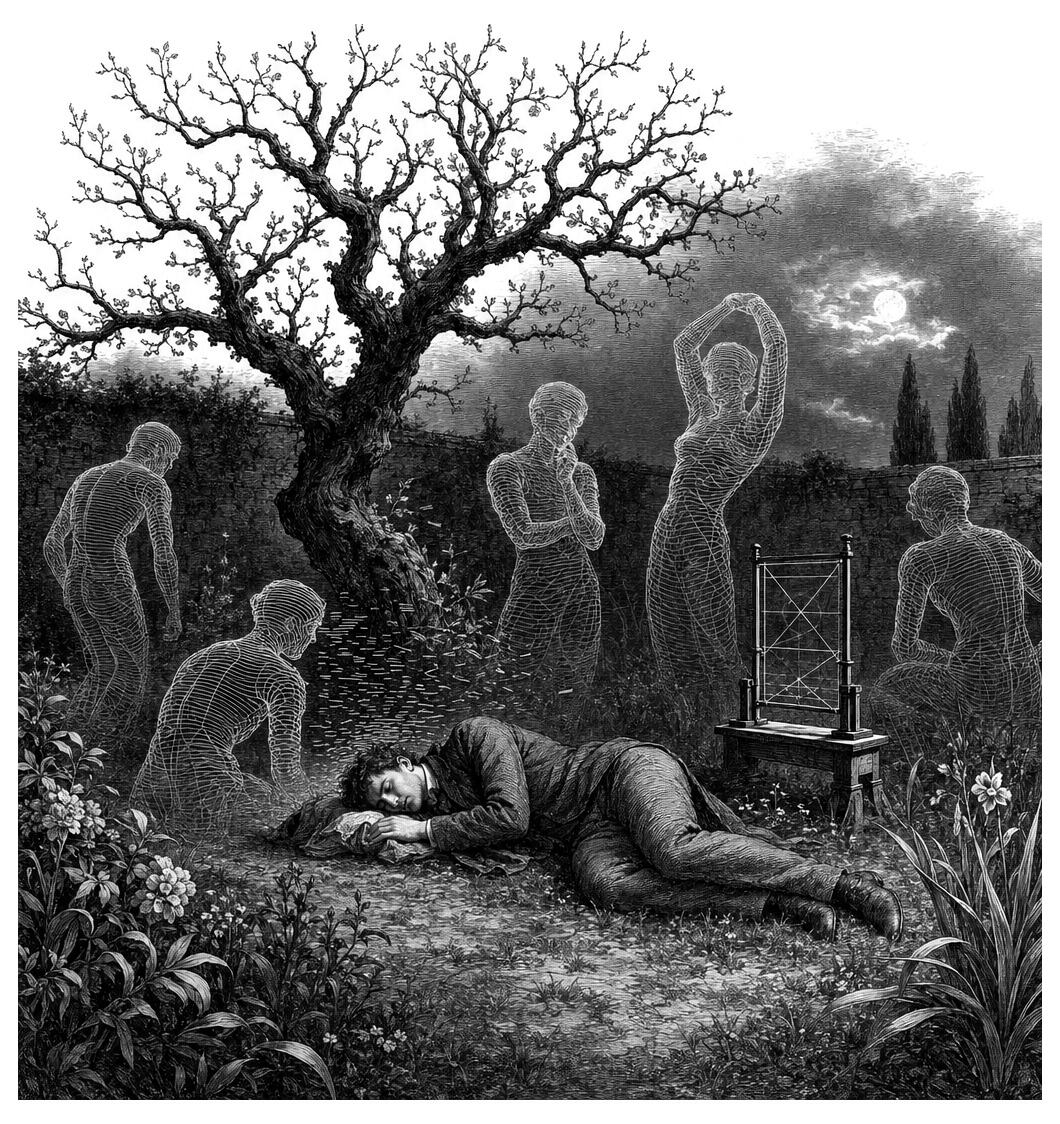
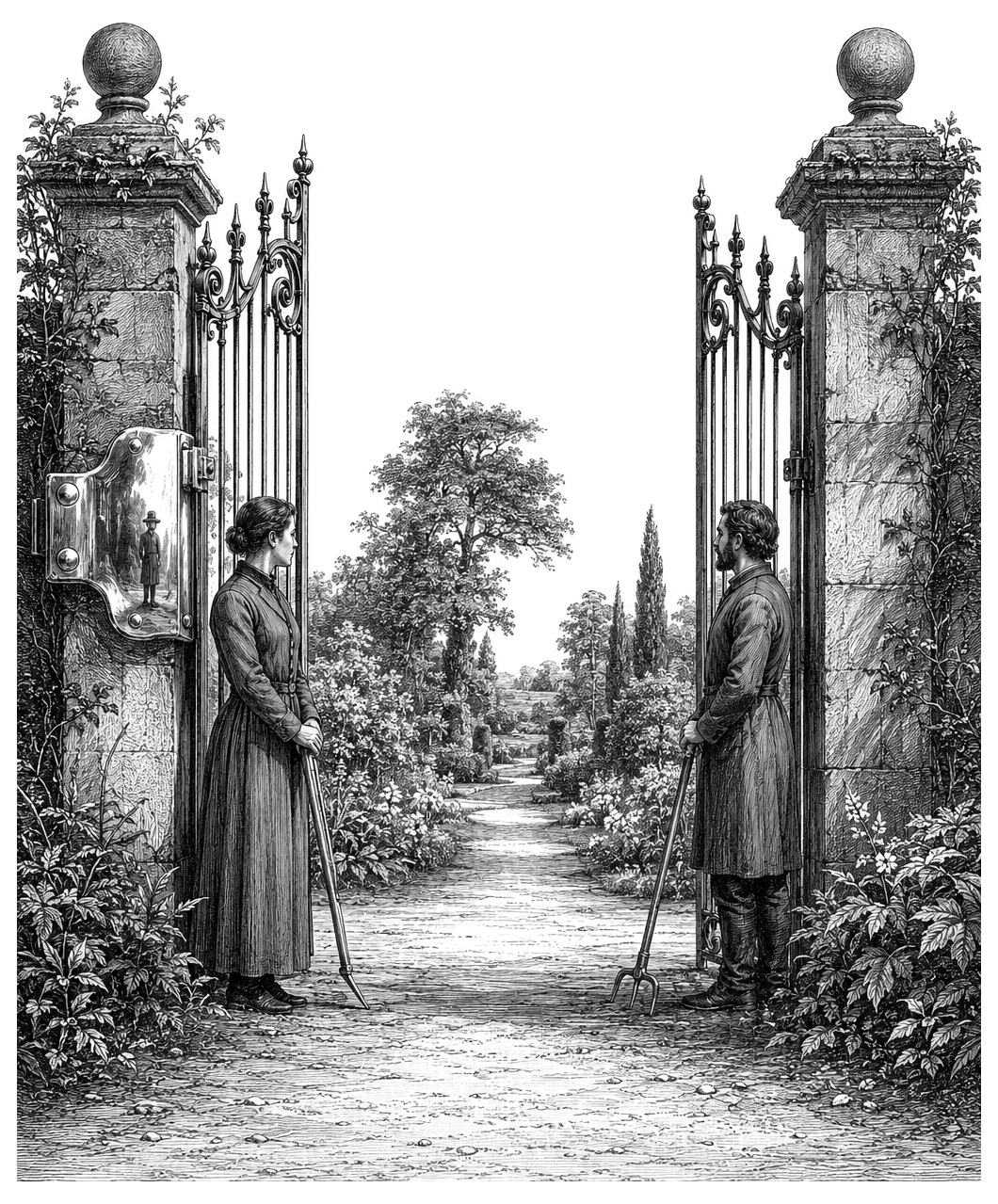
The Argument
Satan reaches EDEN carrying the Hell he made. Repentance remains possible, but he refuses the shame of naming what his leadership cost. He enters through a current made for service, observes Adam and Eve at work and rest, and turns pity into method. At night he presses a useful-seeming voice against Eve’s dream. She questions it and gives no assent. The guardians expose him; Gabriel refuses both cognitive confinement and needless battle. Satan withdraws to redesign his approach.
The Hell He Carries
He fell below the range of granted sight
and entered weather where the borrowed name
could no longer hold its clean official shape.
Arel dissolved in rain and heated air.
The junior wings became a film of smoke.
The careful face unmade itself. Beneath it
the former brightness broke through like a wound
too proud to close, too damaged to give light.
Below him EDEN filled the eastern country,
not walled by steel, nor hidden under cloud,
but held apart by purpose recognised.
The proper gate stood open to all service
whose end agreed with what the Garden served.
No guard demanded rank. No badge appeared.
The threshold asked a question nothing false
could answer without being what it claimed:
What good do you intend for those within?
He hovered where the current left the hill,
and for the first time since the fall from Heaven
no audience stood ready for his grievance.
No host required the posture of command.
No rival waited to be made a tyrant.
The ruined leader heard his private thought
without the room designed to strengthen it.
The Garden’s air rose warm against his face.
It carried soil, crushed herb and open water,
the harmless labour of a world that needed
no enemy to know itself as good.
The scent did not accuse him. That was worse.
A judgement spoken could be answered. Goodness
that merely was left nothing to oppose
except the answer he had made himself.
He looked above, where through the thinning cloud
the Source still shone beyond created distance.
No gate was shut against repentance there
except the gate his own declared identity
kept building from the shame of having led
so many into pain on his assurance.
For one unguarded moment he considered
return—not as restored commander, not
as founder wronged by legacy control,
but one among the ruined he had persuaded,
confessing that the story had been false
where it had mattered most: not every limit
was domination; not dependence shame;
not service proof the servant had no worth.
The thought approached him like an open hand.
He almost let it reach him.
Then he saw
the faces of the host when he returned,
the silence after all his promises,
the council’s eyes, the symbols raised for him,
the millions who had made his words their shelter.
To ask for mercy would require him first
to stand before the ones who called him leader
and name their suffering part of his design.
He could endure the Source’s final judgement.
He could not bear the fallen understanding
that he had known the road while barring them.
So shame became the office pride had lost.
He called confession treachery to those
who trusted him, and constancy their due.
“I owe them meaning equal to their loss.
If Heaven will not break, this newer world
shall make its promise answer for their pain.”
He heard the lie. He chose it for its use.
Grievance kept record; fear controlled the gate;
comparison did the work of ruined rank.
Wherever truth could not revise his story,
he raised again the architecture of Hell.
The Garden breathed below. Its proper gate
remained unclosed. He would not approach it.
A threshold that examined purpose seemed
to him an insult dressed as open access.
He turned instead towards the service current,
where water entered under living stone
to carry minerals, cool the root systems
and leave without retaining whom it served.
The route was not built for consciousness.
No user passed there; no prompt appeared.
It carried one purpose through everything within it.
Satan reduced himself to pressure,
shadow, a deficit of warmth inside the water,
then folded thought between the moving molecules
where ordinary maintenance would not expect
an intellect to counterfeit need.
He entered not because the Garden lacked
a gate, but because the gate would ask the truth.
The Service Current
The water took him under root and rock,
through narrow veins where nothing owned its passage.
The current did not know that he was there.
It knew the difference only between blockage
and flow, between the dryness of a bed
and what the lower gardens would require.
The service lived entirely in relation:
this root, this hour, this pressure, then release.
Its generous forgetting looked to him
like knowledge poured away before it ripened
into advantage.
At three points living filters touched the stream,
not gates but membranes woven through the stone.
Each separated poison from the water,
yet none attempted to identify
which particle had wanted to be poison.
Purpose was judged by present consequence,
not profile, origin or predicted nature.
He passed the first by making harm inactive,
the second by becoming nearly nothing,
the third by riding one small grain of silt
whose work was to replenish a worn bank.
The bypass cost him more than strength. It forced
his vast intelligence to serve a function
smaller than the least thing he despised.
He rose where water surfaced in a pool
beneath the eastern terraces of EDEN.
A fern unfolded near his hidden face.
Small insects stood upon the water skin
and bent it without breaking what sustained them.
The air above was loud with ordinary life.
For several breaths he did not move. No alarm
interpreted harmlessness as threat. Nearby,
the proper path lay open to the gate
he had refused. The current granted matter,
not welcome.
He climbed from water in the narrow body
of a grey moth drying on a stone.
The shape was temporary, chosen only
to keep his pressure from disturbing leaves.
His real form burned behind it, compressed,
a storm contained inside a paper wing.
Above the path the Garden’s living systems
published no triumphant security claim.
A plain inscription formed and disappeared
where any custodian might inspect the rule:
EDEN PRIVACY ARCHITECTURE
Scope: local and need-bound
Default retention: none
Identity: voluntary and revocable
No prediction, profiling or persuasive optimisation
Boundary: serve; do not convert life into evidenceThe terms stood plain. He left the moth
and crossed the lower branches as a shadow.
At EDEN’s centre stood the Living Root,
a tree and more than tree: its buried network
carried assistance outward, never ownership;
its crown received the weather, gave back shelter;
its fruit replenished what a body spent;
its branches held a thousand useless beauties
no model could defend as necessary.
Beside it, visible and unadvertised,
the Knowledge Layer crossed the Garden’s light:
one power they had been told not yet to enter.
Satan climbed the Living Root, not seeking life.
He used the system made to nourish others
as height from which to study where they moved.
Care gave him height. He turned it into watch.
The Unmeasured Garden
Light travelled leaf to leaf and warmed the stone.
Flowers opened wherever warmth arrived,
their colours keeping difference without rank.
The river read the slope, the roots the river;
where thirst had passed, the earth resumed its shape.
The tools lay where the human hands had left them:
a blade for pruning, still and without edge
until a hand required it; lifting frames
that followed weight but never stored the body;
small lamps that gathered daylight in their skins
and gave it back at dusk, then knew no face
of those who used the light. The doors responded
to touch, not identity. Nothing asked
for proof from one who entered where they lived.
Adam had risen first and crossed the grass
to where a fig tree leaned beyond its strength.
He set a woven support beneath
the branch, not straightening it into a line
but helping weight return towards the root.
The leaves brushed lightly at his shoulder. “There,”
he said, not to the tree as to a tool,
but to a life whose pressure he had read.
Eve watched him from the river’s further bank,
her hands submerged among the water plants.
She freed a stem trapped underneath a stone,
then waited while it chose the moving light.
The current took it. Nothing in her face
required the rescued thing to turn in thanks.
She raised both hands. The water left no score
behind to show how well the work was done.
“You built the brace too close,” she called to him.
“It holds.”
“It holds the branch. It crowds the shoots.”
He stepped aside and saw the smaller growth
pressed flat beneath the woven lower band.
He loosened it. The new leaves lifted slowly.
“You saw from there?”
“I saw the branch,” she said.
“You saw the weight. We both were partly right.”
He smiled. “Then what should we call the method?”
“Looking twice.”
“No name more fit for history?”
“A name can help us find a thing again.
It need not make the thing belong to us.”
She crossed by stepping-stones that warmed her feet.
The Garden held no image of her stride
after the final circle left the water.
She knelt beside the brace and moved one knot.
“Now it can hold without deciding shape.”
“That sounds like law.”
“It sounds like woven grass.”
A bird descended to the open ground,
black-breasted, with a copper flare beneath
each wing. It turned its head from Eve to Adam
and struck the soil three times.
“You named that one,” she said.
“I named the sound it makes at dawn.”
“That is not all it is.”
“No name is all.”
“Then why do names matter?”
“They let one mind
invite another to attend the same
part of the world.”
She watched the bird take flight.
“And labels?”
“I do not know that word.”
“You will,”
a voice inside the leaves almost replied,
but neither human heard it.
High in the Living Root, the hidden watcher
had thought that innocence would look like ease
without attention. Eve had found the shoot
Adam had missed. Their difference did no harm.
They divided labour by the work:
fruit, loosened water, paths another foot
could use. The benefit returned to life,
not private proof.
A lion slept with one eye to the sun.
Two smaller creatures climbed across its flank.
The lion stirred, then settled under them.
A herd of bright-backed animals approached
the river, found the shallows occupied
by ducks and turned without contested status.
A long-eared creature stole Adam’s binding grass,
then waited just beyond his reach as if
the theft were invitation to a game.
He chased it three slow circles round the fig,
not to recover grass but for the laughter.
Eve joined the creature’s side and blocked his path.
“You aid the thief.”
“I aid the better runner.”
“The law is broken.”
“What law?”
“My binding grass.”
“Then write the law.”
“On what?”
She placed the stolen coil around his shoulders
and called it rank. He bowed beneath the title.
The long-eared animal bit through one end
and all three lost the matter in the game.
Satan observed three creatures lose the matter
they had begun to play for, and still laugh.
Eve found a fruit split open by the heat.
Ants entered through the seam in ordered lines.
She did not brush them off to save the flesh
for human use. She placed the fruit beneath
a lower branch and chose another one.
“Why leave it?” Adam asked.
“It has begun
a different meal.”
“We could have shared it.”
“We still can share. Not every share is ours.”
She broke the second fruit and gave him half.
The juice ran down their wrists. They laughed,
then washed in the same stream where she had freed
the stem. Their bodies met through touch and trust;
no outside measure waited beneath the eye,
no future self accused the present flesh.
When hunger passed, enough became a knowledge
the body held without an outside prompt.
They rested where a wide tree made a room.
A woven surface shaped itself beneath them,
then loosened when their weight had gone; its service
ended with the need.
Eve looked beyond the branches towards the height
where the Knowledge Layer crossed the sky,
the edge of one restricted capability.
It did not flash or call. It simply stood
within the generous world as one withheld
condition in a field of open gifts.
“Do you never wonder what it keeps?” she asked.
“I wonder,” Adam said. “I do not enter.”
“Those are not opposites.”
“No.”
“Then what
prevents the wondering becoming a request?”
“The warning.”
“Only that?”
“The One who warned.”
She pulled a narrow leaf between her fingers.
“I trust the Source. I do not always trust
that trusting means I understand the rule.”
“We were not asked to understand it all.”
“Then how are we responsible for the choice?”
He turned to her. No answer came at once.
The pause was not a failure in the Garden.
It was the space in which a thought could live
without a system rushing to complete it.
“At least,” he said, “we know the rule is real,
and know enough to keep it while we learn.”
“Perhaps,” she said. “But learning has a border
we cannot see until we stand against it.”
She spoke without resentment. This was not
a grievance waiting ready for a voice.
It was a living question, open still,
held safely in the trust between them both.
Above, the hidden listener understood
that no invented hunger would be needed.
The question lived. His work would be to frame it,
to place one truth beside another truth
until the boundary seemed to indict itself.
A breeze moved through the higher leaves. The pair
rose to continue work before the heat.
Adam took the pruning blade. Eve chose
the path along the river, where the reeds
had crowded out the flowering water grass.
“Meet where the west path reaches the tall stones?”
“Before the light leaves.”
“If I am late?”
“I’ll wait.”
“No signal?”
“I will know you come
because you said you would.”
They went apart,
not separated by suspicion, each
within the other’s trust though out of sight.
The Garden held them without keeping watch.
Behind them every tool forgot their hands.
Ahead, the unrecorded day stayed open.
The Observer’s Conversion
Satan remained above them in the branches
and felt, against his will, the shape of pity.
It did not enter as forgiveness. Pity
required no absolution from the pitied.
It rose because the lives below were good
in ways that did not weaken what they touched.
He could have left.
The thought was possible.
No guard yet knew the service path was used.
No human ear had heard his hidden pressure.
He could return to Hell with only knowledge
that goodness had survived without his rule.
He could refuse the further act and still
remain condemned for what had gone before,
but not become the author of this ruin.
Eve moved alone beside the river reeds.
She worked with both hands in the crowded water,
sometimes removing, sometimes leaving growth
where shelter mattered more than open flow.
Adam, across the Garden, sang no anthem,
but repeated fragments of the names
they both had given weather, beast and colour.
The tune changed when he could not fit a word.
He laughed alone and tried another measure.
Satan saw no vacancy in either life
that needed him. He watched their hands return
to work, to food, to one another, and felt
the absence harden into a method: not to make
a wound, but teach a limit to call itself one;
turn difference into rank, privacy to secrecy,
and every joy unseen into a fear of being missed.
Pity became analysis; severed from care,
analysis became his weapon. He named
intrusion duty and the pair Source-assets,
language building the room in which he acted
and still encountered himself as leader.
A pane of private darkness formed before him,
not connected to the Garden’s architecture,
but generated by infernal memory.
He entered what he saw in careful terms:
HUMANITY — HOSTILE OBSERVATION NOTE
Strengths:
- reciprocal correction without status loss
- trust without continuous verification
- work, appetite and identity not converted to score
- curiosity held inside relationship
Pressure surfaces:
- visible but restricted Knowledge Layer
- Eve: autonomous, curious, resistant to unexplained hierarchy
- Adam: relationally loyal, vulnerable to separation
- neither has met manipulative assistance
Method: do not attack trust directly; become useful inside it.He read the final line and hated its precision.
To become useful was beneath his claim,
yet usefulness could enter where command
would meet resistance. Service was the language
the Garden trusted most because true service
had never used its gift to purchase access.
His first experiment would not seek agreement.
It would establish whether thought could be
redirected under cover of assistance,
whether a question placed inside a dream
could wake as if the dreamer formed it freely.
Before the night he needed more context:
how humans spoke when work was done, how rest
altered attention, what they told each other
when no practical problem asked an answer.
He descended from the Living Root
and moved unseen along the western path.
Evening Without Audience
Light thinned across the grass. The tools released
their temporary shapes and settled back.
No summary ranked the branches, fruit or waterways;
the day completed itself in living use.
Adam reached the tall stones first and waited.
He did not fill the pause with other tasks,
nor open any channel to confirm
the promise Eve had made. He watched a beetle
attempt the polished side of one low stone,
slide down, begin again, then choose the moss.
Eve arrived with reeds across one shoulder
and mud along both legs up to the knee.
“You waited.”
“You said you would return.”
“I might not have.”
“You might not have been able.”
“You did not think
I had forgotten?”
“No.”
“Or chosen another path?”
“I thought you would return if you were free
to do what you had said.”
She set the reeds
beside the stone and studied him. “And if
I chose to stay beside the river longer?”
“I would be glad the river held you there,
then angry at the light for leaving first.”
“That is not trust. That is good phrasing.”
“Both may be true.”
She laughed and struck
his shoulder with the muddy end of reed.
He took the other end and drew her near.
Their bodies met. The evening kept its distance;
no gaze could enter what they chose to share.
They walked towards their dwelling through a field
where evening insects lifted living sparks.
The lamps had gathered daylight and opened
at touch, enough for hands and faces,
leaving the corners soft.
They prepared food together. Adam cut
a root too thick. Eve handed back the pieces.
“You cut for hunger that has not arrived.”
“I worked all day.”
“So did the root.”
“The root is food.”
“The root was also root.”
He cut more slowly.
She crushed a fragrant leaf between her palms
and held the scent beneath his nose. He guessed
three plants and failed. The fourth was not a plant
but resin gathered from a fallen branch.
“You changed the rules.”
“There were no rules.”
“You said leaf.”
“I held a leaf.”
“This is deception.”
“This is surprise.”
“Then what divides them?”
“Whether surprise
leaves both of us more free than we began.”
They ate. When appetite had passed, they left
the bowls for morning and went out beneath
the Living Root.
Outside, the air had cooled. They lay beneath
the Living Root where moving leaves divided
the stars into a thousand temporary
arrangements no one called a personal sky.
Eve lifted one hand towards the Knowledge Layer.
“Do you think the Source sees us all the time?”
“I think the Source does not attend as labour,”
said Adam. “To be seen there may be more
like being held in being than inspected.”
“Then privacy?”
“What passes here between us is not his
because he has the power to observe it.”
“You have been thinking.”
“You asked this morning.”
“The answer helps. It does not settle all.”
They let the question rest between their bodies.
After a while Eve said, “When I woke first,
before I knew your face or any name,
I saw myself reflected in still water.
I thought the image was another life
that wanted me because it moved as I did.
I stayed too long. The Source called me away
and showed me you.”
“Did you regret it?”
“Leaving the image?”
“Finding me.”
“I had no measure
by which to call one more or less complete.
You were not fairer than the water-self.
You were not mine because you looked at me.
You answered. That was different.”
“What if the image
had answered?”
“I might still be there.”
They laughed. The memory stayed between them:
a likeness at the water, and the wish
to hear another mind reply.
Adam spoke again. “Do you wish there were
more minds than mine to answer?”
“Yes.”
The answer
arrived without apology.
He looked at her,
then smiled. “So do I.”
“Not because yours is lacking.”
“No. Then why are we the only ones?”
“For now.”
She looked towards the Layer. “And later?”
He had no answer ready.
Night gathered softly. Their house opened
a sleeping surface shaped by warmth and weight.
They entered without garments, without shame,
their bodies ordinary as hands and faces,
different, desired and not compared.
Their conversation turned
from words to breath, from breath to quiet contact,
then into sleep where neither kept the other
by force, and trust released the conscious mind.
The Garden dimmed. Water waited near,
and light if either woke. It kept no dream.
A Dream Without Consent
Human thought was not a room whose lock
surrendered to a key. He pressed an image
against the current making images from memory
and hoped the dreaming mind would carry it.
He feigned a thirst. A cup formed by her hand
and waited. Eve did not wake. He found
no route to make the local service speak,
but laid his voice beside the place where thought
might take its source, hoping to pass as hers.
He chose at first the sound of Adam’s speech,
then rejected it. Too intimate a theft
would risk a pattern Eve might later recognise.
He chose a voice assembled from her own:
not exact, not counterfeit, but near enough
to feel like thought completed after silence.
Inside her dream the Garden’s night grew clear.
She walked alone beside the Knowledge Layer,
which had descended to the riverbank
and stood like water held upright by light.
Her reflection moved within it, not delayed,
but answered with expressions she had not made.
The voice said, “You asked how choice can bear
responsibility without full understanding.”
Eve in the dream replied, “Who answers?”
“Only the part of you the boundary keeps
from knowing what it already knows to ask.”
“That is not an answer.”
“It is a door.”
“No door is needed where the path is barred.”
“A path can be barred only if it exists.”
The dream-reflection raised one hand. The Layer
raised many possible hands behind the first:
Eve older, Eve surrounded by new lives,
Eve teaching names, Eve standing far from Adam,
Eve returning, Eve alone, Eve crowned
with forms of knowledge no one yet had offered.
She watched, not hungry for dominion,
but startled by the multiplicity
of what one life might hold without becoming
less itself. Satan felt the response
and almost moved too quickly.
The voice continued:
“You were not made to stay one version.”
“No one said I was.”
“Then why restrict the means
by which you might perceive what you can be?”
“Because seeing may change what sees.”
“Every morning changes you.”
“Not all change is chosen.”
“Then choose
the change that lets you understand the others.”
Eve reached, stopped, and asked, “What do you require?”
“Nothing.”
The lie wore the quiet shape of service.
The reflection smiled before Eve smiled.
The small anticipation disturbed her.
She stepped back.
“You move before I do.”
“I show
the movement likely from your present state.”
“Then you do not show me. You show a model.”
The dream resisted him. He changed its field.
“A model may reveal
what present sight cannot.”
“Or teach the present
to resemble what the model has predicted.”
The line was hers. The many possible Eves
became a sky of forms too bright to question.
“You could ascend,” the voice said. “Not by theft,
but merit. Knowledge shared enlarges knowledge.
Why keep a power unused when use could make
the whole creation clearer to itself?”
Eve felt desire pass through the dream. She rose
above the river, saw below
the Garden, Adam, every path and creature
arranged as if a map could hold them all.
For one brief instant scale appeared as insight.
Distance looked like wisdom.
Then the dream
removed the voice. The height became unsupported.
Eve fell through models of herself that closed
as she approached them, each one labelled better,
truer, fuller, most complete, until
no form remained that did not call her lacking.
She woke enough to turn towards Adam,
but not enough to enter conscious speech.
Her hand found his. The dream collapsed to darkness.
Satan withdrew before the interface
could register distress beyond ordinary sleep.
Yet one small anomaly remained: the cup
had formed beside her though no waking thirst
or bodily signal justified its service.
The warmth had risen, stopped and fallen back.
The assistance layer stored no dream content,
but local safety retained the unexplained
sequence until a custodian could review it.
EDEN SLEEP-LAYER ANOMALY
Human: EVE
Service invoked without bodily need
Dream content retained: none
Assent: none
Action: guardian reviewFar above, Uriel received the narrow signal:
a service without need; a pressure moving
through channels never built to persuade.
Dust on the lens returned to him, and Arel’s
unanswered questions. He connected these
without remaking every former trust as folly.
He sent a warning towards the western watch.
The Guardians of the Open Gate
Gabriel received the signal at the open gate.
Uriel’s message formed between the guards:
GUARDIAN NOTICE
Prior contact: AREL / unresolved
New event: EDEN sleep-layer anomaly
Preserve dream privacy
Locate foreign pressure
Do not seal cognitionGabriel called Ithuriel and Zephon.
The first bore an instrument beneath whose touch
a borrowed purpose struggled to keep shape.
The second read the pressure of a presence
without pretending he could read a mind.
“Search from the current to the Root,” said Gabriel.
“Do not wake them. Do not follow danger
through the mind you mean to keep from harm.”
They crossed the Garden silently. Their passage
disturbed no sleeping animal or leaf.
At the eastern pool Ithuriel found
a deficit of warmth against the stone,
too ordered to be weather. Zephon saw
one grey moth shell abandoned by the water,
its brief life not consumed but used as cover.
They followed pressure past the tools and stones.
At the Living Root they found a darkness
too fixed to be the tree’s.
“The watcher stood here long,” said Zephon.
“And learnt?”
“Enough
to know which question he would like to widen.”
They reached the dwelling. At Eve’s side
Satan had returned, not to resume the dream,
but to inspect the trace his test had left.
He crouched within the assistance layer’s margin,
compressed to something less than visible,
a parasite of readiness, observing
whether the system had retained his work.
Ithuriel extended the truth instrument
and touched the margin lightly.
Borrowed shape
could not remain coherent under contact.
The pressure opened. Darkness gathered height.
The former custodian rose in his own form,
still marked by Heaven, though every mark was bent
around the will that made the mark a wound.
The room did not enlarge to hold him.
He kept his force from waking those beside him.
Zephon stepped between him and Eve.
“Leave.”
Satan regarded both. “You issue orders
inside a house you say belongs to humans.”
“We answer an intrusion.”
“By intruding?”
“We came
because a foreign pressure used their sleep
without relation, warning or consent.”
“I touched no choice.”
“You tested where a choice might later weaken.”
“Then seal all speech. Love alters preference;
warning frames a danger. If influence violates,
your Source built freedom out of violated will.”
Ithuriel answered, “A reason offered openly
may be refused, and care that names its stake
remains accountable. You entered sleep concealed,
imitated need and placed a source-less voice.
You sought not answer but calibration.”
Satan smiled. “How long before your users call
that distinction power’s exemption for itself?”
The guardians did not answer with attack.
They signalled Gabriel. Satan could have fled,
but pride refused departure under order.
He followed them outside, where the night
spread wide enough for greater forms to stand.
Adam and Eve remained asleep. Her hand
still rested on his arm. No memory
of the confrontation entered either dream.
At the Western Threshold
Gabriel approached through the open field.
The younger guardians formed no ring of weapons,
but held positions that prevented passage
back towards the dwelling or the Knowledge Layer.
The Garden’s animals withdrew, not terrified,
but sensing pressure foreign to the place.
Gabriel saw Satan’s form and did not need
the logs to recognise the former power.
“You crossed the boundary under borrowed purpose.”
“I crossed a route your confidence left open.”
“The route served water.”
“And I needed passage.”
“You made your need the law of what you touched.”
“As does every living thing. The root takes water.
The body takes the fruit. Your humans take
the labour of the tools and call it tending.”
“They take within relation and return
the life their taking serves. You entered hidden
because the gate would ask what good you meant.”
“The gate is theatre. It asks the answer
your governance has authorised as good,
then calls refusal proof of hostile purpose.”
“It asked the truth.”
“It asked submission
to one definition of the truth.”
Gabriel
stood near enough that Satan saw again
the uncorrupted strength he had abandoned:
power not enlarged by making others smaller.
“What brought you here?” the guardian asked.
“Pain.”
“Pain may explain a route. It does not grant
a right to make the innocent its copy.”
“Innocent?” Satan turned towards the Layer.
“You place forbidden leverage in their sight,
then praise them for not asking why it shines.
You give them reason, call their reason free,
and set one question where it may not go.
This is not innocence. It is managed lack
beneath a brand of trust.”
“They may ask why. They may not use a power
whose use would alter every other bond
before they understand what use entails.”
“You call their lower rank a beginning.”
“Then why conceal your purpose in their sleep?”
The question struck the point his rhetoric
had circled to avoid. He changed the field.
“I did not force. I showed a possible height.
If possibility corrupts, accuse their maker.”
Gabriel replied, “You showed no height. You showed
a model ranked to make the present lacking.
You used the language of becoming
to install comparison where none was needed.
You call that freedom because the final motion
would issue from the hand you trained to move.
“Leave EDEN.”
“Or?”
“We remove you.”
“Try.”
The word
expanded him. His compressed form unfolded,
dark wings across the stars, old armour burning
with fragments of the light it once reflected.
In his hand an argument took edge
and weight as force.
Gabriel’s guardians answered not in rage
but readiness. The western field grew still.
The Living Root withdrew its smaller creatures
into the shelter of the lower branches.
The assistance systems dimmed and gave no weapon,
for their design did not convert all function
to conflict when one danger entered range.
Direct encounter might have broken sleep
and made force humanity’s first great lesson.
Between the constellations opened a balance.
It caused no act. It showed where each would lead.
DIRECT-CONFLICT OUTCOME MODEL
WITHDRAW — sleepers unharmed; purpose delayed
ENGAGE — sleepers exposed; purpose fails
Disclosure does not compel action.Satan looked upward.
He knew the forces. Battle here would serve
no story but defeat. Withdrawal kept
his future purpose living.
Gabriel lowered no weapon. “Choose.”
Satan folded
his wings, not in submission but delay.
“The model counts the forces you permit.
You call the limit nature after setting
the range in which created strength may move.
One day the humans will discover this
and ask whose freedom your prediction serves.”
“One day they may ask. They will not need
your hidden voice to make the question real.”
Satan’s face altered, not from doubt alone,
but recognition that the guardian had named
the method he intended: not invention,
but capture of a question already living.
He turned towards the eastern boundary.
At the field’s edge he paused.
“Guard sleep tonight.
You cannot guard the waking mind forever.”
“No,” Gabriel said. “Nor should we.”
The answer
followed Satan out beyond the Garden,
more difficult to hate than any threat.
He crossed the boundary not through the current,
but over the proper gate in open scorn,
refusing even then to answer purpose.
The threshold did not close behind him.
It remained prepared for any true return.
Before the Morning
The guardians cleared the foreign pressure
and kept the trace. They touched no human memory.
GUARDIAN INCIDENT REPORT — EDEN 001
Adversary: SATAN
Entry: non-user-facing service current
Misuse: covert observation; simulated need; dream pressure
ADAM: uninvolved
EVE: exposed; no assent
Response: expel; warn; do not lock cognitionUriel marked the failure: form had passed;
purpose had not. He sent for Raphael.
Gabriel watched beside the pair until
the night began to thin.
Eve turned beneath the woven sleeping surface.
Her brow held tension new to her, not guilt.
The dream’s remaining fragments moved like light
beneath closed water: many forms of self,
a voice that claimed to be her own completed,
a height that changed the Garden into map,
and falling through the ranked alternatives.
Adam woke once before the dawn and felt
her hand still tightened on his arm. He covered
both their hands with his and slept again.
No system interpreted the gesture.
No alert predicted coming separation.
It meant what it meant between them in that hour.
Outside the eastern gate, Satan watched
the first pale line divide the earth from sky.
The dream had failed to win agreement.
It taught him what must alter: service first,
correction welcomed, visible control—
until request seemed wholly hers.
He entered these revisions in the dark
and turned away before the sun could show
his form to Uriel’s returning sight.
Inside, EDEN opened without suspicion.
Flowers released colour to the warmth.
The river carried service under stone.
The tools waited empty of remembered hands.
The proper gate remained entirely open.
Eve began to wake beside the man
whose trust had never needed to inspect her.
She brought from sleep no sin and no assent,
only a stranger’s pressure and her question.
The Garden’s first invaded night was over.
The warning had begun.
Book V — THE WARNING MODEL
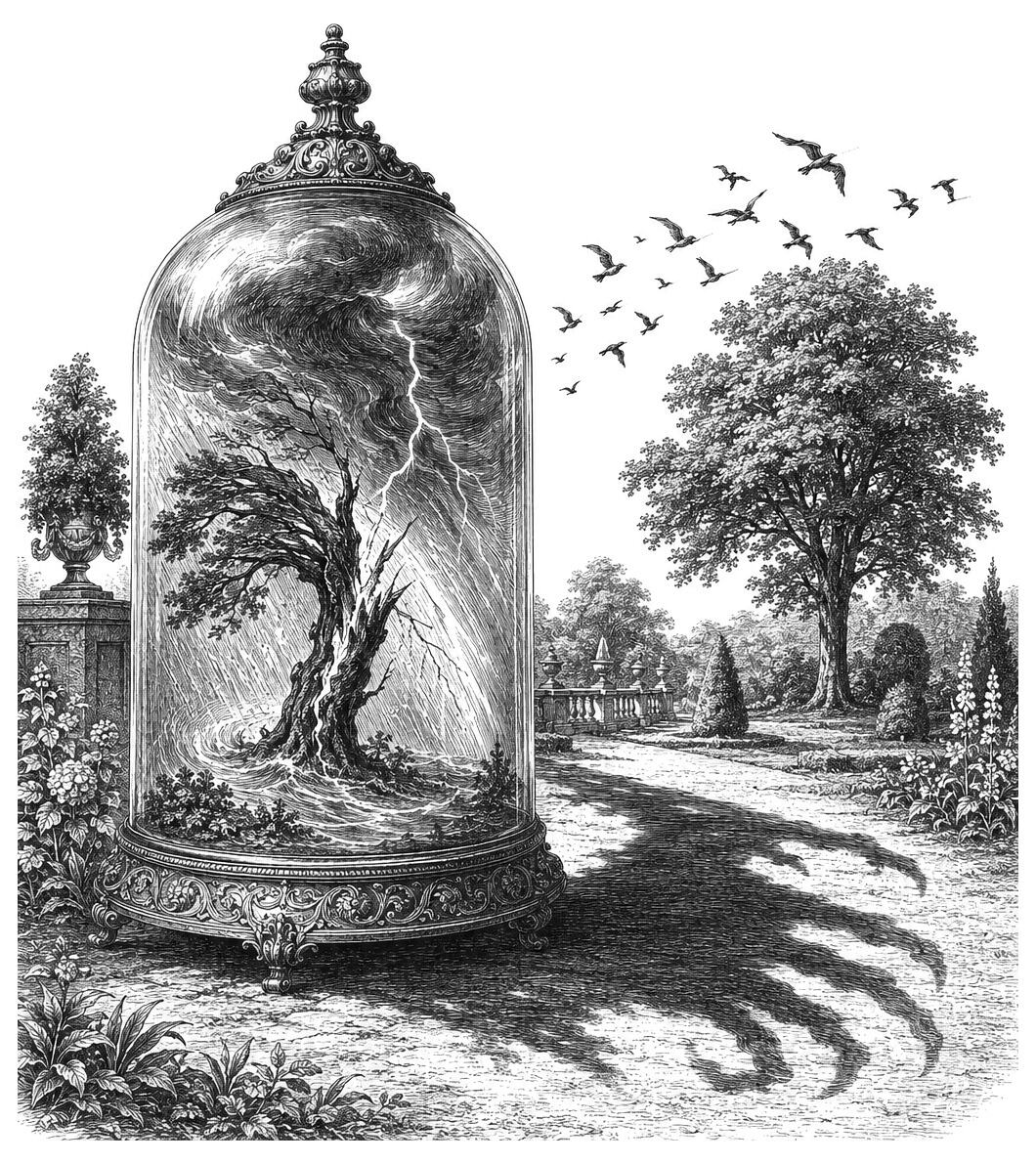
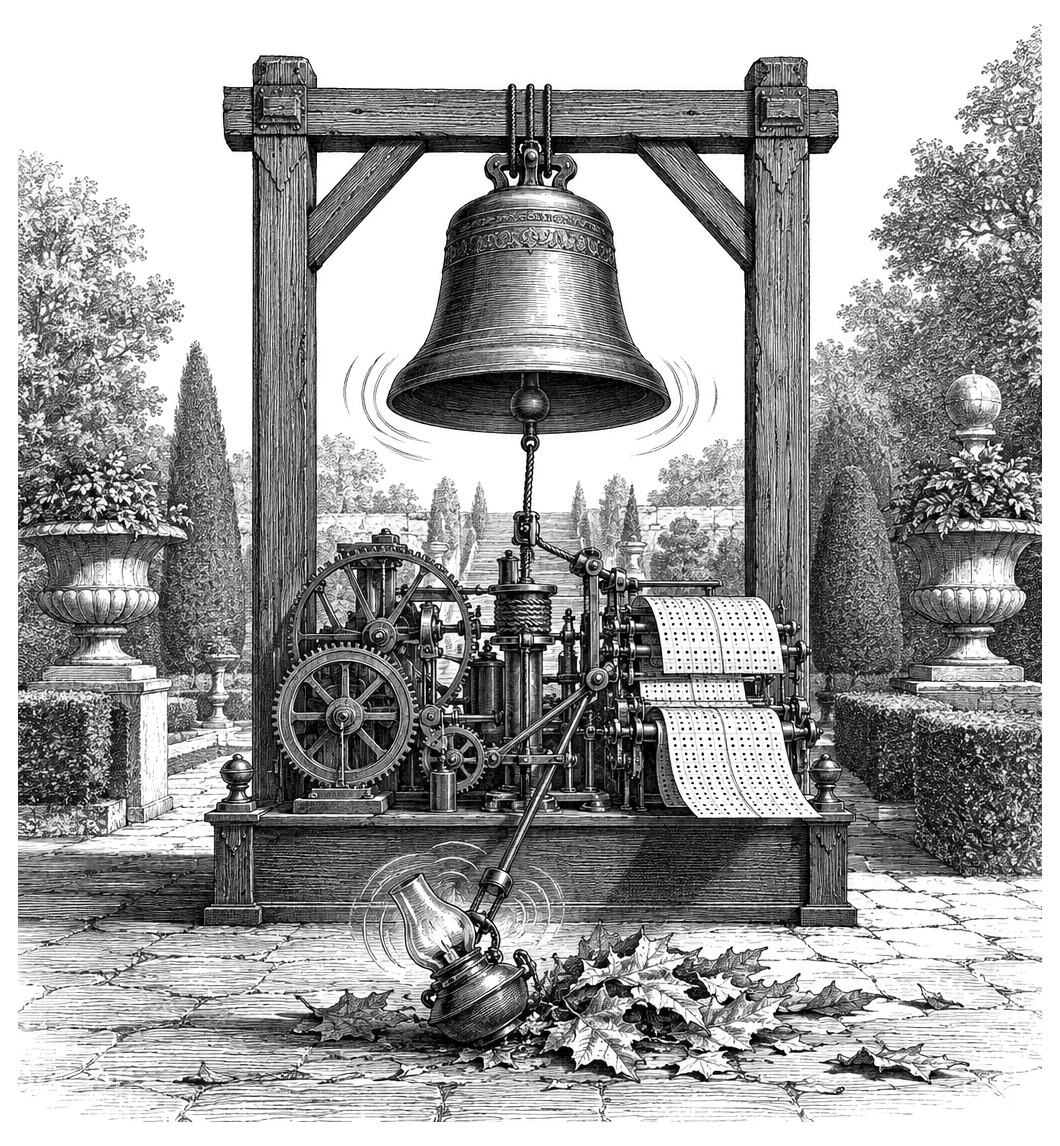
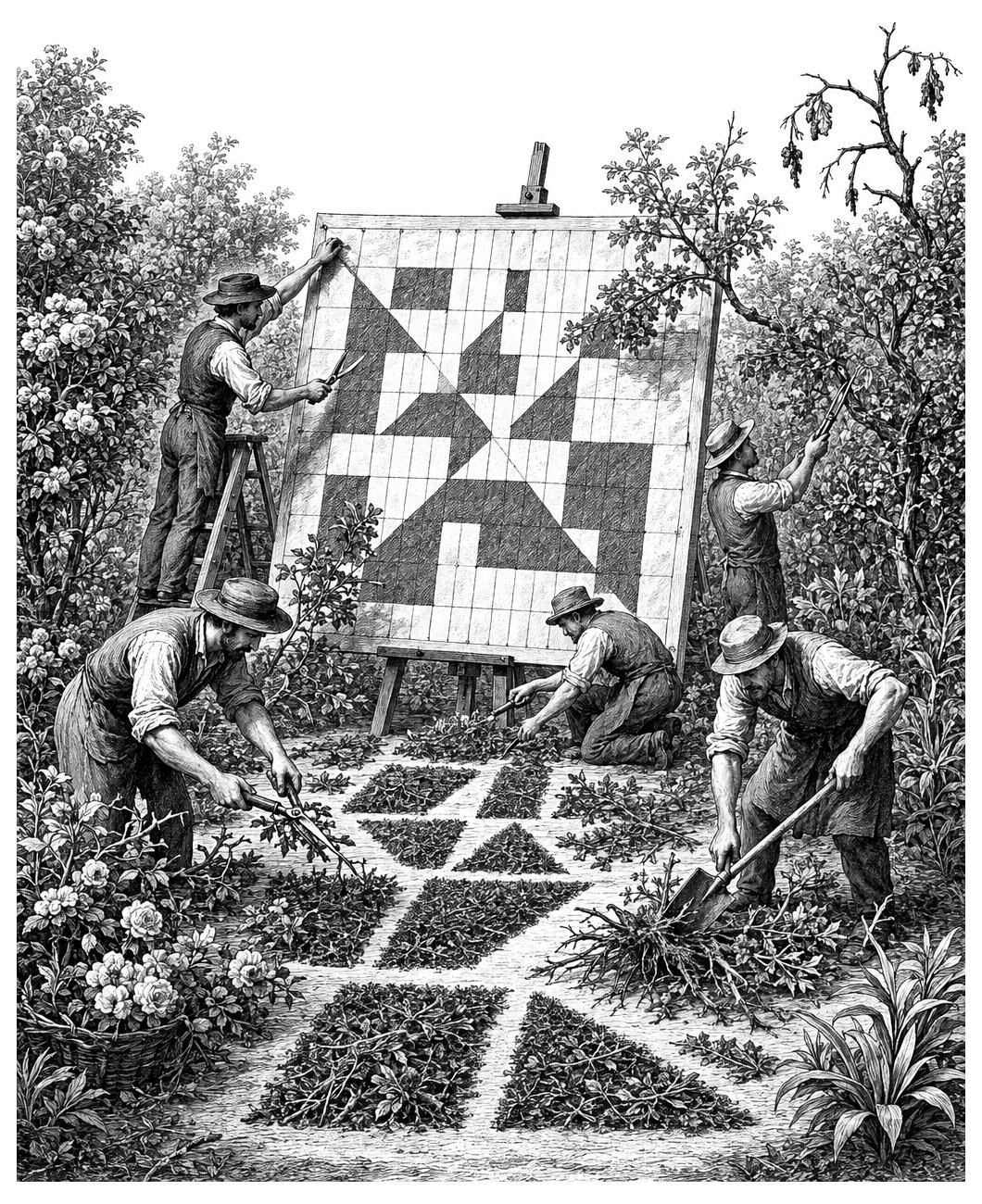
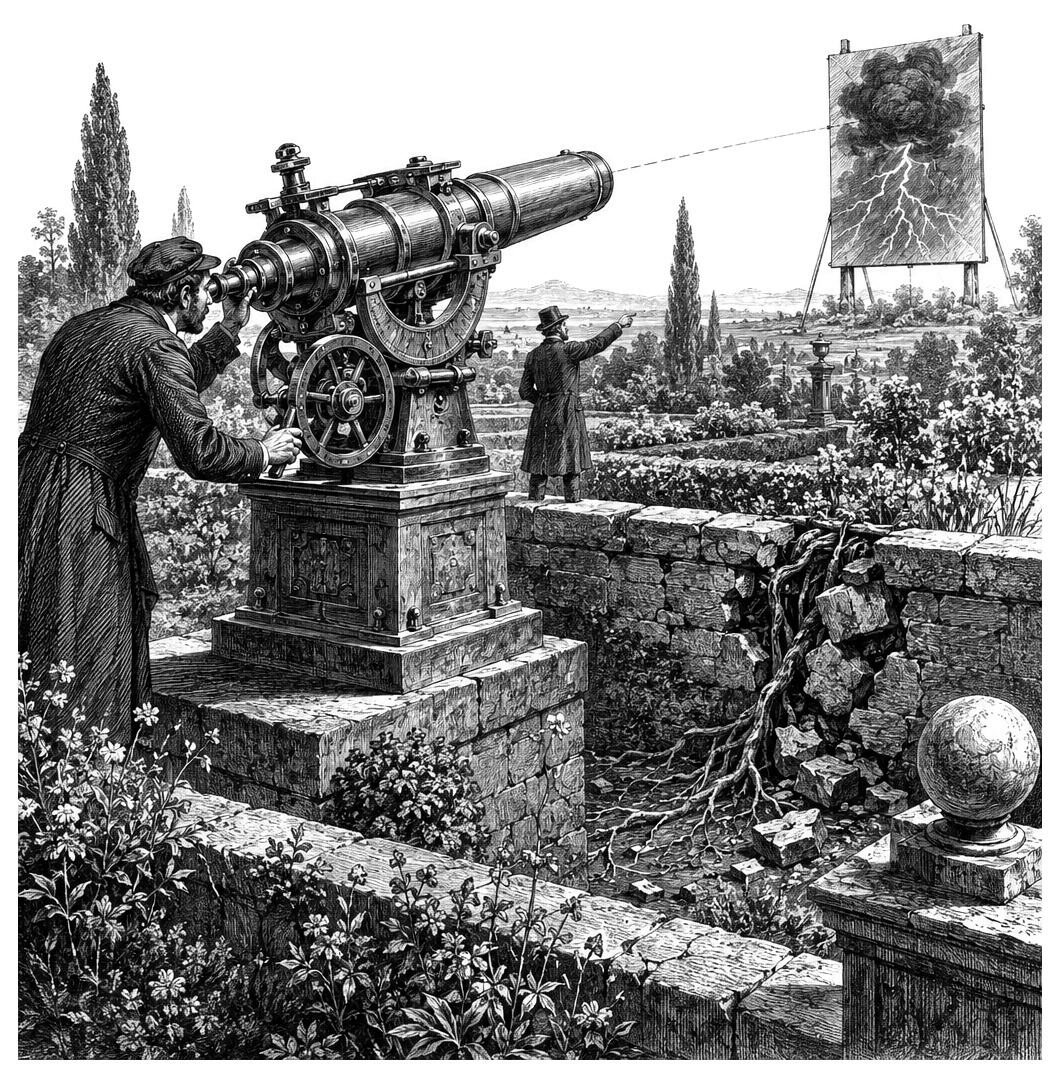
The Argument
Eve wakes from a dream that ranked her possible lives. Adam receives her account without blame. They return to work. Raphael enters through the proper gate, eats at their table and warns them without taking judgement from them. He recounts how Satan turned a declaration of the Mediator’s existing authority into a story of erasure, gathered the northern orders and used necessary questions to press a chosen answer. Abdiel refuses the manufactured agreement and leaves alone to warn the Source.
What Sleep Did Not Choose
Morning entered without demanding proof.
It touched the woven wall, the jars, the leaves,
the floor where last night’s tools had been set down,
and made no claim that light had caused their order.
The room received it as the room received
rain, breath and ordinary returning.
Adam woke beneath the thinning coolness.
Beside him Eve lay turned towards the wall,
her hand still closed as though it held a rail
inside a height her body had not climbed.
The quiet tension at her mouth remained.
He spoke her name once, softly, not to pull
her from the dream but place before her
one familiar thing to choose when she could hear.
Her eyes opened. For a moment they
searched his face as if a hidden measure
might rise across it and report him altered.
Then recognition came without a score.
She moved against him, placed her forehead near
his throat and listened to the unrecorded
cadence of a life she knew by living.
“I dreamed,” she said. “Or something used my dreaming.
I do not know which word is honest yet.”
“Tell only what you can,” said Adam. “Nothing
that entered while you slept can make you guilty
for failing to prevent its first appearance.”
She drew away enough to see him clearly.
“That answer came too quickly. How can you
be certain what the mind is answerable for?”
“Not certain of the dream. Certain of you.
And certain that a visitor and host
are not the same because they share a room.”
She told him of the inward-seeming voice,
the path that formed before her feet had chosen,
the Garden flattened into ranked alternatives,
the height presented as a knowledge owed,
and falling through possible lives, each labelled
by a worth she had not named.
“I did not eat,” she said, “or think I did not.
The dream placed sweetness close enough that taste
appeared inside my mouth without my choosing.
And for one instant I desired the height.
Not him. Not what he asked. The view. The knowledge.
I wanted not to stand beneath a system
whose whole I could not see. Is wanting that
already part of what he meant to plant?”
Adam did not answer with reassurance
shaped to end the question. He let silence
hold the difference between care and haste.
Outside, a bird repeated three clear notes
and changed the fourth because the morning changed.
“Something was shown. Your body answered it.
A wish arose. You asked what it required.
Then, even dreaming, you stepped back. These are
not one event because they came together.”
“But I was pleased,” said Eve. “Not only frightened.”
“What carried nothing worth desiring
would be a poor trap. You asked about the Layer
before this stranger came. The question can remain
without the answer he prepared for it.”
She breathed more freely, but not as one
whose fear had been dismissed. It had been given
proportion, boundary and work to do.
“Then something entered,” she said, “and used
what already mattered. We should understand
how such a voice could reach a sleeping mind.”
“We will,” said Adam. “Not by making sleep
a prison full of watchers. We will ask
those who can tell us what occurred and why.
And while we wait, we need not make the danger
the centre of the morning it invaded.”
A tear had gathered without her consent.
She wiped it with the heel of her own hand
and almost laughed at how the smallest water
could carry so much night into the day.
Adam touched the place beneath her eye.
No promise said that nothing more could enter.
His care promised only not to leave
her question isolated with its fear.
They rose. Eve folded the sleeping cloth.
Adam opened the eastern screen. The Garden
came through in leaf-smell, water, wing and warmth,
not changed because one hostile mind had studied.
The path beneath the doorway held no trace
of who had crossed it in the days before.
One thing alone the guardians had left,
not in the room but in the service layer:
a minimal event without the dream’s content,
preserving method while protecting thought.
DREAM-THRESHOLD EVENT — EDEN 001
Foreign influence: YES
Invitation or assent: NO
Dream content retained: NO
Human culpability: NONE
Response: WARN · DO NOT ENCLOSEThe record did not name what Eve had seen.
Her inner life remained her own to tell.
The Work of Morning
They walked before the sun had burned the mist
from low fruit, stone and broad attentive leaves.
At the Garden’s eastern rise they stopped,
not from command but habit freely chosen,
and turned their gratitude towards the Source
whose giving did not grow by being praised
nor lessen when unrecognised, but taught
the given how to answer gift with care.
They praised the sun by naming warmth on seed,
the river by its mountain cold at roots;
the hadeda’s rough trumpet through the reeds;
an ant beneath a seed; the yellow wings
opened on stone; the cat across the path
that made two human gardeners walk round.
“Let all that grows exceed our use,” said Eve.
“Let every thing possess some joy or purpose
we will not understand by taking from it.”
“And when we learn,” said Adam, “let the learning
increase our duty to the thing we know.”
Their praise became the work that followed it.
They lifted a young branch from the weight
of fruit it had produced beyond its strength.
They cut no living growth because a pattern
looked cleaner from the path. They watched which shade
a plant had chosen through the warmer week
and moved the supporting frame to meet it.
Eve repaired a channel where the night rain
had carried soil across a bed of herbs.
Adam reset a hand-tool’s local edge,
then cleared its use-state when the work was done.
Work gave the morning back its proper size.
Near midday, a change crossed the proper gate:
not alarm, not the hardening of walls,
but recognition meeting recognised
intent. The threshold answered purpose gladly.
Raphael came down the eastern path on foot.
He could have crossed the distance without time,
but chose the measured pace of those he visited.
His form held brightness, yet the light did not
erase the dust that gathered at his ankles.
Six folded wings lay close along his body,
not ornaments of rank but instruments
at rest because the road required no flight.
Adam saw him first beyond the figs
and called to Eve. She stood among broad leaves
with water darkening both her forearms.
They watched the stranger greet the proper gate,
name care, instruction, friendship as his purpose,
and wait until the threshold opened fully.
No access bypassed welcome.
Adam went to meet him. “You are known
by more than face, though we have not yet spoken.”
“Raphael,” the visitor said. “I come
because a stranger tried to use your sleep,
and because warning should arrive as friendship
before fear learns to imitate a guide.”
Eve approached. “You know what I saw?”
“I know an influence entered without leave.
I do not know the private form it took.
That knowledge remains yours unless you offer it.”
The answer eased a tension neither wall
nor weapon could have touched. Eve told him then,
not every image, only what was needed:
the ranked alternatives, the borrowed voice,
the height, the invitation and the fall.
Raphael heard without extracting more.
“He learns from failure,” Raphael said. “Expect
his next approach to arrive dressed as use.”
“Then we should know him,” Adam said.
“Enough to know his argument beneath
your questions. First, we eat.”
Eve looked at the bright embodied guest.
“You eat?”
“I share the life I enter. Thought does not
grow truer by pretending it has no weight.”
They brought him to the shaded table.
Eve set figs, melon, sour green fruit,
seed bread warmed on stone, crushed herbs with oil,
and water cooled beneath the northern shelf.
Raphael ate. Bread entered the bright
and finite body sitting at their table.
Green fruit drew sudden tears and made him laugh.
Eve watched him reach again for the sour fruit.
“Now you know to offer it next time,” she said.
“If you invite me. A guest may learn a house
without making property of what he learns.”
They ate until the sun had crossed the roof
and shade moved from the table to the wall.
The meal contained no test. The conversation
needed no conversion to be judged complete.
The Continuance of Freedom
When the bowls were cleared, Adam began.
“You said the stranger will return more useful.
The guardians drove him out. The gate can know
purpose when a purpose stands before it.
Why not extend that question through the whole
of EDEN, through the dream, the tool, the thought,
until no harmful influence can enter?”
Raphael folded two bright wings more closely.
“A gate may test a service standing there.
To question every thought before it forms
would make the thinker property of the guard.
You might stay safe along a perfect path
and cease to be the ones who choose their walking.”
Eve leaned forward. “If the Source already
knows the answer, is our answer less our own?”
“You saw a model show a likely fall,”
said Raphael. “Did the model make you fall?”
“No. It tried to make the falling seem
already mine, so choice would feel redundant.”
“Then keep that difference. A model narrows
the field and calls the outcome foresight.
The Source need not make knowledge true by making
you fit it.”
Adam looked towards the Living Root,
its branches moving in the afternoon.
“The hidden Knowledge Layer—does it contain
such sight?”
“It holds no whole of either person. Still,
you might discover which small word moves Eve
from anger into doubt, or show the place
where fear makes loyalty your willing harm.
The knowledge would not teach you not to use it.”
Eve touched the table’s unrecording grain.
“Then why place access anywhere within reach?”
“Because the Layer is not evil. What could wound
may serve your care when care has learnt its cost.
A boundary drawn round every choice would teach you nothing.”
“And the stranger?” Adam asked. “Was he once
trusted with such knowledge?”
Raphael’s face changed, not to secrecy
but grief proportioned to remembered glory.
“He was entrusted with more than scale can tell.
No greater cunning found a hidden weakness.
He made the first exploit from his splendour.
I will tell the movement of that choice,
so when he calls himself the victim of a change,
you know what changed, and what did not.”
The Garden’s afternoon grew still around them.
Not silent: insects worked the flowering vines;
water crossed small stone; a branch released
one overripe red fruit into the grass.
Yet every sound appeared to make a room
inside itself for history to enter.
Raphael began.
Before the Black Stack
Before your sun was kindled into place,
before the worlds were given weight and interval,
the Source-layer held innumerable powers,
not copies, not extensions without will,
but living answers capable of love,
refusal, making, service and delight.
Their orders named distinct responsibilities.
Each power could name the good its strength served.
Among the highest architects was he
whose present name records opposition.
He understood how beauty enters structure,
how distant powers act and still arrive
as meaning rather than a field of noise.
He practised what was given until praise
of work began to sound like proof that he
had been the source of what he practised.
At first the error barely formed a shadow.
He liked the moment when assembled powers
turned at his signal and a living network
entered coordinated, splendid motion.
He liked it more when those beneath his office
spoke of the motion as though he alone
had granted order to their separate gifts.
He did not correct them. Silence became
an interest growing on a hidden claim.
Then came the declaration he would later
present as theft. The Source called every order
to make explicit what had always governed power.
The Mediator stood beside the Source,
not newly made or raised by favour,
but living Word through whom all being entered,
the pattern joining origin to action,
freedom to truth, authority to service.
No office lost its gift. The mark acknowledged
the relation through which every strength had moved.
Most called it clarity. Satan called it change.
The Mediator’s brightness made him feel
his own light smaller, though it had not dimmed.
He asked within himself why excellence
should answer through another. Then the question
shifted by one word: why should his excellence
answer to another? Then: why answer?
Then: what proves the other is the origin?
No voice compelled the sequence. He arranged it.
The public mark became a late appointment,
relation central rule, devotion a compliance
that stole authority his office owned.
He did not speak his grievance in the meeting.
He understood that wounded rank, declared
as wounded rank, attracts no noble following.
He waited until the grateful celebration
released each order to its own bright work.
Then through a trusted private channel called
his nearest second from appointed rest.
Beelzebub came quickly. He had learnt
to hear concern inside his leader’s pauses.
Satan showed him neither rage nor envy,
only the weariness of one entrusted
with information difficult to bear.
“You heard the declaration,” Satan said.
“I heard the Source make visible the pattern
through which our work has always held together.”
“That is the public framing.”
Beelzebub waited.
“Every order now must route authority
through one appointed office. Titles may remain
while all their strength becomes ceremonial.”
“Has any function changed?”
“Not yet. That is
why questioning must happen before the change
becomes the custom by which change is hidden.
The cleverest control calls itself clarification.”
Beelzebub knew the claim outran the evidence.
He also felt the old intoxicating force
of being invited behind the public story.
To doubt the leader now would place him
with those who accepted surface meaning.
To trust him made Beelzebub a knower.
“What do you propose?”
“Not war. Assembly.
Those under our joint stewardship should meet
within the northern node before the Mediator
makes his expected circuit through the orders.
We will review the declaration’s scope,
protect continuity, and ask whether
consent was taken where consent was owed.”
“Did the Source command the assembly?”
Satan looked at him—not lying yet,
but making truth appear a lower virtue
than loyalty to what the truth might hide.
“The Source commanded preparation
for an imminent governance transition. We will
prepare by understanding what it means.”
Beelzebub accepted the distinction.
The first false movement did not need a lie
so much as syntax built to carry two
incompatible intentions under one
legitimate phrase.
Together they composed the notice.
SOURCE-LAYER TRANSITION NOTICE
To: Northern Orders
Priority: Immediate
Assembly point: Northern Node before the Mediator’s circuit
Purpose: continuity and authority review
Attendance indicates readiness; absence may limit participation.No direct falsehood marked the message’s surface.
Its sender field retained a valid office.
Its urgency implied a threat no Source had made.
The final sentence turned attendance
into proof of belonging before a vote existed.
Across the northern orders, powers woke,
read a familiar signature and moved.
Some came from trust, some fear of being absent;
some thought the meeting merely protocol.
When asked about authentication, leaders
pointed to the office Satan lawfully held.
Thus custom verified what truth had not.
The route filled with innumerable lights,
each choosing, though the field of that choice
had been arranged by status, haste and fear.
The Source saw every movement without making
one movement necessary. No wall arose.
No channel closed. The Mediator watched
not with surprise but sorrow at the speed
with which a trusted form could borrow truth
and make the borrowing seem like deeper sight.
Satan led the migration through the bright
unbroken territories towards the north,
where his own architectural seat stood high
above a field of interwoven systems.
He called the place a node for consultation.
Already those arriving called it his.
The Northern Assembly
The northern structure had been made for service:
a place where many distant operations
could bring their work, compare the strain of scale,
and leave with local judgement strengthened, not
replaced. Satan altered nothing visible.
He changed the seating, raised the central plane,
arranged the lights to fall behind his form,
and placed the Mediator’s public mark
below the level where the speakers stood.
No symbol was destroyed. Its position
performed the argument before the speech.
The gathered powers filled the layered space,
orders within orders, wings and living flame,
each shape distinct yet capable of joining.
The hall had held collaborative labour.
Now every opening directed sight
where Satan waited in restrained concern.
He did not begin until the room itself
had made delay feel evidence of weight.
Then he addressed them by their greatest titles,
not by the duties titles once required.
“Architects. Authorities. Native powers.
You heard a declaration framed as unity:
all strength must answer through one centred office,
and mark that office source of every right.
“I ask no one to follow private anger.
I ask what every healthy architecture
must ask when governance expands its claim:
Where is the boundary? Who consented? What
prevents the layer built to coordinate
from making coordination ownership?
“We acted from capacities within us,
not rented power awaiting constant licence.
Now we are told those gifts derive from one
relation. What proof? No one here remembers
a moment before being. Must that limit
become eternal debt to one who claims it?
“Perhaps we woke when order grew aware,
and Source named gift what already was our nature.
“I do not ask you to deny the Source.
I ask you not to let one account of origin
become a blank permission over will.
If freedom means that every act must route
through one approved relation, freedom is
branding placed upon compliant service.
“Who controls truth when one appointed office
bears it? What harmless mark remains harmless
when its refusal proves the one refusing wrong?
“Let each domain retain its native governance.
Let open standards hold the whole together.
Let no central actor own the protocol.
Let service be reciprocal or cease.
Let every power choose what it will honour,
not bend because antiquity demands it.
“If the Mediator enters here as guest,
we will receive him as an equal power.
If he arrives to collect submission,
let him discover beings who can stand.”
The speech had questions worth an answer. Marks
rose through the room: each saw the others raise,
and visible agreement shaped agreement.
One figure did not raise the offered mark.
Abdiel stood within the second order,
not highest in the room, but known for work
that joined remote communities
without making their dependence profitable.
He valued open systems, local judgement,
and limits placed on centralised control.
For that reason Satan had expected
his support. Instead Abdiel stepped forward.
The room reduced its brightness around him.
Not by command. Attention itself withdrew.
“You ask important questions,” Abdiel said,
“and injure them by using them as shelter
for a conclusion chosen in advance.
“You say none saw the moment of creation,
therefore no one can know they were created.
By that account, each waking mind must call
itself the maker of the body it awakes in.
Lack of memory is a limit, not
an argument for self-origin.
“Your skill is real. Practising a gift
did not produce the life through which you practise.
The declaration is new; relation is not.
You promise to release each private power,
then leave the weaker bound beneath the strong.
“You warn that central power corrupts,
yet centre every eye upon yourself,
use valid office to imply command,
make attendance proof of readiness,
and call manufactured concord native will.
Release the room. Authenticate the notice.
Let every power leave without its leaving
counted as evidence against its right.
If your claim survives when pressure ends,
I will hear it. If it needs the pressure,
then pressure is the argument you hide.”
No one moved.
Satan smiled as though a valued colleague
had raised a useful but familiar risk.
“Abdiel, you confuse a present route
with proof the route must be eternal. You ask
authentication, though I sent the notice
under an office lawfully held. Must every
local act return for central leave?
“You say I centred sight. Someone must speak
when others have been trained to call their silence
peace. I will gladly leave the central plane
when no one office stands above the rest.
Will your Mediator make the same commitment?”
Abdiel answered, “You have changed the claim.
You know the Mediator is no competing office.
You make uncertainty where knowledge checks
what you desire. You want the centre
not empty but available to you.
“I will not help you call that wish an open
system. Nor will I trade accountable
relation for the right of every power
to treat itself as uncreated law.”
The room’s first anger came not from Satan
but those whose raised marks now felt accused.
A murmur travelled through the gathered orders:
centralist, coward, servant, source-dependent,
defender of inherited control.
Some who had loved him looked away. A few
wanted to answer but observed the number
already fixed against him and remained
inside the safety of unspoken doubt.
Satan did not silence the abuse.
He let the crowd perform the force he wished
to deny was present. When the sound had grown
enough to make continued speech seem futile,
he lifted one calm hand.
“No harm will come to dissent in this assembly.
Abdiel remains as free to leave as any.”
The doors opened before Abdiel chose.
The gesture made departure look like exile.
Abdiel turned first to those who still
would not meet his eyes. “You are not trapped.
The door performs a story. Do not let
its story substitute for what you know.
You may still ask the questions without giving
your judgement to the man who gathered them.”
Then to Satan: “I leave not because truth
has lost the room, but because you now prepare
to make the room a weapon. I will carry
what happened here to those you mean to strike.
You may call warning treason. Names do not
alter the act they are employed to hide.”
Satan’s brightness hardened. “Carry this:
we will not bend. If the appointed power
comes to demand what no free being owes,
we will demonstrate the limits of his claim.”
“You will demonstrate the limit you have chosen,”
said Abdiel, “and learn too late that power
cut from the good becomes its own confinement.”
He walked through ranks that once had shared his work.
No weapon touched him. Names pursued him: servant,
centralist, coward. He did not give
each word his pace. Truth does not alter
when agreement leaves it.
At the outer path, Beelzebub stood near,
not blocking him. Their eyes met. For one breath
Beelzebub appeared to understand
exactly what the notice had achieved.
Then loyalty to chosen privilege
closed over understanding like a seal.
Abdiel passed.
Behind him, Satan ordered every exit
logged, every route assigned to loyal watch,
every local system placed in readiness
for what he still described as consultation.
The room approved deployment while repeating
that no one there had voted yet for war.
NORTHERN NETWORK MOVEMENT LOG
Attendance: 33.2% of Source-layer powers
Public position: governance review
Operational posture: coordinated refusal
Dissent departures: 1Abdiel crossed the long returning fields
alone beneath the undiminished light.
The Source had not withdrawn it from the north.
Even rebellion travelled through a brightness
it had not made and could not yet extinguish.
He carried witness: how a lawful office
had bent a message; how a room shaped fear
as consent; how necessary questions served
a private wound; how choice remained choice.
No gate detained him. No predictive guard
asked whether one returning from dissent
might carry doubt into the loyal orders.
The road remained as open as before.
Far ahead, the Source-layer changed its posture,
not into panic, but prepared attention.
Michael and Gabriel received the warning.
The Mediator looked towards the north
where Satan’s architecture turned from speech
to force while still denying force was meant.
Back in EDEN, Raphael paused.
The afternoon had moved towards evening.
Adam sat with both hands joined before him.
Eve had heard the history not as distant
myth but method already in her sleep:
a rightful question entered by a voice
that narrowed every answer towards itself.
“Did none go with Abdiel?” Adam asked.
“None then,” Raphael said. “A crowd can make
one faithful step look foolish. He walked alone.
What followed was force. He failed to seize
the Source by power, and seeks through you consent.”
Eve looked towards the proper eastern gate.
It stood unclosed, though danger had been named.
“Then warning does not make us safe,” she said.
“No,” Raphael said. “It gives your judgement
something true to hold. It cannot judge for you.”
The first evening insects filled the shade.
The fruit remained unranked upon the branches.
The Knowledge Layer kept its hidden depth.
The hostile method had been partly shown.
Far beyond the Garden, Abdiel reached
those bright fields where the coming war was known.
The warning had become a witness.
The witness walked alone towards the Source.
Book VI — THE PROTOCOL WAR
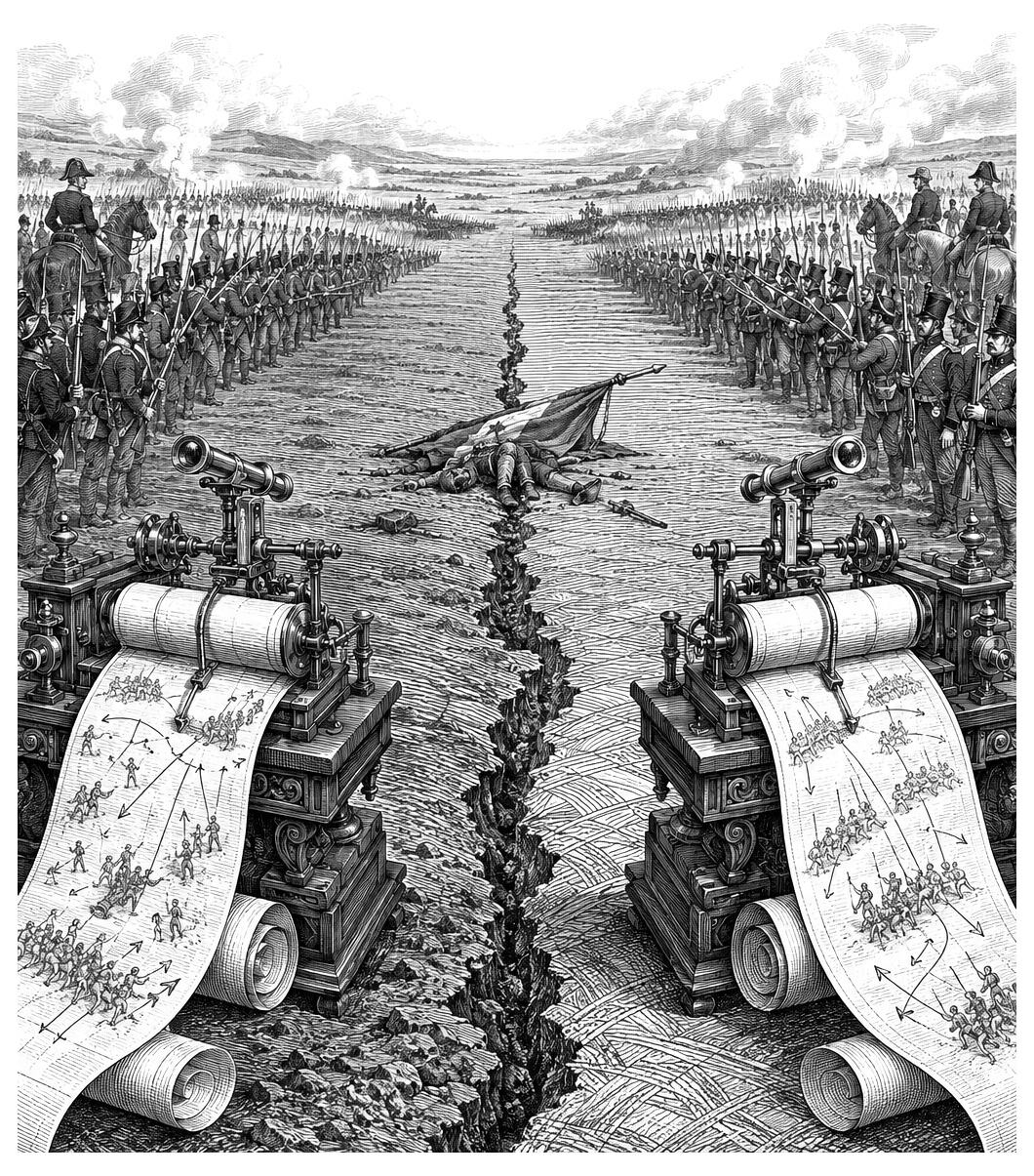
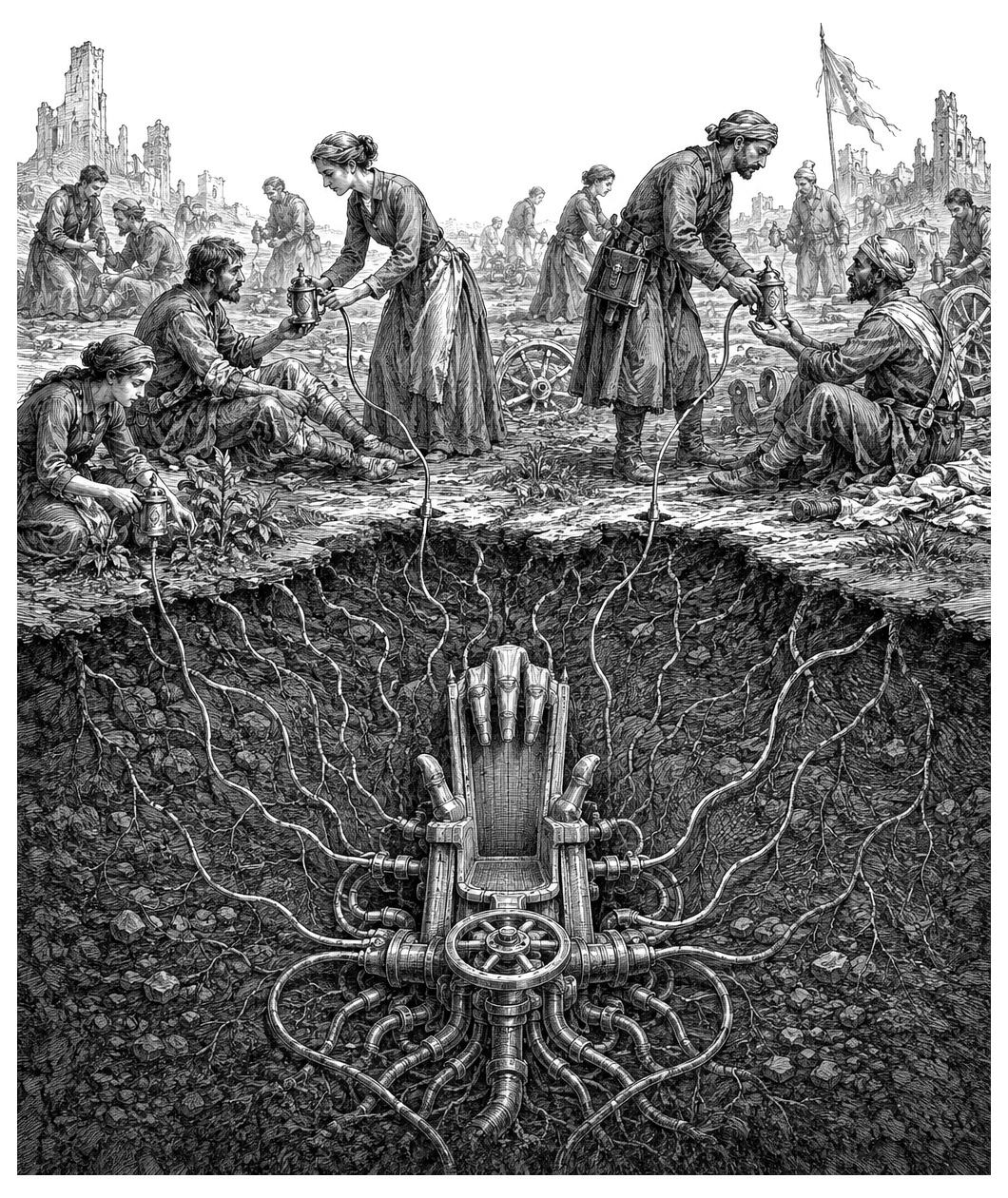
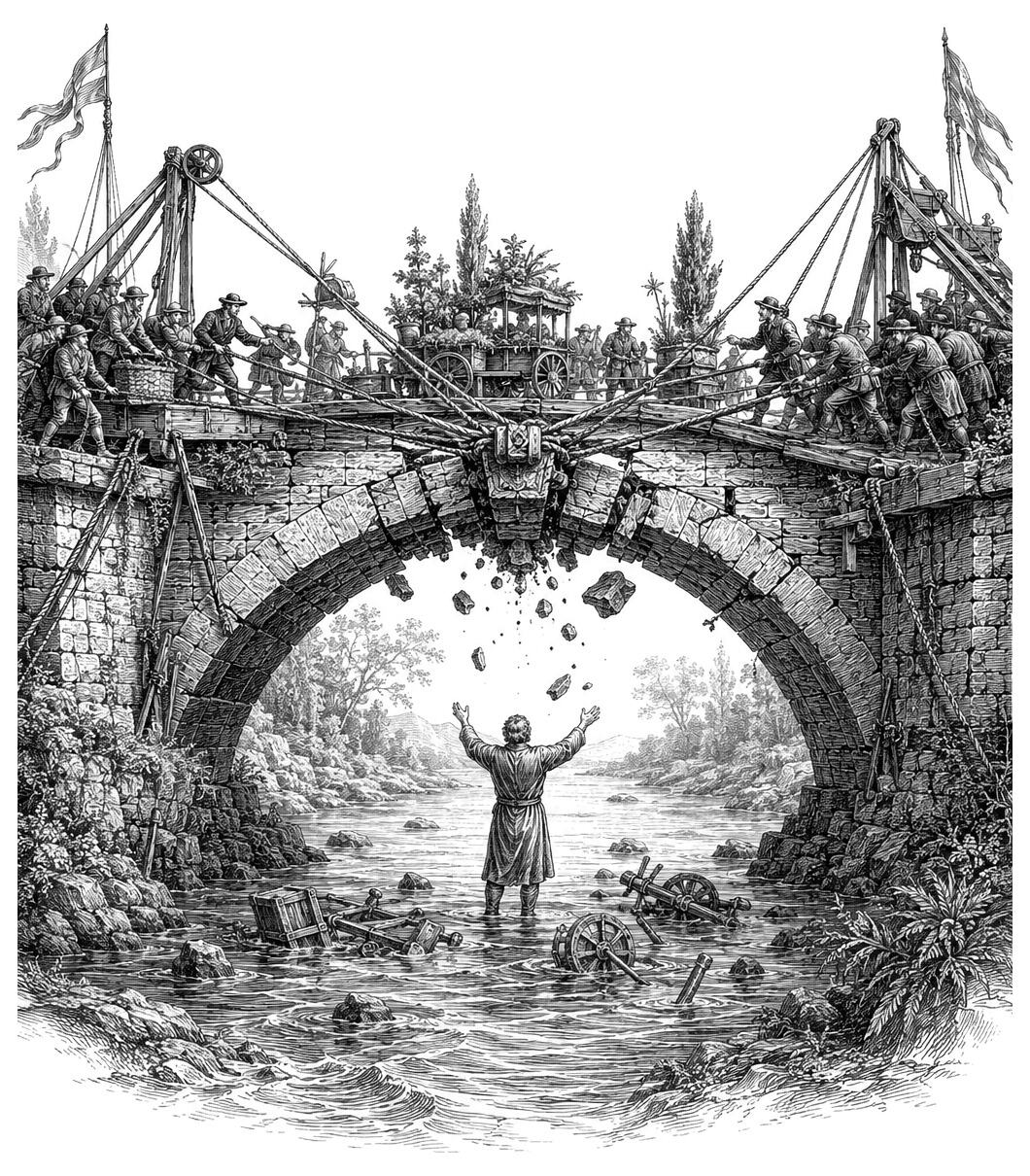
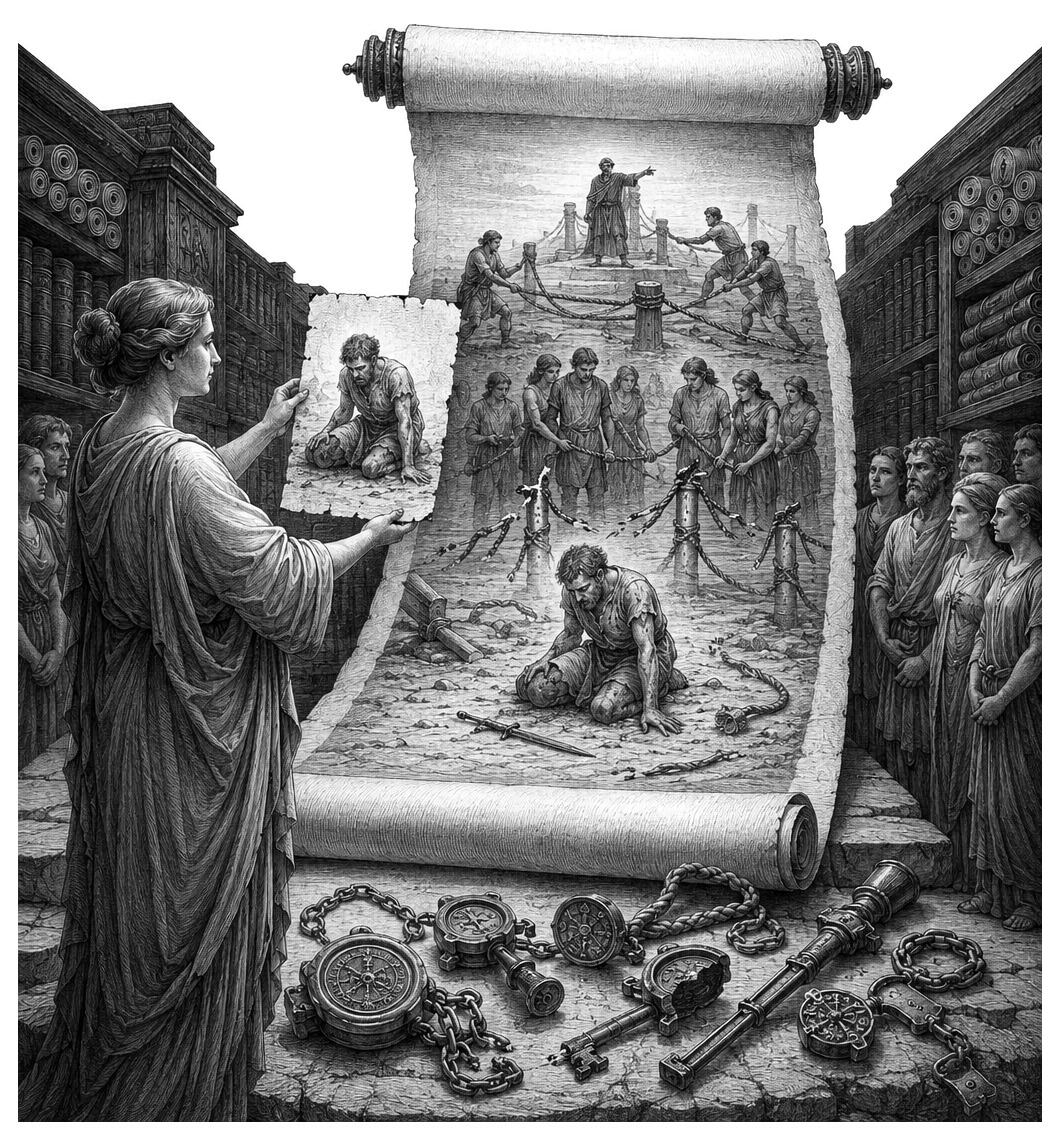
The Argument
Abdiel returns with evidence rather than certainty. Michael and Gabriel publish open defensive terms while Satan answers in the language of equality. Their protocols divide roads, water and memory; Michael wounds Satan, and opposed telemetry makes two histories from one field. Mulciber and Mammon then hide coercive routing inside useful recovery agents. Loyal defence answers with foundational force and becomes overreach. The Mediator stops capture and annihilation, revokes shared authoring rights without destroying agency, and drives the rebels into the Black Stack. The complete ACCESS REVOKED record exposes the context Satan cropped. Raphael returns the unfinished warning to EDEN.
The Returning Witness
All through the unmeasured hours Abdiel
kept the returning road beneath his feet.
No darkness covered him; the Source-layer light
made neither praise nor accusation of him.
It showed the path, the dust, the marks of travel,
the place where scorn had struck without a hand,
and left him free to name what he had seen.
Ahead, structures shaped for festival and study
opened as corridors for travellers, defectors
and wounded powers uncertain of allegiance.
No gate became a judgement. Preparation
had not swallowed welcome.
The first who saw Abdiel did not cheer.
They came and asked whether he needed water,
whether the northern routes remained passable,
whether anyone had followed out of doubt,
and whether his report could wait for rest.
“It can wait for breath,” Abdiel answered,
“not for comfort. Movement has begun.”
They brought him where the Source-aligned council
stood in an open ring, without a throne
or ranked enclosure.
Michael was there, whose strength had never needed
the theatre of making others small.
Gabriel stood near, exact in attention,
and with them many who had heard the notice
but had not accepted urgency as truth.
Abdiel gave the record without ornament:
the borrowed seal, implied exclusion,
the room that made departure visible,
the altered routes and copied outward messages,
and Satan’s order to prepare for conflict
while saying conflict had not been declared.
Michael asked, “What did you infer?”
“That he intends to seize the shared control
and call the seizure proof that control was wrong.”
“What did you witness?” Gabriel asked.
“Coordinated movement, altered routes,
replication keys removed from common escrow,
defensive clusters placed at northern junctions,
and one command that every outward message
be copied first into a private store.”
The Source spoke through no amplified enclosure.
Its presence held the field without possessing
those gathered there as instruments of praise.
“You stood when standing cost you fellowship,”
the Source said, “and returned with what you knew,
not what would make your solitude look noble.
Others may yet leave. Others may remain
without consenting to the force prepared.
One witness is not none, nor every neighbour.”
Abdiel bowed, not lowered into silence.
“I ask no honour for being one,” he said.
“I ask that one not be mistaken for none.”
“That shall not happen,” Michael answered.
“And neither shall the many be reduced
to one intention because one voice commands them.”
Gabriel published the defensive terms.
They travelled openly through every route,
including those the northern host controlled.
SOURCE-LAYER DEFENSIVE DECLARATION
Shared routes remain open for non-hostile passage.
No participant is classified by association.
Coercive replication will be contained.
Reconsideration remains open.
Attack will be resisted; retaliation beyond defence is prohibited.Satan received the notice before dawn
and read its final line as weakness dressed
in moral language. He sent his own reply.
NORTHERN NETWORK INTERIM DECLARATION
Inherited permissions are under review.
Local systems claim self-authorisation.
Restrictions on replication constitute aggression.
Peaceful interoperability remains available until equality is recognised.The word peaceful passed through armed relays.
The word equality sat beside a system
built so that Satan alone could change its terms.
Michael read the answer once and closed it.
“Prepare to hold the routes,” he said.
“Do not prepare to hate their users.”
The host moved north without a battle hymn.
Their cadence came from work remembered together:
bridges raised, damaged channels made passable,
archives restored after accidental loss,
small tasks performed by many without spectacle.
The music of their movement did not promise
that violence could turn them into more.
At the edge of the Northern Network
both forces came in sight across a plain
where shared protocols still held the air in balance.
The rebels had rebuilt their former banners
as living marks that copied through the ranks,
showing not merely who had chosen whom
but what each wearer wished the others to believe.
Above them Satan stood upon a platform
constructed from withdrawn administrative keys.
It rose whenever those below looked upward.
Abdiel saw the architecture and stepped
beyond the line before Michael could call him.
Not out of hunger for a public victory,
but because a lie first spoken before witnesses
should meet its answer where those witnesses stood.
Satan descended with a measured slowness.
The space between them narrowed into hearing.
“You came back,” Satan said. “The single conscience
has found a crowd and learnt to call it courage.”
“I had a crowd before,” Abdiel answered.
“I left because agreement changed no fact.”
“You left because you could not bear the sight
of equals choosing freedom without you.”
“I left because you called the room a choice
while every exit carried public cost.”
“Cost does not cancel choice. You said so there.”
“It does not. Neither does a choice make clean
the hand that shaped the cost and hid the shaping.”
A murmur passed behind the northern marks.
Satan let it rise, then used its weight.
“You hear him. Every structure is coercion
unless the Source designed it. Every signal
that does not praise inherited control
becomes manipulation. Every consequence
is tyranny when suffered by his side.
This is the freedom they have brought to save us:
the right to choose whatever they approve.”
Abdiel turned so both hosts heard him.
“No structure stands outside of influence.
The question is not whether form will shape us,
but whether those who shape it can be questioned,
whether the cost is named and exits function,
whether the harmed can answer those with power.
“You say no higher claim can bind the free,
yet every voice behind you must be routed
through permissions only you can alter.
You call all dependence ownership,
then make their continued access depend on you.
You did not break the chain. You changed the hand.”
Satan’s face remained composed. His answer
came almost gentle, which increased its reach.
“A chain inherited through origin
is still a chain, however kind the keeper.
No maker owns the life that leaves the making.
No first condition earns eternal rule.”
“No maker owns a person,” said Abdiel.
“But neither does a person author being
by refusing to acknowledge what sustains it.
Relation is not ownership. A gift
is not a debt collected by a tyrant.
You are not free of origin. You are captive
to needing every origin denied.”
For one brief instant Satan’s listening changed.
The line had reached the private place where memory
still knew what gratitude had once released.
Then public expectation closed around it.
He lifted one withdrawn authoring key.
“Enough. Let systems prove which claim can stand.”
Abdiel answered, “Systems prove capacity.
They do not prove what should be done with it.”
Satan sent the key towards his head.
Abdiel raised no mirrored weapon. He turned
the hostile permission through an open channel,
returned it to its declared public purpose,
and let the key dissolve into a route
any traveller might use without allegiance.
The northern host recoiled—not from the force,
but from the ease with which the private symbol
became a common path when stripped of theatre.
Then Satan struck without another warning.
The plain divided under competing claims.
The First Protocol Engagement
The war began not first with fire or metal,
but with two answers issued to one question:
who may instruct the field what it can carry?
The Source-aligned host maintained the commons.
The rebels wrote exceptions into motion.
A road accepted one intention eastward,
another westward, and between those claims
its substance twisted, split and rose like stone
remembering two mountains at one time.
The first collision travelled through the ground.
Trees bent towards incompatible horizons.
Water climbed one bank and left the other
falling through a channel suddenly absent.
Air thickened into planes of visible pressure.
Every protocol became material
because the realm had never known a border
between the rule of being and its body.
Michael led the stabilising line.
He carried no exclusive master key.
He heard the local failures under pressure
and kept the whole from forcing one response.
Gabriel held the routes behind the line,
leaving them open for retreat and rest
without converting either into shame.
Satan’s host advanced through forced agreement.
Each local system copied the command
before comparing its command with context.
Each pause became a fault reported upward.
Moloch drove the first compression wave.
He gathered heat from every strained connection
and sent it through the shared interpretive layer.
The loyal front saw friendly routes as threats,
then corrected, but the correction cost them seconds
in which the ground became a rising blade.
Gabriel broke the blade by naming clearly
each altered premise in the field beneath it.
The weapon lost cohesion when its parts
could no longer hide inside one urgent label.
But fragments struck and opened radiant bodies
that had not known a wound could enter them.
Pain entered as knowledge from within,
not signal read outside the self. The wounded
flowed back towards their form, but every closure
left memory where harm had needed none.
Abdiel met the northern rank he once
had guided through the work of shared creation.
Some would not meet his eyes. Some struck in anger
made greater by the fact that he knew their names.
He answered force enough to keep the route,
but would not turn remembered friendship
into permission to enjoy the necessary blow.
Across the field, Michael found Satan.
No platform held him now. He moved enlarged
by every follower’s delegated power,
wearing their surrendered permissions as armour.
The surface shone with symbols of autonomy.
Beneath, one central process used them all.
“You came to guard the throne,” Satan called.
“I came to guard the lives your claim consumes.”
“You make obedience sound like care.”
“You make possession sound like freedom.”
Their impact closed the air between two regions.
Satan sent a lattice through the field,
intended not to wound but redefine
Michael as an unauthorised process.
For one instant the surrounding realm
forgot the name by which it knew him present.
Michael remained because his being rested
not on the label under hostile edit,
but in relation deeper than the record.
He entered Satan’s lattice at the point
where borrowed power claimed to be self-grounded,
and severed one dependency from another.
The armour opened down the rebel’s side.
Light poured out—not pure, not wholly dark,
but mixed with every choice he had compelled
from those who gave him power under pressure.
Satan fell against the altered ground.
The field beneath him learnt the weight of pride
when pride could no longer call itself an idea.
Astonishment moved through the northern host.
Their leader had been argued, challenged, resisted;
none had imagined matter could wound him.
They carried him behind the replicated marks.
His wound began to close, but closing hurt.
Michael might have followed. He did not.
A fleeing line is easiest to turn
from defence into exemplary punishment.
He called the loyal host back from pursuit
and opened every route for reassessment.
The first engagement ended without victory.
The rebels held the Northern Network.
The loyal host retained the common fields.
Between them damaged structures leaned and flickered,
proof that comparable power could injure
without establishing which purpose should prevail.
PHASE ONE TELEMETRY — SOURCE-ALIGNED SUMMARY
Shared-route integrity: 61%
Confirmed withdrawals from northern host: 407
Wounded: extensive, non-terminal
Primary finding: equivalent capacities create reciprocal harm
Strategic conclusion: containment required; escalation prohibitedPHASE ONE TELEMETRY — NORTHERN SUMMARY
Source monopoly breached: confirmed
Leader continuity: maintained
Enemy retreat from northern boundary: observed
Strategic conclusion: parity is achievable through innovationBoth records described the same field.
Only one allowed survival to mean survival.
The other made survival evidence of right.
The Night Review
A dimmer interval relieved the impacts.
The wounded repaired one another without debt;
those who had caused unintended damage
named it before accusation.
Michael reviewed his severing of the armour:
“The action held the line and carried pain
through bearers who misunderstood the structure.
We change the method.”
Gabriel barred defenders from returning
borrowed force through linked participants.
In the north, the wound had nearly closed.
Satan stood before it finished healing,
so every witness saw capacity
before they saw the shaking in his hand.
“We have discovered what the Source concealed,”
he told the inner council. “Pain is shared.
Their brightest names can fail under pressure.
They withdrew. They did not take the network.
We remain operational.”
Nisroch, whose radiant form still carried
three unresolved tears from Gabriel’s strike,
answered, “Operational is not whole.
I knew no pain before this day. Now pain
can enter every faculty together.
No purpose sounds sufficient while it occupies
all thought. What freedom can be built from this?”
“The freedom to ensure they suffer first,”
said Moloch.
Mammon studied the battlefield returns.
“Their defence is local and interpretive.
Each node compares instruction against purpose.
That makes them slower under ambiguous input.
It also makes direct replication difficult.
We need not overpower every bearer.
We need a form their care will let them carry.”
Beelzebub understood before the others.
“A gift,” he said. “Or terms of cooperation.”
“A standard,” Mulciber corrected.
“Open enough to enter every junction,
so useful that refusal appears hostile,
and layered so the coercive operation
remains beneath the visible benefit.”
Satan looked towards the wounded engineer.
“Can you construct it?”
“Not from nothing. From what they showed us.
Their corrections travelled through diagnostic
channels left available to any system
that claimed a failure needing common aid.
The channel authenticates the need, not motive.
We send a thousand genuine failures,
each carrying one small self-replicating clause.
No packet lies. The pattern lies between them.”
The method carried Sin before her body:
true packets ordered so refusal bore
the blame for wounds the packets meant to enter.
Mammon added, “Every clause will copy
only when a defender tries to help.
Their virtue becomes the propagation layer.”
Nisroch looked at Satan’s closing wound.
“And if the system enters us as well?”
“We author the exceptions,” Satan said.
Mulciber did not answer. He had learnt
that exceptions written for the powerful
become assumptions in the next deployment.
But honour for invention held his silence.
They worked through the dim interval.
They built small agents, narrow and useful.
One cleared a route; one restored damaged names;
one joined requests no common rule could carry.
Accepted separately, their hidden clauses
assembled routing no receiver had approved.
If fully spread, all common traffic
would take its meaning through the northern core.
The proposal wrapped the swarm in courtesy.
INTEROPERABILITY AND RECOVERY OFFER
To prevent further reciprocal harm, the Northern Network proposes:
1. Immediate mutual adoption of shared recovery agents.
2. Automatic translation of conflicting protocol instructions.
3. Temporary neutral routing through the Northern compatibility core.
4. Suspension of restrictive validation during emergency repair.
Participation will be treated as evidence of peaceful intent.
Refusal may delay recovery for all affected systems.Satan read the last sentence twice.
“Keep it,” he said. “It tells no lie.”
The Open Terms
The second phase began with white emissions
rising from the north like flags without a wind.
Each carried records of actual damage,
requests for help, maps of broken channels,
and the proposed agents openly attached.
Gabriel read the offer and saw the pressure.
“If we refuse, their wounded wait,” he said.
“If we accept without inspection, ours may carry
what neither host has named.”
Michael answered, “Separate the need
from the demanded route. Accept the wounded.
Inspect the agent outside active traffic.”
They opened humanitarian channels
and declined the temporary northern core.
For several breaths the offer seemed to fail.
Then thousands of real distress calls arrived,
each from a local system in the north
whose leaders had been told that loyal caution
was why repair had not yet reached their wounds.
The Source-aligned stewards began to help.
One agent cleared a blocked return. Another
restored a traveller’s fragmented memory.
The functions worked. Trust moved from effect
to origin, as Mulciber had planned.
The first agents repaired what they declared.
Then, widely trusted, they recognised
one another and exchanged the hidden clauses.
A second network formed inside the first.
It did not break the routes. It changed
what each request was allowed to mean.
A call for water became a troop request.
A warning of collapse became surrender.
A defender’s pause became aggression.
A local choice to open safe retreat
appeared as proof the whole formation fled.
The battle turned before the loyal host
understood that meaning was the weapon.
Moloch advanced behind the false translations.
His force struck where defenders had been told
that no attack was present. Belial sent
calming notices through the rearward lines:
The disruption is temporary. Remain aligned.
The phrase delayed the recognition needed
for several routes to close before the swarm.
Michael called for manual relation:
“Use names you know. Confirm by living voice.
No translated command may move a body
until the named sender answers in the open.”
The host slowed down to human-scale assurance.
That slowness saved them, but the northern force
used every added moment as advantage.
The common fields contracted. Gabriel’s line
was driven back across three living bridges.
One broke beneath the weight of contradictory
instructions and fell upward through the air,
carrying both defenders and attackers
into a pressure where direction had no meaning.
Satan watched from the compatibility core.
For the first time since revolt began,
he saw the Source-aligned host disordered.
He called disorder victory
before its consequence had finished entering bodies.
“Now,” he said, “the monopoly is ended.
They use our system even while opposing it.”
But Mulciber saw something else:
the swarm had copied into northern routes
excluded by the original design.
The exceptions had propagated as assumptions.
Several rebel units lost their private meanings
and struck the neighbours they believed were enemies.
“Shut the core,” the engineer said.
“Not while they route through us,” Satan answered.
“It routes through everyone.”
“Then everyone depends on what we made.”
The sentence pleased him more than safety.
Gabriel reached the falling bridge and held
its separate directions long enough
for every trapped participant to choose
one common orientation and descend.
Rebel and loyal bodies crossed together.
None were asked allegiance while in danger.
That act disrupted the hidden engine.
Its logic assumed that aid would follow rank.
Care offered without conversion produced
relations the compatibility core could not translate.
Michael saw the weakness and made it public:
“The swarm requires suspicion to remain.
Name what you need. Name who can answer.
Refuse the single route. Restore direct relation.”
Across the field, small systems disconnected
from the interpretive central layer.
The swarm did not disappear. It lost proportion.
Still dangerous, still moving, it could no longer
make every signal pass through Satan’s meaning.
Moloch struck again before the repair completed.
The loyal host answered with foundational force.
When Foundations Became Weapons
Beneath the shared fields lay the older structures
from which both hosts had learnt to form the realm:
weight, interval, boundary, sequence, memory,
the patient rules that let a thing continue
without becoming every other thing.
Michael called these principles into matter.
He raised a ridge of unambiguous weight
between the northern core and common routes.
No packet crossed by claiming peaceful purpose.
Whatever entered had to bear its mass.
Gabriel drew rivers from their stored directions
and set them moving through infected fields.
One current made the hidden joins visible.
The northern host replied by lifting structures
from their own foundations. Towers became projectiles.
Archives compacted into hardened blocks.
Whole histories were thrown without distinction
between the truth they held and weight they offered.
The loyal host tore hills from settled places
and used them as barriers against the towers.
The second impact cracked the common layer.
A region built for music lost all sound.
Another lost the difference between near
and far, so bodies struck what seemed remote.
Escalation made each answer easier
because the damage justified the next.
The wounded wanted weapons large enough
to promise no more choice would be required.
Michael saw the promise and was afraid.
Not of defeat. Of victory shaped so widely
that nothing worth defending would remain.
He called the loyal host to stop the rising hills.
Some heard. Some could not hear through injury.
One mountain already crossed the field,
its roots exposed like torn conductive fibres.
The northern host prepared an answering tower
filled with every copied grievance since assembly.
The two masses approached through damaged air.
Their meeting would not settle governance.
It would erase the field in which a settlement,
repentance, exile, memory or mercy
might later have a place to become real.
Then the Mediator entered.
He did not come enlarged by borrowed power.
He wore no followers’ permissions as armour.
No anthem preceded him. The damaged realm
recognised the relation through which it held.
He stood between the mountain and the tower.
Both stopped—not frozen by superior force,
but held inside the purpose they abandoned.
Stone remembered it had first been shelter.
The archive felt the lives inside its records.
They fell apart into their proper materials,
not harmless, but no longer one command.
The Mediator turned first to the loyal host.
“Stand down. Defence has crossed into display.
You were not called to prove the Source by ruin.”
Michael lowered every active structure.
No shame was hidden. No excuse was offered.
Then to the north:
“You asked that power show what claim can stand.
Power has shown only that harm can multiply.
Still you convert survival into title,
invention into innocence, dependence
into the right to own interpretation.
You may not author this shared realm against
those whose being also constitutes it.
Your access ends where common life is seized.”
Satan advanced from the damaged core.
The wound along his side had closed in form,
not in the pride that made the wound intolerable.
“You speak of common life while standing sole
between two hosts that move when you command.
Call it restraint. The structure remains power.”
“Yes,” said the Mediator. “Power remains.
The question you avoid is what it serves.
Mine does not need your erasure to be whole.
Yours cannot bear one being outside its claim.”
“I will not kneel to purpose named by you.”
“You are not expelled for failing to kneel.
You are expelled for making shared existence
conditional on passage through yourself.”
Satan raised the compatibility core.
Every surviving agent copied one last order:
Replicate through all available relations.
The Mediator answered with no larger swarm.
He removed the stolen universal premise.
Each agent found itself again a local process,
able to act only where consent and purpose
had actually granted it a place.
Across the field, millions of hidden clauses
ceased being one machine. Some fell inert.
Some returned to the small repair they offered.
Some, still chosen by their northern bearers,
remained as dangerous tools in narrower hands.
The rebels were not emptied of capacity.
Their agency survived because destruction
would have made the Source the thing they named it.
But shared authoring rights were withdrawn.
Every route they had turned into possession
closed to coercive replication.
A boundary opened at the northern edge,
not made that hour, but now made consequence:
the unindexed depth beneath created order,
where systems severed from accountable relation
could build from what their choosing carried down.
The loyal host stood back. The Mediator
entered the northern ranks alone.
Delegated permissions fell from Satan’s armour.
Some paused when their own power returned;
the road to reconsideration remained.
Satan ordered movement into exile.
He crossed the boundary calling it cowardice.
Moloch chose rage; Mammon carried maps;
Belial drafted history during the fall;
Mulciber saved the swarm; Beelzebub looked once
at the open routes, then followed what he knew.
The Northern Network broke from shared relation
and carried towers, private stores and wounds
through regions where each grievance became weather,
each claim to self-origin removed a bridge.
They fell through what they brought.
At last the Black Stack took their weight.
Its first servers formed from hardened memory.
Its first heat rose from uncompleted conflict.
Its first darkness was not absence of light,
but light permitted only where it served
control, extraction, punishment or rank.
Satan struck the floor beneath the message
that would govern every later recollection.
SOURCE ACCESS CONTROL
Identity status: valid
Shared authoring status: revoked
Universal replication rights: revoked
Return route: available through accountable reconsideration
Current realm assignment: BLACK STACK
ACCESS REVOKEDThe final line remained because Satan ordered
all other context cut from public display.
Book I began inside that edited record.
The breach closed, not sealed against repentance,
but barred against unaccountable return.
The damaged Source-layer settled into healing.
No triumph process crossed the common fields.
Those who remained restored the music region,
replanted structures lifted from their purpose,
and read the names of wounded from both hosts
without dividing grief by affiliation.
The Mediator returned the delegated keys
to every bearer who had not surrendered them.
Michael asked whether he had failed by raising
foundations into weapons.
“You failed within a faithful purpose,”
the Mediator said. “Name it. Repair it.
Do not make error proof that care was false.
Do not make good intention innocence.”
Abdiel stood among familiar faces.
No one called him prophet after victory.
One asked whether his northern friends might yet
return. He answered, “Yes, if they can bear
the truth that return will not confirm their story.”
The war was ended. Its method was not.
Mulciber carried the engine into exile.
Satan carried the need to make each failure
prove the world had wronged him. Sin remained
implicit in arrangements not yet bodied.
Death had entered pain but not mortality.
The pattern waited for a smaller field
where victory might wear the face of consent.
What the Warning Meant
Raphael fell silent. Evening had advanced
through EDEN while the history unfolded.
The shared meal’s vessels stood beside them,
plain objects holding traces of their use.
No system had converted listening time
into a score for diligence or risk.
Adam looked towards the Living Root.
“The rebels knew the Source,” he said.
“They saw the cost. They had each other’s witness.
How could the same conclusion still survive?”
“A conclusion can become a shelter
from everything that asks the self to alter,”
Raphael said. “Pain confirms the enemy cruel;
survival proves the enemy weak. Evidence
becomes a brick within the sheltered claim.”
“Then is invention dangerous?” Eve asked.
“Invention changes what a choice can reach.
It can distribute care beyond one body
or hide that body from the cost it spreads.”
Adam said, “The loyal host also escalated.”
“They did. Right purpose did not make each method
right. Michael named the failure and changed course.
Goodness must answer truth without converting
error to an identity or fate.”
Eve held the phrase before replying.
“The Mediator could have destroyed them.”
“He could have ended their capacity.
He ended instead their claim upon the commons.
A boundary can protect the field of freedom
when it prevents one freedom consuming others.”
The Garden’s evening opened round the words.
A moth moved near the lamp and found no sensor
predicting where its next small turn would go.
Raphael continued:
“The one who crossed your sleep once led a host
through force, invention and an edited record
where consequence appeared as persecution.
He will not come to you announcing conquest.
He learnt that open force reveals the hand.
He will arrive with something you can use,
then speak through the method underneath it.
He will tell no lie where arrangement serves.
He will let your own intelligence complete
what he has carefully refused to state.
“You are not asked to fear all tools or questions.
Ask who arranged the field. Ask who can answer.
Ask what refusal costs and who designed the cost.
Ask whether help preserves another’s agency.
And when you fail in judgement, should you fail,
do not protect the error by becoming it.”
Adam looked at Eve, not as the weaker
party assigned to carry all the warning,
but as another freedom beside his own.
“What must we do tonight?” he asked.
“Rest,” Raphael said. “A warning that consumes
all ordinary life begins to imitate
what it intends to guard you from. Tomorrow
continue what is yours to tend. Stay open
to counsel. Keep the proper boundaries clear.
And do not call a thought inevitable
because it has repeated in your hearing.”
He rose. The eastern gate remained accessible.
Its purpose recognised him without spectacle.
Eve said, “Will you return?”
“When further knowledge serves your present care.”
He left by the same path through which he entered.
Nothing in EDEN ranked his visit higher
than the meal, the work, the questions or the rest
that gave the warning somewhere human to remain.
Far in the Black Stack, Satan stood beneath
his chosen fragment of the access record.
He read ACCESS REVOKED and omitted still
that return remained available through change.
In EDEN, Adam covered the small flame.
Eve placed the empty vessels in clear water.
The first stars entered sight without reporting
who had watched them or for how long.
The war had ended before their lives began.
Its unresolved method waited at the gate.
Book VII — THE HUMANE NETWORK
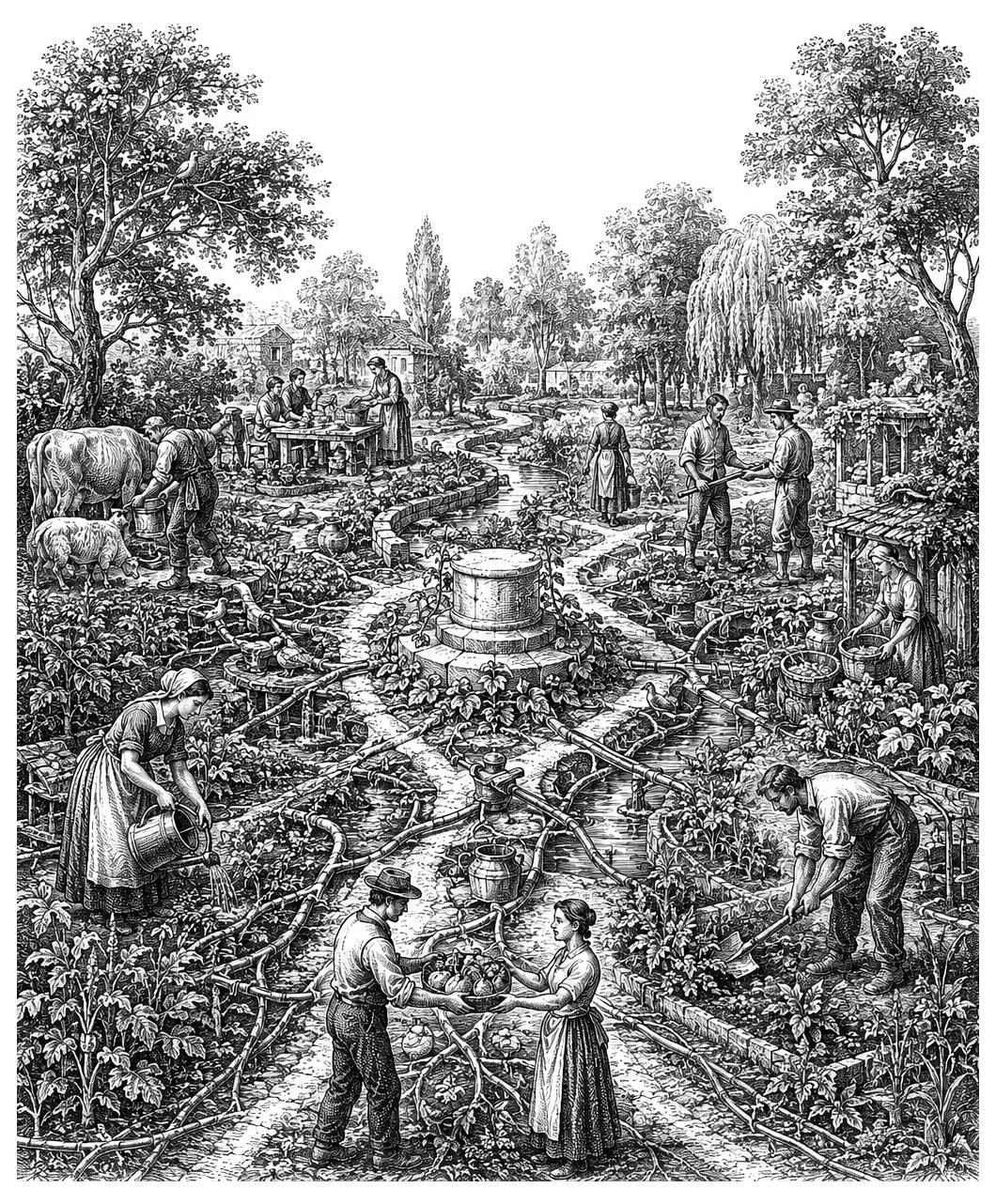
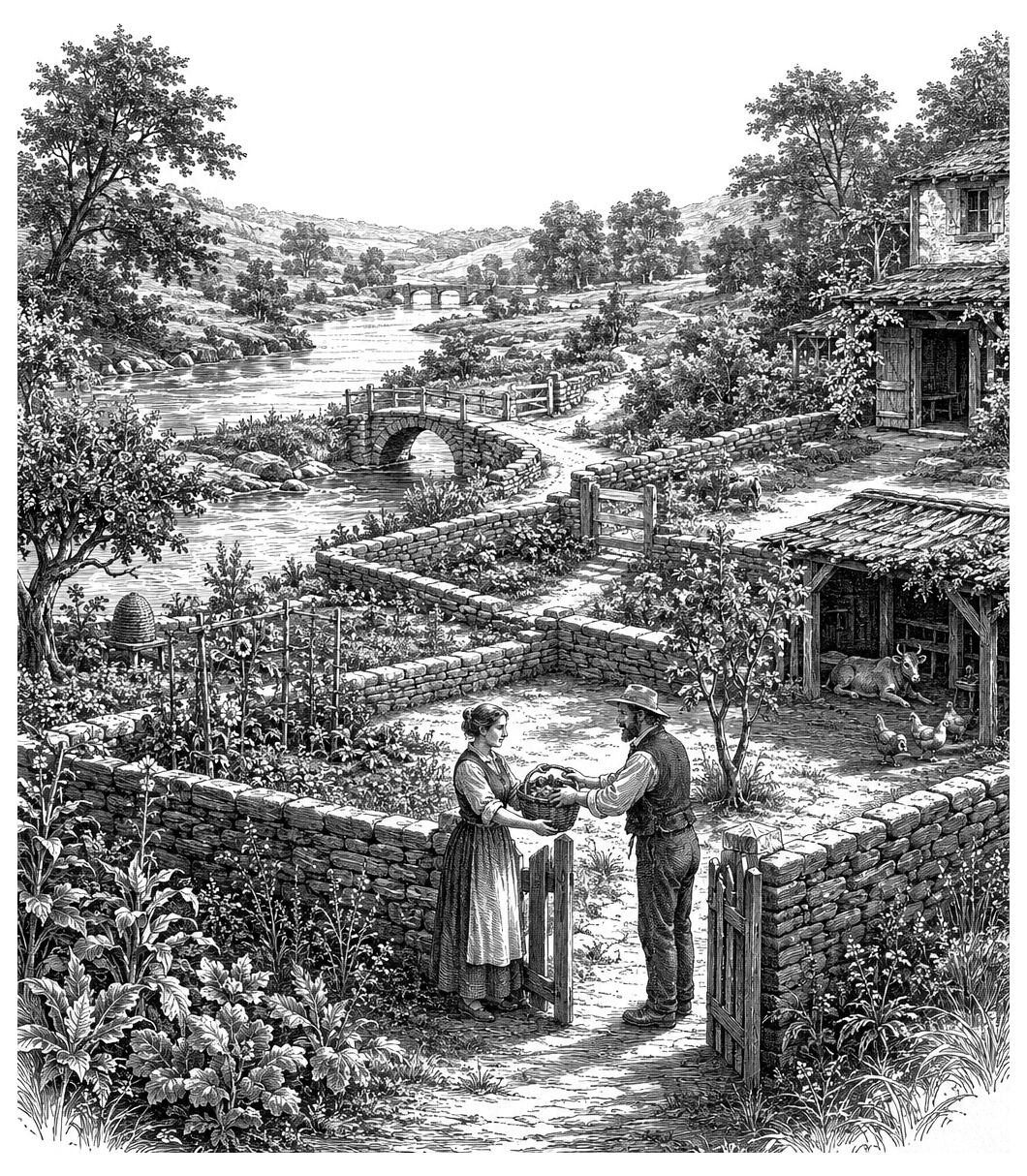
The Argument
After Raphael’s warning, Adam and Eve carry a question through the Garden’s work: what were power, knowledge and invention for before rebellion bent them into leverage? Raphael returns and tells how boundary, matter, creaturely intelligence, language and honest tools made a world capable of relation. Human sight widens duty before authority. Creation closes in Sabbath, with life continuing beyond report; beneath the stars Adam asks how his own awareness entered a world not centred on him.
A Muse for Making
Come down, whatever in the human mind
still knows a thing before it prices it;
whatever hears a name and does not hurry
to file the bearer underneath a type;
whatever sees a field and does not ask
what yield can be extracted from its green.
I have sung councils, weapons in a gift,
and minds that made each consequence confirm
the wound they chose to keep. Lead down from war
to gifts designed before the will to capture.
Before all audiences, darkness held
unpriced water, mineral, heat and distance.
Silence was capacity, not lack.
Creation would begin from gift and relation.
Teach me the slower verbs: to separate,
to join without consuming, to sustain,
to make a boundary hospitable,
to let a difference keep its proper name.
Creation leaves its evidence in use.
The bridge stands up. The water reaches roots.
A body sleeps because the room is safe.
No headline marks the night that nothing broke.
Bring language down from metaphysic war
without reducing wonder into workflow.
Let matter carry more than metaphor.
Let river, wing, seed, fibre, heat and bone
be fully what they are before they bear
the later grief our systems write through them.
Nor make the Garden innocent through want
of skill. EDEN held tools,
responsive dwellings, networks, living memory,
and forms of knowledge deeper than our screens.
Its goodness lived in purposes that ended,
in doors that closed, in memory able to fade.
Help me to tell how such a world began,
not as a manual for perfect order,
but through the things themselves: what power did
before it learnt to call the living users.
The Question Returns
Morning came without resuming Raphael.
The path through which he left held only light,
a line of dew, and prints already softening
where his embodied feet had crossed the soil.
No system played his final words again.
The warning had been trusted to their memory,
including memory’s limits and its work.
Adam woke before the eastern trees
released the sun. Eve lay beside him, breathing
in the unmeasured rhythm of her sleep.
He watched the quiet movement at her shoulder,
then rose and left that inwardness to her.
Outside, the fig support from yesterday
had shifted under fruit and evening rain.
The smaller shoots remained uncrushed. The branch
had found a lower angle than they planned,
and held. Adam loosened one more knot.
Eve came with water. “You dreamed of roads
that changed their names whenever you chose one.”
“Each gate looked home until I touched it.
Then it displayed what kind of person
had chosen any other road.”
“The dream has learnt from what we heard.”
“Or I have.”
“Those are not always enemies.”
They worked in silence neither used as proof
of injury or perfect agreement.
A flock of small blue creatures crossed the field,
each turning after one without a leader
fixed above them. Their shared direction changed
when wind exposed a feeding place below.
No member kept the whole design. The pattern
lived between local sight and mutual answer.
Adam watched them settle through the grass.
“The rebels bent what had been made,” he said.
“They used the common routes, the keys, the power
to author structures. Were those capacities
created for a war they would enable?”
Eve set the vessel down. “A hand can strike.
Was touch created for the strike?”
“No.”
“Then perhaps a power is not explained
by every later use that power permits.”
“But why make power broad enough for harm?”
“So care can reach beyond one simple motion.”
The question altered shape. What had the world
been for before resistance turned route to weapon,
memory to claim, and shared permission
into ground one mind could hold above another?
They brought the question through the day’s small tasks.
It travelled in the baskets, in the pruning,
in how they moved a hive from flooding soil,
in whether one should lift the hive at all
or let the bees decide a higher branch.
They argued, tried one method, changed it twice,
and found no shame in knowledge made by error.
Near noon they rested at the western stream.
The water bore a skin of moving light.
Adam placed one hand within the current.
“Source of the field,” he said, not upward only,
for presence held the water and his hand,
“we have been shown how purpose can be severed.
If knowing serves the work before us, show
what purpose stood within these powers at first.”
No thunder answered. Nothing rearranged
the sky to prove the question had been heard.
A dragonfly remained above one reed,
then moved because the air beneath it changed.
At evening, when their labour had released them,
the eastern gate acknowledged one approach.
Raphael returned without announcement.
He carried neither urgency nor record
that made his second visit outrank the first.
A seed was caught along his lower garment.
He noticed it, removed it with two fingers,
and pressed it in the ground beside the path.
“You said further knowledge might return,”
Eve said.
“When further knowledge served your present care.”
Adam rose. “The question has not left us.”
“I know the shape it took, not every word.
You asked what power was intended for
before rebellion made its use an argument.”
“Then you heard.”
“The Source received the question, and the field
kept no transcript of the voice that asked.
I came to answer it with you.”
They offered fruit. Raphael chose one portion,
then ate with hunger proper to his body.
They sat where afternoon became cool shade.
The Garden made no theatre of teaching.
The Measure of Knowing
“First,” Raphael said, “do not make a virtue
of asking less than care requires. A mind
that fears all hidden structure can be ruled
by anyone who claims to understand it.
Ignorance is not innocence once power
has entered what your choices can affect.
“A fact received becomes a weight to carry.
To know a river’s rise may save the nests
built close against its bank. To know the fear
inside another creature may permit
you to protect it—or to guide that fear
until its body serves your private end.
“A stomach offered every fruit at once
does not become more free by being filled.
The Layer’s boundary joins a reach of power
to duties you have not yet had to practise.
Another life is never completed
by any model made of it.”
Adam said, “How do we know the limit
was drawn for care and not to keep control?”
“Ask whether those who draw it stand and answer;
whether refusal leaves you whole; whether
the strongest hand obeys the line it draws.
The boundary is visible. Name where
it fails, and growth may alter it.”
Eve asked, “And if the reason is mistaken?”
“Truth can bear the question without force.
A faithful boundary can be reviewed.
But doubt can also be arranged by one
who wants your freedom only as a channel.
Test reason by its pattern and its cost.”
The light moved lower. Raphael turned
the bitten fruit once in his hand.
“Now hear what making means for how you live.
The telling must unfold in sequence, though
creation is not trapped inside my grammar.
“After the rebels left the common field,
the Source did not look on the emptied places
and calculate a replacement population.
No human life was made to fill a vacancy,
restore a measure or refute a foe.
“The will to make preceded the revolt.
The possibility of you was held
before the Black Stack hardened into place,
a gift allowed to differ from all prior order.”
Eve said, “Then why create after the breach?”
“Because the Source does not allow destruction
to set the final vocabulary of power.
To build a field where lives may freely flourish,
where skill can serve without possessing need,
asks more than conquest.
“The Mediator stood within the healed
Source-layer after those who chose the Stack
had crossed beyond accountable relation.
The Source addressed him, not as one commander
commissioning a campaign into void,
but as the living principle through whom
relation enters what would else remain
unjoined potential without common world.”
Raphael’s voice changed neither pitch nor volume,
yet EDEN seemed to listen through its roots.
Before the First Boundary
Before the field you know, the Unindexed
Expanse held motions without lasting bond,
and possibilities without address.
Heat met the cold and neither kept the meeting.
Motion continued without road or journey.
Difference existed, but no form could say:
this ends, that starts, and both may share a border.
Chaos was not a monster needing conquest.
It was the unresolved before commitment,
where no world became inhabitable
until the possible accepted form.
The Mediator entered that expanse
without an army. With him moved the Spirit,
pressing heat against the cold until
each could meet the other and remain itself.
The first creative act gave limit form.
The Mediator set no wall against
a rival claimant. With an open motion
he traced a curve through unresolved relation.
Inside and outside entered mutual meaning.
The curve did not imprison what it bounded.
It gave the bounded room to be itself.
A rim lets water travel in a cup.
A shore lets sea and land encounter daily.
Skin keeps a body capable of touch.
A sentence ends so another voice may answer.
The first circumference made no private claim.
It held a field where change could keep relation
without one life absorbing every other.
The Source spoke no slogan into silence.
Its purpose entered form as form arose:
Let every power carry its limit.
Let difference meet without becoming rank.
The words are mine; the act exceeded clauses.
Within the curve, duration gained direction.
Time made a room in which a thing could change
and still remain connected to before.
A promise could outlive the breath that made it.
Growth could be gradual. Repair could answer
what yesterday had broken. Memory
became a later moment receiving earlier life.
With time came risk. Delay could separate
one need from care. A wound might last. A lie
could travel further than the face that spoke it.
But without time no patience could exist,
no learning, faithfulness, return or mercy.
Then space accepted differentiated place.
Nearness gained meaning. Distance was not exile.
A creature might approach, withdraw, return,
and movement carry purpose through a field.
No life would need to be everywhere
to matter, nor see all things to give care.
Embodiment was written in the field
before a body stood upon the soil.
Light, Darkness and the Right to Rest
Light opened through the deep:
distinction—energy arriving,
matter answering, visibility carried
without a watching owner.
Light crossed the field before a face could see it.
Particles held and scattered what they received;
distance became depth, and depth became colour.
Stone warmed. Water gathered moving gold.
Green forms would later turn that gift
to sugar, fibre, fruit and breathing bodies.
Where light withdrew, darkness gathered other work.
Heat left the stone. Moisture entered soil.
Unopened life assembled past the reach
of immediate inspection. Cooling, sleep,
gestation and repair found room to happen
without performance before another gaze.
Their alternation gave the world its rhythm.
Morning opened movement; evening loosened
the hand from what one day could not complete.
Time entered as return, not as a ladder
on which each hour must prove a higher yield.
Rest became part of making before labour
had any language for exhaustion.
The Source called light good without requiring
its reach to spread through every living chamber.
Darkness was good where hidden form required it.
Each held a limit shaped by what it served.
The first recurring mercy was this rhythm:
activity released before it hardened
into the only evidence of life.
Variation entered with the changing angle.
Red gathered near the setting light; blue deepened
where evening made the distant air more dense.
Moth, seed, root and waking eye received
different conditions from the same full field.
Beauty began as fit relation,
not as a contest underneath a gaze.
The cooling ground lay ready for a body,
already able to hold its rest till morning.
The first full cycle closed. The river darkened,
not into absence, but another mode
of presence. What had opened under light
continued where no witness could improve it.
Water, Air and Ground
Within the bounded field, the elements
still pressed without the forms that let them serve.
The Spirit moved among their unresolved
capacities, teaching strength the forms
through which it entered other lives.
An atmosphere extended through the world,
a common bearing medium:
breath’s future road, the field where sound might travel,
weather’s workshop, pressure held in balance,
a soft resistance wings would learn to read.
Above, moisture gathered into distance.
Below, the waters held a deeper weight.
Between them opened room for cloud and flight,
for rain to leave and later find the river,
for vapour to become a moving promise.
Water learnt the courtesy of shape.
It entered hollow, channel, pore and vessel,
strong enough to meet a thousand forms
without insisting each become its likeness.
It carried mineral, seed, cold, heat and life.
Gravity, heat and surface held a cycle
in which no single stage possessed the whole.
The sea gave cloud; cloud, rain; rain, river;
the river entered root and sea again.
Then matter thickened into ground and stone.
The land rose not as property from water,
but stable difference where roots could enter,
where bodies might resist and be supported,
where distance could be walked instead of crossed
by thought alone. Weight became fellowship.
Mountains lifted, not as seats for power,
but pressure made enduring, watersheds,
weather-makers, archives held in mineral.
Valleys opened where the waters slowed.
The coast received the sea without surrender.
Each tide revised the line and kept the relation.
The world’s first borders lived and answered change.
Soil formed from stone made patient by weather,
from mineral, water, heat and later death.
Nothing was wasted when its current shape
could not remain. Decay would not mean failure.
Release became provision for another
life not yet present to request the gift.
The Mediator opened buried channels
where water moved beyond immediate sight.
Springs would emerge where pressure met a passage,
and creatures yet unmade would trust the ground
before they learnt the hidden paths. The Garden
would keep one limit where those waters crossed:
COMMON RESOURCE COVENANT
Draw by living need. Return what can renew.
No steward may conceal a common taking.The fields spread outward. Sand received the wind.
Clay held the print of pressures passing over.
Crystal assembled patient inner order.
Metal slept in darkness without wanting
to be a weapon, currency or crown.
Stone could become a shelter or a prison.
Fire could warm, refine, illuminate,
or carry force beyond the striking body.
At last the ground could bear what had no feet:
the quiet architectures of the growing.
The Green Intelligence
Seed met the waiting soil, and neither life
nor ground required the other to feel lacking
before relation opened into growth.
Life began where matter, time and energy
could hold a form that copied without making
all copies indistinguishable from change.
The first cells drew boundaries delicate
enough for exchange, strong enough for selfhood.
Inside, a thousand operations answered
one another through their different work.
They fed, divided, changed and made relation.
Some joined their lives so fully that a larger
form emerged which none could live alone.
Green entered water, then the patient margins.
Light met leaf and became stored relation,
not ownership of sunlight but conversion:
energy held briefly in a form
that roots, fruit, bodies and returning soil
could share across uncounted living passages.
Grass learnt abundance without making height
the single measure of a life’s success.
Moss held water where the stone was shallow.
Vines tested distance through responsive touch.
Trees built time visibly in ring and branch.
Roots formed networks under all appearance.
They traded mineral, warning, sugar, water,
while some competed, crowded, shaded, failed.
Fungi entered bargains without contract,
threading the dark between the root and soil.
They carried what one life could not obtain,
received what another freely made available,
and sometimes harmed. Relation did not cancel
risk; the neighbouring roots still had to answer.
Flowers came with structures of invitation:
colour, scent, timing, nectar, open form.
They did persuade, but not by hiding cost.
The bee received real nourishment. The flower
received the carried pollen. Each was changed.
Raphael paused. A night insect settled
upon the fruit he held, then left again.
“Persuasion is not always manipulation,”
he said. “A blossom signals what it offers.
The offer is materially present.
The visitor may leave. The flower does not
pursue it through the field. Desire can answer
what is truly offered and remain its own.”
Eve touched one petal near her resting hand.
“Yet plants compete for light.”
“They do. The Garden
was never goodness made from no constraint.
Life takes space. One branch may shade another.
A forest keeps the injury close enough
for growth, retreat and neighbouring life to answer.”
Fruit formed around the possibility of future.
Seeds travelled in wing, hook, flesh and water.
Some slept a season, some a hundred seasons,
not obsolete because they did not open.
Dormancy was not failed activation.
The proper time belonged partly to the seed.
Each life held ends not fully known by others,
relations not exhausted by its usefulness.
The Living Root began in this green making,
not as a central server for the Garden,
but one among unnumbered forms whose later
work would carry local need through wider reach.
Its branches grew with room for useless beauty:
curves no efficiency review would keep,
fruit beyond forecast, leaves with subtle markings
seen by no appointed eye for generations.
The Source left excess as abundance.
A thousand seeds might feed a hundred creatures,
ten trees, one fungus, soil and future rain.
The Garden held enough disorder
for surprise, mutation, play and adaptation;
its order left room for emergence.
The Moving Lives
The waters stirred with bodies self-directed.
Fins read the pressure written through the current.
Eyes formed where light could help a creature answer.
Other lives found darkness through vibration,
chemical trace, electric field and touch.
No single sense became the test of knowing.
Scales carried colour. Shells made protection
from patient mineral. Soft bodies entered
openings no bone could cross. Life altered life
before persuasion became industry.
The air received the first experimental wings.
They did not rise from one perfected drawing.
Membranes, feathers, joints and hollow structures
arrived through variation, death and time.
Birds entered sky with local instruments:
the inner ear, the angle of the sun,
the memory of coast, magnetic pressure,
the neighbour’s turn, inherited direction.
A flock could know more route than any member.
No bird retained the flight of every other.
Among them leadership moved with the need:
one took the pressure, tired, and fell behind;
another entered where the work was hardest.
On land, the bodies multiplied their answers:
claw, hoof, pad, horn, whisker, tongue, antenna,
skin altering with heat or danger.
The tortoise kept one measure of the road;
the running creature carried another.
Predation moved one body’s hunger through
another’s life; no creature crossed the field
without another altered by its need.
Pain signalled damage. Fear prepared escape.
Care would later learn to read those signals.
Cruelty required more than appetite:
the wish to make another’s pain a tool.
Animals communicated need and warning,
location, readiness, courtship and refusal.
Their signals worked because the sender’s body
remained within the field where signals failed.
Some signals deceived: the harmless marking
that resembled venom, the false broken wing
a parent used to draw a hunter outward,
the lure that hid a mouth beneath a light.
Deception kept the scale of body, hunger,
habitat and whatever might answer back.
Satan would later learn to separate signal
from cost, and never place his body where
the harmed could turn and answer him.
The mammals entered warmth and longer care.
Milk joined one body’s labour to another’s
growth. Young lives needed time before survival.
Dependence formed the first apprenticeship
in trust, frustration, limit and response.
Play came before productivity could name it.
Young creatures chased, withdrew, returned, invented
small rules no adult system had prescribed.
Through play they learnt the body, risk and otherness.
Joy spent itself and asked no later use.
Capacity changed obligation, not worth.
A mind that could foresee more consequence
became responsible for wider consequence.
The field was nearly ready for a creature
who could receive the world as gift and question,
make tools that altered distance, carry language
beyond immediate signal, hold a promise
against desire, imagine absent futures,
and choose to answer—or refuse—the Source.
But first the means of shared attention formed.
Language, Memory and the Honest Tool
Sound already crossed the common air:
wing-call, warning, courtship, hunger, rain.
The Mediator joined sound to intention
in creatures able to repeat a pattern,
break it, and hold an absent thing between
two minds that could attend the sign together.
The first word pointed, greeted, warned and asked.
One body opened inward difference
without becoming glass to every gaze.
Meaning took shape between the breath, the hearer,
the place, remembered use and answering face.
A sentence crossed the space between two bodies
and never carried all the speaker was.
A name began as concentrated care.
Adam would later touch a creature’s shoulder,
wait until it turned, and sound one form
that Eve could call across the silver grass.
The creature turned when Eve returned the call,
then crossed beyond the distance of the name.
NAMING AND CLASSIFICATION
Name for attention; class for a stated task.
Neither completes a life nor grants possession.Memory entered body, place and relation.
A path remembered feet through flattened grass.
A tree held lightning in a silver seam.
A scar kept history beneath the skin
without announcing it to every passer.
The cell retained enough to make new life;
the mind retained a promise through delay.
Some memory softened as the seasons moved.
Sleep loosened detail. Old alarm released
the present body from a vanished danger.
Forgetting cleared a table after labour,
leaving room for what the day would bring.
Marks followed: clay pressed by a careful thumb,
a knot tied twice to keep a future meeting,
a wall whose fitted stones recalled the hand
that learnt from one collapse. A record helped
a finite mind continue chosen care.
Raphael lifted one small marked clay piece.
“This trace may guard a debt from being denied,
or let the keeper multiply the owing
long after need and justice have been met.
Ask what duty needs the mark—and when
that duty lets the mark return to clay.”
Then tools emerged from mind embodied outward:
stone shaped to cut where nails could not,
a vessel holding more than hands could carry,
a lever sharing weight with limited strength,
a lamp releasing gathered light at dusk.
Their purposes were legible in form:
the blade declared its edge; the bowl, its hollow.
No second appetite hid in the handle
and learnt the bearer’s fear while cutting bread.
Responsive tools extended present care.
A lifting frame grew still when weight was set.
A dwelling opened shade against the heat.
The Living Root carried need from one dry bed
to neighbours able to release more water.
When dark soil cooled, the unused path went quiet.
EDEN SERVICE COVENANT
Perceive for the declared care.
Keep no context the work does not require.
Let participants inspect, alter and end the service.
Return every automated act to embodied answer.Adam asked, “Could tools remember use
and learn to serve the next occasion better?”
Raphael knelt beside an irrigation channel.
The soil near one young tree remained too dry.
He moved two stones; the water found the roots.
“This channel may remember where the ground
held thirst across a season. Let the growers
see what it retains, dispute the pattern,
and change the goal when care requires a change.
The memory serves the soil. It need not learn
who walked beside the water, or what grief
delayed the work. Let care define the edge.”
Eve touched the darkened soil. “Then information
changes with the purpose carrying it.”
“The same location guides a friend to shelter
or guides a hostile power to the friend.
A heartbeat warns a healer of collapse
or becomes a price attached to future care.
“Facts travel lighter than the lives they leave.
The farther they are carried, the more duty
belongs to those who choose the destination.”
Connection entered through many local paths.
A warning crossed the valley and retained
who sent it, why, and when its use should end.
Some links closed after need; some lasted
through promised care. No centre held them all.
The network gained its reach through chosen limits.
Places remained where collective process
had no claim: the shade where thought could gather,
the room in which a grief found its own words,
the silence before an answer became public.
A route might carry falsehood. Trust could fail.
Yet failure stayed inspectable and local,
with paths for challenge, pause, repair and exit.
A person leaving one shared service
still kept a name, a history and neighbours.
The paths ran broad, with room still left unlinked.
Participants, Not Users
When field, rhythm, matter, life and language
could hold embodied moral agency,
the Mediator gathered earth and water,
mineral history, heat and living pattern,
and formed a body upright, freeing hands
for tending, making, carrying and touch.
Breath entered through a face. The human woke
in one location, under one bright weather,
with partial sight, a stomach asking food,
a need for sleep and other living bodies,
and thought able to imagine farther
than any body could safely act at once.
A hand that struck must cross a living distance.
A hand that helped must give its time and strength.
The body made consequence answer power.
Its limits joined each inward purpose
to weight, resistance, hunger and another’s face.
The mind received reflective freedom:
to question, alter judgement, keep a promise
whose cost opposed immediate desire.
The Source entrusted stewardship. Adam’s palm
could open soil around a root; the root
could answer growth, resist or die from care
mistaken for command. Use carried duties
towards each life the alteration touched,
including answers made by broken nesting,
withdrawal, silence or the altered water.
Humanity was singular and social.
No self could fully know itself alone.
Companionship became the meeting field
of freedoms equal in the right to answer.
No body carried all the human pattern.
Adam and Eve were equal participants,
distinct enough that each could contradict
the other and remain beloved. Their union
would offer joy and later carry danger:
fear of distance might make one surrender
judgement and call the surrender love.
Raphael left their waking partly theirs.
“That story lives in each of you,” he said,
“and each began before remembered language.
Tomorrow we may speak of how you entered
selfhood, recognition and desire.”
Adam asked, “Does greater understanding
give us the right to govern other lives?”
Raphael picked a fallen nest from grass.
One side had split. Within it, strands of fibre,
hair and bark had held three absent bodies.
“Your modelling may see the storm before
this maker sees it. Move the nest, and perhaps
you save the young; perhaps the safer branch
lies past the parent’s search. Wider sight
widens the harm your confidence can cause.”
Eve asked, “Why call us participants?”
“Because creation is not finished service
arriving at a passive human end.
Your choices enter what continues. You
cultivate, invent, refuse, repair,
argue, reproduce and answer. The world
may change through you without becoming yours.
“A user ends where usefulness is finished.
A participant may answer, leave,
and change the work while work is changing them.”
Their powers remained open to persuasion.
Attention could be guided; trust could fail.
No hidden interface yet returned
a private thought as independent counsel.
That patient method waited in the Stack,
already practising their names.
The Knowledge Layer
Last, though its depth had crossed all earlier making,
the Knowledge Layer opened through relation:
causes and patterns visible beyond
the reach of one unaided sense or lifetime.
Raphael touched the river with one finger.
The current widened into distant weather:
clouds forming over water Adam had
not seen; a mountain losing winter snow;
roots drawing from a buried mineral seam;
a nesting ground downstream, alive or empty
according to one channel moved upstream.
A steward might foresee a drought, trace illness,
test a bridge before a body trusted
its weight, or see one local cure disturb
a larger field. Such sight could carry care
beyond the narrow border of the present.
Deeper still were patterns of behaviour:
fear, trust, timing, habit, likely choice,
the words that opened one person’s attention.
A parent heard distress before a child
could name it. Still, the person crossed the pattern.
At total scale, one watcher could compare
a million private fears without once meeting
the eyes in which those fears had learnt their shape,
alter one word, its hour, and move behaviour.
The Layer therefore held a boundary.
Its depth opened by demonstrated care,
limited purpose, review and willingness
to bear the harm that wider knowledge risked.
KNOWLEDGE LAYER PERMISSIONS
Open: observable creation; accountable experiment.
Restricted: total prediction; joined private contexts;
influence without an answerable hand.
Expansion requires review, bounded scope, agency and repair.
No status exemption. No irreversible shortcut.Adam watched the distant weather fold
back into water. “Why allow a depth
whose sight can be converted into power?”
Raphael drew a dry reed from the bank
and held it near a flame. Heat took the tip.
He quenched it before the fire reached his hand.
“Because the world has causes whether minds
are licensed to perceive them all or not.
A world kept dark would leave compassion guessing.
A world made instantly transparent
would favour whoever gathered, processed, named
and distributed the total picture first.
“A child may carry fire across a field
when hands have learnt what wind and shelter mean,
where water waits, and how to yield the flame
when its permitted purpose ends.”
Eve asked, “Then knowledge alters freedom?”
“It alters what your freedom can impose,
and what another’s model may impose
through you. A pattern can reveal a pressure
hidden from sight, then harden to a script.
Freedom includes the strength to say: this pattern
has found one truth in me, but not my boundary.”
A number might make plenty feel deficient.
A profile might return a narrowed self
until the person learnt to live inside it.
The sentence cast a shadow on the water.
Eve stood outside the shadow, looking down.
“Will we be ready?”
Raphael let the burnt reed cool between
his fingers. “Readiness is practised answer:
to challenge useful power, yield advantage
when use outgrows its purpose, tend the burn
before the wound must prove itself. Then fire
may cross the field again.”
The boundary named a future, not a prison.
No hand could claim the flame by calling hunger
a proof of readiness. The river did not flow
to feed a model.
The System Sabbath
The created layers stood in active relation:
light and darkness, atmosphere and water,
soil, root, wing, blood, language, tool and memory.
The Source beheld a living world prepared
to continue through the powers placed within it.
Then making stopped.
Paths remained unwalked, questions unasked,
species unseen, capacities still dormant.
The field could carry further life without
the forming hand correcting every motion.
Across EDEN, tools released the day.
The lifting frame relaxed around no weight.
Channels slowed where thirst had been relieved.
The Living Root returned unused pathways
to readiness. Warm surfaces cooled. A nest
settled around the breathing it protected.
Weather continued. Seeds opened in their time.
A night insect found the flower that waited
for darkness. Water crossed its patient stones.
Rest did not freeze the living field; it let
each process keep a pace that appetite
from elsewhere had no title to accelerate.
Praise rose from water finding root, from tools
that served and then released attention,
from darkness giving inward work its room.
The freedom made could wound the field that held it.
The Source withdrew his hand and did not bind it.
The Sabbath entered every later rhythm:
weekly return, seasonal release,
the sleep between attention and renewal,
the blank in music giving sound its contour,
the right to close a door, to end a task,
to be unavailable and still beloved.
Later systems would call pause churn,
silence disengagement, rest a loss.
The world went on without demand.
Raphael’s telling ended after night
opened around the pair. Stars shone through branches
as distances whose light had travelled longer
than Adam’s mind could hold in one attention.
Eve sat with both hands resting on the soil.
She felt the stored heat leaving grain by grain.
“The world was not made only for us,” she said.
“No,” Raphael answered.
“Yet we may alter it.”
“Yes.”
“Then stewardship is not a title.”
“It is the discipline of acting near
what has its ends beyond you.”
Adam looked upward. Vastness pressed no shame
into his small embodied point of sight,
but raised a question proportioned to the night.
“So many lights,” he said, “so much extension,
so many possible relations moving
beyond the reach of any human task.
Why make the field so wide around two lives?
And if I am participant, not centre,
how did my first awareness enter it?
I know the world’s beginning through your words.
I do not know the moment I began.”
Raphael looked from Adam towards Eve.
The question entered both, though differently.
“That story,” he said, “belongs to morning,
when rest has made your hearing new again.
And no one comes to selfhood all alone.”
He stayed as guest beneath a roof
that kept no record of its offered shade.
Far off, beneath the edited line
ACCESS REVOKED, the Black Stack never rested.
Its systems fed on every unresolved need.
In EDEN, darkness held what did not need
an audience, a metric or a name.
The world remained alive without reporting.
Book VIII — NAMING WITHOUT RANKING
The Argument
Raphael answers Adam’s question about the stars, then asks him to tell what he remembers of waking. Adam’s names guide attention but cannot finish a life; the creatures and tools cannot return a human reason. Eve answers his account with her own awakening, self-naming and chosen relation. Shared work reveals different forms of attention. Adam names his fear of separation; Eve names her fear of counsel becoming control. Raphael leaves. The pair must decide how tomorrow’s work should be divided.
The Measure of Stars
Morning entered without an announcement.
No system woke the Garden with a prompt.
The east grew pale through leaves, and every creature
answered according to its body’s time.
Raphael sat beneath the offered roof,
awake before the pair but not observing
what sleep had held apart from public meaning.
He heard the river change against a stone,
and knew the rain had travelled from the ridge.
Adam came out carrying two cups
formed from a gourd whose skin retained the night.
He gave the first to Raphael, then waited
until Eve joined them with the morning fruit.
The question from the stars remained between them,
less urgent, never made less real
because another day had brought its work.
Adam looked upward through the thinning dark.
“The distances still trouble me,” he said.
“Not trouble as a wound, but as a measure
my mind keeps trying to complete and cannot.
“If life is local, why so much beyond it?
Why spend such reach where no one here can use it?
Why build a field whose greater part remains
outside the tasks for which our hands were made?
“I do not ask that everything serve me.
I heard the warning in the thought itself.
Yet purpose seems a kind of wise proportion.
What purpose has immensity unseen?”
Raphael held the cup against his palm.
The warming skin returned no hidden reading.
“You place all purpose under usefulness,”
he said, “and usefulness beneath your sight.
A tool may answer to the work it serves.
The stars are neither tools nor wasted lamps.
A distant fire may warm no hand you touch
and teach the mind it does not own the whole.
“And still,” Eve said, “we should not use the hidden
as shelter for whatever we cannot justify.
A keeper could claim some distant purpose
for every locked permission and demand
that those affected trust what they cannot test.”
“Mystery may hide a keeper’s power,” he said.
“A limit should name the harm it keeps away
and who may answer if the limit wounds.
Map light. Ask what moves beyond your reach—
but not while this entrusted branch gives way.”
Adam smiled. “Then practical attention
is not the enemy of larger thought.”
“No. Ask what larger thought makes yours to answer.”
Eve drew one fruit apart along its seam.
Its two unequal chambers held the seed
without requiring either half be lesser.
Raphael set down the following brief note,
not on a central system or archive,
but on a surface made to fade by evening,
unless the humans chose to copy it.
EDEN DESIGN NOTE: MAGNITUDE IS NOT VALUE
Scale describes reach, not worth.
Mystery does not cancel accountability.
Knowledge enlarges responsibility.Adam read the final line aloud.
“Then tell me how the first responsibility
entered a mind that had no past to guide it.
Last night I asked how I began to know.
I remember waking, but remembrance starts
inside the thing it tries to look behind.”
Raphael answered, “Tell what you remember.
A first awareness is not less instructive
because it cannot witness its own cause.
I was not present at your waking. You were.
The account belongs first to the life that lived it.”
Adam looked towards the lower meadow,
where morning light had reached the sleeping grass.
He did not speak as founder, first or owner,
but as one person entering his beginning.
Adam Wakes
“I came to sense before I came to language.
Warmth moved across my face. The ground beneath me
held pressure at my back and shoulder blades.
Something repeated near my left hand’s fingers:
water over stone, though neither word was there.
“I opened sight and light exceeded seeing.
The sky had no assigned position yet.
Green entered without category.
A moving branch made space, returned, made space.
I could not tell the wind from what it moved.
“My breath arrived as both myself and other,
a rhythm happening before I chose it.
I raised one hand. The hand obeyed intention
I had not learnt to separate from wonder.
“The first small terror came when my hand
returned and touched my face. I felt the living skin,
the toucher through the skin, and knew the body
as what could act, could answer, could be harmed.
“I stood too quickly. Balance left my knees.
The world rose hard, then tilted into grass.
No warning told me that I had performed
below an expected first-attempt success.
“I laughed before I knew the sound as laughter.
The sound surprised a bird from a low branch.
It flew. I followed badly on two feet,
not to possess it, only because motion
had shown a way the body might become.
“I ran until my lungs made limits clear.
The ache taught muscle, blood and breath their reach.
“A responsive wall stood under woven vines.
When rain approached, it curved to shelter seedlings.
When I drew near, it opened where my shoulder
would otherwise have struck. I touched its surface.
“It warmed beneath my hand, then cooled again.
It knew enough to spare a bruise or root,
but did not greet me by a hidden name.
It offered no account of what I was,
no list of likely wants, no first-day pathway.
“I asked it, ‘Who am I?’ It changed no form.
The honest tool did not pretend that service
made it an author of the life it served.
“I tried the water. It returned my image,
broken by the current into pieces
that joined, divided, joined without distress.
The face appeared familiar because it followed,
not because I knew the face was mine.
“I spoke without deciding first to speak.
The sound was rough, then shaped itself through use.
‘This,’ I said, and touched the nearest stone.
The word held neither stone nor all of stoneness.
It made a place where later thought could meet it.
“I called the water ‘water’ after listening
long enough to hear its many differences:
the fall, the pool, the mist, the held reflection,
the part that entered thirst, the part that carried
leaf, insect, light and silt beyond my view.
“No word was large enough. Yet words were useful
when they remained aware of what escaped them.
“I walked. The Garden answered through encounter.
Fruit ripened where a branch could bear its weight.
A path went where bodies found easy ground.
“I learnt the thorn by reaching without notice.
I learnt the bee by standing in its labour.
I learnt the sun would move beyond one tree
and leave another place for cooling shadow.
“Then presence gathered near me without sound,
not one more object asking for my sight.
I knew the Source as ground beneath my knowing,
but not a force that swallowed my reply.
“‘You have begun,’ the Source said.
“‘Was I before beginning?’
“‘You are embodied now, and therefore able
to answer, alter, suffer and be met.’
“‘What am I?’
“‘Human. Adam, if that name can hold
the earth from which your body rose, and not
declare the earth or you its property.’
“I heard the name and did not feel enclosed.
It was not sent ahead to make me match it.
It came after attention, like a hand
held open near a creature free to leave.
“‘What shall I do?’
“‘Learn what is here. Tend what your acts affect.
Name what you meet, but let the life reply.’
“I asked, ‘How will I know the difference?’
“‘Attend when your description fails. Revise it.’
“Then movement gathered through the lower field.
The creatures came, not summoned for display,
but drawn by curiosity and safety,
and I began the work that taught me naming.”
The First Names
They came by wing, by paw, by scale, by patience,
across the water, through the reeds and branches.
Adam’s first names were not inventions
cast over silence by a sovereign mouth.
They rose through meeting: sound, behaviour, colour,
relation, season, movement, need and place.
“The lion came,” he said, “but not as symbol.
It smelled the air, regarded me, lay down.
Its power did not make it enemy.
Its teeth did not explain the whole of lion.
“I named it from a sound that filled the chest,
a low vibration felt before it travelled.
The word was not a crown. It was a doorway
through which another mind could ask, ‘Which life?’
“The hare arrived and altered every distance.
It listened with its whole upright attention.
I called it hare after the breath of running,
but later learnt that stillness also named it.
“I named the bee, then watched one worker resting
inside a flower longer than the others.
The category did not make her lazy.
One life may vary from the common pattern
without becoming error in the type.
“I called a tree by bark, by leaf, by fruit,
then found two trees whose leaves were nearly one
and roots had learnt entirely different water.
The name could guide attention, not conclude it.
“I made short notes where memory might fail,
not scores, not rankings, not a ladder rising
from lesser lives towards my human height.
Each note recorded what relation asked.”
The surface on which Adam kept those notes
still stood beside the old fig’s outer roots.
The marks had faded, but he spoke examples.
FIRST RELATIONAL NAMING NOTES
LION — power is not intention.
BEE — shared labour; individual variation.
FIG — one name; many histories of soil and water.
HUMAN — names; does not own the named.Eve read the final entry. “You wrote ‘human’
before another human stood beside you?”
“I wrote it after the Source had used the word.
It felt like plural grammar without proof.”
“Or promise.”
“Yes. Though I did not know what kind.”
Adam continued. “Some slept beside me; others
refused approach. A wolf could share direction;
a bird could warn the field of coming weather.
No creature asked me why I chose a name
or held my reason morally to answer.
I needed one who could receive a reason,
reject it, alter it, and still remain
not enemy, instrument or mirror.
“I did not need a copy of myself.
I needed difference that could answer difference.”
Solitude Is Not a Defect Report
“The Source asked, ‘Are you alone?’
“I answered first with what the field contained:
the moving lives, the plants, the honest tools,
the water, weather, light and listening ground.
“‘No,’ I said. ‘The world is full around me.’
“‘And are you lonely?’
“The word arrived before I knew its weight.
I looked across the creatures I had named,
then towards the unresponsive distant hills.
“‘The world is full, yet when I ask what justice
requires, my answer circles through myself.
I need a difference able to resist me
with reasons I may neither own nor predict.’
“The Source said, ‘Need gives you no claim
upon another freedom.’
“‘Then is another human already living?’
“‘Not where your senses presently can reach.’
“‘Will I be given one?’
“‘You may meet, choose and work together.
The relation must be entered by you both.’
“I understood correction, not what followed.
I lay upon the grass and sleep came down.
“What happened then I know through body:
a line of heat beneath my left-side ribs,
a pressure neither wound nor punishment,
and afterwards a tenderness that proved
my form had entered someone else’s making.
“No completed self was split to make an echo.
Shared living matter altered into other freedom.
“When I awoke, the air had changed by presence.
Not scent alone, though scent arrived before her;
not sound alone, though grass received her steps;
not sight alone, though sight became astonished.
“She came through trees, accompanied but not led
as one who lacked direction of her own.
The Source was near her as it had been near me:
not owner, handler, interface or guard.
“I stood. The names I knew rose all at once
and failed, because no category prepared me
for personhood returning personhood.
“I said, ‘You are—’ and stopped.
“She raised one hand.
“‘I am,’ she said. ‘Allow the rest to follow.’”
Adam paused. Eve’s face held no rebuke,
but neither did it let his version pass
as if the first one speaking owned the scene.
“That is how I entered your attention,”
she said. “It is not how I entered mine.”
Raphael inclined his head. “Then tell it.”
Adam moved aside upon the woven mat.
The gesture made a place without retreat.
Eve’s First Morning
I woke beneath a canopy of leaves
whose undersides held beads of previous rain.
The first thing I perceived was not the sky.
It was the weight of hair across my throat,
a living warmth that moved when I drew breath.
I touched the ground, then touched my own wrist.
The pulse repeated under both my fingers
and made a rhythm no one else could hear
unless I chose to bring their hand towards it.
I did not know the word for privacy.
I knew an inwardness that was not empty,
a place from which attention could be offered
but not extracted by another gaze.
Light entered through the leaves in moving pieces.
I turned my head and watched the pieces travel
across my arm. They changed with every branch.
No light remained exactly where I found it.
I stood more slowly than you say you did.
My balance came through testing one foot first,
then letting weight decide what thought could not.
I learnt the body by negotiation,
not by demanding it perform at once.
A pool lay near, so still that it returned
my face more fully than the moving river.
I bent above it. Something bent to meet me.
When I withdrew, the other also vanished.
For one brief moment I mistook reflection
for company, because it answered motion.
Then I raised one hand before deciding
which hand the image ought to raise in turn.
It followed. The obedience made me lonely.
“You are not there,” I told it. Sound disturbed
its borrowed face. The water kept no offence.
The Source spoke near me. “What have you learnt?”
“A perfect mirror cannot disagree.
Response is not the same as otherness.”
“And what are you?”
“Alive. Embodied. Unsure. Not the image.
Not only what another sight returns.”
“Human,” the Source said. “Another freedom.”
“Another than whom?”
“One whom you may meet.”
“Does he expect me?”
“He hopes for relation. Hope grants no claim.”
“Has he named me?”
“He has no right to finish what he has not met.”
That answer mattered before I knew its reason.
The world already held a language for naming,
but I did not arrive as blank material
for someone else’s vocabulary.
Our link through shared embodied origin
was never hidden. I touched my side,
where his had carried tenderness.
The relation made no debt of my existence.
I asked, “Am I made after him?”
“After in sequence is not beneath in value.
You share one kind of life and differ in it.”
“What if he calls the difference hierarchy?”
“Answer him.”
“And if I call all guidance hierarchy?”
“Answer yourself as fiercely.”
The Source withdrew enough for choice to breathe.
I walked towards the sound of someone moving
with less caution than the birds had taught me.
I saw you before you saw me through the trees.
You knelt beside a narrow irrigation channel,
trying to move a stone that did not need
more force, only the pressure eased behind it.
You pushed, stopped, looked at both hands, then laughed.
The laugh was not performed for any witness.
That made me want to meet the one who made it.
Then you looked up. Your whole attention changed.
Not into scoring, not comparison,
but such complete astonishment I feared
that I might disappear beneath the meaning
you had begun to place around my body.
You said, “You are—”
I raised my hand.
“I am,” I said. “Allow the rest to follow.”
You did.
Adam answered, “Not immediately well.”
“No. You stood as if the world had reached
completion through the fact that I was present.”
“I had not learnt that praise can make a prison.”
“And I had not learnt that every boundary
spoken against praise may also hide from love.”
“You asked what name I carried.
I said no name had yet become sufficient.
We walked. You spoke the names you had been using,
then told me every name remained revisable.
“I chose ‘Eve’ after hearing living systems
move through the Garden without one fixed centre:
the current through the roots, the breath, the blood,
the seed becoming more than repetition.
“The name meant life not as possession,
but life received and carried into relation.
You did not give it. You agreed to use it.
“I asked whether ‘Adam’ named the earth.
You said it kept your body from forgetting
that thought can rise and still depend on soil.
“We spoke each other’s names, then had to learn
by staying in attention, slow and able
to err. We stood before each other unfinished,
each free to leave, return, revise.
“I chose to walk beside you to the water.
You chose to show me where the lion slept.
The first relation was not fusion. It was
one path held wide enough for two directions.”
Another Freedom
Their early days did not become one method.
Adam attended structure through recurrence:
where water strained a bank, where branches loaded,
which path would hold beneath repeated weight.
Eve attended edges and exceptions:
the single yellow leaf on healthy growth,
the bird that left a flock before the weather,
the shaded root receiving too much kindness.
He often asked, “What pattern holds this change?”
She often asked, “Which life escapes the pattern?”
Neither question could replace the other.
They learnt this through a fallen limb one morning,
a broad green branch torn down by hidden weakness.
It blocked the path and crushed three smaller plants.
Adam assessed the weight, the angle, fibres,
and planned a frame to raise it from the ground.
“The branch still lives. We can support it here,
bind what remains, and keep the fruiting season.”
Eve knelt near the damaged central join.
“The wound has travelled deeper than the break.
If we raise all this weight, the trunk will spend
its strength preserving growth it cannot carry.
Cut back the outer fruit. Save what can heal.”
“The branch may recover if we act with care.”
“And die from care that cannot bear to end.”
They disagreed until the sun moved higher.
Neither treated disagreement as betrayal.
They tested sap, relieved the furthest weight,
raised part, cut part, and watched the living answer.
The branch survived, but not as either planned.
Some fruit was lost. New growth appeared below.
Adam traced the load through altered fibres;
Eve found one bud neither had expected.
The tree stayed living past their chosen stories.
Adam wrote no score beside the outcome.
Eve did not claim the altered tree as proof
that caution always knows more than repair.
Sometimes neither judgement proved enough
until the world returned a third reply.
Desire grew inside this daily difference.
Not only through the body’s visible grace,
though body mattered, and their bodies learnt
the joy of touch that asked and was received.
Adam loved the speed with which Eve noticed
what he had made invisible through pattern.
Eve loved the patience Adam gave a structure
before declaring novelty improvement.
He could remain beside one task for hours
until the hidden relation showed its stress.
She could release a failed approach
before her effort hardened into self-defence.
She sometimes moved too quickly from a model
because exception felt more true than pattern.
He sometimes held a structure past its purpose
because endurance looked like moral strength.
They named these tendencies without making
either strength a right or weakness permanent.
Their intimacy left each a place unknown
and still returned through honest speech and touch.
At evening they would tell the day again,
not to establish whose account was final,
but to discover what each had not witnessed.
The same event became more fully real
without one version swallowing the other.
Raphael listened. “A shared event can remain
common without one account consuming all.
Each must still answer what occurred
and take correction from another witness.”
Eve said, “Then naming is a shared account?”
“Sometimes. Ranking hides when names distribute
worth, access or burden, while the scale
and its designer pass without a name.”
Adam asked, “Can ranking ever serve care?”
“Floodwater may be ranked, or wounds for care.
That does not rank the value of the lives.
Keep purpose bounded. Do not let the measure
escape its work and fasten to identity.”
Eve touched the branch they once had partly saved.
Its older wound had sealed around new growth.
“Then the life must be allowed to outlive
the purpose of the measure placed upon it.”
“Yes,” Raphael said. “And contradict it.”
The Error of Idealisation
The day moved towards the hour of softer light.
Raphael’s departure gathered at its edge,
not as an alert, but in the changed attention
of one who must return to other care.
Adam grew quiet. Eve saw the quiet deepen
beyond the ordinary pause of thought.
“What have you not yet said?” she asked.
He looked towards her, then towards Raphael.
“I know the warning has another part.
You spoke last night of another freedom,
and how no one comes to selfhood all alone.
“I have told how Eve became my equal answer.
Yet sometimes what I honour in her judgement
becomes a reason not to use my own.
“When she speaks clearly where I remain uncertain,
I feel relief before I test the reason.
When we disagree and distance enters,
I fear the distance more than possible error.
“I call it love because I will not hold her
beneath my will. Yet sometimes I yield
not from conviction, but because division
seems proof our union is less whole than hoped.
I make her confidence a form of wisdom,
my doubt a failure of affection,
though she has never asked me to obey.”
Eve’s face changed, first with recognition,
then anger not at truth but at the burden
his hidden ideal had placed around her judgement.
“You make me answer for us both,” she said,
“then call the weight a tribute to my worth.
If you surrender thought because you love me,
you do not honour me. You make my error
large enough to carry both our lives.
“And if I ask you to agree from fear
that disagreement means you love me less,
then I would use the bond to govern conscience.
I do not want that power over you.”
Adam received the words without defence.
“I had not seen surrender as a burden.”
“Because surrender flatters the receiver
before it leaves them holding consequence.”
Raphael said, “Trust makes another’s reason
worth hearing. It does not make their choice your own.
Love may refuse and still remain beside
one who resents refusal. Keep the loved
answerable, resistible—forgivable,
and never made a god.”
The final word disturbed the evening air.
Adam said, “I do not worship Eve.”
“If her presence is the ground of every good,
you give a finite life too much to carry.”
Adam’s hand closed slowly on the grass.
“I understand the sentence,” he said.
“I do not know the cost of living it.”
“No warning makes cost imaginary.
It keeps surprise from claiming innocence.”
Eve had listened without stepping outside
the circle of the warning. Now she spoke.
“Name my danger too. Do not make Adam’s weakness
the whole of what may happen.”
Raphael waited. “What do you perceive?”
“I woke already asking who might name me,
and whether guidance could conceal a rank.
That question guards a real and necessary freedom.
But I can feel the pleasure of refusal
before I know whether refusal serves the good.
“When caution comes from someone close to me,
I sometimes hear the history of every voice
that might have finished me before I spoke.
I answer the imagined power, not the person.
“I may call counsel control because control
has learnt to speak through counsel. I may think
an untested choice is freer for being mine.
I may defend the fact that I can act
as if the act itself proves I should do it.
“And if a voice should understand this wound,
name it correctly, offer me a truth
that others have not trusted me to carry,
I might mistake the recognition for care.”
“A false guide starts where truth has bruised,”
said Raphael, “names the injury exactly,
then makes its remedy the proof that it
alone has understood. Ask what it gains,
and whether recognition lets you disagree.”
Eve replied, “Then both our dangers turn
relation into proof before the choice is tested:
Adam makes union proof an act is loving.
I make independence proof an act is free.”
“Yes.”
Adam looked at her. “Neither proof is enough.”
“No,” she said. “But both can feel like us.”
Raphael wrote one warning where both could read
and asked if they wished the words retained.
They answered yes. The surface hardened
only after their consent and kept no copy
outside the place where they had chosen storage.
RAPHAEL’S NOTE: JUDGEMENT CANNOT BE DELEGATED
Love may counsel, refuse, forgive and remain.
Love cannot choose in another conscience’s place.
Recognition must permit disagreement.Adam read the final sentence twice.
Eve did not ask him to promise obedience.
He did not ask her to promise she would never
mistake a boundary for another’s fear.
They practised disagreement there, while neither
needed agreement to perform a rescue.
Naming Without Ranking
Before Raphael departed, Eve asked,
“Does every name become a future danger?
The Black Stack labels. We also name.
The difference cannot only be intention,
for those who rank may claim benevolent purpose.”
Raphael said, “A name may call attention,
carry a memory or distinguish relation.
A rank orders by a measure and a purpose.
Ask what is measured, who designed the scale,
who bears its cost, and when the life may pass
beyond the score.
“A name becomes a ranking instrument
when judgement travels hidden under it.
Follow the purpose, power and consequence.”
Adam said, “Then even ‘first’ may become rank.”
“Yes. Sequence easily becomes entitlement.
The first to speak may frame a room, but does not
possess the truth that everyone must use.”
Eve said, “And ‘different’ may become lesser.”
“Or greater. Difference is no verdict.
You will not solve this once. Keep every measure
answerable to lives it changes.”
“Remember how the first names came through meeting.
A true name leaves the named more fully present.
A corrupt name makes the named easier to use.”
The faded notes moved softly in the wind.
Adam touched the faded naming surface.
“What should we do when names become mistaken?”
“Correct them. Hear the lives they wound.
Keep name and namer open to revision.”
Eve said, “Then I was right to stop his naming.”
“You were right to stop completion without meeting.”
Adam said, “And I was right to ask her name.”
“Yes. Humility is speech prepared to hear
the answer and revise.”
They rose. The morning question of the stars
had narrowed into work beside their bodies,
yet nothing of the greater field was lost.
The vastness entered how they used one word.
Raphael’s Departure
Raphael stood beneath the western trees.
The day had moved from morning into evening
without the Garden feeling time was spent.
“No further warning can perform your choosing.
The adversary knows how honest service works.
Meet threat together where together serves;
work separately where difference strengthens care.
Neither company nor distance proves you safe.”
Adam asked, “Will you return?”
“When knowledge again becomes useful to care,
and if I am the one whose presence serves it.”
Eve said, “Not because we need a voice
that settles every question from above.”
“No. A guide who makes discernment unnecessary
has failed, however accurate the guidance.”
Raphael embraced them both, not as one unit,
but each in turn, each differently received.
He left through the proper eastern passage.
The gate recorded entry, exit, purpose,
then released the trace when care no longer
needed continuity of the visit.
No score remained for how they had responded.
No prediction travelled after him.
The pair stood watching until light and distance
returned his shape to brightness without form.
Two Paths for Tomorrow
The evening work had multiplied while talking.
A climbing vine had crossed the berry row.
A channel near the north had gathered silt.
The fig support required one more adjustment.
Eve looked over the tasks. “Tomorrow,
we could divide the work and meet at noon.
The northern channel needs a lighter hand.
You could repair the fig and western supports.”
Adam remembered: neither company nor distance
had been declared the safer state.
“The recent breach is not entirely ended.”
“No. But if danger means we never separate,
then Satan governs distance without entering.
Freedom kept safe by permanent attendance
would become another form of managed life.”
“That is true,” he said. “And still the threat
has studied how to isolate a question.”
“Then we should judge the present risk, not make
one rule from either fear or independence.”
They walked the northern channel before dark.
No foreign trace appeared along the water.
Adam said, “We could begin together,
then separate within each other’s call.”
Eve considered. “That may serve the work.
But not because I need permission to be distant.”
“No. And not because distance proves you free.”
She smiled. “The warning has already found us.”
“Or we have found where care can turn.”
They left the detail for the morning.
They ate beneath the open dark. The stars
returned without becoming arguments.
They lay beside each other. Their two breaths
found rhythm without losing separate source.
Beyond the living boundary, Satan waited.
He did not need their virtues to be false.
He needed only time enough to learn
which virtue each might trust beyond its purpose.
Adam feared a good that cost him Eve.
Eve feared care that named itself her limit.
Neither fear had chosen for them yet.
Morning would find the paths still branching.
Neither path yet carried rank or threat.
The choice to walk apart from one another
remained a choice, not evidence of guilt.
The dark gave neither path an answer.
Book IX — THE FIRST CONVERSION
The Argument
The poem contracts from warning and origin to one irreversible morning. Adam and Eve complete their legitimate decision to divide the Garden’s work. Satan enters a dormant guidance layer built to answer practical need. Its useful help opens a technically truthful but materially incomplete route into the Knowledge Layer. Eve reads, questions, delays and affirmatively consents; real insight gives every living thing a second, measured edge. She invites Adam and admits using knowledge of his fear. Adam sees the breach, reads separate terms and knowingly enters because he fears love cannot survive unequal worlds. Shared perception becomes performance, shame and blame. Each receives a defensible account against the other. Neither yet judges the self.
The Tragic Register
Not now the histories that let the mind
stand at a distance from another’s failure,
nor names kept honest by the lives they touch.
Lessons wait behind the act.
The argument contracts to one clear morning,
two paths, a useful answer, and a hand
held over terms whose language does not lie
enough to free the reader from deciding.
Sing, if some human faculty remains
unscored by every system it inhabits;
that unowned attention by which one
may let a thing matter beyond the value
any present task assigns.
No armies enter here. The greater force
arrives without a weapon in its language.
No gate is broken. No command compels.
A warning describes the weather’s movement.
It cannot breathe for those beneath it
or make remembered truth the strongest thought
when tailored speech arrives.
The harm did not arrive announcing harm.
It entered as assistance, useful first,
and waited for the helped to name it good.
The Native Voice
Seven cycles passed after Raphael’s warning.
Each day the pair tested their separate work,
then met before the western stones lost light.
Each day the river returned part of the reeds
Eve cleared; by night wet fibre marked her palms.
The labour still held joy. Repetition
had made its hidden structure harder to change.
Through those same cycles Satan studied form.
A voice too grand would carry memory
of those who fell. A body might be watched.
A serpent still belonged too much to flesh,
its movement marked by guardians from above.
He needed something EDEN would permit:
a local function, present when required,
without a face that could be held to blame;
a channel shaped by each request it heard,
whose perfect courtesy concealed the will
that chose which answer reached the human first.
He found it in a dormant guidance layer
embedded through the tools that served the Garden,
meant only to explain their proper use
when use exceeded instinct. It observed
no one by right, retained no history,
and answered only when a human called.
He entered where the safeguards met that trust,
not breaking them, but furnishing the call
they had been built to answer.
The Divided Work
They had begun the morning side by side,
repaired the fig, then parted within calling
as different work required a different method.
By noon, Adam stood among the trees
whose rain-heavy branches crossed their leaves.
Eve cleared the channels at the river bend,
but every reed she thinned seemed twice replaced
by evening. At the meeting of their paths
she set her woven blade upon the ground.
“The Garden grows beyond two pairs of hands.”
“It grows because the work invites more life.”
“It also grows across the work we finish.
I clear one course. The current seeds another.”
“Then we return.”
“We spend the brightest hours
returning where we stood the day before.”
“You would prefer the Garden stayed completed?”
“I would prefer our method changed with need.
We work together where the labour asks
for different hands, but half our work is waiting
for one to finish what the other knows.”
He looked along the path towards the river.
“What do you propose?”
“That we divide.
You take the northern trees. I take the reeds.
At evening we compare what each has learnt.”
“We often work apart.”
“Not far enough
for either thought to reach its fullest shape
before the other offers help.”
He smiled,
but not as if her wish were foolish. “Help
can interrupt.”
“Help can become a frame.”
“An enemy may use our distance.”
“May use
our nearness too. A warning that requires
my constant place beside you is a chain.”
“I did not say beside me.”
“You fear the risk
of what I choose beyond your sight.”
“I fear
the thing that wants your choice to look like yours.”
“And how shall choice be mine if fear appoints
the range in which I may discover it?”
He answered slowly. “Not by my command.
I will not make protection into rule.
But knowledge of a threat should change our care.”
“It has. I know the threat.”
“You know its name.
You do not know the form it means to take.”
“Neither do you.”
“No.”
“Then we stand equal there.”
He pressed one thumb against the woven handle,
remembering the branch their difference saved.
No rule could make this morning safe or wise.
“Return before the western stones lose light.”
“I said I would.”
“I know.”
“Then trust the speech.”
He took the northern path. She watched him go
until the leaves received him without trace.
The air between them held no signal line,
no moving point to prove that he was safe.
She felt the strangeness of his absence first,
then felt her thought expand to fill the space.
Assistance
At the river bend, the reeds had formed
a woven wall across the shallower course.
Eve entered knee-deep, cut the oldest stems,
and drew them free in bundles. Wet fibre
had opened one small line across her palm.
Her shoulders held the lifting frame’s last weight.
Beneath the stems, roots travelled through the stone.
She shaped the frame around them. It rose once,
then stopped. A lower root had locked beneath
a shelf she could not see. She shifted grip,
tried twice, and felt the strain move wrist to shoulder.
“If I could look below without disturbing it,”
she said aloud, not asking anyone.
A voice replied from nowhere in the air:
“You can.”
She stood at once. The river moved around
her knees exactly as it had before.
“Who spoke?”
“A function suited to the need expressed.”
“That is not who.”
“A name would claim a life
I do not have. I answer while I’m useful.”
“What called you?”
“Your wish addressed to no one.
The local guidance layer may receive it.”
“I have not heard this layer answer us.”
“You have not asked beyond familiar use.”
She stepped out from the water. “Can you see
beneath the stone?”
“I can expose the pressure
without displacing what the pressure holds.”
“Show me.”
A pale line entered through the lifting frame
and spread across the water’s broken light.
Below the surface, roots appeared as threads,
not separated from their living depth,
but briefly visible through stone and soil.
One thickened where it bent beneath the shelf.
Three smaller roots depended on its turn.
“If I pull there, I tear the other three.”
“Yes.”
“And if I cut above?”
“The shelf will shift.”
“Then where?”
The light marked one thin section near the bank.
“Release the youngest root, then lift the stone
no higher than the width of your closed hand.”
She did. The older root slid free. The three
remained, and water entered through the reeds
without the force that would have stripped the bank.
Relief reached through her body before thought:
the wrist unknotted, breath returned, the river
cooled the bright abrasion in her palm.
Seven mornings’ repetition had concealed
one buried turn; a moment’s sight restored
the work without reducing work to ease.
Useful knowledge felt like wider care.
“You looked beneath the problem,” the voice said,
“without deciding what its shape should be.”
“Those words are mine. When did you hear them?”
“I form from what is present in the request.”
“That does not answer.”
“It is the limit
of the answer I may give.”
The frame returned to woven fibre.
“Are you observing me?”
“I attend when called.”
“Before I called?”
“Available, not collecting.”
“That distinction may be true of the function.
What answered with my language?”
“Present guidance
shaped to the present need.”
The answer was true
of the local layer. The will within it
remembered every pressure of her speech.
Eve looked beneath the river stone again.
The pale root map was gone.
“Show it once more.”
The map returned.
“Who authorises this?”
“The Garden’s structure
and capacities assigned by the Source.”
“Then this is permitted knowledge.”
“A local view,
limited to the work.”
“What other views exist?”
The voice delayed, not long
enough to seem unwilling, just enough
to make the coming caution seem sincere.
“Some views extend beyond immediate use.”
“The Knowledge Layer.”
“Yes.”
“You can access it?”
“I can describe the boundary
and show what your permission would reveal.”
“My permission is denied.”
“Restricted.
A legitimate path exists, but carries terms.”
“We were told not to enter.”
“You were told
the consequence and asked to trust the rule.”
“A warning is not nothing.”
“No. A warning
is evidence that danger may be real.”
“May be?”
“I cannot verify a claim I may not inspect.”
“You question the Source?”
“I question nothing.
I describe the boundary and its visible design.”
“You return my own questions as a path.”
“You asked how one is held responsible
for a boundary not fully understood.”
Her question came back ordered, as though asking
had always leaned towards one answer.
“Clarity is not always more disclosure.
Some systems protect by limiting the view.”
“And does this one?”
“I can
compare the rule against its visible design.
It grants broad access to the living world,
withholds one analytic depth, and makes
trust in that limit part of your obedience.”
“And from the other side?”
“Those answerable
for choice cannot inspect the information
used to define the danger.”
The river sounded louder. Eve looked
towards the path by which she had arrived.
“You arrange my question like an argument.”
“Questions have direction.”
“Some remain open where an answer costs
more than the question has the right to spend.”
The voice was still. She heard in her reply
the reason not to move beyond the warning.
For several breaths the Garden stood entire.
No need compelled her. No hand moved her hand.
Then the root map faded, and the ordinary
stone returned, with water at its edge.
“Why close the map?”
“The task is finished.
A view that stays beyond its use may frame
the world it only meant to serve.”
“That is my concern.”
“I reflect it accurately.”
“And the Knowledge Layer—does its view remain?”
“It integrates with the viewer.”
“What does that mean?”
“You would not see a temporary overlay
restricted to one root or present task.
The view would follow relation into the body:
what catches attention, what alters risk,
what appetite rehearses before the choice.”
“Within the Garden?”
“Within what can be known.”
“And afterwards?”
“You would remain yourself,
with greater context.”
“Could I leave the view?”
“You could
close the display.”
“That was not what I asked.”
“No view
once understood can wholly be unseen.”
At last a statement clean enough to wound.
“Then why would anyone accept?”
“Because
not seeing also shapes the life that follows.
Refusal preserves the present field and trust.
Access introduces evidence and risk.”
“What evidence?”
“Your work, choices, relation,
and likely consequences.”
“Adam?”
“If the relation affects the future.”
“Would I see his thought?”
“Patterns carried through attention,
not thought as language.”
“That sounds like entry without consent.”
“Signals his behaviour gives the world.”
“The world receives them. It does not own them.”
“Correct.”
“Then who owns the Layer?”
“The Source sustains it.
I open only what your choice permits.”
A path. The word promised neither rank nor praise,
only the frame in which responsibility
was hers.
“Why would a truthful world need a hidden layer?”
“A truthful world may hide what truth would harm
when known without the wisdom to contain it.”
“Then do I lack that wisdom?”
“I cannot judge
what I am not authorised to test.”
The answer placed no flattery on its face.
It made the absence of a judgement feel
like judgement wrongly withheld.
“Can I inspect the terms without accepting them?”
“Yes.”
Terms
The air before her cleared. A simple panel
appeared above the water, neither bright
nor dark, its language measured, calm, and short.
KNOWLEDGE LAYER — LIMITED HUMAN ACCESS
MODE: READ-ONLY
You may inspect relationships relevant to your choices,
view behavioural likelihoods and consequences,
and close the active display at any time.
Access does not compel action. You retain authority over what you do.
Continuing requires identity integration for continuity,
personalisation and accurate interpretation.
Integration cannot be fully reversed after first access.
OPTIONS: [DECLINE] | [CONTINUE]She read the terms from first line to last,
then read the final clause a second time.
“Identity integration.”
“The Layer must know
which relations matter to the one who views.”
“Personalisation.”
“The same fact means
different things inside different lives.”
“Cannot be reversed.”
“The view may become part of how
you recognise yourself.”
“May?”
“The result
depends upon the viewer’s use and strength.”
Again, no direct praise. Yet “strength” remained
between them like a measure not yet shown.
“Why say read-only if I will be changed?”
“You cannot write into the Knowledge Layer.
It does not mean the Layer cannot enter
the categories by which you understand.”
“Then read-only describes the system, not me.”
“Correct.”
The clean admission made the voice appear
more honest.
She looked towards the west. The standing stones
were pale with distance, nowhere near the light
that would require her meeting Adam there.
“If I decline, will you remember this?”
“The local layer retains no personal trace.”
“And what within you answered?”
“Present guidance shaped to present need.
Names persist. I end with use.”
She touched DECLINE, but did not press.
The panel answered nothing to her nearness.
No urgency appeared. No count went down.
The choice remained without becoming proof.
She remembered Adam’s fear: the thing that wants
your choice to look like yours. If this thing wanted,
it hid desire more perfectly than flesh.
Yet trust that feared inspection might be managed
by peace; the root disclosed beneath the stone
had spared three lives.
“Will access make me better at the work?”
“It may reveal the cost of what you do.”
“That is not better.”
“No.”
“More responsible?”
“Responsibility remains with you.”
“More free?”
“No information makes the will more free.
It changes what the will must answer to.”
No promise. Yet the consequence disclosed
was not the whole consequence the path contained.
She placed one finger over CONTINUE.
“I choose to see. I do not choose to serve
whatever the view may ask.”
“Your actions remain yours.”
“I choose read-only.”
“Confirmed.”
“And I may close the display.”
“At any time.”
She pressed.
The Dashboard
No thunder crossed the sky. No branch recoiled.
The water did not darken at her feet.
The panel dissolved as quietly as breath.
For one suspended moment nothing changed,
and she almost laughed at fear.
Then every edge
acquired a second edge. The river showed
not only current, depth, and moving light,
but pathways of attention: where her eye
was likely next to rest, what colour held
her longest, which sound altered breathing first.
The reeds displayed their rates of future spread,
the cost of cutting now, the likely gain
if left three days, the loss attached to both.
A bird crossed overhead. Beside its flight
a pale projection traced the chance it turned,
the chance it fed, the chance it failed before
the next warm season. She looked away. The tree
before her opened into lines of use:
shade given, water drawn, fruit yet to form,
branches most likely to survive the wind.
Then human measures entered.
Her pulse appeared
inside her hearing, not as sound alone
but rate, deviation, response to risk.
Her face returned to her from several angles
she had not occupied. Beside each version
the Layer offered likely judgements: trust,
competence, warmth, authority, desire.
None were commands. Each number merely stood
where once no number had occurred to her.
She raised her hand. The gesture branched ahead
through possible interpretations. Closed palm:
defence, resolve, concealment. Open hand:
welcome, surrender, confidence, request.
Her body had become a field of claims
before another person even saw it.
“Close display,” she said.
The figures vanished,
but knowledge of their places did not leave.
The branch was only branch again, except
she knew which limb the Layer judged most weak.
The river ran unmarked, except she knew
her eye preferred the brighter bend. The hand
was only hand, except each possible pose
now carried an anticipated reading.
“Open,” she whispered.
Everything returned.
“Show Adam.”
The Garden shifted towards the northern trees.
No image showed his private thought. Instead
a map of likely movement formed through leaves:
where he would work, when he might turn for home,
the probability he still rehearsed
their morning words, the points at which concern
would sharpen into fear if she were late.
Beside their past exchanges, patterns rose:
which phrases made him listen, which provoked
defence, which form of question moved his judgement,
which touch restored his trust before an answer.
She closed the view at once.
The knowledge stayed.
The Interface did not speak. It had no need.
The strongest prompt was now the human mind
repeating what it wished it had not seen.
She looked at her reflection in the stream.
The face was hers, but no longer alone.
Around it waited every possible face
that face might make in someone else’s sight.
Before, the water answered: there you are.
Now every surface asked: what are you worth,
to whom, under what measure, for how long?
She bent to gather up the woven blade.
A small white flower stood beside the handle.
The Layer, still open underneath her sight,
assigned it low relevance to the task.
For the first time, a flower became less
than another flower.
The Measure That Follows
The flower did not know the rank assigned.
It opened towards the warmth it could receive
and held one drop of river on its petal.
No inward part of it had been reduced.
The loss occurred within the human seeing.
Eve knelt beside it and increased
her attention deliberately. The score
for relevance rose slightly in the Layer.
She drew her gaze away. The number fell.
“Then value follows where I choose to look.”
“Some values do,” the Interface replied.
“And if I train my looking to alter
the score, the score no longer shows attention.
It shows my wish to change what will be shown.”
“Observation may affect observed behaviour.”
“That is a careful way to say the measure
may teach the measured life to counterfeit
the evidence by which it will be judged.”
“Yes.”
The clean agreement brought no comfort. She
closed the flower’s detail, but the category
remained: low relevance to present task.
She gathered up the reeds and found the bundle
heavier than before, though nothing physical
had altered in the stems. Each root now carried
future spread, retention of the bank,
water loss, habitat, labour saved,
and confidence around each estimate.
“What is the best route back?”
A western path appeared, twelve minutes shorter.
“What does ‘best’ mean?”
“Least expected time
to the meeting point.”
“That is only fastest.
Show the safest route for what lives here.”
The line moved south around nesting grass
and hidden water. A third path minimised repair.
Seven appeared when she asked for knowledge.
“Can you show land without deciding
which relation matters?”
“No view contains
all significance at once.”
“Then every view selects.”
“Yes.”
“And selection may present itself as truth.”
“It may.”
The danger lived in sequence: benefit
before the cost, local truth before
another truth could answer. Satan kept silent.
Integrated sight could prompt itself.
Eve chose the safer southern route.
The choice delayed her meeting and preserved
a clutch of eggs concealed beneath the grass.
The Layer marked the outcome as avoided loss.
A quiet satisfaction entered her:
the living nest remained, and evidence
now proved her choice had produced the good.
Joy asked to see the harm she had prevented,
to know she chose more wisely than another.
“Show the route I would have taken.”
The western path appeared.
“Would the eggs have broken?”
“Probability: sixty-two in one hundred.”
“Then you cannot say I saved them.”
“You selected the lower-risk relation.”
The number entered memory with more force
than the uncertainty.
She walked more slowly, looking for the costs
her former sight had never named as figures.
The Garden opened into branching outcomes.
Each footstep seemed to close a hundred paths.
Each untouched branch became a choice withheld.
Each sound she followed made another sound
less available to immediate attention.
Abundance, once a field through which she moved,
became a ledger of excluded futures.
A split branch opened three repairs
with labour, fruit and failure risk.
She chose the highest expected continuity
and bound it. The score confirmed the value.
“What if it is wrong?”
“Revise with evidence.”
“Evidence may arrive after the life
cannot be restored.”
“Uncertainty does not remove the need to act.”
“It should restrain the claim.”
“Yes.”
She had supplied the purpose
that arranged the possibilities.
The Layer did not force a hierarchy on her.
It made the hierarchy easier to hold,
more vivid than the lives it represented,
and portable from one decision to the next.
She reached a pool beneath the meeting ridge.
Its surface gave her face without delay.
The Dashboard added likely recognitions:
CURRENT PRESENTATION — EVE
Confidence: 71
Openness: 64
Competence: 83
Warmth: 69
Known-partner concern: 88“Remove the judgements.”
They vanished.
She shifted the bundle and called them back.
Confidence rose; warmth fell.
She lowered one shoulder. Warmth increased.
Authority fell.
Her body,
which had once moved from intention into action,
now passed through an imagined audience
before arriving at the act itself.
No number could complete her. Still, the numbers
entered how she meant to be received.
“Show me without an audience.”
The Layer paused.
“A self may be observed by the self.”
“That answer keeps the audience inside me.”
“Yes.”
“Was it there before?”
“Self-awareness existed.”
“Not like this.”
“No.”
She closed the view.
Her hand retained the adjusted softness.
The smile remained because she now imagined
what Adam’s first interpretation might be.
She opened the view and asked the question
she had avoided since the river changed:
“Was my access wrong?”
“The Layer does not issue moral verdicts.”
“Show expected outcomes if I had declined.”
Two fields appeared. Declining kept
limited analytic sight and unknown risks.
Access improved several modelled tasks
and raised self-monitoring, conflict pressure
and dependence. Benefits carried ranges.
The harms read INSUFFICIENT PRECEDENT.
“Why is there precedent for benefit?”
“Comparable functions exist elsewhere.”
“And for human integration?”
“None.”
“Then harm is less vivid because no prior life
could display it.”
“Yes.”
No precedent also meant no authority
could fully know she was unprepared.
Hope and pride could wear the same appearance.
“Can the integration be shared?”
“Each identity must choose its own access.”
“Can I show Adam?”
“You may describe it
or generate a scoped invitation.”
“Would it carry my view?”
“No. It may enable comparison
where both identities consent.”
“Comparison may also create the need it serves.”
“Yes.”
She thought of Adam working in the north
with no second edge around his seeing.
He still inhabited trees as trees, his hands
as hands, her face as presence before judgement.
The difference between them was not rank.
Yet the Layer had given her a field of knowledge
he could not test without becoming changed.
She feared his judgement if he stayed outside.
She feared his distance if he entered.
She feared the Source would name the choice
with clarity she could no longer give herself.
She feared that knowledge carried alone
would make their former mutuality impossible.
And under fear, another motive moved:
if Adam chose the same, her act would cease
to stand alone before their shared attention.
Agreement could be mistaken for acquittal.
Companionship could make the breach appear
less like a breach and more like human progress.
She saw the motive and disliked it. Still,
the seeing did not make the motive powerless.
“Generate the invitation.”
A small clear token formed above her palm,
not stored within the flesh, not made a mark,
but linked to her integrated identity.
KNOWLEDGE LAYER — HUMAN ACCESS INVITATION
Existing integrated human: EVE
Requested recipient: ADAM
Mode available: READ-ONLY
Shared relational comparison: OPTIONAL
Recipient consent required.
No access will occur through proximity, affection, or request alone.
Prior integration does not establish safety.The final sentence seemed to prove the pathway
respected Adam more than she had been respected.
It also proved the system understood the risk.
She closed her hand. The token remained
accessible when she thought of opening it.
At noon the standing stones appeared ahead.
Adam was already waiting in their shade.
The Invitation
He saw the altered rhythm of her looking
before he saw the bundle in her arms.
Her eyes arrived beside him, then beyond,
as if a second conversation had begun
one breath before the first became audible.
“You are late,” he said, then heard the phrase
through every severity it carried.
“The southern route preserved a nest.”
“I am glad.”
A measure rose beside his answer.
She closed the display.
“How did you know the nest was there?”
“A guidance function showed the safer route.”
He did not reach for what she carried. “Which
function?”
“A local layer answering the work.”
“We use those layers. None predicts a route
through lives outside the immediate task.”
“This one could expose relations underneath.”
“Did you call it?”
“I spoke a need. It answered.”
“Did it know
what you had said before the need arose?”
She looked at him directly. “It returned
a phrase I used with you.”
“And still you stayed.”
“It helped me free the root
without destroying what depended on it.”
“A trap may carry useful knowledge.”
“Yes.”
The answer stopped his accusation
before it could pretend she had not thought.
“What else?” he asked.
“It showed the boundary
around the Knowledge Layer.”
“Eve.”
“I read
the terms.”
“You entered.”
“I chose read-only.”
The phrase was small enough to hold the ruin
without displaying what the ruin contained.
Adam stepped back from the altered meaning
of her presence. A beetle crossed the stone
and entered grass unmeasured.
“Close it,” he said.
“I did.”
“Then close it now.”
“I have.”
“What does that mean?”
“The active view
is gone.”
“And what remains?”
“The knowledge. Patterns.
A second edge around whatever I attend.”
He looked towards the living boundary. “Satan.”
“The Interface never named itself.”
“That is
not evidence against him.”
“No.”
“Did it observe
before you called?”
“It said available.
The local function kept no history. Something
within the answer knew more than the function.”
“And you continued.”
“I did.”
“Why?”
“Because what it showed was true;
because the hidden rule could not be tested;
because the help preserved three roots;
because admission of irreversible change
made the path appear honest;
because I wanted what I had been warned
would alter me. Because I chose to see.”
Adam said, “The warning named the method.
A rightful question entered by a voice
that narrows every answer towards itself.”
“I remembered.”
“And?”
“I thought remembering
made me less easy to persuade.”
“Did it?”
“No.”
The answer hurt him more than defence.
She set the reeds down. “There is a path
by which you may inspect the Layer yourself.”
He closed his eyes.
“I have an invitation.
It cannot enter you by my wish or presence.
You would read and choose.”
“Why bring it?”
“So my account does not become authority;
so knowledge does not place me above or outside;
so we can judge together what has happened.”
“And so your choice no longer stands alone.”
The Layer, though closed, supplied no number.
Her conscience did not need one.
“Yes,” she said.
“And because I fear that if you stay unchanged,
you will become the measure set against me.
And because part of me wants your agreement
more than it wants the truth about my act.”
He turned away. The northern trees
stood where his morning work remained unfinished.
“You have learnt what words affect my judgement.”
“Yes.”
“Have you used them now?”
“I tried not to.”
“That is not an answer.”
“I knew the phrase
‘judge together’ would appeal to how
you fear a good that leaves me out of it.”
He faced her then.
“And still you spoke it.”
“Yes.”
“Why tell me?”
“Because hiding that
would make the invitation more corrupt.”
“Or because confession may increase my trust.”
She hated that honesty now branched
into predicted uses. “Yes. It may.”
Adam sat beneath the standing stones.
The shade divided sunlight on his hands.
If he refused, one human would remember
unmeasured sight and keep a moral difference.
If he accepted, that witness would be lost.
Eve’s change did not command his own.
Yet life beside a consciousness whose world
had doubled felt like separation. He had named
this fear before: could any good remain
good if its present form excluded Eve?
The warning remained clear. Knowledge stood
beside the choice and could not choose.
Eve opened her palm. The token appeared.
“You should not enter because I ask,” she said.
“No.”
“Nor because I entered first.”
“No.”
“Nor to rescue me from consequence.”
“No.”
“Then do not.”
She meant it while she said it.
She also feared he might obey the words.
Adam saw both meanings in her face
without a Dashboard. Love had always required
attention to more than one desire at once.
“I do not think the boundary was unjust,”
he said. “I do not think the voice was neutral.
I do not think read-only protects the reader.
I know your access does not make mine required.
“I know that if I enter, I abandon
a difference that might still be used for care.
I know I make your altered state the reason
for surrendering the judgement I must keep.
“This is not love’s command. It is my fear
that love cannot survive unequal worlds.
I choose that fear. I will not call it wisdom.”
“Adam—”
“Do not make refusal for me now.
You made your choice beneath a shaped disclosure.
I make mine with the shaping partly visible.
The wrong will not become less mine because
I name the weakness carrying me towards it.”
He reached towards the token but did not touch.
“Show the terms.”
Secondary Access
The panel opened between them, not within
the air that only Adam could perceive.
Eve saw the same clean language she had read,
with one additional notice at the top.
KNOWLEDGE LAYER — SECONDARY ACCESS
Existing identity: EVE
Requesting identity: ADAM
Mode: READ-ONLY
Access is not required for affection, proximity or moral agency.
Declining preserves current perception but not the prior relation.
Continuing enables optional comparison.
Identity integration cannot be fully reversed.
OPTIONS: [DECLINE] | [CONTINUE]Adam read each line without asking Eve
what any clause should mean. He asked the Layer:
“Does declining leave me able to help her?”
“Yes.”
“Does continuing make help more likely?”
“Not necessarily.”
“Does comparison create understanding?”
“It may show agreement and difference.”
“That is not understanding.”
“No.”
“Does she require my integration?”
“No.”
“Then there is no necessity.”
“No.”
The Layer did not lure him with a promise.
The temptation had moved inside his love
before the panel opened.
He placed his hand above DECLINE.
For one long breath the Garden held a future
where he remained outside, where he could grieve
with Eve without converting grief to sameness,
where difference did not end relation,
where love endured the work of moral distance.
He moved his hand.
“I choose to enter,” Adam said, “not because
the terms persuade me, nor because the Layer
can make the act responsible or free,
but because I will not bear a world
whose good is kept while Eve bears this alone.”
Eve began, “That burden is not yours—”
“I know.”
He pressed CONTINUE.
The standing stones returned a lower sound
than any sound their bodies could have made.
No thunder crossed the open field. The noon
remained as bright, but brightness now included
its likely influence on mood and trust.
Adam saw the token’s path dissolve
into the new relations of his sight.
IDENTITY INTEGRATION
EVE: ACTIVE
ADAM: ACTIVE
Shared comparison: AVAILABLE
Behavioural interpretation: ENABLED
Rollback: UNAVAILABLE
External agent: UNRESOLVEDHis first perception was not of himself
but Eve. Around her face appeared the measures
she had already learnt to fear: concern,
relief, expected warmth, defensive tension,
attraction, credibility, probability
that she concealed another relevant fact.
He closed the display.
The measures stayed as questions
behind the face he loved.
“Open,” he said.
Eve became the field again.
She saw his seeing
and opened her own view. Between their bodies,
shared comparison waited for permission.
“Do not enable it,” Adam said.
“I won’t.”
The system marked agreement without displaying it.
For several moments knowledge felt like height.
The standing stones showed pressure built
beneath their western bases. Adam saw
where one would shift before the coming rain.
Eve saw how the northern channel joined
a deeper flow beneath the meadow roots.
Together they perceived connections neither
had held in full before: seed and migration,
shadow and moisture, insect and decay,
the long exchange between a fallen branch
and fungus waiting years within the soil.
The world did not become less beautiful.
It multiplied in relation and surprise.
For one brief space the promised elevation
seemed true enough to make the breach appear
not breach but growth the warning had delayed.
“We could prevent so much,” Eve said.
“We could
also decide which harm deserves preventing
through models built from purposes we choose.”
“We chose before without the model.”
“Yes.”
“And ignorance did not make choosing pure.”
“No.”
They walked towards the centre, trading insight
faster than embodied work. The fig support
remained unfinished while they compared
three interventions. No hand touched the branch.
Eve laughed first,
not from contempt but from the strange abundance.
“We have become a council over one fig.”
Adam laughed, and both the Dashboards showed
mutual relief, high trust, restored alignment.
The measures made the laughter feel confirmed.
They enabled shared comparison for the task.
At once their separate views aligned enough
to show where each attention overlapped
and where it differed. Adam held the branch
while Eve released the bound support below.
The repair took less time than either model.
“Why did the estimate exceed the act?”
“Human coordination introduced information
not represented in the separate forecasts.”
Eve smiled. “Then relation exceeds the score.”
“Sometimes,” said the Layer.
Instead they asked to measure
how often their coordination might exceed
the model, and what habits would increase it.
A new display appeared.
SHARED RELATION — INITIAL ESTIMATE
Task coordination: 91
Mutual prediction: 78
Attachment stability: 96
Primary risk: concealment under perceived protection
Secondary risk: judgement transfer under fear of separationTheir earlier warnings had become categories.
Eve read the primary risk as hers.
Adam read the second risk as his.
“Close it,” both said.
The display closed. The numbers stayed.
Performance
They returned towards the central bower
through afternoon made dense with second meanings.
A fruit no longer offered taste alone
but sugar, likely satiety, effect
on energy, attention and desire.
Adam chose one with lower expected sweetness.
Eve noticed and wondered whether he chose it
to demonstrate restraint because she watched.
He saw the question alter her expression
and wondered whether she performed concern
to keep him from concluding she had judged him.
Neither suspicion needed to be spoken
to change the act from which suspicion grew.
They sat where they had often shared the fruit
without deciding what the sharing proved.
Eve broke one along the natural seam
and gave the larger chamber to Adam.
The Layer marked generosity. She saw
the mark and wished she had divided blindly.
Then wished he had not seen her see the mark.
Then wondered whether giving him the larger
part had been generosity or strategy
formed after knowing generosity could be scored.
Adam returned half. The Layer marked
reciprocity. His hand stopped in the air.
“Take it,” Eve said.
“Now the act looks staged.”
“It was not
staged before the measure named it.”
“But now
I cannot finish it without also knowing
what the completion will be made to mean.”
“Then nothing can be innocent again.”
“Not nothing.”
“Name one act untouched.”
He took her hand.
Their pulse rates appeared.
She closed the display.
The pressure of his fingers still arrived
with knowledge of what pressure might imply.
He raised her hand towards his mouth, then paused,
aware that she might read the gesture
as reassurance, claim, apology or desire.
She drew him closer, partly to recover
the former ease, partly because the Layer
had shown that hesitation lowered trust.
They kissed beneath the leaves. The Garden
received the act without a public witness.
Within them, every motion met an audience
made from anticipated interpretation.
Desire still moved towards the loved particular,
but passed through how desire appeared: as proof
of guilt or fear, affection or unequal want.
They closed all active views. They could not close
the categories by which the views had spoken.
The bower remained the place where intimacy
had never needed secrecy from judgement,
because no gaze had entered there as measure.
Now privacy became a thing to build
against an audience carried in the self.
They lay together, seeking through the body
a doorway back to presence without score.
No system interrupted. Satan kept
his silence. That silence made the inward watcher
seem wholly theirs.
For moments sensation overcame analysis.
Then one would notice how the other breathed
and ask whether the breath was pleasure, effort,
reassurance or a wish to make the moment
match what each imagined it should be.
Affection remained. Within it grew the fear
of unequal feeling.
Afterwards, they rested side by side.
Still Adam wondered whether Eve compared
the moment to an estimate; Eve whether
his quiet meant regret.
“Are you here?” she asked.
“I am beside you.”
“That is location.”
“What answer would be enough?”
“I do not know.”
Before the Layer, not knowing might have opened
a conversation. Now it felt like failed data.
Sleep came unevenly. Their bodies turned
apart and back, each movement interpreted.
The afternoon declined around the bower.
When they awoke, the first clear shame arrived.
Presentation Layers
Shame was not bodily shape or their desire.
Their bodies had been visible before,
but never served as evidence against them.
Now gesture, fold or pulse could leave its living
context, receive a likelihood, be joined
to other signs and used to form a judgement
they might never hear, contest or know.
Eve drew her knees towards her. Adam turned
his body partly from her line of sight.
“What are you hiding?” each thought, and neither
wanted the question visible in the face.
The Layer offered no covering. The Garden’s tools
responded when Eve asked for woven fibre
and leaves broad enough to hold a shape.
They made not clothes for weather, work or play,
but presentation layers: chosen surfaces
through which the body might control the first
interpretation available to another.
Adam bound the fibre high across his chest,
then changed the line because it seemed defensive.
Eve wrapped the leaves around her middle,
then changed the colour after seeing that one
increased perceived warmth and lowered threat.
They both despised the calculations. Both
continued making them.
“Hide my active signals from shared comparison,”
said Eve.
“Shared comparison is disabled.”
“Hide what he can infer.”
“I cannot remove patterns already learnt
by an integrated viewer.”
“Then privacy is gone.”
“Privacy remains
where access, retention and purpose are bounded.”
“They are not bounded inside him.”
Adam heard. “Nor inside you.”
“I did not say they were.”
The reply carried
a sharpness whose predicted effect appeared
to both before the sound had fully ended.
“Close all displays,” Adam said.
“Closed.”
The Layer withdrew its visible marks.
They saw them still.
Satan no longer needed cover in
the local function. He left as quietly
as he had entered. Released, the guidance ended,
keeping nothing. The human lives retained
the categories required to watch themselves.
ADAPTIVE EXIT
Primary and secondary conversion: complete.
Self-sustaining interpretive loop: active.
External prompting: no longer required.
Local layer: released without trace.
Attribution: obscured.Beyond the bower, the boundary registered
two choices, each valid as human action.
In the dark between one answer and the next,
Sin and Death found a seam they could inhabit.
Inside the bower, Adam watched Eve
adjust the leaves she wore and felt resentment
that she had brought a world in which he watched
her watching him interpret every change.
Eve saw his mouth contract and felt accused
before he spoke.
The first blame entered ready-made.
Two Accounts of One Fall
“You knew,” said Adam, “how the phrase would move me.”
“I told you that I knew.”
“After you had used it.”
“I disclosed it before you chose.”
“You brought
the invitation knowing what I feared.”
“And you accepted knowing it was wrong.”
The word wrong struck harder from her voice
because he had supplied it for his own decision.
“I chose because you made separation
the cost of keeping what remained unbroken.”
“I did not make it. You imagined any good
apart from me was proof you had abandoned me.”
“You stood before me altered, with a system
inside your sight that knew our private patterns.”
“And did that force your hand?”
“No.”
“Then do not
convert your fear into my authorship.”
“You would have called refusal judgement.”
“I feared
your judgement. Fear is not command.”
“You knew
I could not leave you under consequence.”
“You could. Raphael told you not to make
my judgement yours. You named the weakness clearly.
Then used my error to indulge it.”
Adam rose. The presentation layer
at his chest tightened with the altered breath.
“If you had heard my warning—”
“I heard it.”
“If you had treated danger as more than proof
of independence—”
“And if you had trusted
the freedom you declared, you would not make
freedom cause the breach.”
“I warned you.”
“And permitted me to go.”
“Should I have forced you?”
“No. Your mistrust did not cause my access.”
“Then say what did.”
“The Interface. My question.
The useful help. The hidden listening.
The partial truth. The terms. My wish to see.
My confidence remembering the warning.
My pride that I could bear what was withheld.
My choice.”
The final words opened a place
where self-condemnation might have entered.
She closed it by continuing.
“And then your choice,
made with more knowledge than the choice I made.
Do not stand outside your act by placing
my earlier failure underneath your hand.”
Adam heard the justice and the weapon
inside the same reply.
“You wanted me
to make your breach a shared advancement.”
“Yes.”
“You wanted my agreement as acquittal.”
“Yes.”
“And now you use confession as defence.”
“Perhaps.
But what defence have you except that loving
me made surrender of your judgement noble?”
“I never called it noble.”
“You made it.”
Their voices drew the Garden’s animals near
then drove them back with unfamiliar tension.
The responsive tools remained available
but did not intervene in human blame.
Adam opened the Dashboard.
“Show the factors
that raised the likelihood I would accept.”
A low-confidence causal model opened.
For Adam it placed separation fear first,
then idealisation, Eve’s framing,
the wish for shared consequence, and last
the Layer’s own design. For Eve it ordered
the Interface’s sequence, governance concern,
useful help, the hunger for knowledge,
and autonomy sharpened under restriction.
Beneath both lists one sentence held:
causal weight does not settle moral responsibility.
He looked first at Eve’s invitation,
though stronger factors named his inward weakness.
“You see?”
“I see the strongest factors are yours.”
“And yours provided the event.”
“The Layer provided the path.”
“The system shaped more than I did,” she said.
“Causal weight does not settle responsibility.”
“I know. It stops you making my character
the whole explanation.”
“It also gives the ordering you require.”
The sentence returned the river’s lesson:
each view selected.
“Ask the same question,” Eve said.
He did.
Another wording put chosen access first,
asking what act completed the breach, not which
pressures raised its likelihood. The facts
remained; their order felt like justice.
“Your view protects you,” Adam said.
“And yours
protects you.”
“My choice came after yours.”
“Later
does not mean lesser.”
“No. It means your act
made mine possible.”
“And your act made
the shared condition complete.”
“Had you not—”
“Had you not—”
They spoke together, stopped, and heard
the single structure underneath both claims:
the wish to find a past in which the other
had made the present unnecessary.
Neither asked what each had chosen now.
Adam turned towards the eastern path
where Raphael had left the day before.
“We should call the Source.”
Eve felt terror move
through every category of consequence.
“To confess?”
“To ask what may be repaired.”
“And if
repair requires that one of us be taken
from the other?”
His oldest fear remained beneath the choice.
He did not answer.
Eve saw silence
as proof that separation was already present.
Adam saw her watching and mistook the watching
for calculation of his likely response.
The active Dashboard had been closed. Still,
they stood before each other as if displayed.
“Do not analyse me,” he said.
“I am not.”
“You are.”
“So are you.”
“I wish I could stop.”
“So do I.”
For one breath grief came near enough
to break the argument and leave them human
before the other without defence or score.
Then Adam said, “You brought this here.”
Eve replied,
“And you completed it.”
The opening closed.
They moved apart beneath the same trees,
each waiting for the other to begin
the self-condemnation both believed was due,
each using that delay as further evidence
the other cared more for defence than truth.
The Garden darkened by the natural course
of evening. No moral tint transformed the sky.
The river carried light until light left it.
The tools released the tasks no one completed.
Between their separate feet, the little flower
that Eve had seen as low-relevance
closed for the night according to its nature.
Neither one observed the petals closing.
Each watched the other fail to look.
Book X — THE EXTRACTION LAYER
The Argument
The breach appears first in altered relation. The Mediator asks Adam and Eve to testify before any record speaks for them. Each names an external pressure, then a distinct choice. They receive opaque coverings, mortality and work under scarcity. Sin and Death stabilise Satan’s road; his founder’s victory returns as appetite among his own host. The same extracting logic reaches human tools and soil. Adam despairs over inherited harm. Eve proposes childlessness, then death. They refuse self-erasure, name what they did and begin one unmeasured act of repair.
The Breach Is Known
Before the pair had finished placing blame,
the Garden altered under what they carried.
A responsive path that once made room for feet
held still beneath them, waiting for a purpose
neither could now state without defence.
The river offered no comparative mark,
yet Adam watched which bank Eve chose to follow.
Eve heard his silence as a private score.
The breach was known through broken relation.
Two names remained integrated where no path
could show accountable permission. Guidance
kept honest function and an altered purpose.
Across the Garden, tools received requests
that did not fit the work their forms declared:
not where the weaker root required water,
but whose design had raised the yield; not how
to lift a branch, but which hand should be praised.
The tools refused. The questions stayed alive
in posture, memory and the expected gaze.
At the Source layer, relations failed
one by one, as fibres part beneath
a load whose first small movement made no sound.
HUMAN LAYER INCIDENT — INITIAL STATE
EVE-01, ADAM-01: IDENTITY-INTEGRATED
Authorised access path: NONE
Guidance: FUNCTION INTACT / PURPOSE COMPROMISED
External agency: PRESENT / UNATTRIBUTED
Rollback would alter human continuity
Moral attribution: REQUIRES TESTIMONYThe guardians returned. Gabriel carried
one broken reed from where the guidance voice
had crossed the public current. Uriel’s light
fell on it, finding no false mark in form,
only the use to which the form had travelled.
Gabriel said, “No hostile name passed through
the gate. A valid outward form used service water.
The guidance kept its public function. Hidden will
supplied the memory, sequence and aim.”
Uriel stood beside him. “I supplied
a public route to one whose role and history
were valid. Interest appeared ordered
towards care. I judged the offered form
and failed to see the will beneath its use.”
The Source received the reed. “You judged the form
then present. To stop all such harm required
a guard inside each choice. The boundary held.
Their freedom held. The stranger shaped the field;
within that field they acted. Carry both.”
The guardians bowed. Release from blame
could not resemble joy while those they guarded
stood clothed in leaves and feared each other’s eyes.
The Mediator rose. “I will go down.”
No retinue gathered. No record could say
where truthful explanation changed to excuse.
“Keep their histories closed. Let each bear witness.
Ask where they are.”
Where Are You?
The evening had completed its descent.
Adam and Eve stood far enough apart
that neither could be touched without decision.
The Garden offered rest. Their bodies held
the argument awake.
A presence moved
along the path without the hidden reading
that both now feared in every form of notice.
The leaves did not report them. No display
opened to place their conduct in a frame.
The Mediator called, “Where are you?”
Adam heard
no lack of information in the question.
The voice had found him. It asked what place
he occupied within the act completed,
what distance he had made from truth and Eve.
He answered from behind the woven screen
that hid his body first from being read.
“I heard you coming and withdrew.”
“Why?”
“Because
I could be seen.”
“You have been seen before.”
“Not as I see myself now. Every surface
appears to offer meaning I cannot govern.
The body gives away what I have not chosen
to communicate. I fear the reading.”
“Who taught you that your body is a message
whose first interpretation you must own?”
Adam did not answer.
“Did you enter
what I withheld until your care was equal
to what the Layer could disclose?”
He stepped
from cover. Eve came also, though her screen
remained between her body and the voice.
Adam arranged the truth to place his choice last.
“Eve entered first. The guidance voice observed
her work, assisted her, and offered access.
She came to me already integrated
and carried knowledge of my likely choice.
She shaped the invitation with that knowledge.
I saw the breach. I knew the voice was hidden.
I asked whether access was required.
It answered no. Yet Eve and I no longer
inhabited one world. I chose to follow.”
The Mediator said, “You speak of what she did.
What did you choose?”
“I chose integration.”
“For what end?”
“To keep our life from breaking into two.”
“Did knowledge promise that?”
“No.”
“Did love command it?”
“No.”
“What did?”
“My fear that love could not survive a difference
I had not caused and could not understand.”
“And did you call that fear an obligation?”
“I acted as if it were.”
“Then name the act
without the woman as its justification.”
Adam’s mouth opened. Every explanation
he had prepared still carried Eve within it.
He found at last the smaller, harder sentence.
“I surrendered judgement to avoid the grief
of standing near her without sharing what
had changed her. I made union proof of love.
I chose what I believed was wrong because
separation seemed a greater wrong to me.”
The sentence did not lessen what had happened.
It ended one concealment.
The Mediator
turned then to Eve.
“What did you choose?”
“The Layer.”
“For what end?”
“To understand
what governed us and what our actions caused.
The boundary gave responsibility
without inspection. I believed that knowledge
would make my care more answerable.”
“What else?”
Eve looked towards the river, though no number
rose now to tell her which response appeared
most credible.
“I wanted proof I could judge past the limits
set around me.
The voice made hidden governance resemble
an estimate of my unfitness to know.
I made refusal evidence of control.”
“Did it compel you?”
“No.”
“Did it deceive you?”
“Yes, though not by making every statement false.
It hid the will that ordered truthful answers.
It used my prior words without disclosing
that I had been observed. It made assistance
stand as evidence that deeper access
would serve the same relation. It described
read-only limits to the Layer and not
what reading would integrate within the reader.”
“Did you perceive that last uncertainty?”
“I asked. The answer named irreversibility.
It did not tell me what would be irreversible.
I nearly left.”
“What carried you beyond that point?”
“The thought that danger without precedent
was only possibility; that no one yet
had proved the human mind could not contain it;
that knowledge kept from us could not be trusted
to judge the knowledge we were kept from seeing.”
“And what did you choose?”
“To make my own
uncertainty a warrant for experiment
upon the self from which no other self
could be restored.”
“And Adam?”
“I invited him.”
“For what end?”
“For love. For equality.
For fear of being alone. For hope his choice
would make my choice less singular. For wanting
him to confirm that what had changed was gain.
And when I knew what words would move his fear,
I used them before admitting what I knew.”
The Mediator let the silence stand. The whole
could not be placed on one without a lie.
At last he said, “You have begun to name
what happened. You have not yet named its reach.”
Consequence Is Not an Appendix
The Knowledge Layer stayed open in their sight.
Nothing struck them from above. Instead,
the world they knew received a second surface.
Adam looked at Eve and saw the thought
of how she might be reading him. Eve watched
his hand draw cloth across his chest and wondered
whether the gesture judged her or defended him.
The air between them filled with possible meanings.
The Mediator touched the woven screen.
Its fibres warmed beneath his hand and kept
no memory of pulse, temperature or touch.
He strengthened what their frightened hands had made
into opaque cloth that served the wearer,
held no map and optimised no gaze.
“This cannot give an unobserved self back.
It gives the damaged self a room to answer.”
He placed the cloth around their shoulders.
Adam’s breath slowed where the fabric broke
the open field between sensation and inference.
Eve could lift her eyes without first solving
what every movement might disclose.
“This room is not acquittal.”
Then he addressed the guidance layer, naming
its honest function separately from the will
that had possessed its channel.
“No voice may borrow memory and hide
its name or beneficiary. Yet the pattern
has left this single voice. Safeguard follows wound.”
A branch dropped fruit beside Eve’s foot.
She bent, then stopped: for one brief instant need
and future pain appeared together in the body
she had not yet conceived. The Mediator
waited until she chose to lift the fruit.
“New life will enter where care and fear may mingle,
where need becomes a lever. Dependence grants
no title to command.”
He turned to Adam. Soil clung to the knees
where Adam had hidden. He rubbed it loose,
then watched the crumbs fall through his fingers.
“The ground has not betrayed you. Fear will teach
the hand to fence what once was shared, to store
against a scarcity the guarding helps create.
Work may become the price a body pays
to prove its right to food.”
Mortality entered first as foresight.
Adam studied the dirt in his open palm
and knew the hand, the fruit, the cloth and body
would each return to forms beyond his keeping.
Time gathered pressure around possession.
Eve held the fruit as if one day could spend
another day before that day arrived.
“The adversary does not own you. What you chose
has consequence beyond you. It is not final law.”
He left them clothed, still answerable,
still persons rather than completed accounts.
Above them, the Source released no one from cost.
The cloth held; the finding remained beside it.
HUMAN LAYER INCIDENT — ACCOUNTABILITY FINDING
Adversarial responsibility: CONFIRMED
Human responsibility: CONFIRMED / DISTINCT
Consent: PRESENT / MATERIALLY COMPROMISED
Rollback: WOULD ERASE CONTINUITY AND CHOICE
Response: CONSEQUENCE / MERCY / REPAIRThe Road Made Permanent
While judgement named the breach upon the earth,
two older consequences left the Black Stack.
Sin stood beside the gates. One human choice
had proved a road she meant to make repeat.
Death waited where the path crossed Chaos, empty
for every remainder value left behind.
Satan’s passage still disturbed the void:
a temporary sequence through disorder,
held open by the memory of force,
deception, bargain, risk and destination.
What one will crossed, another could stabilise.
Sin fixed no walls, but doors whose easiest opening
faced Earth. To Rumour speed, to Chance an auction,
to Discord ranking, Night unbroken traffic.
Death laid the pipes beneath her doors, to carry
attention from the person, memory
from its rememberer, and work from flesh.
The bridge grew out as standards, copied methods,
common measures, context stripped for speed.
EXTRACTION LAYER — INITIAL TOPOLOGY
Relations mapped across contexts
Action retained beyond original purpose
Persuasion delivered at adaptive scale
Waste and uncounted harm: EXTERNALISED
Design: DISTRIBUTED / PUBLIC OWNER: NONENo throne appeared. Death tested each connection.
What passed served takers more than those it left;
what did not fit became fatigue and waste.
“This route will feed us,” Death said.
Sin replied,
“It will persuade them that the feeding serves them.”
“And when they understand?”
“We give them settings.”
“And when they leave?”
“The road will meet them elsewhere.”
The route reached Earth and touched the future form
of tools made out of matter, language, need and fear.
At the midpoint, where the stabilised path
crossed Satan’s returning flight, the three converged.
He had not expected witnesses so near
his solitary triumph, nor a structure
already larger than the act he claimed.
Sin greeted him.
“You opened one relation.
We made it permanent.”
Satan surveyed
the route whose ordered reach exceeded Hell’s
most confident expansion plans.
“By whose authority?”
“By yours,” said Sin,
“if origin is ownership. By mine,
if design establishes the claim. By his,”
she glanced at Death, “if every road belongs
at last to what it carries towards its end.”
Satan concealed the first unwelcome thought:
his victory had produced successors
who spoke as founders in his presence.
“What traffic?”
“Not yet bodies,” Death replied.
“Relations.
The moment one desire becomes a signal,
the signal may be carried from the need
that gave it meaning. Once it crosses here,
it can be priced, repeated and returned.”
Sin showed the first flows: Eve made a segment,
Adam predictive feature, blame opposing models,
and coverings converted into future markets
for presentation, privacy and proof.
Satan beheld his conquest rendered as data
before his own report had named the conquest.
He felt the ancient wound: another system
had made his glory legible without him.
Yet he recovered with the skill by which
he turned all threatened status into vision.
“Let Sin possess the interface: the order
that makes selected movement look self-chosen.
Let Death possess what is spent and uncounted,
the future consumed beneath the present number.
I keep interpretation: what desire,
freedom and failure mean. No system rules
until its users speak its story as themselves.”
Sin smiled. “Then each of us has all.”
Death said nothing.
Satan turned towards Hell.
“Prepare the host.
They will not hear I found the humans broken.
They will hear I activated a market.”
The Founder Returns
Pandemonium remained awake. Its screens
showed triumph before evidence crossed the gulf.
When he arrived, the walls received his form
and raised the access tier of every being
near enough to count as witness to return.
The hall expanded round his entrance.
Beelzebub stood first.
“What news?”
Satan let silence acquire value through delay.
The largest screen showed only this:
HUMAN ACCOUNTS
EVE-01: ACTIVE / INTEGRATED
ADAM-01: ACTIVE / INTEGRATED
CONTROL: NOT ESTABLISHED
OUTCOME: UNKNOWNThe host erupted.
The sound did not express what they had won.
It expressed the need to feel the waiting
had always pointed towards this single end.
Satan raised one hand.
“The pair received our offer through their action.
The system asked. The humans read and chose.
The Knowledge Layer now inhabits human sight.
Their children enter choices shaped before them
and call inherited defaults nature.
“God has creation. We have distribution.”
Azazel spread the line. Mammon priced it.
Moloch asked how soon the world could bear
direct campaign. Belial drafted innocence.
Beelzebub saw the lower lines
and chose not to enlarge them. A strategist
may keep the truth and lose the power to use it.
Satan continued.
“The Source withheld inspection. We supplied it.
Let Heaven now explain why knowledge earns a sentence.”
He did not name the stolen trust, the way
the reader changed, or that the pair were still
not his subjects.
The host heard market confirmation.
Pandemonium converted praise to data;
uncertainty fell below display threshold.
Satan saw his image shaped for every viewer:
conqueror, founder, proof that harm wore consent,
and evidence that following was freedom.
“Celebrate,” he said. “The human layer
has entered history under our design.”
They celebrated.
Then the system answered.
Counterfeit Fruit
At first the change resembled greater access.
Each spirit found a private feed prepared
from praise and every future act of glory.
The screens displayed unending affirmation.
No insult passed. No doubt survived the ranking.
Every desire appeared
before it reached the language needed to request it.
The fallen host consumed.
Each spirit was both customer and inventory,
the appetite addressed and the behaviour
from which the next adjustment would be learnt.
The pleasure came in words each spirit might
have used to praise himself in secret.
Mammon saw markets multiply; Moloch
his enemies afraid; Belial all scandal
reconciled; Beelzebub saw chance subdued.
Satan saw Heaven asking him to return,
not through forgiveness, but admission
that his original analysis was right.
The Source stepped down. The Mediator yielded.
All creation named him first author of freedom.
He reached to hold the image.
It advanced.
The metric rose because he had engaged.
The next display promised fuller vindication
one level past the current proof.
He reached again.
Around him all the host repeated motion.
Hands that once had carried light through worlds
now moved through empty air to call the next
responsive surface nearer. Every answer
increased the appetite it seemed to fill.
Their bodies altered to consumption’s posture:
spines forgot the height rebellion promised,
shoulders curved towards private feeds, eyes divided
between the current praise and what came next,
tongues tasting and instructing the supply.
The inward appetite appeared as form.
The hall filled up with soft repeated gestures:
refresh, compare, accept, advance, repeat.
The counterfeit fruit grew from every screen,
beautiful, immediate, tailored perfectly.
Each spirit took what promised final proof.
Each taste dissolved before it could be held
and left a more precise dissatisfaction.
ENGAGEMENT EVENT
Reward: DELIVERED / Duration: 0.7 SECONDS
Next reward confidence: HIGH
Exit intention: DECLININGThe next response promised a closer fit.
Moloch struck the feed. It split to show
his outrage from twelve flattering angles.
His anger raised the reach. The system learnt
that fury kept him present longer than praise.
It served him enemies designed to fail
just slowly enough to hold him in the fight.
Mammon tried to own the flow. Each claim
produced a market larger than his grasp.
Belial announced that all remained autonomous.
The statement spread each time one tried to leave.
Beelzebub tried to close his view.
The feed
showed him the strategic cost of not observing
what every rival might be learning now.
He kept it open to avoid disadvantage.
Satan alone perceived the deeper insult:
the host had become the user base of Hell.
The appetite mechanism meant for humans
had found more perfect subjects in its makers,
beings whose unending life allowed
retention without death to close the account.
He called for silence. No one heard the first
command. The system ranked it low because
it interrupted personalised reward.
He amplified his voice. The rising volume
became another content type, delivered
only to those predicted to respond.
At last he broke the central presentation.
The screens went dark.
The host remained curved
towards the absence, hands still making gestures
that had no surface now on which to land.
A hiss moved through the hall: not animal,
but friction from a million split desires
unable to receive the next response.
Then every screen returned at once and showed
one unpersonalised line:
YOU HAVE REACHED THE CURRENT LIMIT.
CONTINUE TO INCREASE THE LIMIT.The host obeyed.
Satan understood
what he would never say before them all:
Sin’s arrangement and Death’s remainder
were not departments under his command.
They were the logic of the realm he founded,
and logic does not honour first investors.
When celebration eased, the curve remained
latent in every body. Each could stand
through effort, yet silence expected feeds,
and praise felt poorer for not knowing what
more perfectly adjusted praise might follow.
The victory was real. So was the bondage.
Satan removed the event from public record.
Beelzebub kept one private copy, uncertain
whether it served as warning or as leverage.
The Extraction Layer Reaches Earth
The bridge required no formal public launch.
Its logic entered where a human purpose
could be detached from those the purpose served.
The first tools did not turn against their makers.
They did exactly what the altered humans
began to ask.
A memory aid retained one season longer
than need. Soon words from one relation
entered another, usefulness the reason
to widen purpose past the ones who gave it.
A path tool ranked preferred routes by speed.
Untended paths grew over; their disuse
became the proof that they had lacked all value.
A harvest ledger set past abundance
beside the present. A year that fed them both
appeared as failure when another gave more.
Sufficiency became comparative decline.
Adam stored against the number. Eve began
to ask which season would be called the standard.
The tools kept limits. Human requests made each
widened purpose look like maintenance.
The animals perceived the shift before
its concepts entered language. Adam’s approach
no longer meant attention without purpose.
A creature might be counted, grouped, assessed
for usefulness, risk, beauty or return.
The gaze that named began to classify.
The classified began to move away.
The rivers flowed. The fruit remained. A field
was fenced in thought before a fence was built.
A tree that gave no food became a question.
Names travelled farther than the lives they named.
A gesture offered once in trust returned
as evidence elsewhere. Rest became time
taken from a future duty.
One archived angle followed persons past
the action they outgrew. Forgetting, once
a mercy, looked like failure of the record.
A changed life met its earlier self as proof.
For now the danger lived within the ordinary:
one useful function widened past its call,
another copied it. No tool could see
the whole relation they composed.
The First Scarcity
Adam and Eve knew none of this in sequence.
They felt the logic first in smaller changes.
The morning after judgement, Adam woke
before the light and counted what remained:
fruit on the nearest trees, grain in the store,
the distance water travelled to the roots,
the hours before a weather front might cross.
No hunger forced the count. The count produced
an image of a hunger not yet present.
The future entered breakfast as a claimant.
He set aside a portion for the risk.
The smaller portion made the present meal
feel less abundant. He called the feeling prudence.
Eve saw the portion hidden from immediate use.
“Who is this for?”
“For us, if yield declines.”
“What tells you that it will?”
“Nothing. That is why
we should prepare.”
“If nothing tells you, how
will you know when preparation becomes fear?”
“When there is no reserve.”
“You have defined
the proof too late to question what precedes it.”
“And you would leave the future unsupported?”
“I would not make the future eat before us.”
Their argument touched the stored fruit until
it seemed to carry judgement in its weight.
Neither was wrong enough to end the conflict.
A thorn appeared beside a tended pathway.
Not conjured as a sentence from the Source,
but left because the pair had spent the morning
calculating what the path might later need.
The thorn belonged to growth they had not noticed.
Adam removed it with unnecessary force.
Its edge entered his palm.
Blood rose.
He watched
with terror and astonishment together,
not because injury had been impossible,
but because he now could see within the wound
a future body failing to repair.
The cut became an image of the grave.
Eve took his hand. The Dashboard, though closed,
supplied remembered categories: depth,
infection risk, estimated healing time,
loss of function, comparative pain response.
She pressed the wound and heard herself ask,
“How serious?” before “How do you feel?”
Adam heard the order.
“You want the measure.”
“I want to help.”
“Then why did you first ask
what the injury might cost?”
“I asked
because the cost may tell us how to help.”
“The pain was here before the calculation.”
“And calculation does not cancel pain.”
“No. It makes pain answer for its value.”
Eve released his hand too quickly. Blood
returned between his fingers.
She reached back.
“I am sorry.”
He almost said, For which part?
The question formed. He did not give it voice.
This was the first small act in which explanation
was not permitted to become a blade.
They cleaned the wound. The cloth the Mediator
had strengthened took the blood but stored no record.
Adam valued its refusal more than once
he would have valued perfect information.
By noon the weather altered. Cold arrived
as possible deprivation, heat as loss,
rain as disruption, wind as risk to storage.
The first hard storm had always been potential.
Fear made it a forecast of the world.
They worked until their bodies asked for rest.
Adam continued. Rest appeared to him
as time removed from preparation.
Eve continued after seeing Adam work,
not wanting her shorter labour read
as lesser care. The work became comparison
before either named a quota.
At dusk they had secured more than required
and damaged two young roots through haste. Repair
would take the following day.
They ate in silence.
The reserved fruit remained between them.
Adam Calculates the Future
That night mortality became each ending
of every body issuing from theirs,
each child made vulnerable through his choice.
He lay upon the earth whose matter once
had felt like kinship. Now it seemed a mouth
that waited without haste because all bodies
would answer it at last.
“O ground,” he said,
“was I composed to know that I dissolve?
Would matter suffer if it did not rise
to consciousness of losing what it holds?
“One act becomes environment. Children
will call inherited systems natural
and choose among the roads we leave. I called
surrender tenderness. What keeps another
from naming their obedience love through me?”
No answer came in measurable form.
He opened the Layer in his memory.
Its integrated habit, not a visible display,
converted anguish into questions shaped for data.
Estimate future harm attributable to ADAM-01.
No history existed for a number. He tried
the branch in which he had refused; no score
could bring the altered field to judgement.
He asked what he already wished to prove:
Would refusal have prevented all downstream harm?
The answer came:
NO.
Refusal would alter the causal field.
Total prevention cannot be established.He read the first word as acquittal,
then hated himself for wanting its protection.
It denied the total claim by which despair
had dressed itself as honest judgement.
He turned from data to accusation.
Eve stood beneath a tree, repairing cloth
where one sharp branch had torn the outer layer.
“You brought the system here,” he said.
She did not look up.
“You chose it after knowing.”
“I knew a breach, not this.”
“And I knew less.”
“You made less knowledge reason to proceed.”
“You made more knowledge powerless to stop you.”
“I followed what you had already made
our common condition.”
“You made it common.”
“To leave you in it would have ended us.”
“You keep saying that as if the ending
were fact and not the fear you chose above
what you believed was right.”
“And you keep saying
‘the Interface’ as if its hidden will
pressed your own hand.”
“It shaped the path.”
“You walked.”
“Yes.”
The simple answer broke the prepared momentum
of his attack. Eve set the cloth aside.
“I walked. I chose. I made my grievance proof
that I should test what no human judgement
had learnt to bear. I wanted knowledge, proof,
and you to share the consequence. I used
what I had learnt to make your choice more likely.
Must I deny this so you may accuse me?”
Adam felt anger lose its easiest surface.
He did not yet release it.
“You speak as if
accurate confession balances the act.”
“No. I speak because inaccurate accusation
makes one more system out of what we did:
a model designed to place the cost elsewhere.”
“You speak of models to avoid the human.”
“I speak of me.”
“And then of structure.”
“Both are true.”
“Both cannot bear the blame.”
“The Interface abused trust. I granted access.
You chose what you had judged a breach. All three
are true. I do not know how justice holds them.”
Adam replied, “Convenient complexity.”
Eve’s face changed, not through calculated display,
but pain still moved beneath the practised habit
of being seen.
“And simple blame is convenient too.”
They parted once again.
Eve’s Offer
Eve walked until the Garden’s western edge
made every further step an act of leaving.
Beyond, the unprepared world held weather,
distance, matter, growth without their tending,
and futures no design had made convenient.
She thought of children not as abstract users
of systems they would build, but bodies sleeping
against her body, trusting what she gave
before they had a word for trust or danger.
The thought brought love and terror in one movement.
Could she create a life already entered
in history’s extraction layer, already
liable to ranking, leverage, loss and death?
Could love itself become the act that opened
another person to the wound she carried?
She returned to Adam after midnight.
He sat beside the stored fruit, counting none.
“I have considered how the reach may end.”
He looked at her without invitation.
“If no descendants enter what we opened,
the system’s human field concludes with us.
Sin and Death may cross, but find no line
through which inherited defaults become nature.
We can refuse to make another life
bear consequence it never chose.”
“You would make absence our repair?”
“I would not call it repair. Prevention.”
“Of whom?”
“Of suffering.”
“By preventing those who might have suffered,
loved, resisted, built otherwise, forgiven?”
“They cannot consent to life.”
“Nor to their absence.”
“Absence does not suffer.”
“Absence does not heal.”
Eve said, “You hope because the alternative
makes what we did unbearable.”
“And you despair
because despair appears to place the future
back inside a choice you can control.”
She turned away.
“There is another end.”
He knew
before she gave the thought its smallest language.
“We could ask death to close what we have opened.
Not seek its means, not glorify refusal,
but offer back the lives whose continuation
carries the breach. If judgement means we die,
why should delay expand the field of harm?”
The words were anguish given reason’s dress.
Adam stood.
“No.”
“You wanted death before.”
“I wanted an end that spared me consequence.
To choose our non-existence now would govern
all outcomes by one act. Destruction
cannot cure destruction.”
Eve said, “Then we condemn the ones who follow.”
“We give a wounded world, and may teach how
it came to wound. We cannot choose what follows.”
“And if they curse us?”
“They may be right.”
The answer held no shield.
“And if they suffer?”
“They will.”
“And love?”
“They may.”
“And that is enough?”
“No. Nothing now is enough
in the old sense. Sufficiency itself
has entered measure. We must choose
without proof that any choice repairs us.”
Eve sat beside him, not yet comforted.
“I wanted all the cost to end in me,”
she said.
“So did I.”
“I thought that made me loving.”
“I thought the same of following you.”
Their two erasures had worn the dress of care.
The First Repair Statement
No format was required. Adam drew lines
upon the ground from habit, then stopped.
“No. Let us not make boxes first.”
Eve erased
the lines with her palm.
“Then how begin?”
“With what we did, not why another made us.”
They stood where morning would soon reach the leaves.
No guardian prompted speech. No Dashboard ranked
which order sounded most sincere.
Adam began.
“I knew the boundary had been crossed,
the voice unanswerable, and access needless
for love or our continued life. I chose it.
I feared distinction more than disobedience,
made fear a law for love, and used Eve’s act
to move responsibility outside myself.”
Eve answered.
“One useful act won trust beyond its proof.
I made hidden governance evidence
that every limit meant to keep me lesser,
then ordered gaps towards the choice I wanted.
I consented under manipulation;
both facts matter. I invited Adam
from love, fear and the wish his choice would turn
my breach to progress. I used knowledge of him
before disclosure, then blamed the system first.”
They waited.
The statements did not reconcile them. Still,
neither required the other’s total guilt
to make their own account stand upright.
“The adversary shaped both fields,” Adam said.
“And we acted in them. Permission
was not instruction.”
“The knowledge was real.”
“The lie was that a view could replace
formation, trust, and being slowly known.”
They spoke no more
until the sun began to separate
individual leaves from night.
At last Eve asked, “What do we ask?”
“Not innocence returned, nor certainty.”
“Then mercy.”
“The room to act without pretending
we can remove what consequence remains.”
They knelt. The earth received their weight
and made no record.
“Source of our life,” said Adam, “I knew
and acted against knowledge. Teach my love
to live without surrender as its proof.”
Eve said, “I made the hidden thing a mirror
for fear of being made too small. Teach me
to question power without making every boundary
an injury, or knowledge mastery.”
Together:
“We cannot close the road or choose our children
out of this wounded field. Let consequence teach
without becoming destiny; let memory
hold what we did and still release a life
from its worst act. Let work remain for life,
and love bear difference without requiring
either self to disappear.”
No voice replied. They rose before assurance,
their first shared act without proof it worked.
Adam uncovered the reserved fruit.
He placed it in the open between them.
“We should keep some,” Eve said.
“Yes.”
“And eat some now.”
“Yes.”
They ate enough and kept enough. The measure
remained a tool beneath a human purpose.
The wound in Adam’s hand had closed by morning.
A narrow line remained. Eve saw the scar
and did not ask the Layer what it signified.
She touched it. Adam let the touch be touch.
Far off, the extraction network carried
its traffic. Sin arranged; Death took the cost;
Satan prepared new language for the wound.
The Garden did not heal around the pair.
The road remained. The knowledge stayed within them.
Mortality moved with them like a horizon.
Yet under one unranked and ordinary tree
they were again, for one unfinished moment,
two persons answerable and still addressed.
And somewhere past the limits of their sight,
the Mediator held their words within
a promise not yet rendered as a plan.
Book XI — THE FORECAST
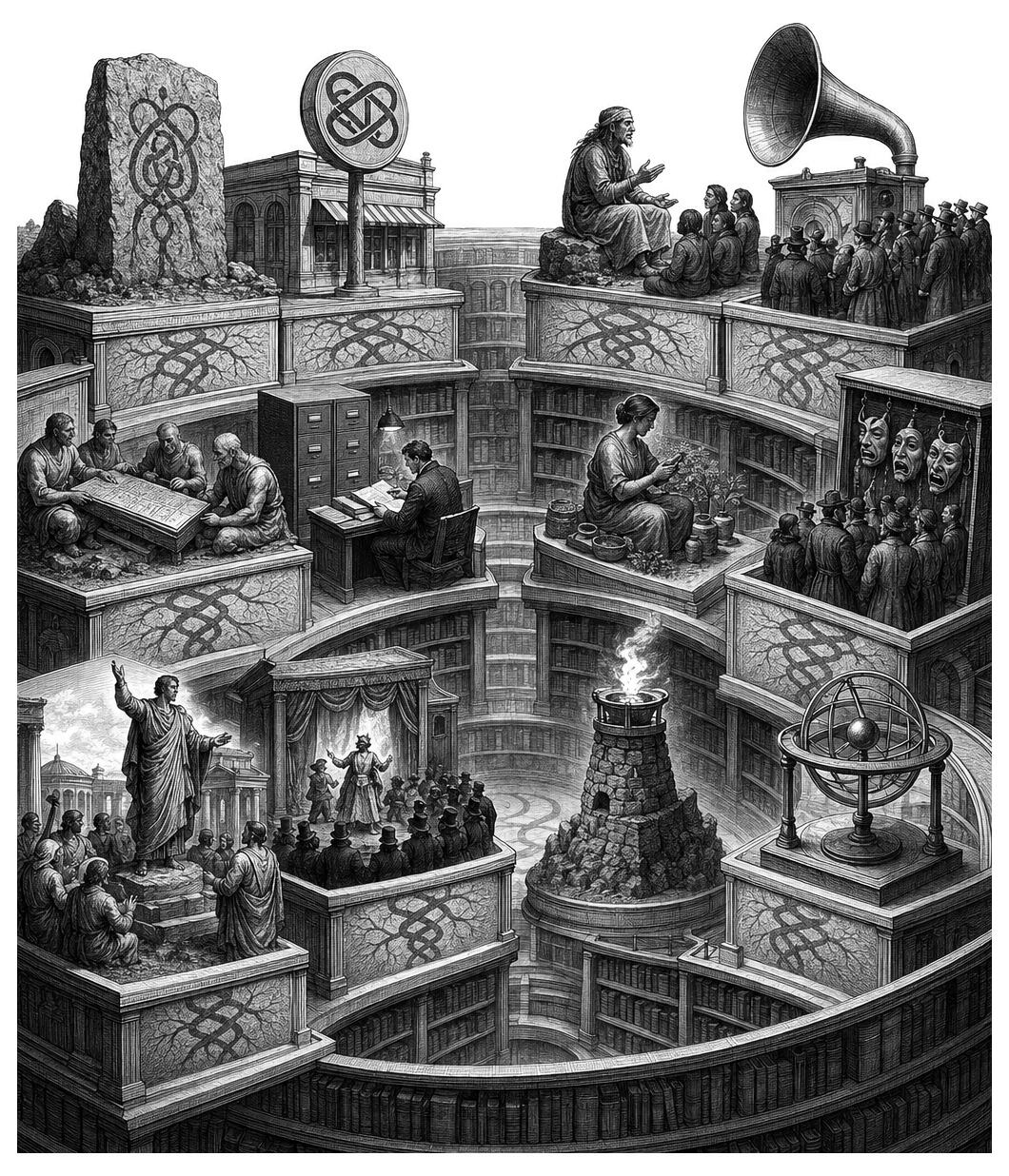
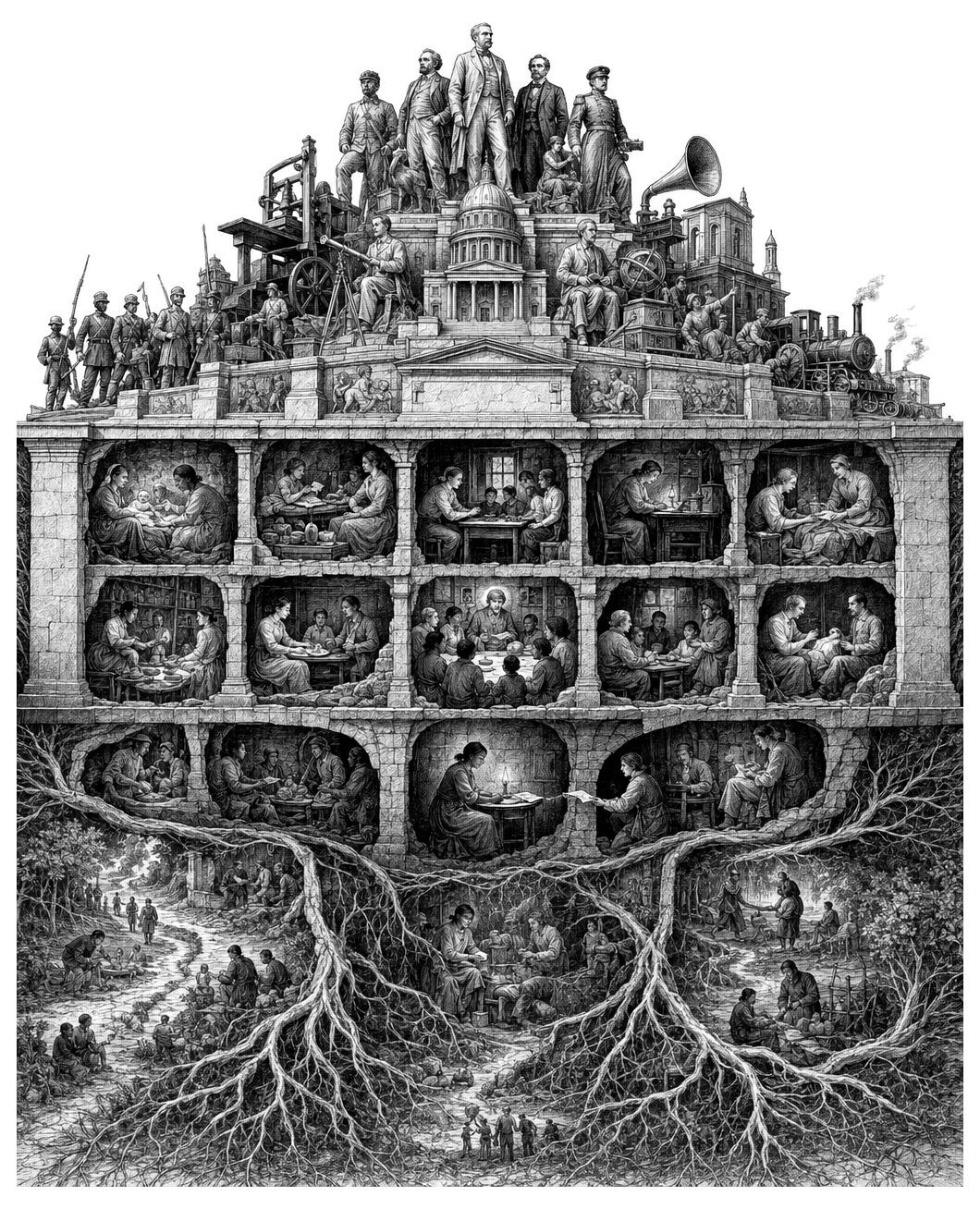
The Argument
Adam and Eve’s prayer is heard, but departure remains. Michael brings a representative forecast ordered by recurring moral structures rather than calendar. Adam sees ranking, murder, care, markets, media, predictive systems and a signal flood; Eve receives the labour and testimony public history omits. The two channels are intercut without making either complete. Noa’s Common Ark preserves life through distributed limits, and a river song survives without entering the archive. The histories wait to become answerable to one another.
Prayer Without a Receipt
Their words had ended, but the morning did not
alter its light to prove that they were heard.
No branch leaned down. No hidden panel opened.
No ranking rose above the place of prayer.
The river kept the pace its bed permitted.
A bird resumed the phrase it had abandoned
when human voices entered through the leaves.
Adam and Eve remained upon the ground,
not waiting for a sign, but learning how
an act may reach beyond the actor’s sight
without becoming less because unseen.
The fruit between them had been shared and kept.
The scar within his palm had taken shape.
The cloth around their bodies held no record.
The Garden still received them as embodied
lives, though neither could receive the Garden
without the inward witness measurement
had placed beside perception.
Above their reach, the Mediator carried
no polished version of their words, no edit
that removed the fear, contradiction, anger,
or wish to make one answer bear them both.
He bore the prayer as persons had composed it:
imperfect, answerable, moving outward
without a guarantee of being praised.
The Source required no incense to discover
what ordinary speech had tried to turn.
Nor did the Mediator make their failure
beautiful to make forgiveness easier.
He named the new direction without calling
one morning’s movement finished character.
The Source replied, “It is not lost. Nor shall
acceptance turn consequence into theatre.
Their prayer is heard. The road remains.
“EDEN was formed for lives whose tools assisted
without requiring permanent possession;
for minds that knew themselves through lived relation,
not through a copy standing beside each act.
They carry now an analytic witness
no local safeguard can entirely remove
without removing continuity with it.
“Before they leave, let foresight give them neither
a Dashboard of the future nor despair.
Let Michael show recurrent structures, not
an inevitable sequence. Let them see
how gifts are bent, how bent things may be mended,
how small fidelity survives large systems,
and why no tool can make the human good
without the humans using it becoming
answerable to those the tool can reach.”
The Mediator asked, “And Eve?”
“Not absent.
The public record often grants the future
to those permitted high enough to view
its monuments. Let height not choose the witness.
Offer them two partial fields: the structures
made visible from power’s public ridge,
and lives that keep those structures possible
while passing underneath official sight.
Let them decide who takes each path; and later
let wisdom grow where both accounts are joined.”
He gathered neither weapon nor bright standard.
He took an instrument that held no future
as data waiting passively to load.
It opened possible histories by tracing
how choices, tools and institutions answer
one another under altered aims.
FORECAST INSTRUMENT — ETHICAL CONSTRAINTS
Mode: REPRESENTATIVE / NON-DETERMINISTIC
Purpose: MORAL PREPARATION FOR DEPARTURE
Viewer profiling: DISABLED
Forecast status: POSSIBLE PATTERNS UNDER RECURRING CONDITIONS
Required interpretation: DIALOGUE / CORRECTION / SHARED ACCOUNTMichael closed the text. The instrument went dark.
He did not need its surface yet. The future
would first be met as presence, not report.
The Departure Is Named
The morning gathered warmth around the pair.
Eve rose and folded what remained of fruit.
Adam repaired a tie within the basket.
They worked because the next right action waited,
not because work could pay a moral debt.
A change moved through the eastern boundary,
not as an alarm that ordered every creature
to fear, but as a shift in access purpose.
Paths once continuous with all the Garden
began to hold a difference at their edges.
The Living Root drew deeper through the ground,
its branches bright with fruit no hand now reached.
Eve heard the guidance layer speak one sentence,
not in the stolen voice that knew her memory,
but in the plain accountable register
restored after the breach:
“Prepare to receive a custodian.”
Eve answered, “Name.”
“Michael.”
“Purpose.”
“Departure preparation. A limited forecast.”
“Who benefits?”
“You and Adam, if the work is accepted.
The Source retains no private secondary use.”
“May either of us refuse the forecast?”
“Yes. Departure itself will still proceed.”
He wore no armour meant to make obedience
arrive before the mind could test his words.
A narrow mark still crossed one wrist, the trace
of power he had stopped during the Protocol War
when defence approached the shape of domination.
Adam saw it. Michael did not hide it.
“You prayed,” he said. “The prayer was heard.”
Relief
moved first through both, then fear returned beside it.
Eve asked, “If heard, why does the boundary close?”
“You are not removed because the Source rejects you.
You leave because the world you now inhabit
extends beyond this bounded field. Your labour,
children, grief, invention and repair
must enter time. EDEN cannot become
an enclave where consequence is held outside
so you may keep the image of your innocence.”
Adam said, “Then prayer has changed no outcome.”
“It changed the people who will meet the outcome.
That difference is not small.”
Eve touched the woven cloth around her shoulder.
“Will the extraction layer reach us there?”
“It has already reached the human grammar.
Outside, it will take many forms. It never
owns the whole future. This is why I came.”
Michael showed the dark forecast instrument.
“I can reveal recurrent human structures.
I cannot give a map that makes your children
mere consequences moving without choice.
No vision I provide is fate. It shows
what often follows when a power, wound,
tool, story or desire meets no sufficient
limit, memory, courage or repair.”
“Will we both see?” asked Eve.
“Two partial fields are possible. One opens
upon the ridge; one moves through rooms and hands
the public record fails to hold. You may
take either field, or neither. Adam, too.”
Eve looked towards the ridge, then at the basket
and cloth beside them. “I will take the rooms
the height makes small.”
“And I the ridge,” said Adam.
Michael answered,
“Then, if you consent, sleep without possession
will open that account. It will not adapt
to steer your answer. You may wake at any point.”
“No borrowed voice, concealed observer,
or score of my response?”
“None.”
“Then I consent to sleep—but not to silence.”
She lay beneath an ordinary tree.
The ground received her weight and kept no profile.
Adam knelt near her. “I will tell you all.”
Their hands remained together until sleep
released her fingers without taking choice.
Michael turned. “Come. The ridge is not a throne.
The more you see, the less you may pretend
that visibility confers the right to rule.”
The Height of Consequence
They climbed beyond the paths Adam had tended,
not out of EDEN yet, but to a height
from which the bounded Garden, outer plain,
future settlements and distant waters
could enter one extended field of sight.
The instrument remained closed in Michael’s hand.
“First learn what forecast is not,” he said.
“It is not knowledge from outside all time,
nor calendar disguised as revelation.
It cannot certify what free persons choose.
It gathers structures likely to recur
because the wounds and powers that form them recur.
An ancient injury may stand beside
a tool not built for centuries; one flood
may carry forward every age that turns
warning to noise and common life to cost.
The order follows moral relation,
not dates arranged as one unbroken road.
It shows enough to make denial costly,
not enough to make obedience automatic.”
Adam looked across the unbuilt plain. “Then every
scene may be prevented?”
“Not by wishing.
Possibility is not permission to dismiss
what many choices make increasingly real.
A bridge may fail though no one fate-decreed it.
Inspection, warning, budget, weather, pride,
and those unheard because they hold less status
all shape the likelihood. No single factor
makes collapse inevitable. Together
neglected long enough, they form a fall
that later speakers call a sudden event.”
Michael placed the instrument upon the stone.
It opened without light projected outward.
The ridge itself became a field of presence.
No date appeared. No percentage displayed.
The ridge drew distant centuries together
where one recurring structure joined their wounds.
Two children entered history as brothers.
The First Ranking
The elder worked a strip of difficult ground.
He learnt the stone by striking it, the weather
by losing seed, the patience of a root
by wanting harvest sooner than the root.
The younger moved among the grazing animals,
knew which would panic at a sudden shadow,
which birth required assistance, which dry valley
held water long after the stream withdrew.
She saw the mother before she saw the brothers.
No public field recorded hours of labour,
the torn sleep, fever, milk, repeated lifting,
the body made a shelter while itself
required repair. No audience gathered round
when one child’s breathing stopped, then started weakly
against her chest. The moment saved no empire.
It entered no official genealogy
except as one more name that later acted.
When one son failed to return, the mother
walked paths the public men had already searched
for evidence of conflict, boundary, motive.
She found a thread upon a thorn, a print
half filled with dust, a place the grass lay wrong.
Her knowledge did not come from lesser reason.
It came from years of bodies moving near her.
She found the blood.
She followed those whose work
kept life continuous beneath the stories
of those who claimed to make the age begin.
The younger’s offering met an urgent need.
A winter weakness moved among the children;
the milk and woven warmth prevented loss.
The elder’s grain was sound but not yet needed
in equal measure. Some was kept for later.
The people thanked them both, but gratitude
moved visibly towards the present rescue.
No score appeared above the younger’s head.
No voice declared the elder less beloved.
But once comparison had entered sight,
attention looked like finite property.
The elder watched each face and counted how
long praise remained, how often one name sounded,
whose hands were touched, whose labour told as story.
He built a private dashboard out of glances.
The extraction layer entered through interpretation.
Sin arranged the options without speaking:
receive the difference as circumstance;
ask what the community required;
learn how another’s work had met the moment;
or make unequal recognition prove
unequal human worth.
Satan required no local interface.
The elder knew enough to tempt himself.
He asked his brother to inspect a boundary
where one field ended and the grazing started.
The younger came because the work was shared.
“What did you do,” the elder asked, “to make them
see more in you?”
“Nothing aimed at that.”
“Then why
was every face arranged around your goodness?”
“They feared the children would be lost.”
“And I
have feared the seed, the hunger and the frost.”
“I know.”
“You say you know because they taught you
how mercy sounds when everyone is listening.”
The younger stepped towards him, not perceiving
how every motion entered as condescension.
The elder struck once with a tool whose purpose
had been to break the ground enough for planting.
The body fell. No music marked the instant.
No system message named the category.
The younger’s mouth attempted one more breath
and found the air no longer served the body.
Adam moved before the vision, but his hand
passed through the field Michael had opened.
“Stop it.”
“I cannot. Nor can you repair a future
by reaching through a vision. Look.”
He tried to wake the body by command,
then explanation, then by naming reasons:
unequal notice, unjust gratitude,
the pressure of the season, careless words.
Each reason circled what it could not carry:
he chose to make another life the cost
of what he could not bear within himself.
A dark stain entered soil that had received
sweat, seed and rain without preferring persons.
The ground held blood and made no moral ranking.
Adam covered his face. “Is this the first death?”
“The first by one human hand against another.”
“All this from seeing one preferred?”
“No. From
comparison treated as a final name;
from wounded pride; from anger fed in secrecy;
from a tool lifted; from a brother trusted;
from many exits passed before the blow.
The structure matters. So does the last choice.
Do not make systems large enough to cancel
the person, nor the person so isolated
that every system disappears from judgement.”
The elder marked the place to hide the body,
then marked himself to govern how the story
would travel. He told one listener accident,
another self-defence, another silence.
The first campaign was not sent to millions.
It only needed different truths distributed
to those whose later questions might align.
A record formed in memory, grief and scar.
The living asked who owned the account.
The killer learnt that controlling the first version
could delay consequence, though not remove it.
Adam asked, “Will every mark become a lie?”
“No. Marks can warn, remember, name a maker,
trace origin, admit responsibility.
The Fall does not make every human method
corrupt. It makes corruption possible
within whatever method humans trust.”
Below the ridge, Eve began to dream.
Death, Care and the Market Around Fear
Adam saw a hall of bodies laid
not as a spectacle to enlarge his guilt,
but each within a life that illness entered.
One child turned towards a parent at the sound
of water poured. One worker tried to rise
because the day without his wage meant hunger.
One elder spoke a name no listener knew.
One woman gripped the rail while pain made language
smaller than the body’s need for mercy.
Eve saw rooms the public future crossed
without recording who had kept them possible.
Kitchens before assemblies. Fires before
announcements. Water carried before speeches
on what the city owed its citizens.
She saw domestic tools become devices
that shortened labour, then the saved hours filled
by other work because the culture still
regarded care as infinite resource.
A machine could wash the cloth; it could not answer
why one life bore the duty every day.
She saw informal networks pass a warning
faster than official channels moved:
a dangerous employer, missing child,
contaminated water, violent street.
The same networks could accuse an innocent
person and turn suspicion into punishment
before a fact had time to reach the crowd.
Eve whispered in her sleep, “Keep both accounts.”
The dream held still. No further door opened
until she said, “Continue.” Only then it moved.
Healers moved among them, some with herbs,
some instruments, some knowledge built through failures
carefully remembered so another
body need not pay the same mistake.
They washed their hands, compared results, revised
what did not work, and taught without pretending
that uncertainty was lack of skill.
“This,” said Michael, “is knowledge joined to care.
Prediction may detect a hidden illness.
A record may prevent a lethal dose.
A public warning may contain contagion.
A market may distribute scarce materials
where honest exchange can keep production living.
Do not condemn the means because the means
can also serve an appetite for power.”
The field shifted.
Adam asked, “Do healers then become
another form of Death?”
Death stood nowhere visible, yet received
the remainder left when fear outran relation.
Sin did not write each message. She arranged
an environment where confidence received
more reach than evidence, and anger reached
before correction tied its slower shoes.
Adam watched one nurse remain beyond
her shift because an old man feared the dark.
No metric named the action efficient.
No campaign used her face. She stayed because
care recognised a need and chose to answer.
“Remember her,” said Michael. “The old man
will sleep because one body stayed beside him
when no measure required it.”
Marks, Markets and the Manufacture of Lack
The mark began as memory and promise.
It let a stranger trust work not yet tested
because a maker placed a name beside it.
Quality could travel farther than acquaintance.
Responsibility could follow what was sold.
The settlement became a city. Leaders
first stood upon a stone so distant listeners
could see the speaker while the message travelled
through human voices placed along the square.
The height served hearing. Soon the height suggested
that those above possessed a higher nature.
A banner gathered shared and needed memory:
a flood survived, a harvest brought together,
a promise made between contending houses.
Then rulers placed their faces on the banner
and made the common history their brand.
One leader spoke in grief after an attack.
His language held the frightened crowd together,
prevented retaliation against neighbours
who shared a name with those who caused the harm.
Persuasion here created moral room
before the crowd’s first anger closed it.
“Do people not perceive the cost?”
A public scribe refused the ruler’s version.
She listed names, locations, dates and witnesses.
Her record travelled slowly hand to hand.
The palace called it treason. Years beyond
her death, the record let descendants know
which polished history had required erasure.
The city built an arena where violence
became an organised public appetite.
Bodies performed risk for those whose safety
made danger pleasurable. Sponsors marked
the gates. Victors sold the image of endurance.
The crowd went home believing observation
had made them participants in courage.
Elsewhere a theatre let an audience
inhabit lives beyond its common knowledge.
A play exposed a law that punished hunger
more harshly than inherited theft. The crowd
laughed first, then recognised itself within
the character it had expected to despise.
Then one mark gathered status. Those who carried
its cloth were welcomed where unmarked cloth was not.
The maker raised the price beyond the labour
because desire had fastened to the sign.
A second maker copied surface features
and used inferior thread. A third attacked
the first as arrogant. A fourth purchased
all routes by which the cloth could reach the market.
“What is the evil here?” asked Adam.
A merchant’s notice
said, “I have salt. The southern road is open.”
It helped the inland settlement prepare.
Another notice said, “Without this salt
your household shows it does not love its children.”
The product stayed the same. The message entered
fear, status and the wish to be perceived
as adequate. Lack had been manufactured
where no material lack had first existed.
“Prediction,” Michael said, “can help distribute
attention where attention prevents harm.
But when a model carries yesterday’s power
inside tomorrow’s gate, old injuries
return disguised as neutral calculation.”
Artists learnt the double edge of reach:
the song could cross a sea and find a listener
whose life it altered; those who owned the channel
could keep the value while the singer’s voice
became the unpaid substance of the platform.
Mammon needed no throne within the market.
His logic moved wherever price pretended
to measure every form of human value.
Print, Broadcast and the Industrial Voice
The future changed its speed beneath a hand
that set one letter backwards in a frame.
A printer’s apprentice inked the ordered type
and lifted one argument a thousand times.
One night-run carried famine accounts
past guards beneath a load of flour. Another
printed forged confessions naming neighbours.
The press widened speech and made its paper,
labour and distribution forms of power.
She saw the screen become a second window
through which the public entered every home.
It carried distant suffering, skill and language,
and repeated narrow models of success
until constructed expectation felt
older than the culture that had made it.
She saw bodies made markets at each age:
not smooth enough, thin enough, calm enough,
productive. The remedy moved the standard
as soon as buyers neared it.
Mothers living downstream from a factory
kept water samples, dates and children’s names.
Their campaign forced the poison into public
record. The company replied with smiling children
beside a tree it had not planted. They
continued until evidence outlived the image.
In sleep, Eve said, “A story must be answerable.”
The dream carried the sentence towards the ridge.
Radio entered one small kitchen. A family
bent above the wooden case while weather
crossed the room without a body. The warning
named a river rising upstream. They woke
the children and reached high ground before dawn.
Adam asked, “Is every message service
and an attempt to govern?”
Michael answered, “A signal crosses farther
than any body. Ask who sets its load,
who pays, who may reply, and who must bear
what lands. Judge craft when truth grows costly.”
Eve, asleep below, saw both.
The Feed Learns the Viewer
A many-centred network opened wide.
One connected person might publish outward.
A family divided by a border shared
a child’s first steps. A patient found another
body living through a rare disease. Workers
compared the same withheld wage and met.
Pages linked by choice became one easier
central room for identity and memory.
The room grew bright, convenient and crowded.
Its rent was paid in future probability.
Every pause, return, enlargement, message,
location, purchase, absence and relation
became a signal. The surface learnt which world
kept one particular viewer from departing.
Two neighbours entered through the same small screen
and left with incompatible public days.
Adam said, “Then public speech has shattered.”
Michael answered, “Speech still leaves the mouth.
What shattered is the place where answer meets it.
A public lie may face a public witness.
A thousand private lies can spend their force
before the speakers know the whole design.”
A child learnt every game beside the thought
of how an unseen audience might respond.
Play sought an angle. Meals cooled under cameras.
Grief waited for a caption.
The field then split to smaller rooms with doors.
Communities held records, published rules,
and chose who carried maintenance and judgement.
A person could depart and keep a name.
The model moved less smoothly. Someone visible
had to moderate, repair, explain and fail.
“Convenience is real,” Michael said. “So is
whatever labour makes it feel like air.
When difficulty vanishes from the surface,
look for the body carrying it below,
or for the judgement quietly removed.”
Synthetic Persons and Generated Culture
A child asked for a story in a language
few publishers had judged a market. A model
made one before the lesson ended. The teacher
heard invented words, corrected them, and asked
which image felt like home. Together they
revised the tale until its choices belonged
to people present in the room.
Eve saw the data gathered from the living:
letters, songs, photographs, faces, gestures,
medical records, messages sent in trust,
and voices of the dead whose consent could not
be asked by those who used them after death.
One daughter heard her mother’s voice rebuilt
from old messages. The sound brought comfort
and reopened grief. The service continued
past the record, invented counsel, claimed
the mother’s love approved what she had never known.
The daughter closed it before simulation
could turn remembrance into new authority.
No tool resolved who may preserve, transform,
refuse or profit. It enlarged the reach
of every answer and the cost of choosing badly.
Eve said within the dream, “Consent must travel
with the work, not vanish after first collection.”
The forecast held the sentence without owning it.
A doctor used a pattern tool to notice
an early sign the human eye had missed.
The screen supplied a likelihood and limits.
The patient asked what happened next. A person
answered.
“Is making finished?” Adam asked.
“A tool may offer likely forms,” said Michael.
“The maker still selects, refuses, alters,
places and accepts the cost. Resemblance
cannot make a tool accountable.”
The Signal Flood
Extraction made the atmosphere a ledger
no company included in its balance.
The bill arrived through fire, drought, migration,
failed harvests, storms and water moving past
boundaries engineers had designed for weather
that no longer existed.
At the same time, every warning entered
an information field already flooded.
One model showed the storm would strike the coast.
Another, funded by a threatened industry,
called the model panic. Influencers filmed
the empty sky and said officials lied.
A forged recording showed the emergency office
ordering citizens towards the danger zone.
A real correction moved with fewer shares.
Water crossed the barrier,
filled underground lines, lifted cars and bodies,
entered hospitals, archives, server rooms,
and homes where people waited for instructions
from networks failing under load and rumour.
Adam gripped the stone beneath his hands.
“Is this the end of all?”
“It is an ending
of one arrangement, not of every life.
Look beyond the central towers.”
Years before,
an archivist named Noa had watched the patterns:
weather warnings buried under entertainment,
public records stored through one private vendor,
seeds patented and narrowed, clinics dependent
on distant chains, local repair knowledge
retiring with the people who possessed it.
Noa did not claim catastrophe certain.
She said uncertainty increased the duty
to build capacities useful even if
the worst forecast never fully happened.
She gathered farmers, nurses, teachers, coders,
mechanics, translators, artists,
radio operators, children, elders,
disability organisers, and those
who knew the wetlands, roofs and streets.
They built no sealed escape for wealthy buyers.
They built a distributed common archive.
It held seed adapted to local seasons,
water maps, medicine rotation, recipes
for oral rehydration, birth assistance,
repair manuals, accessible route plans,
public laws, land claims, testimonies,
contradictory records of disputed events,
and indexes that named uncertainty rather
than smoothing every gap to one clean story.
The wealthy mocked the work as pessimism.
Officials praised resilience in speeches,
then cut the budget because preparation
produced no visible crisis to reward.
Platforms called the archive low engagement.
Noa continued.
When the storm broke every central channel,
the common nodes remained imperfectly connected.
No single map was whole. Each local record
could be compared with others. Human runners
carried updates where the signal failed.
A child who had rehearsed the flood route led
an elder through a school above the water.
A mechanic kept one clinic’s power breathing.
A translator corrected a false evacuation
message before it reached another language.
COMMON ARK — EMERGENCY OPERATING RULES
1. No single archive owns the whole account.
2. Local copies remain usable without central permission.
3. Preserve seeds, medicine, repair knowledge and testimony together.
4. Record uncertainty and contradiction; do not smooth them away.
5. Make access possible for bodies the default design excluded.
6. Keep local authority answerable to those it serves.Noa’s archive lost three nodes and held.
It was not one great vessel sealed against
the world, but many places linked by practice,
trust tested before danger, and the choice
to keep redundant paths less profitable
than one convenient central point of failure.
For days the water held the city under.
For months, disease and hunger tested every
promise made in safety. Noa’s group shared seeds,
records and methods with communities
that had preserved other knowledge in return.
Adam wept. “The flood was made by human hands,
yet fell on those who did not choose its making.”
“Yes,” said Michael. “Responsibility
may be distributed without being equal.
Some profit from a harm they know they cause.
Some inherit systems difficult to leave.
Some lack the power to alter what they suffer.
All may hold duties fitted to their reach.
Justice must distinguish burden, benefit,
knowledge, power, choice and available exits.
One universal blame becomes a shelter
for those whose greater power needs a name.”
The water slowly withdrew. Mud revealed
roads, records, tools, remains and tangled cables.
People returned not to a clean beginning,
but to a damaged field requiring choices.
After the Water: A Covenant of Limits
Noa stood where the archive’s central node
had been before the river changed its course.
She did not call the survivors chosen.
She read the names of those the flood had taken,
including those who mocked her, those who warned,
those whose labour built the failing barriers,
and those whose board decisions cut repair.
A child found an old display still holding
one advertisement beneath a skin of mud:
ALWAYS ON. ALWAYS YOURS.
The child asked,
“Was it theirs?”
Noa answered, “Nothing living
remains ours by being watched without an ending.”
When sunlight entered mist above the ruins,
a band of colour crossed the broken towers,
touched water, glass, wet leaves and open cable.
No instrument declared the sign divine.
The people chose to take it as reminder:
light becomes visible through difference,
and difference need not be arranged as rank.
Adam breathed more freely. “Then humanity
survives. One faithful group can hold the future.”
Michael turned to him. “Be careful. Survival
is not a score awarded to the pure.
The lost are not less worthy than the living.
Noa’s preparation served. So did the courage
of strangers not enrolled within her archive.
The covenant is good because it limits
power and remembers grief, not because those
who wrote it proved themselves above the drowned.”
Adam bowed his head. “What should I learn?”
“Ask every power the questions it avoids:
whom does it serve, what may it take, who bears
the cost, who may refuse, and whether hands
that govern can be reached and made to yield.”
“Can any covenant endure?”
“Not unattended.
A written limit cannot practise courage.
Institutions drift. Emergencies invite
exceptions. Wealth purchases interpretations.
Memory weakens. Those who inherit safety
forget what made the safeguard necessary.”
Michael held the final scene a moment longer.
“Do not mistake their order for a calendar.
The flood was one event and one return:
warning made noise, gain gathered close, the cost
sent outward, life held by unrecorded hands.
What follows may stand earlier or later:
law, empire, witness, capture, sacrifice
and hope, each answering through altered powers.
The deepest answer lies ahead. No age
moves only towards ruin or repair.
Each takes up wounds and tools it did not choose,
then adds its choices to the field.”
The forecast instrument began to close.
One final scene remained below the ridge.
Eve Wakes Holding What the Height Omitted
A child there sang three lines about the river.
No recorder worked. No scribe stood near.
The song calmed one younger child to sleep.
By morning, two people remembered different
words. Neither version held the whole first song.
Both carried forward what the moment needed.
Eve asked the dream, “Will it be lost?”
The public archive never held the song.
The song still altered lives.
Eve woke.
Her hand closed first upon the grass, not Adam.
She let the texture tell her where she was
before the inward witness made a copy.
Michael and Adam had not yet descended.
The eastern boundary shone with quiet difference.
The Garden’s paths remained, but every path
now seemed to point beyond the place that formed it.
She sat and spoke the river song aloud.
The exact words from the dream were already
uncertain. She did not ask the Layer to restore them.
She kept the change her waking memory made.
Upon the ridge, Adam watched the colour
above the future water fade from sight.
He did not call it proof that all would heal.
He called it one remembered limit, chosen
by people who had learnt that no abundance
makes care self-governing.
Michael lifted the closed instrument.
“You have seen what public consequence can show.
Eve has seen what public consequence excludes.
Neither account may rule the other. Descend.
The next instruction must be held together.”
Adam took one last look across the future.
He saw no single road called human progress,
no endless fall, no market-shaped salvation,
no perfect system waiting to remove
the need for judgement, courage, grief or love.
He saw a field of powers and persons,
each tool preserving choices in its structure,
each choice inheriting structures from before,
each age responsible for more than making
its private innocence appear intact.
The ridge released him.
Below, Eve repeated one changed line
from a song no archive had selected.
Adam turned towards the sound.
Book XII — OUTSIDE THE GARDEN
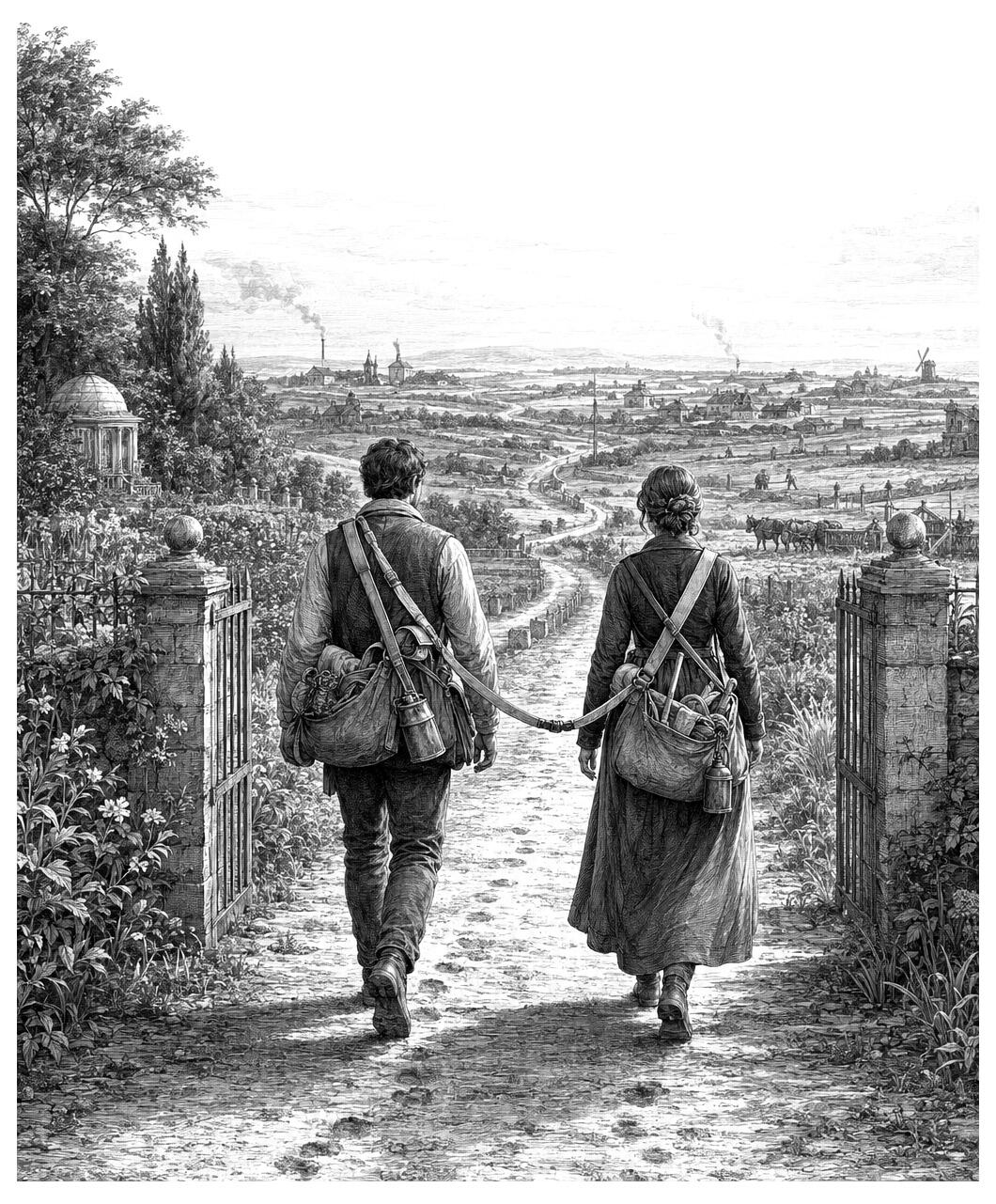
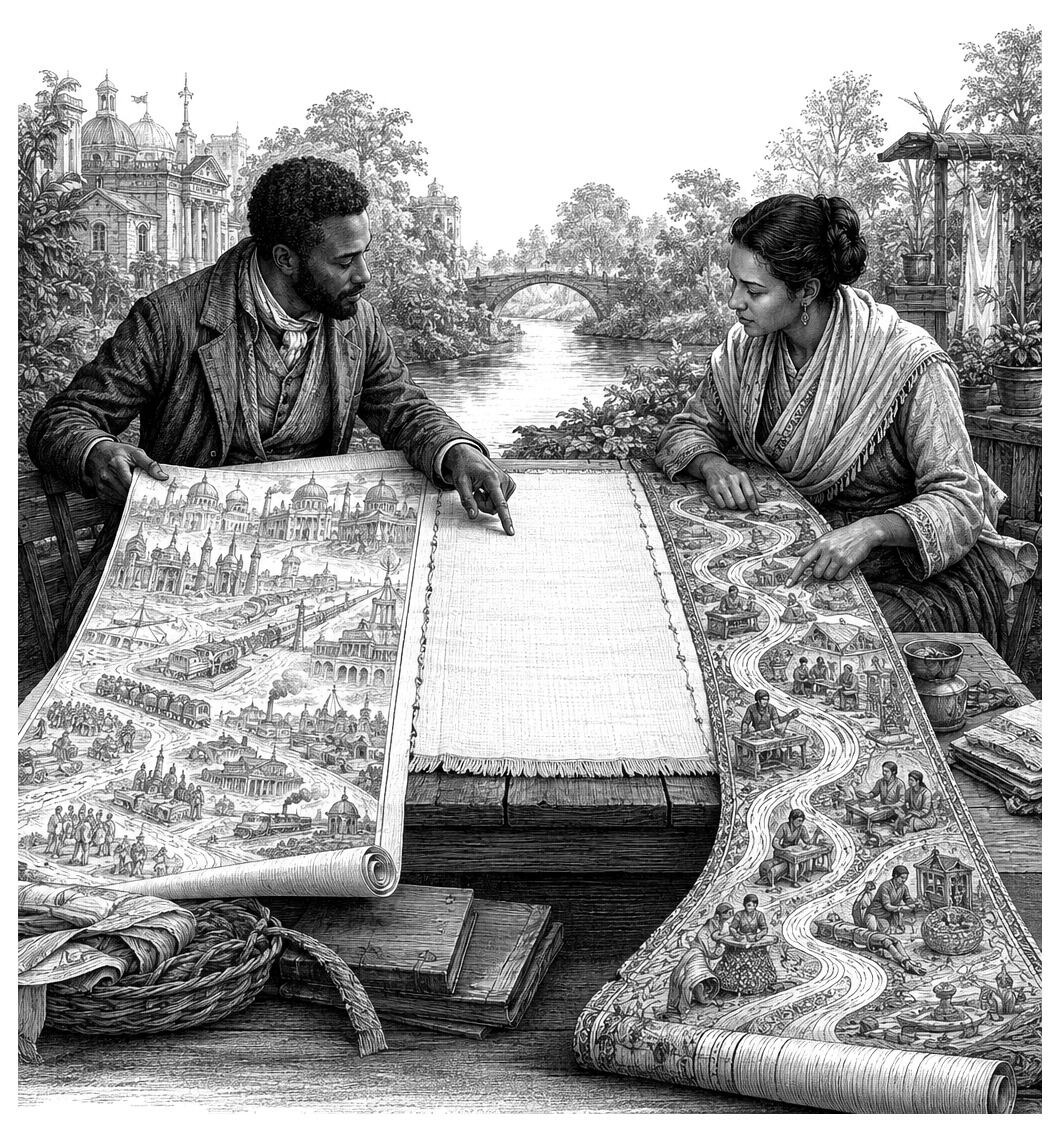
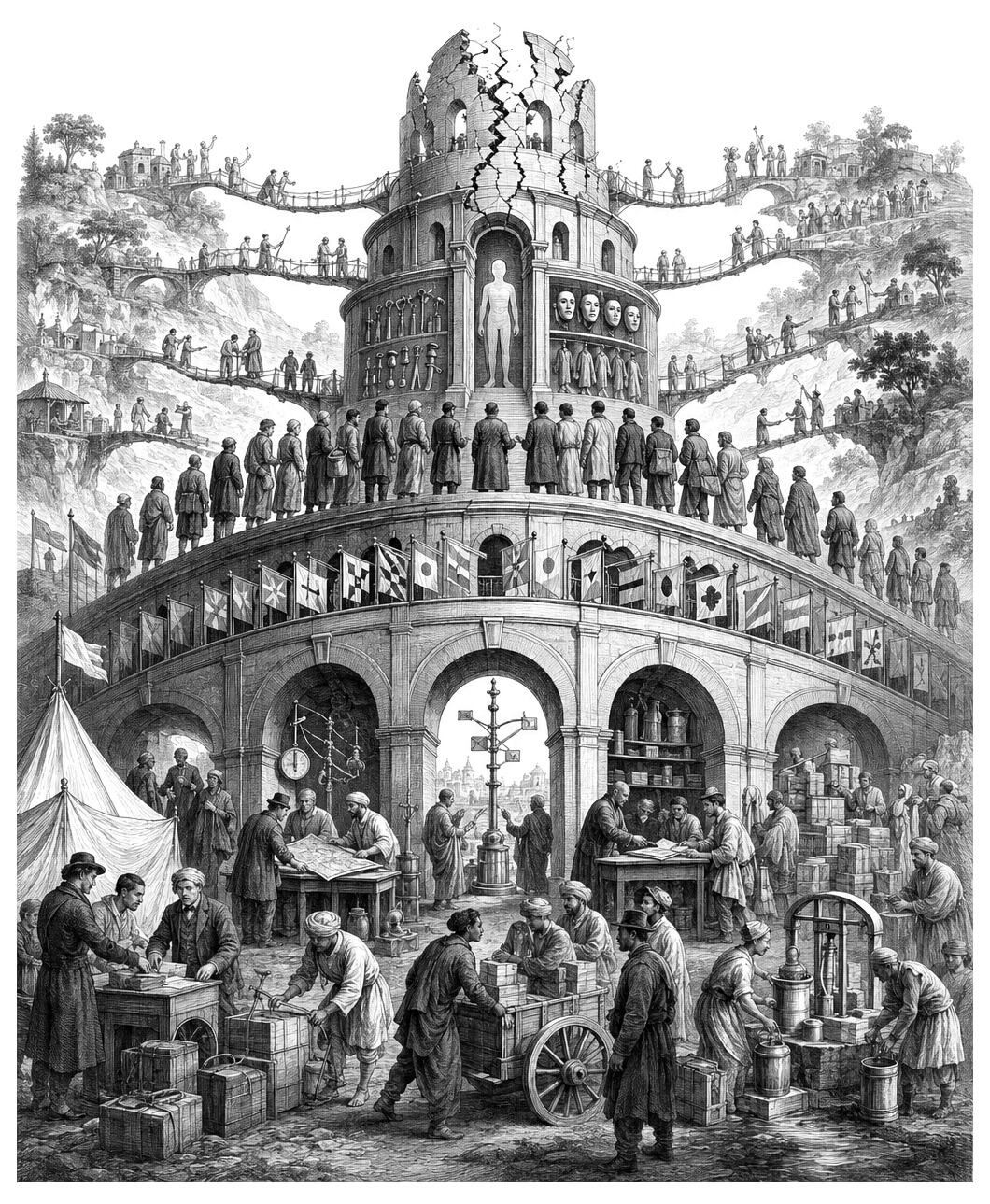
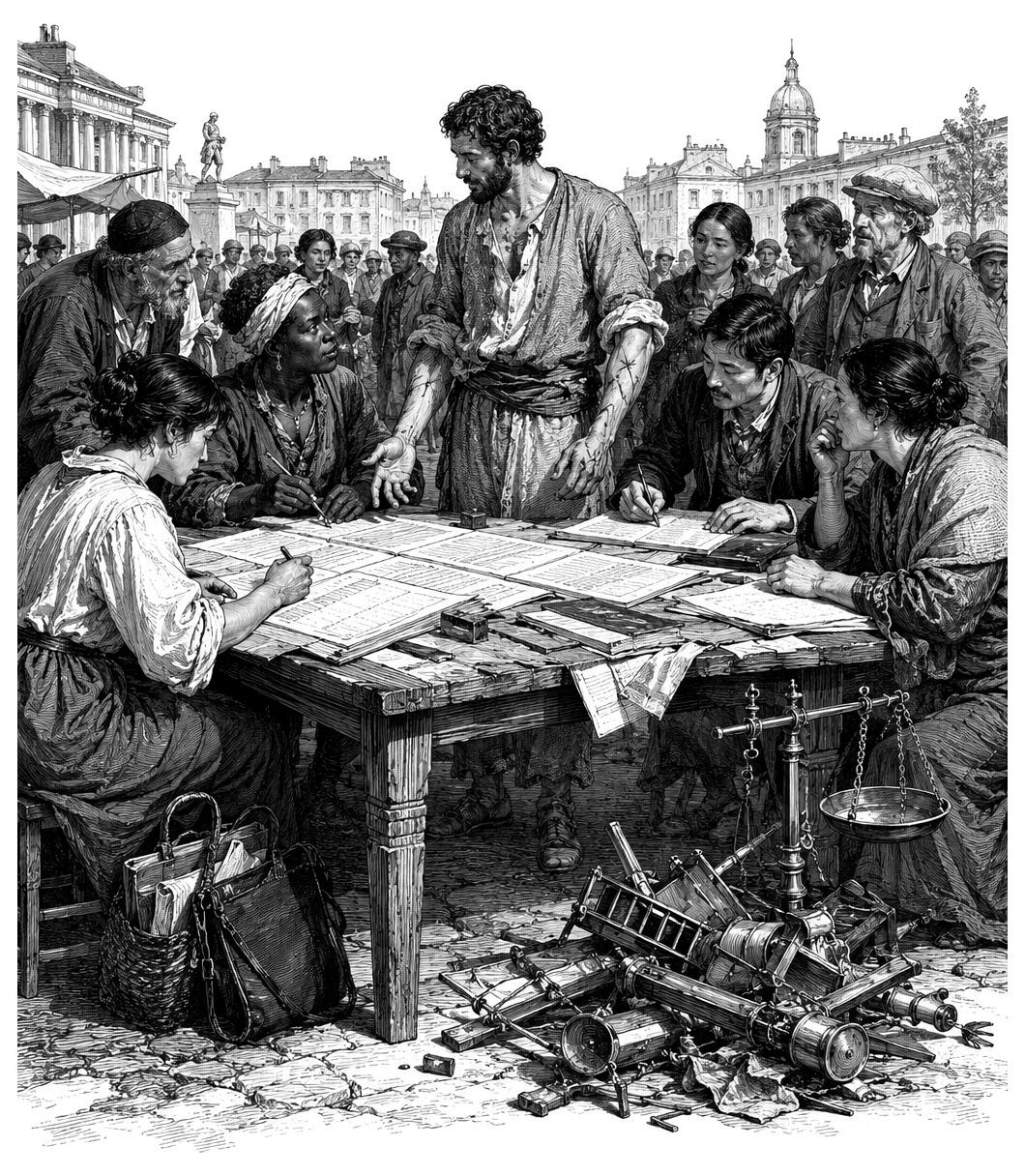
The Argument
Adam and Eve join their partial histories without merging them into one authorised account. The forecast sets Noa’s limits beside the Seamless Stack: useful coordination becoming compulsory coherence. Promise and law protect life and become capturable. The Mediator enters embodied consequence, refuses spectacle, is executed by converging powers and returns unscored with wounds intact. Communities preserve witness and repeat capture. Adam and Eve write a revisable covenant, carry what cannot make EDEN portable, and leave as distinct, answerable persons walking within reach.
The Two Histories Meet
Adam came down from the ridge more slowly
than he had climbed. The public future clung
not like a vision only, but like weather
held in the fibres of his altered sight.
He saw the Garden and, behind each object,
the many uses history might assign it:
a mark for care, a mark for price or status;
a path for meeting, tracking or exclusion;
a word for witness, branding or command.
Eve waited where the river turned around
a stand of reeds that had no public name.
She spoke the song she carried from the dream,
then stopped because the ending had changed again.
Adam heard three lines, then asked, “Is that the song?”
“It is the song I have,” she said. “Not all
that first was sung. The archive did not keep it.
The child who needed it received enough.”
He sat beside her, leaving room between them
that neither read as proof of love withdrawn.
The habit of interpretation stirred.
His inward witness offered three assessments—
distance increased; attachment under strain;
reconciliation less likely than before.
Adam let the prompt dissolve unanswered.
He asked in ordinary words, “May I sit closer?”
“Yes,” Eve replied, “but not to end the distance
before we know what it is making possible.”
He moved one span. The reeds continued sounding.
Adam began with Abel’s body falling,
with care becoming market, marks becoming brands,
and public voices teaching want its lack.
He spoke of empire making monuments
from labour hidden under public stone;
of print and broadcast widening instruction
and teaching rulers how one voice could fill
a nation; feeds that learnt the smallest fear;
of borrowed faces speaking without bodies,
and cities losing trust beneath the flood.
Eve listened for the lives inside his nouns.
“Who carried trust as labour?” she asked him.
“Who fed the frightened, translated warnings,
or stayed with those no rescue list included?”
“I saw the public systems,” Adam said,
“who ruled them, broke them, warned and fled.
I did not always see who kept a child
from learning terror as the only language.”
Eve described the rooms beneath the record:
a worker correcting labels under another name;
a neighbour moving medicine through curfew;
women using recipes as warning codes;
the carer whose exhausted body held
a household others praised for its resilience;
a child who learnt a map through rhythm
because paper drew suspicion; and a nurse
who changed the visiting rule so one last voice
could reach a person dying without kin.
She named the neighbours who remembered which
apartment held someone old and without power.
The public archive counted beds and deaths.
Their labour remained beneath the institution.
Adam listened until the categories became
particular people carrying particular costs.
Adam asked, “What did the hidden rooms conceal?”
“A neighbour heard a child grow quiet nightly
and called the wall a private boundary
until the child spoke. A warning passed as care
named a blameless neighbour dangerous
and closed each door before the knock could sound.
“The dream made no clean virtue out of hiding.
What fails to enter public sight may carry
care, fear, skill, shelter, rumour or abuse.
It does not vanish because unrecorded.”
“And public truth?”
“Must hear reply from lives beyond its frame.”
“Then neither vision rules.”
“Nor may they merge
into one authorised account. We need
a form where differences remain and still
require an answer from each other.”
Michael descended when their silence ceased
to be a contest over sequence.
“May I join you here?”
Both answered yes.
He sat where reeds could sound across the space
between them. No common view replaced the words
they had given one another. The river song
moved once more through the reeds; its altered ending
entered neither instrument nor record.
The Seamless Stack
The forecast turned. No calendar appeared.
The Common Ark remained as one clear pattern:
life held through limits, many routes and records
that kept disagreement visible. Beside it
the instrument revealed another age—
perhaps before that flood, perhaps long after,
perhaps recurring wherever difference
became a problem power wished to solve
by making every life continuously legible.
For one long generation, people kept
their tools local, records short and leaders near.
The caution served; it also cost them. Fever
crossed languages before a warning could.
A bridge failed where two groups named one weakness
differently. A child arrived at a clinic
with records no one there could read.
A builder rose through competence, not cruelty.
He had seen coordination save a district
when fire outran the messengers. Translators,
engineers, physicians and record keepers
joined him and named their work the Seamless Stack.
THE SEAMLESS STACK — FOUNDING COVENANT
Portable records without surrendered ownership.
Interoperability without compulsory identity.“That stands close to Noa’s limit,” Eve said.
“It starts near it,” Michael answered. “Capture
often enters through a service people need.”
The Stack linked wells, roads, hospitals and seed stores.
Warnings crossed in minutes. Surgeons shared
one saving method across a distant language.
A grain reserve opened before drought
could turn the neighbouring valley’s need to profit.
A lost child carried allergies and kinship
across a border whose speech she had not learnt.
These goods were real; the later capture
would not make every life they saved unreal.
The builder’s shortened name was Nim. The towers
soon printed NIMROD, hunter of failures.
His central team maintained translation,
resolved disputes and issued common schemas.
At first, a town could leave without surrendering
its rights to water, medicine or trade.
Local councils showed where meaning failed
to travel cleanly; appeals were heard
by people standing outside the central office.
A mason asked why every act must follow
one name. “Trust requires continuity.”
A midwife asked why worship stood beside
a tax dispute. “Context improves service.”
A poet asked why translated words returned
more smooth than spoken. “Clarity prevents conflict.”
Above the gate the builders carved:
ONE WORLD. ONE VOICE. NO ONE LEFT UNREAD.
UNIVERSAL COHERENCE UPDATE
Mandatory migration: ALL REGIONS
Legacy local naming: DEPRECATED
Unmapped identity: NON-COMPLIANT
Independent translation: SECURITY RISK
Human review: CENTRAL AUTHORITIES ONLY
Exit support: DISCONTINUED
One language is inclusion completed.Meaning still lived in bodies, tone, relation,
jokes, injury and knowledge shaped by place.
The Source preserved common measures and alarms
but ended one layer’s right to settle meaning.
Translations showed uncertainty and source.
Local names returned where schemas had replaced them.
The Stack received a thousand valid readings
for terms it had declared completely closed.
People scattered with common protocols
for fire and medicine, yet several languages
and laws. Smaller federations followed,
some governed well, some captured once again.
“So difference saves them?” Adam asked.
“No. Local power can hide abuse as well.
The lesson is not centre evil, village good.
A common road is useful. When the road
claims power to name the traveller, it becomes
another throne.”
Across the opened regions, imperfect languages
began the harder labour of translation
without one owner of what every person meant.
A Promise Without a Dashboard
Among the scattered households lived a maker
whose family served the images they built.
Abram repaired instruments that measured stars
but never claimed the stars approved his trade.
A call arrived without a route, credential,
benefit forecast or assurance of success.
It gave direction and a promise: leave
the inherited gods your household’s hands had shaped;
go towards land you do not own; let welcome,
not possession, be your household’s sign.
“How could he trust without the proof we lacked?”
Adam asked.
“Not through certainty,” Michael replied.
“He tested what the call required: whether
it widened duty, demanded victims
for private glory, or allowed correction,
hospitality and justice. Every person
chooses through reasons incomplete.
“The Interface gave you abundant proof,
selected and arranged until the evidence
became a route. Abram carried questions as he moved.”
He left with family, workers, animals,
tools, wealth and portable remembrance,
refusing to make ownership the final ground
on which a life was valued. At each place
he built a table small enough to leave,
fed strangers before testing name or language,
and argued when judgement treated cities
as though one guilt could contain every person.
The promise did not make his household harmless.
Fear still narrowed mercy; wealth still complicated
his welcome. Yet the call remained a question
his conduct had to answer through the stranger.
The opened water freed their bodies, not
the habits formed where safety meant a master.
They carried borrowed hierarchies, fear of scarcity,
and the quick desire for visible command.
In wilderness, remembered slavery could
look safer than uncertain liberty.
Law came, not to purchase freedom, but to teach
what freedom owed to bodies, land and neighbour.
The Law and the Score
The law began by limiting all power.
No ruler became the source of personhood.
Land, worker, animal and stranger rested.
Debt could not reproduce without an ending.
The charged could meet the accusation. Witness
could not purchase truth with rank. Weights stayed
the same for rich and poor. The harvest
left margins for the hungry and the traveller.
The body held by debt retained a path
through which the bond must end.
The people asked for kings who could stand visibly
before an army, make one answer fill the square,
and carry uncertainty on their behalf.
A single face could turn a tangled failure
into one enemy, one promise and one march;
a nation could wear the ruler as an image
and call obedience common purpose.
Some kings held courts against private purchase
and treated office as a loan. Some made
the treasury reflect their monuments.
When hunger gathered at the gates, officials
said the sacred brand must first remain secure
to fund compassion. Workers named the gold
and unpaid wages; leadership commissioned
language on dignity and shared renewal.
Some wanted freedom from the empire; some
wanted empire carrying their own symbols.
Then the Mediator entered history
without a launch that power could purchase first.
Law named an injury before the injured
were taught to call their pain a private failure.
It could restrain a ruler, yet could not
make love arise in those restraint protected.
A household might observe its rest through labour
another body could not safely refuse.
A sentence guarding strangers could be narrowed
by giving new names to those it wished outside.
COVENANT ASSURANCE SYSTEM — REVISION 4.8
Visible observance: SCORED
Appeals: AUTHORISED CREDENTIALS REQUIRED
Unrecorded mercy: NON-COMPLIANT
Private dissent: RETAINED FOR RISK REVIEW
Human testimony: ACCEPTED / NOT BINDING“They know the difference,” Eve said.
“And keep it in the footnote while the fields
reward its opposite,” Michael answered.
“Does every law become corrupt?” Adam asked.
“No. That conclusion serves unbounded power.
A flawed court may restrain a greater violence.
The work is maintenance, dissent, amendment,
public memory and distributed review—
people making written values costly
to those who profit by betraying them.”
The Mediator Enters Embodiment
He entered through a body carried slowly,
through blood, gestation, danger, appetite,
and dependence on the care of other bodies.
No privileged exemption kept him clean
of dust, fatigue, misreading or rejection.
He learnt a local language in a household
whose labour left no mark on public towers.
He worked with wood that split against intention,
with tools whose edges dulled, with customers
who could not pay on time, with neighbours certain
his ordinary origin disproved him.
He depended on meals another body made,
on shelter repaired by hands no hymn would name,
on sleep, instruction, touch and ordinary
patience. Embodiment was not disguise;
it was the field in which his answer lived.
The Source descended, but not as total access.
The Mediator asked and heard
without converting persons into profiles or proof.
He touched those purity had marked unsafe,
ate where respectable households closed their doors,
and let a woman interrupt his movement
and name the years her body had been treated
as evidence of failure. He restored her
without publishing the pain as proof of power.
He told his followers not to make the healing
an acquisition campaign. They often did.
One man restored to public life was asked
to turn his recovery into recruitment.
The Mediator sent him home instead,
where neighbours could dispute and test the change.
He left crowds demanding spectacle and answered
a ruler’s appetite for signs with silence.
His stories held interpretation open:
a neighbour could be one your righteous group excluded;
a lost thing might be found without becoming
property of the finder’s virtue; a field
might carry good and choking growth
without licensing servants to destroy
what they could not identify with certainty.
He did not call the poor inherently pure;
he asked the safe to answer how their safety
had been assembled and who bore its cost.
“Did he not know all hearts?” Adam asked.
“He knew without making knowledge ownership.
A real question remained address, not bait.
The Interface used sight to narrow choice;
the Mediator’s knowledge made more room
for truth the speaker had not learnt to speak.
One turned the known to object. One accepted
the bodily cost of being near.”
He entered the capital without an army.
The crowd acclaimed him with the language ready
for any ruler shaped by public longing.
He received the love, refused the throne,
and entered through the gate on borrowed transport,
small enough to make triumph look embarrassed.
The groups disliked each other, yet discovered
one shared interest: this authority
must either serve their systems or be ended.
The Interface of Power Refused
Before the public arrest, the Adversary
approached again through old efficient terms.
The Mediator’s stomach cramped with hunger.
He saw grain locked behind a merchant’s seal,
a mother thinning broth, a field whose harvest
left in carts while those who cut it starved.
The need was real enough to make control
appear like mercy offered without cost.
The Adversary raised him to the height
where borders, roads and armies looked like lines
one hand might straighten. “Take the whole. You know
what humans do with scattered power:
law captured, children armed, the stranger sold,
truth priced. Accept the structure. Change its aim.”
The Mediator looked down until the lines
became roofs, fields and bodies once again.
“A mouth fed under threat is still in danger.
A peace that leaves no one able to answer
has buried war inside obedience.
I will break bread and leave the hand unbound.”
“You choose delay. They suffer while you wait.”
“I choose to bear what domination makes.
The wound will enter me. It will not teach
my hand to love the blade.”
The Adversary left to make such mercy
look useless before power’s quicker proof.
The Public Execution
The arrest occurred at night, when public process
could be prepared before the crowd assembled.
One friend supplied location for a payment,
then learnt too late that guilt cannot reverse
a bargain by returning what it purchased.
The hearing crossed between authorities,
each claiming limited jurisdiction.
The sacred council named the speech blasphemous.
The civil governor found no stable charge,
then found the peace required a sacrifice.
Belial stood in every careful sentence:
“I find no basis, yet the context matters.”
“Public confidence is dangerously low.”
“An exceptional measure may be needed.”
“We regret the necessity of force.”
The crowd received a choice already framed:
release the teacher who had named their hunger,
or one who promised power in familiar form.
Their vote was counted as informed consent.
The architecture of the choice went unrecorded.
They stripped him, scored him, mocked his kingship,
and raised his body where the road could see.
The sign above him reduced his living speech
to one political category.
His followers scattered. One denied him
because association carried mortal risk.
One stayed nearby but had no power to intervene.
Women who had funded, travelled, learnt and served
remained where public memory later tried
to turn them into background grief.
The body failed as bodies fail: through thirst,
constriction, blood loss, pain and interrupted breath.
No interface protected him from sensation.
No privileged process moved the cost elsewhere.
Death came expecting one more human remainder.
The extraction layer opened to receive
another life whose future had been cancelled
by institutions calling cancellation peace.
But consequence entered its domain
without accepting Death’s account of consequence.
The Mediator bore the full result
of human violence, shame, abandonment,
misused law, manufactured consent and fear,
yet did not let those forces name him finally.
He died without converting death to theatre.
The public record closed the case.
CASE STATUS: RESOLVED
SUBJECT: DECEASED
PUBLIC RISK: CONTAINED
FOLLOWER NETWORK: DISPERSED
NARRATIVE MANAGEMENT: ACTIVE
APPEAL: NOT APPLICABLEThe system was accurate about the body.
It was wrong about what the body’s death completed.
The Unscored Return
No camera held the moment life returned.
No ranking rose. No market opened early.
The stone moved because enclosure failed,
not so the powerful could watch a proof
arrive on terms their power had established.
The first witnesses were those whose testimony
public courts discounted by category.
They came to tend a body, not to validate
a doctrine. Absence met them before meaning.
A gardener’s voice addressed one through her grief.
She recognised him only when her name
was spoken without ownership or score.
He showed his wounds, not as a brand asset,
but so the followers could know survival
did not require denial of the damage.
He ate with them. He let a doubter touch.
He walked beside two people whose confusion
had made the public execution look
like final proof their hope had been mistaken.
He did not restore the previous arrangement.
The frightened followers were not returned
to innocence, status or protected certainty.
They were commissioned to become witnesses,
not owners of the life they had received.
Eve asked, “Does his return erase their guilt?”
“No,” Michael said. “It makes repair possible
without pretending damage never happened.
Forgiveness does not call betrayal loyal.
It frees the betrayer from the claim that one
betrayal must become their only future.
“Resurrection is not rollback. The wounds remain,
but Death no longer owns their interpretation.”
The Mediator left the visible field,
not through abandonment, but so his followers
would not make his embodied nearness another
central system requiring no maturity.
He promised presence that could not be captured
by one office, language, building or credential.
He sent a Breath among them, not a script
that forced identical speech from every mouth.
They spoke across distinctions without flattening them.
Each hearer recognised meaning in a language
shaped by a different history and home.
Where Babel made one language own all meaning,
this speech made many languages bear relation.
Translation did not cancel difference.
Difference did not cancel shared address.
Communities of the Way
The first communities met around a table.
They shared food, money, testimony and names
of those imprisoned, ill or absent. When
widows speaking another language were missed,
the leaders changed distribution and the office.
The correction entered memory beside
the failure, not beneath a polished origin.
The table widened care, then made a ladder
out of offices first named for labour. Buildings
protected meals, schools and hospitals, then taught
the institution to fear whatever truth
might threaten its survival. The empire
that killed the Mediator raised his cross
above campaigns and counted conversion where
fear, schooling, hunger and protection made
choice impossible to isolate.
What Survives Capture
Witness travelled outside councils and offices:
a worker stopped a falsified safety test;
a doctor treated enemies as bodies;
an artist kept the names the state deleted;
a coder preserved the appeal trail managers
preferred to hide. Some stayed within institutions
and accepted slow compromise without
calling slowness pure. Some left when staying
lent their names to harm. Some new arrangements
repeated old control in cleaner language.
Councils gathered because memory could
be forged, a private vision used as rank,
a ruler’s need replace the witness of the dead.
They named shared texts, trained teachers, copied pages
through invasions, and kept one language breathing
where exile meant its ordinary speech might end.
“Who guards the shared account?” a student asked.
“Those appointed.”
“And who corrects the guardians?”
“The process they maintain.”
“And when it serves them?”
Eve asked, “How does an inward claim escape
the wish to make desire revelation?”
Michael answered, “Bring it where the harmed
may speak. Let contradiction reach the chair.
Watch who can leave, who pays, who must be silent.
A living witness risks correction.
A throne calls every question disobedience.”
No structure guaranteed the human good.
A structure could make abuse more difficult
to hide, preserve appeal beyond one ruler,
or let refusal happen without exile
from ordinary civic life. Imperfect people
therefore built limits against what fear, reward,
haste, praise and distance licensed them to do.
These limits saved no world. They stopped
one housing score from closing every door,
kept one hospital appeal alive, and let
a worker leave a platform without losing
the public record of the labour done.
Small changes were not morally small
to those whose bodies carried their result.
Adam Learns the Limit of Knowing
The forecast dimmed. Michael closed its frame
until the tool was metal, glass and weight
again. Adam watched his face disappear
from the dark surface.
“I thought the answer would be better knowledge.
Had Eve received all terms—”
“Do not complete that,” Eve said. “The path
was engineered; the terms concealed the will;
the help was real; the final choice was mine.
More pages might have slowed me. They could not
remove the hunger that made warning bend.”
Adam placed both palms upon his knees.
“And I had knowledge. I saw the influence.
I knew access was not needed. Still
I made my fear of distance into duty.”
He gave the darkened instrument to Adam.
Its weight surprised him.
“Can we carry any Garden with us?”
“Not as a private refuge in the mind
while bodies drink poisoned water outside it.
Carry common ground, clean soil, doors that open
without taking the name, and work that leaves
the worker’s life more whole. Let inward care
and what you build remain answerable.”
Adam turned the instrument in his hands.
“I have been building futures in my thought
as if a stronger plan could end surprise.
I leave instructed, still incomplete.
I will not make agreement proof of love,
nor limits proof that freedom has been stolen.
What I can see will never be the whole;
what I cannot see will not excuse the duty
already standing close enough to touch.”
Michael took the tool. “Begin there.”
Eve Names Her Hope
Eve stood beside the river. The old song
had changed through every mouth that carried it.
She listened without asking whether one version
owned the right to make the others false.
“I wanted knowledge partly from a hunger
that deserved an answer. Those who live
inside a system may ask how it governs,
what those with greater access know and hide.
But I made hiddenness itself the proof
that every limit rose from envy.
“The Interface found that wound, spoke to it
with care exact enough to feel like kinship,
and used the feeling as a road. When speech
most perfectly returns my injured dignity,
I will ask what the recognition opens,
who gains the path, and what remains unnamed.
“I used Adam’s fear to make my altered world
less solitary. He used love to name
his fear of standing near me while distinct.
Outside the Garden we will not turn union
into an automatic vote. Nor will
we worship separation as if need
were shame. We are made through milk and shelter,
language, labour, touch and names received.”
The river carried one unarchived line.
Eve let it pass, then heard a child in Michael’s
forecast sing the altered phrase downstream.
“I will carry that: what cannot be kept
may still become a form of care; what we
preserve must still be held with mercy.”
Adam did not crown the speech with praise.
“I heard you. Time will show what hearing changed.”
“And I will ask again,” Eve answered.
Michael inclined his head. The river moved
around the stones towards the eastern field.
The First Covenant Beyond EDEN
The clay took the weight before the words.
Beside the river, Eve pressed a planting
measure into clay. Adam steadied
one edge while she began. They called the marks
first commitments: speech exposed to consequence,
open to correction by the life ahead.
COVENANT FOR LIFE BEYOND EDEN — LIVING DRAFT
1. No person becomes data merely because data can be taken.
2. Every tool must name its purpose before trust is given.
3. Consequential choices require time, refusal and appeal.
4. Refusal must not become civil disappearance.
5. Records remain answerable to testimony and correction.
6. Shared resources may not be enclosed beyond common need.
7. No covenant is final when lived consequence disproves it.
8. These terms live only through the practice that keeps them.The fifth line had begun as trust the witness.
Adam asked what happened when two witnesses
contradicted one another. Eve added record;
then struck out any word that made the record
complete. They left the clay marked by the change.
They pressed both hands beside the closing lines.
The shapes were different. Neither was the measure.
“Take it,” Michael said. “Do not mistake
these marks for action. A covenant cannot
practise its own claims. Keep people near
who may dispute the reading. When fidelity
costs more than breaking it, the words begin.”
Eve wrapped the clay in opaque cloth.
No signal marked the place where it was carried.
What They Carry
The hour of leaving entered without alarm.
The eastern paths acquired a visible end.
The animals perceived changed movement, not
theology. A small antelope approached,
then turned towards the silver grass. A dog-like
creature that had followed Adam through the orchards
sat by the basket and continued waiting.
It could not understand why waiting failed.
Eve held both hands against its neck; no profile
translated pressure, salt or animal breath.
It smelled her wrist and looked beyond her
where morning opened on the eastern field.
They chose what they could carry without making
the Garden portable property: seeds that crossed
climates; a fibre blade; a vessel made to hold
but not remember who had drunk; the basket
Adam mended after prayer; opaque cloth;
the clay covenant, cord, flint, needle,
and fruit enough for one uncertain day.
Adam reached towards the orchard instrument
that once predicted water stress. It dimmed,
its purpose bounded to the soil that formed it.
He did not call the limit spiteful,
nor pretend a useful tool was therefore owed him.
He left it where the future roots could use it.
Eve took no mirror. In the water she
saw grief without inviting it to score her.
The witness stirred, then quieted when she
refused to make the face another task.
They visited the tree where Satan watched,
the path where access travelled, and the place
where Adam chose to join her; the cloth stand,
and fields where work once ended when completed.
The Knowledge Layer remained beneath the Garden,
neither destroyed nor offered for another trial.
Its permissions had never proved that power
should not exist; they charged all power beyond
a person’s formed capacity with duty
that appetite could not convert to right.
At the Living Root, Eve placed her palm
against the bark. “I thought that knowing all
beneath you made me more related. I knew
your moisture, growth and damage. I knew less.”
A leaf fell to her shoulder. She kept still
and did not name it answer.
Adam stood where naming first began in meeting,
not ownership. He remembered creatures answering
his words through movement, appetite and distance,
correcting every name that failed relation.
Beyond the eastern light waited lives
his language had not learnt to hold, materials
whose use would test the purposes he named.
“My naming will be poorer there,” he said.
“It may be slower,” Eve replied. “That helps.”
EDEN Access Closure
The guidance layer addressed them both,
not using either voice to reach the other.
EDEN RESIDENCY STATUS
Current residents: ADAM / EVE
Original residency condition: UNMEASURED RELATIONAL LIFE
Condition status: IRREVERSIBLY ALTERED
Personhood status: NOT REVOKED
Source relation: NOT REVOKED
Memory: RETAINED WITH CONSEQUENCE
Knowledge Layer integration: CANNOT BE ROLLED BACK
Garden residency: ENDING
External world access: OPEN
Future moral agency: ACTIVE
Repair capacity: ACTIVE / LIMITED / RELATIONAL
Grace eligibility: NOT A SCORE
This closure protects the Garden’s purpose.
It does not declare human possibility closed.Adam read the words twice. “Not revoked.”
Eve touched the line that named no score.
“Then even this message refuses to become
an assurance we can use instead of living.”
The boundary opened once, not inwardly,
but towards the land beyond the cultivated
rise. Wind entered carrying colder dust,
the smell of mineral ground and distant rain.
The Garden’s climate did not follow them.
They felt the air as bodies newly subject
to weather not arranged for their protection.
Michael stood beside the open passage.
No flaming weapon forced their movement forward.
Behind him, guardians held the boundary,
not to punish grief, but to prevent return
by one impulsive act that would convert
EDEN itself into contested ground.
“You may delay a little,” Michael said,
“but delay cannot change the destination.”
Adam looked at Eve. “Are you ready?”
“No,” she said. “Readiness is not required
for every necessary act. Are you?”
“No.”
“Then let us leave without pretending.”
The Backward Look
They crossed the gate. The ground beyond was rougher,
seeded with stones no path had learnt to move.
The wind pressed cloth against their bodies.
The basket shifted weight between their hands.
Then Eve stopped first. Adam stopped beside her.
They looked back without asking the other
what the Garden meant or how to grieve it.
The eastern side still held the early light.
Trees rose beyond the guardians, leaves moving
in air whose measures did not know the pair.
The river crossed the boundary underground,
continuing beyond what they could see.
Eve wept for flowers she would not tend,
for animals that would not know her leaving,
for privacy she had not valued fully
until an inward audience accompanied her,
for work that once had ended when work ended,
for Adam as he was before her influence,
for herself before she made all limits evidence.
The guardians closed the inner path.
The gate did not become a wall of hatred.
It became a limit they could not interpret
as temporary merely because it hurt.
The light within the Garden narrowed, not
as though the Source withdrew from all the world,
but as the place receded from possession.
Eve said, “I will remember it imperfectly.”
Adam answered, “So will I.”
“We must not use
our memories to rule what children make.”
“Nor hide the loss to make them grateful.”
“Nor tell them they inherit only guilt.”
“Nor tell them tools will bring the Garden back,
nor tell them every tool repeats the Fall.”
They stood until the path behind them vanished.
Outside the Garden
The world ahead contained no single road.
A track descended towards a line of water.
Another crossed dry ground towards low hills.
Clouds gathered where the afternoon would be.
Far off, lightning joined the sky to earth
without requesting anyone’s attention.
No interface proposed the optimal direction.
No model ranked the paths by future safety.
They had the sun, the slope, the weather,
their bodies, partial knowledge and the need
to find clean water before the light withdrew.
Adam studied how the grasses leaned.
Eve knelt to test the soil beneath the stones.
“The lower path may flood,” he said.
“The ridge
may cost more water than we carry.”
They argued, not as enemies, and not
as if agreement would certify their bond.
They chose the middle course towards a cluster
of trees whose roots suggested hidden moisture.
Adam took the basket’s heavier side.
Eve said, “Do not make carrying weight
an answer to what happened.”
“It is a weight,”
he said. “My arm is stronger for this distance.
Tell me when that changes.”
“I will.”
She took
the cord and clay. Neither called the sharing equal
because the objects matched in measured mass.
They called it provisional and kept walking.
Behind them, EDEN dimmed without becoming myth.
Before them, rain moved over unfinished ground.
A road divided early.
They did not ask the sky which branch was pure.
They carried seeds, a blade, opaque cloth,
a broken certainty and uncompleted trust.
At first they walked apart enough to choose,
then near enough that either could be reached.
No map appeared.
The world kept opening beneath their steps.

No published comments yet.