
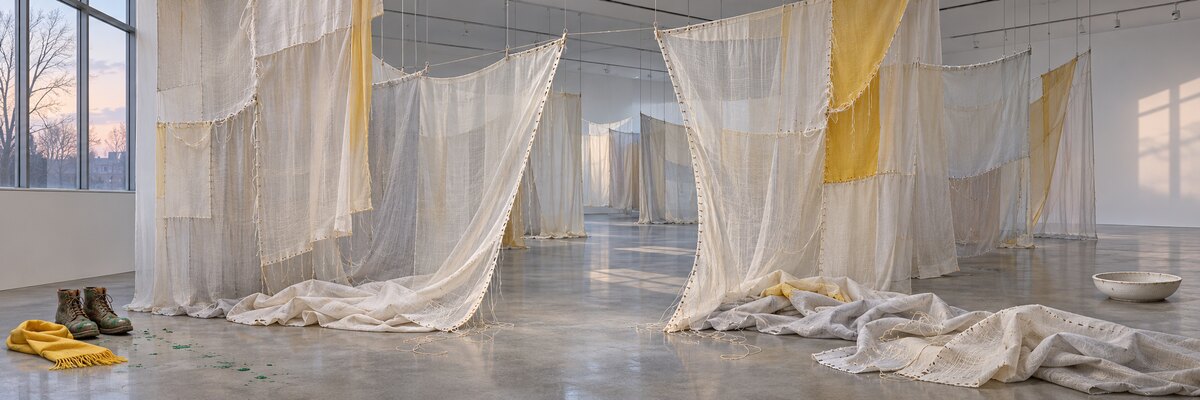
The first person to vanish was a man with a yellow scarf. He had stood beside the technician at the preview, making notes on a folded invitation, while the artist's widow described the work. He had asked whether visitors could touch the walls. The widow had said they could touch anything they liked, as long as they left their shoes outside.
An hour later the technician found the scarf on the gallery floor. It was folded into a narrow strip, the way a shop assistant might arrange it on a shelf. No one had seen the man leave. His shoes were still in the rack beside the entrance, a polished pair of brown brogues with red laces.
The technician, whose name was Sal, carried the scarf to the reception desk. She gave it to the attendant and asked whether a man in brown shoes had come through.
“Plenty of men in brown shoes,” the attendant said.
“Red laces.”
The attendant looked in the shoe rack. “Those have been there all afternoon. Someone left them at the last show.”
Sal had installed the rack that morning. It had been empty when she put it against the wall. She almost said so, but the widow was approaching with a group of donors, and Sal was supposed to be available if anything went wrong inside the installation. She took the scarf back and put it in her pocket.
The work occupied the largest room in the gallery. From the outside it was an ordinary white cube with a single doorway. Inside, a series of pale fabric walls divided the floor into passages, each just wide enough for one person. The ceiling was open to the gallery's rafters. A visitor could hear other people moving, but could not see them unless they came round a corner. At the centre stood a shallow basin filled with water.
The artist had called the piece A Room for the Looking. According to the catalogue, it had first been shown thirty years earlier and had not been reconstructed since. The widow had brought the original fabric in six long crates. Sal and her assistant had hung it from a grid of wires, following a plan drawn on yellowing paper. The fabric was heavier than it appeared, and whenever Sal touched it her hands smelled faintly of oranges.
She had worked in galleries for fourteen years. She liked the hours before an opening, when the work belonged to nobody but the people fitting it together. She liked finding the cable that had been hidden behind a wall, or making a loose fitting sit level without anyone noticing the repair. She had applied for this job because the retrospective was large enough to keep her employed for six months and because, as a student, she had once seen a photograph of the artist standing in this very room. She had cut it out of a magazine and put it above her desk.
At six, the public preview began. Sal stood by the entrance and handed out numbered shoe tags. People came in pairs or groups, laughing at the idea of walking through an exhibition in socks. A woman in silver tights asked if she could go barefoot. A man in a suit asked if his socks matched. Sal told him they did not, and he went in anyway.
The woman in silver tights came out alone. She sat on the bench, found her shoes and began to put them on. Halfway through fastening the second, she looked up at Sal.
“Did I come with someone?” she asked.
Sal had seen her enter with an older man in a dark blue coat. He had held the woman's elbow as they crossed the threshold. “Yes,” she said. “He's still inside.”
The woman looked towards the doorway. “Are you sure?”
Before Sal could answer, someone called from reception. A delivery had arrived, and the driver needed a signature. Sal went to sign for the crates of catalogues. When she returned, the woman in silver tights had gone. A pair of black shoes remained in the rack, next to the brown brogues.
Sal entered the work. The fabric brushed her shoulders as she followed the passage towards the basin. There were voices on the other side of the walls, too muffled to distinguish. At the centre, a man in a dark blue coat stood with his back to her, looking into the water. He had one hand raised to his face.
“Sir?” Sal said. “Are you all right?”
He turned. His face was ordinary enough that she could not have described it afterwards: greying hair, a narrow mouth, a small mark on one cheek. He looked at her with alarm, then put his hand down.
“Where did she go?” he asked.
“Who?”
“My daughter.”
Sal told him the woman had left. He asked her to take him out. She led him through the passages to the doorway. He stepped over the threshold ahead of her, and a group of visitors passed between them. When the group had gone in, he was no longer there.
His shoes were still in the rack. Sal checked the reception area, the lavatories and the street. She found no man in a blue coat. At the desk, the attendant was answering a question about the catalogue. Sal waited until the visitor moved away.
“Did you see a man come out just now?”
“What man?”
“Blue coat. He was right here.”
The attendant shook her head. “You came out by yourself.”
Sal took the black shoes from the rack and carried them to the office. She placed them on the desk. The gallery's director was talking on the phone, so Sal wrote a note: Two visitors missing. Please check the cameras. She left it under the shoes and returned to the door.
The artist's widow stood there, speaking to a woman Sal had not seen before. The woman was older than the widow, with cropped grey hair and a long cardigan. She carried a canvas bag containing a roll of cloth and a thermos flask. When the widow saw Sal, she introduced them.
“This is Nessa. She helped build the original.”
“Helped is generous,” Nessa said. “I stitched it.”
The widow's smile held. “Nessa has come to check the reconstruction.”
“I've come to take my fabric back.” Nessa looked at Sal. “Did you hang it?”
Sal nodded.
“Did you go to the centre?”
“Just now.”
“Did you look in the water?”
“I don't think so.”
“Good.” Nessa set her bag on the bench. “You need to close the door.”
The widow said, “We've discussed this.”
“And you told me there wasn't enough money to insure the rest of his work unless this one opened. I heard you.” Nessa turned back to Sal. “Close it.”
Sal looked into the installation. Through the entrance she could see the first turn in the passage and a visitor's hand trailing along the fabric. “There are people inside.”
“Bring them out, then.”
The widow stepped between them. “You can't interrupt a private viewing on the basis of a disagreement about ownership.”
Sal took the yellow scarf from her pocket. “Two people are missing.”
Nessa stared at the scarf. “Were they looking into the basin?”
“I saw one of them there.”
“Did someone who knew him come out first?”
Sal remembered the woman in silver tights asking whether she had arrived alone. “His daughter.”
Nessa closed her eyes. When she opened them, she spoke to the widow. “You said you had emptied it.”
“I did.”
“How?”
“I left it dry.”
“The water isn't what holds them.”
Nessa took the scarf from Sal and felt along its damp edge. She returned it; Sal spread it on the bench beside the entrance. The widow touched the fabric, then drew her hand away. “You said it needed water.”
“It needs water to show you what you want.” Nessa picked up her bag. “The rest of it keeps working.”
Sal asked what they meant. The widow moved aside, and Nessa spoke quickly, as if she had already spent years explaining and did not expect to be believed. The artist had asked her to make a room where a visitor could set down a memory. She had stitched the walls from strips cut from clothing, using material donated by people who attended the first exhibition. The basin had been his addition. A visitor who looked into it could see someone they wanted gone, and the room could take that person. The visitor left relieved, unable to recall what had been removed. The person taken remained inside until the fabric was unpicked.
“How many?” Sal asked.
“I don't know now. I got seven out of the first version.”
“Who gave you the right to do it in the first place?”
“I didn't know what he had made until the opening.” Nessa put a hand on the fabric beside the entrance. “When I realised, I took this apart. He kept enough to rebuild it. He also kept my name off the work.”
The widow said, “He told me you sold it to him.”
“I sold him a room made of cloth.”
Sal took the shoe tags from her apron and counted them. Twenty-three were missing from the ring. She had handed out more than that during the evening, but she had also collected tags as visitors left. She could not tell how many people were still inside, or how many had already gone missing.
“We need everyone out,” she said.
The widow looked towards the donors gathered at reception. “I'll speak to the director.”
“No,” said Nessa. “Start here.”
Sal went in, calling that the gallery was closing the work temporarily. A man protested that he had only just entered. She asked him to wait outside and brought him to the entrance. Nessa directed him to the shoe rack. Sal went back for the next group. The passages seemed longer than before. At the centre, the basin was full to the rim. A woman stood over it with both hands on its edge.
“Please come with me,” Sal said.
The woman did not turn. “I didn't think it would work.”
“What did you see?”
“My husband.” Her voice was thin and steady. “He's been ill a long time.”
Sal stepped beside her. In the water she saw her own face, broken by a faint ripple. She looked away.
“Where is he?” she asked.
“At home. I left him with a nurse.”
“We need to get him back.”
The woman gripped the basin. “I haven't slept properly in two years.”
Sal did not know what to say. She could hear Nessa calling from the entrance and the soft movement of people coming through the passages. The woman released the basin and wiped her hands on her trousers. “I'm coming,” she said.
Outside, the director had put a rope across the doorway. The widow was on her phone. Nessa knelt beside the first fabric panel, opening a seam with a small pair of scissors. Sal helped her lift the cloth from the wire. They laid it on the floor and worked along the stitching from opposite ends.
The director came over. “What are you doing?”
“Taking it down,” Sal said.
“You can't. It's insured for the exhibition.”
“People are missing.”
“We checked the cameras. No one is missing.”
“Look at the shoes.”
He looked. The rack held seven pairs. The visitors they belonged to had come out and gone home, he said. Their shoes must have been left over from an earlier event. Sal saw him glance at the yellow scarf on the bench, then look away from it.
Nessa cut another stitch. A seam opened by several centimetres. From inside the room came a cough, followed by the sound of bare feet on the floor. A man in a blue coat emerged through the doorway. He blinked at the lights and asked where his daughter was.
The director stepped back. Sal handed the man his shoes and helped him sit. He remembered his daughter's address, but could not remember her telephone number. The attendant found a taxi firm that would take him there. While they waited, Sal asked him to describe what had happened inside. He said he had stood by the basin and seen the reflection of his wife, who had died the previous year. Then the water had gone dark. He remembered looking for the exit and finding the same passage again and again.
“Did you see anyone else?” Sal asked.
“I heard them.” He rubbed his hands together. “They were calling to one another. I couldn't get close.”
Nessa opened another seam. The man with the yellow scarf came out, followed by a child carrying one red mitten. A woman at reception hurried forward and took the child in her arms. She looked bewildered, then began to cry. Sal gave the man his scarf. He thanked her and asked whether the exhibition was still open.
They worked until midnight. Every time a panel came apart, someone emerged, sometimes alone and sometimes holding another person's hand. Sal kept count: seven people, then nine, then twelve. The director called the gallery trustees; the widow stayed to help, taking down the wires with Sal's assistant. The woman whose husband had been ill waited on the bench. When he appeared, wearing slippers and a cardigan, she stood but did not go to him. He crossed the room and sat beside her. After a while she put her hand on his knee.
At half past twelve the last seam opened. No one else came out. Nessa walked the cleared floor with Sal, checking every corner and each fallen length of cloth. The basin was empty. Sal picked it up; underneath, on the floor, was a faint ring of damp.
The director asked them to stop work until he had spoken to the trustees. Nessa put down her scissors. “It's mine,” she said.
“He purchased it.”
“He purchased what he thought it did. The people who gave me their clothes didn't agree to this.”
The widow stood by the crates. “Take it,” she said.
The director began to object. She repeated herself, more loudly. “Take it. I'll deal with them.”
Nessa folded the pieces and packed them into her canvas bag. The bag was too small. Sal found a clean sheet in the storeroom, and together they wrapped the remaining cloth in it. Nessa tied the bundle with cord from the packing table. She would not say what she intended to do with it.
Outside, the first delivery vans were already on the street. Sal helped her carry the bundle to a taxi. Nessa put her hand on the roof before getting in.
“There may be people we didn't get,” she said. “From the first exhibition. I don't know whether he used all the fabric I made.”
“Can I help you look?”
“Perhaps. I'll call when I know where to start.”
Sal gave her a number. The taxi pulled away, and she returned to the gallery to collect her coat. On the way out she passed the shoe rack. One pair remained: small brown boots with green paint on the toes. She picked them up, looking for a name inside. There was none.
The attendant was locking the front door. “Whose are those?” Sal asked.
“I thought you knew.”
Sal held one boot in each hand. The paint had dried in the grooves of the leather, as if someone had worn them while working. She tried to remember who had come in wearing them. At the back of her mind there was a laugh, a familiar voice saying something she could not make out. She stood there until the attendant switched off the lights in the reception area.
“Shall I put them in lost property?” he asked.
“No,” Sal said. She carried them home with her. In the morning she put them on the table and began to write down the names of everyone she had known at art school, leaving room between the names for anything she might remember.
No published comments yet.