
At eleven, when the last train was supposed to have gone, Kemi found a man asleep inside the ticket machine. His legs were folded against his chest, his cheek pressed to the glass. Someone had left a cup of tea beside him, and the steam had made a little clear patch in the condensation.
She tapped the glass with the handle of her mop. “We're closing.”
The man opened one eye. “I paid until midnight.”
“There isn't a midnight.”
“There was when I got in.”
A notice above the machine confirmed what he said. TEMPORARY SHELTER: NINE TO MIDNIGHT. The notice had been put up that afternoon; the closure signs had gone up later, once the council decided which tunnels it could afford to keep lit. Kemi had been given a fresh list and told to clear the station by eleven fifteen. She peeled the notice off and showed him the blank wall beneath.
He watched her without moving. “You could leave me here.”
“They're cutting power to the machines. You'd have to break the glass to get out.”
“Would they charge me for it?”
“Probably.”
He unfolded himself with difficulty, pressed the door release and stepped out with his tea. Kemi gave him the paper notice. He read it twice and put it in his pocket. At the foot of the escalator he turned and asked whether the entrance on Mercer Street was still open.
“Until the lights go off. Then the gate locks.”
He walked that way, keeping one hand on the wall. Kemi watched until his coat disappeared past the tiled pillar. Then she finished washing the floor around the machine and wrung her mop. The water in the bucket was grey, with a film of soap on top.
Her phone vibrated in her apron. A message from her upstairs neighbour: Are you still at the station? I need a favour.
Kemi typed yes. Another message arrived almost immediately. My mother's medicine is at the late chemist. They won't deliver. I'm on the bus with the little ones and it isn't moving. Can you collect it? She's at home. The cold pack lasts an hour.
Kemi looked at the clock above the ticket gates. Eleven seven. The late chemist was across the river, two stops away when the trains ran. On foot, with the bridge works and the fence around the civic square, it was closer to forty minutes each way.
She called. Her neighbour answered over the noise of children arguing and a bus engine idling. “They've already taken payment,” she said. “My mother's name is on the bag. Just show them the message.”
“What time does the chemist close?”
“Eleven thirty. I'm sorry. I thought the bus would be through by now.”
Kemi could say no. It was the end of a shift; she had started at three, and her feet were damp inside her shoes. She could hear the younger child calling for his mother in the background. She said, “Send me the address.”
The walkway beneath Mercer Street had once connected the station to the old market. The market had closed years ago, but the walkway remained useful to anyone who knew how to move it. It did not move far without help. A single person could draw it round a corner, or bring its far end up through a basement floor, provided there was a door there to receive it. To cross the river she would need three people: two to move the gate together and a third to keep the middle steady.
She went to the staff room. The supervisor had gone home. The only other cleaner on the late shift was Dineo, who was emptying bins on the platform. Kemi found her with two bags already tied and a third open at her feet.
“Can you help me shift Mercer?” Kemi asked.
Dineo kept packing the bag. “I'm clocking out.”
“Just as far as the chemist on Bell Street.”
“That isn't just.”
Kemi explained about the medicine. Dineo twisted the neck of the bag and tied it tight. “Who else have you got?”
“No one yet.”
“Find someone at the far end. I'll hold the middle for ten minutes.”
It was more than Kemi had expected. She had not spoken to Dineo outside work since an argument six months earlier, when Kemi had lent her a month's rent and asked for it back on the day it was due. Dineo had paid, in coins and small notes, without saying where she had found the last of it. Afterwards she had stopped accepting lifts and stopped coming upstairs for tea. They still worked together, because the station floors did not care who had borrowed from whom.
Kemi called the chemist. The pharmacist answered on the fourth ring. Yes, the bag was ready; yes, she could wait a few minutes after closing, but she had to catch a bus. No, there was no doorway in her back room leading underground. There was a cupboard. It had a door.
“A proper door?” Kemi asked.
“A cupboard door.”
“Does it reach the floor?”
A pause. “Yes.”
“Could you stand beside it and hold the handle? I'll come through that way.”
Another pause. “Who did you say you were?”
Kemi gave her neighbour's name again. “Please don't open it until you hear me knock.”
The pharmacist said she had other customers and ended the call.
Kemi stood for a moment with the phone in her hand. Dineo had already gone up the escalator, dragging the bin bags behind her. Kemi followed, carrying the mop bucket. She left it beside the ticket machine and went down Mercer walkway.
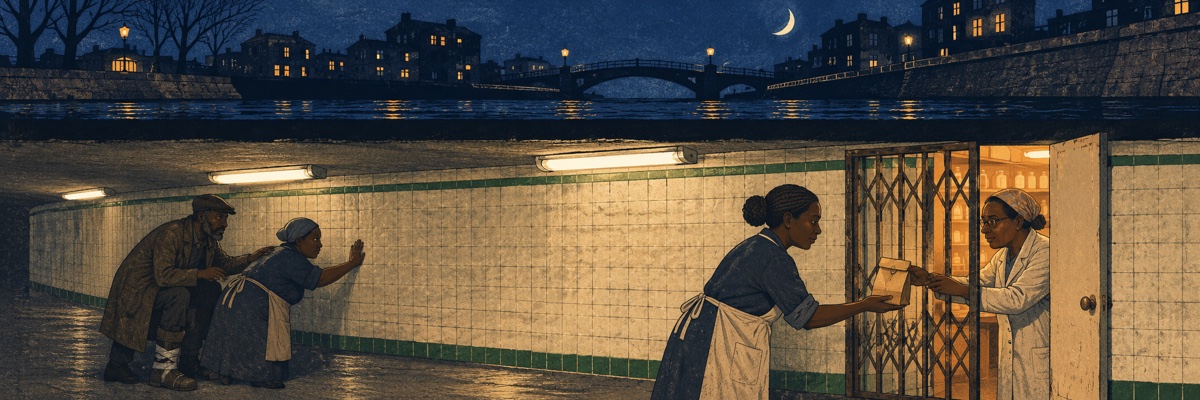
The tiles here were older than the station: small cream squares with a thin green border, interrupted at intervals by advertisements for shops that no longer existed. The air smelled of damp cement and the sweet dust from the bakery above. At the far end a locked gate separated the walkway from the market basement. Kemi put both palms against the gate and pushed.
The first movement was always difficult. The floor resisted like a heavy table with one leg caught on a rug. She shifted her feet, bent her knees and pushed again. The green line on the tiles moved under her shoes. Above her, pipes ticked in their brackets. The gate and the wall around it slid forward by a hand's breadth.
Her phone rang. Dineo. “I'm in the middle. Tell me when.”
“Now.”
The walkway moved. Kemi took small steps, keeping her palms on the bars. The gate scraped past the place where the market staircase had been, and a new wall came into view through it: bare brick, painted with a faded number. A delivery basement. She pushed harder, aiming for the river, while Dineo called out distances from behind her.
“Five metres. Ten. Slow down, the lights are flickering.”
At fifteen metres the gate stopped. Kemi leaned into it. Nothing. She tried lifting, then pushing at one side. The tiles buckled slightly beneath her feet.
“Someone's holding it,” Dineo called.
Kemi looked through the bars. On the other side of the gate, in the delivery basement, the man from the ticket machine was sitting on a crate. He had put down his cup and was pulling a boot off. His sock was wet through.
“You again,” he said.
“Are you holding the gate?”
“I was trying to get it open.”
“Let go.”
He lifted both hands. The walkway shifted a few centimetres, then stopped again. Kemi looked down. His boot was wedged beneath the gate, its toe caught against the bottom rail. He tugged, but it would not come free.
“I'll open it,” she said. “Move back.”
The key was on her cleaning ring, though she had never needed it. The lock resisted at first, then turned. She pulled the gate towards her, freeing the boot. The man took it and shook his head at the tear in its side.
“There's a tap upstairs,” Kemi said. “You can wash your foot.”
“I need somewhere to sleep.”
“The shelter on South Road opens at midnight.”
“It was full yesterday.”
She heard Dineo call her name. The lights had gone out behind them, leaving the far end of the walkway dim. Kemi held the gate open. “Come through. There's a place near the chemist that might still be open.”
“Might?”
“I don't know.”
The man put his boot back on. As he stepped through, the gate swung in Kemi's hand, tugged by the weight of the walkway. He caught the other side before it struck her.
“Tell me what to do,” he said.
She showed him where to put his hands. Together they pushed. The basement wall passed, followed by a narrow gap full of pipes, and then a concrete wall with a painted blue stripe. Kemi recognised it: the parking garage beneath Bell Street. They were across the river.
“Nearly there,” she called.
The pharmacist had not called back. Kemi tried her number, but it rang unanswered. The gate slowed again. She could feel the walkway stretching behind them, every tile and pipe pulling against the hands holding it. Dineo would not be able to keep the middle steady much longer.
“There's a door,” the man said.
Through the bars Kemi could see the edge of one, set into the concrete wall. It was too high: its threshold sat half a metre above the walkway floor. She pushed the gate upwards. It rose a little and slid back down.
The man crouched. “Step on my knee.”
She did, steadying herself against his shoulder, and pushed from higher up. The gate rose until its threshold met the other door. Kemi reached through the bars and knocked.
No answer.
She knocked again, harder. There was movement on the other side, followed by a sharp clatter. A voice said, “I'm calling the police.”
“It's me. For the medicine.”
The cupboard door opened a crack. The pharmacist's face appeared in the gap. She looked at Kemi, at the gate and at the man crouching below it.
“I thought you were joking,” she said.
“So did I,” said the man.
The pharmacist opened the door wider. Shelves of bandages and bottles stood behind her, and beyond them Kemi could see the bright shop. She took a paper bag from a counter and passed it through the gate. The cold pack inside was hard and icy against Kemi's hand.
“Thank you,” Kemi said. “We have to go back.”
“Wait.” The pharmacist went into the shop and returned with a roll of tape. She tore off a strip and handed it to the man. “For your boot.”
He took it. “Do you know anywhere open tonight?”
“The church hall on Bell Street. They put mattresses down when it's cold.”
She pointed him through the cupboard. He climbed past Kemi and unfolded himself among the shelves. For a moment all three of them were crowded there, the gate pressing against his back, the pharmacist holding the cupboard door. Then he stepped out into the shop.
Kemi lowered herself from the threshold. The gate dropped with her. “Thank you,” she said again, and the pharmacist shut the door.
The return was faster. A stretched walkway wanted to go home, and Kemi only had to guide it, keeping the gate level as the blue stripe, the pipes and the delivery basement passed in reverse. At the middle Dineo joined her, breathing hard. Together they steadied the last few metres and set the gate down against the market wall.
When Kemi locked it, the key bent in her hand. She left it in the lock.
They walked back through the dark station. Kemi carried the medicine against her side. Dineo picked up the bucket from beside the ticket machine and emptied it into the drain.
“You can go,” Kemi said. “I'll put that away.”
“I know.” Dineo rinsed the bucket and set it upside down. “My sister has a car. She's collecting me at the top of the road. We can drop you.”
Outside, a municipal van was parked across the Mercer entrance. Two workers were fixing a sheet of metal over the gate. One held the sheet while the other drilled into the brick. The noise drowned out Kemi's attempt to ask what they were doing. When the drill stopped, the worker said the entrance was being sealed under the closure order.
“We've just come out,” Dineo said. “What if someone's still down there?”
“The station supervisor signed the clearance.”
Kemi thought of the ticket machine, the empty platform and the gate she had locked herself. She could not account for every corner of the station. “You need to check.”
The worker looked at the van. “We were told it was clear.”
“Then check with us.”
The other worker set down the drill. After a long moment, he unfastened the one bolt he had put in. The four of them went back inside with their phone torches. They checked the platform, the staff room, the toilets and the ticket machines. In the Mercer walkway they found a woman asleep on a folded coat, hidden behind a pillar. She came out with them, angry at being woken, and accepted a lift from the workers after Kemi told her about the church hall.
Dineo's sister arrived while the metal sheet was being fixed in place again. Kemi gave her directions to the flats. They drove through the quiet streets with the heater on, the medicine bag resting on Kemi's lap. At her building she thanked them and climbed the stairs two at a time.
Her neighbour's mother opened the door in a dressing gown. She checked the label, put the medicine in the fridge and offered Kemi a slice of bread with butter. Kemi ate it standing at the kitchen counter while the older woman called her daughter to say it had arrived.
When Kemi went back outside, the car was still there. Dineo stood beside it, smoking beneath the streetlamp. She held out her phone. A message from the cleaners' group said their hours at the station would be cut from the following week. The Mercer closure was only the beginning.
“My sister's building needs someone for mornings,” Dineo said. “She's going to ask the caretaker tomorrow. Do you want me to give him your number too?”
Kemi looked at the message. She had enough saved for perhaps two weeks without the station shift. “Yes, please.”
Dineo put the phone away. “And when I find out, I'll come upstairs and tell you.”
Kemi nodded. The cigarette had burned almost to Dineo's fingers. She dropped it, put it out with her shoe and got back into the car. Kemi waited until the tail-lights turned the corner, then went inside to sleep before morning.

No published comments yet.